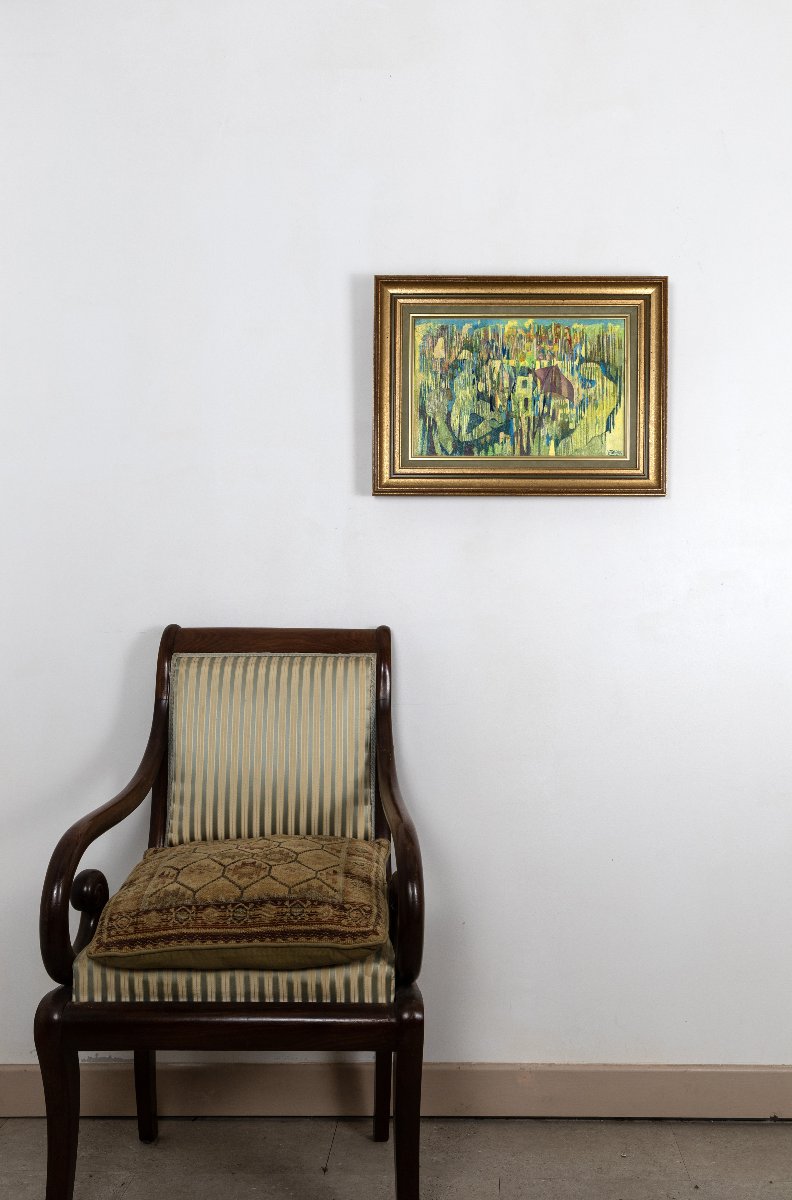
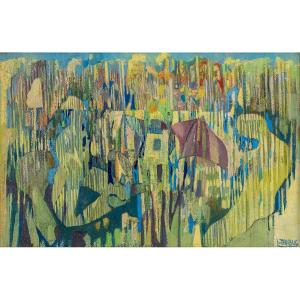


Louis Trabuc - Provençal Garden - Oil On Canvas - Signed - Circa 1970
Artist: Trabuc Louis (1928 - 2008, France)
Louis TRABUC (Marseille 1928 – Manosque 2008)
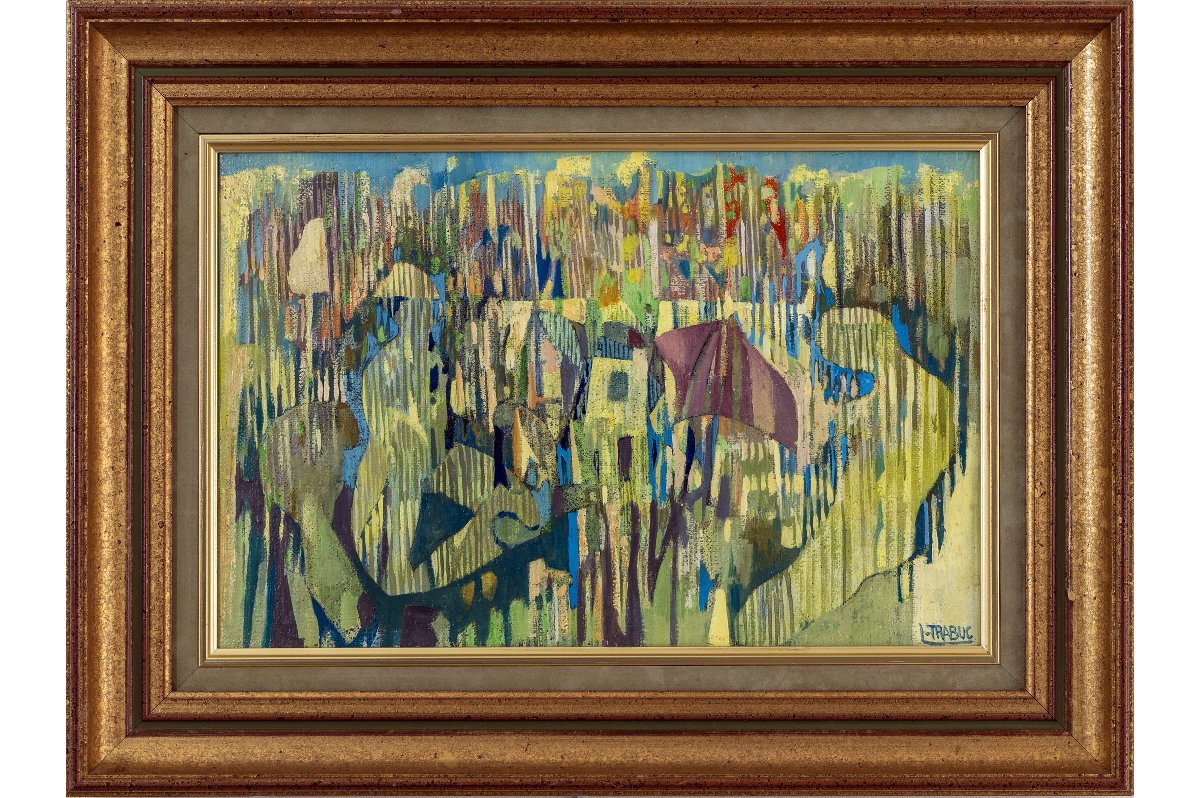
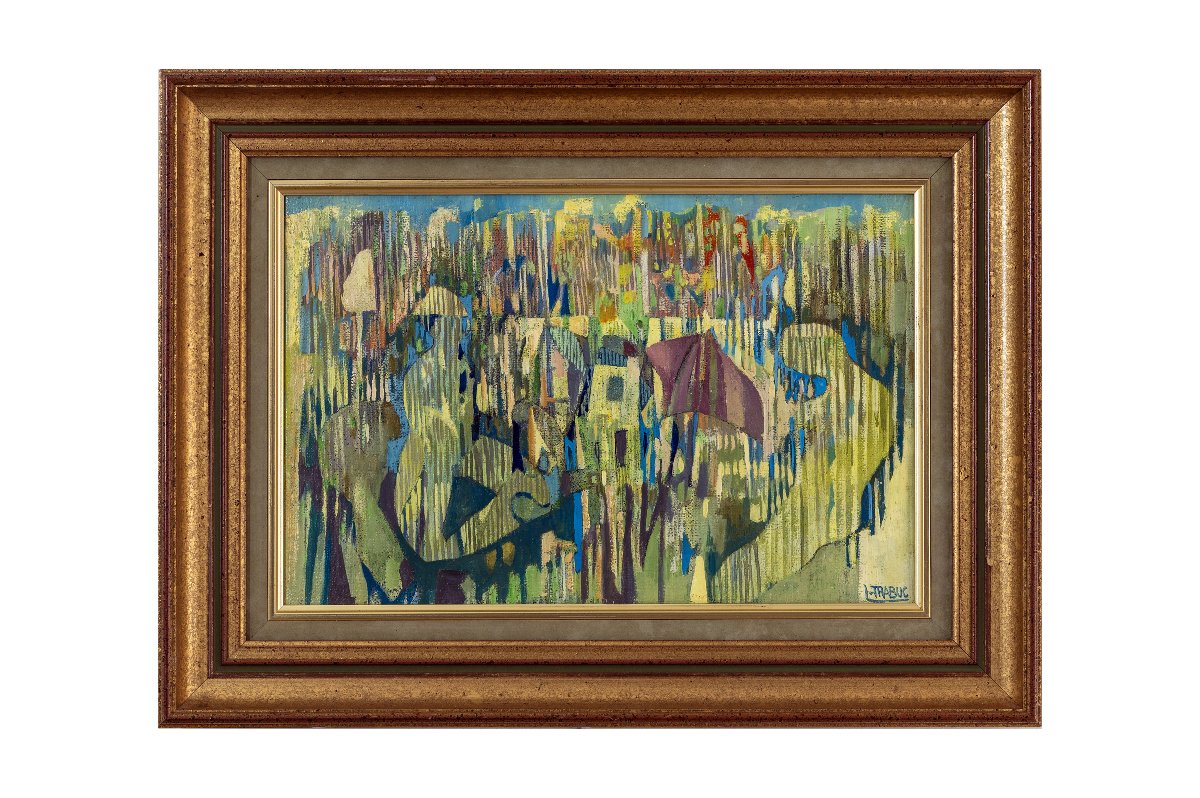
“Provençal Garden”
Oil on canvas
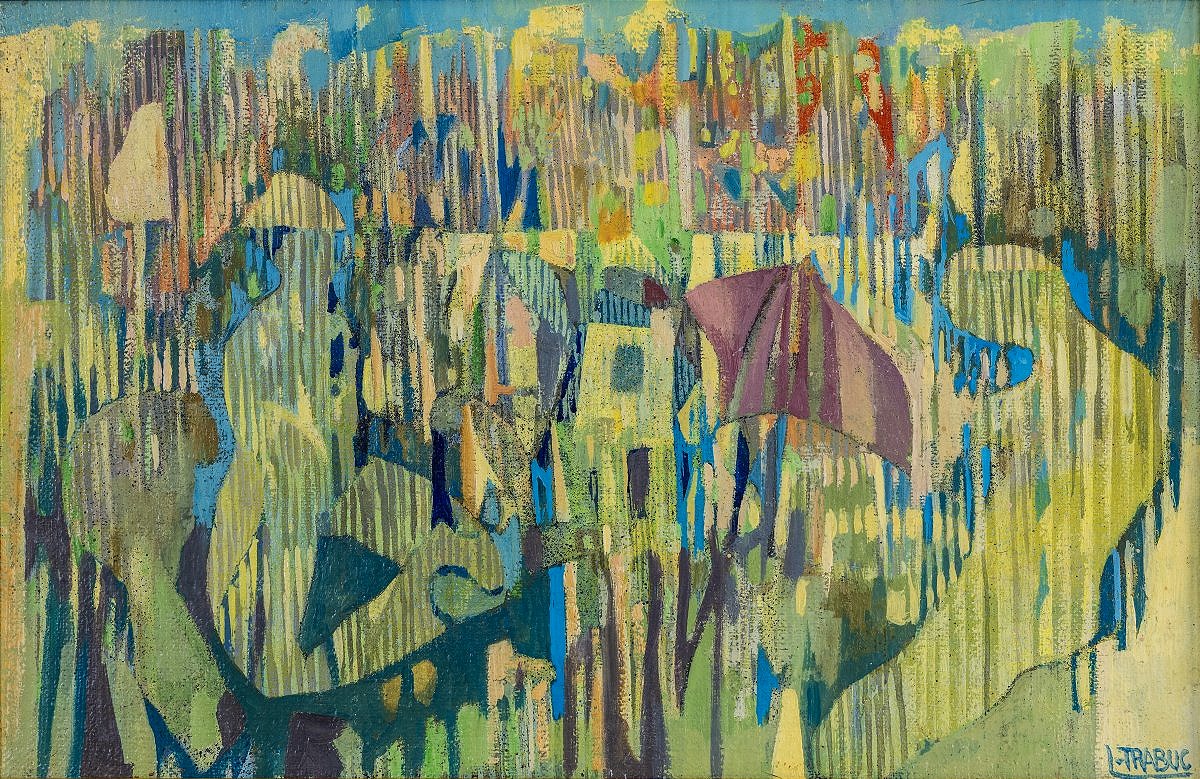
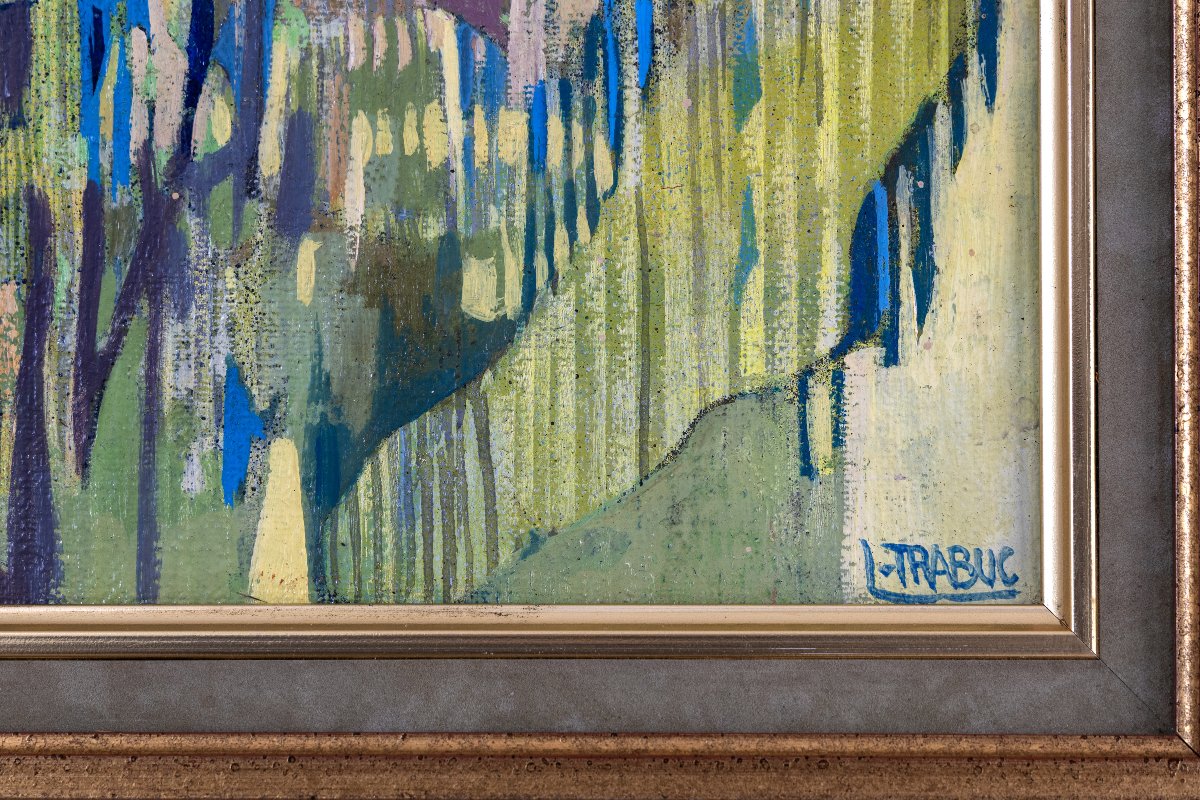
Signed lower right “L. Trabuc”
41 x 27 cm (6 Landscape format) — 55 x 41 cm with frame
Very good condition
Modern gilded wood frame
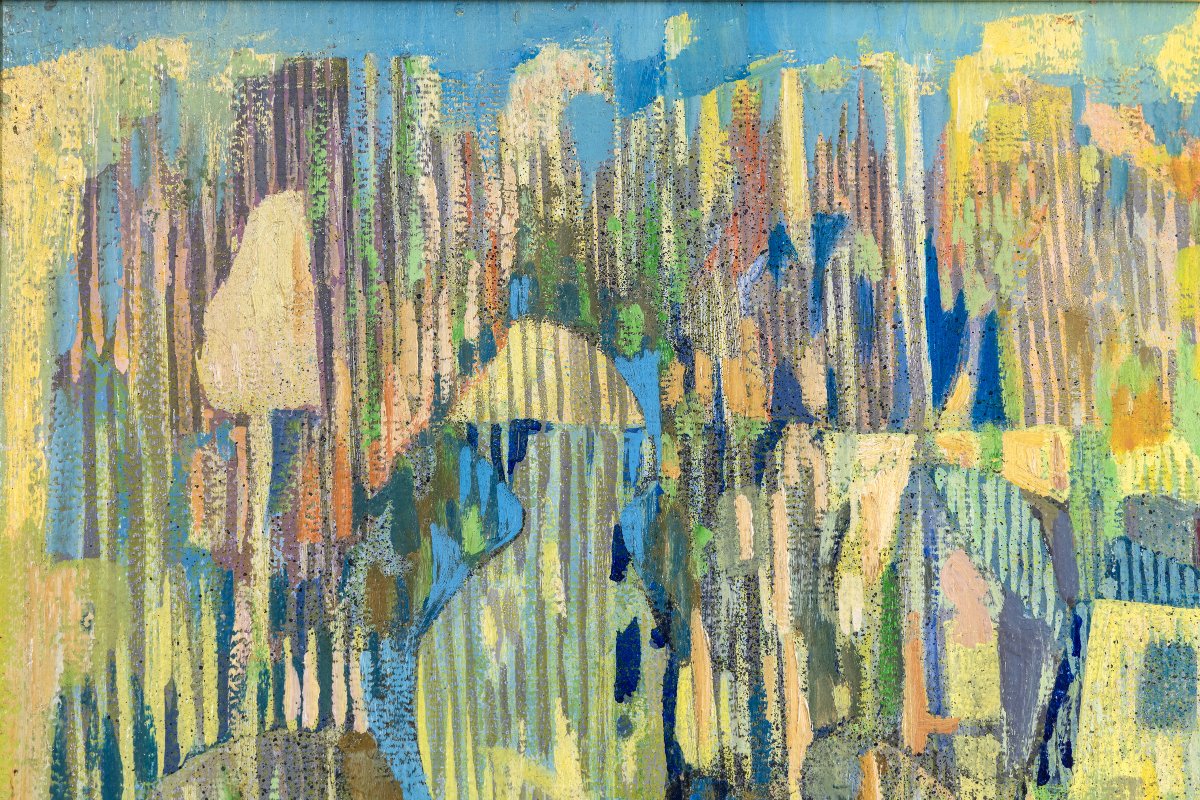
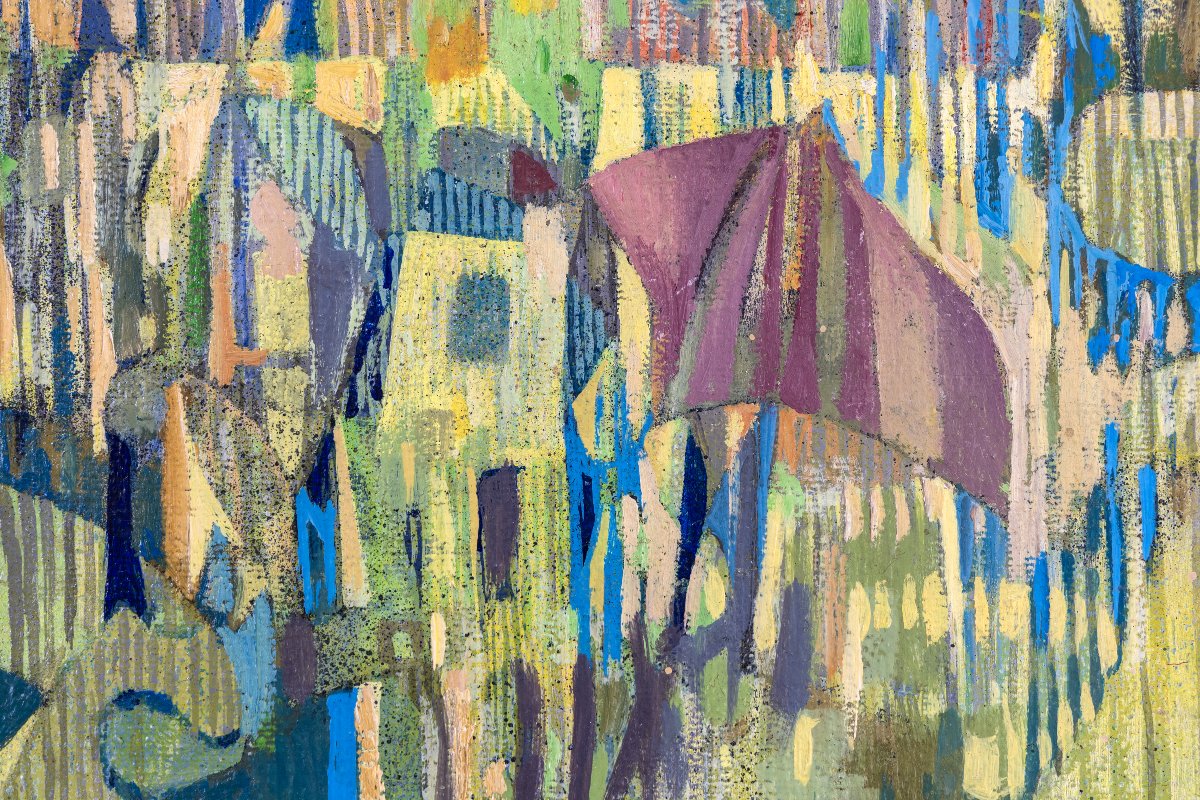
A mauve parasol, a house, trees: that’s what the eye eventually recognizes. But it takes a moment to get there, and that is the whole appeal of the painting.
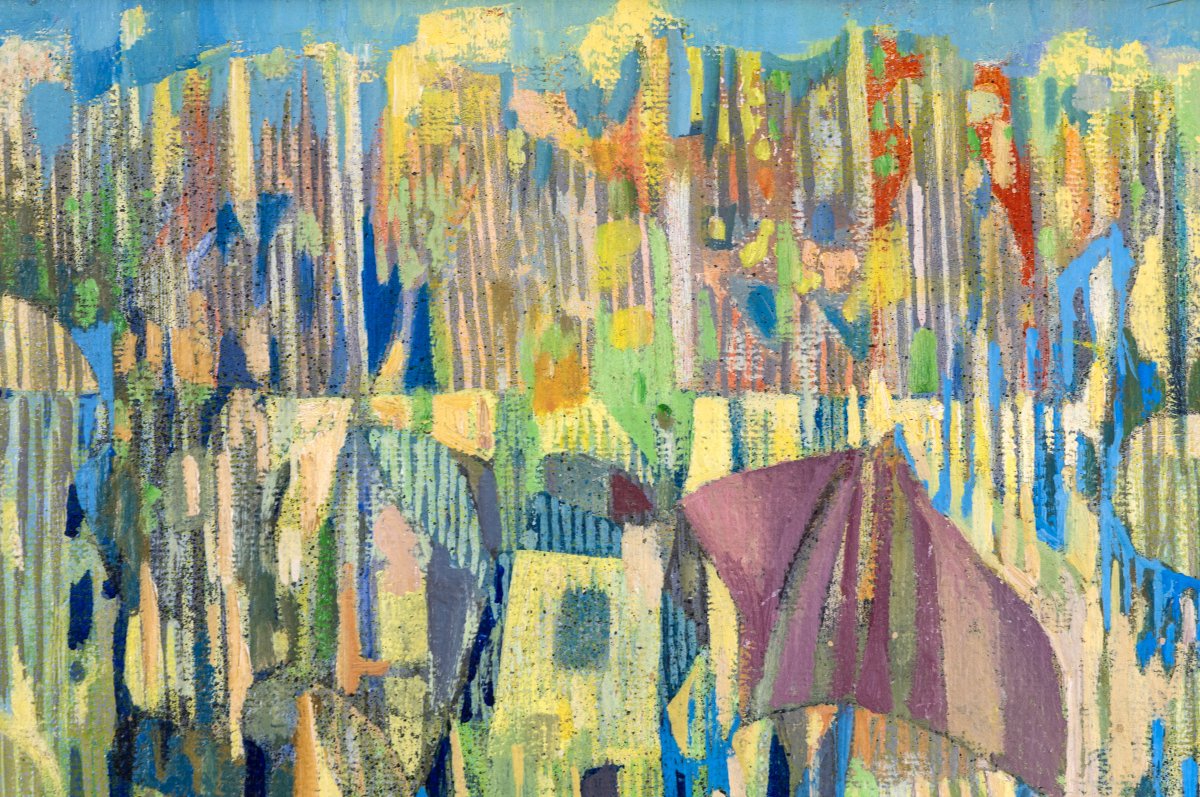
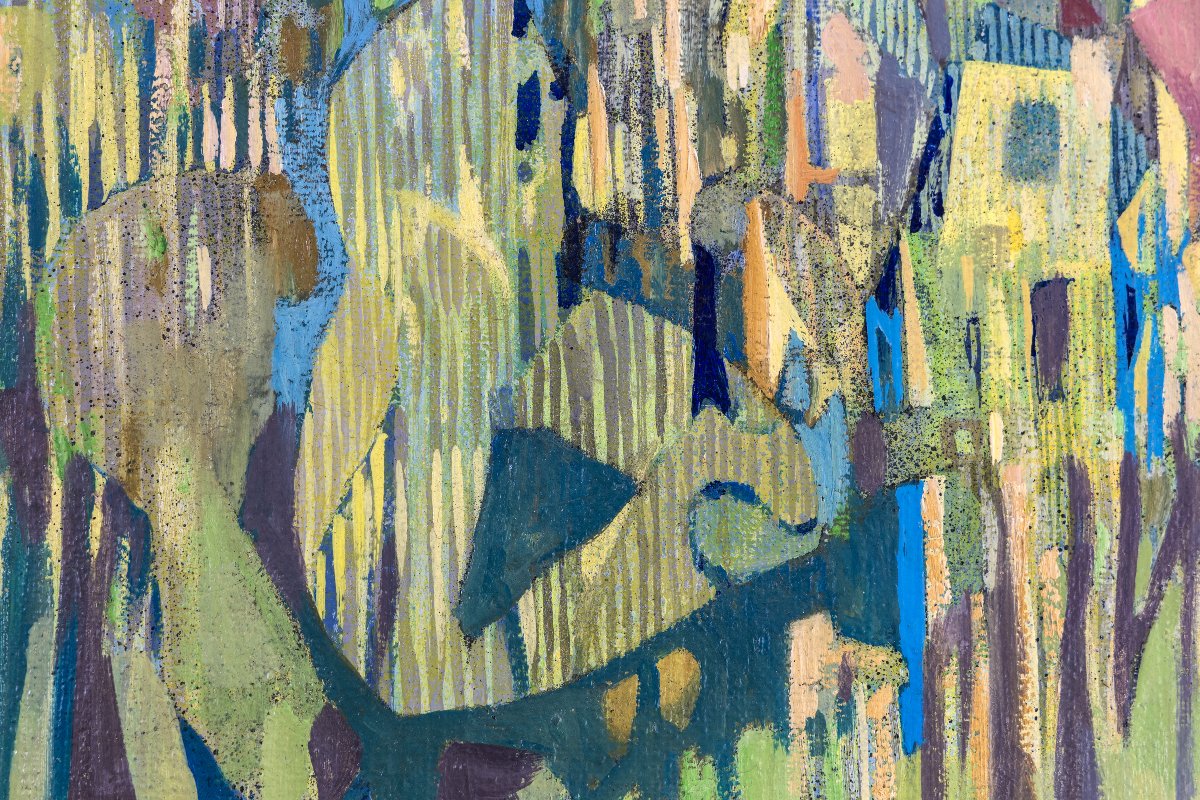
Here, Trabuc has painted Provence as no one else does. No ochre farmhouses under a blue sky, no neatly arranged olive trees. The landscape is built up of hundreds of small vertical strokes, tightly packed together—yellow, green, blue—with flashes of red and orange in the upper part. The whole composition vibrates. It’s as if we’re seeing the scene through a curtain of light, or through the heat rising from the ground in summer.
The shapes are there, but simplified to the extreme: a dark triangle, a mauve mass stretched like a canvas, the silhouettes of trees reduced to columns. The viewer’s eye does the rest. Depending on how far away you stand, the painting shifts from one interpretation to the other—pure abstraction up close, a sun-drenched Provençal garden from a distance.
This is precisely the style that has made Trabuc’s reputation. After an early, decidedly figurative period (portraits, seascapes, still lifes), he moved away from painting from life to reconstructing plant-filled landscapes from memory, straddling the mineral and the vegetal. His color harmonies—blues, greens, and yellows accented with red—are his signature.
For a contemporary interior, the appeal is simple: here is a Provençal landscape that hangs like a contemporary abstract work. The subject is one we’ve seen a thousand times; the treatment, however, is unique.
Condition
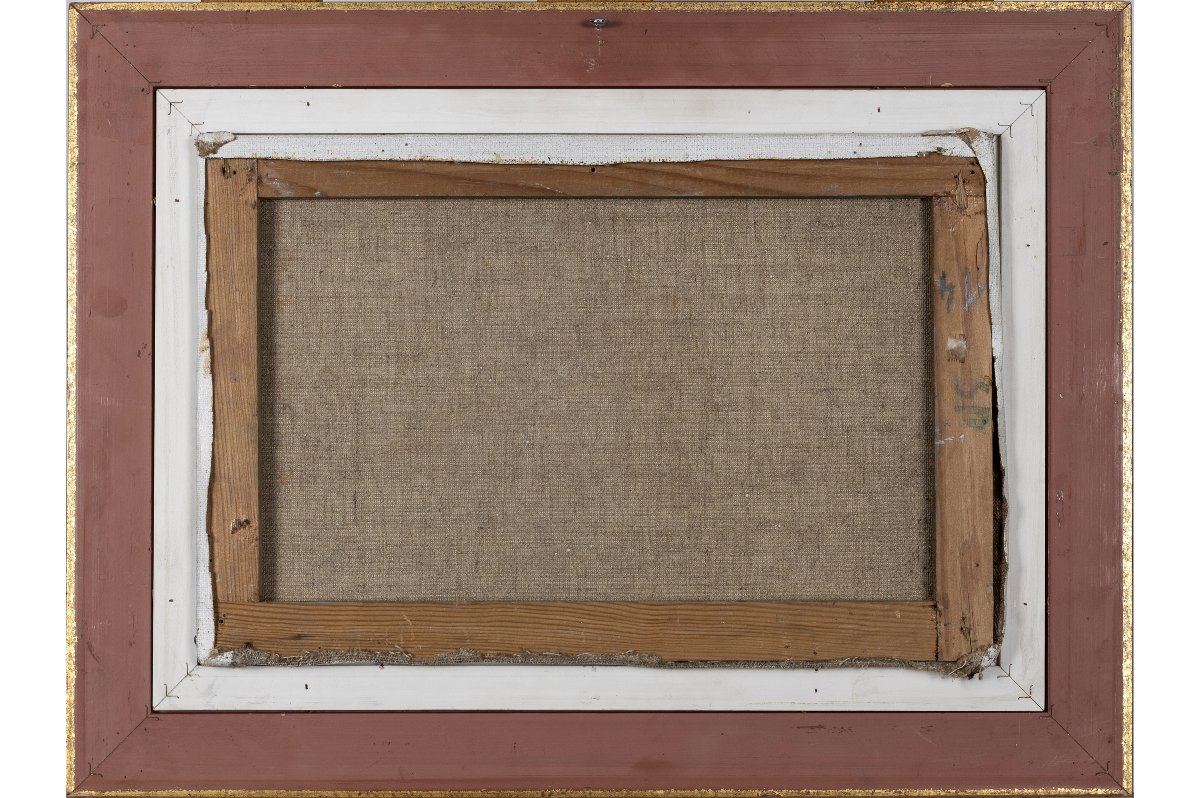
Overall in very good condition. Canvas on its original stretcher, with fresh, well-preserved colors. Modern gilded wood frame, in good condition.
The Artist
Louis Trabuc was born in Marseille in 1928. At the age of fifteen, he enrolled at the city’s École des Beaux-Arts, where he quickly made a name for himself: the Justin Claverie Prize in 1949, the Stanislas Torrents Prize and the Jeune Peinture Prize in 1950, and the UMAM Prize in Nice three years in a row (1954, 1955, 1956). In 1953, the school’s director nominated him for the Grand Prix de Rome competition.
The 1950s were a time of recognition: the Lucien Blanc Gallery in Aix, the Spinazzola Gallery, the Réattu Museum in Arles, and then Paris—the Galerie de Seine in 1956 and the prestigious Drouant David Gallery in 1957. He participated in the first editions of the Paris Biennale, in 1959 and 1961, at the Musée d’Art Moderne.
After settling in Pierrevert, near Manosque, in 1956, he met Jean Giono, who asked him to illustrate two of his works (*Virgile* in 1969 and *La Mission* in 1971). He then became friends with the painter Lucien Jacques, André Marchand, and the photographer Lucien Clergue. In 1964, he moved to Lauris, in the Luberon, which would remain his home base.
A discreet man who was always critical of his own work, he deliberately kept his distance from art movements and the media circuit, choosing to spend the rest of his life painting in the quiet of his studio in the Haut-Var. He died in Manosque in 2008.
His works are included in several public collections: the Musée d’Art Moderne de la Ville de Paris, the Musée Cantini in Marseille, the Fonds Communal d’Art Contemporain de Marseille, the Musée des Baux-de-Provence, and the Conseil Général des Bouches-du-Rhône.
Work on view at the gallery (07240)
Shipping: Please contact us for shipping rates within France and internationally.
“Provençal Garden”
Oil on canvas
Signed lower right “L. Trabuc”
41 x 27 cm (6 Landscape format) — 55 x 41 cm with frame
Very good condition
Modern gilded wood frame
A mauve parasol, a house, trees: that’s what the eye eventually recognizes. But it takes a moment to get there, and that is the whole appeal of the painting.
Here, Trabuc has painted Provence as no one else does. No ochre farmhouses under a blue sky, no neatly arranged olive trees. The landscape is built up of hundreds of small vertical strokes, tightly packed together—yellow, green, blue—with flashes of red and orange in the upper part. The whole composition vibrates. It’s as if we’re seeing the scene through a curtain of light, or through the heat rising from the ground in summer.
The shapes are there, but simplified to the extreme: a dark triangle, a mauve mass stretched like a canvas, the silhouettes of trees reduced to columns. The viewer’s eye does the rest. Depending on how far away you stand, the painting shifts from one interpretation to the other—pure abstraction up close, a sun-drenched Provençal garden from a distance.
This is precisely the style that has made Trabuc’s reputation. After an early, decidedly figurative period (portraits, seascapes, still lifes), he moved away from painting from life to reconstructing plant-filled landscapes from memory, straddling the mineral and the vegetal. His color harmonies—blues, greens, and yellows accented with red—are his signature.
For a contemporary interior, the appeal is simple: here is a Provençal landscape that hangs like a contemporary abstract work. The subject is one we’ve seen a thousand times; the treatment, however, is unique.
Condition
Overall in very good condition. Canvas on its original stretcher, with fresh, well-preserved colors. Modern gilded wood frame, in good condition.
The Artist
Louis Trabuc was born in Marseille in 1928. At the age of fifteen, he enrolled at the city’s École des Beaux-Arts, where he quickly made a name for himself: the Justin Claverie Prize in 1949, the Stanislas Torrents Prize and the Jeune Peinture Prize in 1950, and the UMAM Prize in Nice three years in a row (1954, 1955, 1956). In 1953, the school’s director nominated him for the Grand Prix de Rome competition.
The 1950s were a time of recognition: the Lucien Blanc Gallery in Aix, the Spinazzola Gallery, the Réattu Museum in Arles, and then Paris—the Galerie de Seine in 1956 and the prestigious Drouant David Gallery in 1957. He participated in the first editions of the Paris Biennale, in 1959 and 1961, at the Musée d’Art Moderne.
After settling in Pierrevert, near Manosque, in 1956, he met Jean Giono, who asked him to illustrate two of his works (*Virgile* in 1969 and *La Mission* in 1971). He then became friends with the painter Lucien Jacques, André Marchand, and the photographer Lucien Clergue. In 1964, he moved to Lauris, in the Luberon, which would remain his home base.
A discreet man who was always critical of his own work, he deliberately kept his distance from art movements and the media circuit, choosing to spend the rest of his life painting in the quiet of his studio in the Haut-Var. He died in Manosque in 2008.
His works are included in several public collections: the Musée d’Art Moderne de la Ville de Paris, the Musée Cantini in Marseille, the Fonds Communal d’Art Contemporain de Marseille, the Musée des Baux-de-Provence, and the Conseil Général des Bouches-du-Rhône.
Work on view at the gallery (07240)
Shipping: Please contact us for shipping rates within France and internationally.
400 €
Period: 20th century
Style: Modern Art
Condition: Excellent condition
Material: Oil painting
Width: 41 cm / 55 cm encadré
Height: 27 cm / 41 cm encadré
Reference (ID): 1810984
Availability: In stock
Print