

Navy Enlisted Men's Consular Saber, Model 1782, Modified In 1790
RARE MANUFACTURE OF THE CONSULATE — 1801-1804
France, Consulate, 1801-1804
Manufacture Nationale de Klingenthal – Coulaux brothers entrepreneurs
Steel and brass
Total length: 72 cm
Blade length: about 60 cm
Without sheath
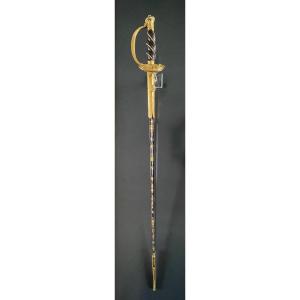
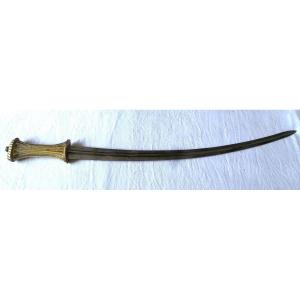
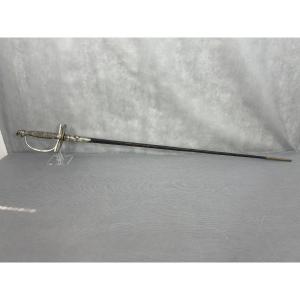
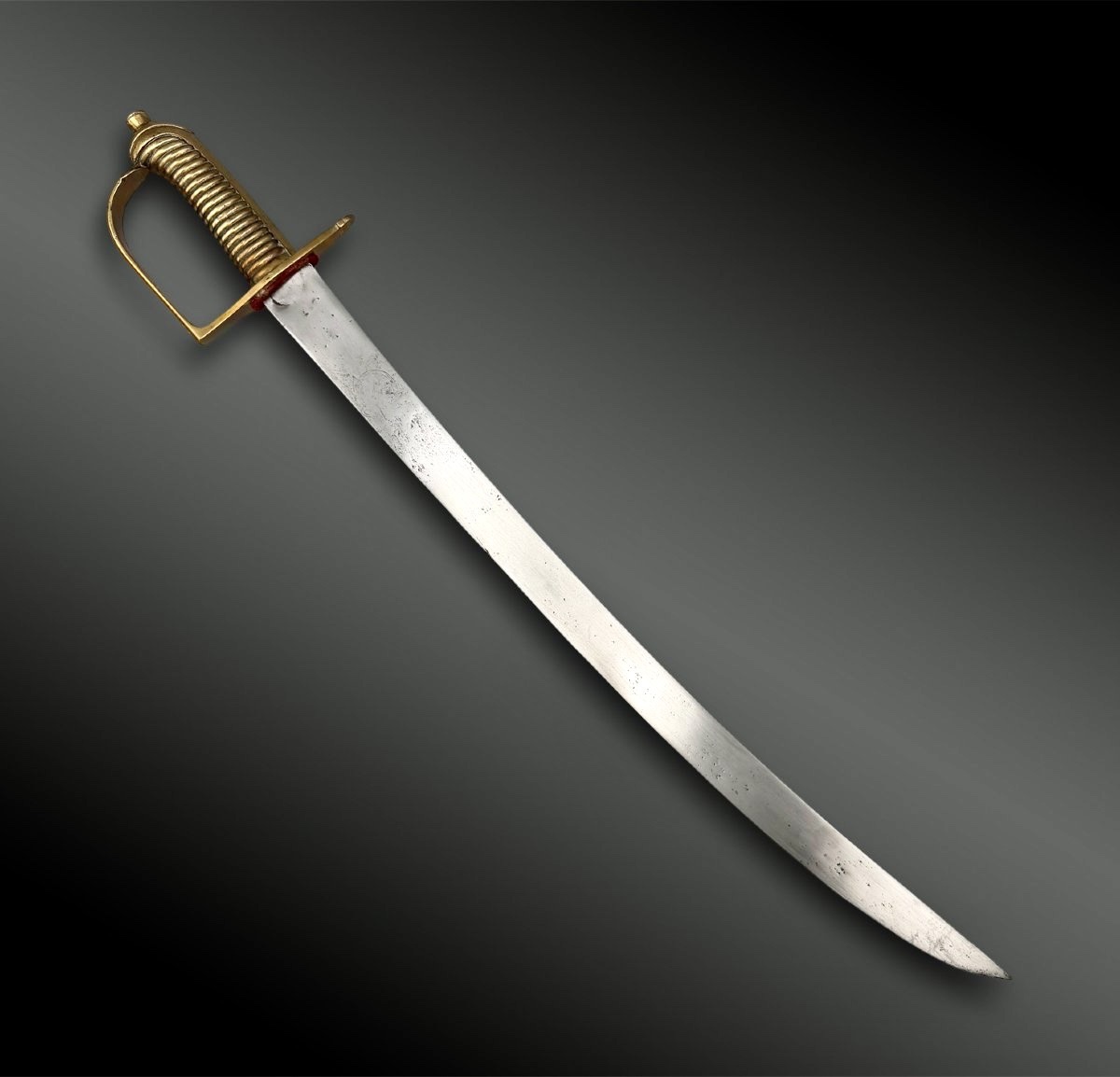
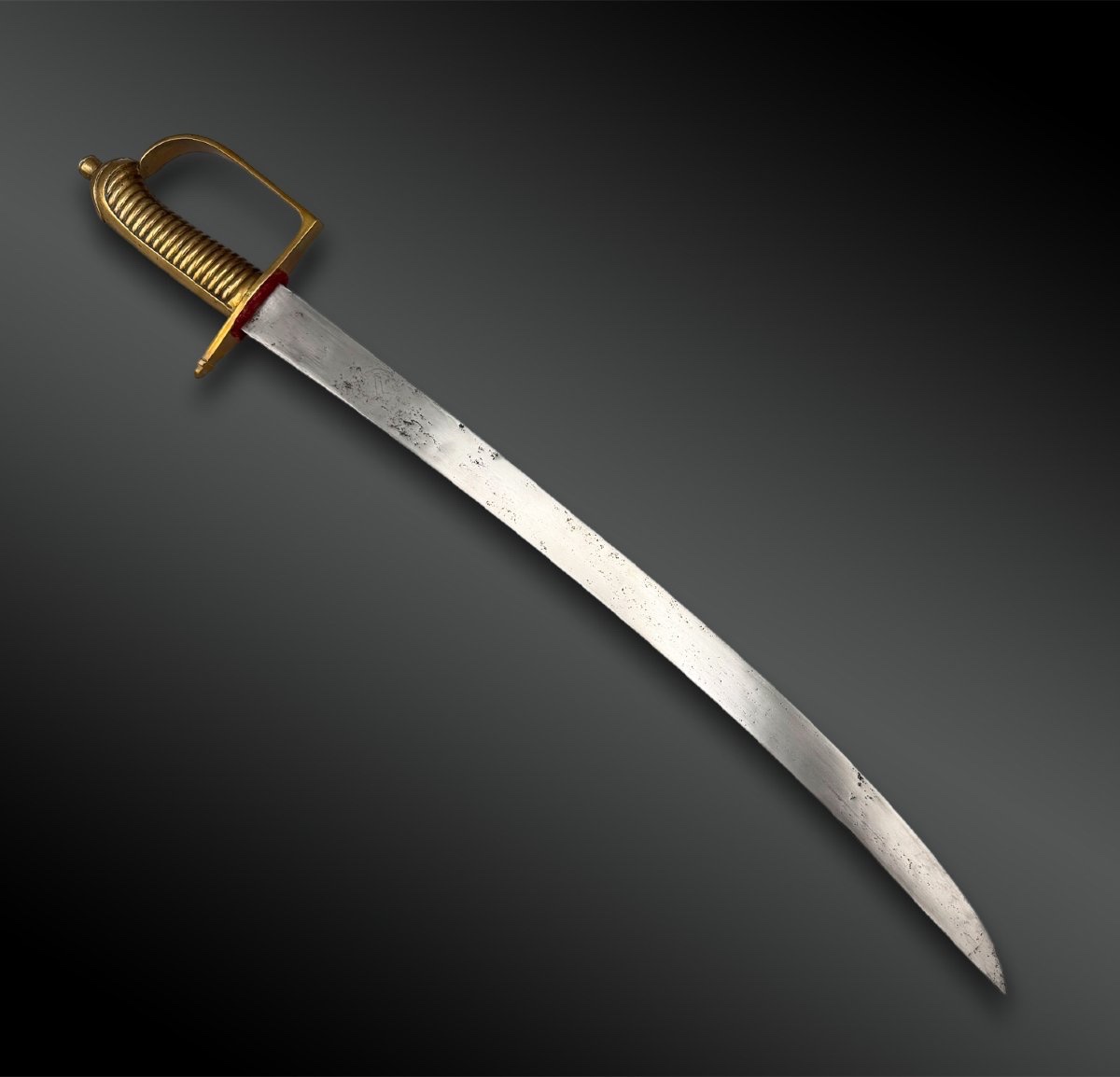
Rare regulatory sword of French Navy troops, model 1782 modified 1790, particularly interesting for its late manufacture under the Consulate, between 1801 and 1804.
The weapon associates a regulatory mount inherited from the end of the Ancien Régime and the revolutionary period with a blade manufactured in Klingenthal under the company of the Coulaux brothers, in the short period when the establishment still bears the title of Manufacture Nationale.
Mount
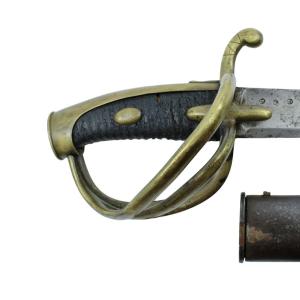
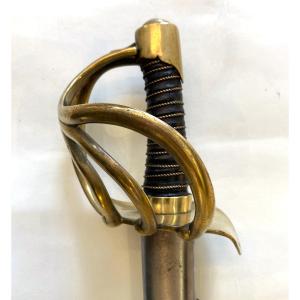
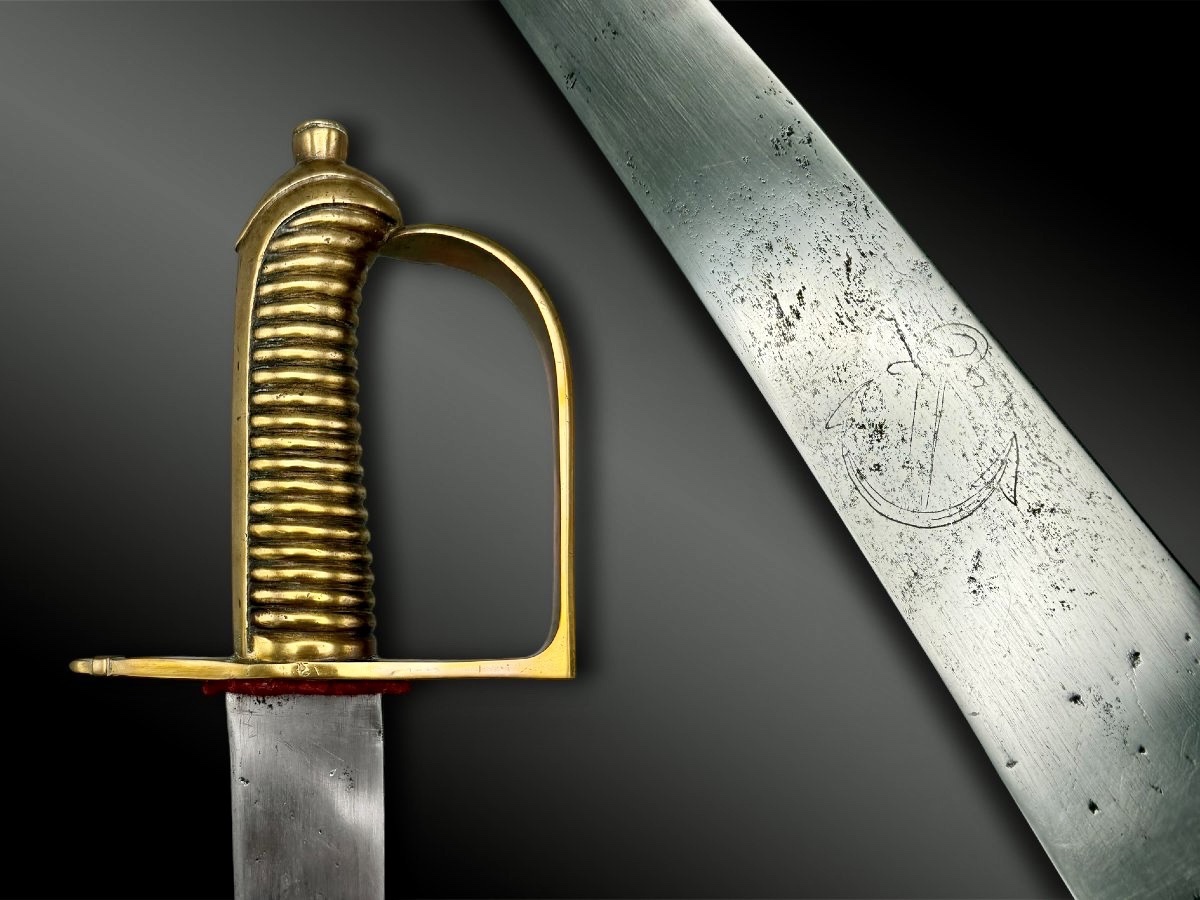
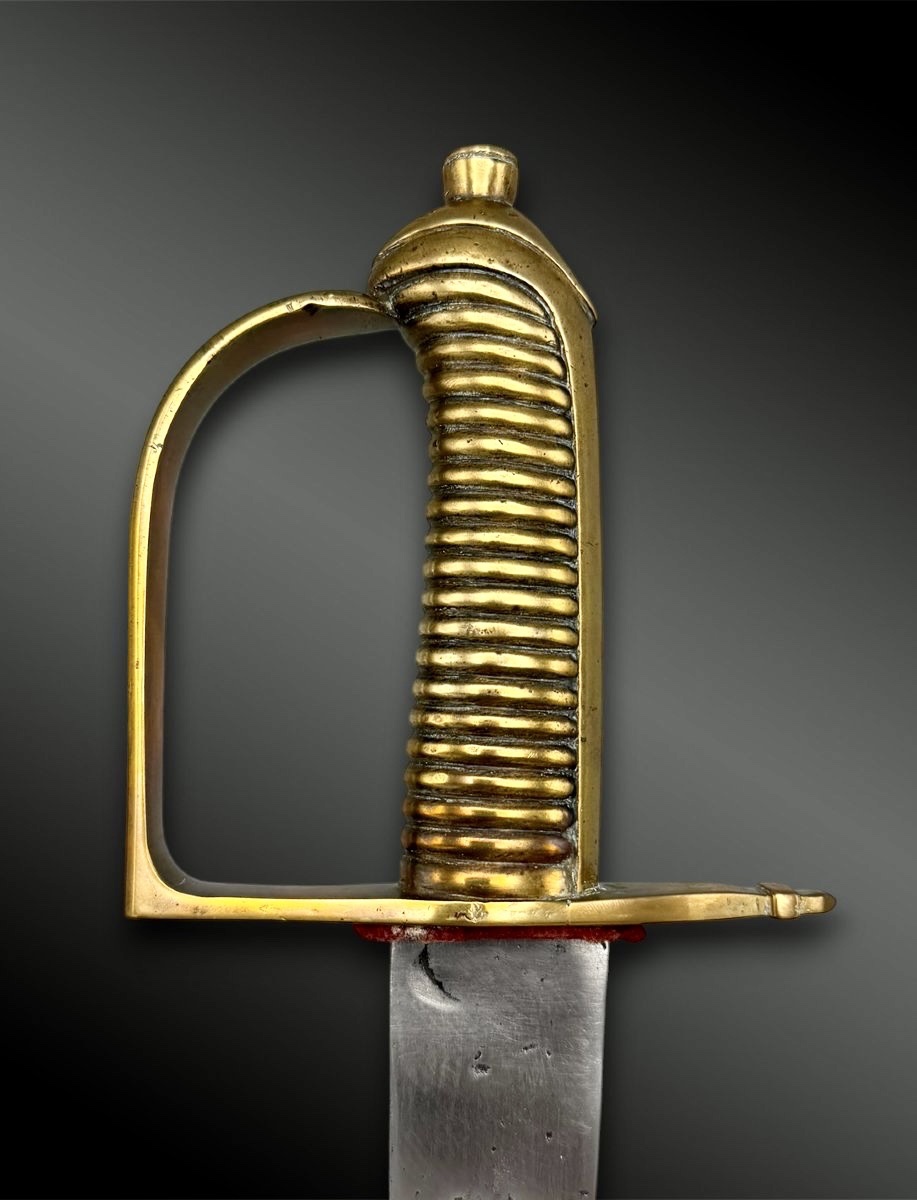
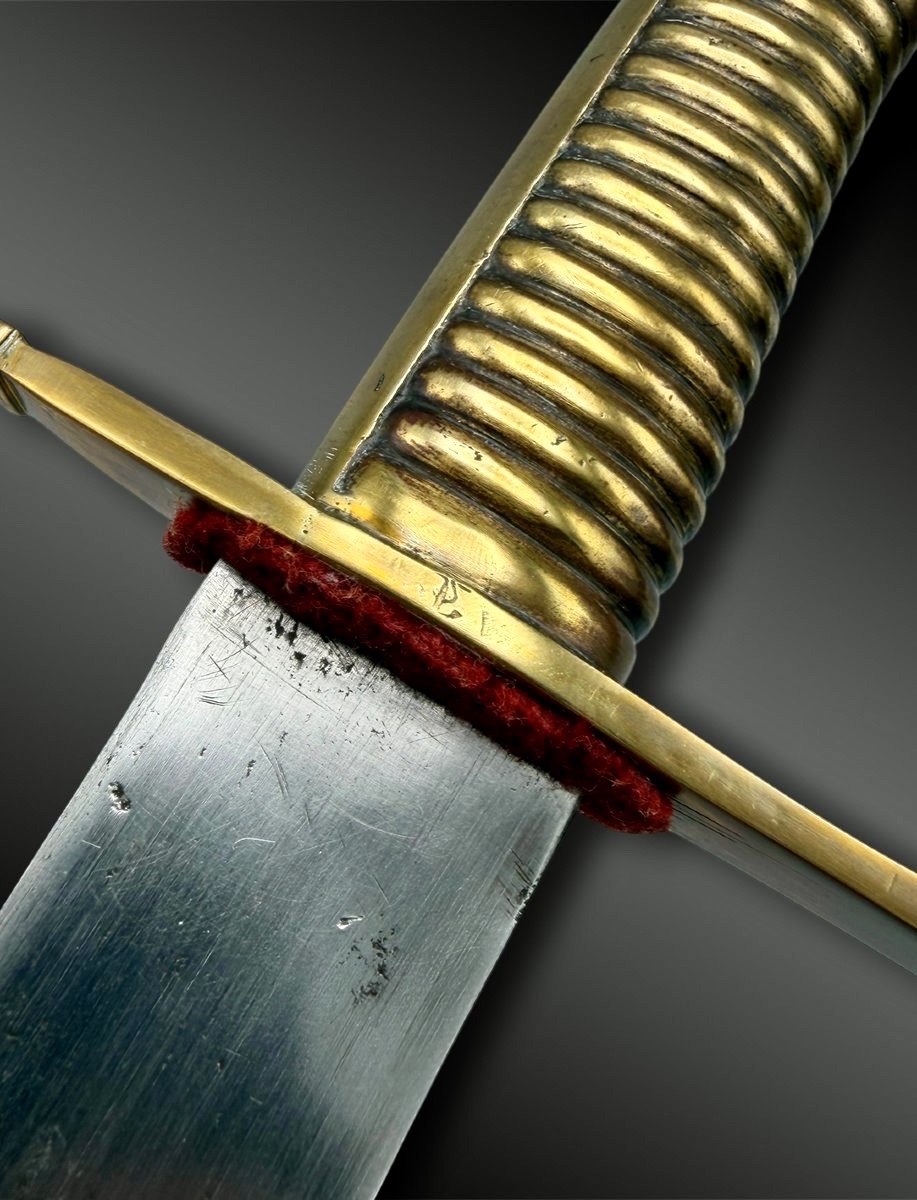
The characteristic frame of this Marine model is entirely made of a single piece in cast brass, a particularly robust construction adapted to the conditions of on-board service.
The handle has twenty strong transverse beams or fluts. It is topped with a dome cap extended by a long tail and finished with its rive button.
The guard with a branch forms a right angle with the cruise, which is extended by a curved killon finished in a point.
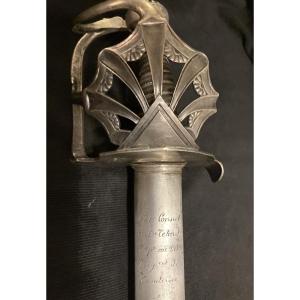
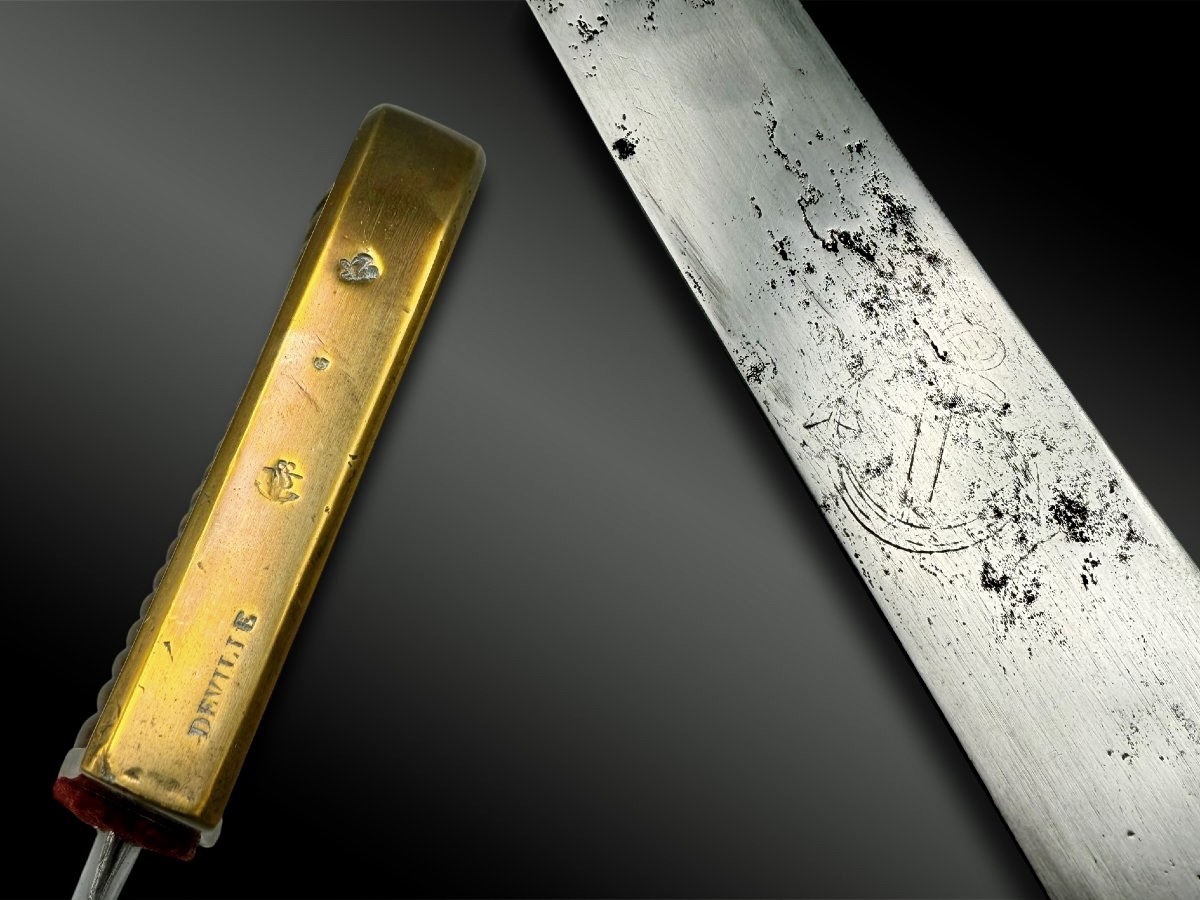
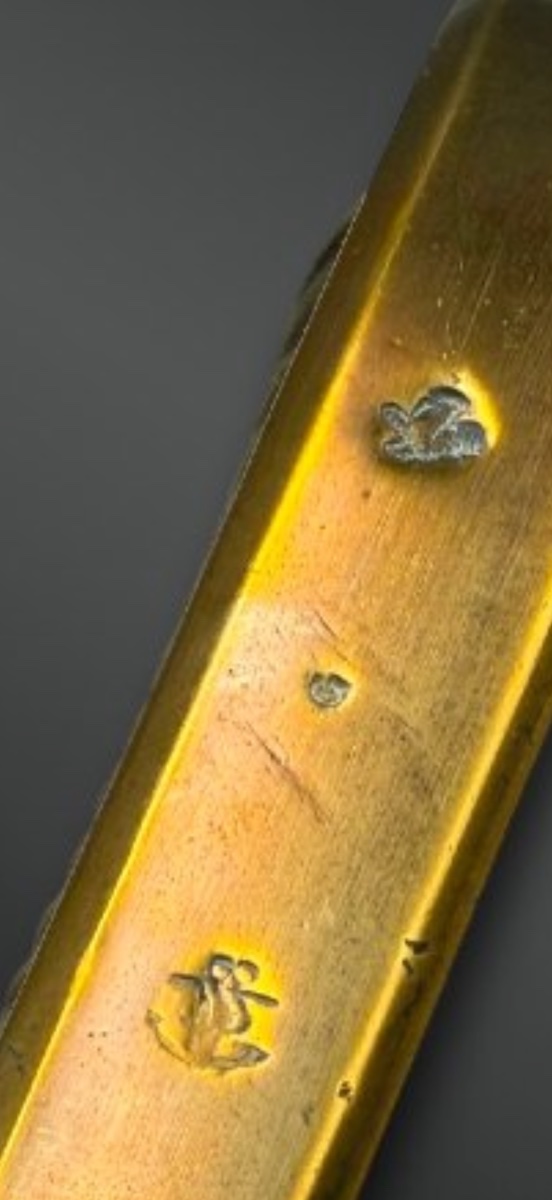
The frame bears the marking:
"DEVILLE"
As well as several control punches: a "G", a figurative punch remaining to be identified and, a particularly remarkable element, a Marine anchor struck directly in the brass.
MARINE BLADE
Strong steel blade, slightly curved and one-edged.
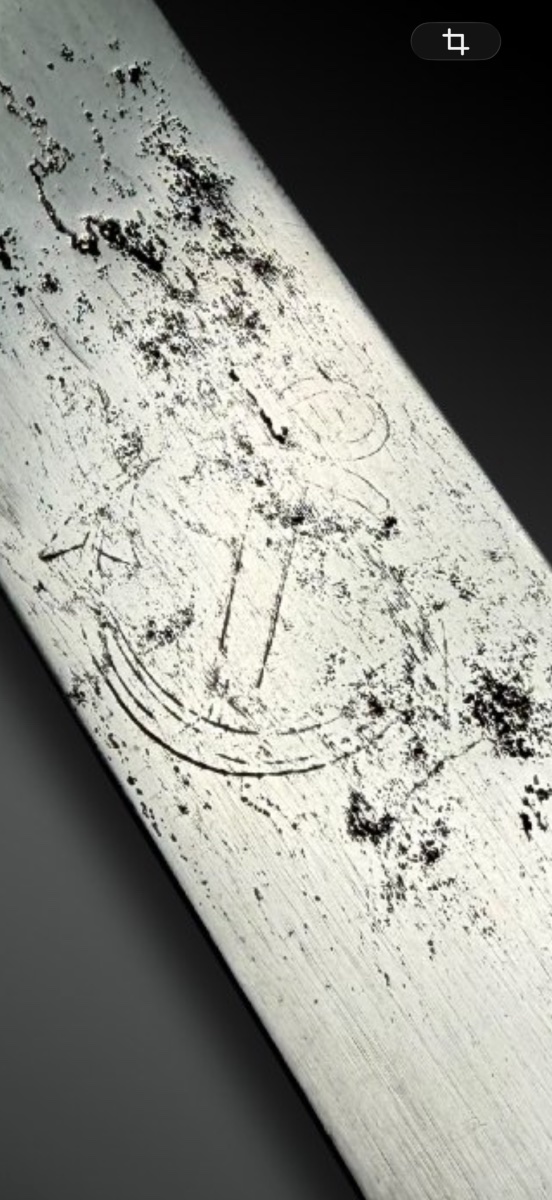
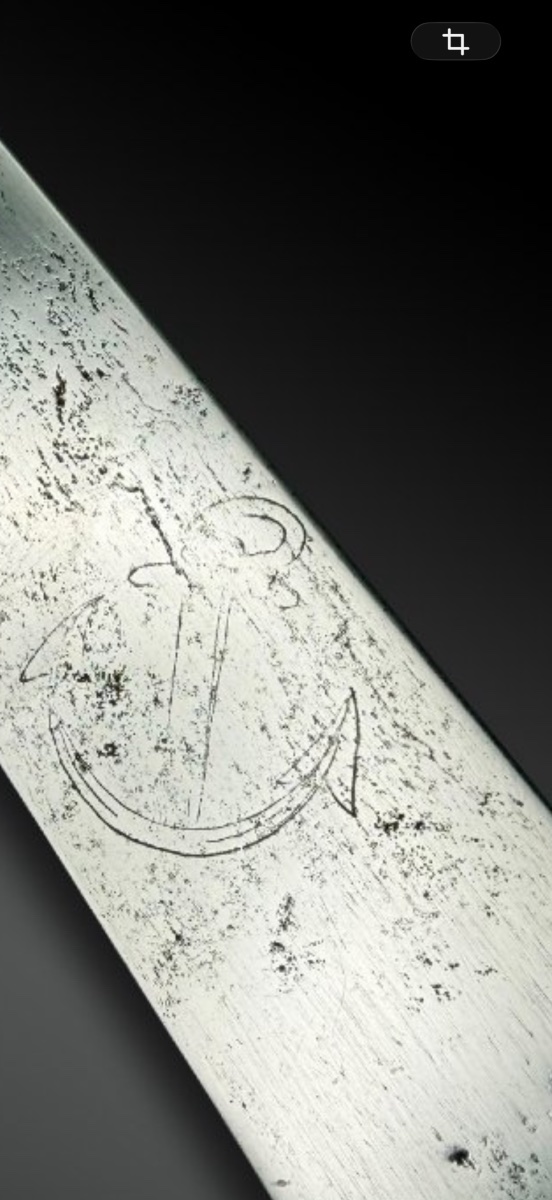
It has on each of its two sides a large engraved Marine anchor, a characteristic element confirming its destination at the service of the French Navy.
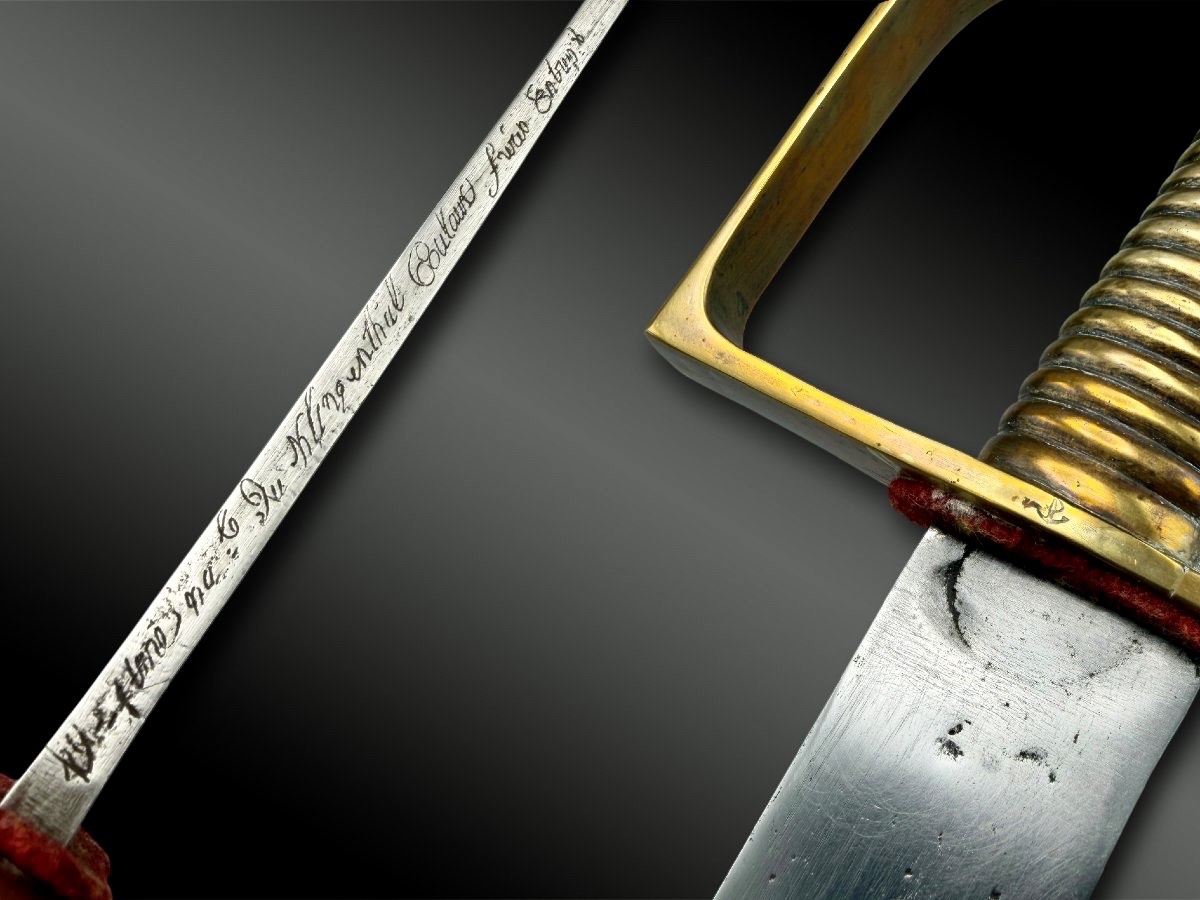
The back of the blade bears the important cursive inscription:
"Mfture Nale de Klingenthal Coulaux brothers Entrepreneur..."
For:
"National Manufacture of Klingenthal - Coulaux brothers Entrepreneurs".
A rarely preserved detail, the red felt tie is always present at the base of the blade.
A CONSULAR DATING: 1801-1804
The marking of the back of the blade is an essential element to date the weapon.
The brothers Jacques and Julien Coulaux became contractors of the Klingenthal Manufacture in 1801. With the advent of the Empire in 1804, the establishment then took the title of Imperial Manufacture.
The simultaneous presence of the words "Manufacture Nationale" and "Coulaux frères" therefore makes it possible to link the manufacture of this blade to the short period between 1801 and 1804, corresponding to the Consulate.
This dating gives all its interest to the copy: a model whose origin dates back to the Navy at the end of the 18th century was still manufactured or assembled at the beginning of the 19th century, when French naval armament was experiencing an important period of transition.
The remarkable consistency of the markings reinforces this reading: DEVILLE marking, control punches, anchor struck on the frame, large anchors engraved on both sides of the blade and consular signature of the Manufacture Nationale de Klingenthal.
HISTORICAL CONTEXT: THE CONSULATE NAVY
The manufacture of this saber takes place in a period of particularly intense naval rearmament.
From the beginning of the Consulate, Bonaparte relaunched the project of an invasion of England and undertook the constitution of a huge flotilla of light buildings concentrated in particular around Boulogne and the ports of the English Channel.
Cannor boats, gunboats, barges, prames and transport buildings are built in large numbers. This force must be able to embark not only tens of thousands of soldiers, but also thousands of sailors responsible for maneuvering and defending the ships.
In 1803, this organization took the name of National Flotilla. Arsenals, shipyards and factories were then solicited by the considerable armament effort undertaken by the Consulate.
It was precisely in this context of mobilization and rearmament of the French Navy that the Manufacture Nationale de Klingenthal made the blade of this saber between 1801 and 1804.
The coexistence of a regulatory mount of the 1782 model modified 1790 with a newly manufactured blade under the Consulate perfectly illustrates the continuity of the old materials during this period of profound military reorganization.
It cannot naturally be said, in the absence of a specific assignment marking, that this saber belonged to the Boulogne Flotilla. However, its manufacture is exactly contemporary with this immense naval effort.
THE SABER IN SERVICE
The ship's saber is primarily a regulatory combat weapon, designed to be robust, manageable and effective in the small space of a building.
The weapons intended for the crews constitute a collective weapon of the ship, kept on board and distributed to men when circumstances require it, especially during combat stockings.
Flotilla sailors do not fight exclusively on board. They participate in coastal protection, escorts, operations against enemy vessels and can also intervene on land.
This intensive use explains the relative scarcity of copies that have reached us in a satisfactory state of conservation.
STATE OF CONSERVATION
Good general condition for a regulatory weapon that has known the service.
Beautiful old patina of the brass frame. The blade retains its two large engraved Marine anchors and its precious Klingenthal consular marking.
Traces of use, oxidations and small punctures in accordance with the age and function of the weapon.
Old red felt tie preserved.
Without sheath.
COMPARISONS AND BIBLIOGRAPHY
A Navy troop sabre model 1782 modified 1790 is listed in the specialized archives of Bertrand Malvaux.
The evolution of the regulatory sabers of the French Navy from the end of the Ancien Régime to the Revolution, to the Consulate and then to the First Empire is also documented in the reference work devoted to French armament, especially those of Michel Pétard.
The particularly interesting character of this copy lies in the association of a regulatory frame of the model 1782 modified 1790 with a blade bearing the signature:
"National Manufacture of Klingenthal - Coulaux brothers Entrepreneurs"
To situate its manufacture in the short period of the Consulate, between 1801 and 1804.
A rare testimony of the continuity of the regulatory armament of the French Navy at the time of the great naval rearmament undertaken by Bonaparte.
France, Consulate, 1801-1804.
France, Consulate, 1801-1804
Manufacture Nationale de Klingenthal – Coulaux brothers entrepreneurs
Steel and brass
Total length: 72 cm
Blade length: about 60 cm
Without sheath
Rare regulatory sword of French Navy troops, model 1782 modified 1790, particularly interesting for its late manufacture under the Consulate, between 1801 and 1804.
The weapon associates a regulatory mount inherited from the end of the Ancien Régime and the revolutionary period with a blade manufactured in Klingenthal under the company of the Coulaux brothers, in the short period when the establishment still bears the title of Manufacture Nationale.
Mount
The characteristic frame of this Marine model is entirely made of a single piece in cast brass, a particularly robust construction adapted to the conditions of on-board service.
The handle has twenty strong transverse beams or fluts. It is topped with a dome cap extended by a long tail and finished with its rive button.
The guard with a branch forms a right angle with the cruise, which is extended by a curved killon finished in a point.
The frame bears the marking:
"DEVILLE"
As well as several control punches: a "G", a figurative punch remaining to be identified and, a particularly remarkable element, a Marine anchor struck directly in the brass.
MARINE BLADE
Strong steel blade, slightly curved and one-edged.
It has on each of its two sides a large engraved Marine anchor, a characteristic element confirming its destination at the service of the French Navy.
The back of the blade bears the important cursive inscription:
"Mfture Nale de Klingenthal Coulaux brothers Entrepreneur..."
For:
"National Manufacture of Klingenthal - Coulaux brothers Entrepreneurs".
A rarely preserved detail, the red felt tie is always present at the base of the blade.
A CONSULAR DATING: 1801-1804
The marking of the back of the blade is an essential element to date the weapon.
The brothers Jacques and Julien Coulaux became contractors of the Klingenthal Manufacture in 1801. With the advent of the Empire in 1804, the establishment then took the title of Imperial Manufacture.
The simultaneous presence of the words "Manufacture Nationale" and "Coulaux frères" therefore makes it possible to link the manufacture of this blade to the short period between 1801 and 1804, corresponding to the Consulate.
This dating gives all its interest to the copy: a model whose origin dates back to the Navy at the end of the 18th century was still manufactured or assembled at the beginning of the 19th century, when French naval armament was experiencing an important period of transition.
The remarkable consistency of the markings reinforces this reading: DEVILLE marking, control punches, anchor struck on the frame, large anchors engraved on both sides of the blade and consular signature of the Manufacture Nationale de Klingenthal.
HISTORICAL CONTEXT: THE CONSULATE NAVY
The manufacture of this saber takes place in a period of particularly intense naval rearmament.
From the beginning of the Consulate, Bonaparte relaunched the project of an invasion of England and undertook the constitution of a huge flotilla of light buildings concentrated in particular around Boulogne and the ports of the English Channel.
Cannor boats, gunboats, barges, prames and transport buildings are built in large numbers. This force must be able to embark not only tens of thousands of soldiers, but also thousands of sailors responsible for maneuvering and defending the ships.
In 1803, this organization took the name of National Flotilla. Arsenals, shipyards and factories were then solicited by the considerable armament effort undertaken by the Consulate.
It was precisely in this context of mobilization and rearmament of the French Navy that the Manufacture Nationale de Klingenthal made the blade of this saber between 1801 and 1804.
The coexistence of a regulatory mount of the 1782 model modified 1790 with a newly manufactured blade under the Consulate perfectly illustrates the continuity of the old materials during this period of profound military reorganization.
It cannot naturally be said, in the absence of a specific assignment marking, that this saber belonged to the Boulogne Flotilla. However, its manufacture is exactly contemporary with this immense naval effort.
THE SABER IN SERVICE
The ship's saber is primarily a regulatory combat weapon, designed to be robust, manageable and effective in the small space of a building.
The weapons intended for the crews constitute a collective weapon of the ship, kept on board and distributed to men when circumstances require it, especially during combat stockings.
Flotilla sailors do not fight exclusively on board. They participate in coastal protection, escorts, operations against enemy vessels and can also intervene on land.
This intensive use explains the relative scarcity of copies that have reached us in a satisfactory state of conservation.
STATE OF CONSERVATION
Good general condition for a regulatory weapon that has known the service.
Beautiful old patina of the brass frame. The blade retains its two large engraved Marine anchors and its precious Klingenthal consular marking.
Traces of use, oxidations and small punctures in accordance with the age and function of the weapon.
Old red felt tie preserved.
Without sheath.
COMPARISONS AND BIBLIOGRAPHY
A Navy troop sabre model 1782 modified 1790 is listed in the specialized archives of Bertrand Malvaux.
The evolution of the regulatory sabers of the French Navy from the end of the Ancien Régime to the Revolution, to the Consulate and then to the First Empire is also documented in the reference work devoted to French armament, especially those of Michel Pétard.
The particularly interesting character of this copy lies in the association of a regulatory frame of the model 1782 modified 1790 with a blade bearing the signature:
"National Manufacture of Klingenthal - Coulaux brothers Entrepreneurs"
To situate its manufacture in the short period of the Consulate, between 1801 and 1804.
A rare testimony of the continuity of the regulatory armament of the French Navy at the time of the great naval rearmament undertaken by Bonaparte.
France, Consulate, 1801-1804.
3 850 €
Period: 19th century
Style: Consulat, Empire
Condition: En l'etat
Reference (ID): 1808401
Availability: In stock
Print