

Jean-baptiste Olive (1848–1936) Seashore With Stormy Sky
Artist: Jean-baptiste Olive (1848-1936)
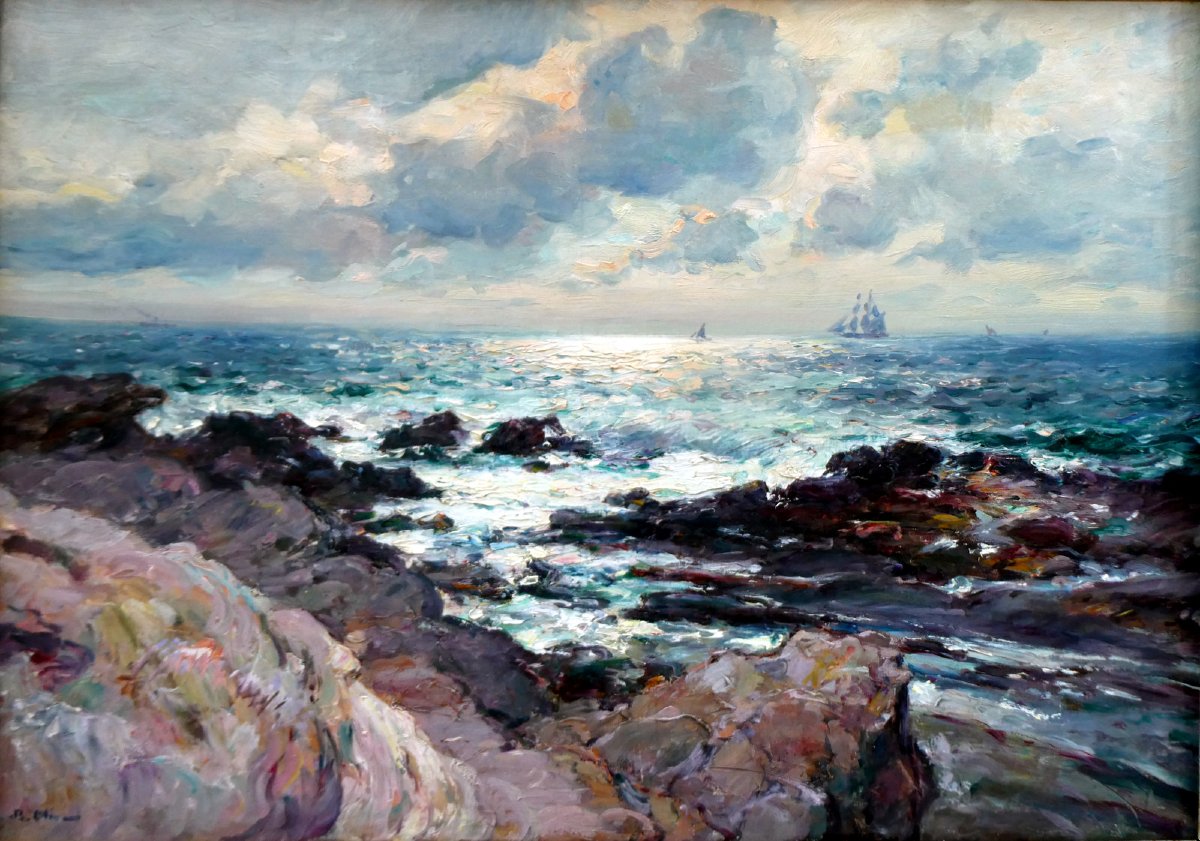
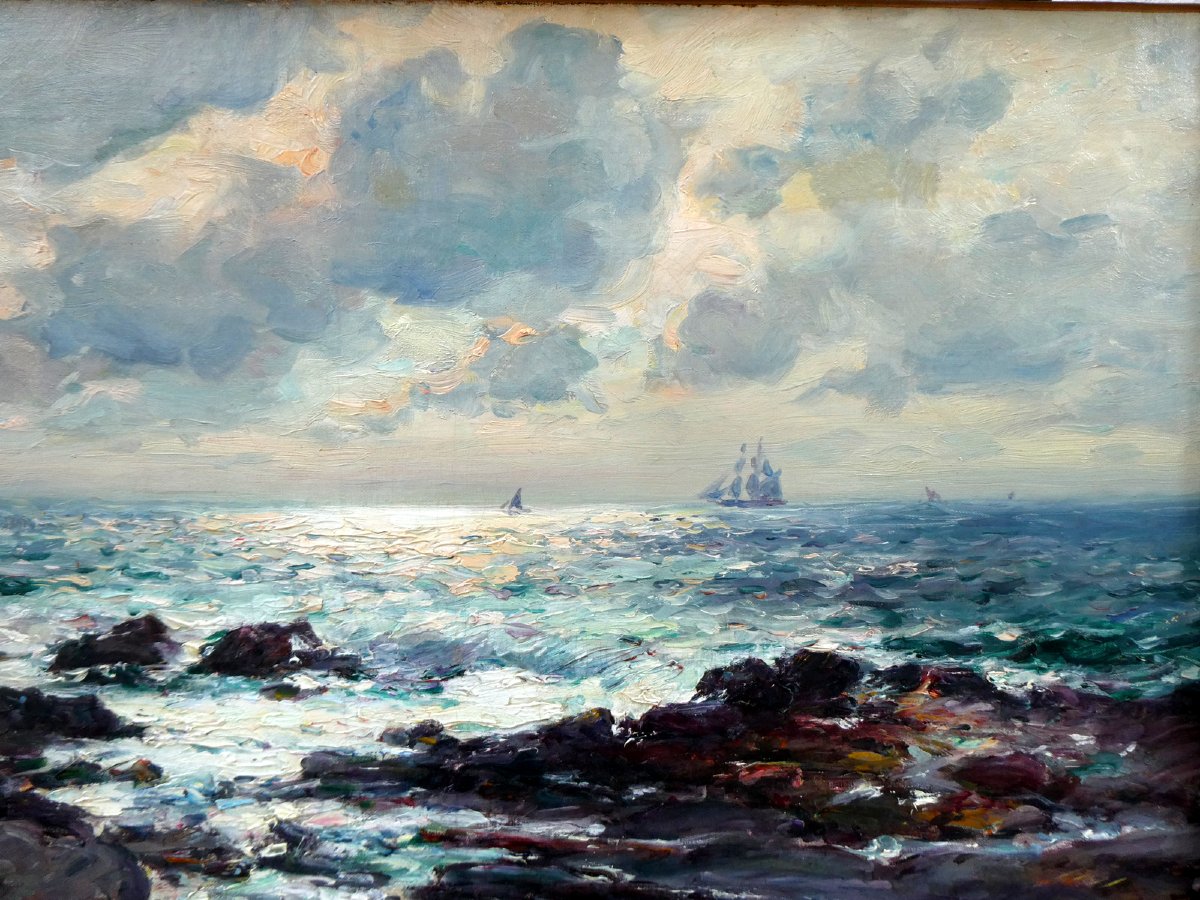
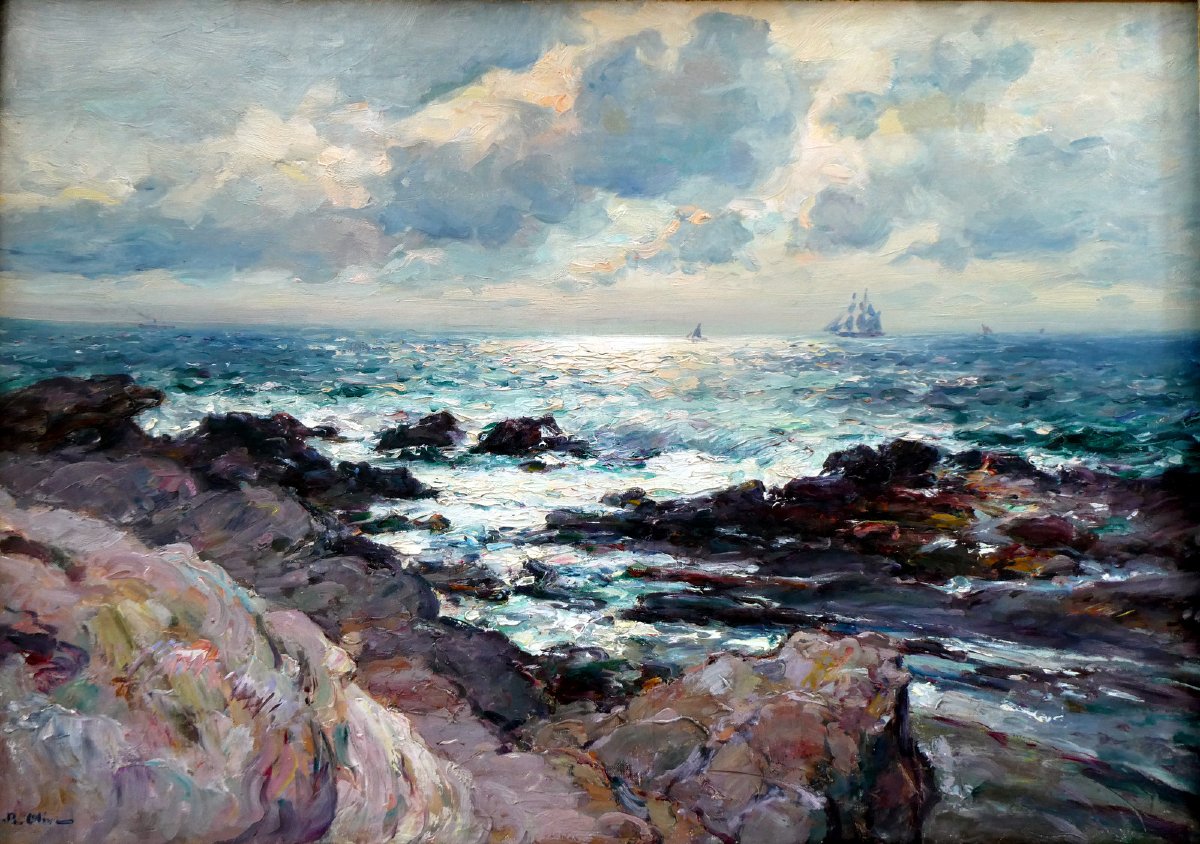
A seashore scene with a stormy sky—a classic motif among Provençal marine painters of the late 19th and early 20th centuries, and especially among their leading figure, Jean-Baptiste Olive.
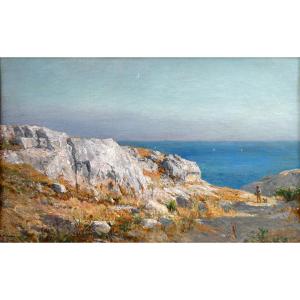
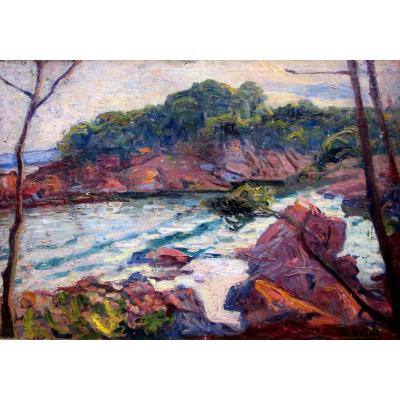
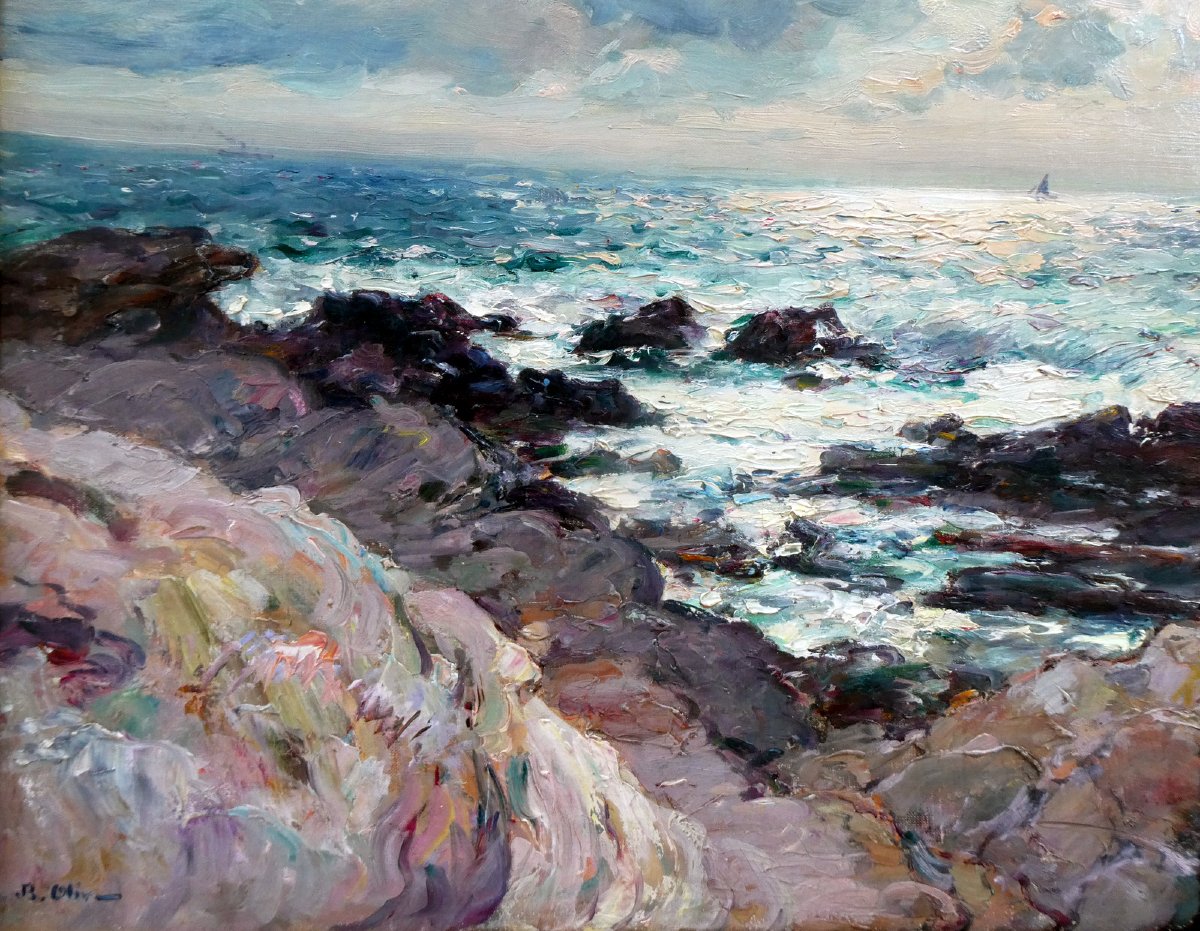
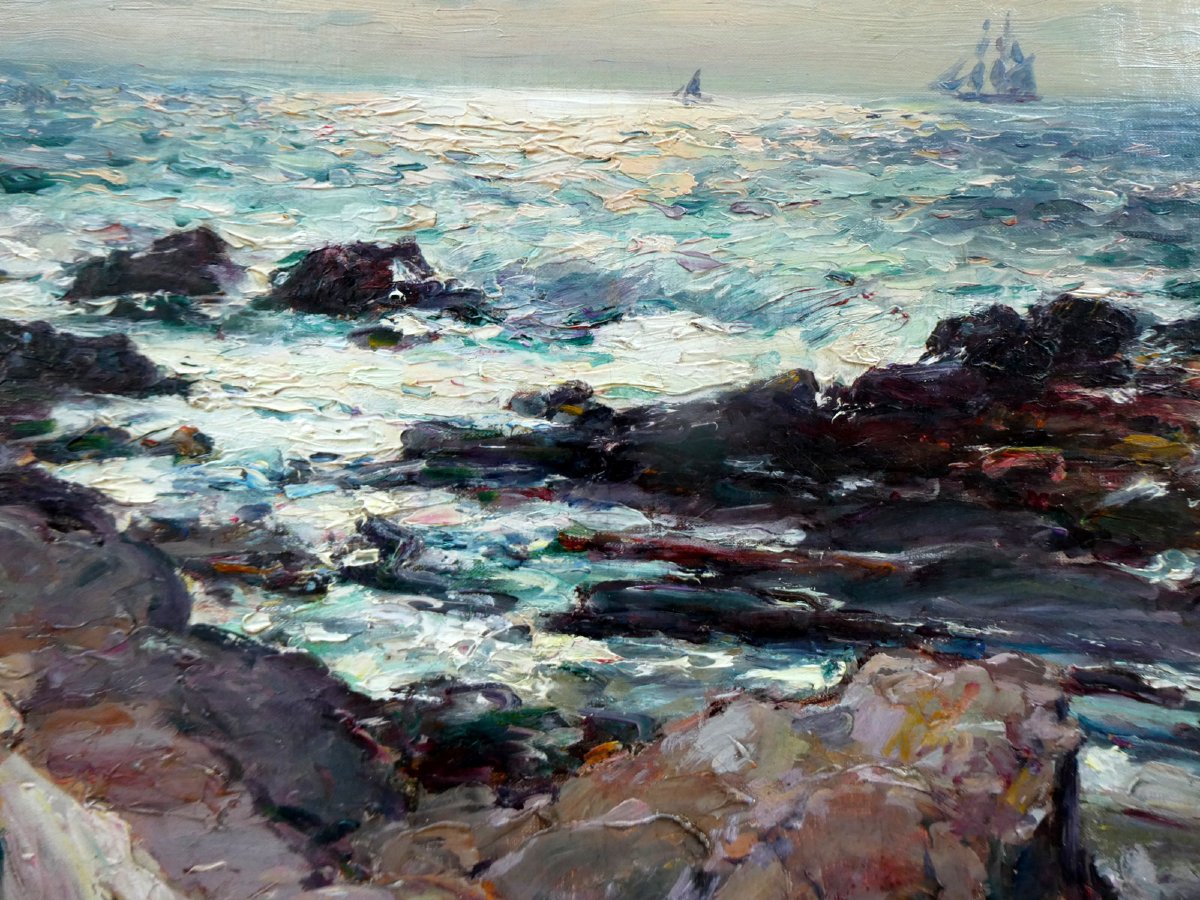
A diagonal line of rocks occupies the entire foreground and a good half of the lower portion of the canvas, guiding the eye toward the shimmering sea and a spectacular cloudy sky filling the upper half.
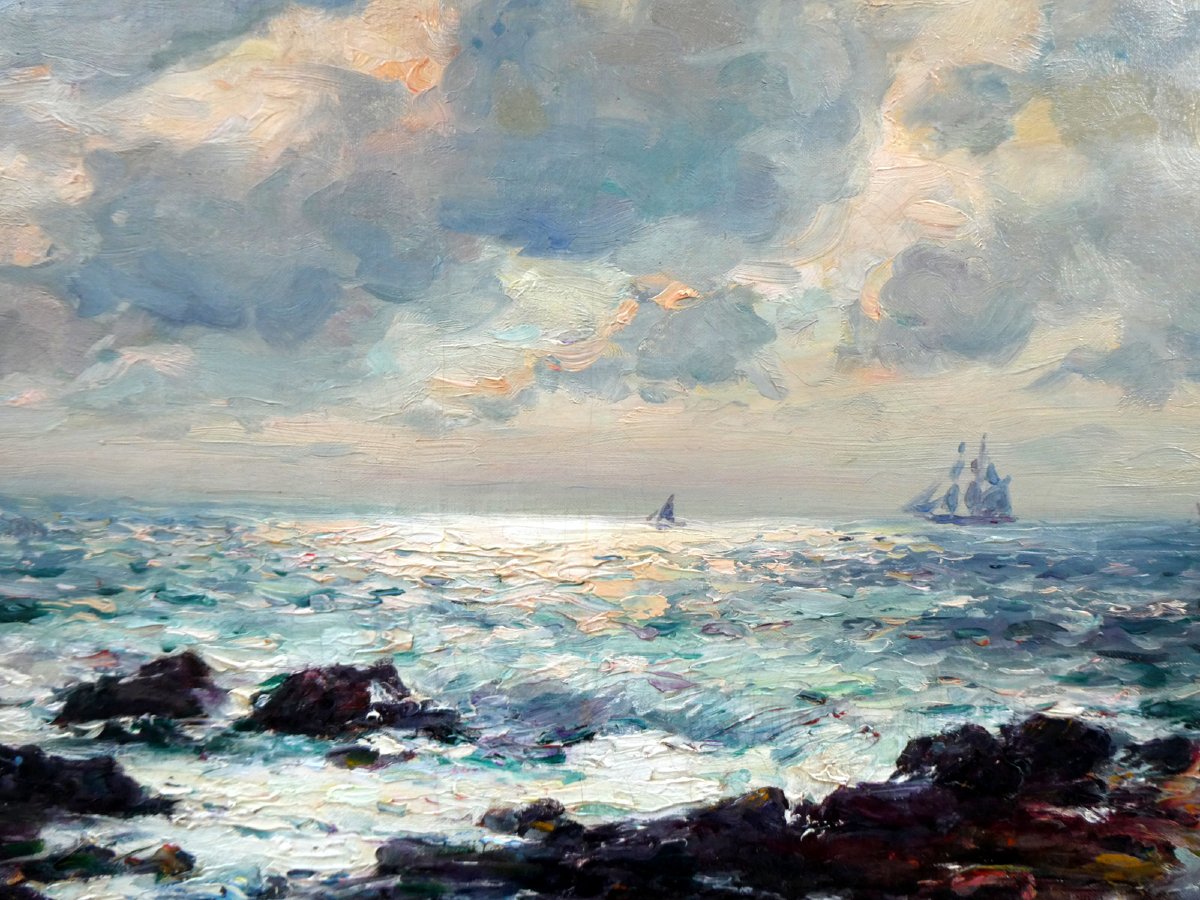
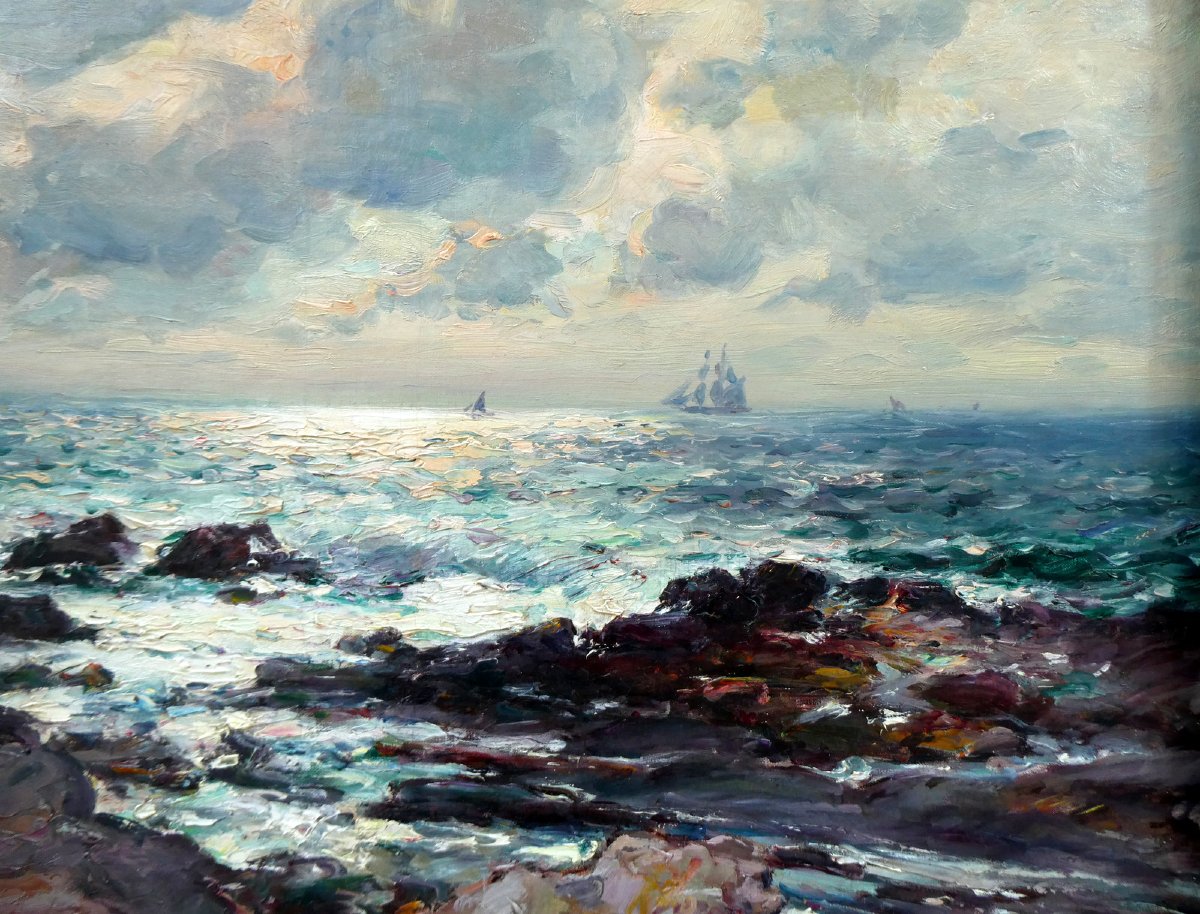
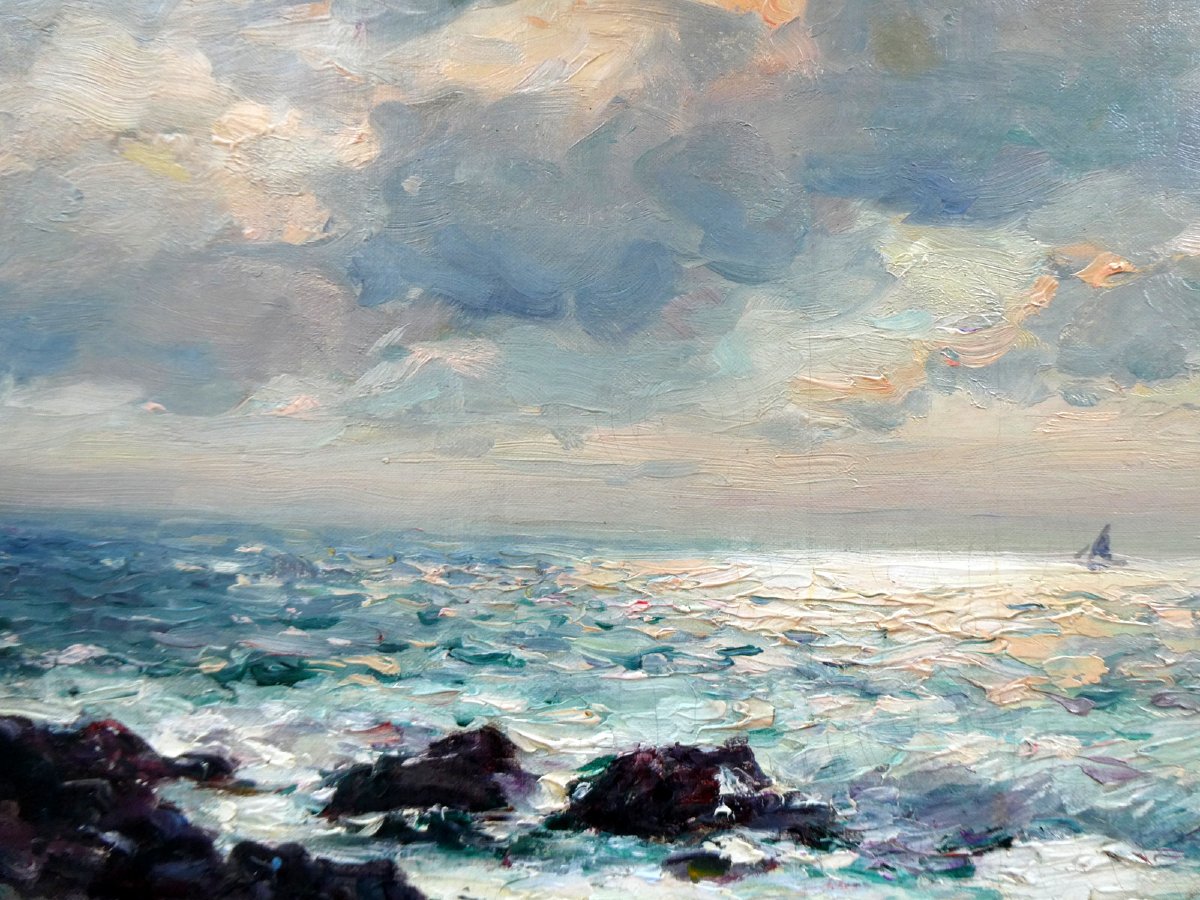
On the horizon, sailboats provide a sense of scale and depth while remaining discreet, without distracting from the main subject: the light on the sea—a backlighting effect with white and silvery reflections that contrast with the dark rocks.
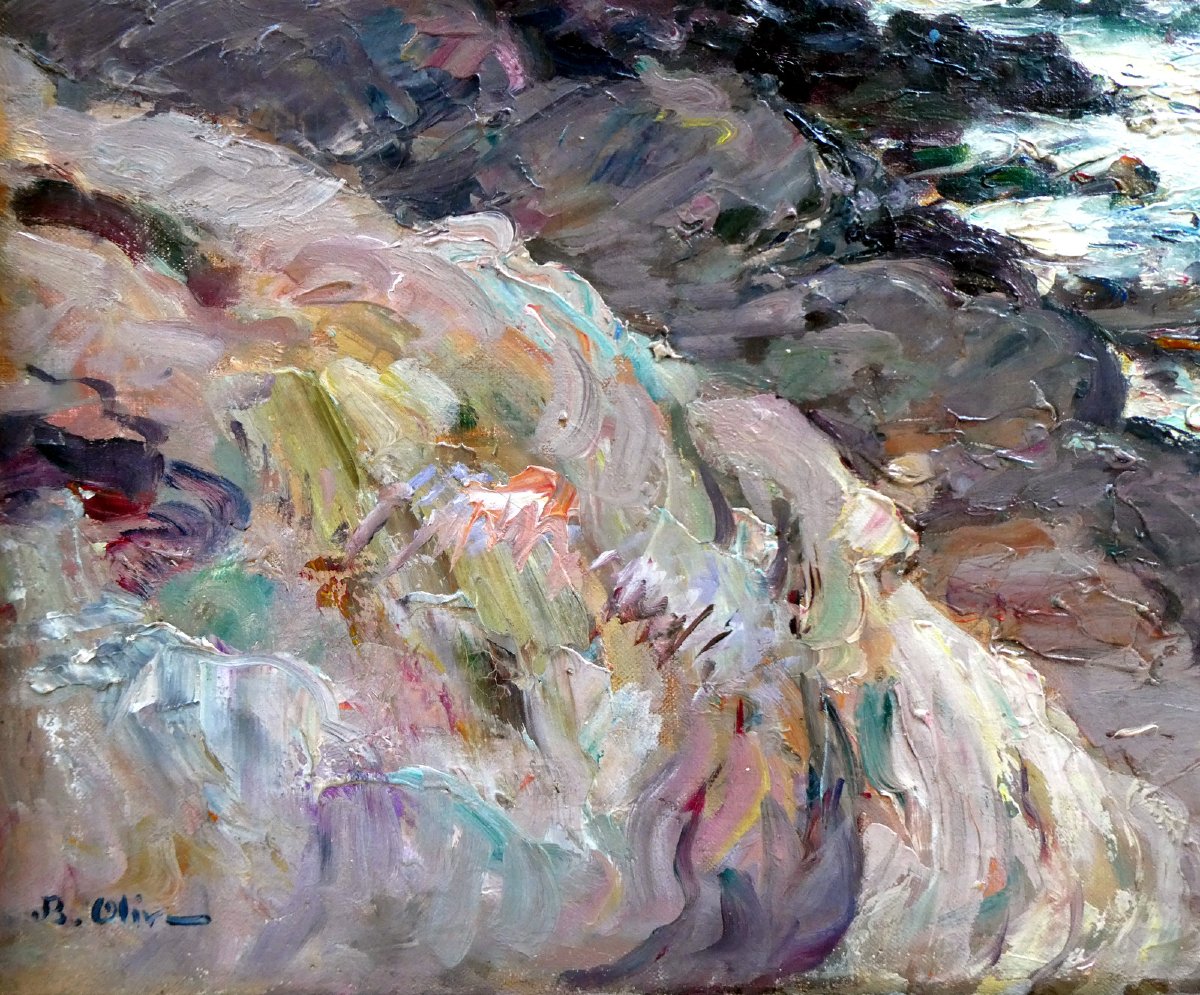
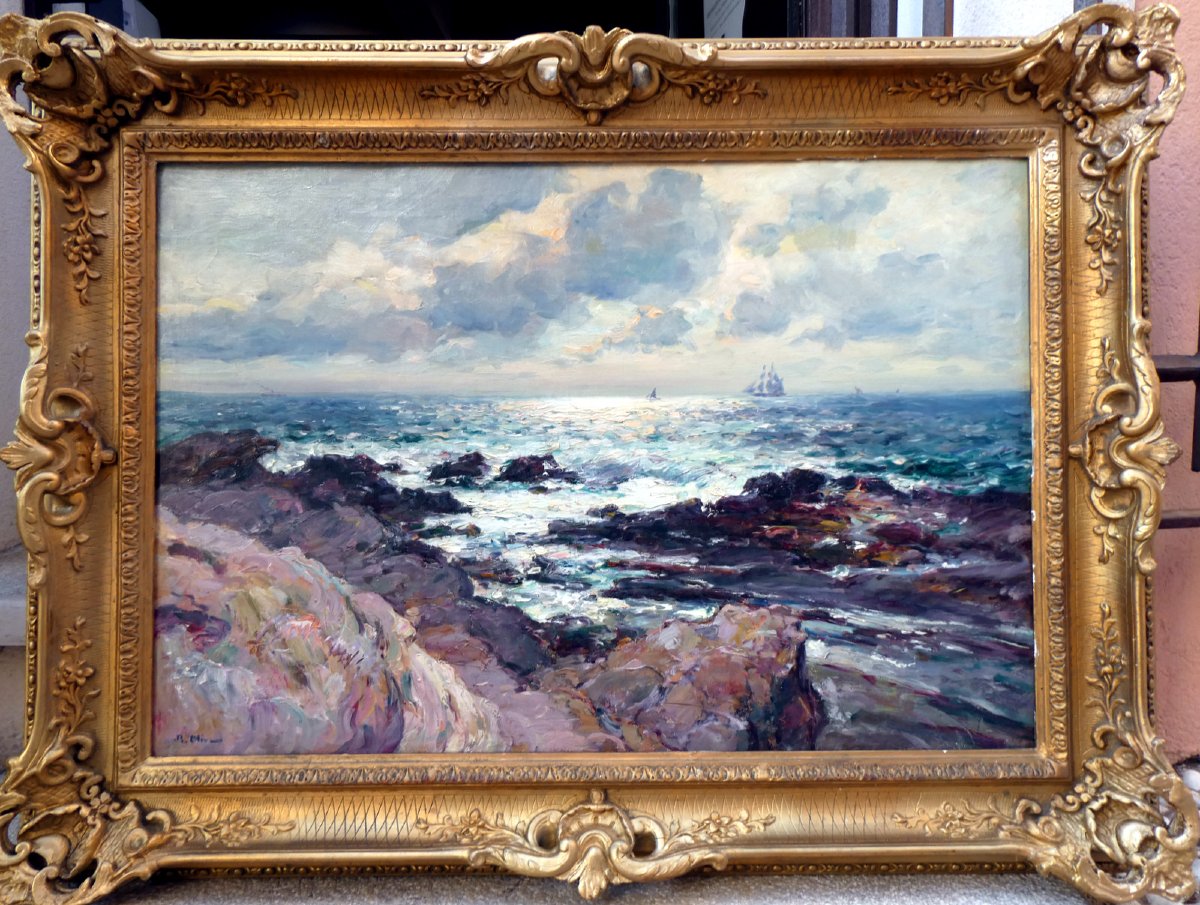
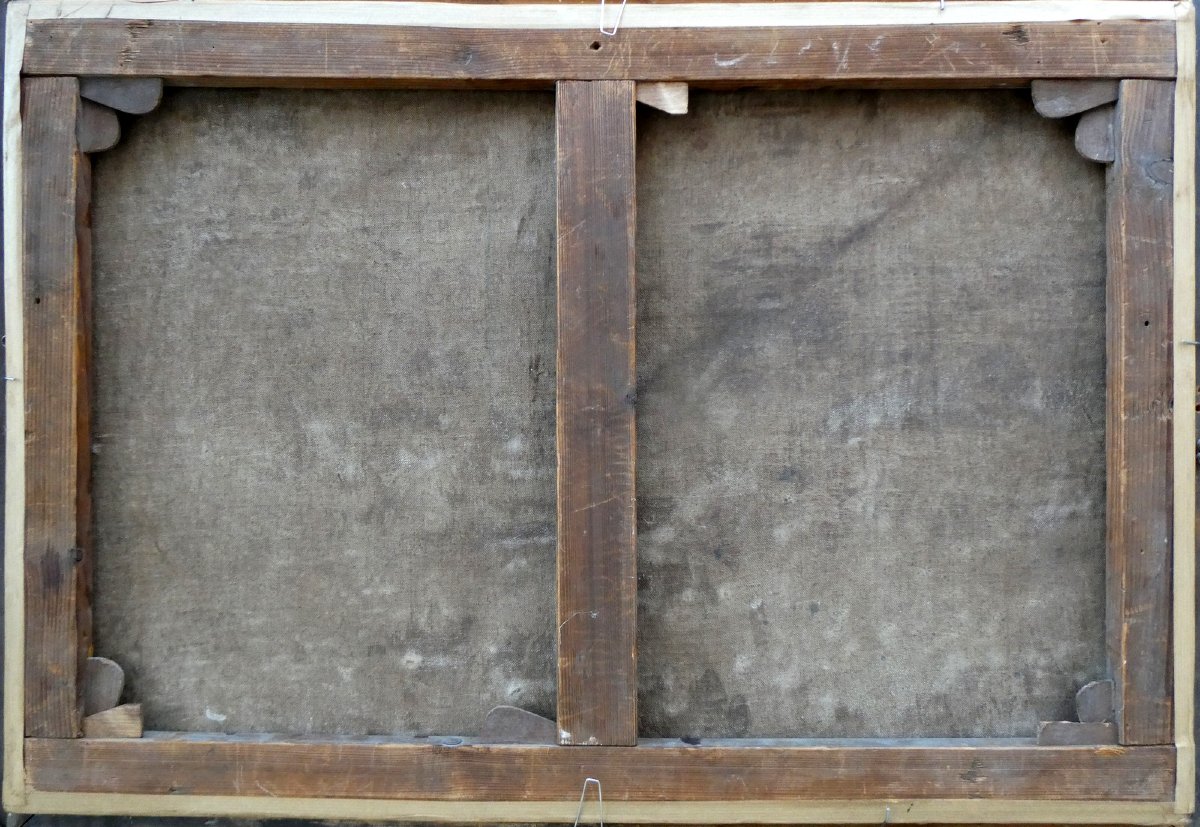
A thick, energetic brushstroke, typical of theway Olive rendered Mediterranean scenes.The work is signed in the lower left corner, it is made in oil on canvas and offered in a beautiful Louis XV style gilt frame which measures 68 cm by 91 cm and 50 cm by 73 cm for the painting alone.
As is often the case with Olive, one senses the influence of Impressionism in the way the light is rendered through small brushstrokes.
The clouds are also painted with great freedom, featuring visible impasto, variations of blue-gray, off-white, and touches of pink-ochre suggesting a low or setting sun.
This stormy sky is almost richerin texture than the sea itself, creating a beautiful balance between the turbulence of the sky and the turbulence of the rocks, which are rendered in broad strokes of various colors (mauves, pinks, greens, ochres)
In the “Post-Impressionist” style found in the work of several painters of this period, the rocks are never simply grayor brown but capture all the surrounding colors.
A luminous and powerful work.
Jean-Baptiste Olive was encouraged by his friend, the decorator Étienne Cornellier, to enroll at the École des Beaux-Arts in Marseille, where he studied under Johanny Rave (1827-1882).
His work earned him awards every year, including a first prize in the life drawing class.
He learned the craft of interior design.
He painted Marseille extensively, including its Old Port, its islands, and its shores.
In 1874, he traveled to Italy, visiting Genoa and Venice.
He exhibited sporadically at various Provençal Salons.
He possessed a profound humility regarding his talent and felt no desire to pass on his knowledge to any students. However, Jean-Baptiste Olive perplexed critics, gallery owners, and friends alike, who were fascinated by the contrast between his dazzlingly clear paintings and the complex, introverted personality of the artist. He earned a place of honor in the lives and hearts of those he met throughout his career, and numerous patrons supported him.
In 1948, ten years after his death, the Musée Cantini in Marseille dedicated the centenary exhibition to him, presenting eighty-two works from his extensive artistic career.
His presence is a dominant force in the maritime landscape movement.
He formed close ties with Gustave Marius Jullien (1825-1881), Étienne Cornellier, and Antoine Vollon.
He frequented Robert Mols and became friends with Raymond Allègre and Théophile Henri Décanis.
In Paris, he contributed to the decoration of the Cirque d'Hiver, the Sacré-Cœur Basilica in Montmartre, and several pavilions at the 1889 Universal Exposition.
From 1874 onward, he exhibited at the Paris Salon and won several prizes in the following years. He became a member of the Salon des Artistes Français in 1881 and received a silver medal at the 1889 Universal Exposition.
General Malesherbes purchased some of his paintings.
In 1900, he was commissioned to paint two canvases to decorate the Salle Dorée (Golden Room) of the Le Train Bleu restaurant at the Gare de Lyon in Paris.
Works in Public Collections
Athens, National Gallery: The Environs of Saint-Cyr, 1914, oil on canvas; Mistral, oil on canvas; Mistral in Marseille, oil on canvas; Shore at Marseille, oil on canvas.
Béziers, Museum of Fine Arts: Still Life with Fruit, 1872, oil on canvas.
Colmar, Prefecture of Haut-Rhin: Evening, Bay of Villefranche, 1893, pen, India ink, scratchboard. Study for the painting exhibited at the Salon of 1893
Le Havre, André Malraux Museum of Modern Art: The Cliff, oil on canvas
Marseille: Cantini Museum: Carry-le-Rouet, before 1917, oil on canvas, The Wreck of the Navarre, near Carry, before 1917, oil on canvas, Storm, before 1917, oil on canvas
Grobet-Labadié Museum: A Wave, oil on canvas
Museum of the Navy and Economy: Oil Quay. Marseille Museum of Fine Arts: The Corniche in Marseille, oil on canvas, The Salute in Venice, oil on canvas, Seascape, oil on canvas
Paris: Department of Graphic Arts, Louvre Museum, Landscape, scratchboard, India ink
Gare de Lyon: Large Fresco of the Gare de Lyon, 1900, oil on canvas mounted on canvas.
Le Train Bleu Restaurant, Golden Room: The Old Port of Marseille, 1900, oil on canvas; Saint-Honorat, 1901, oil on canvas. Toulon, Museum of Art: Port of Toulon, 1878, oil on canvas; Port of Marseille, 1880, oil on wood. This small painting bears a dedication to Jean Aicard dated May 3, 1880, and located in Paris. Calanque d'en Vau, oil on canvas.
Brazil, São Paulo, Museum of Art: Seascape with Rocks.
Tribute
Knight of the Legion of Honor on January 20, 1899, promoted to Officer on August 12, 1923. A street in Marseille bears his name. Exhibitions: Paris, Universal Exhibition of 1889 (silver medal). 1948, Cantini Museum in Marseille, exhibition commemorating the centenary of the birth of Jean-Baptiste Olive, 82 works presented. In 2008, in Geneva, Switzerland, the Bartha and Senarclens Gallery hosted the Marc Stammegna Gallery from June 6 to July 31, 2008, for "These Painters of Provence," a group exhibition of 22 painters including Jean-Baptiste Olive, Frédéric Montenard, Louis Valtat, and Félix Ziem. From September 26, 2008, to January 25, 2009, at the Palais des Arts in Marseille, "Jean-Baptiste Olive - Prism of Light" was organized by the Regards de Provence Foundation.
A diagonal line of rocks occupies the entire foreground and a good half of the lower portion of the canvas, guiding the eye toward the shimmering sea and a spectacular cloudy sky filling the upper half.
On the horizon, sailboats provide a sense of scale and depth while remaining discreet, without distracting from the main subject: the light on the sea—a backlighting effect with white and silvery reflections that contrast with the dark rocks.
A thick, energetic brushstroke, typical of theway Olive rendered Mediterranean scenes.The work is signed in the lower left corner, it is made in oil on canvas and offered in a beautiful Louis XV style gilt frame which measures 68 cm by 91 cm and 50 cm by 73 cm for the painting alone.
As is often the case with Olive, one senses the influence of Impressionism in the way the light is rendered through small brushstrokes.
The clouds are also painted with great freedom, featuring visible impasto, variations of blue-gray, off-white, and touches of pink-ochre suggesting a low or setting sun.
This stormy sky is almost richerin texture than the sea itself, creating a beautiful balance between the turbulence of the sky and the turbulence of the rocks, which are rendered in broad strokes of various colors (mauves, pinks, greens, ochres)
In the “Post-Impressionist” style found in the work of several painters of this period, the rocks are never simply grayor brown but capture all the surrounding colors.
A luminous and powerful work.
Jean-Baptiste Olive was encouraged by his friend, the decorator Étienne Cornellier, to enroll at the École des Beaux-Arts in Marseille, where he studied under Johanny Rave (1827-1882).
His work earned him awards every year, including a first prize in the life drawing class.
He learned the craft of interior design.
He painted Marseille extensively, including its Old Port, its islands, and its shores.
In 1874, he traveled to Italy, visiting Genoa and Venice.
He exhibited sporadically at various Provençal Salons.
He possessed a profound humility regarding his talent and felt no desire to pass on his knowledge to any students. However, Jean-Baptiste Olive perplexed critics, gallery owners, and friends alike, who were fascinated by the contrast between his dazzlingly clear paintings and the complex, introverted personality of the artist. He earned a place of honor in the lives and hearts of those he met throughout his career, and numerous patrons supported him.
In 1948, ten years after his death, the Musée Cantini in Marseille dedicated the centenary exhibition to him, presenting eighty-two works from his extensive artistic career.
His presence is a dominant force in the maritime landscape movement.
He formed close ties with Gustave Marius Jullien (1825-1881), Étienne Cornellier, and Antoine Vollon.
He frequented Robert Mols and became friends with Raymond Allègre and Théophile Henri Décanis.
In Paris, he contributed to the decoration of the Cirque d'Hiver, the Sacré-Cœur Basilica in Montmartre, and several pavilions at the 1889 Universal Exposition.
From 1874 onward, he exhibited at the Paris Salon and won several prizes in the following years. He became a member of the Salon des Artistes Français in 1881 and received a silver medal at the 1889 Universal Exposition.
General Malesherbes purchased some of his paintings.
In 1900, he was commissioned to paint two canvases to decorate the Salle Dorée (Golden Room) of the Le Train Bleu restaurant at the Gare de Lyon in Paris.
Works in Public Collections
Athens, National Gallery: The Environs of Saint-Cyr, 1914, oil on canvas; Mistral, oil on canvas; Mistral in Marseille, oil on canvas; Shore at Marseille, oil on canvas.
Béziers, Museum of Fine Arts: Still Life with Fruit, 1872, oil on canvas.
Colmar, Prefecture of Haut-Rhin: Evening, Bay of Villefranche, 1893, pen, India ink, scratchboard. Study for the painting exhibited at the Salon of 1893
Le Havre, André Malraux Museum of Modern Art: The Cliff, oil on canvas
Marseille: Cantini Museum: Carry-le-Rouet, before 1917, oil on canvas, The Wreck of the Navarre, near Carry, before 1917, oil on canvas, Storm, before 1917, oil on canvas
Grobet-Labadié Museum: A Wave, oil on canvas
Museum of the Navy and Economy: Oil Quay. Marseille Museum of Fine Arts: The Corniche in Marseille, oil on canvas, The Salute in Venice, oil on canvas, Seascape, oil on canvas
Paris: Department of Graphic Arts, Louvre Museum, Landscape, scratchboard, India ink
Gare de Lyon: Large Fresco of the Gare de Lyon, 1900, oil on canvas mounted on canvas.
Le Train Bleu Restaurant, Golden Room: The Old Port of Marseille, 1900, oil on canvas; Saint-Honorat, 1901, oil on canvas. Toulon, Museum of Art: Port of Toulon, 1878, oil on canvas; Port of Marseille, 1880, oil on wood. This small painting bears a dedication to Jean Aicard dated May 3, 1880, and located in Paris. Calanque d'en Vau, oil on canvas.
Brazil, São Paulo, Museum of Art: Seascape with Rocks.
Tribute
Knight of the Legion of Honor on January 20, 1899, promoted to Officer on August 12, 1923. A street in Marseille bears his name. Exhibitions: Paris, Universal Exhibition of 1889 (silver medal). 1948, Cantini Museum in Marseille, exhibition commemorating the centenary of the birth of Jean-Baptiste Olive, 82 works presented. In 2008, in Geneva, Switzerland, the Bartha and Senarclens Gallery hosted the Marc Stammegna Gallery from June 6 to July 31, 2008, for "These Painters of Provence," a group exhibition of 22 painters including Jean-Baptiste Olive, Frédéric Montenard, Louis Valtat, and Félix Ziem. From September 26, 2008, to January 25, 2009, at the Palais des Arts in Marseille, "Jean-Baptiste Olive - Prism of Light" was organized by the Regards de Provence Foundation.
12 000 €
Period: 19th century
Style: Other Style
Condition: Fully restored in our whorkshop
Material: Oil painting
Length: 73 cm
Height: 50 cm
Reference (ID): 1807633
Availability: In stock
Print