

Claude-françois Rabiat - Silence, Attention - Exceptional Empire-period Clock - 1809
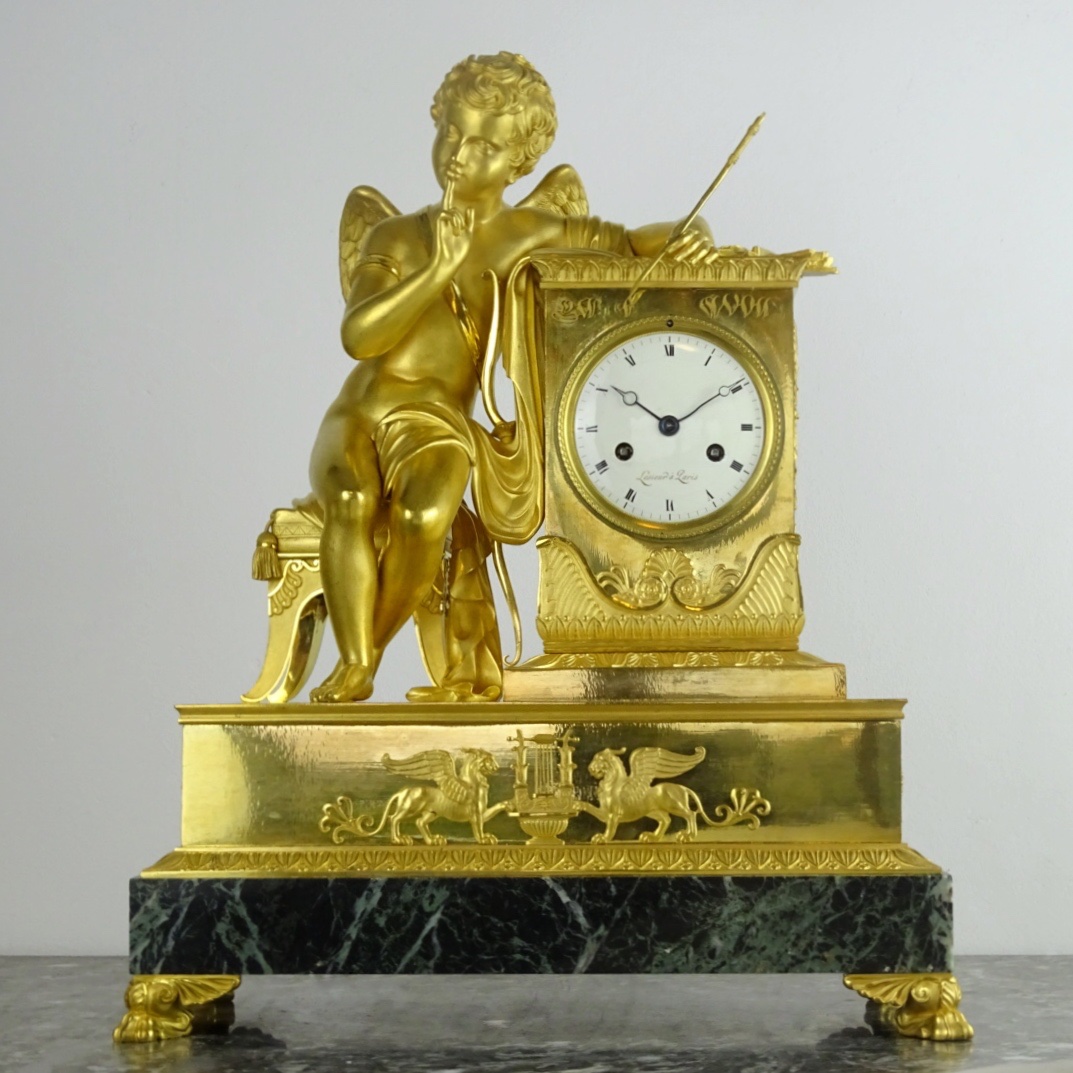
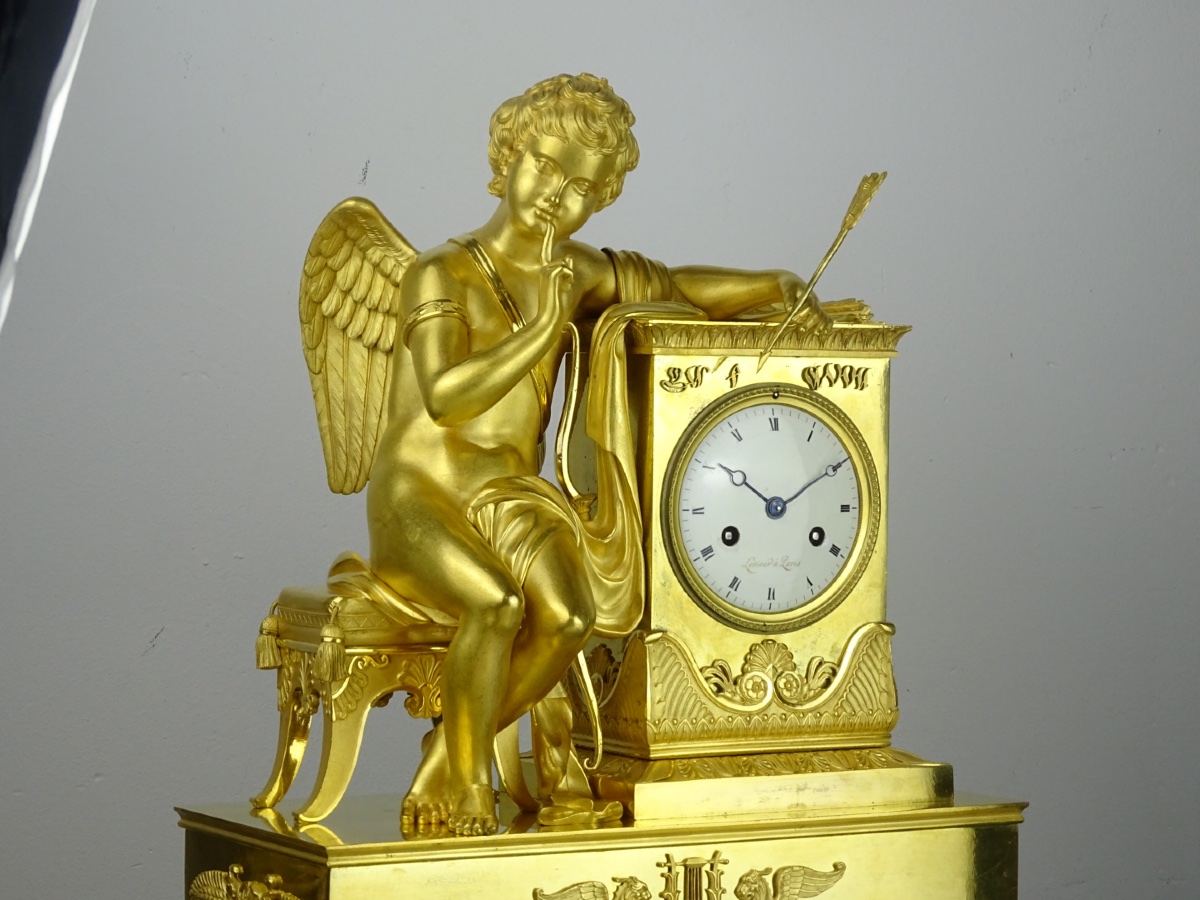
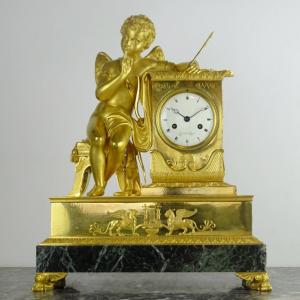
A rare and important Empire period mantel clock, known as “Garde à vous” (“Attention”) or “Le Silence” (“Silence”), made in Paris in the early 19th century in very finely chased and mercury-gilt bronze, patinated bronze and vert de mer marble.
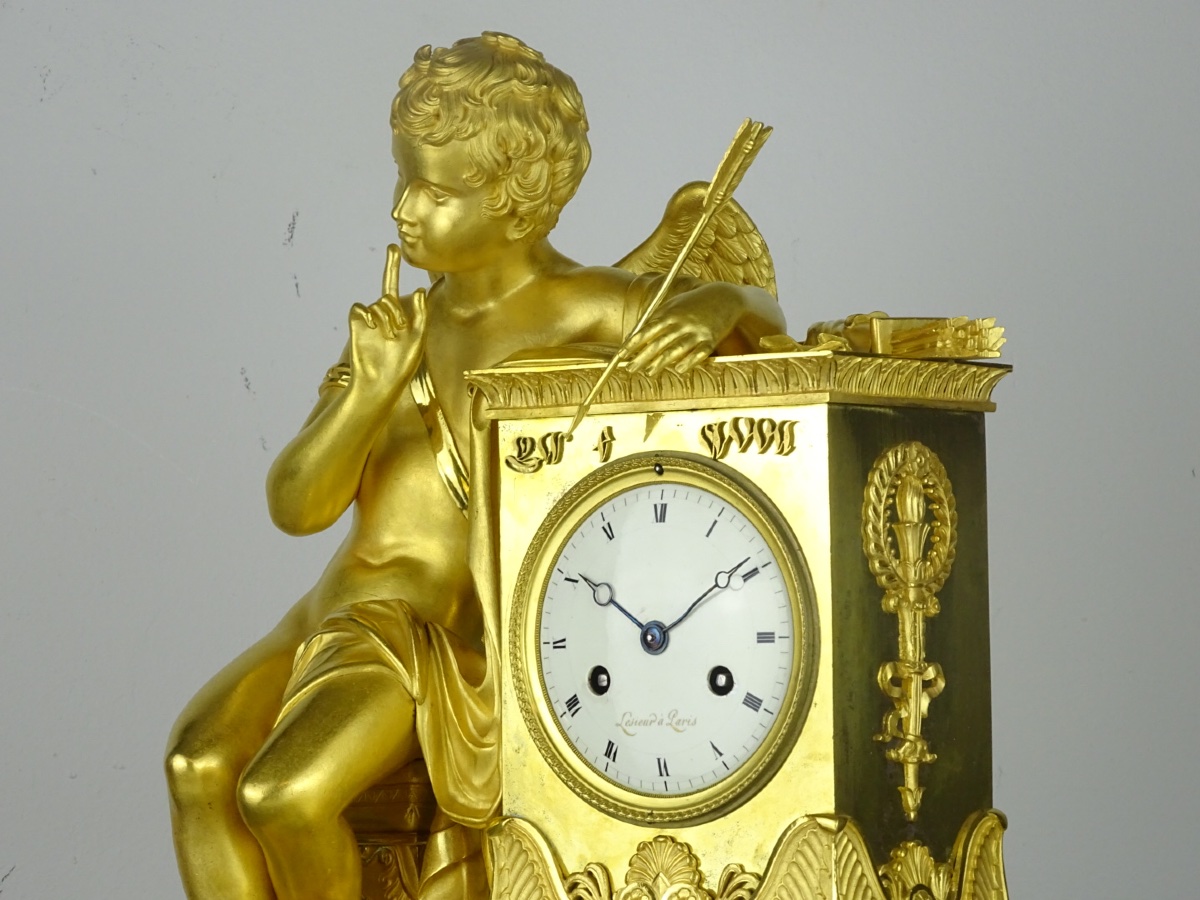
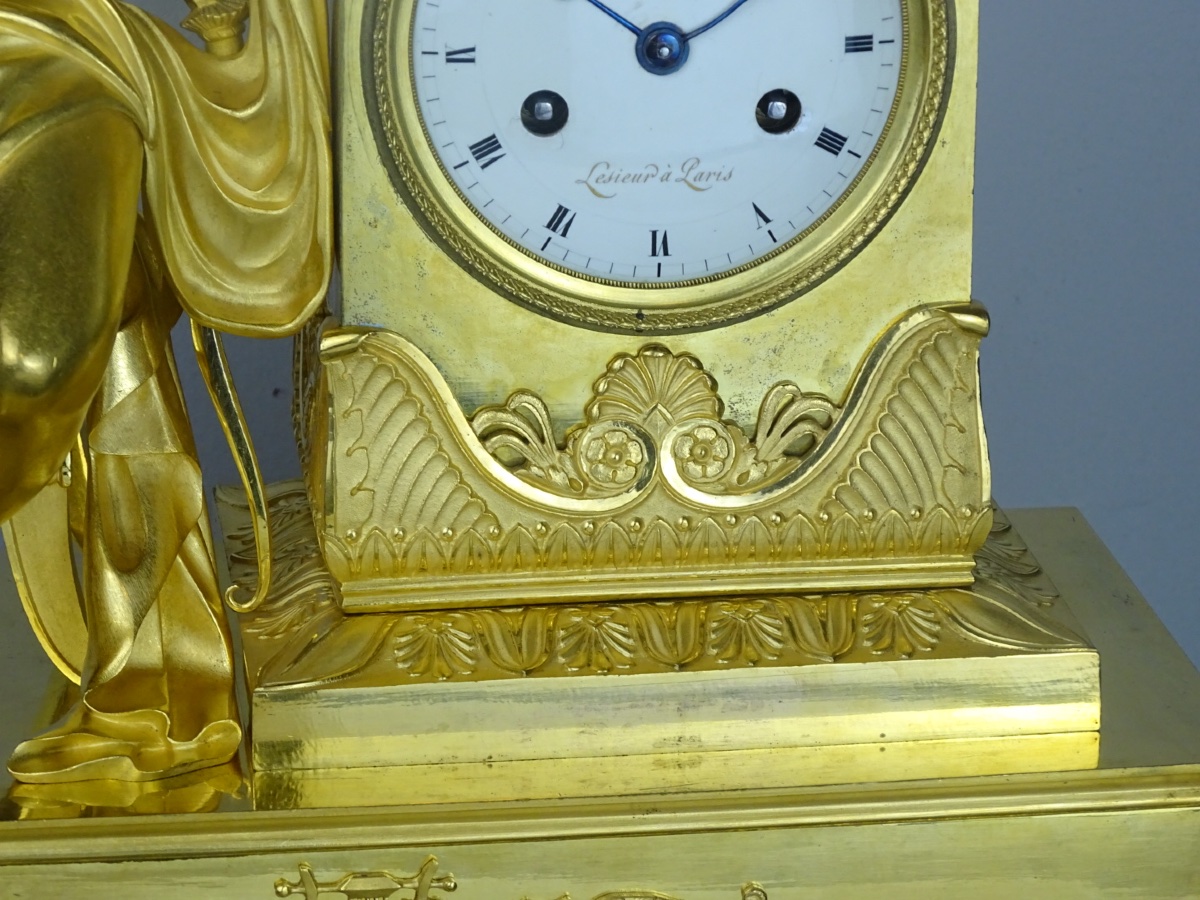
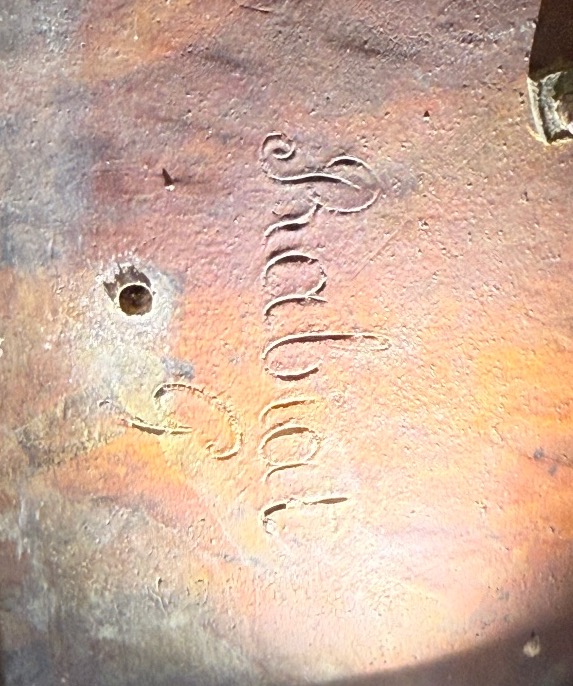
Of remarkable quality of execution, it bears the signature of Claude-François Rabiat (1756–1815) twice on the reverse of the bronzes. The dial and movement are both signed “Lesieur à Paris”, thus bringing together on a single object the names of an important Parisian bronze founder and chaser and a recognised clockmaker of the Empire period.
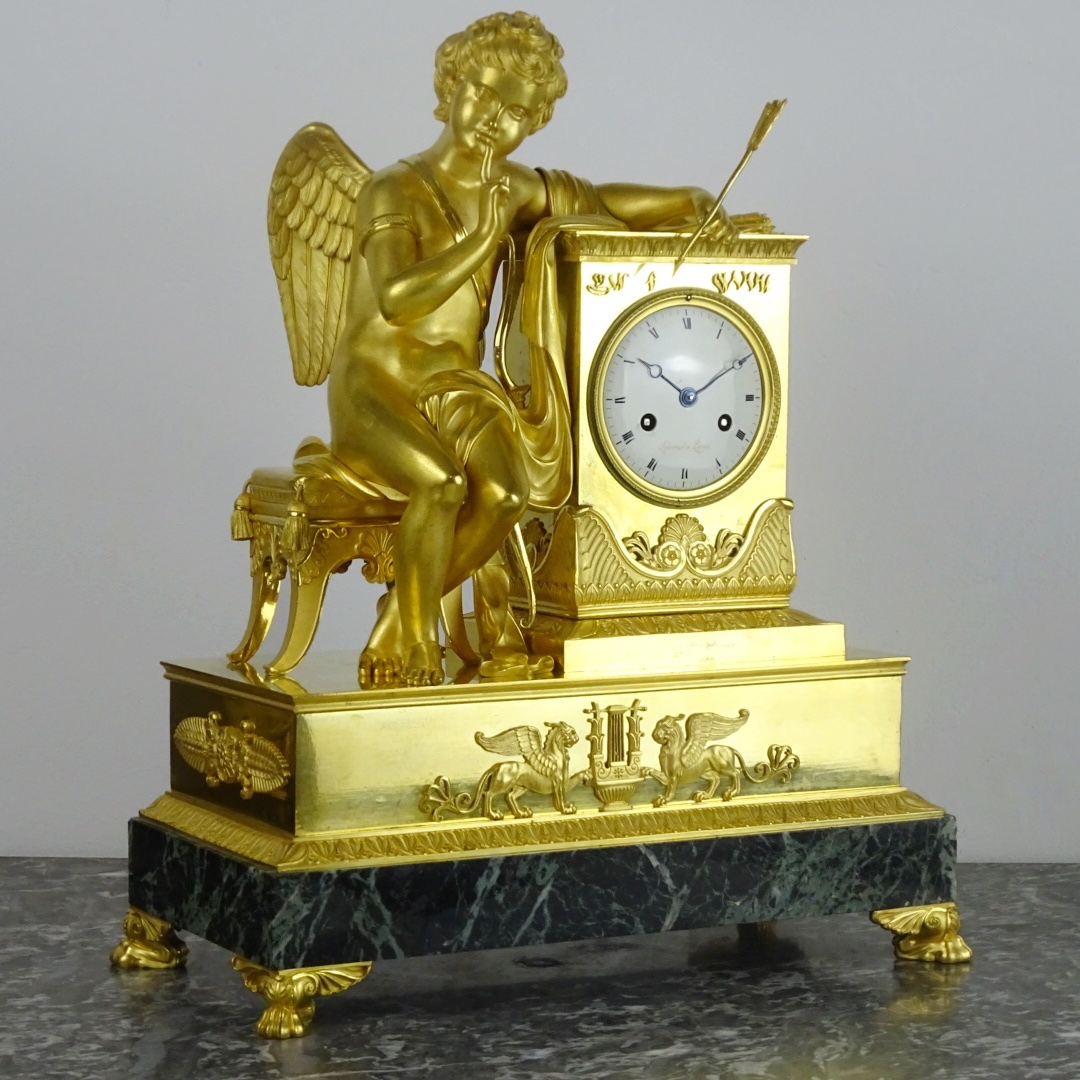
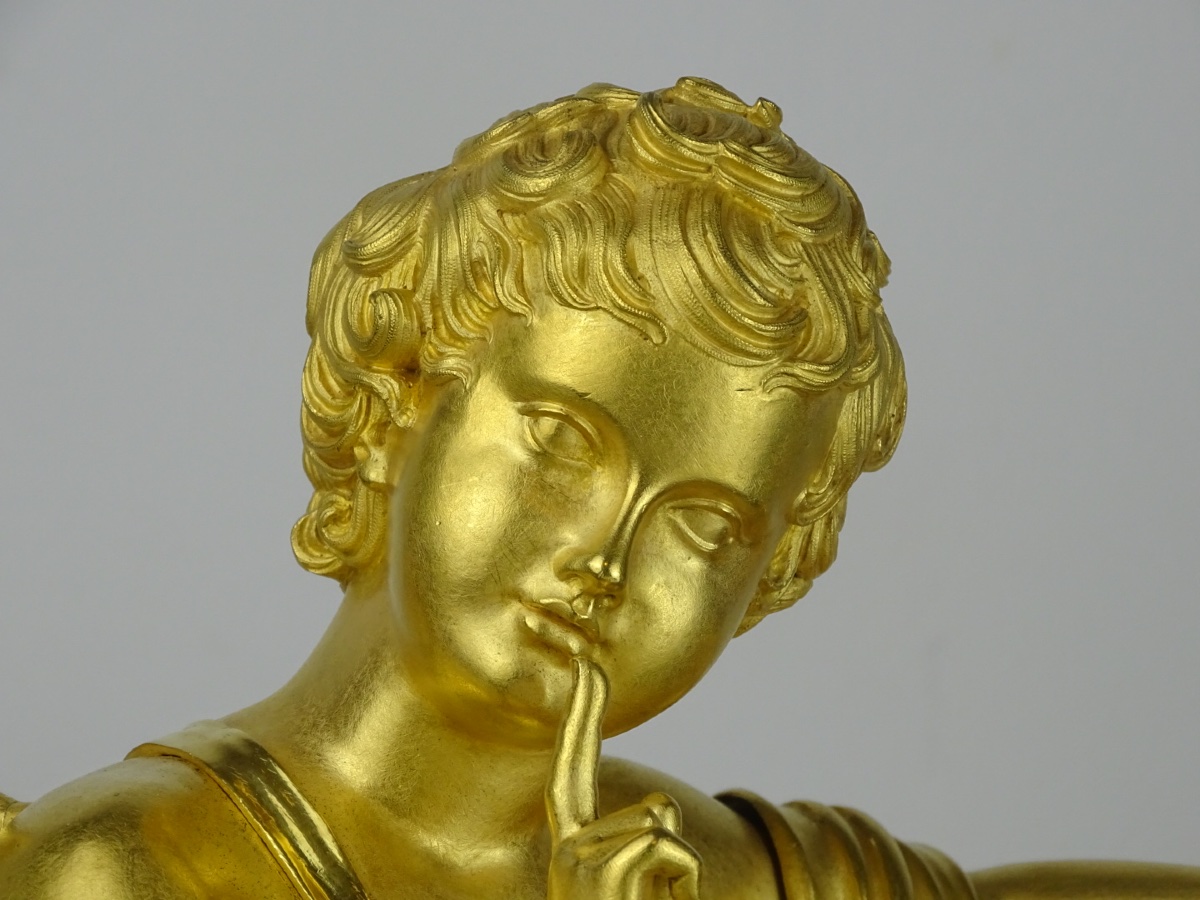
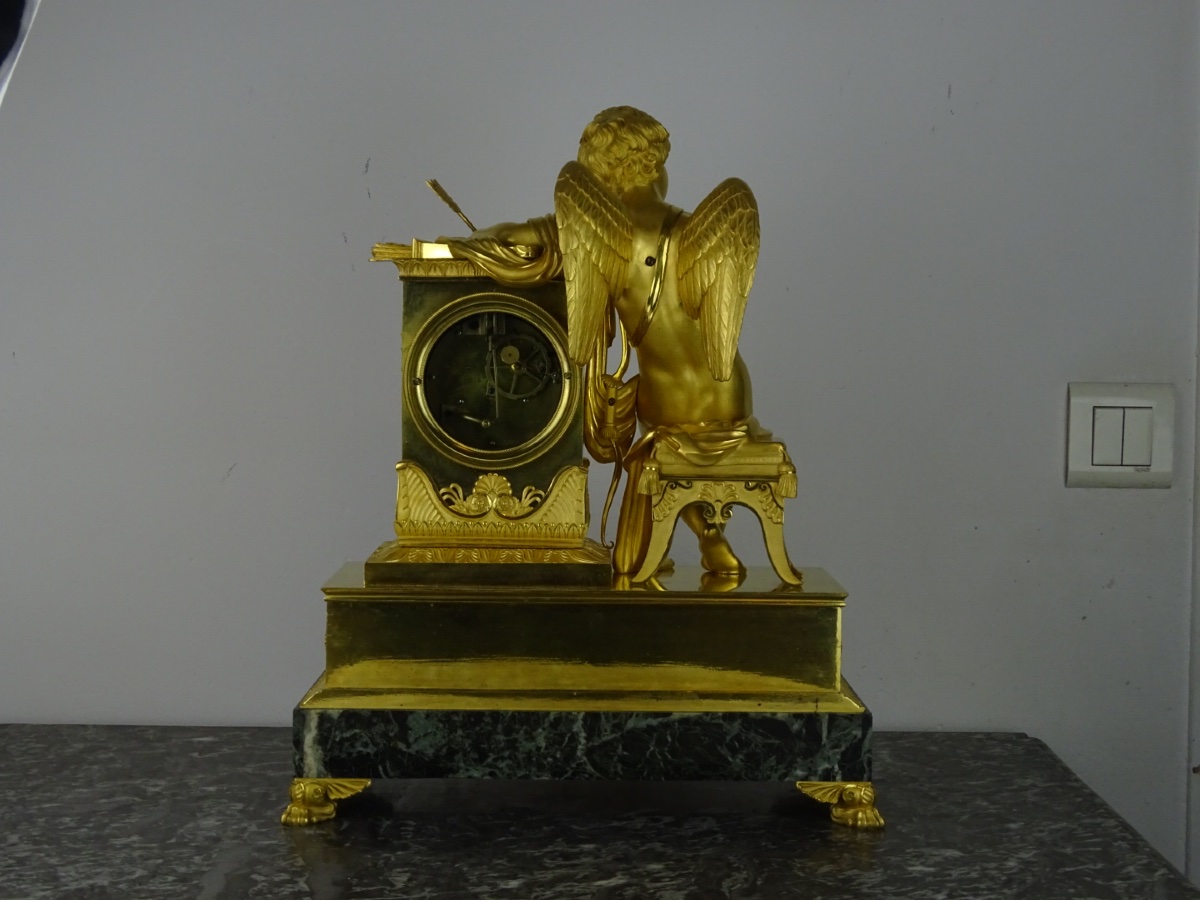
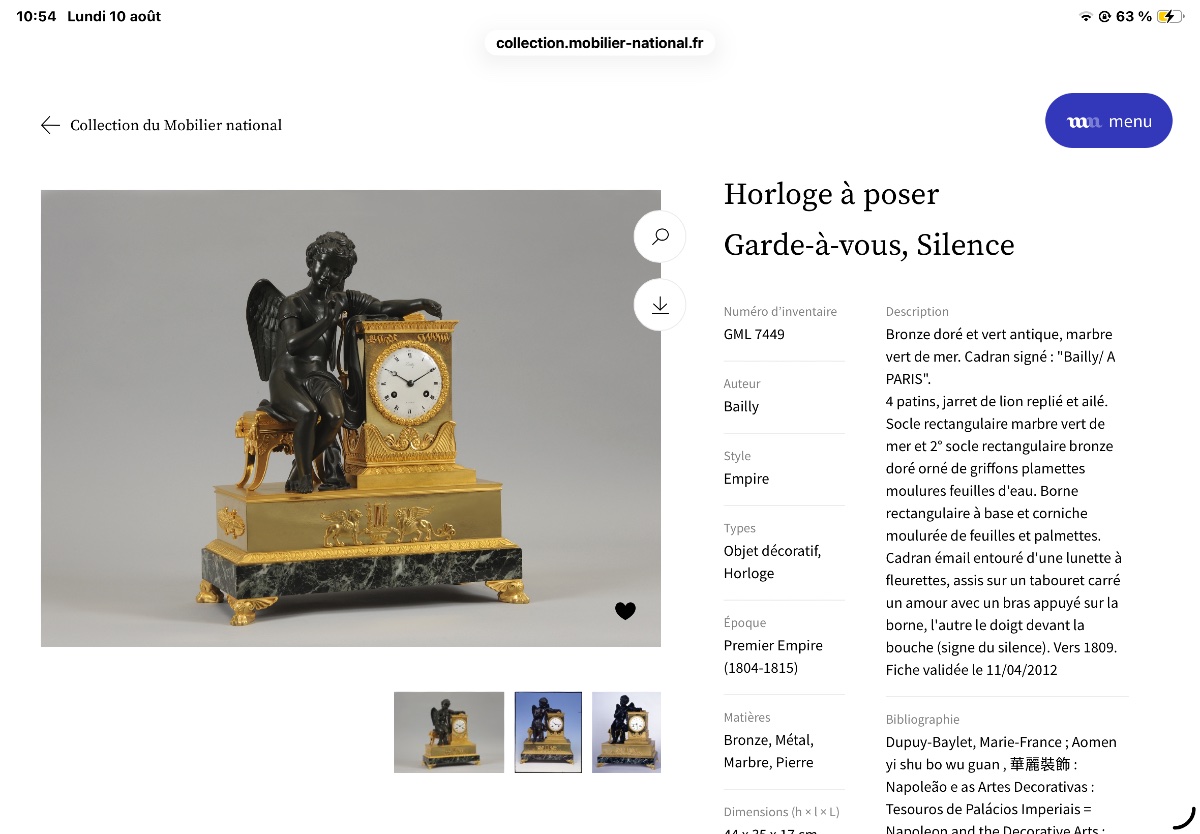
The composition is dominated by a spectacular figure of Cupid, seated beside the architectural case housing the movement. The god of Love raises his index finger to his lips in a gesture calling for silence; his bow, arrow and quiver immediately identify him.
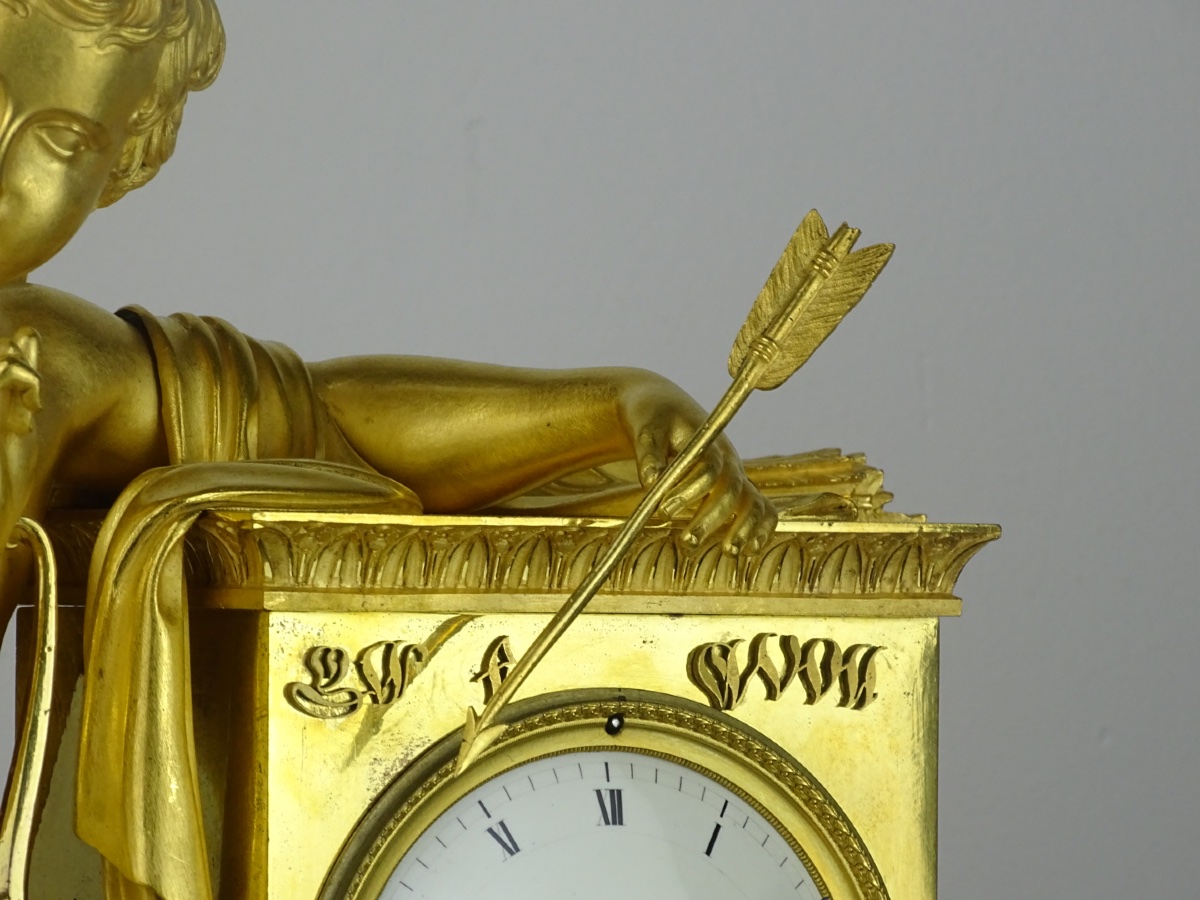
Above the dial appears the inscription which gives the model its name: “GARDE À VOUS.” Two applied letters are now missing, the D and the S, so that the inscription currently reads “GARE À VOU.”
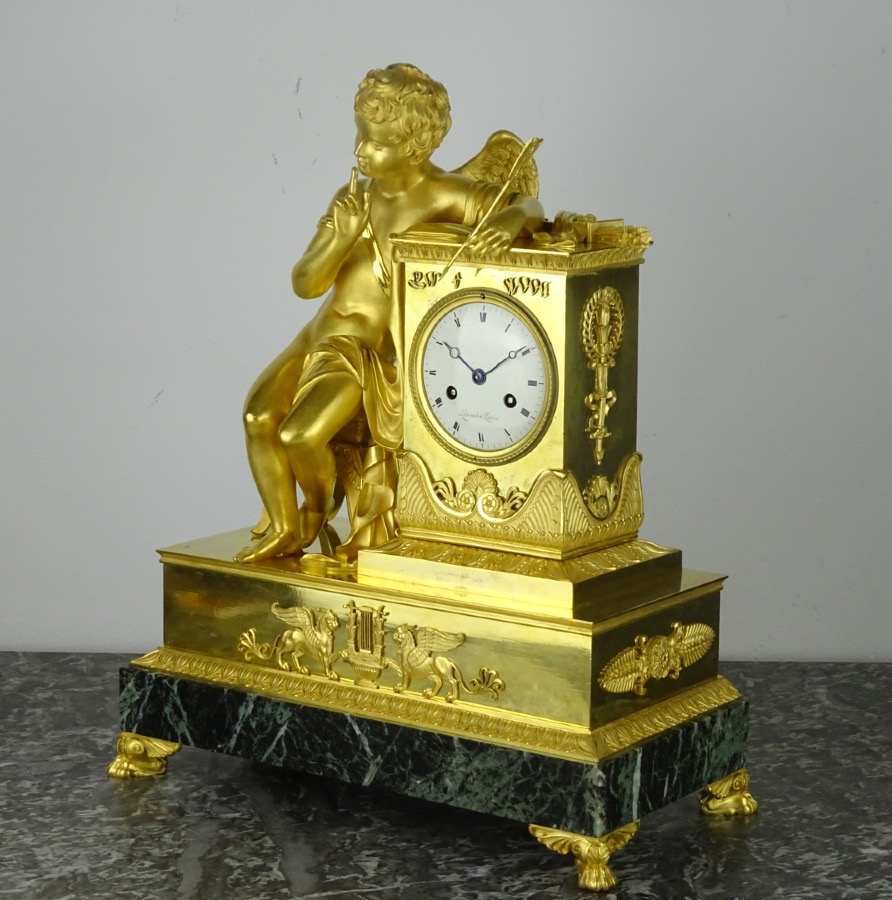
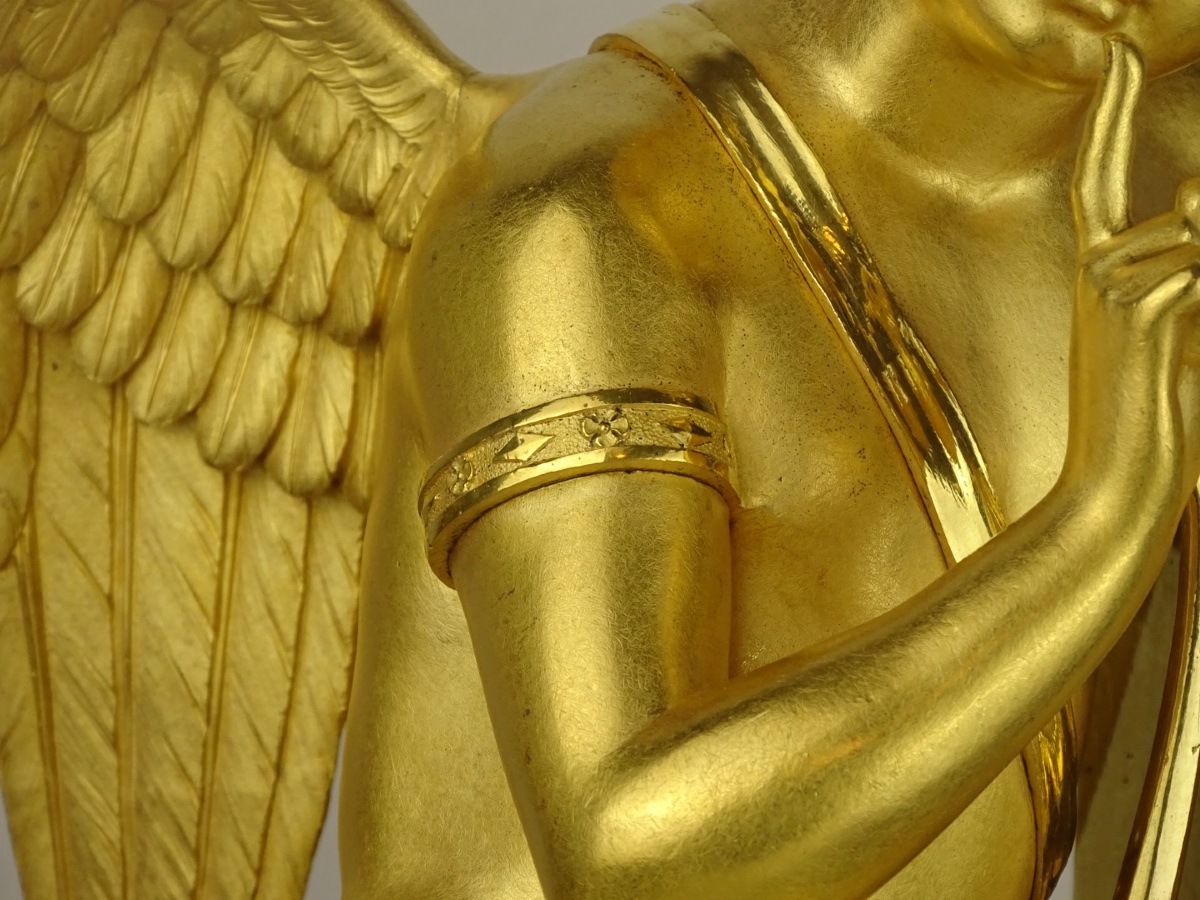
The figure of Cupid constitutes a sculpture in its own right. The face, curls of the hair, modelling of the body, hands and feet, feathers of the wings and folds of the drapery are all rendered with exceptional precision. The quality of the casting is enhanced by particularly fine chasing, extending even to details that are not immediately visible.
The mercury gilding is equally remarkable. Exceptionally well preserved, it retains the subtle contrasts between matte and burnished surfaces that give the finest French bronzes of the early 19th century their characteristic depth and brilliance.
At 46 cm high, the clock is already of substantial size. It is, however, above all the unusual scale given to Cupid that lends the composition its spectacular presence: the figure occupies a considerable proportion of the whole and appears almost independent of the clock case itself. This unusually prominent treatment of the figure gives the clock a visual impact not necessarily found in figural clocks of even greater overall height.
The rectangular architectural case is itself richly decorated with palmettes, water leaves, rosettes and applied ornaments. The front of the terrace is embellished with a fine composition of two winged griffins flanking a lyre, motifs characteristic of the Neoclassical vocabulary adopted during the First Empire.
The whole rests upon a base of vert de mer marble, whose deep tones provide a superb contrast with the brilliance of the gilded bronze. It is supported by four finely modelled and chased winged claw feet in gilt bronze.
Particular care was devoted to every aspect of its construction: the clock is decorated on all sides. Both the sides of the architectural case and those of the base are embellished with their own ornaments. Such complete decoration, considerably less common than on clocks intended primarily to be viewed from the front, is a clear indication of the high level of quality to which this example belongs.
Claude-François Rabiat and the organisation of the great Parisian workshopsThe presence of Rabiat’s signature twice is one of the major features of this clock.
Claude-François Rabiat (1756–1815), received as a master bronze founder in 1778, was one of the important Parisian craftsmen working in bronze at the turn of the 18th and 19th centuries.
To understand the significance of his signature, it is important to recall the highly specialised organisation of the bronze trades in Paris. A clock of this importance was generally not the work of a single craftsman. The model might be conceived or marketed by a bronzier or marchand-bronzier, while the casting and chasing could be entrusted to a specialised workshop; the clockmaker would then supply and fit the movement.
Thus, bronziers as important as Thomire could place orders with founders and chasers such as Rabiat, purchase their castings or commission them to execute particular elements before incorporating these into their own creations. Rabiat’s signature on the reverse of the bronzes should therefore be understood as a valuable trace of one of the workshops directly involved in the physical execution of the clock case.
This division of labour explains why the finest Parisian productions can today bear several prestigious names on the same object, each corresponding to a different specialised trade.
Lesieur à ParisThe clockwork is signed “Lesieur à Paris.”
Lesieur was a well-documented Parisian clockmaker active in the early 19th century, notably recorded in the Vieille rue du Temple in 1806. His name appears on a number of fine Empire clocks, sometimes associated with particularly ambitious cases. An Empire period portico clock signed Lesieur is notably recorded in the French national heritage collections, while other movements bearing his name are known in figural clocks from the early 19th century.
His association here with a case whose bronzes bear Rabiat’s mark twice is particularly interesting: it provides a clear illustration of the collaboration between clockmakers and bronze workshops that contributed to the exceptional reputation of Parisian clockmaking during this period.
The movement is fitted with a knife-edge suspension, consistent with the early construction of the clock.
A model associated with the Imperial furnishingsThe importance of this clock extends far beyond the quality of its execution alone.
The “Garde à vous” model belongs to a group of compositions selected in the early 19th century for the great Imperial furnishing schemes. Examples of this model are documented among commissions made by the Garde-Meuble Impérial, notably for residences of Emperor Napoleon I and the Empress.
Clocks of this composition are recorded in Imperial furnishing schemes from 1809, and again in 1810 at the Château de Compiègne and at the Petit Trianon at Versailles, in connection with the furnishing of the Imperial apartments.
Examples of the model are today recorded in the French national collections of the Mobilier national, notably under inventory numbers GML 7449 and GML 7504, and the composition has been published in specialist literature devoted to clocks from the national collections.
These comparisons are particularly significant: they place the present clock within a family of models prestigious enough to have been selected by the Imperial Garde-Meuble for the residences of the Imperial family.
ConditionThe present example is preserved in an exceptional state of conservation.
The mercury gilding retains remarkable freshness and beautifully highlights the work of the chaser. The reliefs remain crisp, the details of Cupid are exceptionally well preserved, and the vert de mer marble is likewise in very fine condition.
The only point to note is the old loss of the two applied letters D and S from the inscription “GARDE À VOUS”, clearly visible in the photographs and having no impact on the remarkable overall appearance of the piece.
With its double Rabiat signature, movement signed Lesieur à Paris, exceptional quality of casting and chasing, remarkably preserved mercury gilding, decoration extending to all sides, unusually imposing figure of Cupid and, above all, the historical importance of the model, this clock constitutes a remarkable example of the finest Parisian production of the First Empire period.
A collector’s piece of the highest order, whose exceptional quality can be fully appreciated when compared with the documented examples associated with the French Imperial furnishings.
Paris, Empire period, circa 1809–1810.
Finely chased and mercury-gilt bronze, patinated bronze and vert de mer marble.
Bronzes signed twice “RABIAT” on the reverse.
Dial and movement signed “Lesieur à Paris”.
Knife-edge suspension.
Height: 46 cm.
Marie-France Dupuy-Baylet, Pendules du Mobilier national, 1800–1870, Dijon, 2006, pp. 152–153, no. 74.
Elke Niehüser, French Bronze Clocks, Munich, 1997.
Mobilier national collections, comparable models, inv. GML 7449 and GML 7504.
Period: 19th century
Style: Consulat, Empire
Condition: Perfect condition
Material: Bronze
Width: 39 cm
Height: 46 cm
Reference (ID): 1806708
Availability: In stock