THIS OBJECT WAS SOLD
Ledieu-signoret (1853–1903)—*child With A Turtle Dove*. Bronze Inkwell. Circa 1890
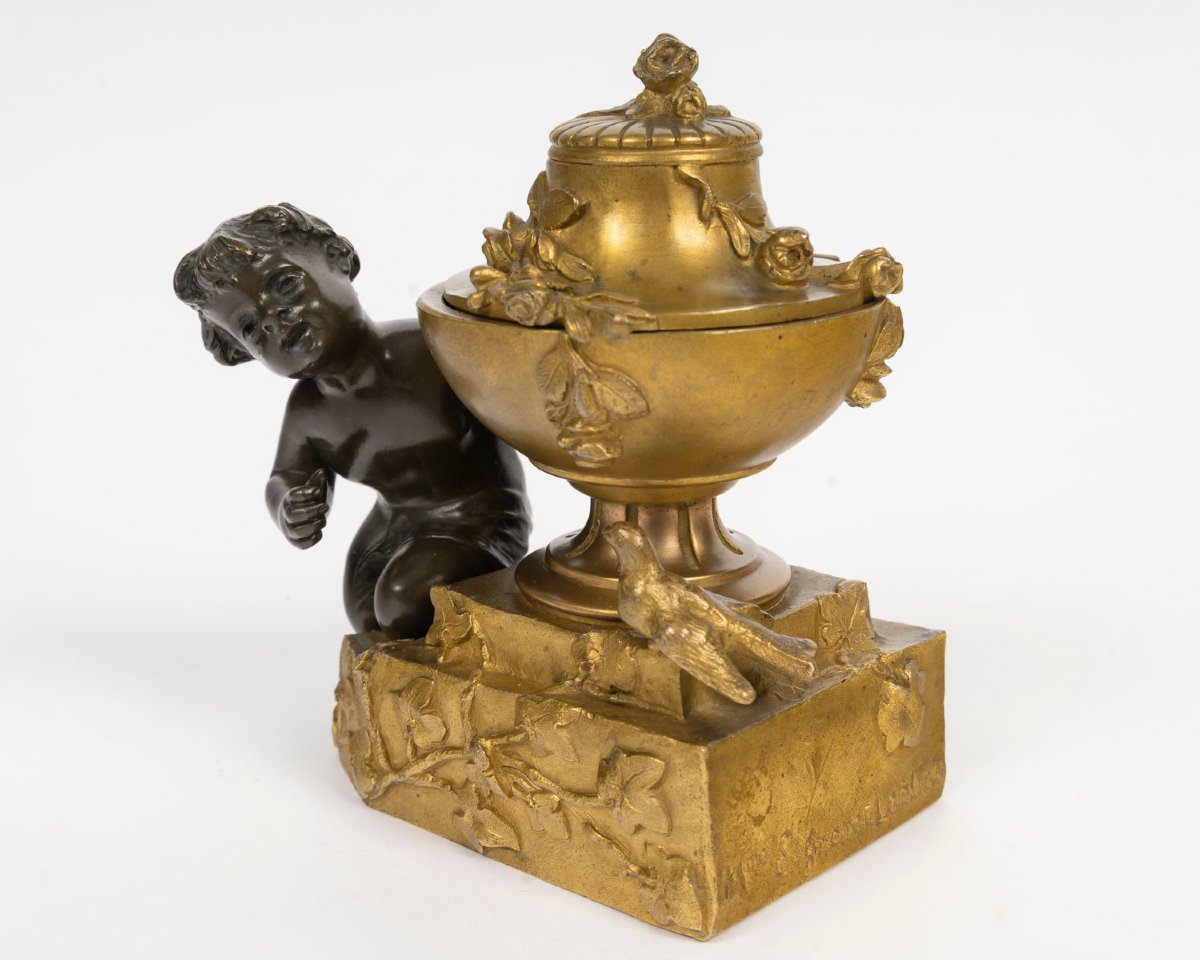
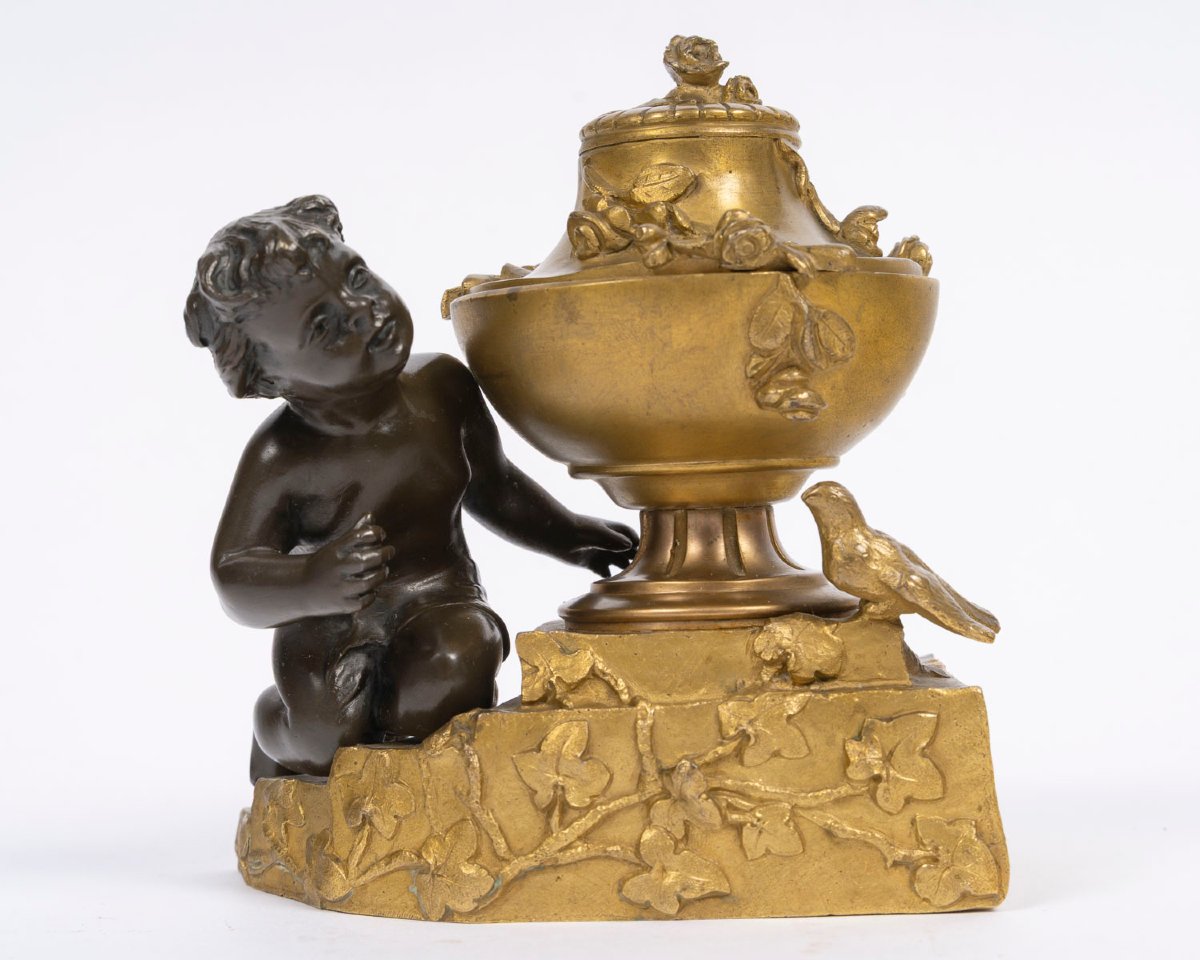
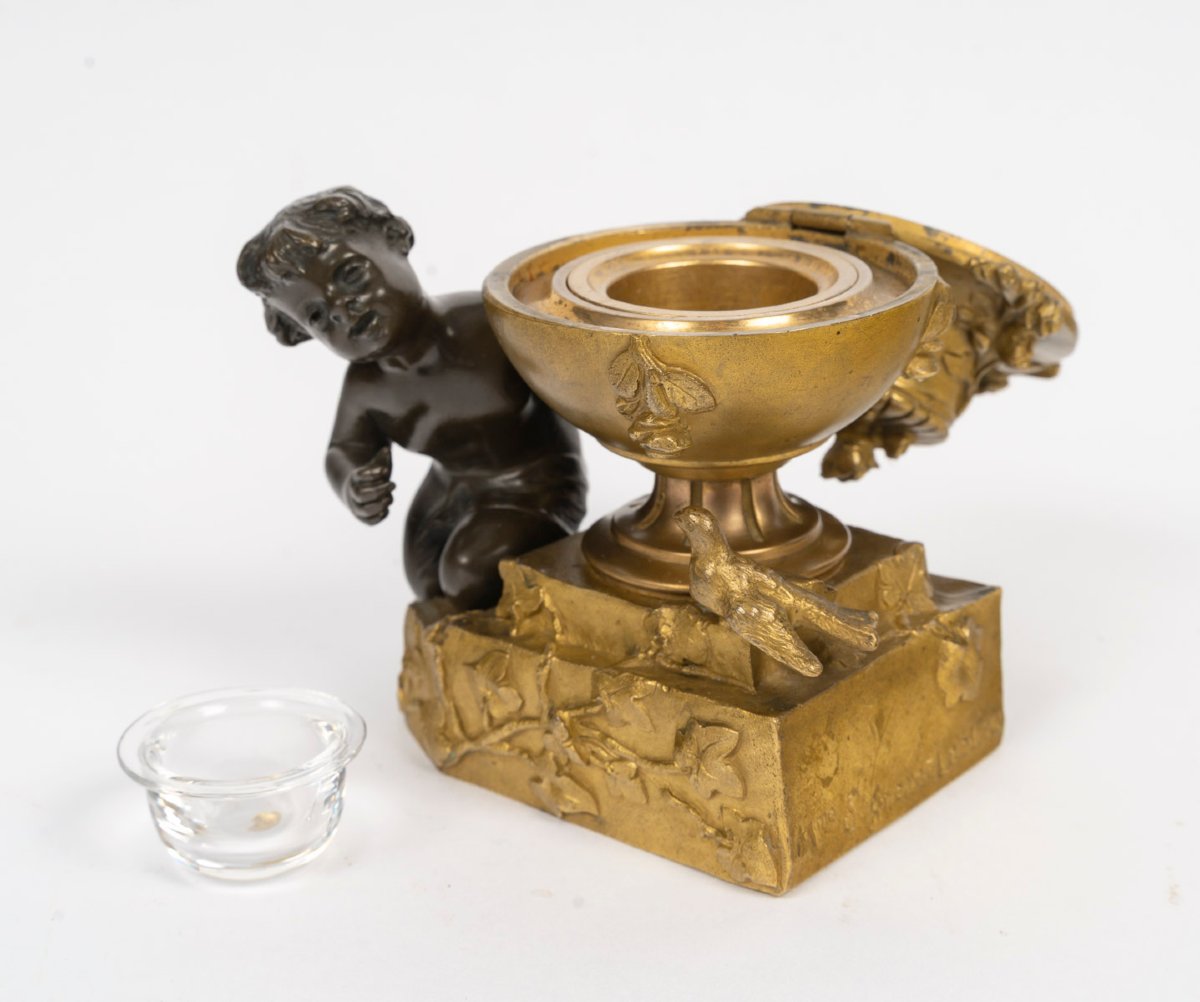
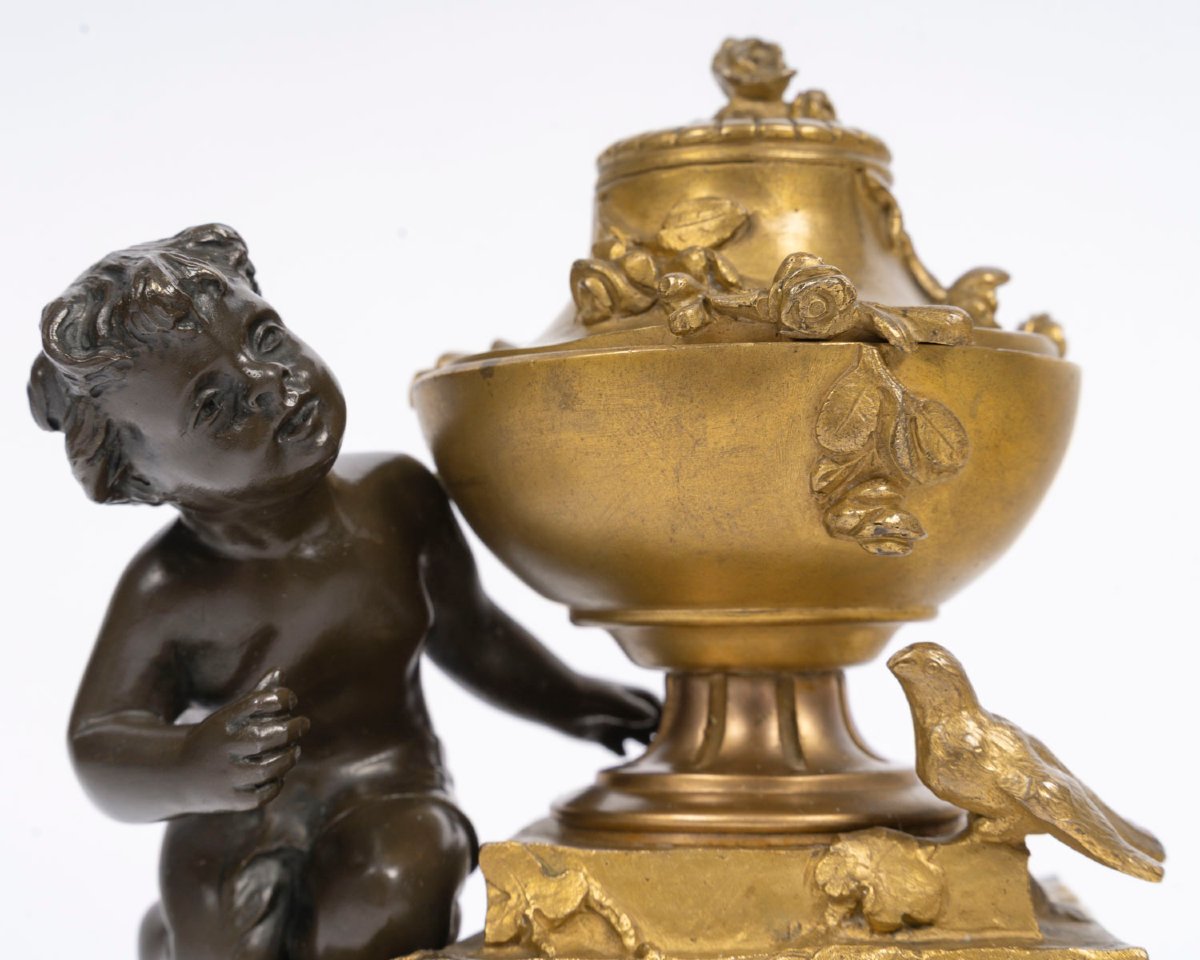
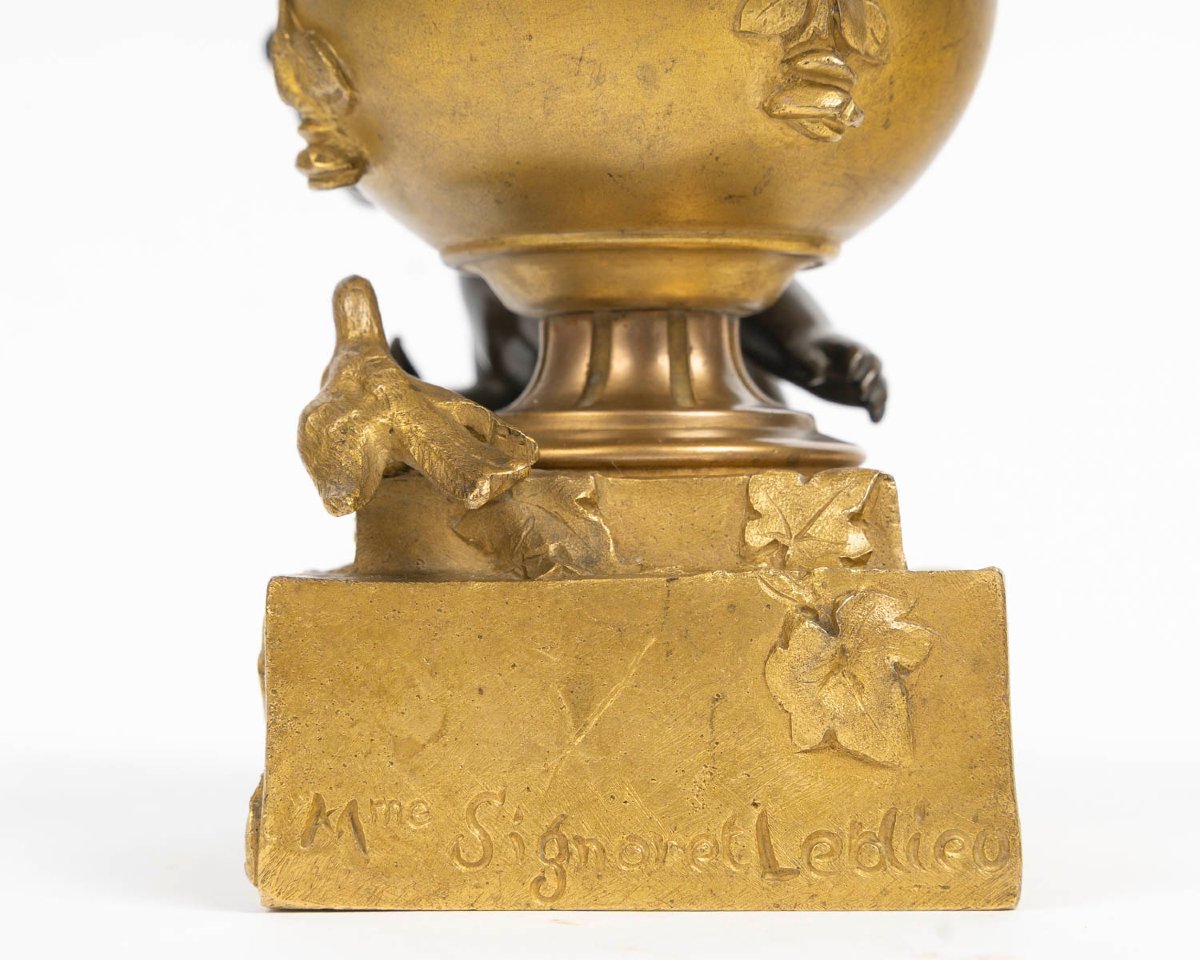
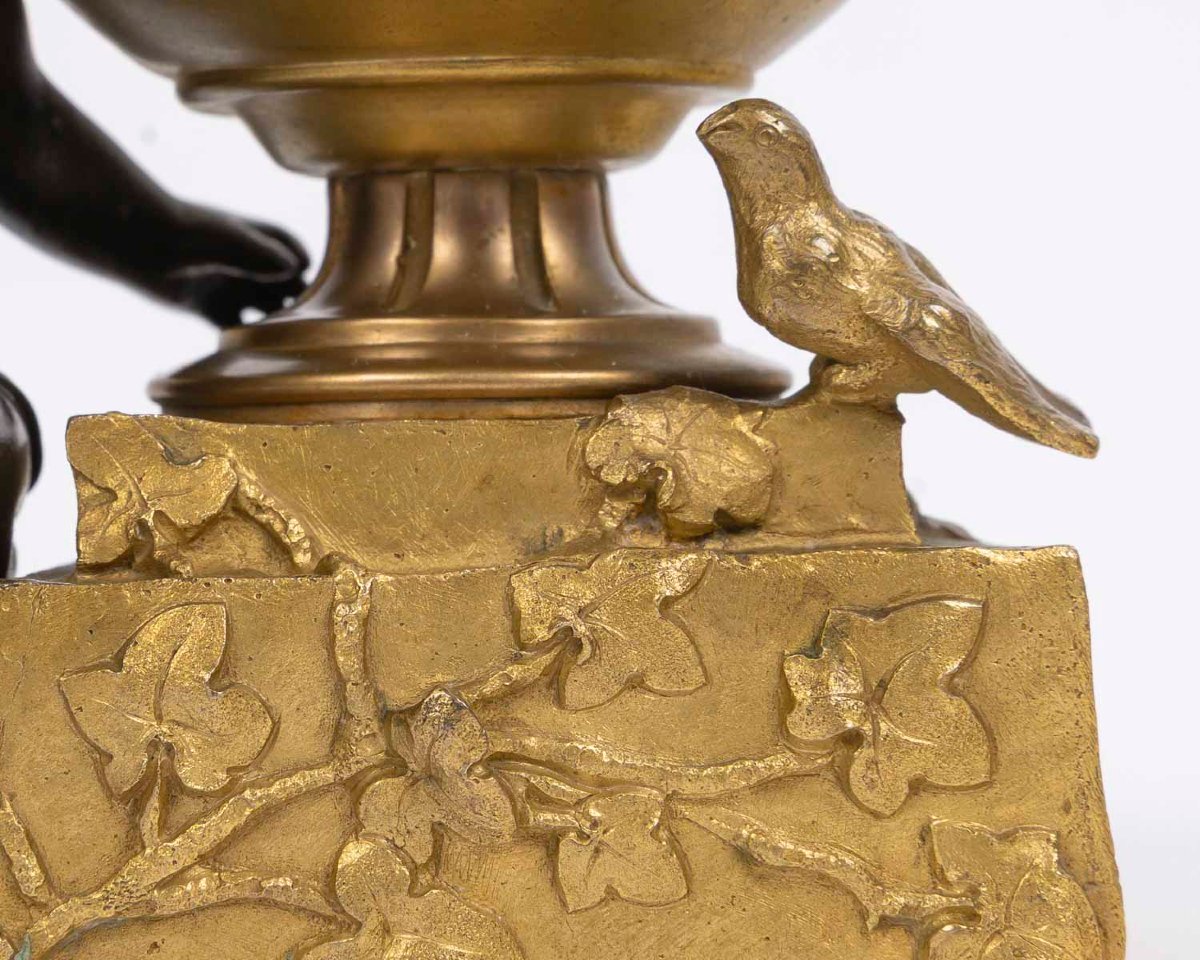
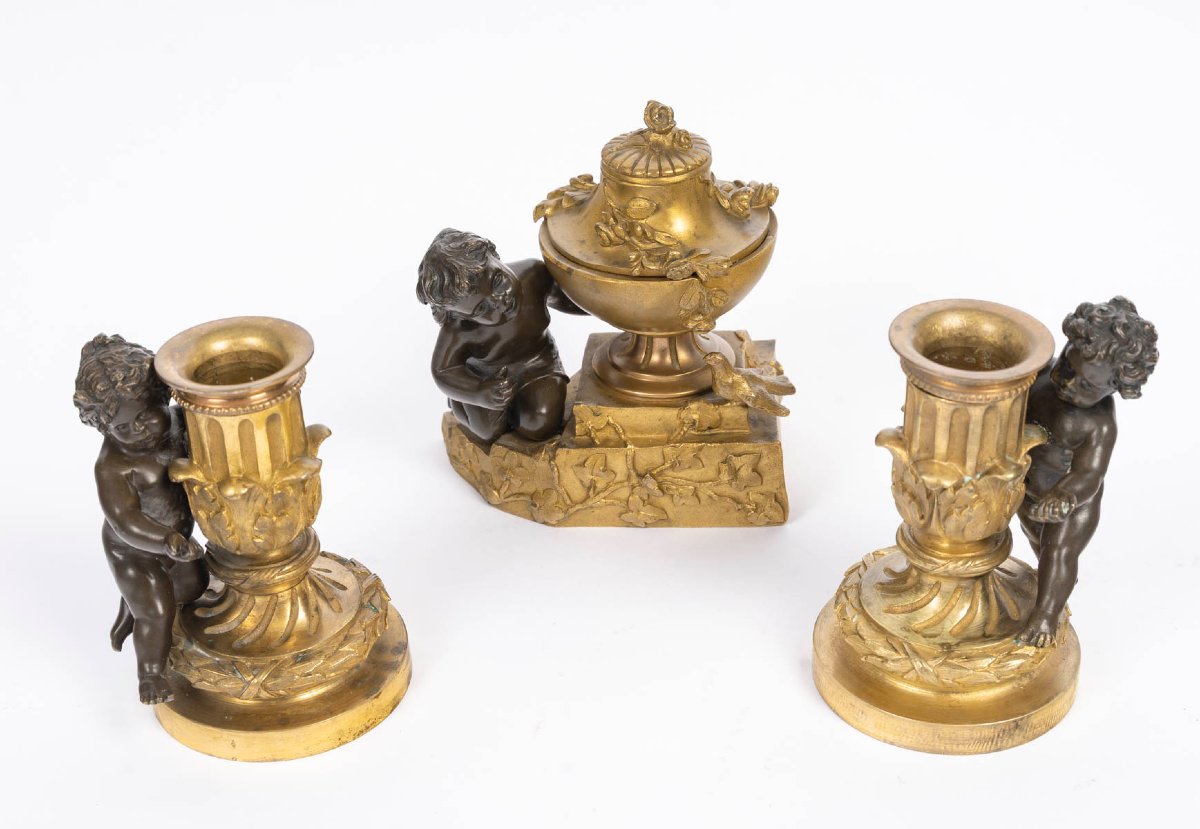


SIGNORET-LEDIEU Marie-Lucie (Nevers, 1853 – Arcueil, 1903) – *Child with a Turtle Dove*. Desk Inkwell, c. 1890. A delightful desk inkwell featuring a dark and finely chased gilt patina. It depicts a smiling child—kneeling on a stepped base—observing or tenderly attempting to tame a turtle dove that has alighted beside an ornamental vase. Adorned with floral garlands, the vase is hinged to open, serving as a receptacle for the glass inkwell insert. Signed on the right side of the base, which is embellished with trailing ivy: "Mme Signoret Ledieu." French School of Sculpture, late 19th to early 20th century.
A DECORATIVE OBJECT, A SIGNATURE
Possessing a particularly captivating grace, this delightful decorative inkwell—conceived with tact and sensitivity by Lucienne Signoret-Ledieu (1853–1903)—exemplifies the stylistic qualities of an artist whose work was unanimously praised by discerning contemporary critics for its "delicate, delightfully feminine talent, full of charm and kindness."
Crafted with poise and gentleness, the piece features a charming child figure—modeled with tact and sensitivity—gracefully positioned on a stepped base, kneeling with torso inclined forward. Captured in a tender pose, a young boy with a face that is both smiling and dreamy gazes guilelessly at a small turtledove—a bird associated with amorous emotion and tenderness—which has landed with half-open wings on the rim of an ornamental garden vase. Festooned with garlands of spring flowers—some in bud, others freshly bloomed—the vase features fluting and radiating gadroons on its pedestal and upper section; its lid is topped by a handle beautifully adorned with a "sentimental" rose on its stem, while its circular body houses a glass inkwell insert.
Infused with a sense of extreme delicacy, this exquisite sculptural composition integrates seamlessly with a partially oblong base, the stonework of which is traversed by leafy ivy tendrils—symbols of attachment and friendship. A subtle contrast is evident between the "naturalistic" treatment of this architectural element and the soft lines of the child's figure.
Likely created during the 1890s, this desk inkwell is a remarkable work of art in its own right, uniting functionality with symbolism linked to the world of writing.
Lucienne Signoret-Ledieu (Nevers, 1853 – Arcueil, 1904): a female sculptor with an unconventional career path. Shortly after her untimely death in Arcueil, a brief monograph dedicated to the artist noted: "The young errand girl who began her career at a fashion house in Nevers went far. In Paris, she caught the eye of Jean Gautherin (1840–1890), who recognized her remarkable artistic aptitude and took her on as a pupil. Rising from the working class, this humble milliner became a distinguished artist through her intelligence and determination. She began exhibiting at the Salon in 1878; since then, she has received two honorable mentions—in 1883 for *Aux Champs* (plaster statue) and 1886 for *La Fileuse* (bronze)—a silver medal in 1884 for *Enfant en prière* (plaster bust), and a third-class medal and diploma in 1889 for *Nymphe au dauphin* (statue) and 1897 for *Le Soir* (bust). Mme Signoret produced a great number of subjects—busts, statuettes, etc.—executed with great refinement; her work is highly regarded by connoisseurs" (*Mémoires de la Société Académique du Nivernais*, January 1904, pp. 64–65).
While receptive to the formal experiments and stylistic shifts introduced into French sculpture during the second half of the 19th century by her male contemporaries (Carrier-Belleuse, Mathurin Moreau, Raoul Larche), Lucienne Signoret-Ledieu never abandoned her own artistic values. Upon seeing her busts, allegorical groups of "infinite tenderness," "nubile and graceful" mythological figures, and "energetic" historical effigies (such as Joan of Arc), contemporary Salon critics (J. Alès, T. Véron, L. Enault, O. Mirbeau) praised the sculptress's "fine talent," noting that "everything is lifelike and natural—true to life in pose and attitude—possessing character and deep poetic feeling."
Parisian art and decorative bronze founders (such as the Thiébaut, A. Basset, and C. Bouché firms) recognized her talent and commissioned her to create ornamental pieces (vases, flower holders, etc.). Between 1890 and 1900, she designed statuettes and various objects featuring female figures (e.g., *Coquetterie*, *La Bouquetière*, *Libellule*, *Les Bruits de la Mer*) and children (e.g., *Cache-Cache*, *Enfant jardinier*, *Grimpeur*, *Aux papillons*).
Bibliography: E. Bénézit, *Dictionnaire des peintres, sculpteurs*, 1999, Vol. III, p. 786; Pierre Kjellberg, *Les Bronzes du XIXe siècle. Dictionnaire des Sculpteurs*, Paris, Éditions de l'Amateur, 2001, p. 616.
A DECORATIVE OBJECT, A SIGNATURE
Possessing a particularly captivating grace, this delightful decorative inkwell—conceived with tact and sensitivity by Lucienne Signoret-Ledieu (1853–1903)—exemplifies the stylistic qualities of an artist whose work was unanimously praised by discerning contemporary critics for its "delicate, delightfully feminine talent, full of charm and kindness."
Crafted with poise and gentleness, the piece features a charming child figure—modeled with tact and sensitivity—gracefully positioned on a stepped base, kneeling with torso inclined forward. Captured in a tender pose, a young boy with a face that is both smiling and dreamy gazes guilelessly at a small turtledove—a bird associated with amorous emotion and tenderness—which has landed with half-open wings on the rim of an ornamental garden vase. Festooned with garlands of spring flowers—some in bud, others freshly bloomed—the vase features fluting and radiating gadroons on its pedestal and upper section; its lid is topped by a handle beautifully adorned with a "sentimental" rose on its stem, while its circular body houses a glass inkwell insert.
Infused with a sense of extreme delicacy, this exquisite sculptural composition integrates seamlessly with a partially oblong base, the stonework of which is traversed by leafy ivy tendrils—symbols of attachment and friendship. A subtle contrast is evident between the "naturalistic" treatment of this architectural element and the soft lines of the child's figure.
Likely created during the 1890s, this desk inkwell is a remarkable work of art in its own right, uniting functionality with symbolism linked to the world of writing.
Lucienne Signoret-Ledieu (Nevers, 1853 – Arcueil, 1904): a female sculptor with an unconventional career path. Shortly after her untimely death in Arcueil, a brief monograph dedicated to the artist noted: "The young errand girl who began her career at a fashion house in Nevers went far. In Paris, she caught the eye of Jean Gautherin (1840–1890), who recognized her remarkable artistic aptitude and took her on as a pupil. Rising from the working class, this humble milliner became a distinguished artist through her intelligence and determination. She began exhibiting at the Salon in 1878; since then, she has received two honorable mentions—in 1883 for *Aux Champs* (plaster statue) and 1886 for *La Fileuse* (bronze)—a silver medal in 1884 for *Enfant en prière* (plaster bust), and a third-class medal and diploma in 1889 for *Nymphe au dauphin* (statue) and 1897 for *Le Soir* (bust). Mme Signoret produced a great number of subjects—busts, statuettes, etc.—executed with great refinement; her work is highly regarded by connoisseurs" (*Mémoires de la Société Académique du Nivernais*, January 1904, pp. 64–65).
While receptive to the formal experiments and stylistic shifts introduced into French sculpture during the second half of the 19th century by her male contemporaries (Carrier-Belleuse, Mathurin Moreau, Raoul Larche), Lucienne Signoret-Ledieu never abandoned her own artistic values. Upon seeing her busts, allegorical groups of "infinite tenderness," "nubile and graceful" mythological figures, and "energetic" historical effigies (such as Joan of Arc), contemporary Salon critics (J. Alès, T. Véron, L. Enault, O. Mirbeau) praised the sculptress's "fine talent," noting that "everything is lifelike and natural—true to life in pose and attitude—possessing character and deep poetic feeling."
Parisian art and decorative bronze founders (such as the Thiébaut, A. Basset, and C. Bouché firms) recognized her talent and commissioned her to create ornamental pieces (vases, flower holders, etc.). Between 1890 and 1900, she designed statuettes and various objects featuring female figures (e.g., *Coquetterie*, *La Bouquetière*, *Libellule*, *Les Bruits de la Mer*) and children (e.g., *Cache-Cache*, *Enfant jardinier*, *Grimpeur*, *Aux papillons*).
Bibliography: E. Bénézit, *Dictionnaire des peintres, sculpteurs*, 1999, Vol. III, p. 786; Pierre Kjellberg, *Les Bronzes du XIXe siècle. Dictionnaire des Sculpteurs*, Paris, Éditions de l'Amateur, 2001, p. 616.
Explore similar pieces and discover your ideal find:
Inkwells, Desks Accessories