


Sleeping Venus With Cupid, Alessandro Varotari, Known As "il Padovanino" (1588–1649) Workshop Of
Artist: Alessandro Varotari, Dit « Le Padovanino » (padoue, 1588 - Venise, 1649) Atelier De
Alessandro Varotari, known as ‘il Padovanino’ (Padua, 1588 – Venice, 1649)
workshop of
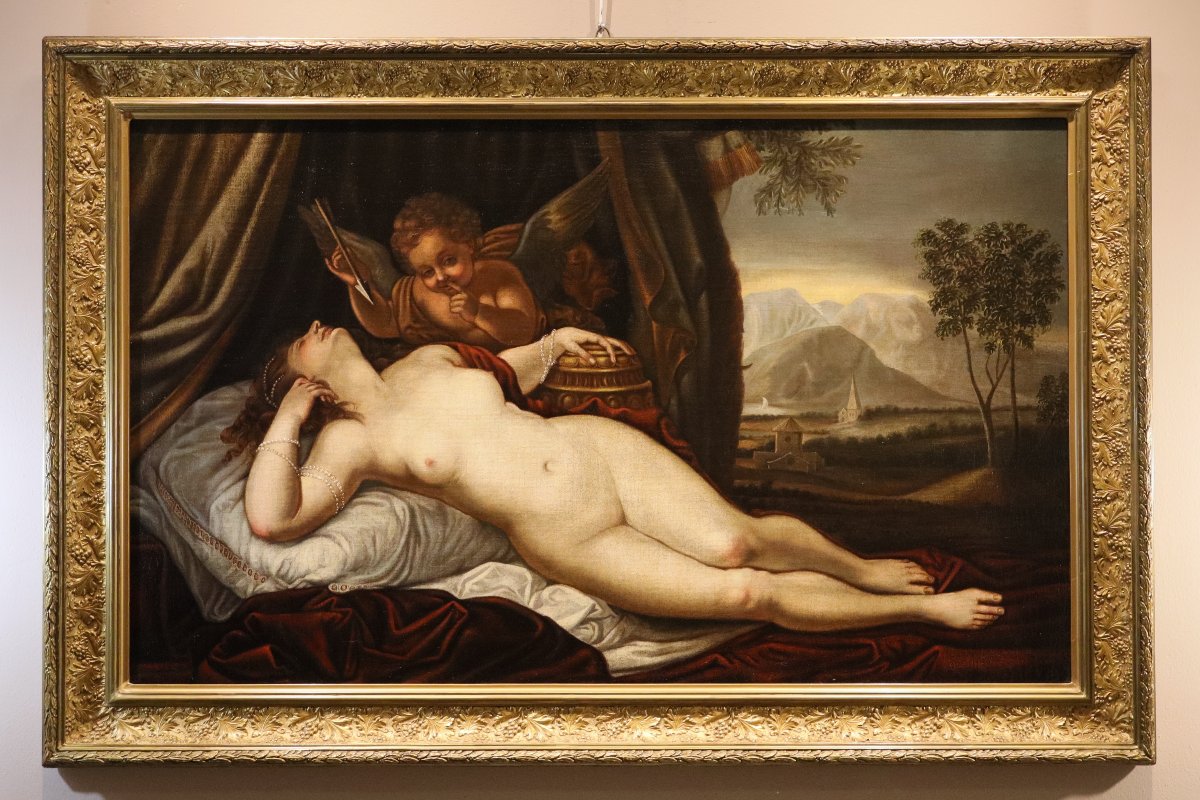
Sleeping Venus with Cupid
Oil on canvas
90 x 145 – Framed 114 x 168 cm.
FULL DETAILS OF THE PAINTING (CLICK ON THE FOLLOWING LINK)
The iconography of the Sleeping Venus is one of the most fascinating, sensual and successful themes of 16th-century Venetian Renaissance painting, representing the perfect fusion of classical myth and the celebration of feminine beauty.
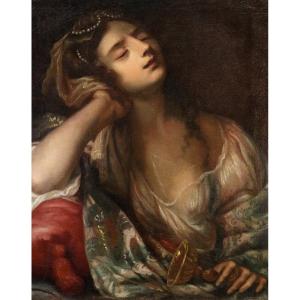
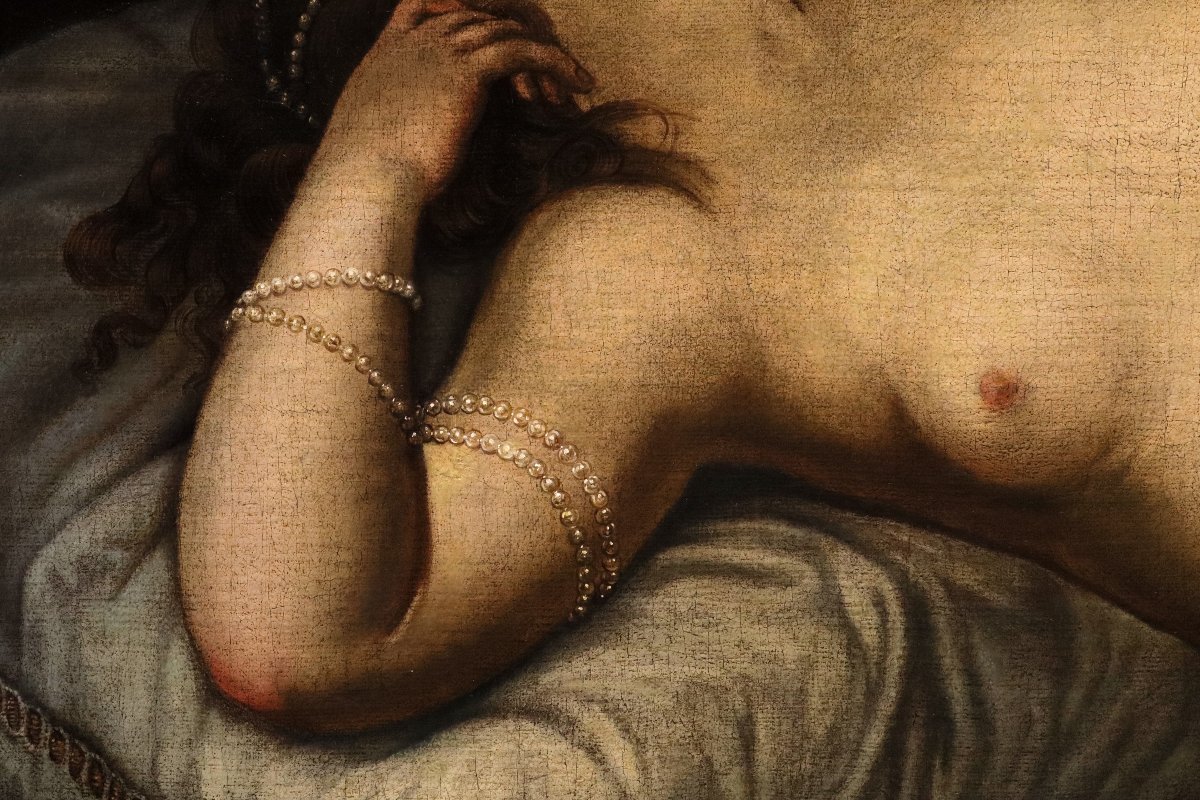
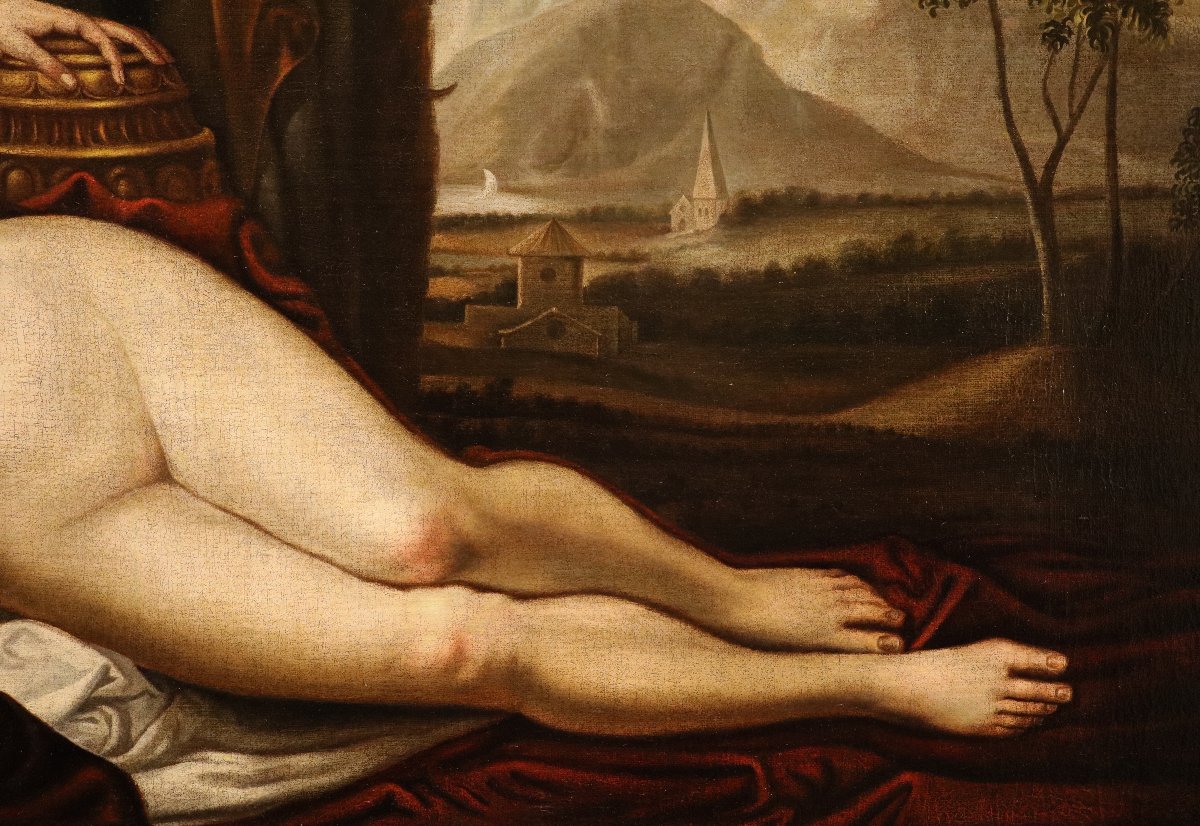
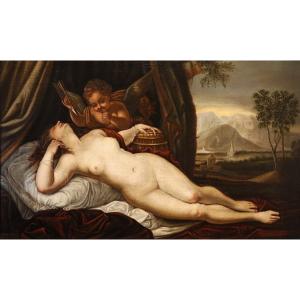
It is within this artistic context that the female nude becomes the undisputed protagonist of the painting, as in the case of our sinuous Venus, lost in sleep and reclining on a bed of soft white cushions and red drapes – a combination of colours with immediate symbolic significance which, together, create a perfect balance between spiritual love and carnal passion, extolling the concept of ideal love.
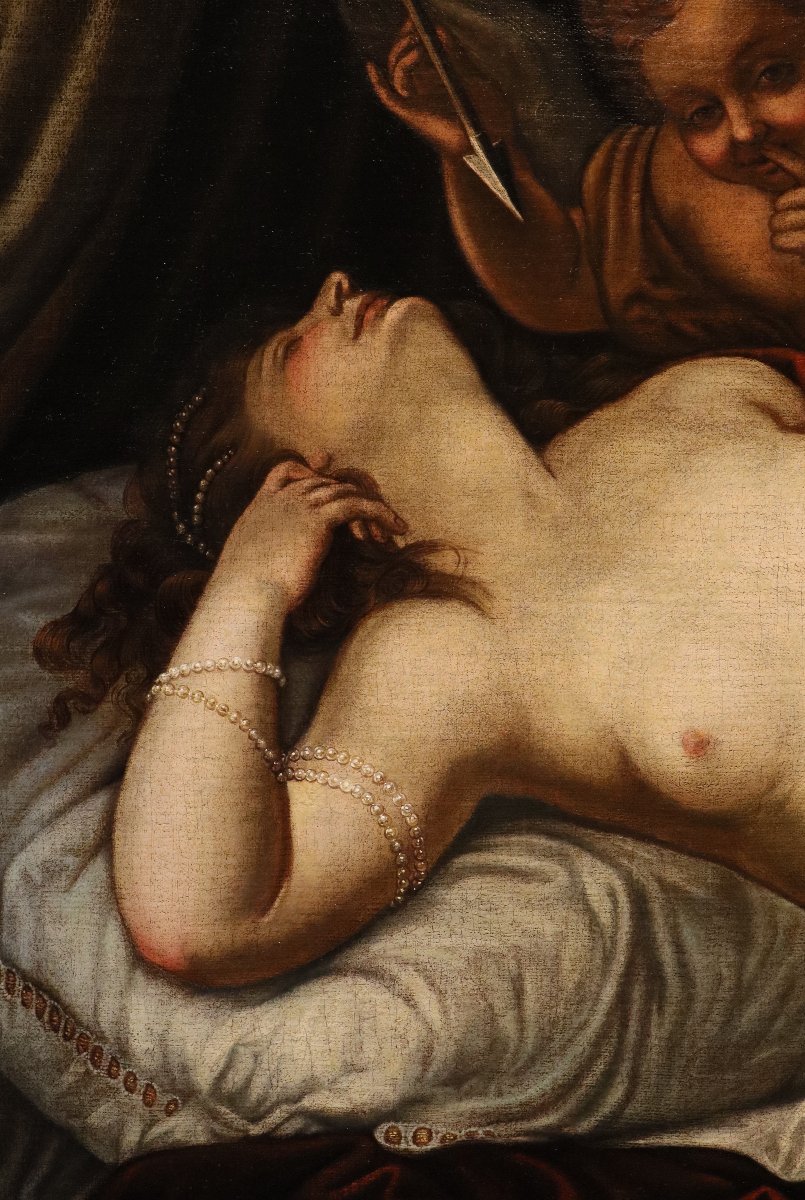
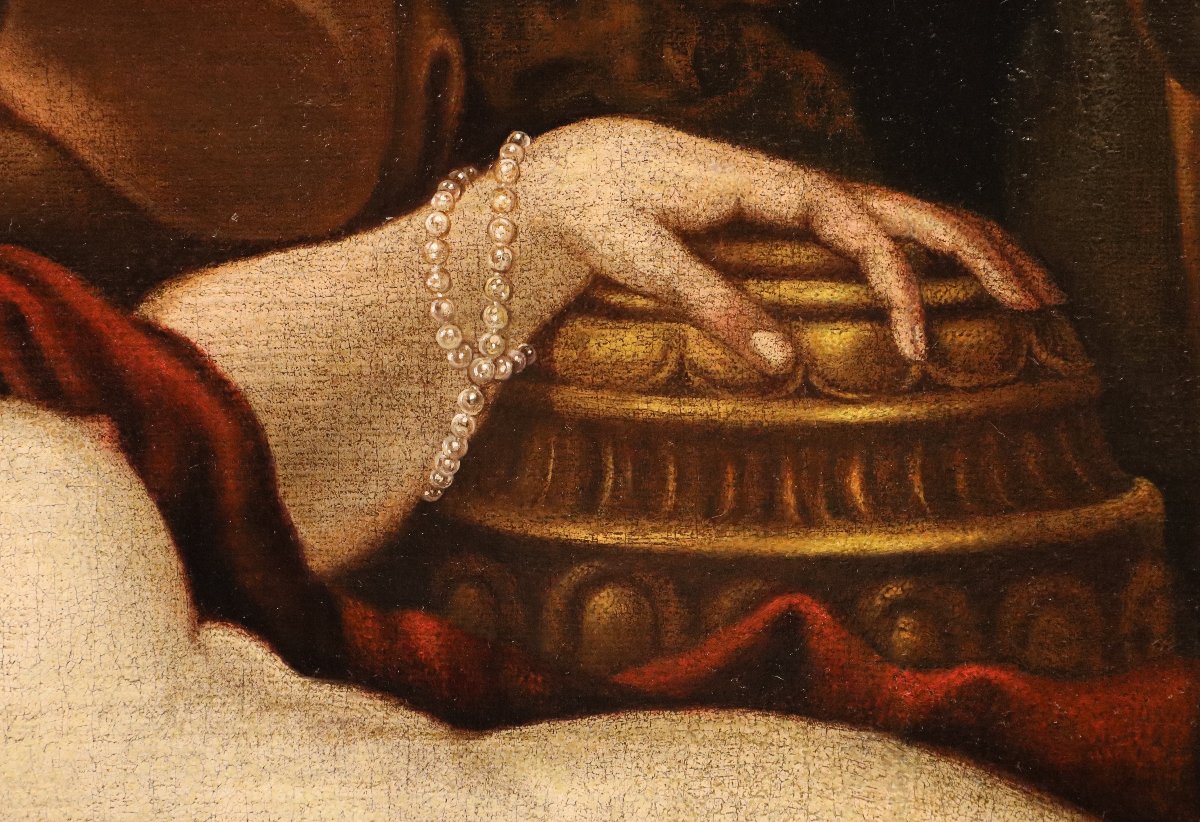
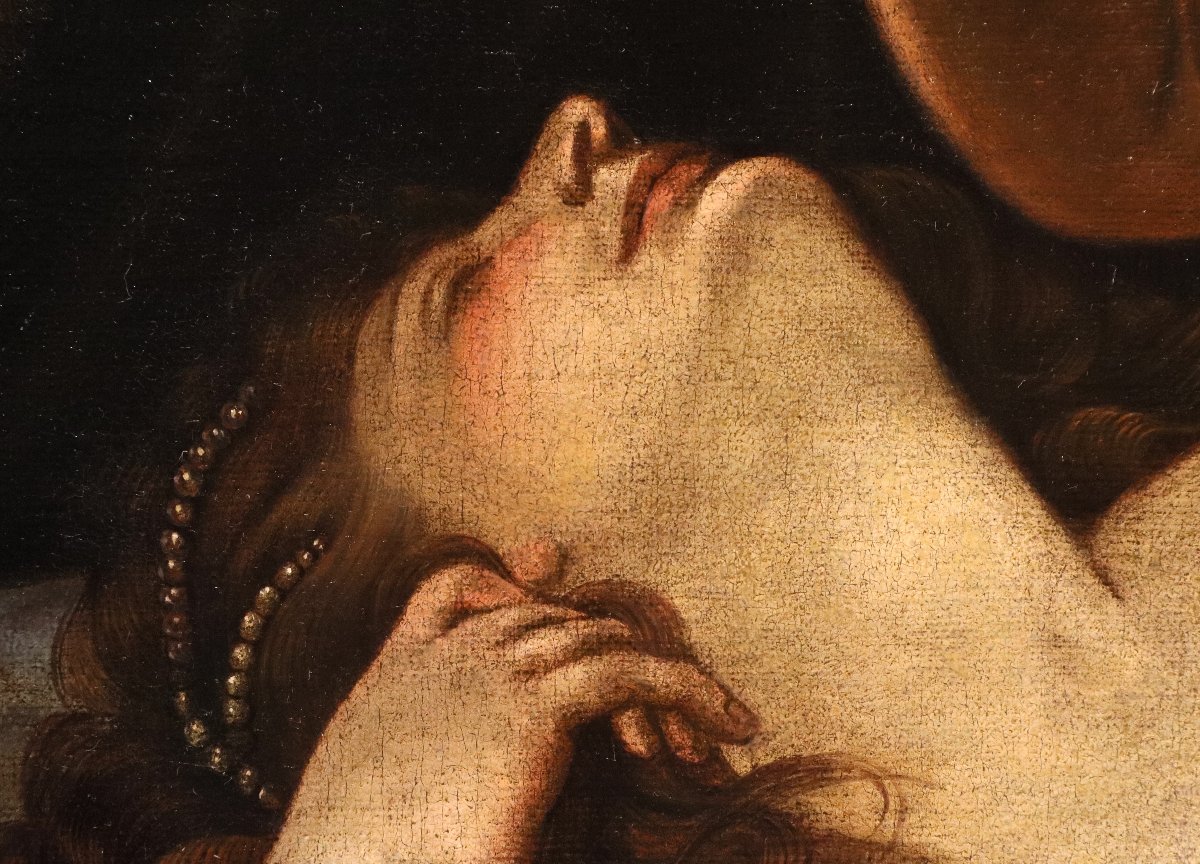
Her fair, luminous complexion stands out sharply against the shadowy background, immediately drawing the viewer’s gaze, whilst she wears only strands of pearls around her arms and in her hair – traditional symbols of purity and attributes of regal beauty. Next to Venus’s left hand, a richly decorated golden casket or container can be glimpsed, a possible allusion to the goddess’s jewels or secrets.
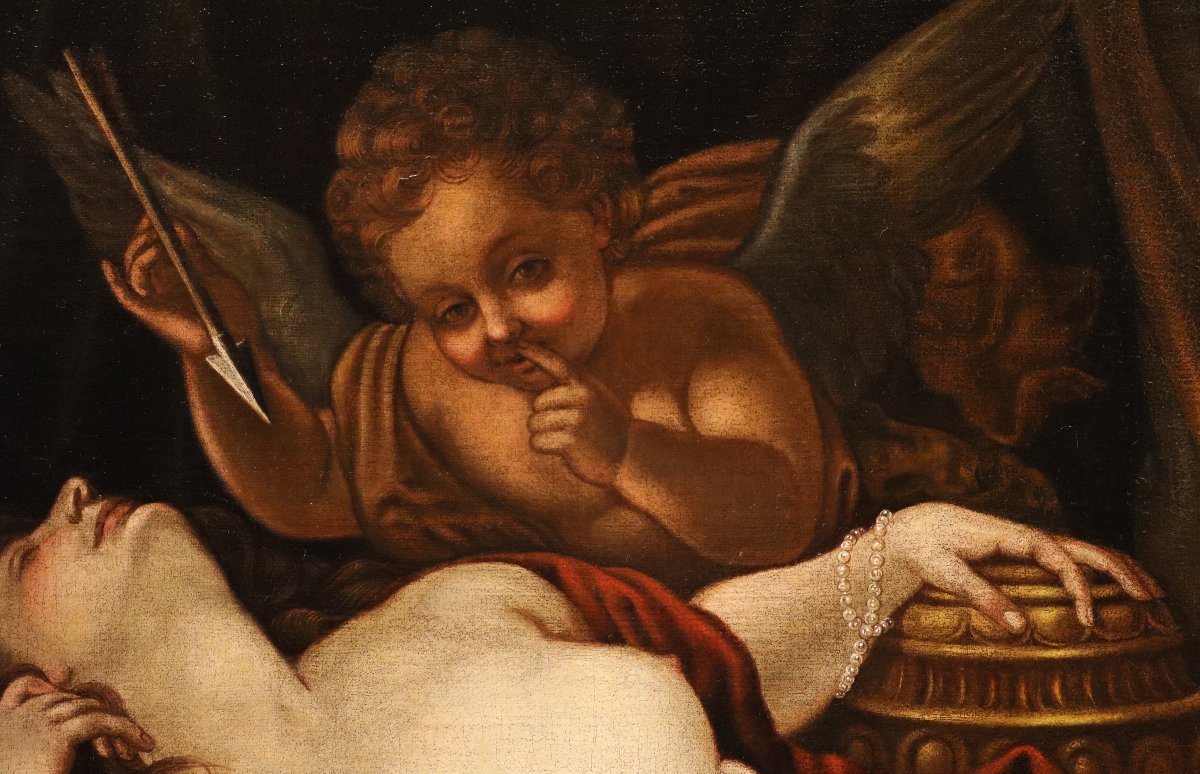
Behind her, half-hidden amongst the shadows of a sumptuous canopy, emerges Cupid, the little god of Love, who looks at the viewer, raising a finger to his mouth in the classic gesture of silence to protect the goddess’s sleep.
During the Renaissance, paintings of the Sleeping Venus were often commissioned as wedding gifts to celebrate aristocratic unions, and such works served as a blessing for married life. The presence of Cupid, ready to shoot his arrow, was therefore a crucial element, alluding to the moment when two hearts are struck and bound together indissolubly, symbolising fidelity and harmony.
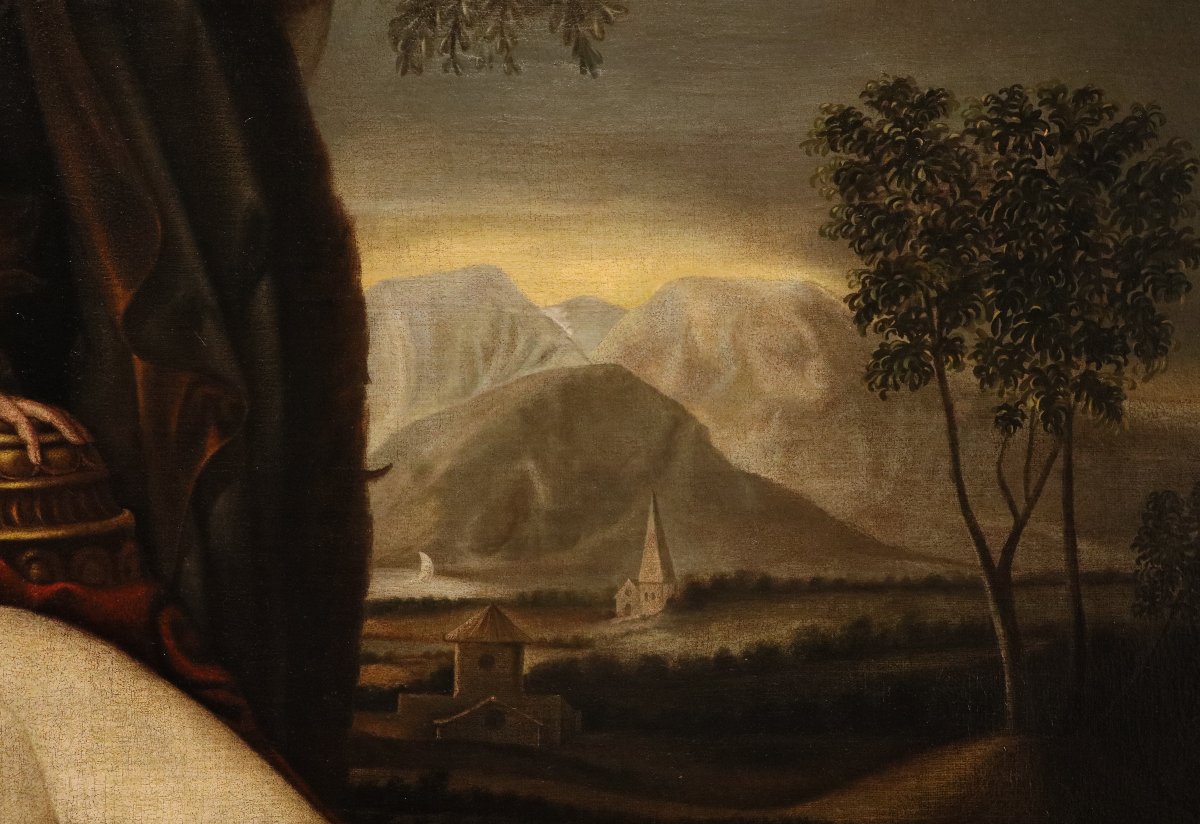
In the background lies a vast and evocative landscape of hills and mountains, featuring small rural buildings and a slender bell tower, typical of the Venetian tradition (influenced by Giorgione and Titian) which seeks harmony between man and nature.
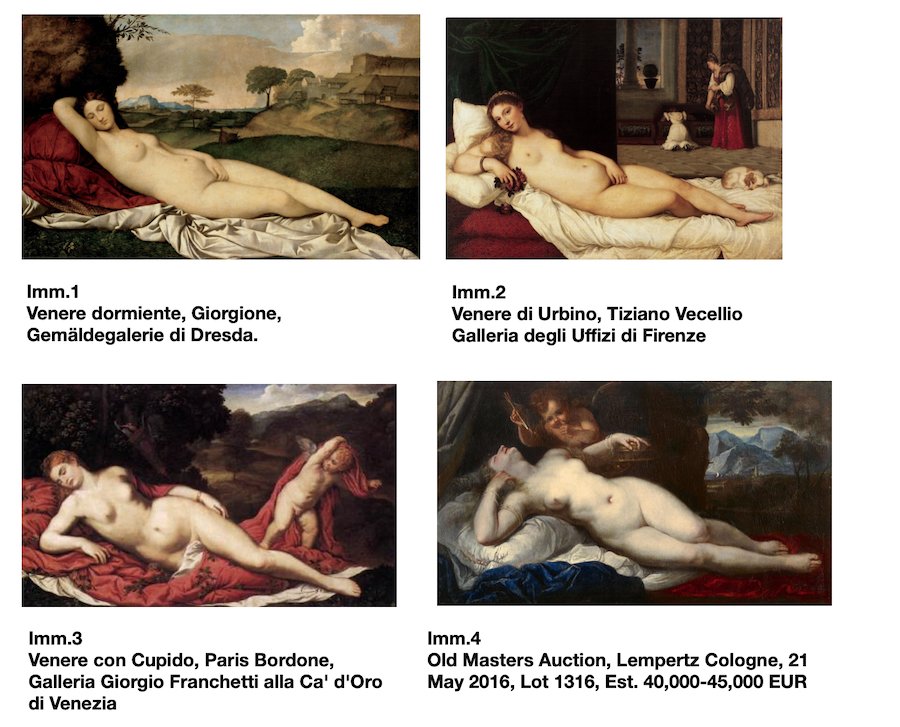
If we now consider the style of the composition, with its pronounced chiaroscuro – where the light vigorously models the goddess’s soft forms – and the fusion of the mythological element with the vastness of the natural landscape, it powerfully echoes the great legacy of sixteenth-century Venetian painting; in particular, among the undisputed forerunners of the visual canon of the Sleeping Venus are Giorgione, who painted the goddess naked, asleep in the open air, perfectly integrated into a hilly landscape (Sleeping Venus, 1507–1510, Gemäldegalerie, Dresden) and, even more so, Titian Vecellio, the architect of a revolution that introduced the concept of sensuality into painting for the first time (Venus of Urbino, 1538, Uffizi, Florence).
Commissioned by powerful noble families and sovereigns of the time—such as the Este and Gonzaga families and the Spanish royal family—who were keen to recreate within their private spheres a mythical world populated by sensual female nudes, this trend prompted Titian to pioneer a genre characterised by intense and elegant eroticism.
There is a third name to mention: that of Paris Bordone, and his *Sleeping Venus with Cupid* (dated 1550–1555) in the Giorgio Franchetti Gallery at the Ca’ d’Oro in Venice, which depicts the goddess set against a hilly landscape, blending the harmony of nature with the characteristic soft colours of the Venetian school (https://www.wga.hu/ frames-e.html?/html/b%2Fbordone%2Fsleep_ve.html ).
In relation to the latter, we may mention a painting virtually identical to the one on offer here, formerly in the Baumgärtner Collection, which was sold at Lempertz in Cologne (21 May 2016, Lot 1316*), and previously attributed to Bordone himself.
*Old Masters Auction, Lempertz, Cologne, 21 May 2016, Lot 1316, Estimate 40,000–45,000 EUR
https://www.lempertz.com/en/catalogues/lot/1067-1/1316-italian-school-c-1660venetian-school.html
In this instance too, the work is distinguished by the fusion of the figure’s classical perfection with a strong erotic and contemplative charge, closely resembling Titian’s models. However, upon closer examination of the composition and stylistic details, we are inclined to discern nuances that point us towards another great exponent of the early 17th-century Venetian tradition.
In our view, this is in fact a beautiful work from the workshop of Alessandro Varotari, known as ‘il Padovanino’ (Padua, 1588 – Venice, 1649), exhibiting the characteristic full forms, soft and luminous flesh tones, and warm colour palette that Varotari drew directly from his in-depth study of Titian’s masterpieces.
His Venuses became extremely famous amongst 17th-century collectors for their ability to revive the chromatic sensuality of the preceding century.
Il Padovanino was, in fact, the principal architect of the revival of Venetian painting in the early 17th century: in an era dominated by the Baroque and Caravaggism, he deliberately chose to look back, travelling to Rome to copy the masterpieces of the Venetian Renaissance (particularly Titian’s Bacchanalia and Venuses).
In his works, alongside the influence of Titian, one can discern an attention to architectural backdrops derived from Veronese and, as the years went by, the dynamism of Palma the Younger.
His formal elegance and painterly softness are particularly evident in the mythological scenes characterised by sensual, classical nudes, and it is for this reason that we are inclined to attribute the painting on offer to his hand.
ADDITIONAL INFORMATION:
The work comes with an attractive frame and is accompanied by a certificate of authenticity and a descriptive iconographic sheet.
We arrange and organise the transport of purchased works, both within Italy and abroad, using professional, insured carriers.
It is also possible to view the painting at our gallery in Riva del Garda; we would be delighted to welcome you and show you our collection of works.
Please feel free to contact us, with no obligation, for any further information.
Follow us on:
INSTAGRAM https://www.instagram.com/galleriacastelbarco/?hl=it
FACEBOOK https://www.facebook.com/galleriacastelbarco/
workshop of
Sleeping Venus with Cupid
Oil on canvas
90 x 145 – Framed 114 x 168 cm.
FULL DETAILS OF THE PAINTING (CLICK ON THE FOLLOWING LINK)
The iconography of the Sleeping Venus is one of the most fascinating, sensual and successful themes of 16th-century Venetian Renaissance painting, representing the perfect fusion of classical myth and the celebration of feminine beauty.
It is within this artistic context that the female nude becomes the undisputed protagonist of the painting, as in the case of our sinuous Venus, lost in sleep and reclining on a bed of soft white cushions and red drapes – a combination of colours with immediate symbolic significance which, together, create a perfect balance between spiritual love and carnal passion, extolling the concept of ideal love.
Her fair, luminous complexion stands out sharply against the shadowy background, immediately drawing the viewer’s gaze, whilst she wears only strands of pearls around her arms and in her hair – traditional symbols of purity and attributes of regal beauty. Next to Venus’s left hand, a richly decorated golden casket or container can be glimpsed, a possible allusion to the goddess’s jewels or secrets.
Behind her, half-hidden amongst the shadows of a sumptuous canopy, emerges Cupid, the little god of Love, who looks at the viewer, raising a finger to his mouth in the classic gesture of silence to protect the goddess’s sleep.
During the Renaissance, paintings of the Sleeping Venus were often commissioned as wedding gifts to celebrate aristocratic unions, and such works served as a blessing for married life. The presence of Cupid, ready to shoot his arrow, was therefore a crucial element, alluding to the moment when two hearts are struck and bound together indissolubly, symbolising fidelity and harmony.
In the background lies a vast and evocative landscape of hills and mountains, featuring small rural buildings and a slender bell tower, typical of the Venetian tradition (influenced by Giorgione and Titian) which seeks harmony between man and nature.
If we now consider the style of the composition, with its pronounced chiaroscuro – where the light vigorously models the goddess’s soft forms – and the fusion of the mythological element with the vastness of the natural landscape, it powerfully echoes the great legacy of sixteenth-century Venetian painting; in particular, among the undisputed forerunners of the visual canon of the Sleeping Venus are Giorgione, who painted the goddess naked, asleep in the open air, perfectly integrated into a hilly landscape (Sleeping Venus, 1507–1510, Gemäldegalerie, Dresden) and, even more so, Titian Vecellio, the architect of a revolution that introduced the concept of sensuality into painting for the first time (Venus of Urbino, 1538, Uffizi, Florence).
Commissioned by powerful noble families and sovereigns of the time—such as the Este and Gonzaga families and the Spanish royal family—who were keen to recreate within their private spheres a mythical world populated by sensual female nudes, this trend prompted Titian to pioneer a genre characterised by intense and elegant eroticism.
There is a third name to mention: that of Paris Bordone, and his *Sleeping Venus with Cupid* (dated 1550–1555) in the Giorgio Franchetti Gallery at the Ca’ d’Oro in Venice, which depicts the goddess set against a hilly landscape, blending the harmony of nature with the characteristic soft colours of the Venetian school (https://www.wga.hu/ frames-e.html?/html/b%2Fbordone%2Fsleep_ve.html ).
In relation to the latter, we may mention a painting virtually identical to the one on offer here, formerly in the Baumgärtner Collection, which was sold at Lempertz in Cologne (21 May 2016, Lot 1316*), and previously attributed to Bordone himself.
*Old Masters Auction, Lempertz, Cologne, 21 May 2016, Lot 1316, Estimate 40,000–45,000 EUR
https://www.lempertz.com/en/catalogues/lot/1067-1/1316-italian-school-c-1660venetian-school.html
In this instance too, the work is distinguished by the fusion of the figure’s classical perfection with a strong erotic and contemplative charge, closely resembling Titian’s models. However, upon closer examination of the composition and stylistic details, we are inclined to discern nuances that point us towards another great exponent of the early 17th-century Venetian tradition.
In our view, this is in fact a beautiful work from the workshop of Alessandro Varotari, known as ‘il Padovanino’ (Padua, 1588 – Venice, 1649), exhibiting the characteristic full forms, soft and luminous flesh tones, and warm colour palette that Varotari drew directly from his in-depth study of Titian’s masterpieces.
His Venuses became extremely famous amongst 17th-century collectors for their ability to revive the chromatic sensuality of the preceding century.
Il Padovanino was, in fact, the principal architect of the revival of Venetian painting in the early 17th century: in an era dominated by the Baroque and Caravaggism, he deliberately chose to look back, travelling to Rome to copy the masterpieces of the Venetian Renaissance (particularly Titian’s Bacchanalia and Venuses).
In his works, alongside the influence of Titian, one can discern an attention to architectural backdrops derived from Veronese and, as the years went by, the dynamism of Palma the Younger.
His formal elegance and painterly softness are particularly evident in the mythological scenes characterised by sensual, classical nudes, and it is for this reason that we are inclined to attribute the painting on offer to his hand.
ADDITIONAL INFORMATION:
The work comes with an attractive frame and is accompanied by a certificate of authenticity and a descriptive iconographic sheet.
We arrange and organise the transport of purchased works, both within Italy and abroad, using professional, insured carriers.
It is also possible to view the painting at our gallery in Riva del Garda; we would be delighted to welcome you and show you our collection of works.
Please feel free to contact us, with no obligation, for any further information.
Follow us on:
INSTAGRAM https://www.instagram.com/galleriacastelbarco/?hl=it
FACEBOOK https://www.facebook.com/galleriacastelbarco/
14 500 €
Period: 17th century
Style: Louis 15th - Transition
Condition: Excellent condition
Material: Oil painting
Width: encadré 168 cm.
Height: encadré 114 cm.
Reference (ID): 1801298
Availability: In stock
Print