THIS OBJECT WAS SOLD
Wedding Chest With A Domed Top, Made Of Burl Poplar And Inlaid With Marquetry. Rhine Valley, 18th Century
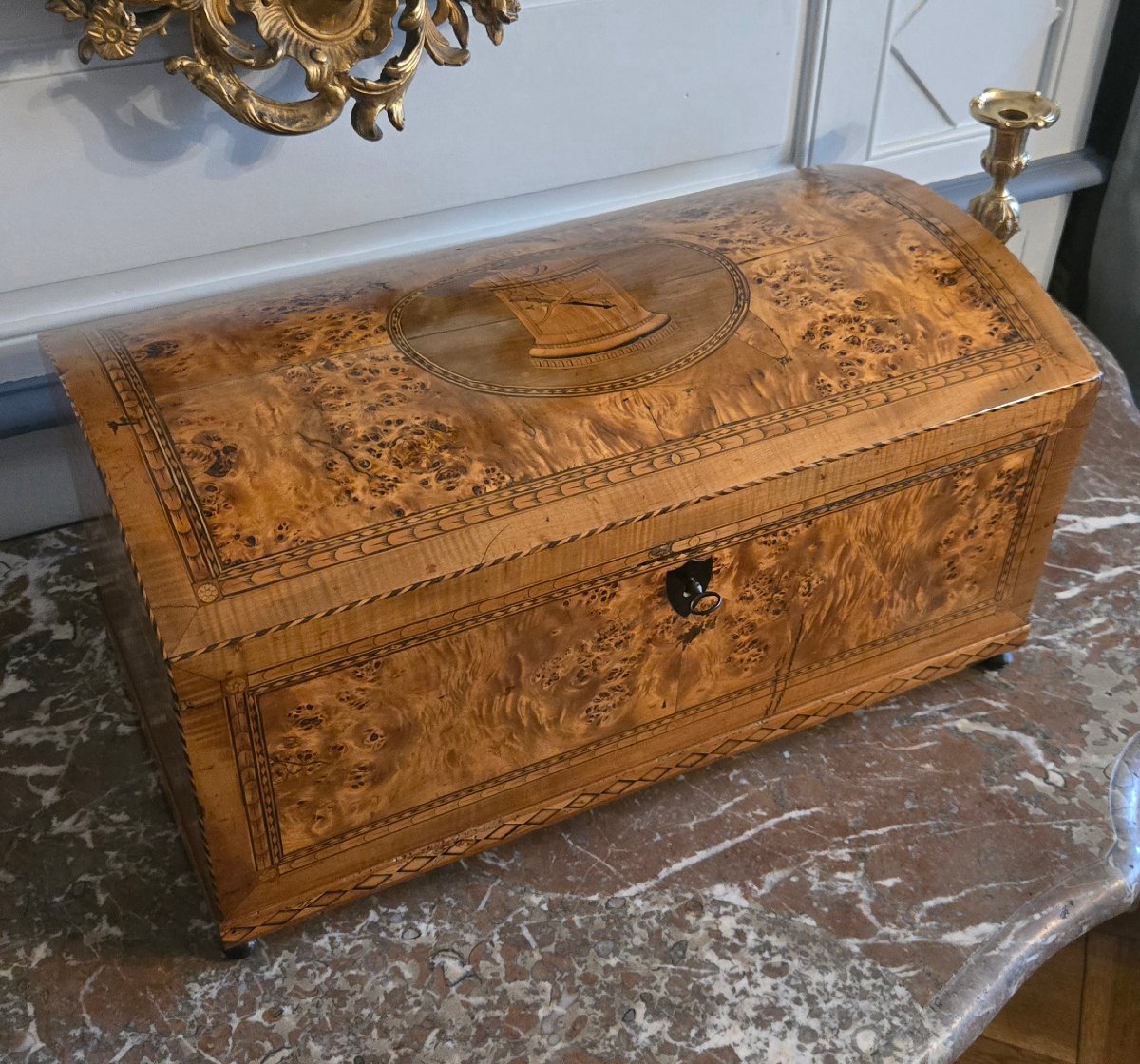
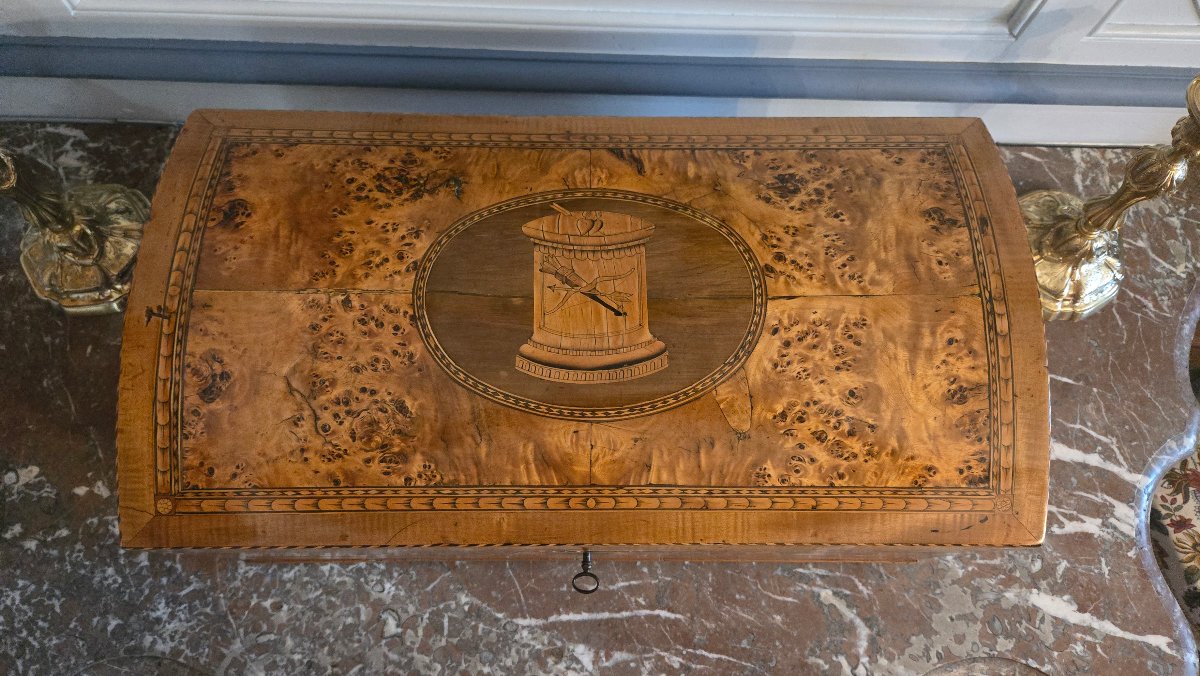
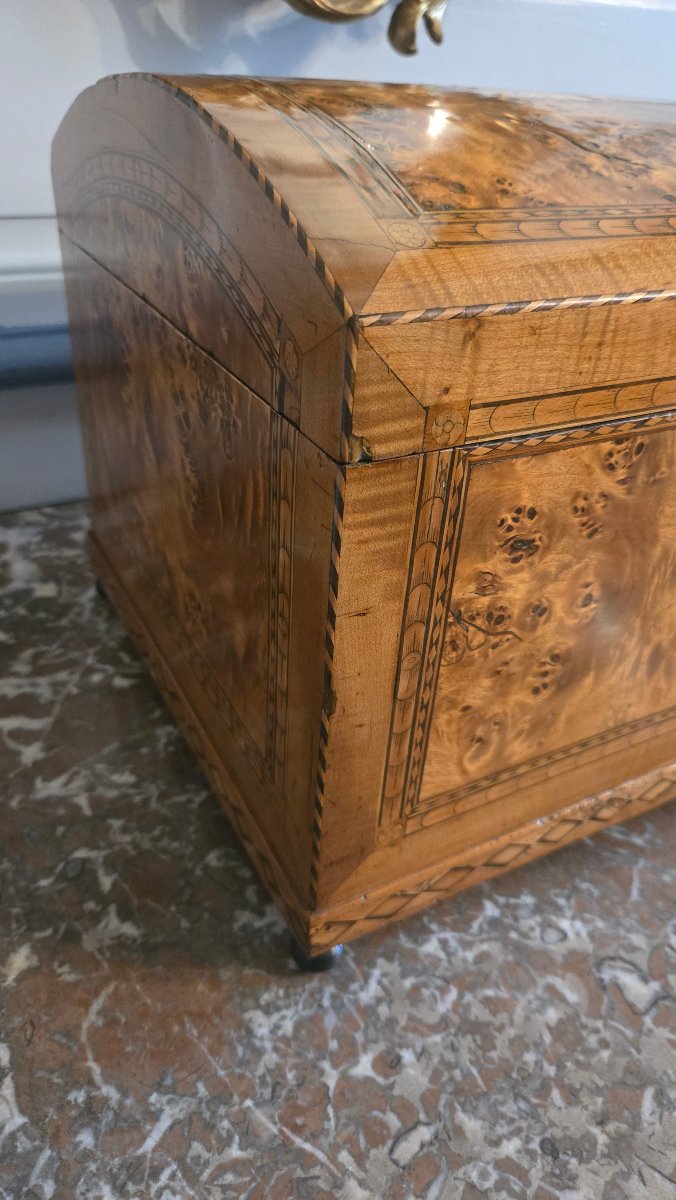
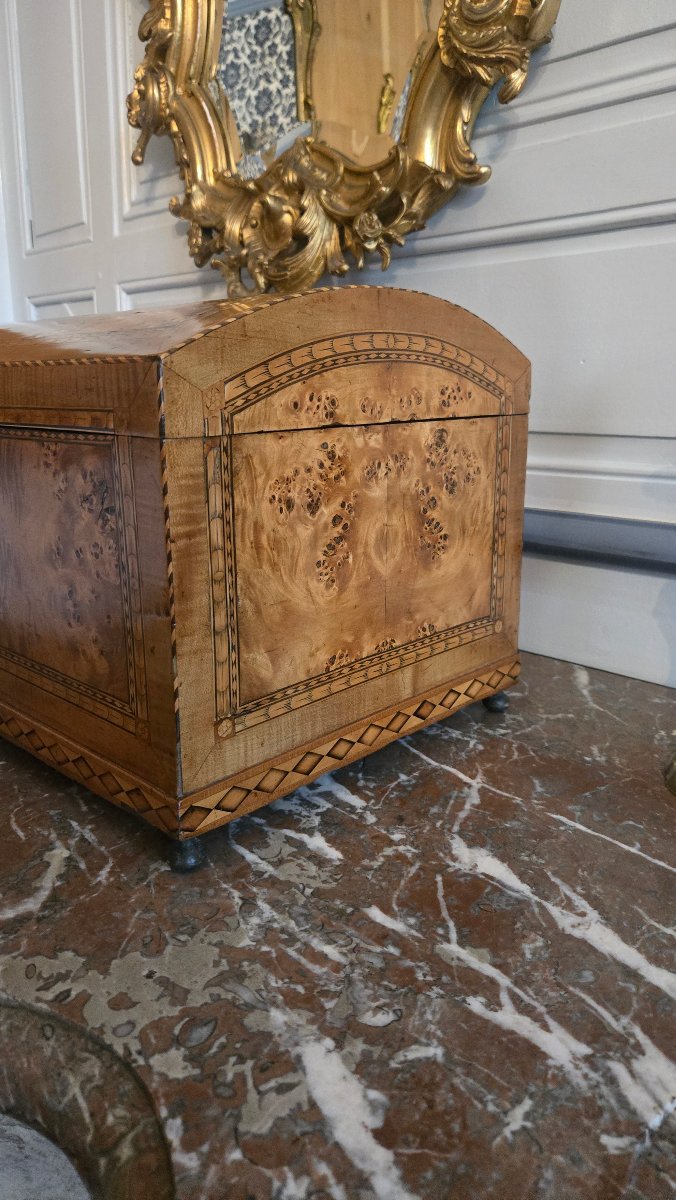
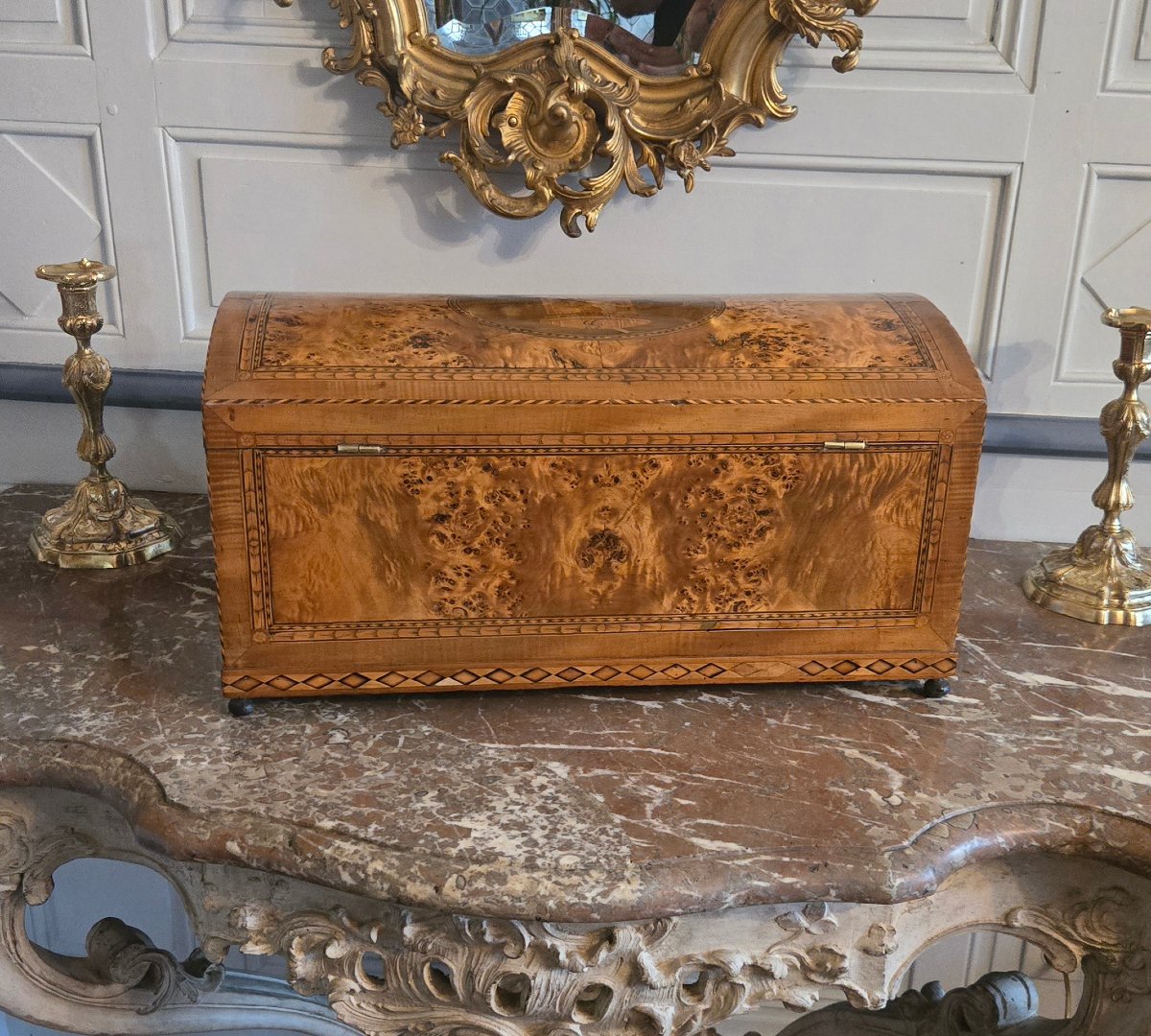
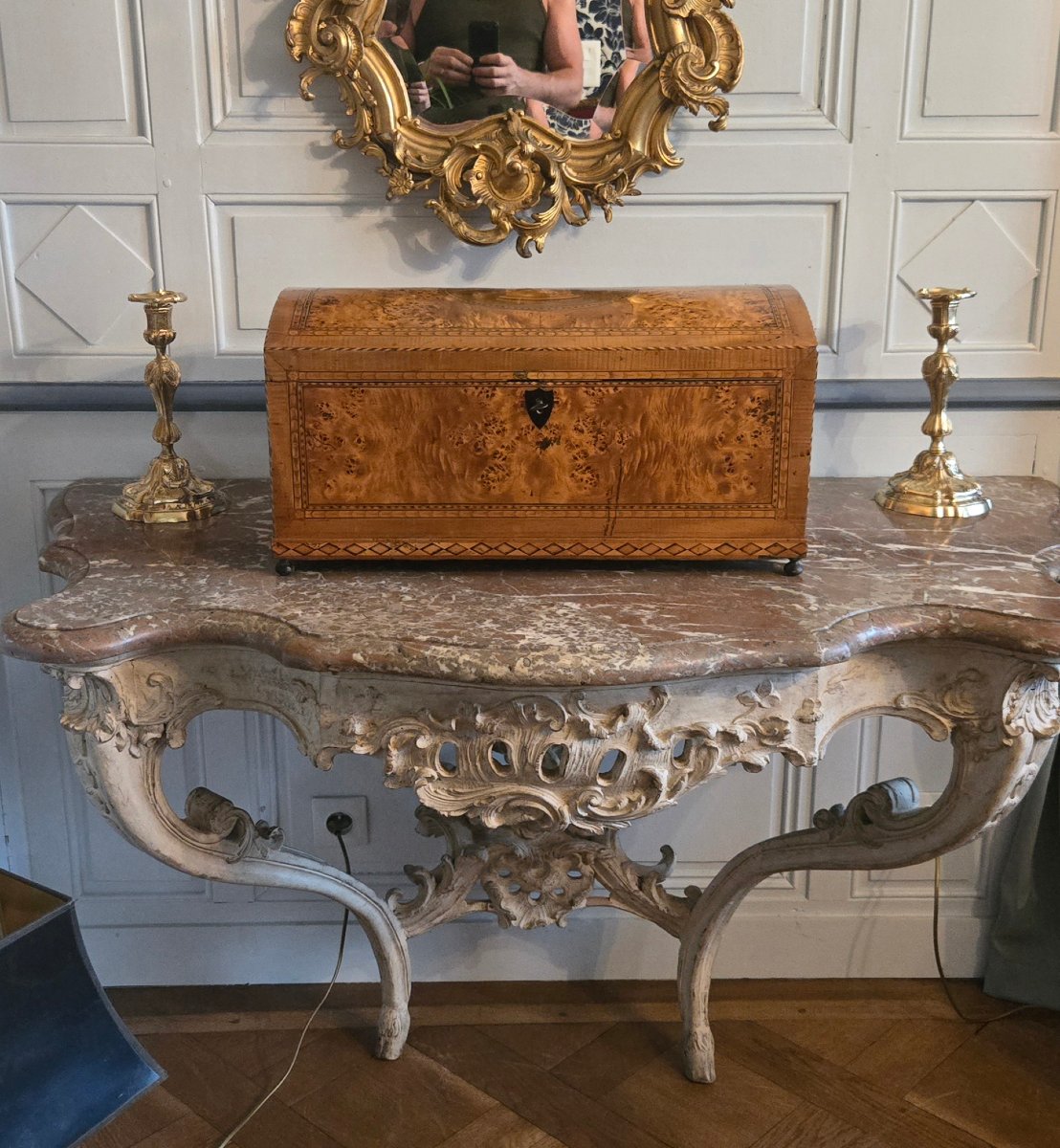
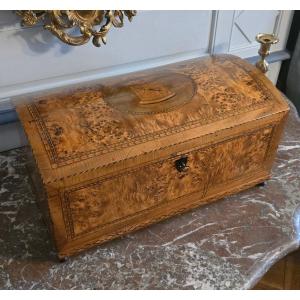


This remarkable wedding chest is a testament to the refinement of the workshops in the Rhine Valley during the last quarter of the 18th century. Carrying on an ancient tradition, it retains the domed lid characteristic of medieval and Renaissance chests, a form that remained particularly prevalent in Rhineland productions long after it had gradually disappeared from the major French centers. This silhouette, both elegant and functional, gives the chest a distinctive presence while evoking its regional origins.
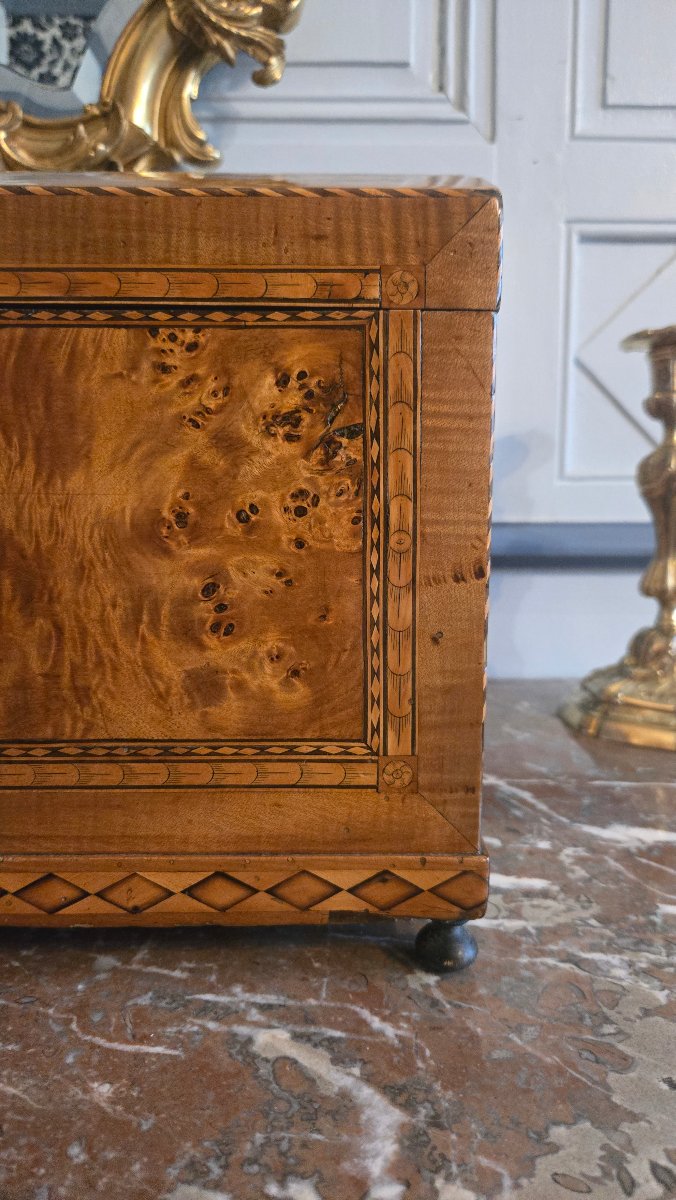
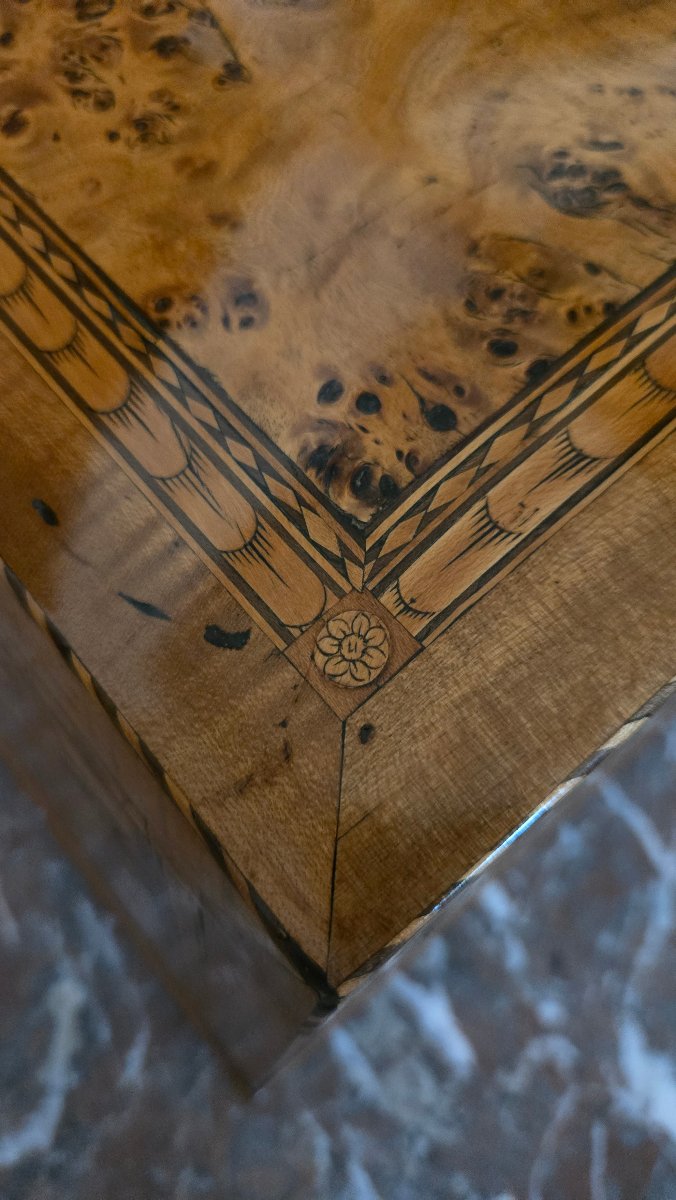
The frame, made entirely of softwood, is fully veneered with a remarkable poplar burl—a wood known in German-speaking countries as “Pappelmaser.” The veneer sheets were carefully selected and arranged to highlight the wood’s natural patterns, alternating between broad, iridescent patches and spectacular clusters of burl. Each panel is framed by elegant composite fillets of light and dark wood, while the lower section is accented by a geometric frieze of lozenges, whose elements feature delicate shading achieved through hot-sand burning, a traditional technique of 18th-century marquetry.
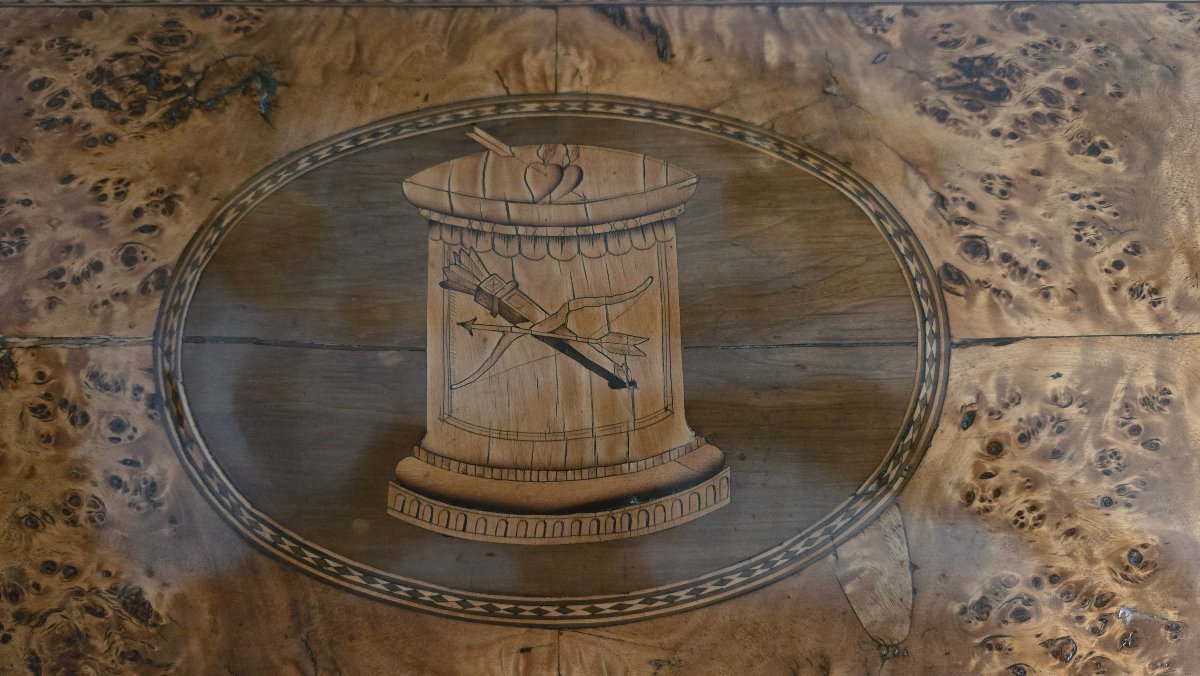
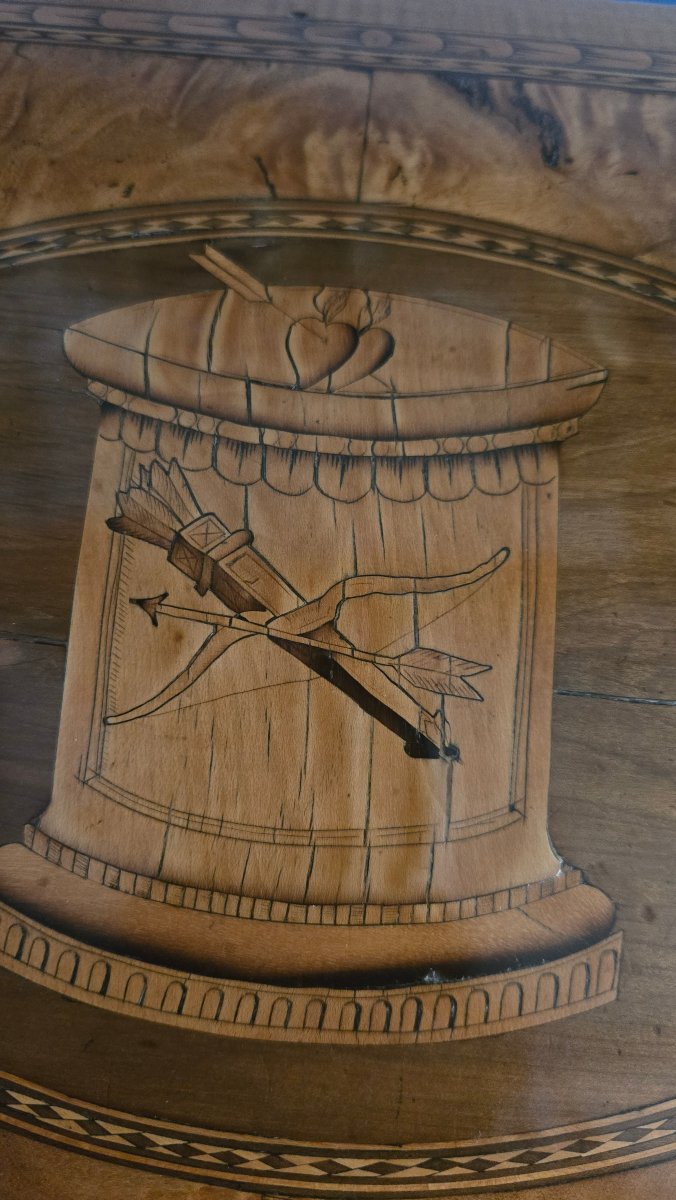
The lid is adorned with a large oval medallion of walnut veneer, encircled by a composite border. Its marquetry decoration unfolds a true iconographic program inspired by the neoclassical repertoire then in vogue. It depicts an antique-inspired votive altar surmounted by two joined, flaming hearts, while its shaft is adorned with Cupid’s attributes: a bow, an arrow, and a quiver. The piece as a whole constitutes a true trophy of Love, a symbol of marital union, fidelity, and the consecration of marriage. Widespread in ornamentation compendia and the decorative arts of the second half of the 18th century, these motifs find a particularly fitting application here on a casket intended to accompany the life of a young married couple.
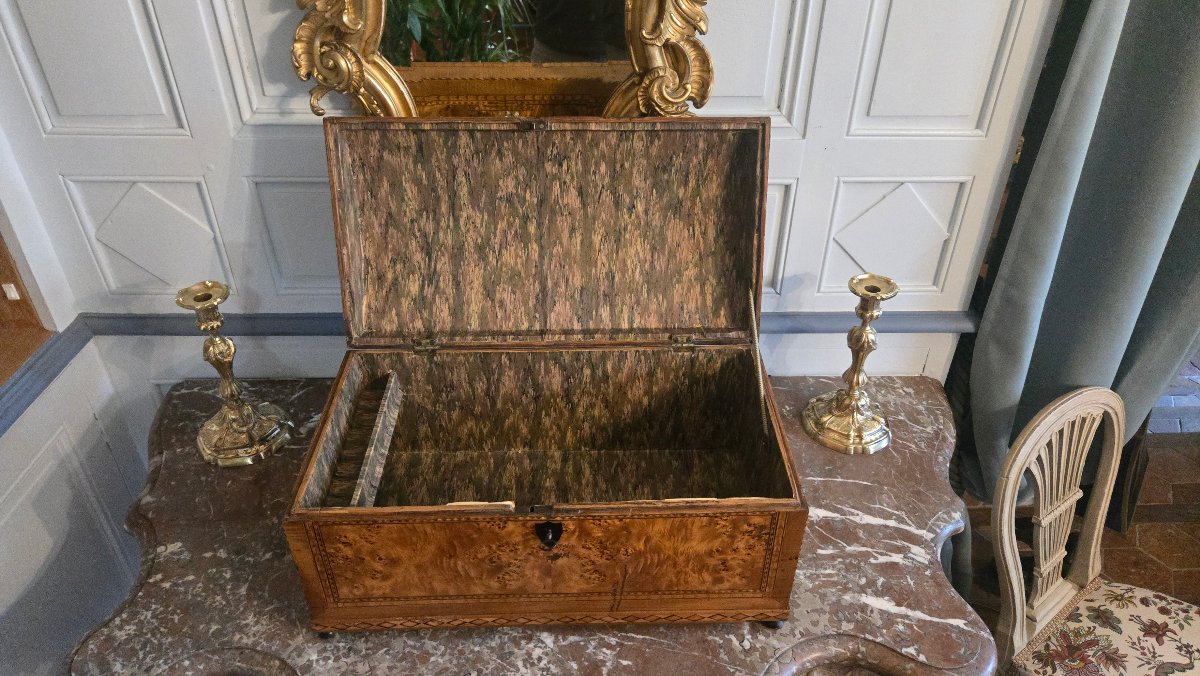
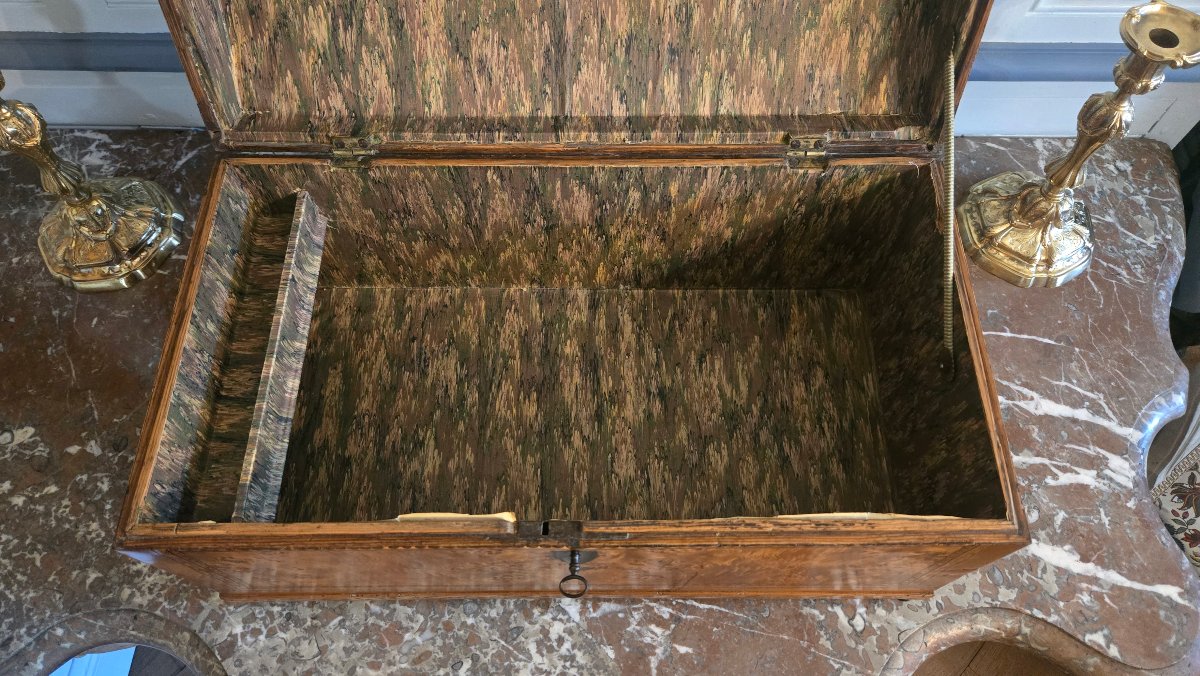
This iconography reinforces the hypothesis that this is a wedding chest, intended to hold the household’s most precious belongings: jewelry, papers, ribbons, or family mementos. This function is supported by the presence, inside, of a side compartment originally designed to hold small objects.
The interior is entirely lined with an antique decorative paper made with polychrome paste, known in German-speaking countries as Kleisterpapier. This lining, carefully applied to the bottom, the sides, the underside of the lid, and the side compartment, contributes fully to the charm of the piece as a whole. Whether it dates from the time of the box’s manufacture or is the result of a later refurbishment carried out in the late 18th or early 19th century, it attests to the box’s long-term use and the care taken in its preservation.
The wrought-iron lock is the original one and works perfectly with its key. The brass hinges, also original, exemplify deliberately understated hardware, prioritizing quality of craftsmanship over ostentatious decoration—a characteristic frequently found in regional productions from the Rhine Valley. The four small ball-shaped feet are 19th-century additions that are now part of the object’s history.
Research conducted on this chest links it to pieces preserved or documented in southwestern Germany, particularly in the regions of Württemberg and the Upper Rhine. The combination of a softwood frame, poplar burl veneer, geometric fillets, a domed lid, and neoclassically inspired marquetry decoration fully corresponds to the decorative vocabulary developed in this cultural region during the last quarter of the 18th century.
Condition: The cabinet is in excellent overall condition. The frame is sound and stable. The veneers retain a beautiful freshness despite a few isolated, carefully executed historical restorations. There is some subtle wear from use, rare old traces of wood-boring insects that are now fully stabilized, as well as an old shrink crack on the domed top, which was restored in the past and remains inconspicuous. These interventions in no way detract from the object’s appearance and are a natural part of its history spanning more than two centuries.
Dimensions:
Width: 58.5 cm
Depth: 31.5 cm
Height: 29.5 cm
The frame, made entirely of softwood, is fully veneered with a remarkable poplar burl—a wood known in German-speaking countries as “Pappelmaser.” The veneer sheets were carefully selected and arranged to highlight the wood’s natural patterns, alternating between broad, iridescent patches and spectacular clusters of burl. Each panel is framed by elegant composite fillets of light and dark wood, while the lower section is accented by a geometric frieze of lozenges, whose elements feature delicate shading achieved through hot-sand burning, a traditional technique of 18th-century marquetry.
The lid is adorned with a large oval medallion of walnut veneer, encircled by a composite border. Its marquetry decoration unfolds a true iconographic program inspired by the neoclassical repertoire then in vogue. It depicts an antique-inspired votive altar surmounted by two joined, flaming hearts, while its shaft is adorned with Cupid’s attributes: a bow, an arrow, and a quiver. The piece as a whole constitutes a true trophy of Love, a symbol of marital union, fidelity, and the consecration of marriage. Widespread in ornamentation compendia and the decorative arts of the second half of the 18th century, these motifs find a particularly fitting application here on a casket intended to accompany the life of a young married couple.
This iconography reinforces the hypothesis that this is a wedding chest, intended to hold the household’s most precious belongings: jewelry, papers, ribbons, or family mementos. This function is supported by the presence, inside, of a side compartment originally designed to hold small objects.
The interior is entirely lined with an antique decorative paper made with polychrome paste, known in German-speaking countries as Kleisterpapier. This lining, carefully applied to the bottom, the sides, the underside of the lid, and the side compartment, contributes fully to the charm of the piece as a whole. Whether it dates from the time of the box’s manufacture or is the result of a later refurbishment carried out in the late 18th or early 19th century, it attests to the box’s long-term use and the care taken in its preservation.
The wrought-iron lock is the original one and works perfectly with its key. The brass hinges, also original, exemplify deliberately understated hardware, prioritizing quality of craftsmanship over ostentatious decoration—a characteristic frequently found in regional productions from the Rhine Valley. The four small ball-shaped feet are 19th-century additions that are now part of the object’s history.
Research conducted on this chest links it to pieces preserved or documented in southwestern Germany, particularly in the regions of Württemberg and the Upper Rhine. The combination of a softwood frame, poplar burl veneer, geometric fillets, a domed lid, and neoclassically inspired marquetry decoration fully corresponds to the decorative vocabulary developed in this cultural region during the last quarter of the 18th century.
Condition: The cabinet is in excellent overall condition. The frame is sound and stable. The veneers retain a beautiful freshness despite a few isolated, carefully executed historical restorations. There is some subtle wear from use, rare old traces of wood-boring insects that are now fully stabilized, as well as an old shrink crack on the domed top, which was restored in the past and remains inconspicuous. These interventions in no way detract from the object’s appearance and are a natural part of its history spanning more than two centuries.
Dimensions:
Width: 58.5 cm
Depth: 31.5 cm
Height: 29.5 cm
Explore similar pieces and discover your ideal find:
Boxes, Cases