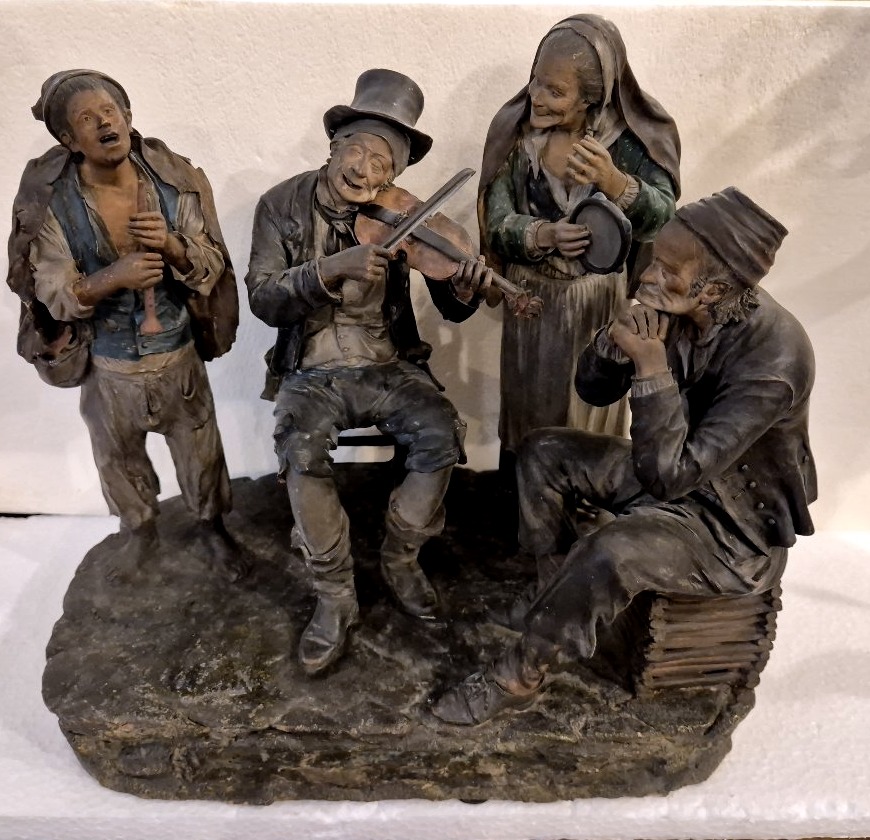
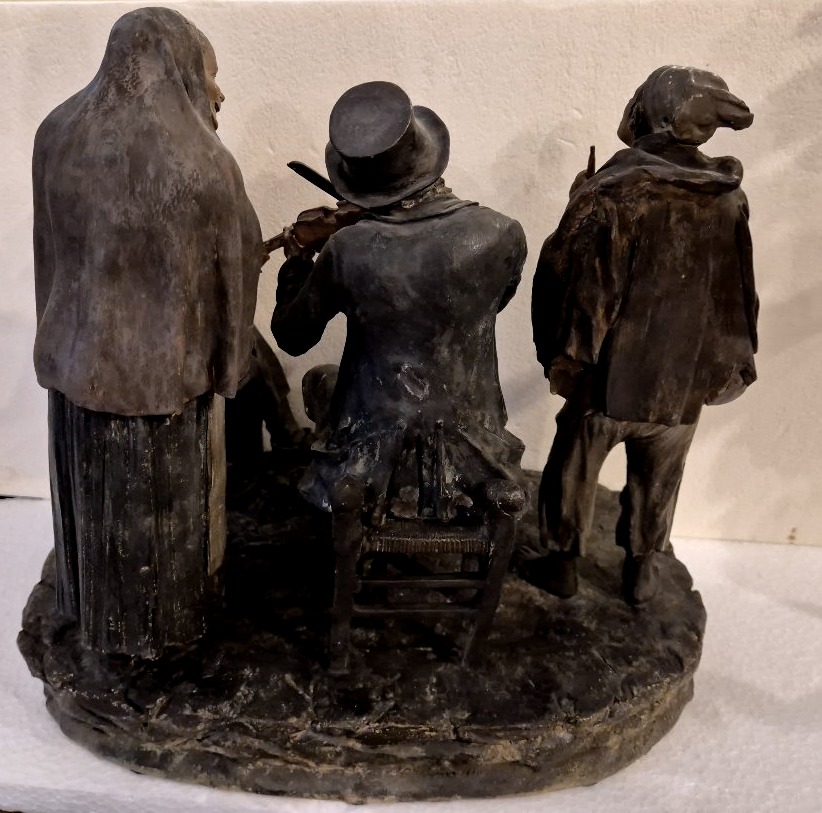


Terracotta Sculpture Group By Giacomo Bongiovanni, Caltagirone, Sicily, 19th Century
Artist: Giacomo Bongiovanni
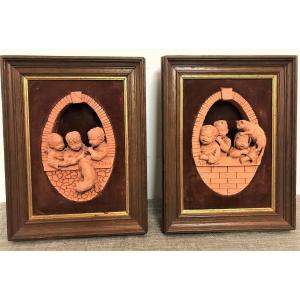
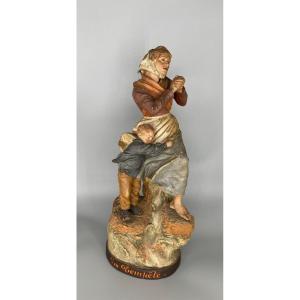
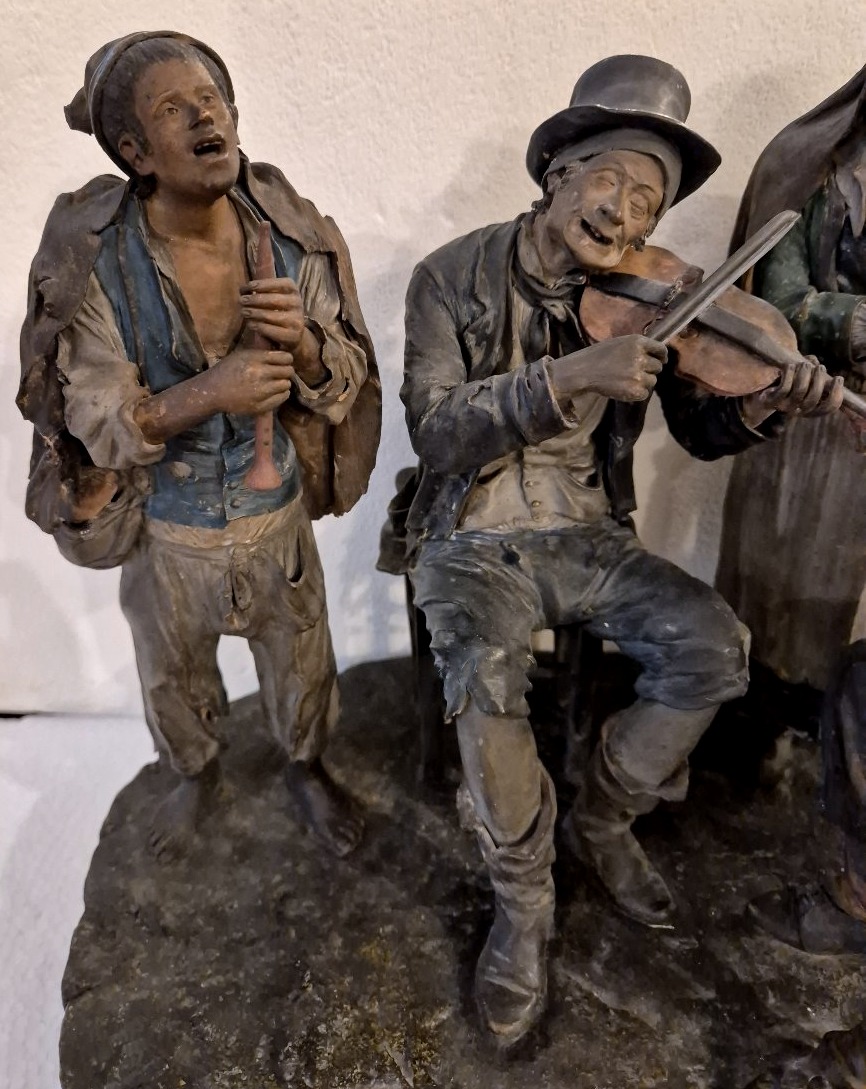
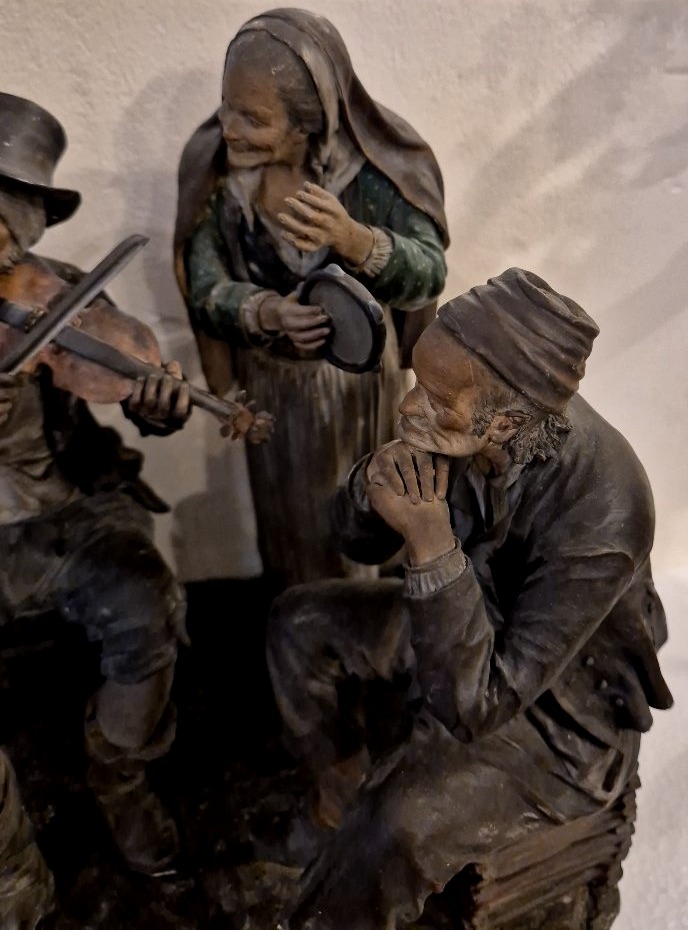
A cold-painted terracotta group depicting a beggar and three musicians, including a blind violinist who gives the work its title, *Il cieco* (*The Blind Man*), as indicated by the engraving on the base (see photo).
This is undoubtedly a work by Bongiovanni Vaccaro, despite the absence of a signature in clay or raised marks on the base, which often held a paper strip bearing the name of the artist and the title of the work—a strip that was frequently lost or damaged and is therefore missing in this case.
The condition appears to be very good; to the naked eye, some touch-ups in the paint are visible, which likely conceal restorations—probable given the fragility of these terracotta pieces—but since we did not perform any interventions, we are unable to either confirm or deny them. The overall appearance is, however, quite pleasing.
Giacomo Bongiovanni was born in Caltagirone on July 20, 1772. He was introduced to the art of modeling terracotta figurines by his older brother Salvatore. At just fourteen years old, he was left to pursue the art on his own, as his brother had moved to Rome. In 1794, he opened his own workshop.
Although uneducated to the point of not knowing how to sign his name, he was endowed with great artistic sensitivity and a keen, penetrating spirit of observation that allowed him to capture, with exceptional ease, the most natural postures and expressions of the people in his surroundings. He introduced a significant innovation to the traditional technique of terracotta figurines, which consisted of rendering the drapery with thin sheets of clay, cut and arranged over the modeled nude bodies as if they were actual garments. He was aided in this by having observed, at the local convent of St. Bonaventure of the Reformed Fathers, Nativity scene figurines by Giovanni Matera of Trapani, which were dressed in actual fabrics cut into garments and soaked in glue to better adhere to the contours of the body. While still living in his hometown, he observed the gatherings and quarrels of the local women, the gossip-filled gatherings in the cobbler’s and barber’s shops, the blind beggars, the street musicians, the peasants returning home on donkeys or mules, and the mendicant friars who went from door to door asking for and receiving alms. These are the subjects that he, with admirable psychological insight, captured in his terracotta groups, painted in true-to-life colors using tempera and oil. With equal sensitivity and skill, he modeled nativity scene shepherds, bringing to life the types of farmers and herdsmen from his village. He trained and brought his nephew Giuseppe Vaccaro—his sister’s son, born in 1809—into the art. Thus, the workshop bore the name Bongiovanni-Vaccaro. In 1856, already advanced in years, he entrusted his nephew with the task of annually providing the city administration with the terracotta groups promised as a token of gratitude for having decreed, while he was still alive, that a portrait of him be placed among those of the city’s illustrious citizens.
He died on December 6, 1859.
This is undoubtedly a work by Bongiovanni Vaccaro, despite the absence of a signature in clay or raised marks on the base, which often held a paper strip bearing the name of the artist and the title of the work—a strip that was frequently lost or damaged and is therefore missing in this case.
The condition appears to be very good; to the naked eye, some touch-ups in the paint are visible, which likely conceal restorations—probable given the fragility of these terracotta pieces—but since we did not perform any interventions, we are unable to either confirm or deny them. The overall appearance is, however, quite pleasing.
Giacomo Bongiovanni was born in Caltagirone on July 20, 1772. He was introduced to the art of modeling terracotta figurines by his older brother Salvatore. At just fourteen years old, he was left to pursue the art on his own, as his brother had moved to Rome. In 1794, he opened his own workshop.
Although uneducated to the point of not knowing how to sign his name, he was endowed with great artistic sensitivity and a keen, penetrating spirit of observation that allowed him to capture, with exceptional ease, the most natural postures and expressions of the people in his surroundings. He introduced a significant innovation to the traditional technique of terracotta figurines, which consisted of rendering the drapery with thin sheets of clay, cut and arranged over the modeled nude bodies as if they were actual garments. He was aided in this by having observed, at the local convent of St. Bonaventure of the Reformed Fathers, Nativity scene figurines by Giovanni Matera of Trapani, which were dressed in actual fabrics cut into garments and soaked in glue to better adhere to the contours of the body. While still living in his hometown, he observed the gatherings and quarrels of the local women, the gossip-filled gatherings in the cobbler’s and barber’s shops, the blind beggars, the street musicians, the peasants returning home on donkeys or mules, and the mendicant friars who went from door to door asking for and receiving alms. These are the subjects that he, with admirable psychological insight, captured in his terracotta groups, painted in true-to-life colors using tempera and oil. With equal sensitivity and skill, he modeled nativity scene shepherds, bringing to life the types of farmers and herdsmen from his village. He trained and brought his nephew Giuseppe Vaccaro—his sister’s son, born in 1809—into the art. Thus, the workshop bore the name Bongiovanni-Vaccaro. In 1856, already advanced in years, he entrusted his nephew with the task of annually providing the city administration with the terracotta groups promised as a token of gratitude for having decreed, while he was still alive, that a portrait of him be placed among those of the city’s illustrious citizens.
He died on December 6, 1859.
3 650 €
Period: 19th century
Style: Other Style
Condition: Condition of use
Material: Terracotta
Length: cm 33,5
Height: cm 31
Depth: cm 21
Reference (ID): 1797539
Availability: In stock
Print