

Religious Community Pitcher Featuring A Jesuit Goat And The Ihs Symbol, Italian Earthenware, 17th Century, Venus Pharmacy
Jesuit community pouring pitcher or apothecary jug – Majolica with IHS decoration – Italy or Languedoc – 17th–18th century
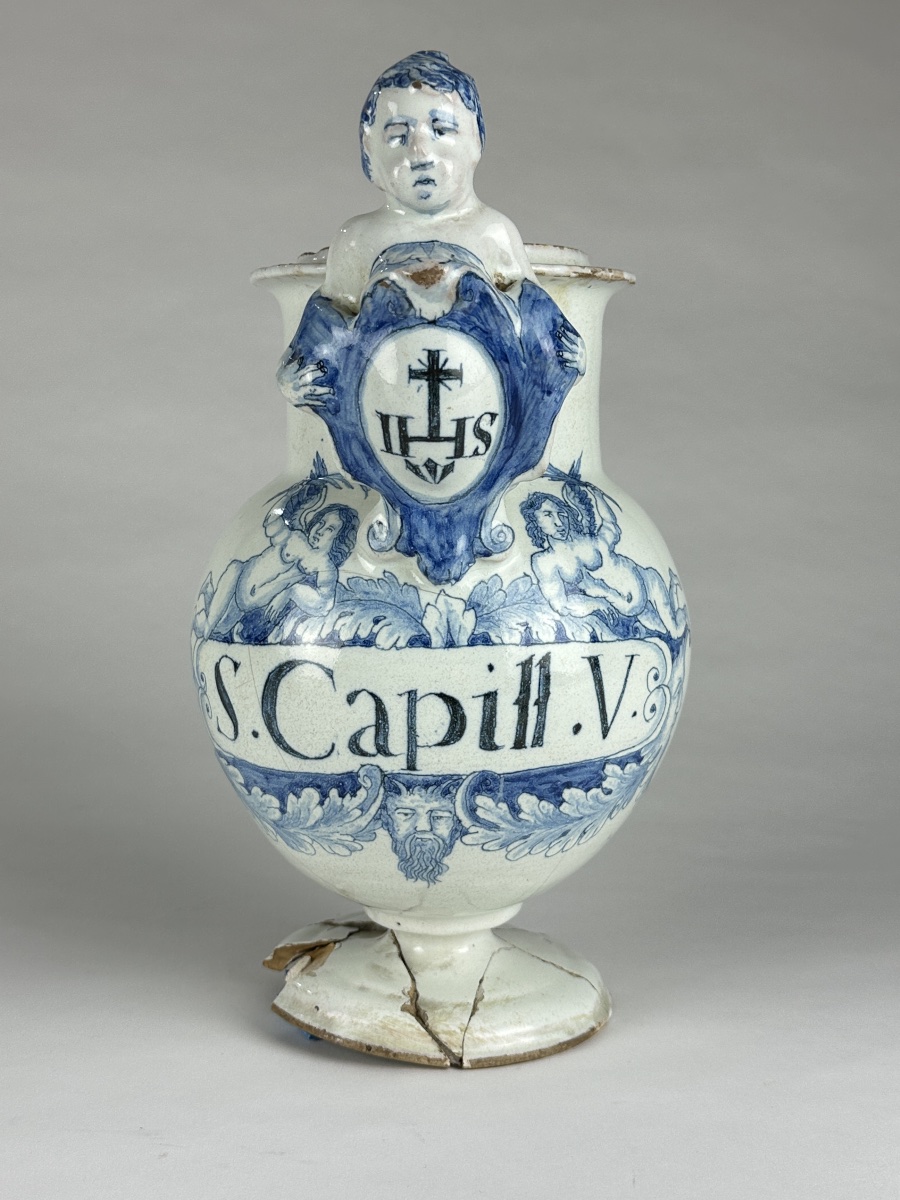
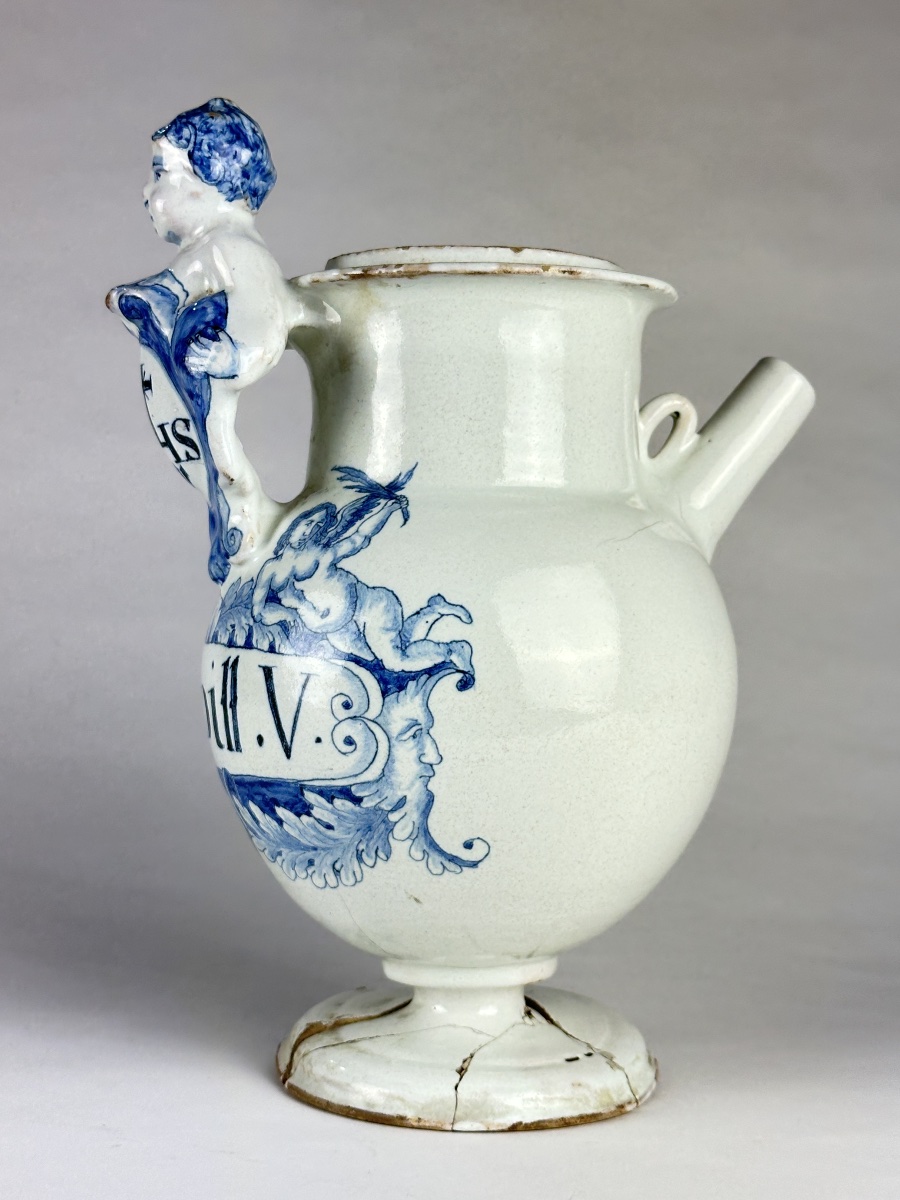
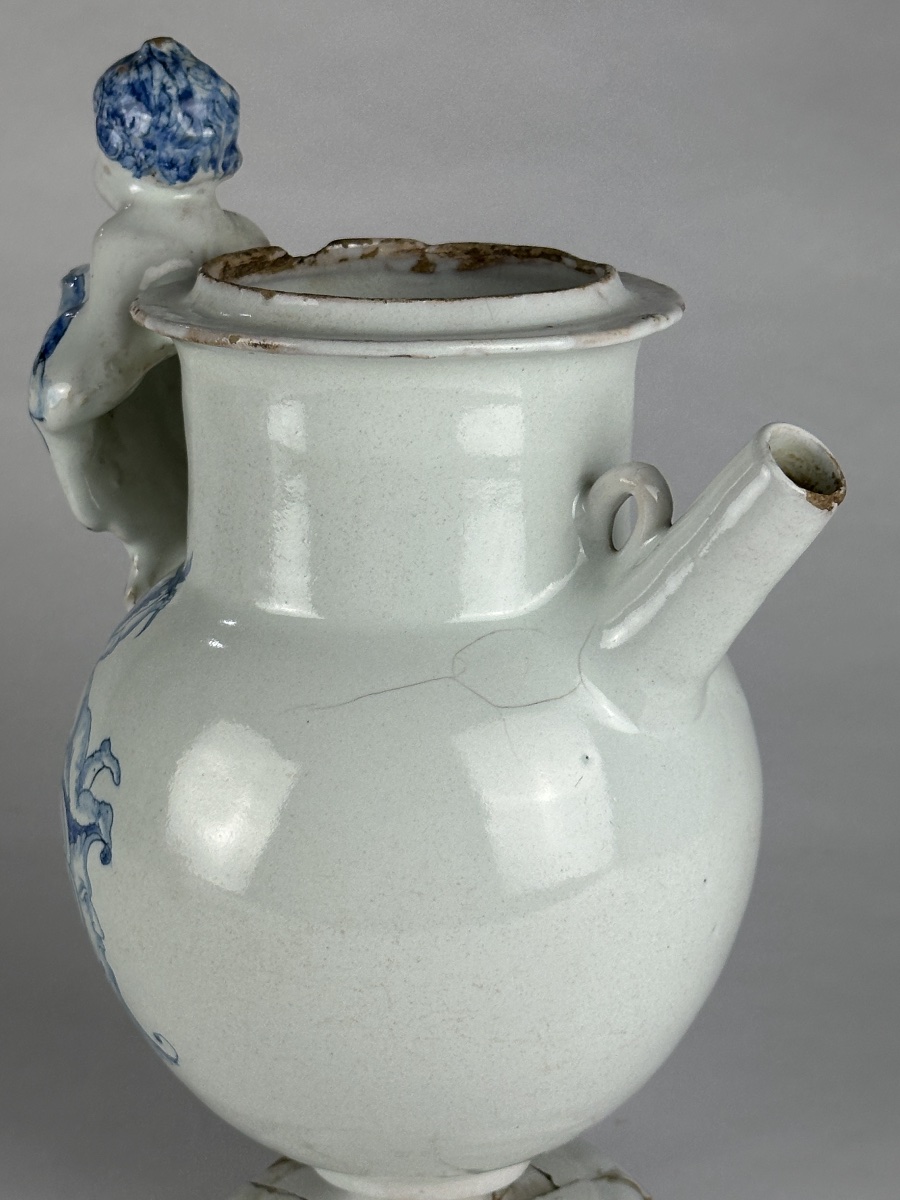
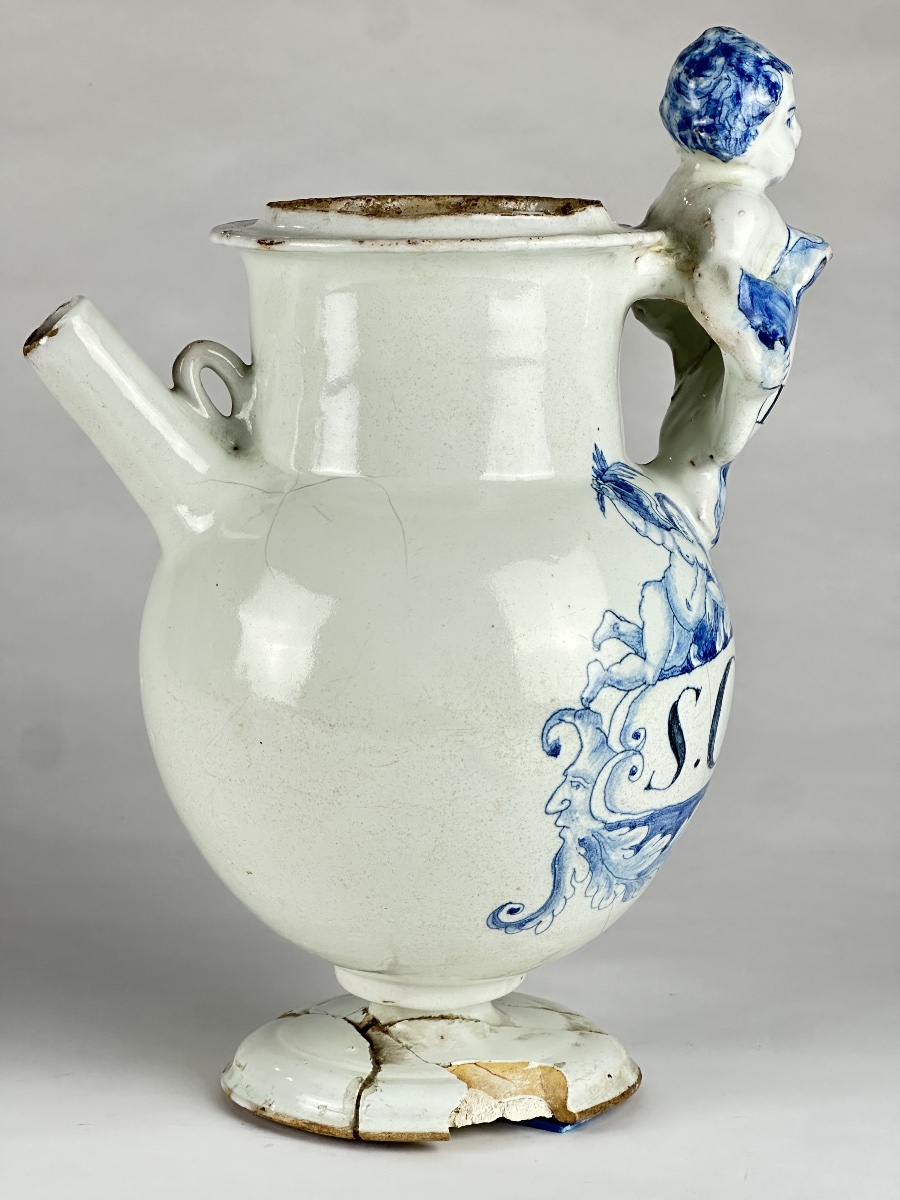
Rare pouring pitcher or apothecary jar made of tin-glazed earthenware, with a blue monochrome painted decoration on a white background. The piece features an ovoid body mounted on a pedestal, a side handle, a tubular spout, and a top opening fitted with a lid bearing a blue knob.
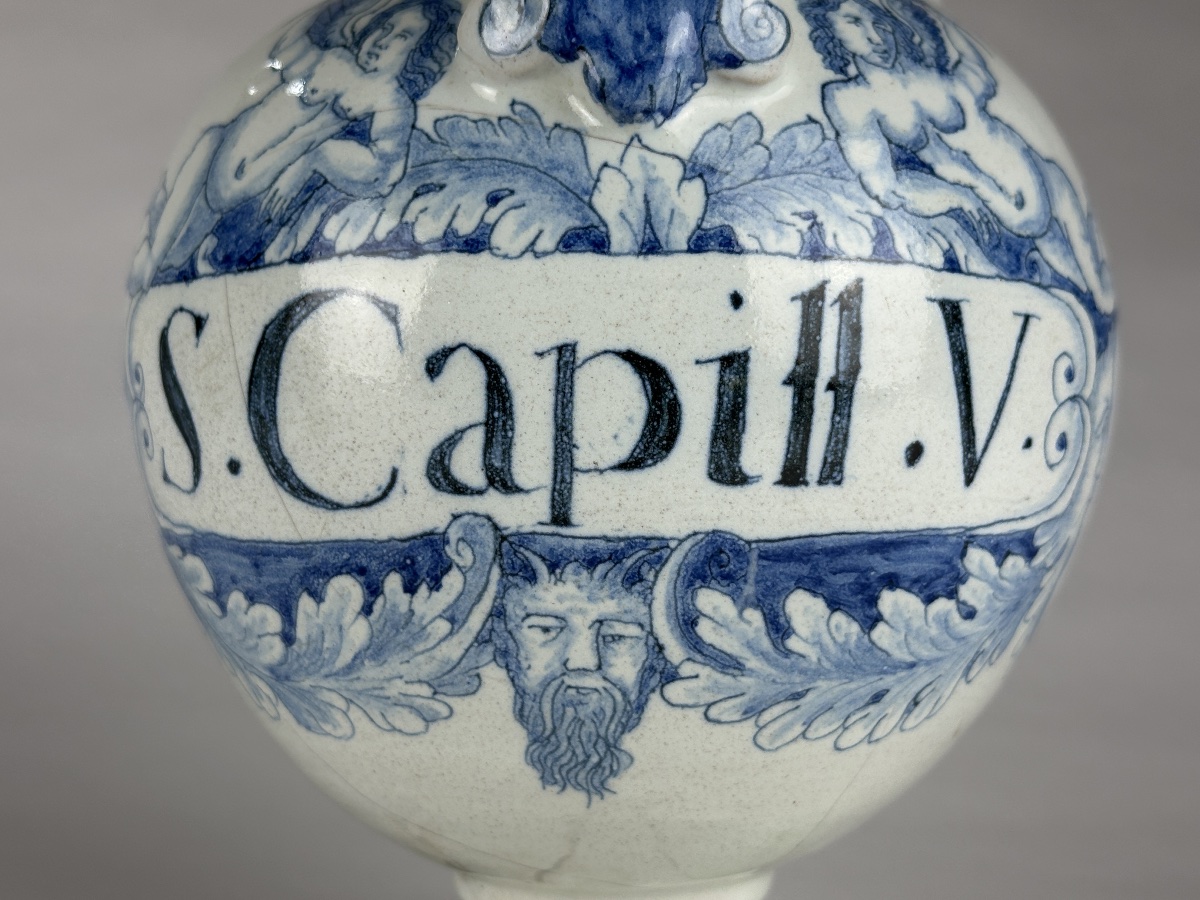
The main face bears the pharmaceutical inscription:
“ S. CAPILL. V.”
This abbreviated Latin formula can be expanded to “Syrupus Capillorum Veneris,” meaning “Venus’s Capillary Syrup.” This medicinal preparation, made from the Adiantum capillus-veneris fern, was used in ancient pharmacopoeias as an emollient and pectoral remedy, particularly for ailments of the throat and respiratory tract.
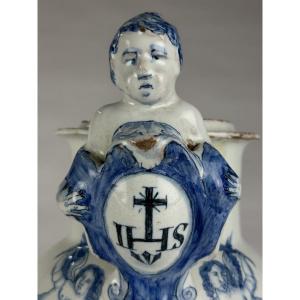
Above the inscription, a child depicted in relief holds a shield bearing the monogram IHS, accompanied by a cross and three nails. This Christological emblem, closely associated with the Society of Jesus, suggests that the piece was commissioned for a Jesuit community, a religious college pharmacy, or a major convent apothecary.
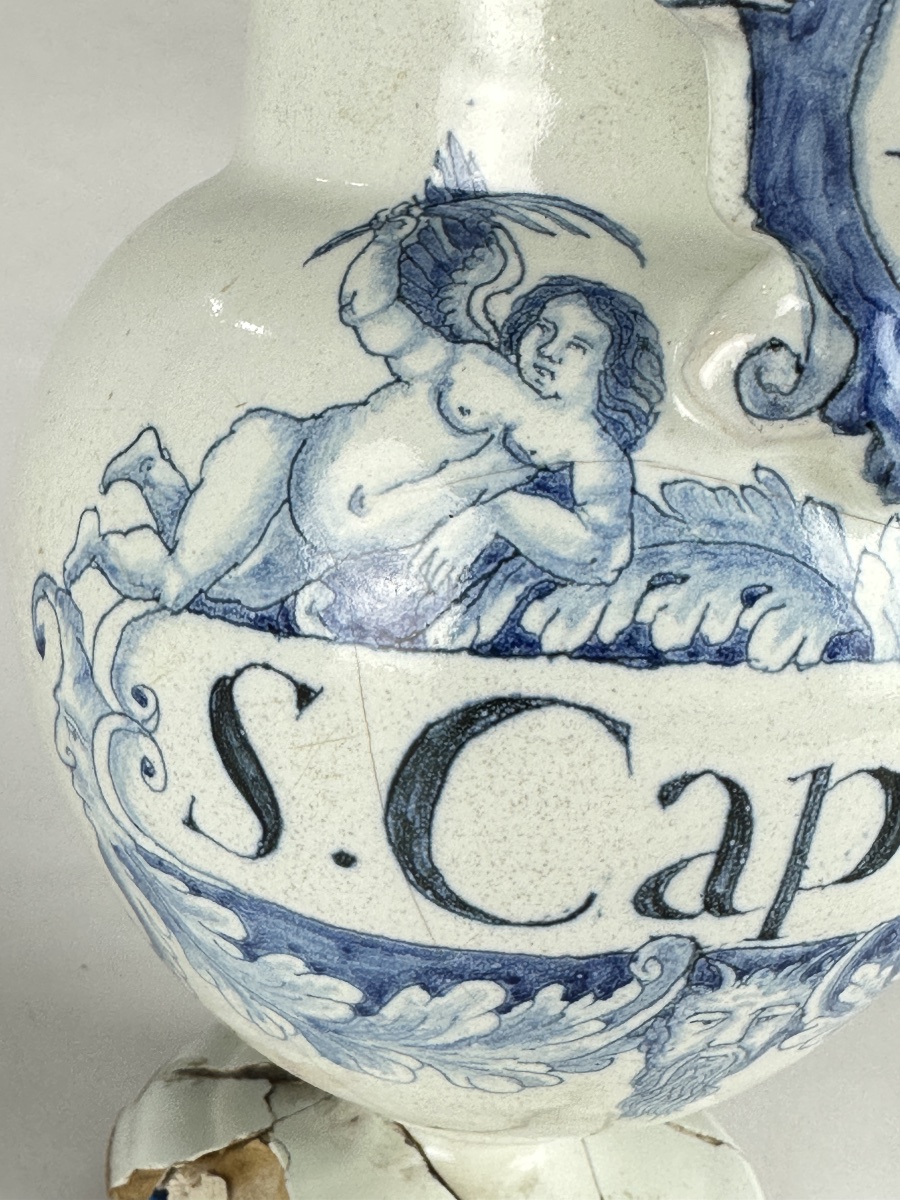
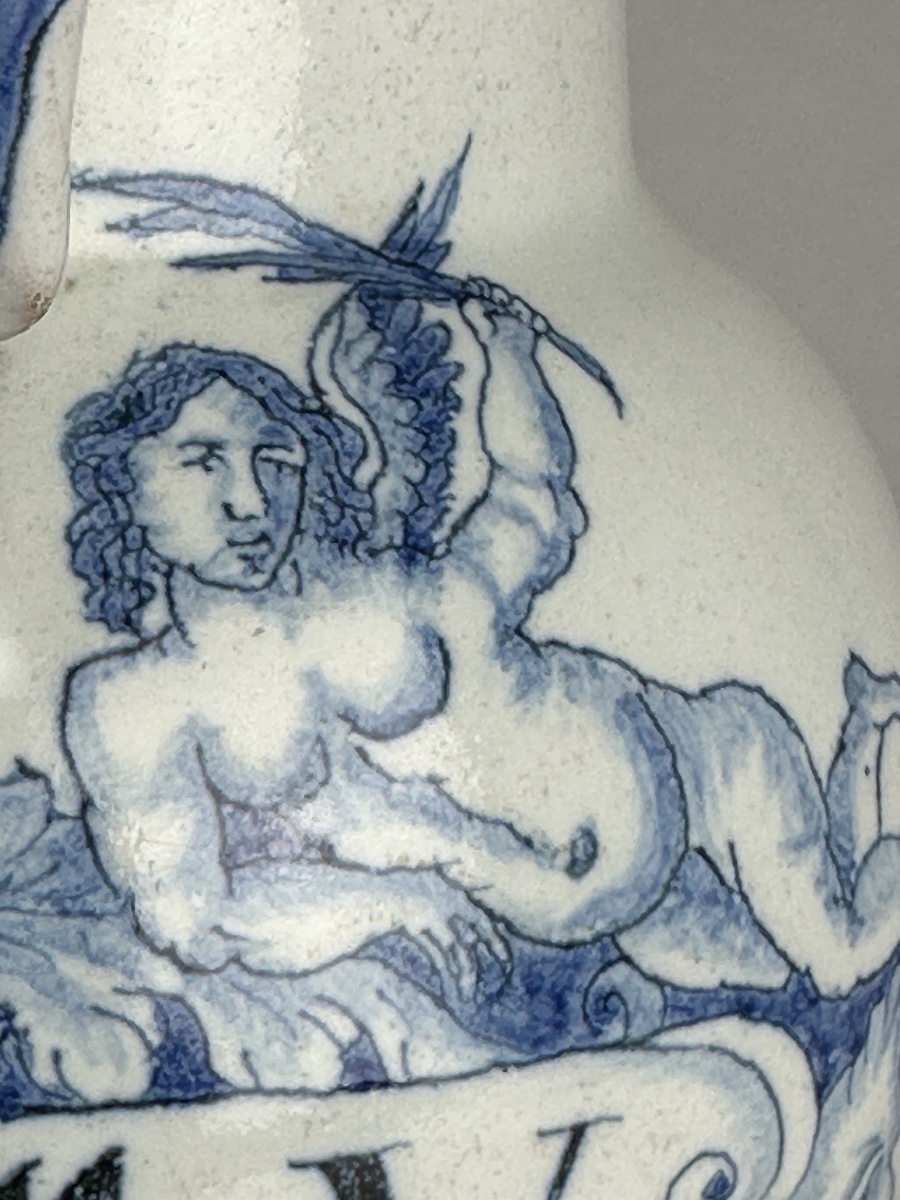
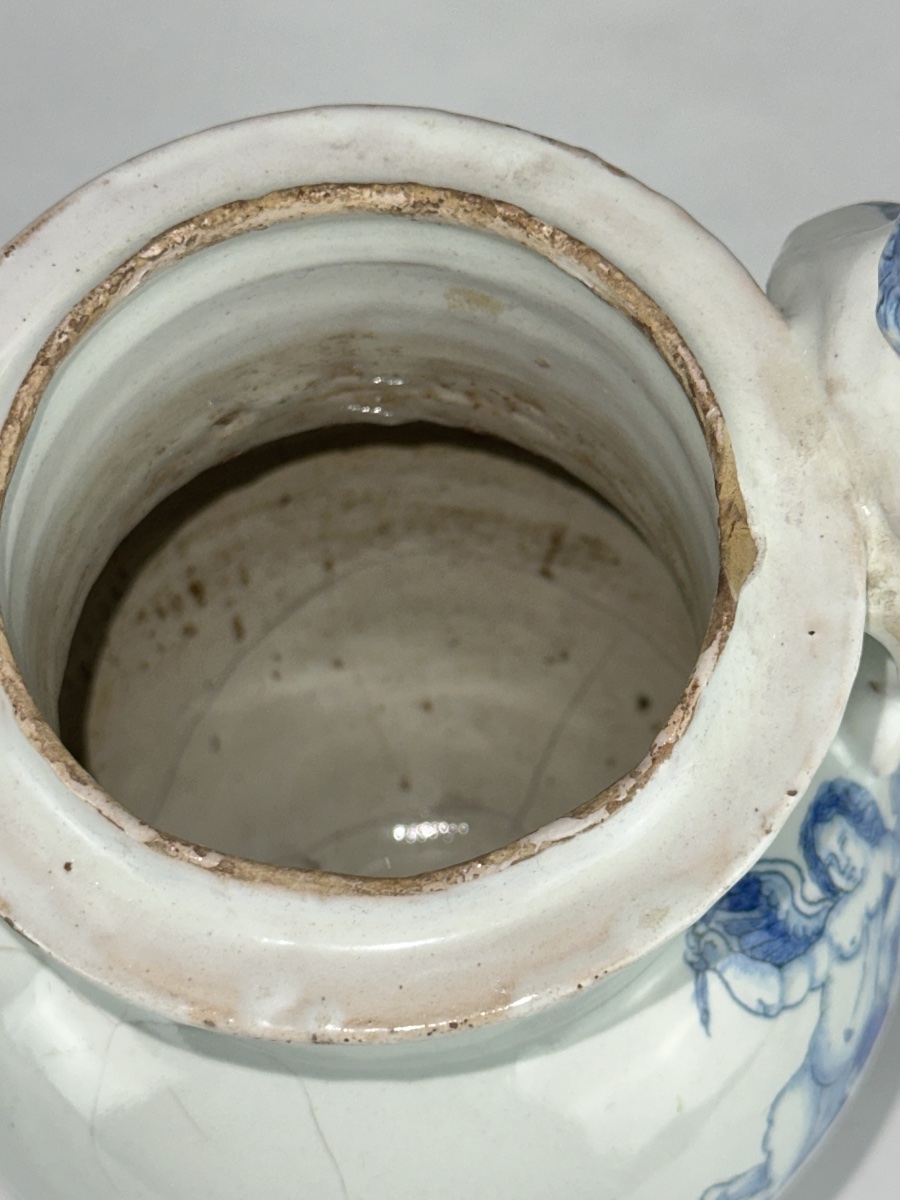
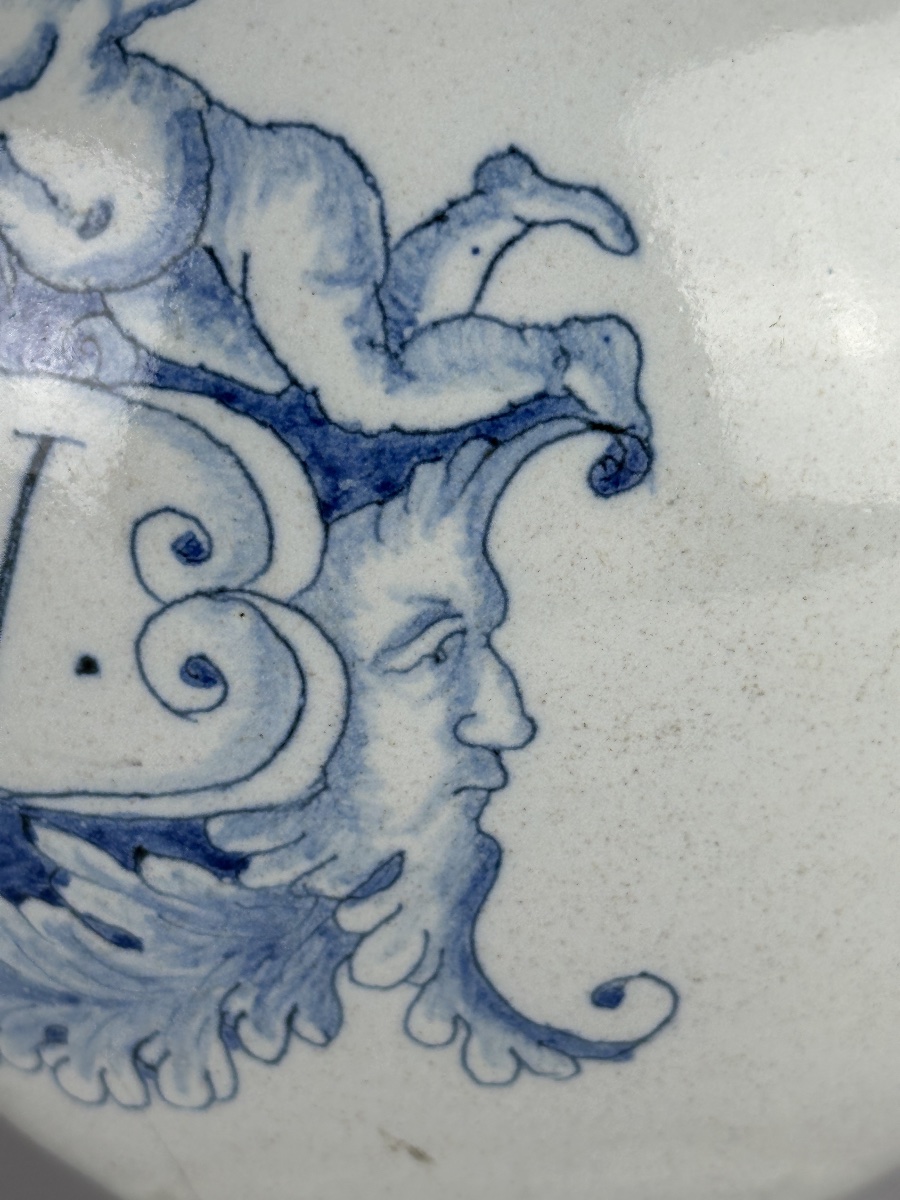
The highly elaborate decoration combines female figures and winged genies, foliage scrolls, mascarons, grotesques, and motifs inspired by the Mannerist repertoire. Two reclining figures frame the central cartouche. A bearded mascaron appears beneath the inscription, flanked on either side by fantastical faces integrated into the ornamentation.
The combined presence of a precise pharmaceutical inscription, a religious emblem, a figure modeled in the round, and such abundant figurative decoration distinguishes this piece from common apothecary vessels featuring simple floral decoration.
Two hypotheses regarding its origin can be considered.
The first points to Italian production commissioned for a Jesuit community. The major houses of the Society of Jesus maintained their own “spezierie,” particularly in colleges and novitiates. The Jesuit pharmacy in Novellara, in Emilia-Romagna, as well as that of the Collegio Romano in Rome, housed large collections of majolica vessels intended for the preparation and storage of medicines. The grotesque motifs, reclining figures, blue monochrome palette, and the IHS monogram are consistent with an Italian commission of an institutional nature.
The second hypothesis points to an apothecary in the Languedoc region, in the area of Montpellier, Toulouse, or Nîmes. In the late 17th and early 18th centuries, workshops in southern France produced small jugs and pharmaceutical pitchers strongly influenced by Italian majolica. At that time, Montpellier was a major medical and pharmaceutical center, surrounded by religious communities, hospitals, and important apothecaries.
Period: late 17th or early 18th century.
Dimensions: height 27.5 cm; width 20 cm; depth 15 cm.
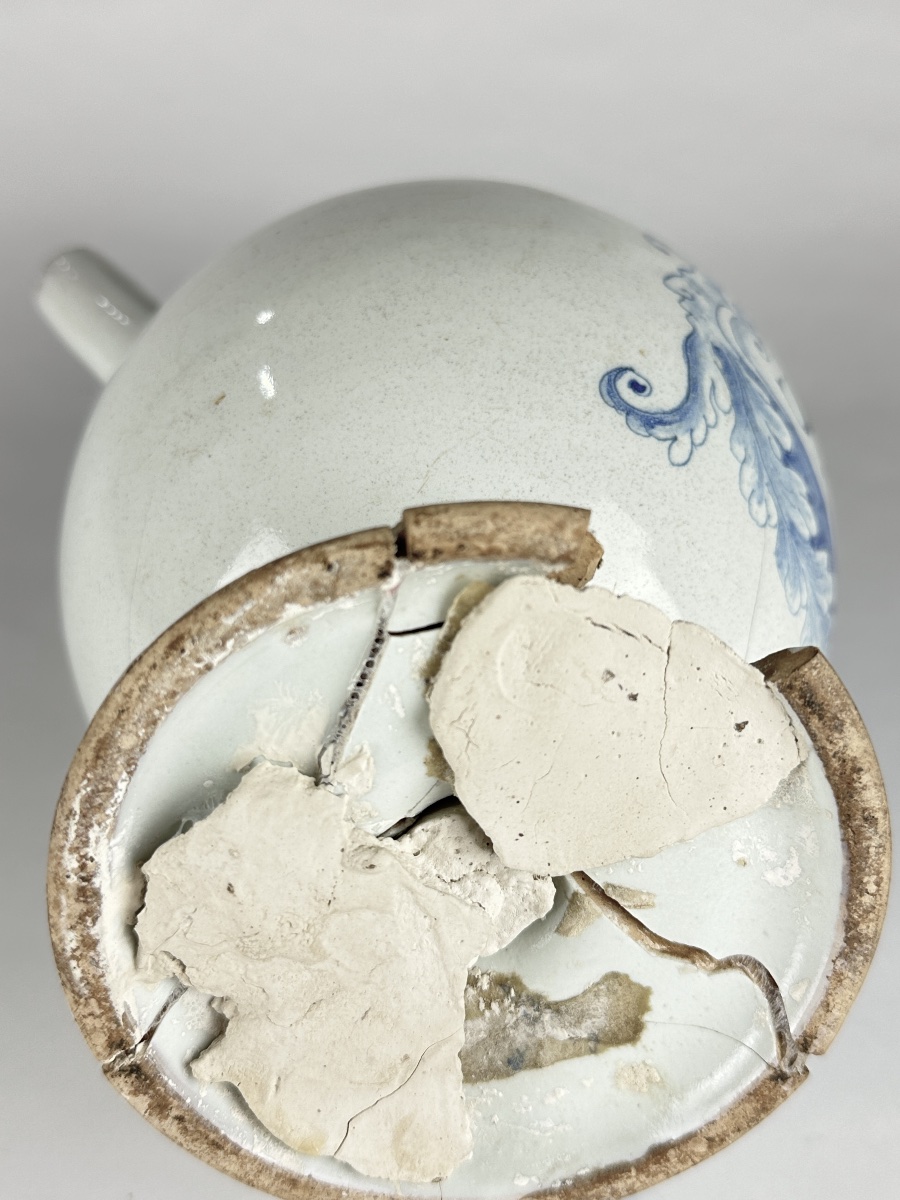
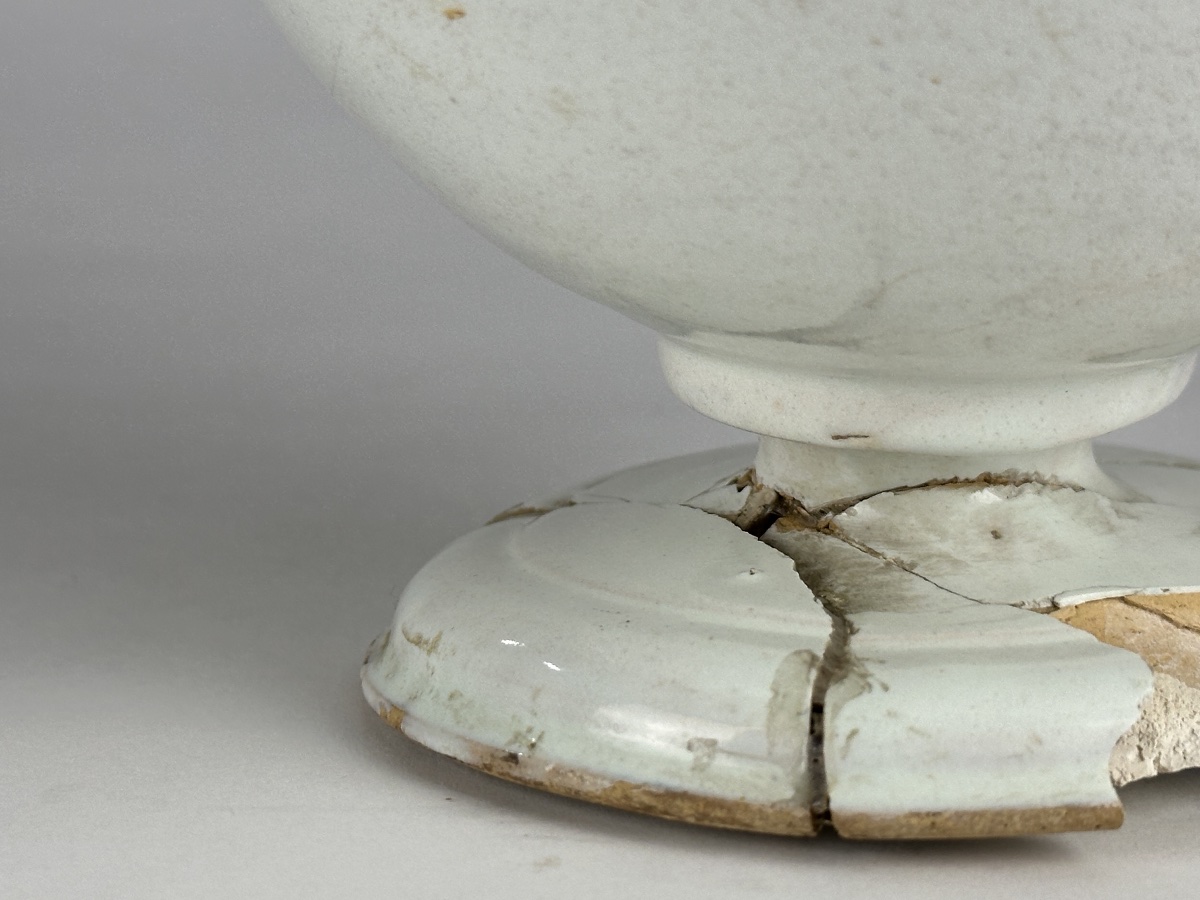
Condition: The foot was broken into several fragments and subsequently repaired. There are chips around the base, cracks extending from the foot up toward the body, as well as chipping, spalling, and wear on the glaze. Visible damage on certain protruding parts and along the rims. The piece remains recognizable and retains its main decoration, its pharmaceutical inscription, its spout, its handle, and its figure bearing the IHS monogram. The photographs are an integral part of the condition description.
Period: 17th century
Style: Renaissance, Louis 13th
Condition: En l'etat
Material: Earthenware
Height: 27,5
Reference (ID): 1797110
Availability: In stock