



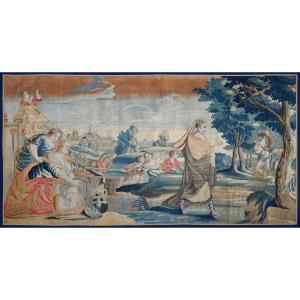


16th-century Tapestry From The Flandres Workshop—ulysses And Nausicaa, From Homer’s *odyssey*—no. 901
This magnificent tapestry has undergone a thorough cleaning, as well as being hand-lined with 100% linen fabric and meticulously inspected by our experts in our artisanal workshop. It is now ready to adorn your home
Ulysses and Nausicaa
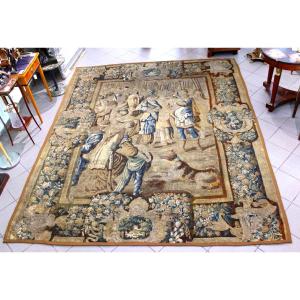
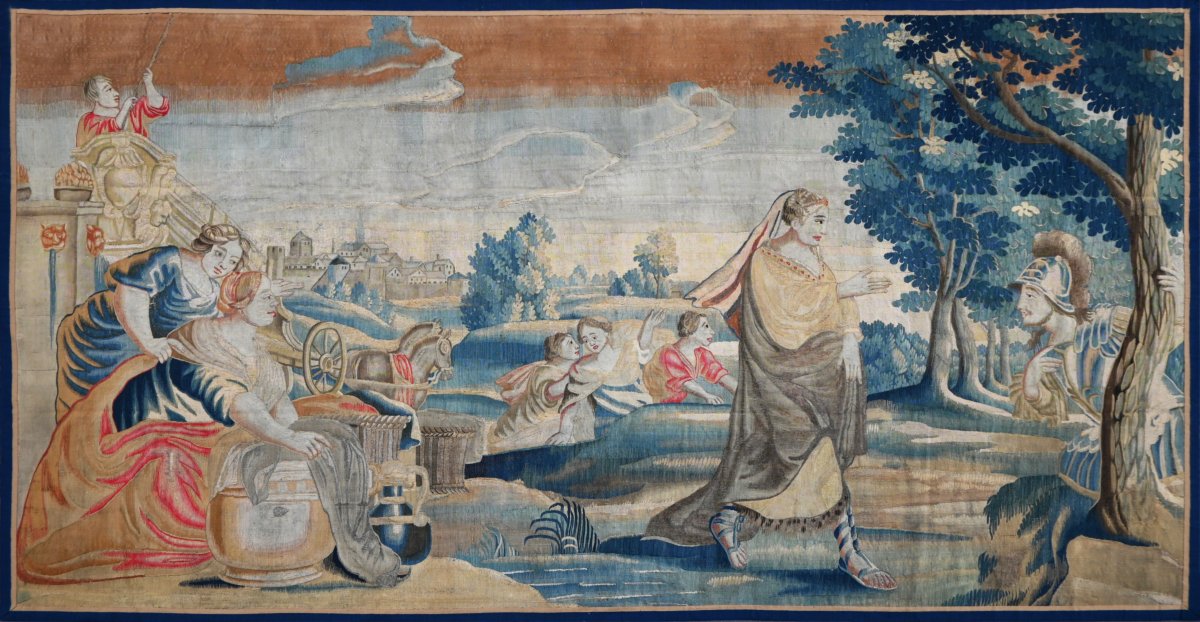
This remarkable 17th-century work from the Manufacture des Flandres depicts a famous episode from Book VI of Homer’s Odyssey. It depicts the chance encounter between the Greek hero Odysseus and the Phaeacian princess Nausicaa, rendered in the Baroque and theatrical style of the era.
The Mythological Story
After a terrible shipwreck caused by the god Poseidon, Odysseus washes ashore alone and exhausted on the coast of the island of Scheria. At the same time, the young princess Nausicaa, guided by a dream inspired by the goddess Athena, goes to the river accompanied by her maidservants to wash the royal family’s laundry. After finishing their chores, the young women play with a ball. Their bursts of laughter awaken Odysseus, who then emerges from the thicket, transforming a simple day of chores into a crucial mythological encounter.
The Characters and Composition
The tapestry’s composition unfolds from right to left, contrasting the castaway’s wild world with the civilized, domestic world of the royal court:
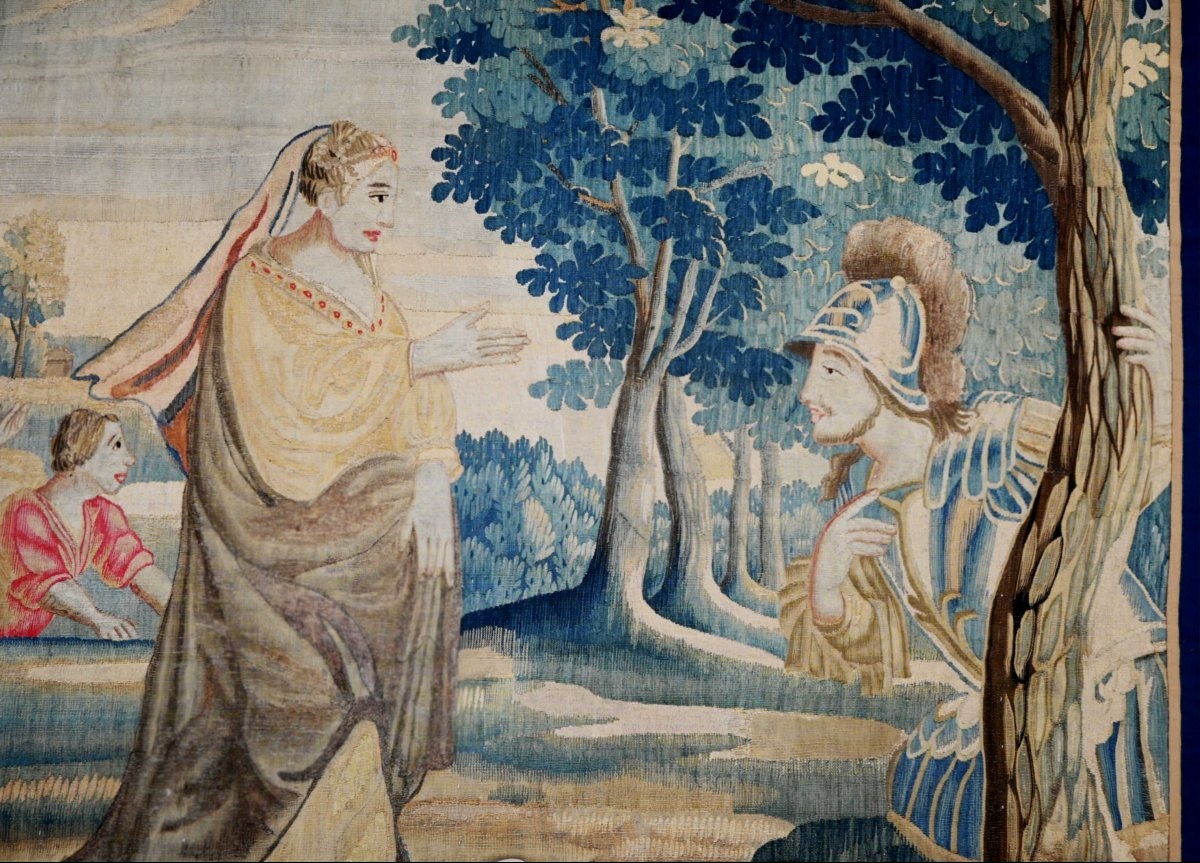
Odysseus (on the right): Emerging from behind a large tree, the Greek hero observes the scene.
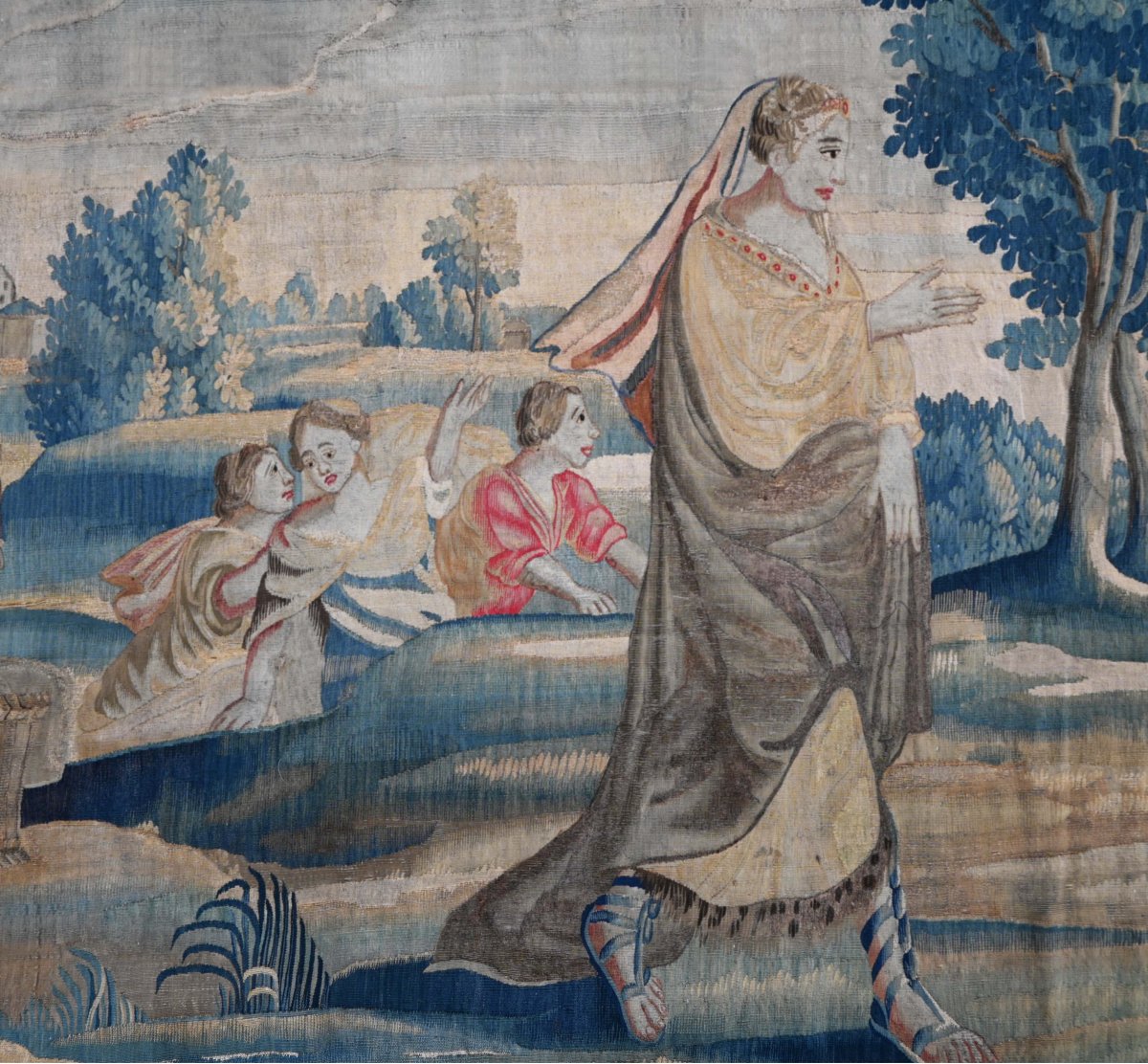
Princess Nausicaa (center): The queen of the scene, she advances with grace and dignity, dressed in rich drapery and wearing a veil. Unlike her companions, she does not flee. Endowed with great courage, she reaches out her hand toward Odysseus in a gesture of welcome and dialogue.
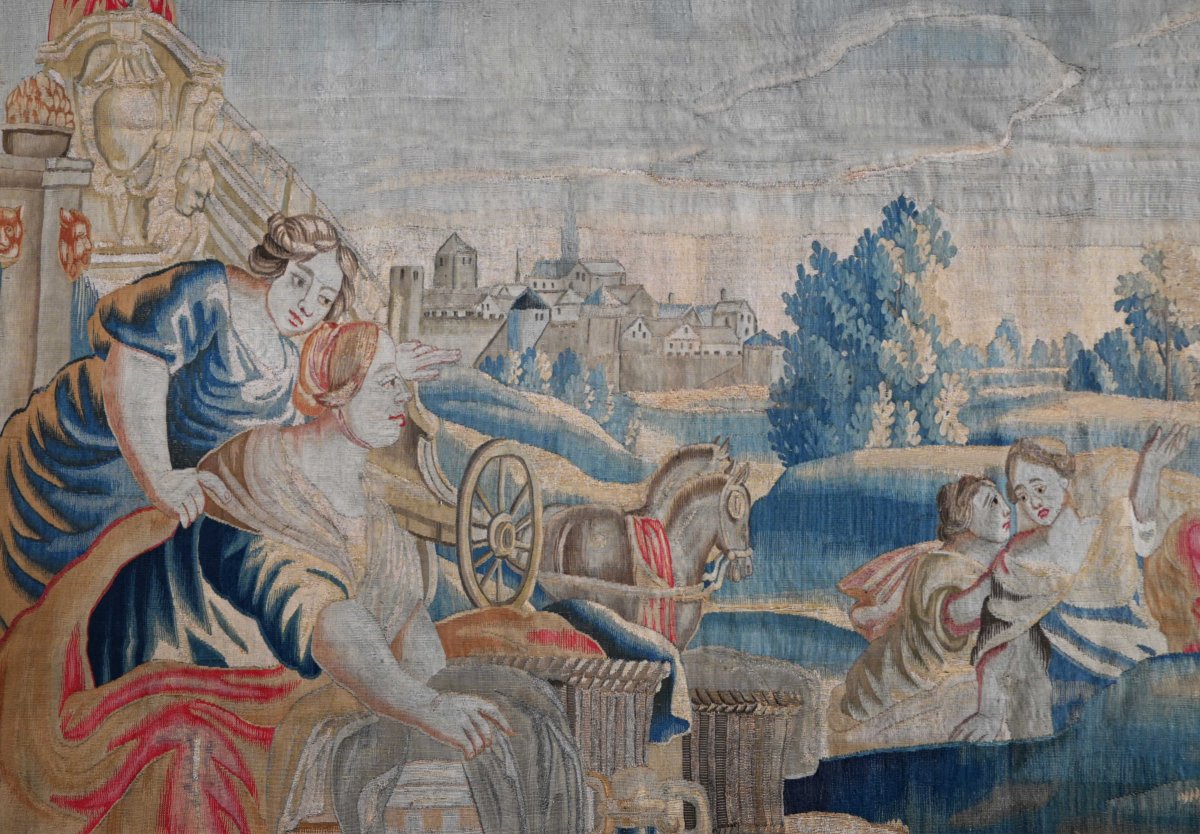
The maidservants and washerwomen (on the left and in the background): They embody panic and domestic labor. In the background, some are running away, terrified by the appearance of the stranger. In the foreground on the left, two of them are busy around a large terracotta jar and baskets of laundry, while the mule-drawn cart used for transport waits in the background.
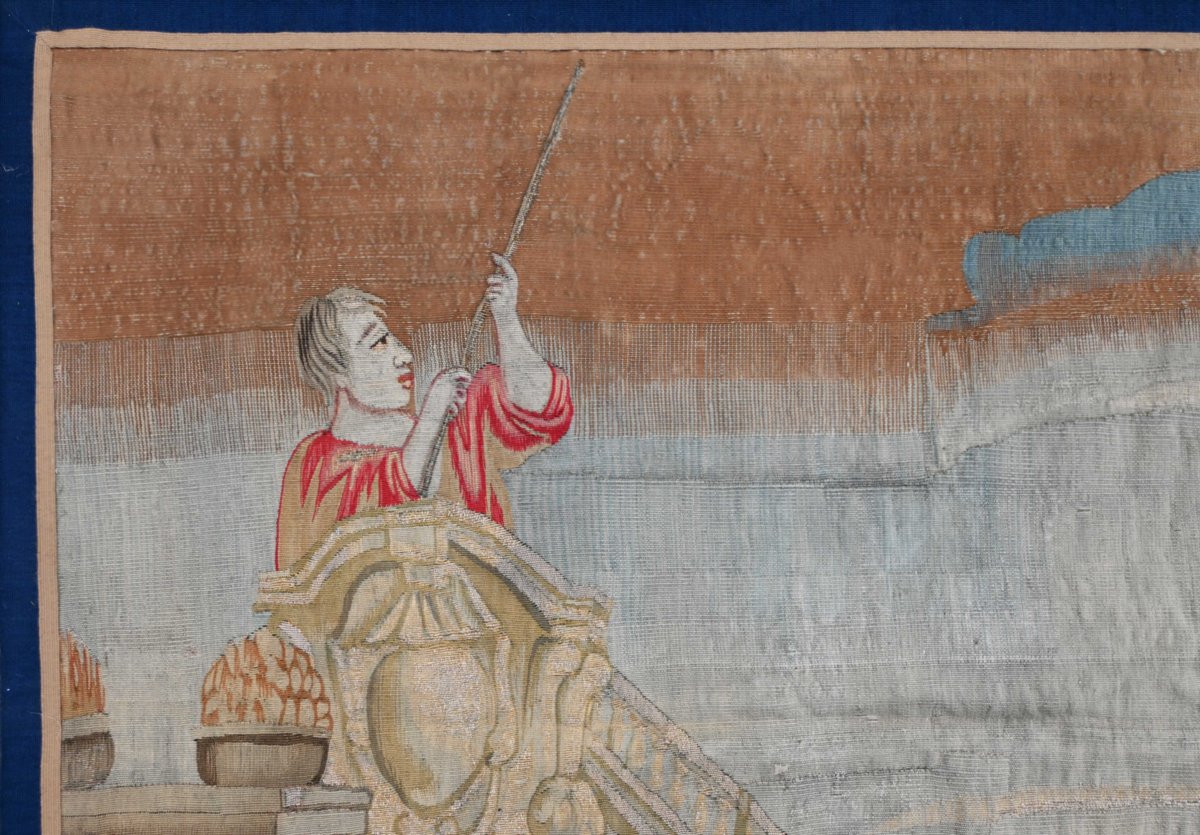
The laborer (top left): Perched high on a balustrade, this secondary character (absent from Homer’s narrative but invented by the tapestry’s cartoonist) adds a touch of everyday life. Holding a pole for hanging laundry or guiding the team of mules, he calmly oversees the logistics, creating an amusing and typically Baroque contrast with the intense drama unfolding at the other end of the work.
Historical Clarification: Why Is Odysseus Wearing Roman Armor?
One detail immediately strikes the attentive viewer: Odysseus is not naked, unlike in Homer’s text, where he emerges from the bushes stripped of all his clothes after his shipwreck. Instead, he is depicted wearing gleaming armor and a Roman soldier’s helmet. This was not an error on the part of the 17th-century artists, but a deliberate choice in keeping with several conventions of the time:
The rule of propriety (Decorum): In the 17th century, under the influence of classical and Baroque conventions, it was unthinkable and considered indecent to depict a fully nude man on a tapestry intended to adorn the walls of a castle or a wealthy residence. Clothing him allowed for respect for the modesty of the era.
The affirmation of his status as a hero: To ensure that the viewer would instantly recognize Odysseus as a great king and warlord (the victor of the Trojan War) rather than as a mere vagabond or a bandit of the woods, the tapestry weaver dressed him in the ideal attire of an ancient warrior: ceremonial Roman-style armor.
The Baroque Aesthetic: Flemish workshops sought visual opulence. Weaving in details of gilded armor, bluish metallic sheen, and a helmet adorned with a plume offered a far more spectacular and theatrical artistic effect than a naked body weathered by the sea.
Style and Setting
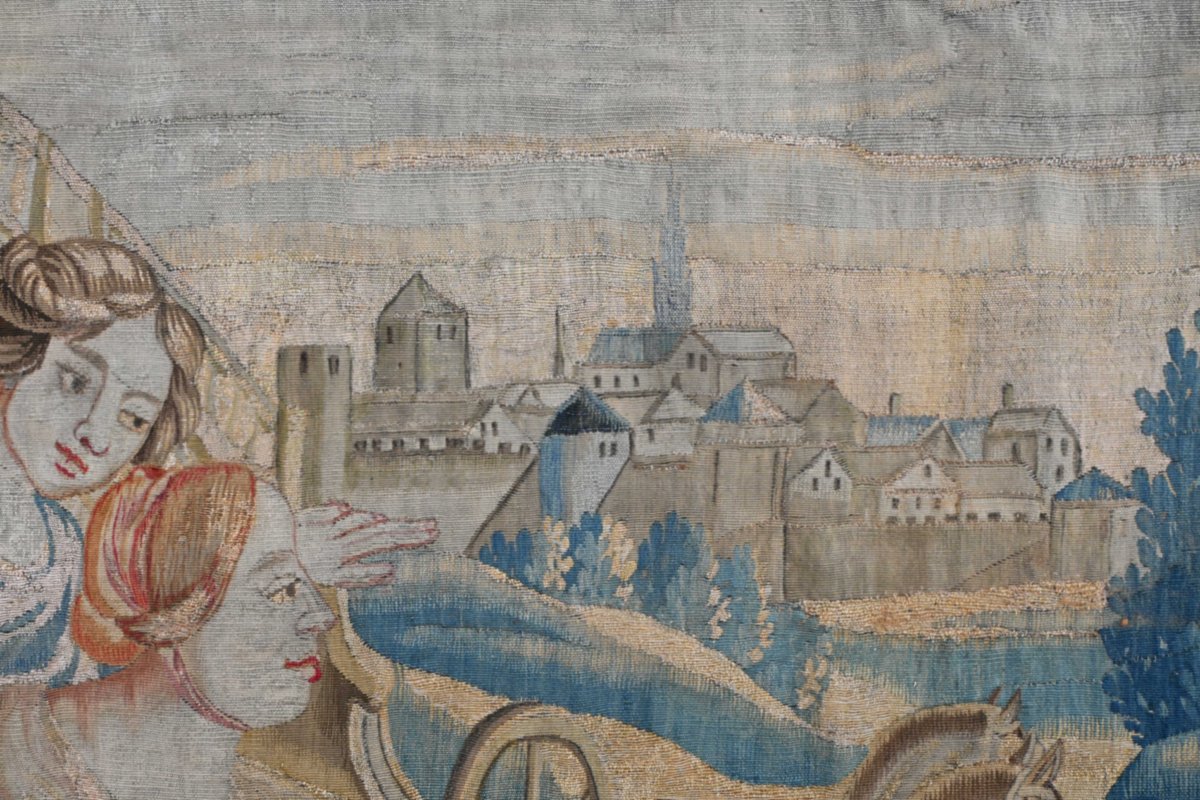
The background landscape features a fortified city representing the palace of King Alcinous, Nausicaa’s father. The depiction of nature, with its densely foliaged trees and shades of blue-green (characteristic of the famous Flemish “verdures”), attests to the exceptional skill of 17th-century Flemish workshops in integrating grand epic narratives into the heart of bucolic and vibrant settings.
Ulysses and Nausicaa
This remarkable 17th-century work from the Manufacture des Flandres depicts a famous episode from Book VI of Homer’s Odyssey. It depicts the chance encounter between the Greek hero Odysseus and the Phaeacian princess Nausicaa, rendered in the Baroque and theatrical style of the era.
The Mythological Story
After a terrible shipwreck caused by the god Poseidon, Odysseus washes ashore alone and exhausted on the coast of the island of Scheria. At the same time, the young princess Nausicaa, guided by a dream inspired by the goddess Athena, goes to the river accompanied by her maidservants to wash the royal family’s laundry. After finishing their chores, the young women play with a ball. Their bursts of laughter awaken Odysseus, who then emerges from the thicket, transforming a simple day of chores into a crucial mythological encounter.
The Characters and Composition
The tapestry’s composition unfolds from right to left, contrasting the castaway’s wild world with the civilized, domestic world of the royal court:
Odysseus (on the right): Emerging from behind a large tree, the Greek hero observes the scene.
Princess Nausicaa (center): The queen of the scene, she advances with grace and dignity, dressed in rich drapery and wearing a veil. Unlike her companions, she does not flee. Endowed with great courage, she reaches out her hand toward Odysseus in a gesture of welcome and dialogue.
The maidservants and washerwomen (on the left and in the background): They embody panic and domestic labor. In the background, some are running away, terrified by the appearance of the stranger. In the foreground on the left, two of them are busy around a large terracotta jar and baskets of laundry, while the mule-drawn cart used for transport waits in the background.
The laborer (top left): Perched high on a balustrade, this secondary character (absent from Homer’s narrative but invented by the tapestry’s cartoonist) adds a touch of everyday life. Holding a pole for hanging laundry or guiding the team of mules, he calmly oversees the logistics, creating an amusing and typically Baroque contrast with the intense drama unfolding at the other end of the work.
Historical Clarification: Why Is Odysseus Wearing Roman Armor?
One detail immediately strikes the attentive viewer: Odysseus is not naked, unlike in Homer’s text, where he emerges from the bushes stripped of all his clothes after his shipwreck. Instead, he is depicted wearing gleaming armor and a Roman soldier’s helmet. This was not an error on the part of the 17th-century artists, but a deliberate choice in keeping with several conventions of the time:
The rule of propriety (Decorum): In the 17th century, under the influence of classical and Baroque conventions, it was unthinkable and considered indecent to depict a fully nude man on a tapestry intended to adorn the walls of a castle or a wealthy residence. Clothing him allowed for respect for the modesty of the era.
The affirmation of his status as a hero: To ensure that the viewer would instantly recognize Odysseus as a great king and warlord (the victor of the Trojan War) rather than as a mere vagabond or a bandit of the woods, the tapestry weaver dressed him in the ideal attire of an ancient warrior: ceremonial Roman-style armor.
The Baroque Aesthetic: Flemish workshops sought visual opulence. Weaving in details of gilded armor, bluish metallic sheen, and a helmet adorned with a plume offered a far more spectacular and theatrical artistic effect than a naked body weathered by the sea.
Style and Setting
The background landscape features a fortified city representing the palace of King Alcinous, Nausicaa’s father. The depiction of nature, with its densely foliaged trees and shades of blue-green (characteristic of the famous Flemish “verdures”), attests to the exceptional skill of 17th-century Flemish workshops in integrating grand epic narratives into the heart of bucolic and vibrant settings.
12 000 €
Period: 17th century
Style: Rome and Antic Greece
Condition: Perfect condition
Material: Wool
Width: 360 cm
Height: 210 cm
Depth: 0.5
Reference (ID): 1795624
Availability: In stock
Print