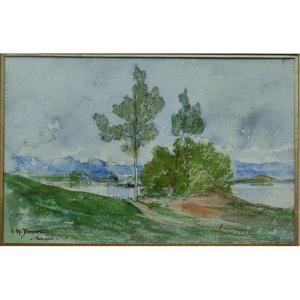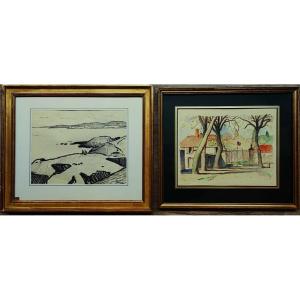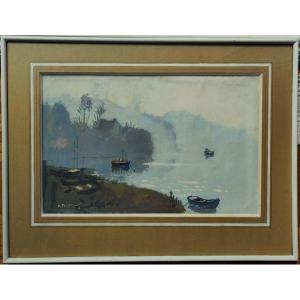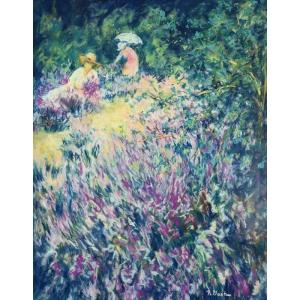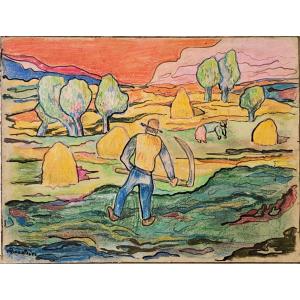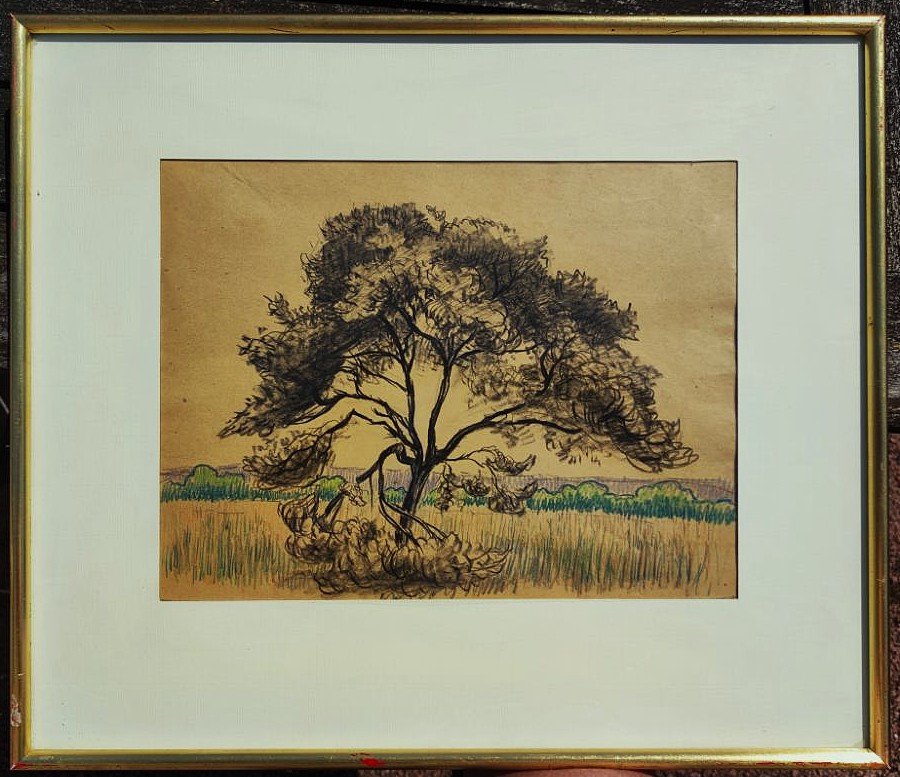
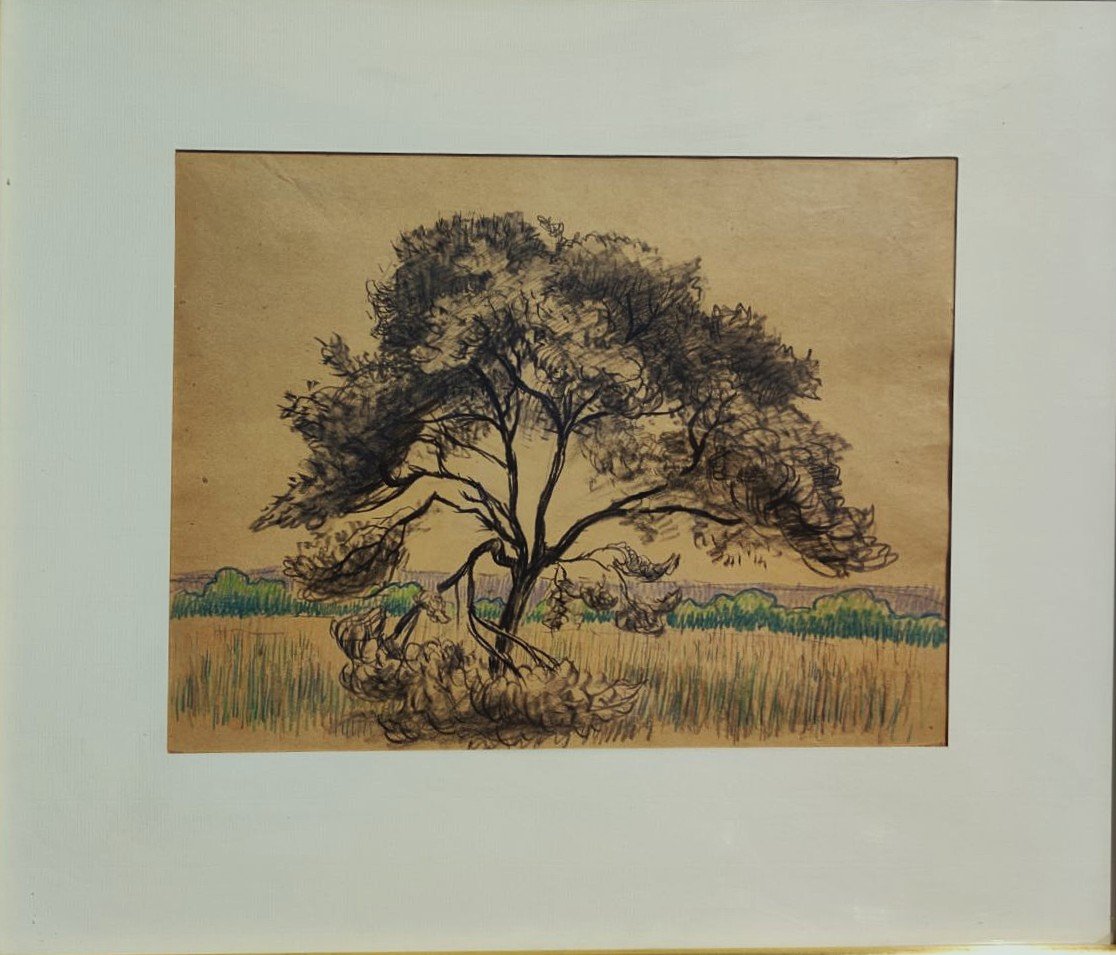
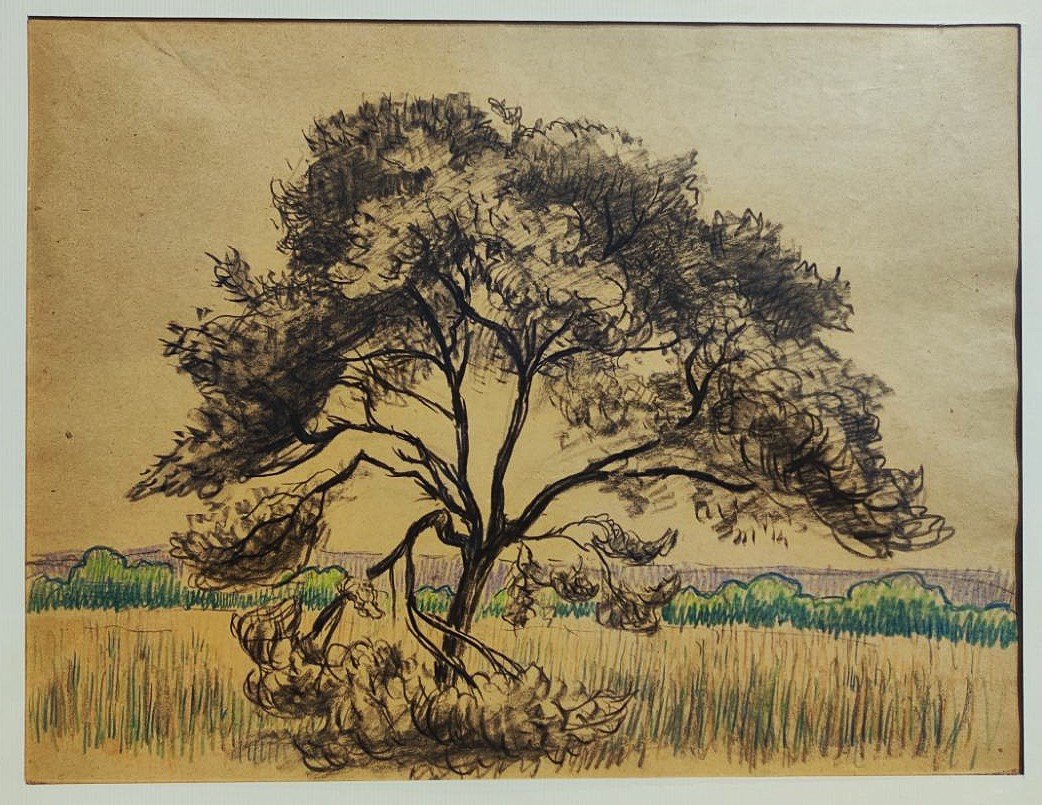
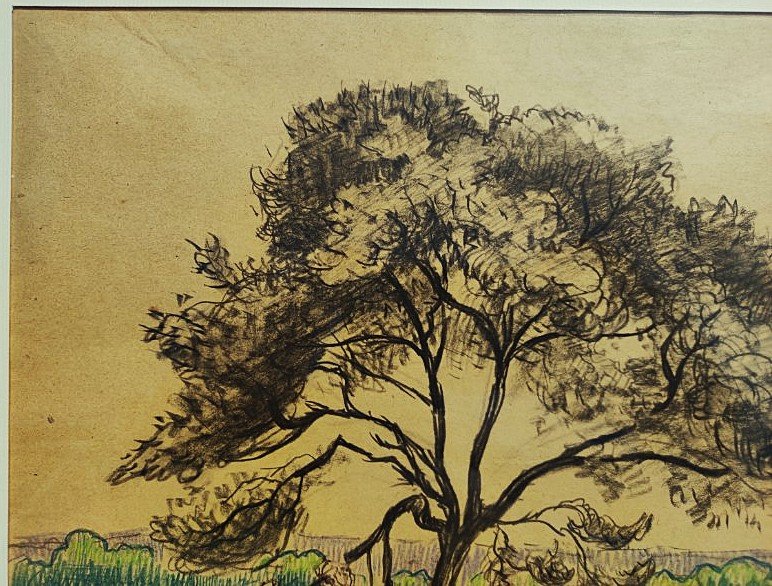
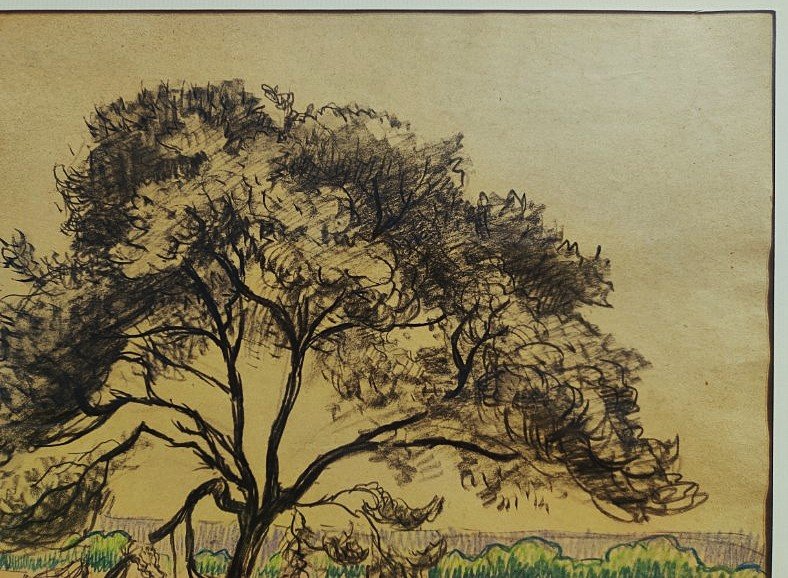
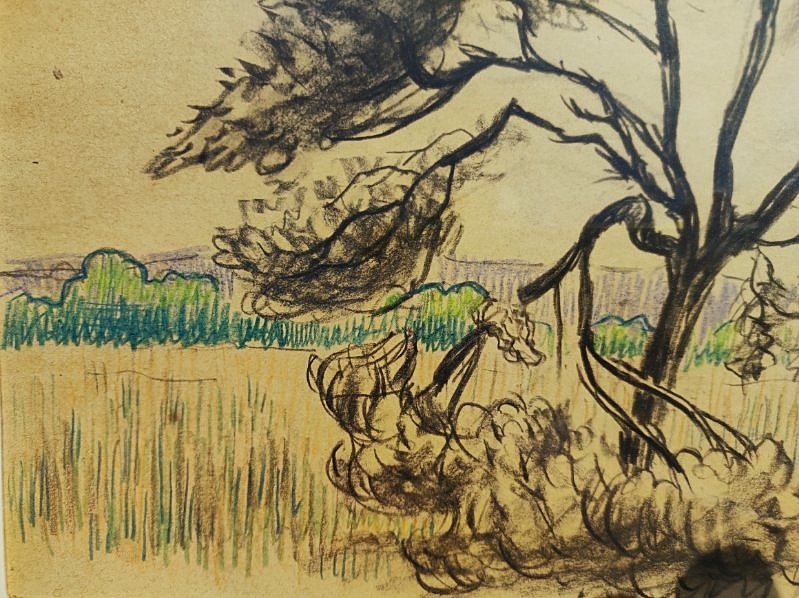
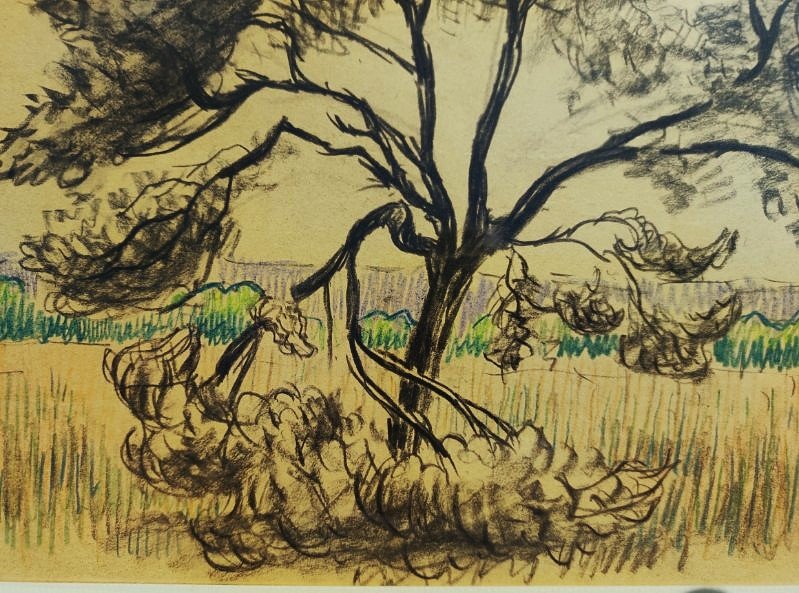
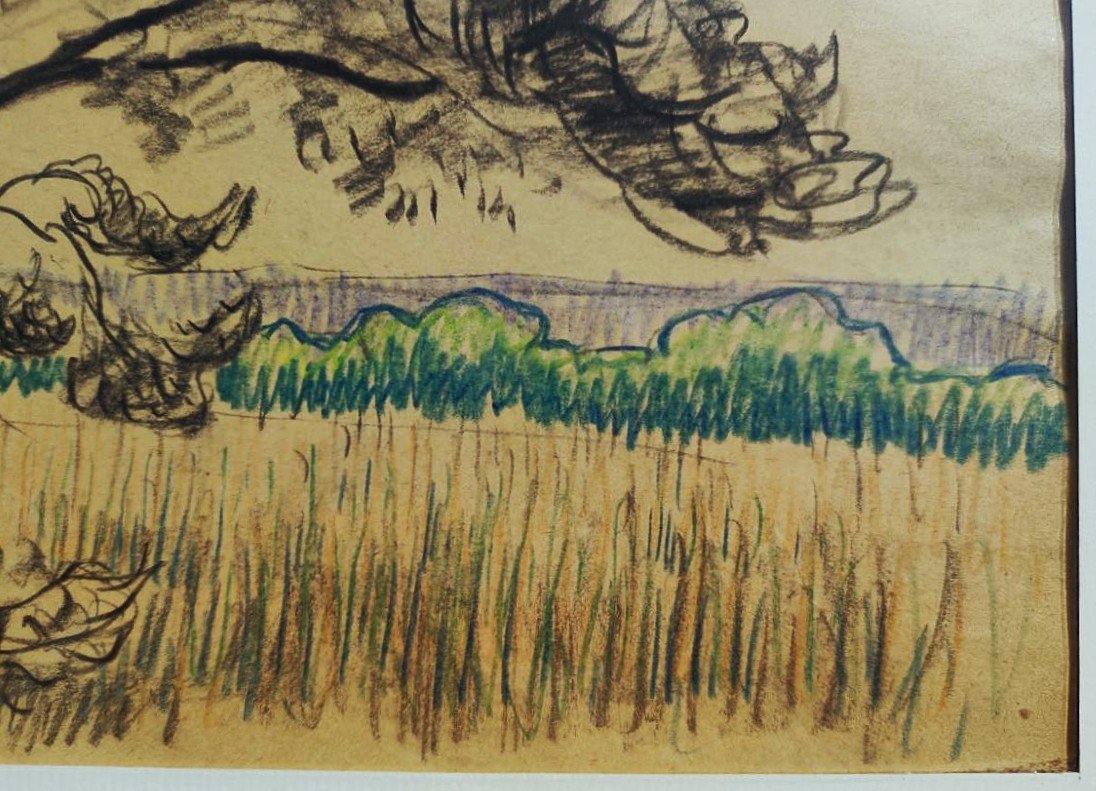
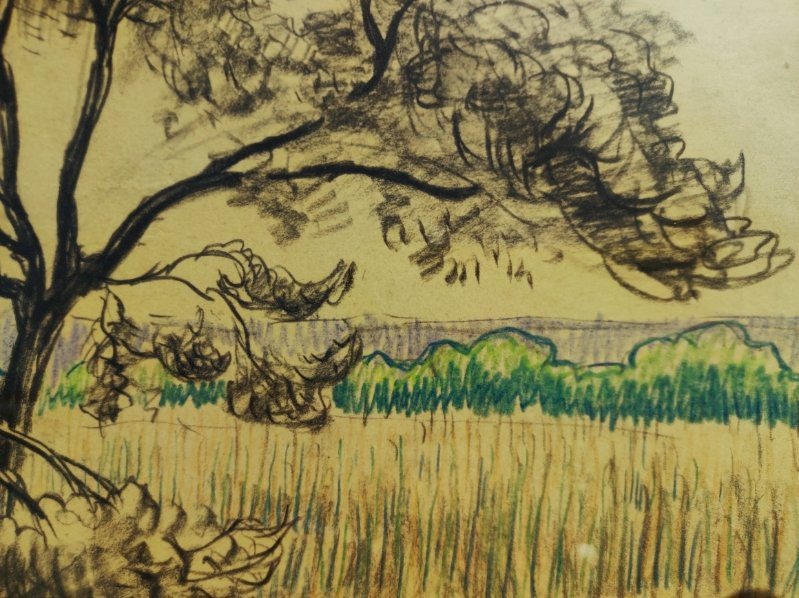
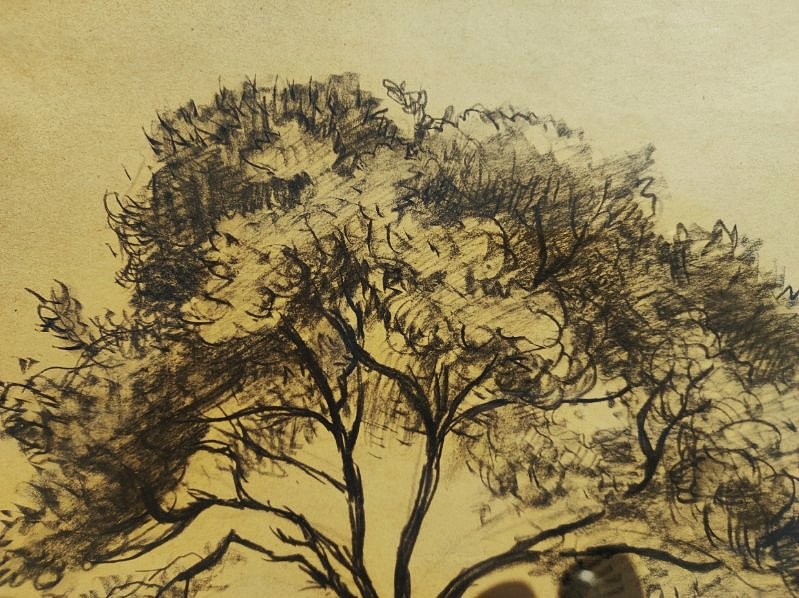
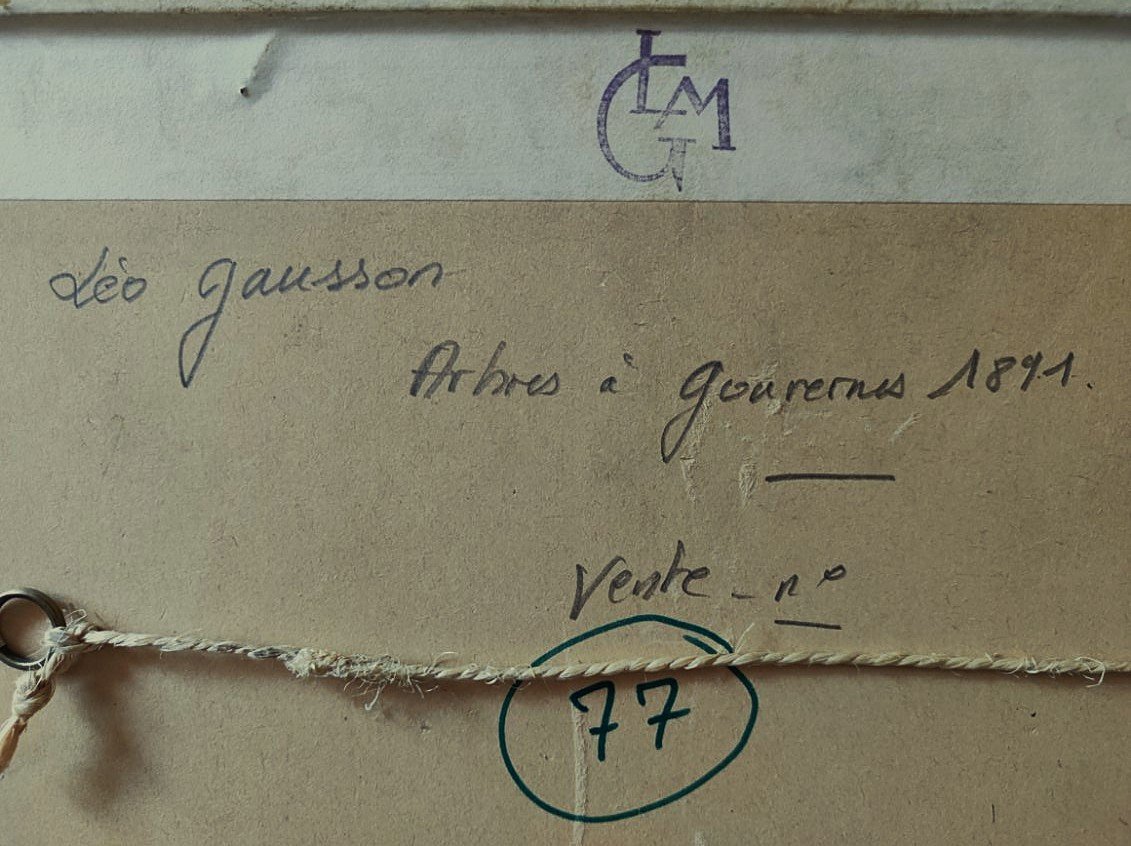
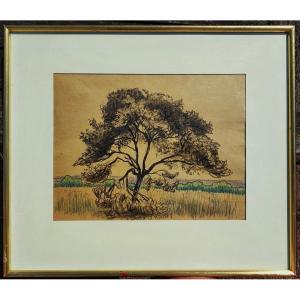


Léo Gausson (1860–1944), *tree And Landscape At Gouvernes*, 1891. Lagny School, Pointillism, Luce...
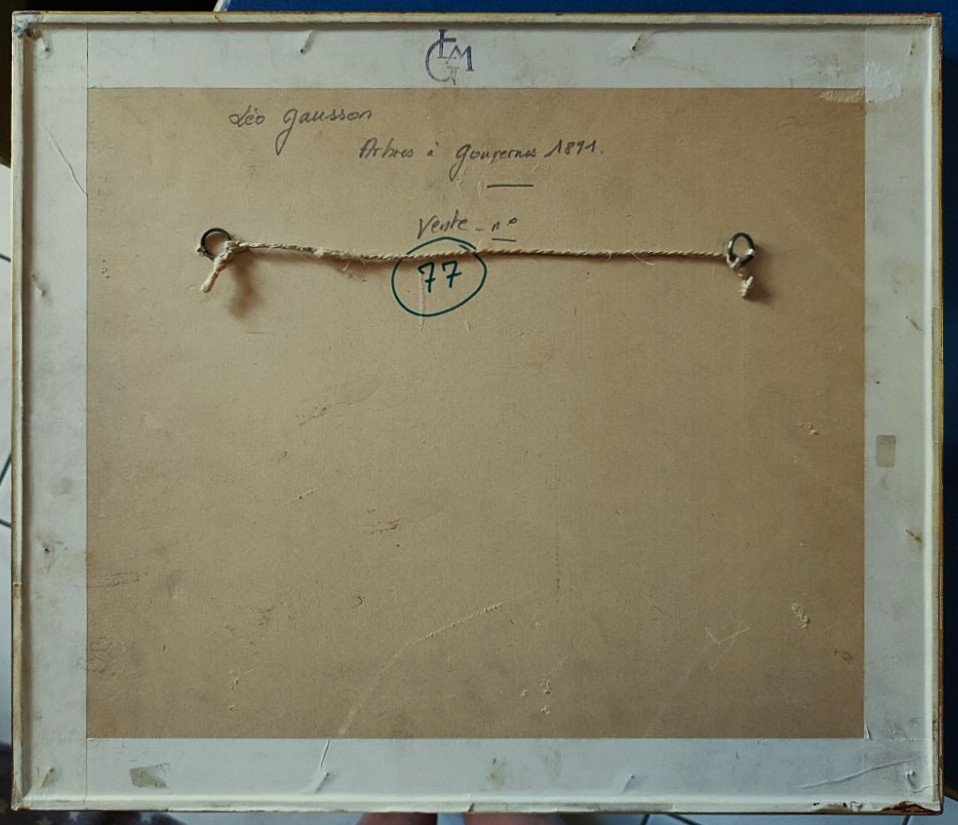
Dimensions of the drawing alone (unframed): 24x31 cm; 40x46.5 cm including the frame.
The drawing is in good condition and comes in an antique gold-leaf frame.
Authenticity guaranteed.
Probable provenance: sale of part of the artist’s studio collection.
This is therefore a magnificent colored pencil drawing by Léo Gausson, a relatively early work; the drawing is very powerful, and the coloring is exceptionally subtle.
Gausson produced several drawings—in pencil, charcoal, colored pencils, watercolor, or pastel—many of which were signed with the studio stamp “GLM,” either on the front or on the back, as seen here. About three or four years ago, I sold a superb oil painting depicting the church in Gouvernes.
Léo Gausson (February 14, 1860, in Lagny-sur-Marne – October 27, 1944, in Lagny-sur-Marne) was a French painter associated with the Neo-Impressionist and Synthetic movements.
Léo Gausson was born on February 14, 1860, in Lagny-sur-Marnelocated about forty kilometers east of Paris.
Painting was the core of his artistic practice. A versatile artist, he also worked in other media such as drawing, printmaking, and sculpture.
Léo Gausson, an innovative artist, enthusiastically participated in two movements that emerged in quick succession—Neo-Impressionism and Synthetism—each based on different aesthetic concepts.
He initially trained as a sculptor by taking evening classes at the École nationale supérieure des arts décoratifs. Throughout his life, he created numerous medallions. However, even at a very young age, he wanted to study painting.
His early work in this discipline was shaped by two influences. He was first introduced to the Barbizon School by Antonio Cortès, a painter from Lagny and a former student of Constant Troyon. Curious about everything, Gausson paid close attention to contemporary painting. His palette became lighter, reflecting a deep understanding of the Impressionists.
He met two woodcut artists, Maximilien Luce and Émile-Gustave Cavallo-Péduzzi, at the home of the engraver Eugène Froment, who had trained Luce. Together, they explored and studied the scientific principles applied to art. This was the period when Neo-Impressionism was taking shape, with its most prominent figures—Georges Seurat and Paul Signac, supported by the master Camille Pissarro—forming the initial group. Gausson and his friends foresaw the full significance of Eugène Chevreul’s work: On the Law of Simultaneous Color Contrast.
By 1885, Gausson was thoroughly familiar with the principles of this theory and explained them in a long letter to Émile Zola. Gausson’s work became particularly innovative in 1886, the year in which he created works based on his study of simultaneous contrast.
Continuing his research, he naturally turned toward Synthetism, which allowed him to depict the intensity of certain effects found in nature. From 1890 to 1894—and even as early as 1889—he created bold works featuring simplified forms rendered in flat, compartmentalized areas of color.
He participated in avant-garde exhibitions: in Saint-Germain-en-Laye, at Les XX in Brussels, with the “Pour l’Art” association in Antwerp, in Paris at Le Barc de Boutteville, the Hôtel Brébant, and the Salon des Cent.
Throughout this period, however, he did not abandon Neo-Impressionism.In fact, setting aside all theory, he focused more on the representation of reality, in a synthesis of elements that was very personal to him: Farmyard, 1891, (based on the golden ratio).
His poster for Lessive Figaro (1893) was reproduced in the magazine Les Maîtres de l’affiche (1895–1900).
Correspondence attests to his relationships with Symbolist writers: Gausson illustrated books by Adolphe Retté; Gustave Kahn wrote the preface to the catalog for his solo exhibition at the Laffitte Gallery in 1896.
Gausson wrote a book of short stories, Histoires vertigineuses, in 1896.
In 1900, he was promoted to the rank of Officer of the Academy for creating, together with Adolphe Retté, a monument dedicated to Charles Colinet in the Forest of Fontainebleau.
A resident of the 5th arrondissement of Paris, he died at his nephew’s home—his nephew was a merchant—in Lagny-sur-Marne on October 27, 1944
Period: 19th century
Style: Modern Art
Condition: Good condition
Material: Paper
Length: 31
Height: 24
Reference (ID): 1791682
Availability: In stock