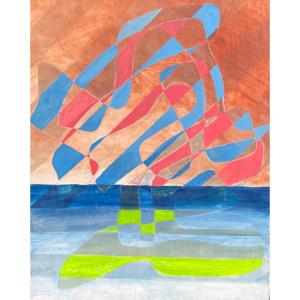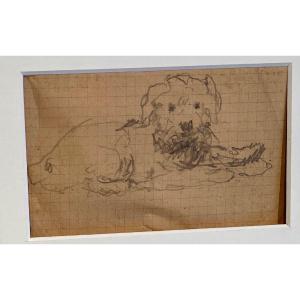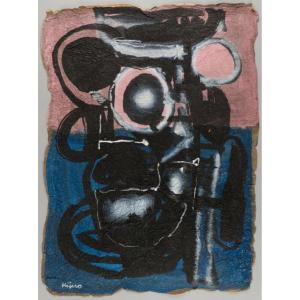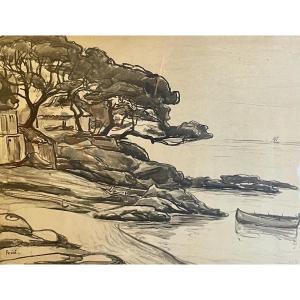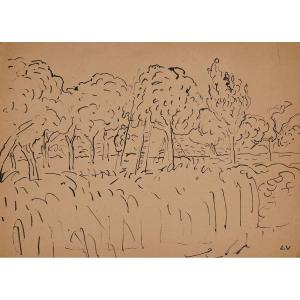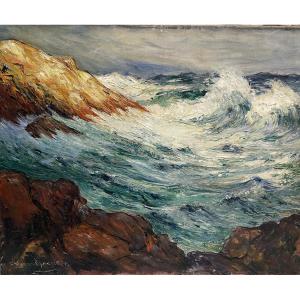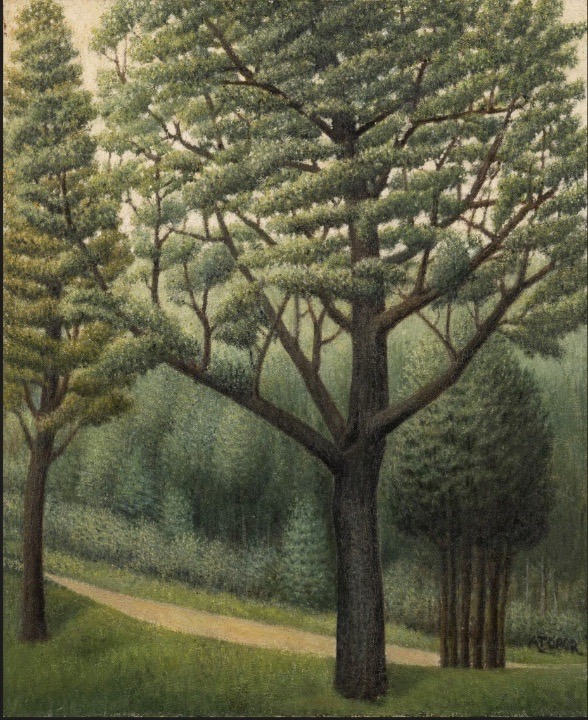
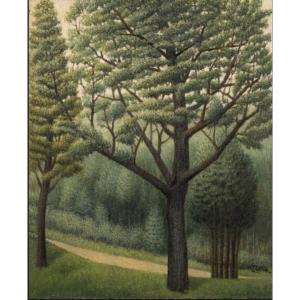


Abram Topor (1903–1992), Oil Painting Of A Landscape
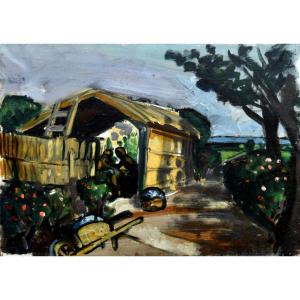
The Forest,
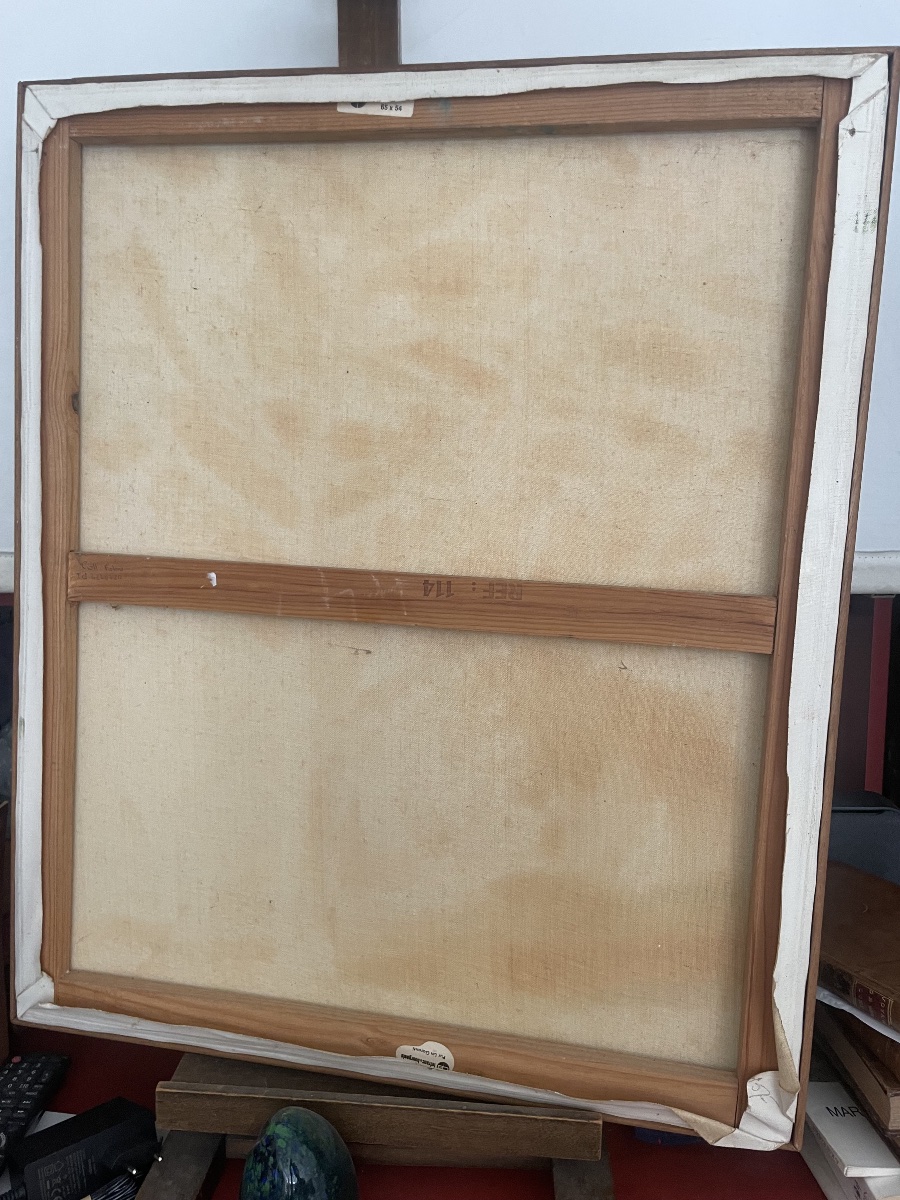
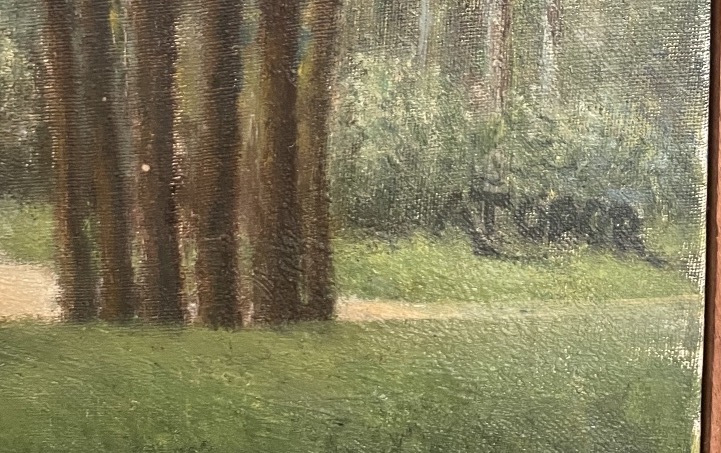
oil on canvas, signed, 65 x 54 cm
Abram Topor, born in 1903 into a Jewish family in Poland, won second prize in sculpture at the Warsaw School of Fine Arts in 1929, along with a scholarship and a free passport to France.
In 1930, he completed his training at the École des Beaux-Arts in Paris, where he brought his fiancée, Zlata Binsztok, an embroidery worker, and where he admired the masterpieces at the Louvre.
To make a living, he was hired at a factory in Lorraine that upholstered seats for railroad cars. “During his breaks, he would create small bas-reliefs in repoussé copper using scraps of metal left behind in the workshop,” writes his daughter, the historian Hélène d’Almeida-Topor.
After being laid off, Abram Topor became a leather craftsman, like his father, in his workshop in Paris’s 13th arrondissement. And for convenience, he chose to paint and sculpt.
In the spring of 1941, he was interned at the Pithiviers camp as a Jew.
In the summer of 1942, he volunteered as a harvester and, with his wife’s help, escaped. The family went into hiding in Savoie. Of those years, Roland Topor, the couple’s son and a hidden child, said: “The Germans are hot on my trail. They want me dead. Many French people are Germans who speak French.”
Later, this retiree—who calls himself the “up-and-coming young painter”—devoted himself entirely to painting and exhibited his works in museums and galleries in France, Belgium, the Netherlands, Switzerland, Germany, and Italy. Hélène d’Almeida-Topor, daughter of Abram Topor, Anne d’Almeida, Fabrice d’Almeida, and Nicolas Topor, a landscape gardener, co-authored the book *Abram Topor, grandeur nature* (Passages and Seli Arslan Publishing, 2003), dedicated to Zlata Topor.
Success came quickly, as it did for his son, the multifaceted artist—a cartoonist notably for *Hara-Kiri* (1964–1968) and for René Laloux’s *La Planète sauvage* (1973), a poster artist for film and theater, a book illustrator, a painter, a writer, a poet, a director, an illustrator, a singer-songwriter, a playwright, an actor, a screenwriter, and a filmmaker—Roland Topor (1938–1997), whose artistic calling was encouraged by the entire family.
In 2003, the Center for Art and Culture—Espace Rachi—presented some sixty oil paintings and a lithograph, primarily landscapes, allowing visitors to trace the evolution of his style over nearly fifty years.
After World War II, Abram Topor resumed his professional career and his artistic passion.
In 2012, the François-Pompon Museum in Saulieu hosted the exhibition “Abram Topor: Life-Size,” accompanied by a linocut by Roland Topor. For some thirty years, Abram Topor painted the wooded landscapes of the Morvan during his stays near Gouloux, in the hamlet of Breuil
Period: 20th century
Style: Modern Art
Condition: Excellent condition
Material: Oil painting
Length: 65
Width: 54
Reference (ID): 1790126
Availability: In stock