

Louis XVI Lion-figured Clock
Artist: Lepneveu
Louis XVI-era clock in mercury-gilded bronze.
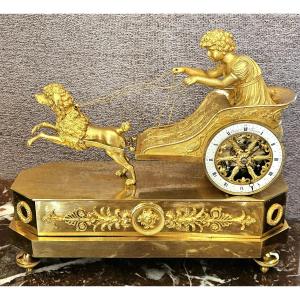
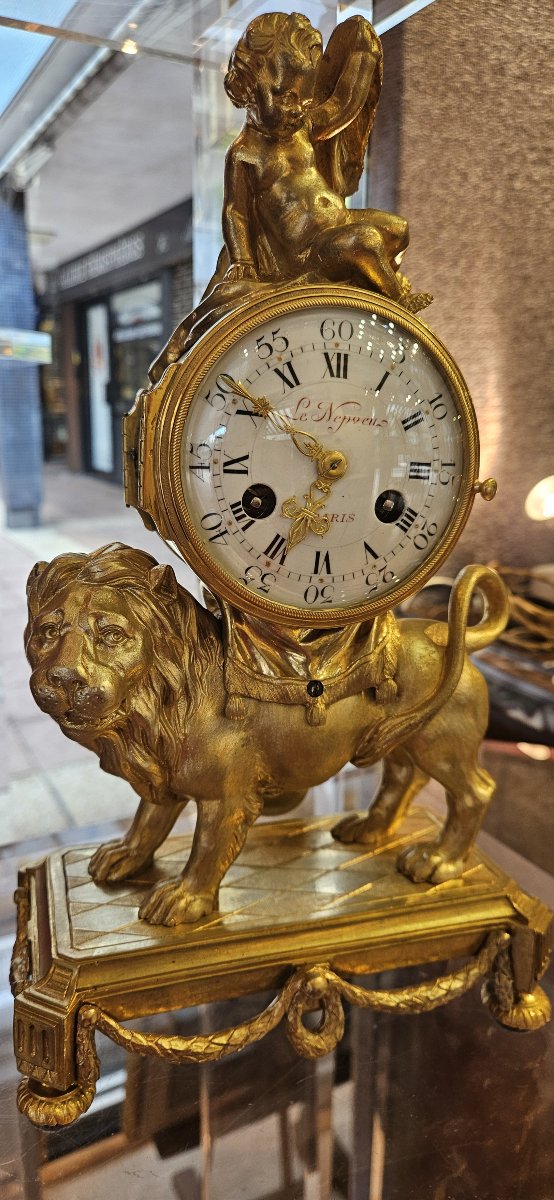
Signed Le Nepneveu in Paris. This elegant clock, crafted from finely chiseled and mercury-gilded bronze, perfectly illustrates the renewal of Parisian taste during the early years of the reign of Louis XVI.
Its design, characterized by great architectural simplicity, is enriched by a sculpted composition that harmoniously blends references to Antiquity and the allegorical vocabulary characteristic of Neoclassicism.
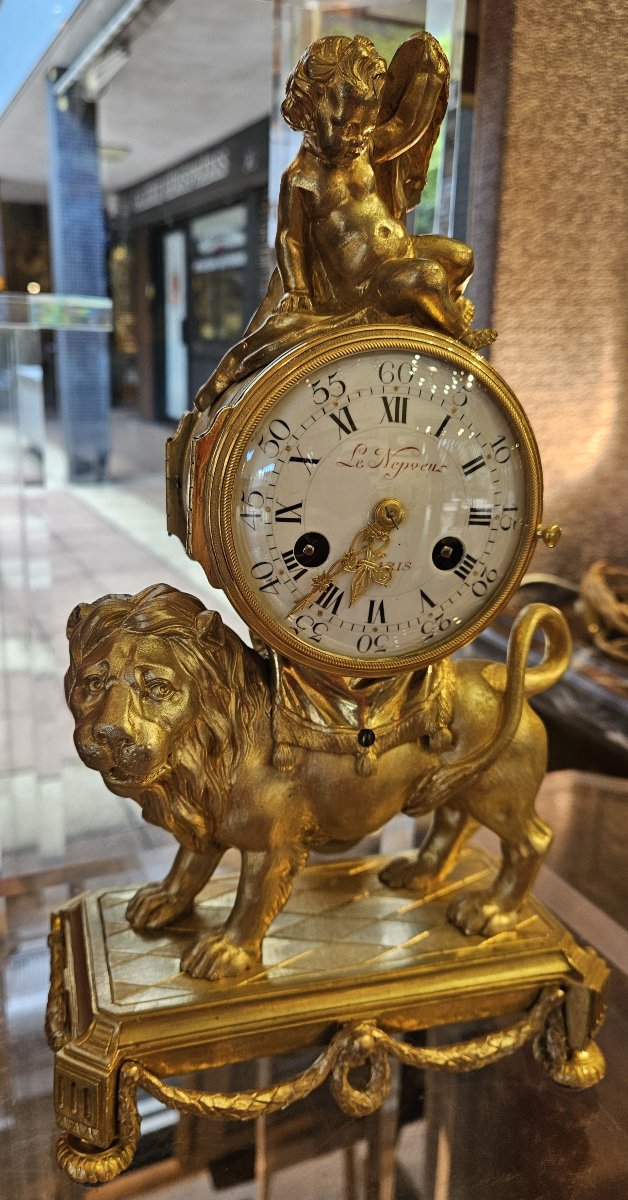
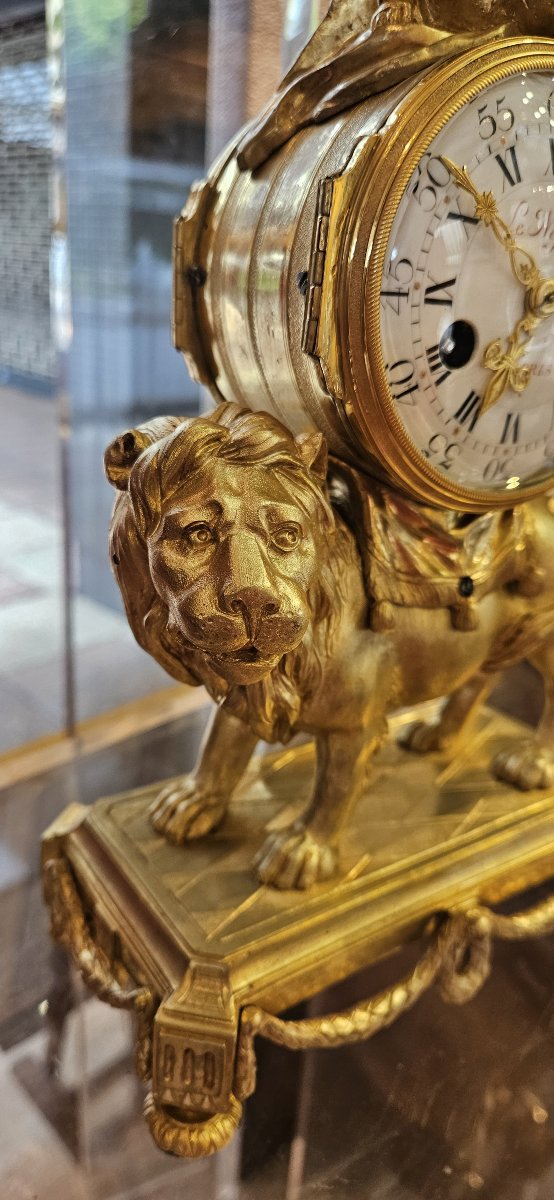
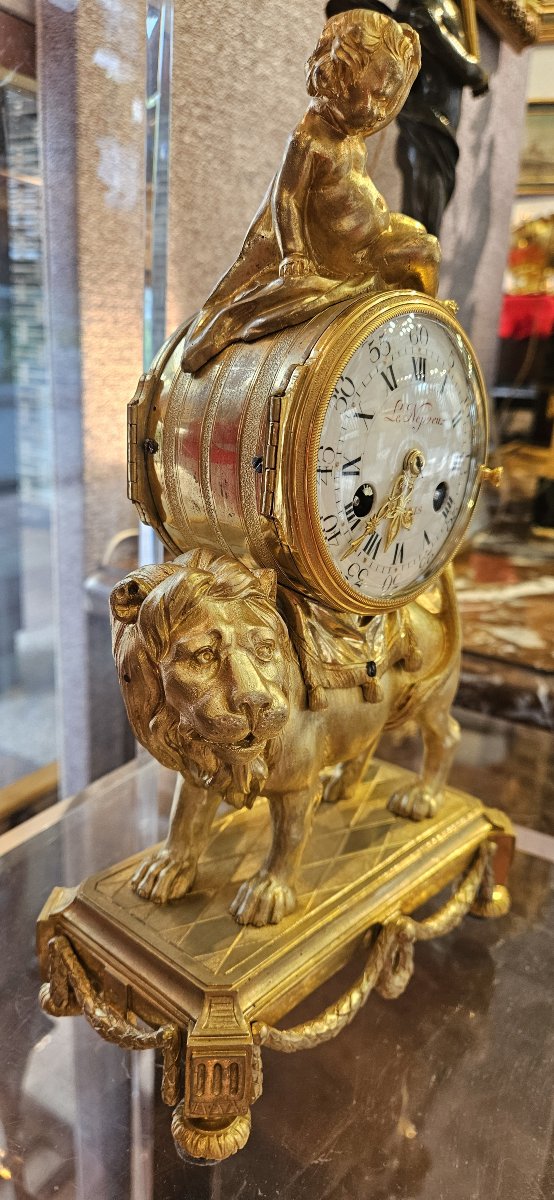
The dial is supported by a striding lion, rendered with a remarkable sense of form and naturalistic observation. A symbol of power, vigilance, and courage, the animal supports Time, while a winged Cupid is delicately perched at the top of the clock.
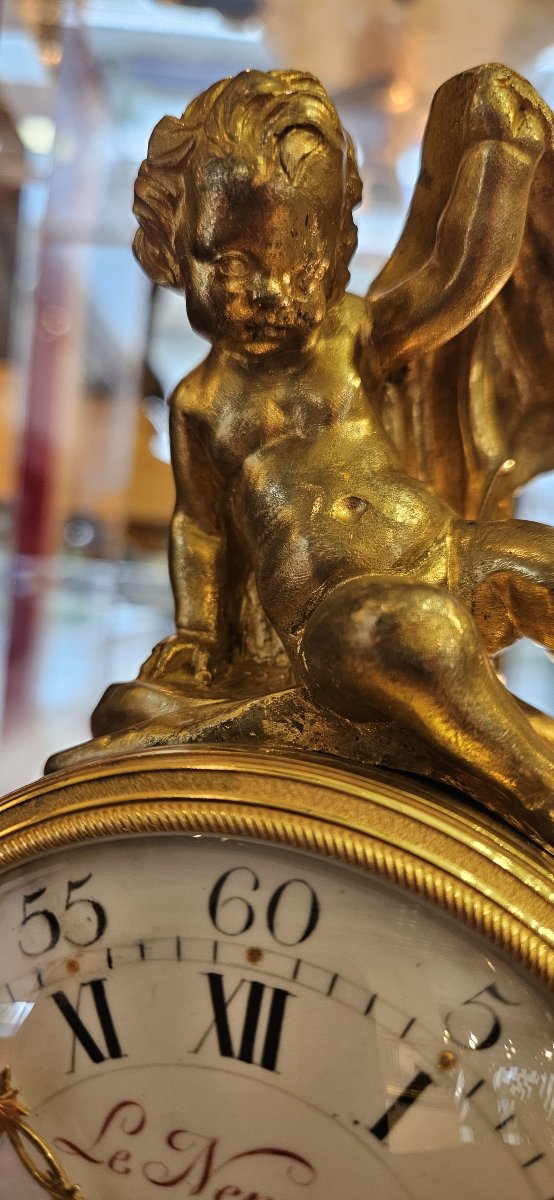
This youthful figure, with supple forms and a face marked by gentleness, provides a graceful counterpoint to the beast’s vigor. The composition evokes the allegorical themes popular in the late 18th century, where Love, Strength, and Time engage in a subtle dialogue inspired by ancient mythology.
The circular dial in white enamel is signed “Le Nepneveu à Paris.” It features hours in Roman numerals, an outer minute track in Arabic numerals, and retains its delicate openwork hands in gilded bronze. The bezel is accented by an elegant row of finely chiseled pearls. The base, rectangular in shape with beveled edges, is decorated with laurel garlands held in place by rosettes and rests on four turned feet.
The piece as a whole displays particularly meticulous chiseling, both in the execution of the ornamental decoration and in the quality of the carving of the lion and Cupid.
The mercury gilding, with its warm, deep hues, highlights refined elegance every detail of the bronze.
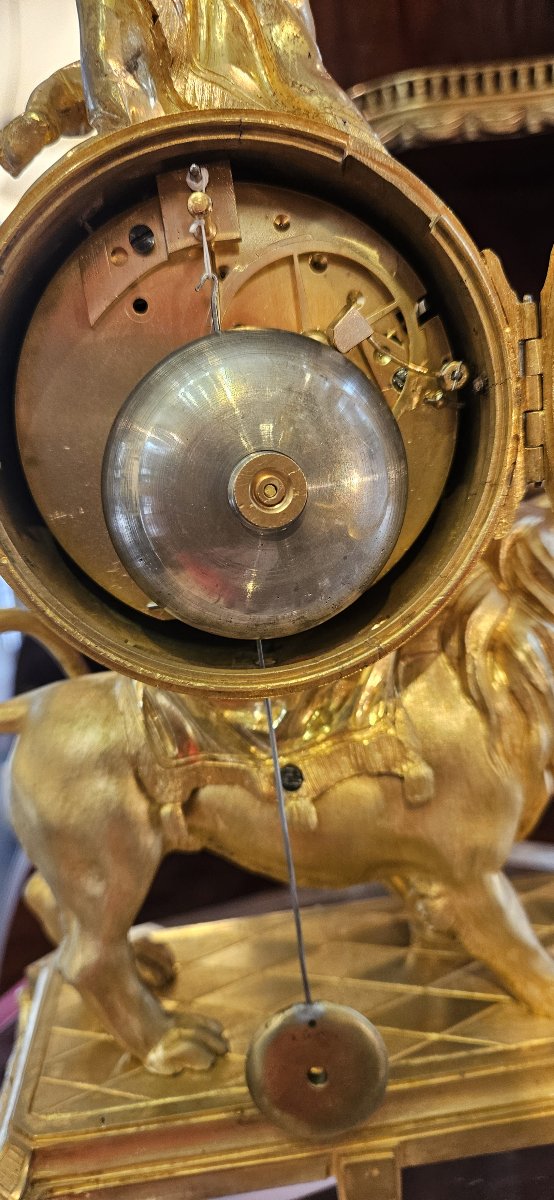
Signed “Le Nepneveu” in Paris, the movement is the work of a Parisian clockmaker documented between 1778 and 1789, a period corresponding to the heyday of the production of large bronze pendulum clocks. At that time, the finest clockmakers collaborated with the most talented casters and engravers to create works in which the mechanical quality rivaled the excellence of the ornamental sculpture.
With its balanced proportions, the finesse of its craftsmanship, and the quality of its gilding, this clock stands as a captivating testament to Parisian production in the 1780s, when the Louis XVI style reached its full maturity.
Materials: finely chased bronze gilded with mercury; dial in white enamel. Wire suspension. Movement serviced.
Signed Le Nepneveu in Paris. This elegant clock, crafted from finely chiseled and mercury-gilded bronze, perfectly illustrates the renewal of Parisian taste during the early years of the reign of Louis XVI.
Its design, characterized by great architectural simplicity, is enriched by a sculpted composition that harmoniously blends references to Antiquity and the allegorical vocabulary characteristic of Neoclassicism.
The dial is supported by a striding lion, rendered with a remarkable sense of form and naturalistic observation. A symbol of power, vigilance, and courage, the animal supports Time, while a winged Cupid is delicately perched at the top of the clock.
This youthful figure, with supple forms and a face marked by gentleness, provides a graceful counterpoint to the beast’s vigor. The composition evokes the allegorical themes popular in the late 18th century, where Love, Strength, and Time engage in a subtle dialogue inspired by ancient mythology.
The circular dial in white enamel is signed “Le Nepneveu à Paris.” It features hours in Roman numerals, an outer minute track in Arabic numerals, and retains its delicate openwork hands in gilded bronze. The bezel is accented by an elegant row of finely chiseled pearls. The base, rectangular in shape with beveled edges, is decorated with laurel garlands held in place by rosettes and rests on four turned feet.
The piece as a whole displays particularly meticulous chiseling, both in the execution of the ornamental decoration and in the quality of the carving of the lion and Cupid.
The mercury gilding, with its warm, deep hues, highlights refined elegance every detail of the bronze.
Signed “Le Nepneveu” in Paris, the movement is the work of a Parisian clockmaker documented between 1778 and 1789, a period corresponding to the heyday of the production of large bronze pendulum clocks. At that time, the finest clockmakers collaborated with the most talented casters and engravers to create works in which the mechanical quality rivaled the excellence of the ornamental sculpture.
With its balanced proportions, the finesse of its craftsmanship, and the quality of its gilding, this clock stands as a captivating testament to Parisian production in the 1780s, when the Louis XVI style reached its full maturity.
Materials: finely chased bronze gilded with mercury; dial in white enamel. Wire suspension. Movement serviced.
8 500 €
Period: 18th century
Style: Louis 16th, Directory
Condition: Excellent condition
Length: 16.5
Height: 30
Reference (ID): 1789716
Availability: In stock
Print