

Paul Duchein Display Case Painting: A Unique Work Of Naive Art, St. Cornell XX Oedipus
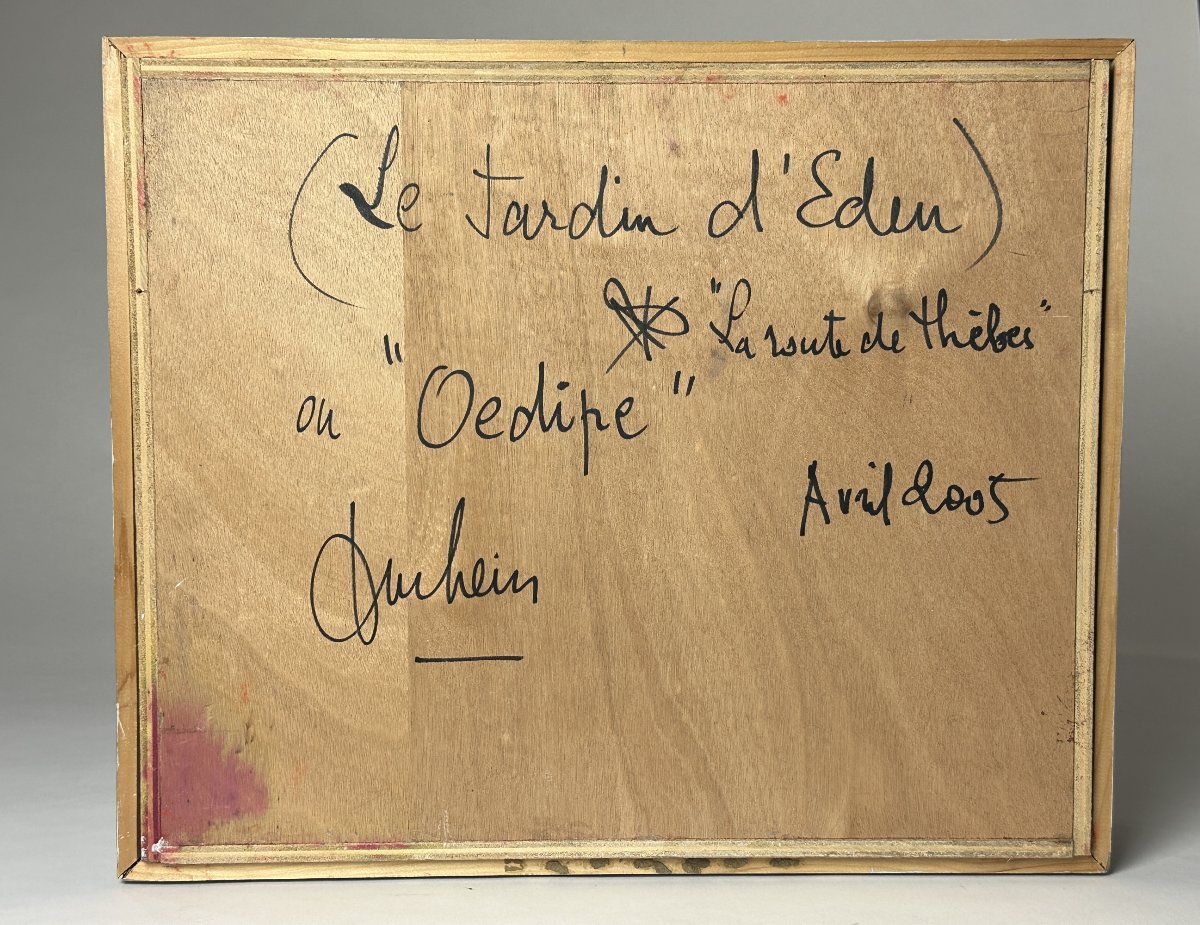
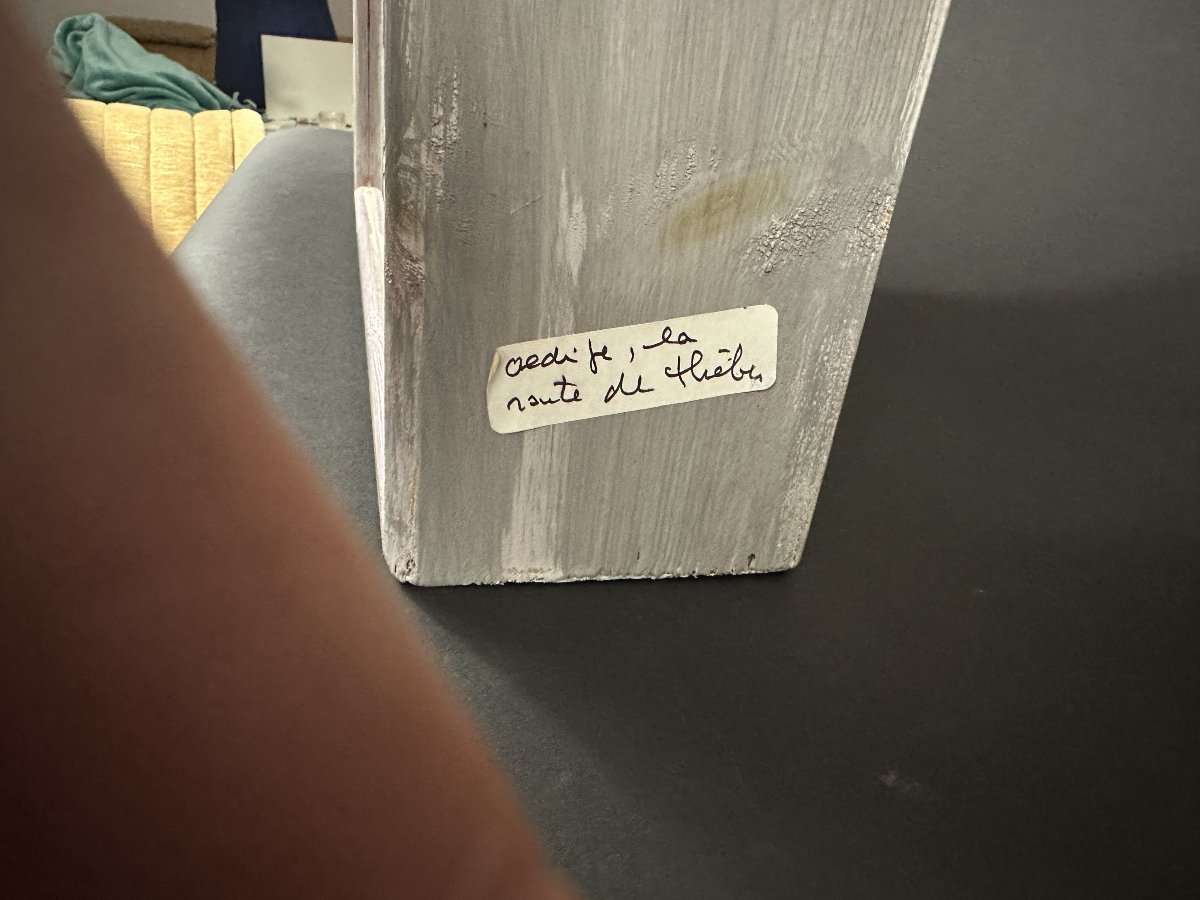
Paul Duchein, The Garden of Eden or Oedipus / The Road to Thebes, box-sculpture, April 2005
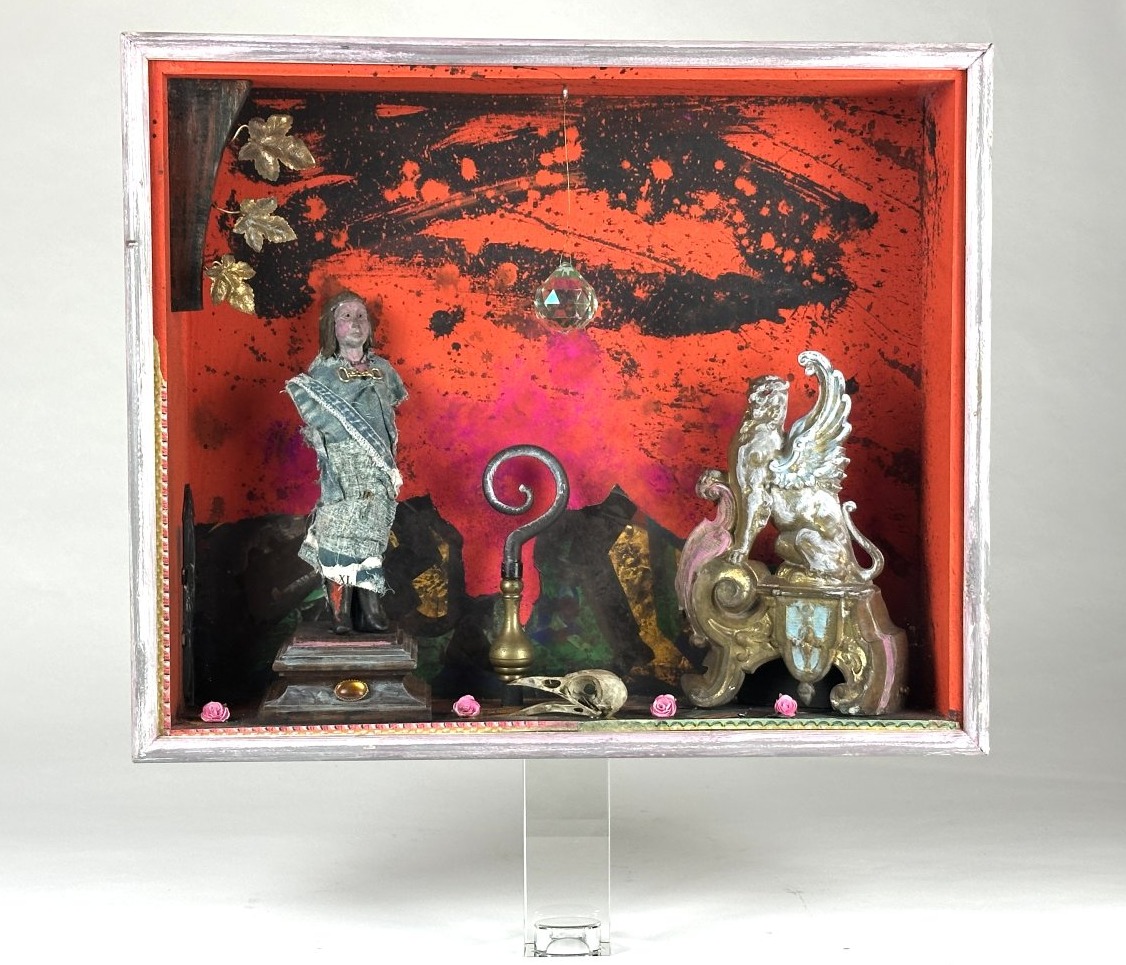
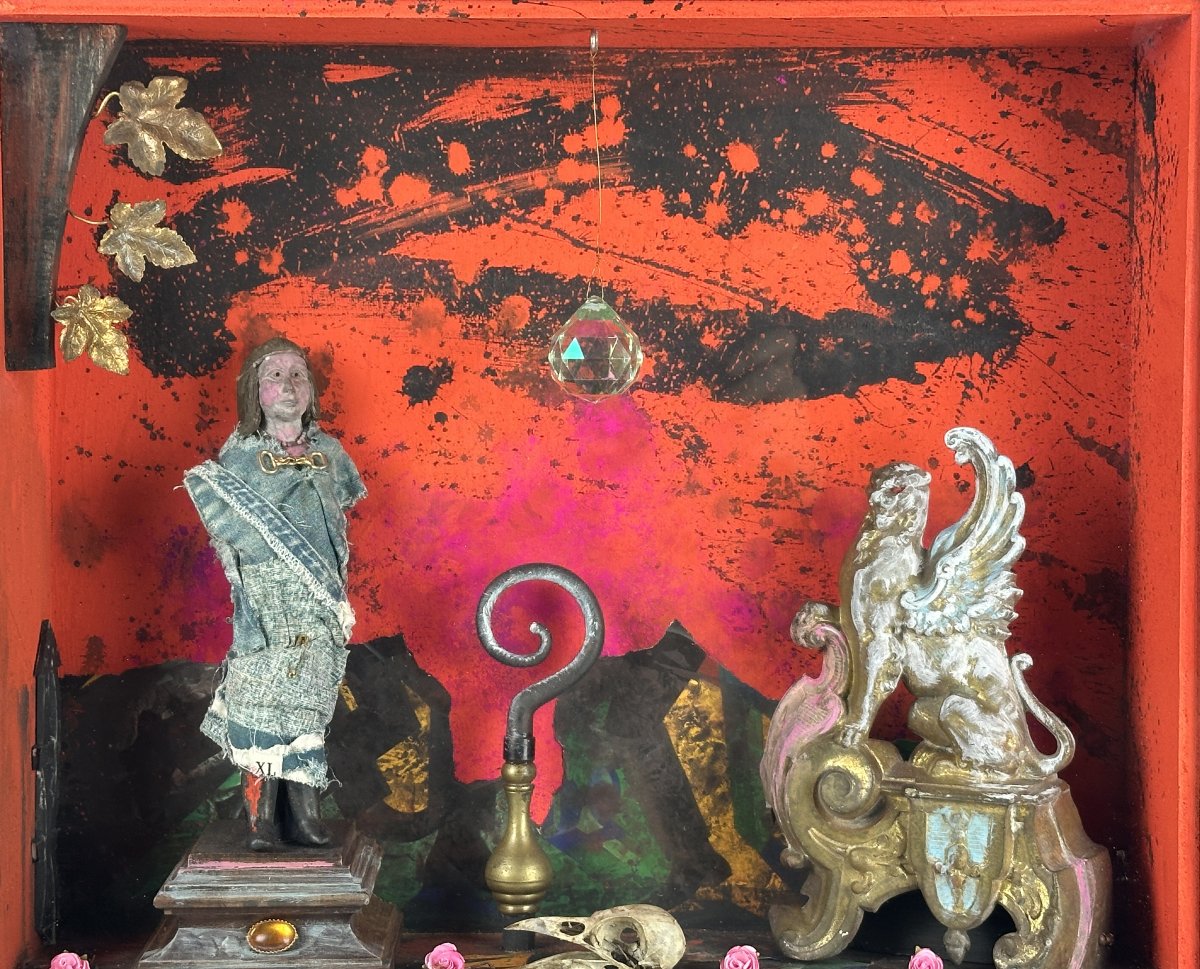
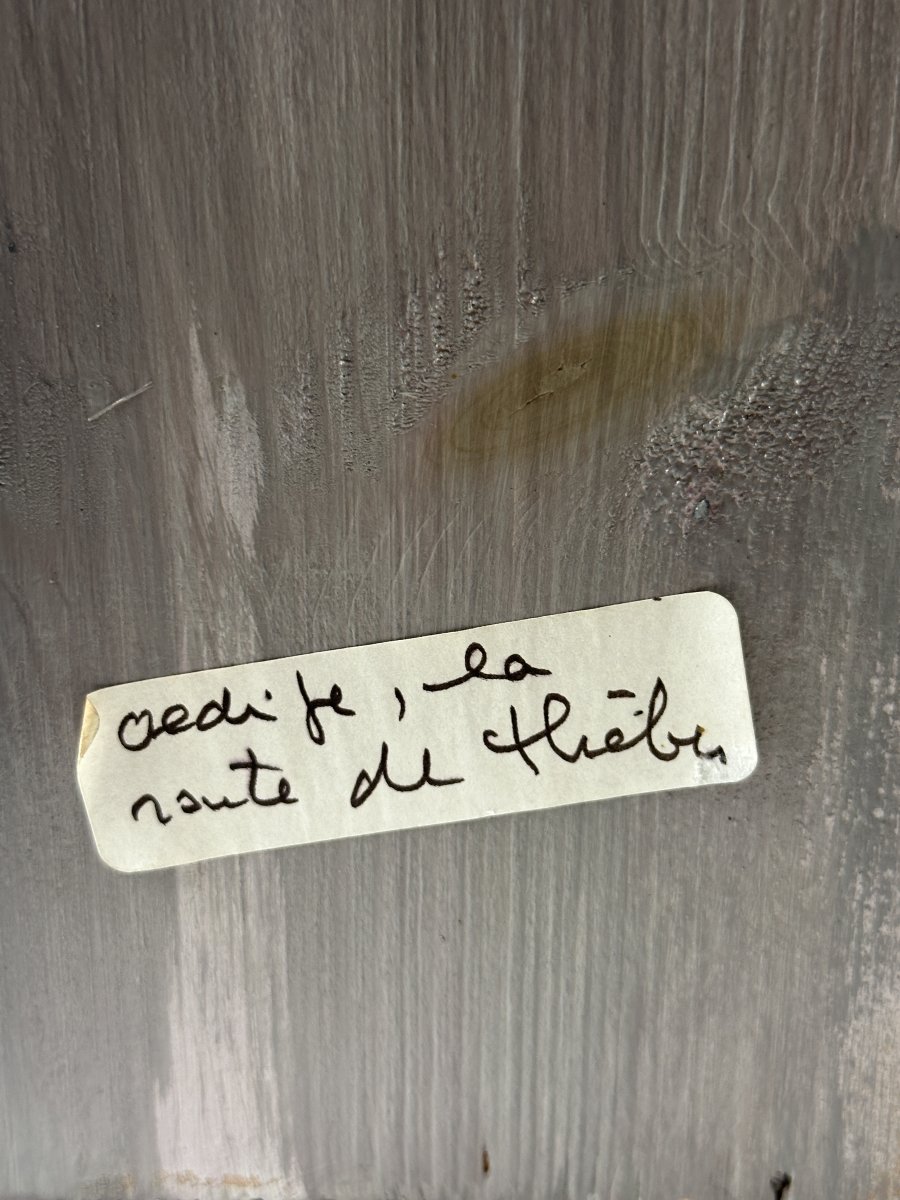
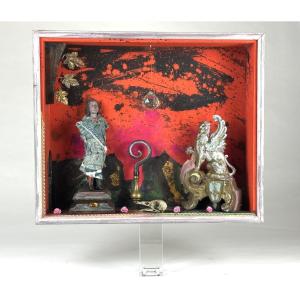
Rare box-sculpture / diorama by Paul Duchein, signed on the reverse, titled The Garden of Eden or Oedipus, with the handwritten mention The Road to Thebes, dated April 2005.
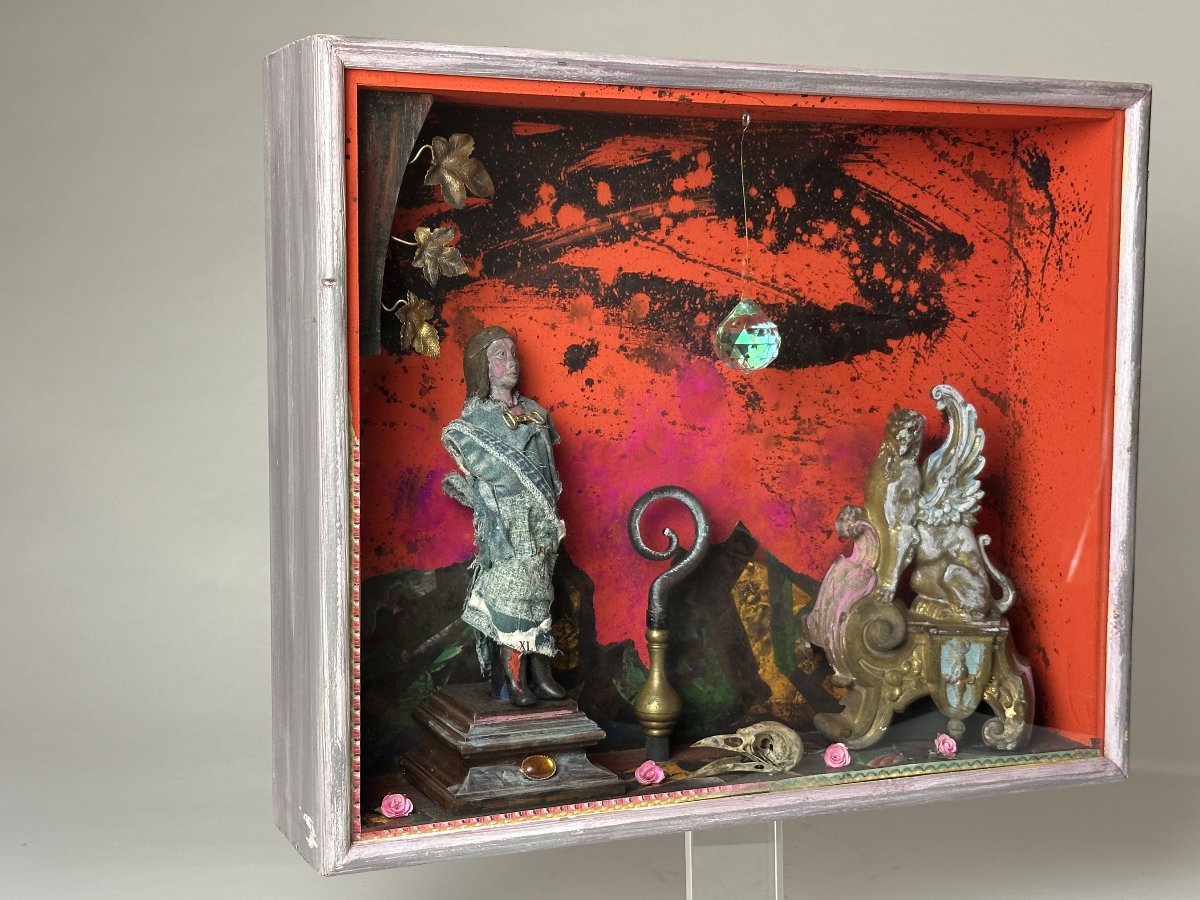
Mixed media and assemblage of various objects under glass, conceived as a small inner theatre, at the crossroads of Surrealism, Art Brut, Outsider Art, the cabinet of curiosities and the secular reliquary.
Dimensions: height 41.5 cm, width 49 cm, depth 11.5 cm.
The work belongs to the Garden of Eden series, yet Duchein introduces here a very strong mythological subject: Oedipus and the road to Thebes. The title is essential, as it gives this box a reading that is more dramatic than decorative. We are not merely looking at an assemblage of objects: the scene becomes a visual enigma, a theatre of destiny, passage and knowledge.
The composition is built around an incandescent red background, crossed by large black splashes, like a stormy, fiery or catastrophic sky. This dominant red gives the box a rare intensity within Duchein’s work. The setting evokes less a peaceful garden than an Eden in turmoil, crossed by fault, ordeal and revelation.
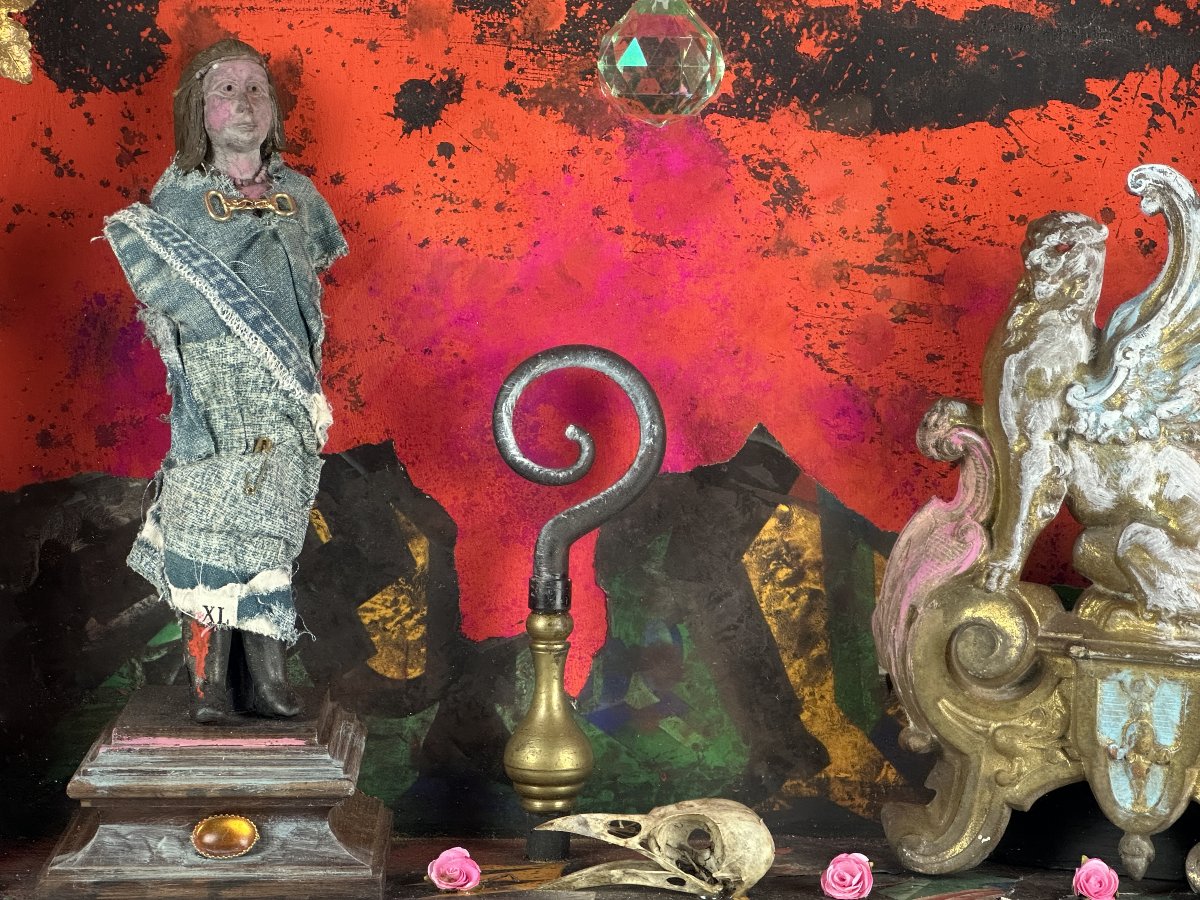
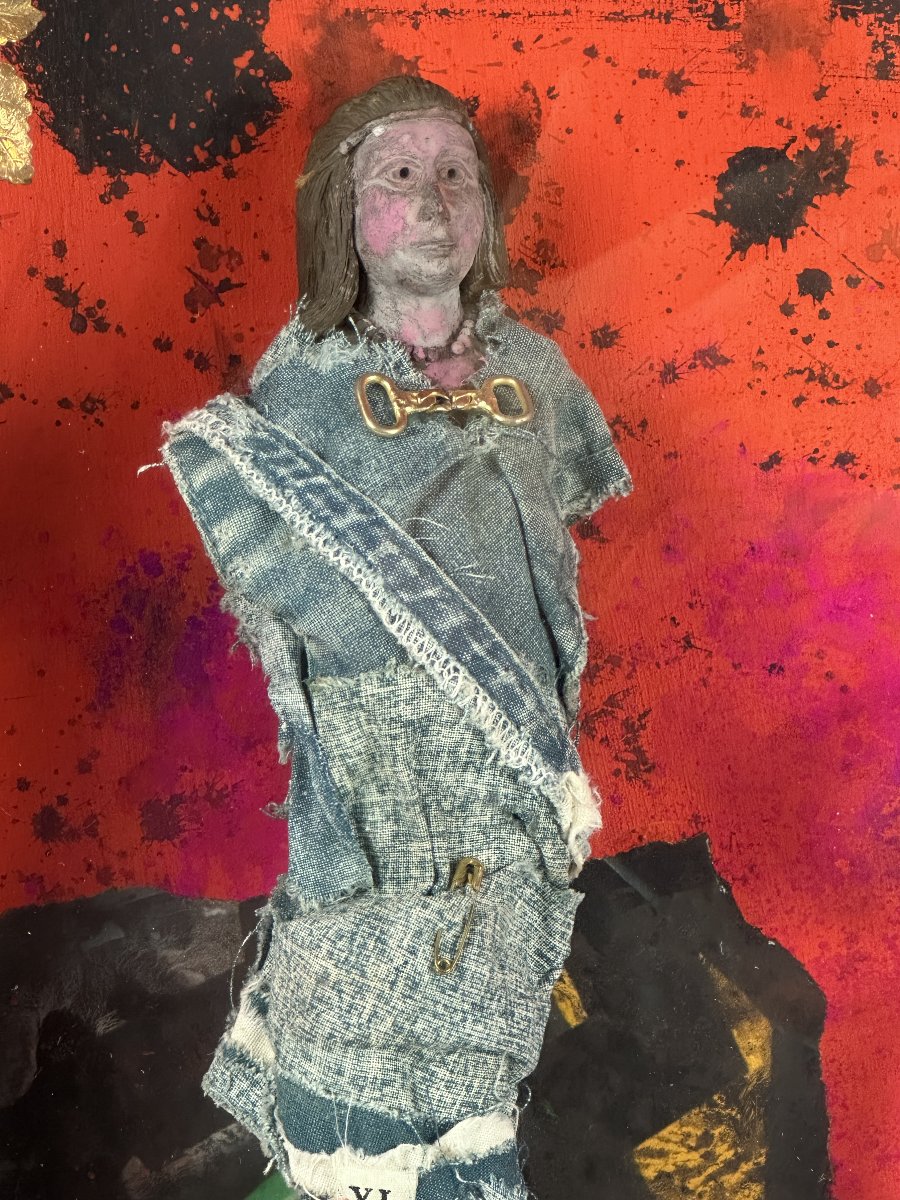
On the left, a human figure stands on a pedestal. Its fixed face, blue-grey textile garment, and archaic, fragile doll-like presence give it a highly singular character. It may be read as Oedipus himself, the figure of the traveller, questioning and destiny. The small “XI” visible at the bottom of the garment adds a cryptic, almost divinatory dimension, like a card, a scene number or a tarot-like sign.
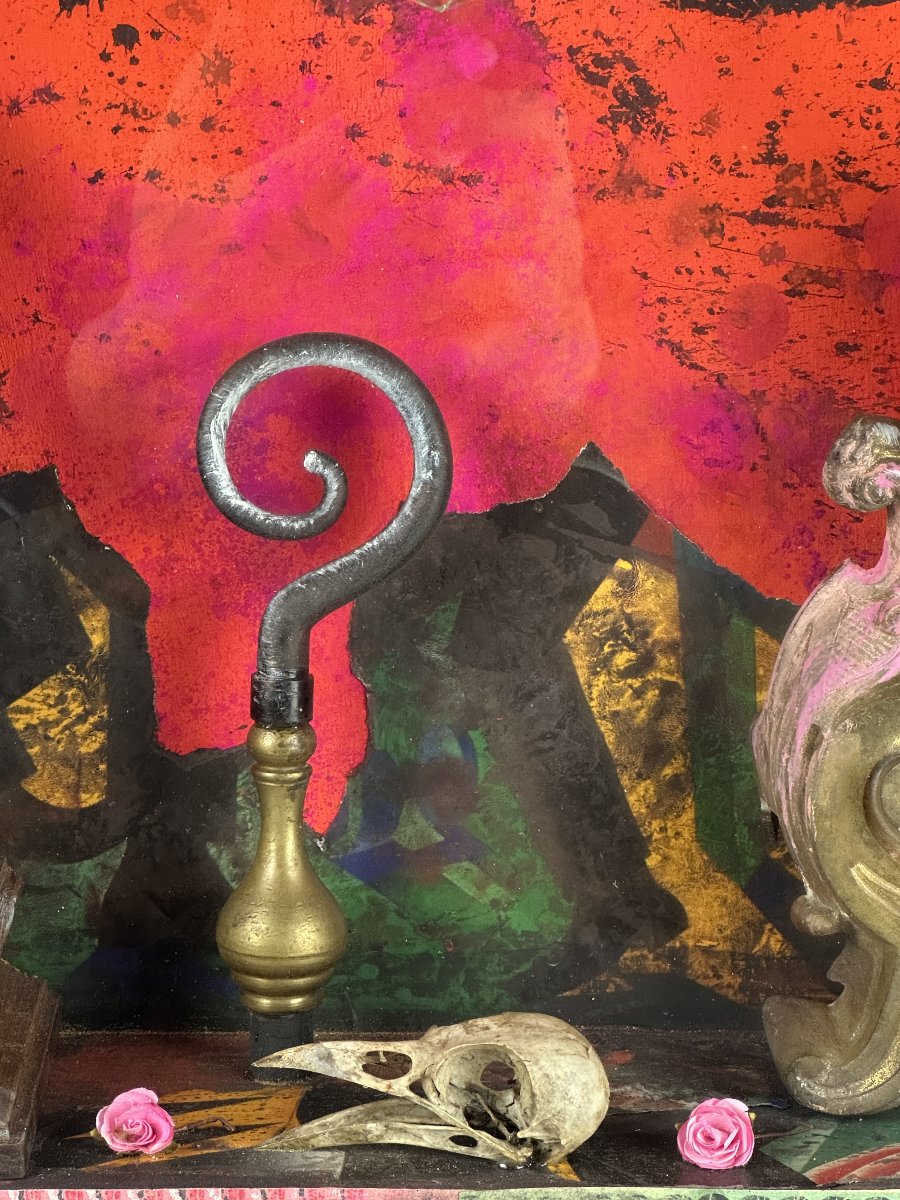
At the centre, a spiral-shaped metal element mounted on a brass base acts as a major sign. It evokes at once a crozier, a hook, a question mark, a walking staff or a symbol of the riddle. In the context of Oedipus, this object takes on particular force: it becomes the image of the question itself, of the detour, of the path that coils back upon itself. It is the object of the threshold, the one separating man from knowledge.
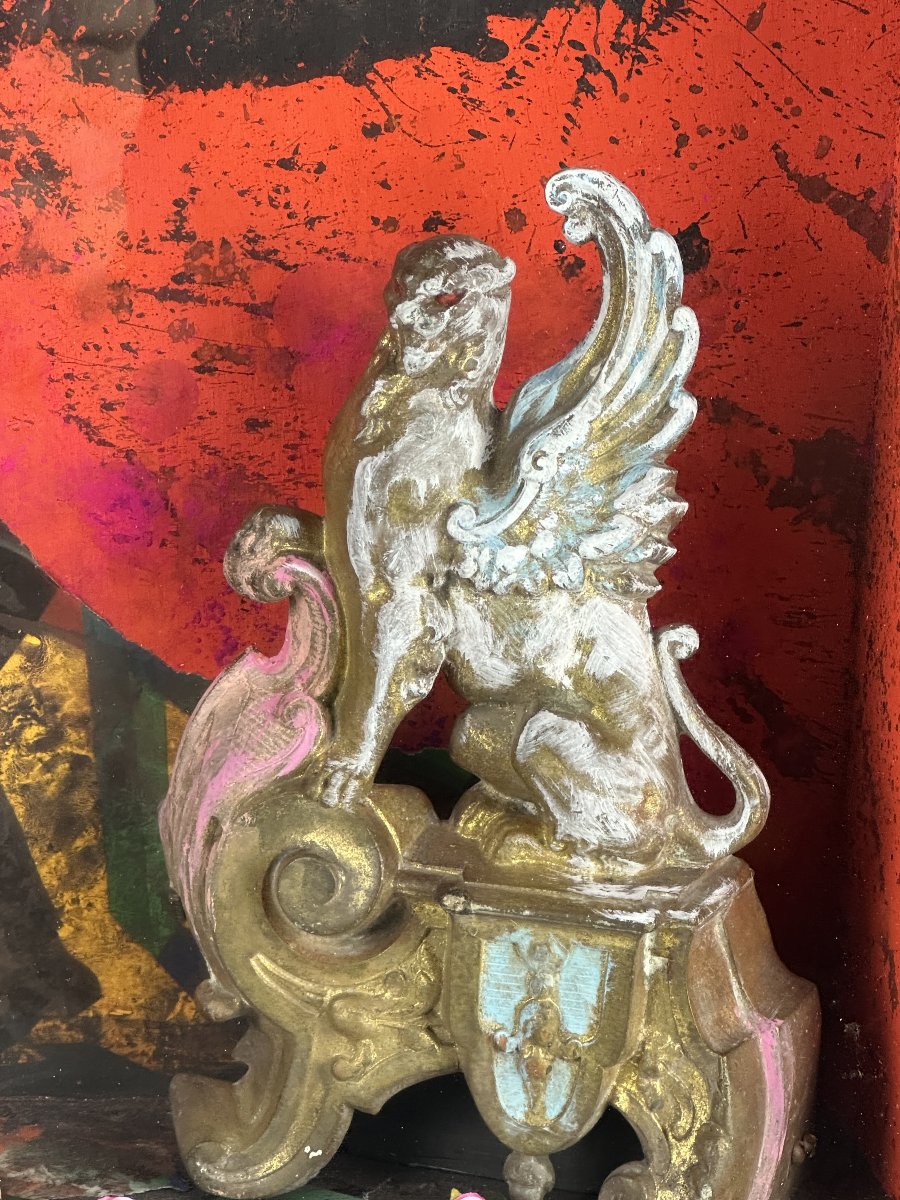
On the right, the winged sphinx dominates the scene. This is the clearest and most important iconographic element. In the myth, the sphinx guards the entrance to Thebes and submits travellers to its riddle. Duchein places it here as a hybrid creature, gilded, white and bluish, at once decorative, heraldic and threatening. Its aspect as a salvaged, almost Baroque object reinforces the cabinet-of-curiosities character of the work. This is not a classical illustration of the myth, but a transposition into Outsider Art: the sphinx becomes a totem-object.
The bird skull placed on the ground introduces a vanitas note. It recalls death, omen, sacrifice and the fragility of all knowledge. Within this Oedipal scene, it may be read as the sign of a destiny already fulfilled. It gives the work a more solemn, almost ritual dimension.
The faceted sphere suspended in the centre plays a very subtle role. It may be understood as a star, a crystal ball, an eye or an oracle. Placed between the human figure and the sphinx, it suspends the scene in a moment of expectation: the instant of the riddle, the moment when light fragments before revelation.
The small pink roses placed in the foreground bring a deliberate contradiction. They soften the scene, but also make it stranger. In a setting of trial and fatality, they appear as tiny offerings, signs of innocence or remnants of a lost Eden.
The box thus functions as a mythological and secular hagiography. Duchein takes the story of Oedipus not to illustrate it literally, but to extract its signs: the traveller, the sphinx, the riddle, the road, the skull, the star, the threshold. Each element retains its autonomy as a found object, yet together they form a highly coherent mental scene.
What makes this work especially interesting within Paul Duchein’s corpus is the association between the biblical title The Garden of Eden and the Greek myth of Oedipus. Eden refers to origin, fault and forbidden knowledge; Oedipus refers to the riddle, self-knowledge and the fatal road to Thebes. Duchein thus brings together two founding narratives: the loss of innocence and the danger of truth. The box becomes a small theatre of knowledge, vision and fall.
This work fully belongs to the field of French Outsider Art and Art Singulier. Duchein does not seek academic finish: he favours the force of fragments, modest objects, salvaged materials and unexpected associations. In this sense, his work may be linked to the Art Brut spirit championed by Jean Dubuffet: freedom of invention, rejection of artistic hierarchies, a taste for marginal forms, poor materials and personal mythologies. In Duchein’s work, the found object is never anecdotal; it becomes sign, relic, character or instrument of fiction.
Paul Duchein was born in 1930 in Rabastens and lived and worked in Montauban. A pharmacist by training, as well as a collector, critic, cultural organiser and artist, he occupied a singular place in the artistic life of south-west France. From an early age, he developed an interest in images, objects, curiosities, marginal creations and non-academic worlds. He discovered Surrealism during his studies in Toulouse and gradually developed a personal language made of boxes, collages, assemblages and miniature scenes.
In Montauban, Paul Duchein became an important figure in the art world. From the 1970s onwards, he organised the Rencontres d’art at the Musée Ingres, wrote about contemporary art, and together with his wife Jacqueline formed a major collection combining Surrealism, Art Brut, folk art, tribal arts, objects of curiosity and major modern signatures. The sale of the Paul and Jacqueline Duchein collection at Christie’s confirmed the importance of this universe, in which works by Toyen, Max Ernst, Yves Tanguy, Wolfgang Paalen, André Breton, Salvador Dalí, Victor Brauner, Man Ray, Jean Dubuffet, Jean Fautrier, Henri Michaux, Serge Poliakoff, Maria Helena Vieira da Silva, Josef Šíma, Sam Francis and Wifredo Lam entered into dialogue.
His own artistic work, often referred to as the Theatre of the Imagination, brings together the artist’s box, the secular reliquary, the dreamlike scene, the cabinet of curiosities and the miniature theatre. His assemblages engage with Surrealism, but also with Art Brut and Art Singulier, through their taste for discarded objects, ordinary materials, popular signs, private mythologies and secret worlds.
Period: 20th century
Style: Design 50's and 60's
Condition: Good condition
Material: Painted wood
Width: 49
Height: 41
Depth: 11
Reference (ID): 1789445
Availability: In stock