
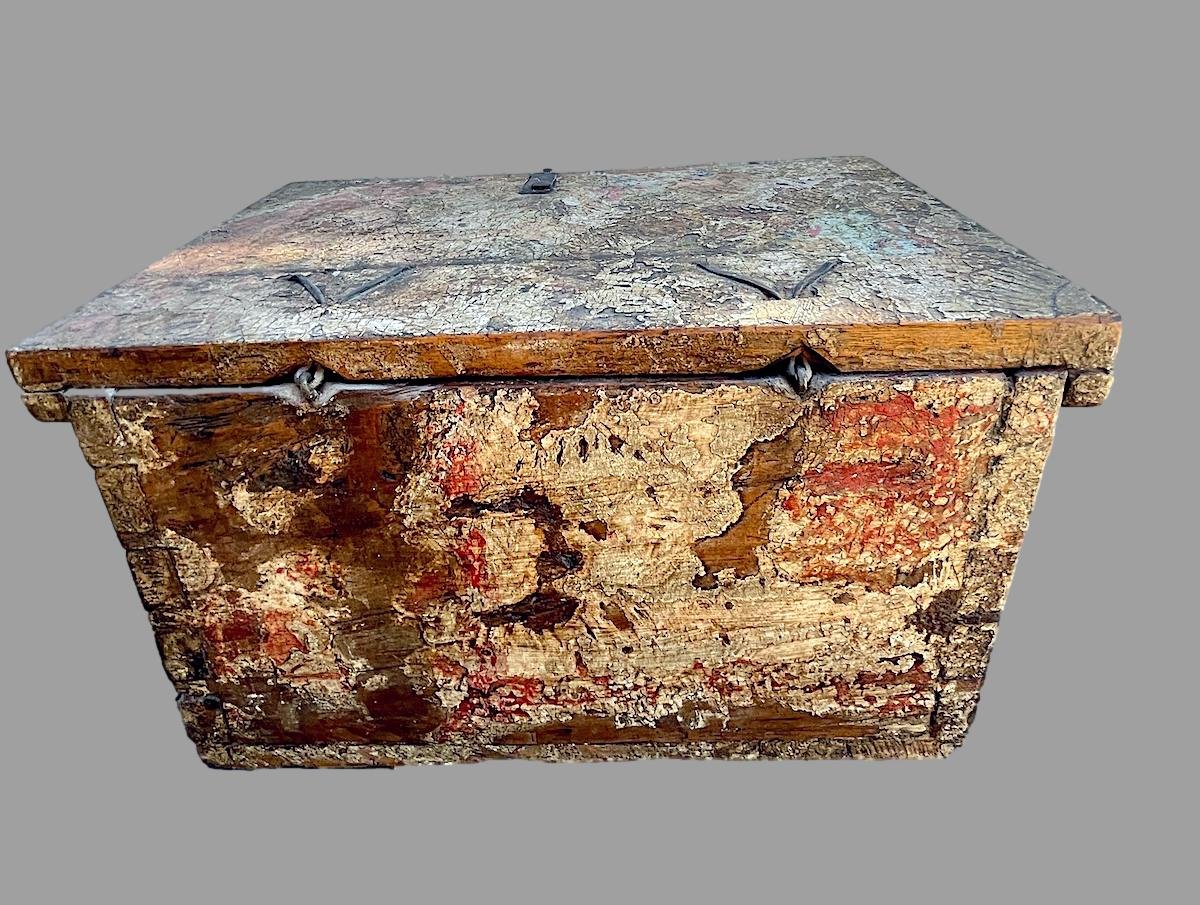


Small Spanish Travel Bargueño In Polychrome Walnut – Castile, Late 17th Century
Artist: Castille, Fin Du Xviie Siècle
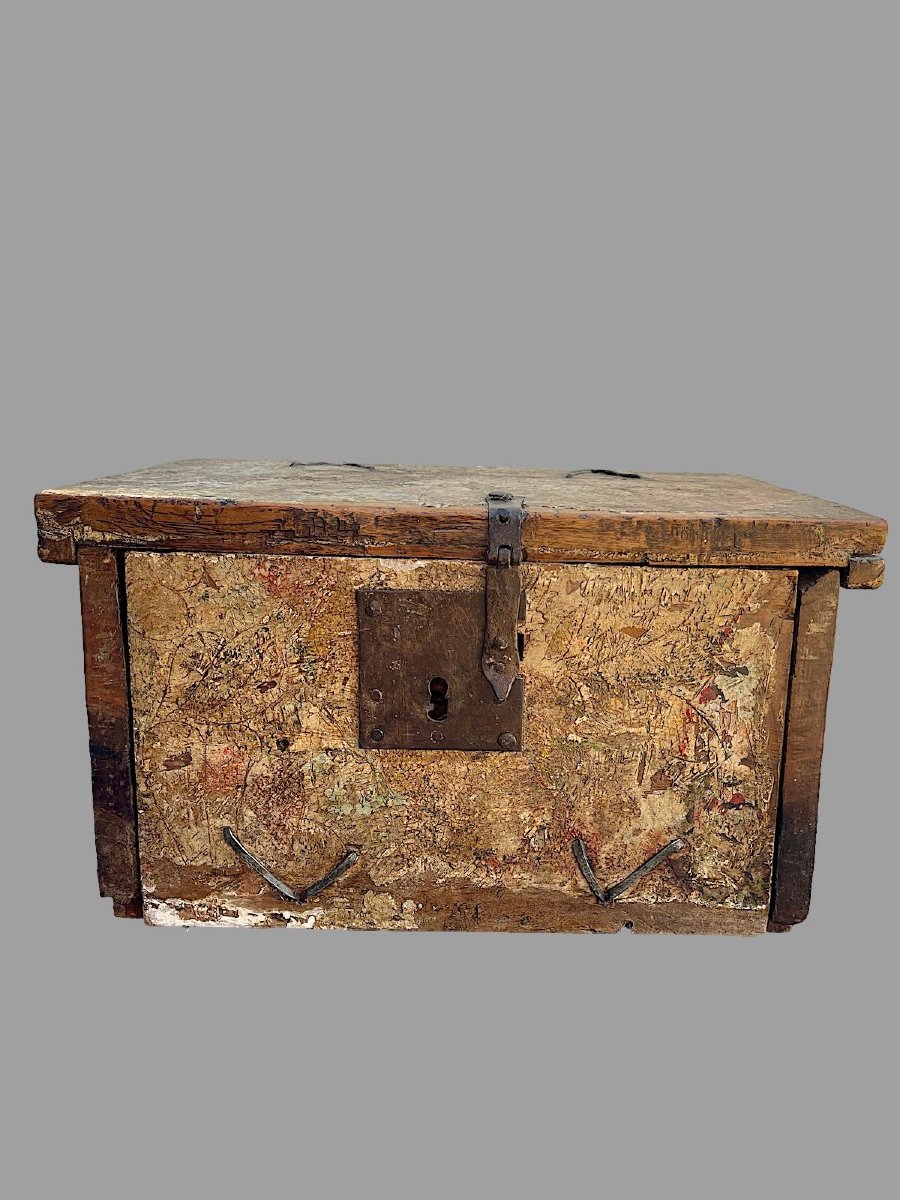
Small Spanish Polychrome Walnut *Bargueño*
Portable cabinet with six drawers
Spain, likely Castile
Late 17th – Early 18th century (circa 1680–1720)
Dimensions:
Height: 22 cm
Width: 38.2 cm
Depth: 23.4 cm
Description
This remarkable small Spanish *bargueño* serves as a fine example of the domestic and portable furniture produced on the Iberian Peninsula in the late 17th century. Crafted primarily from walnut—with several drawer bottoms made of oak—it perfectly illustrates the tradition of Castilian workshops, which combined fine woods with sturdier timber for less visible structural components.
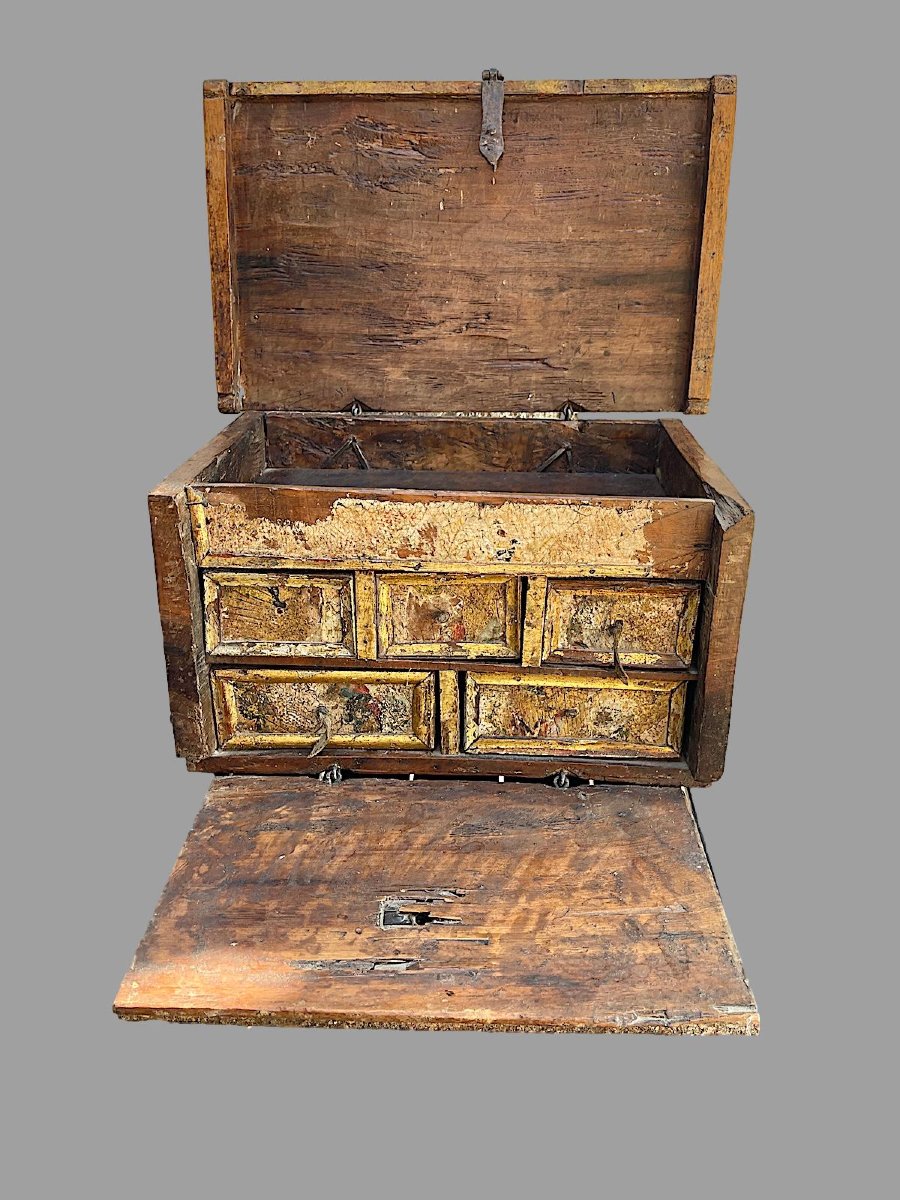
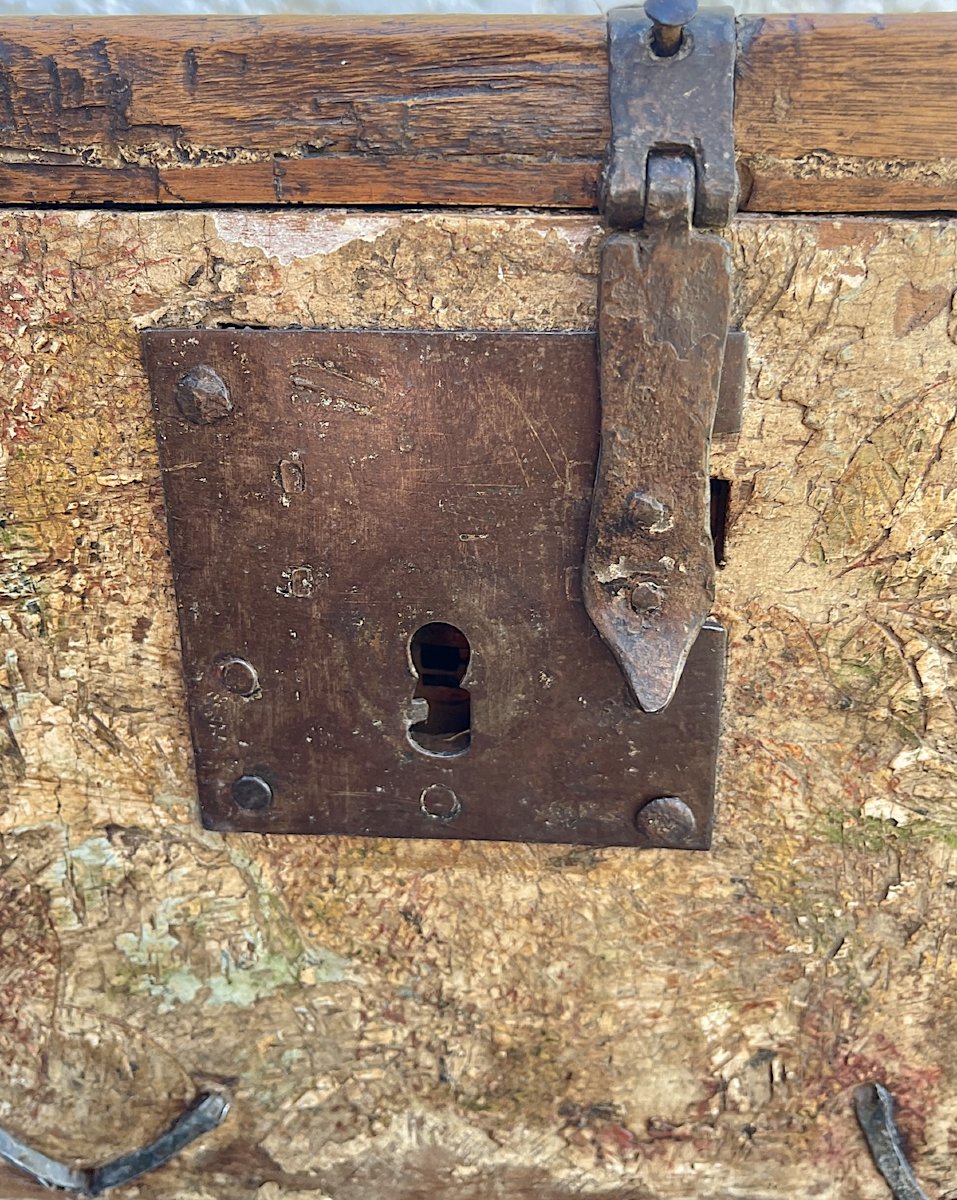
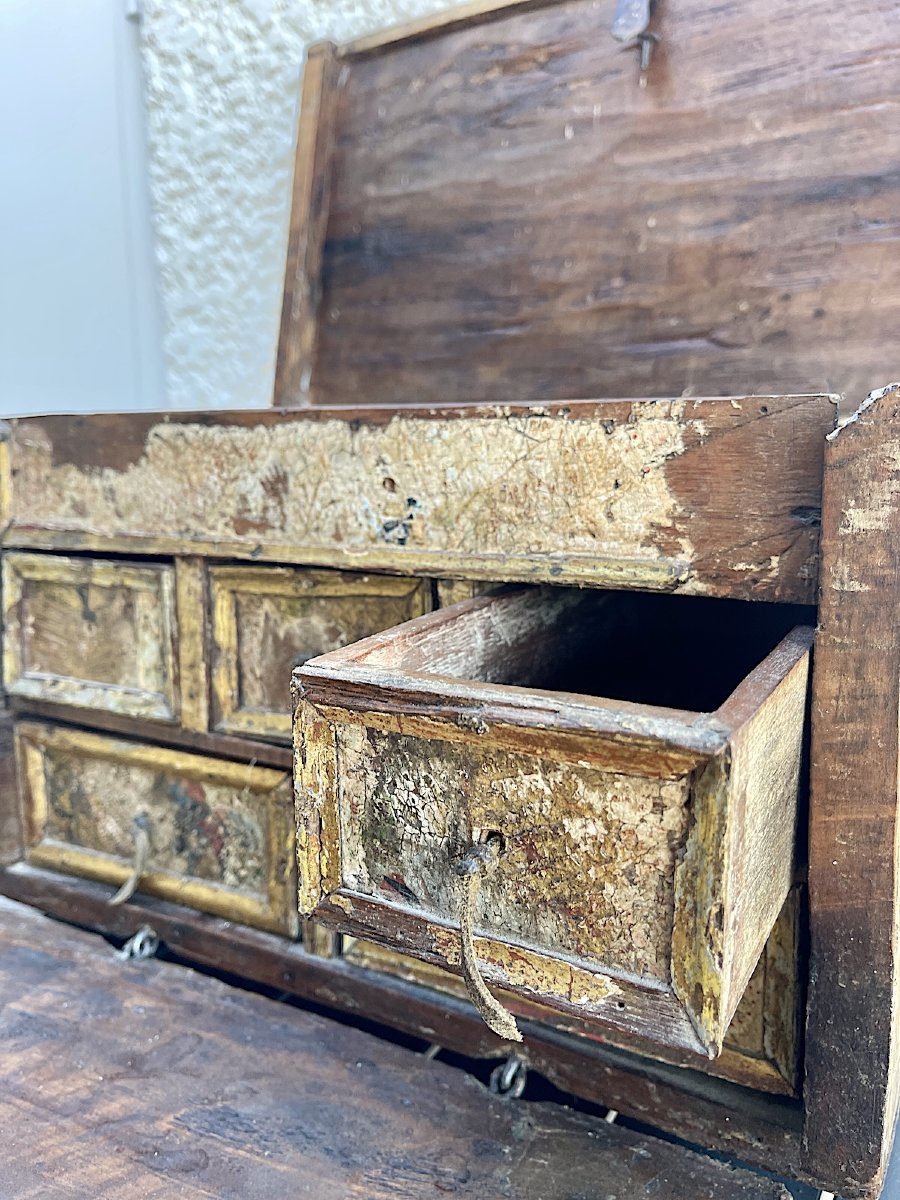
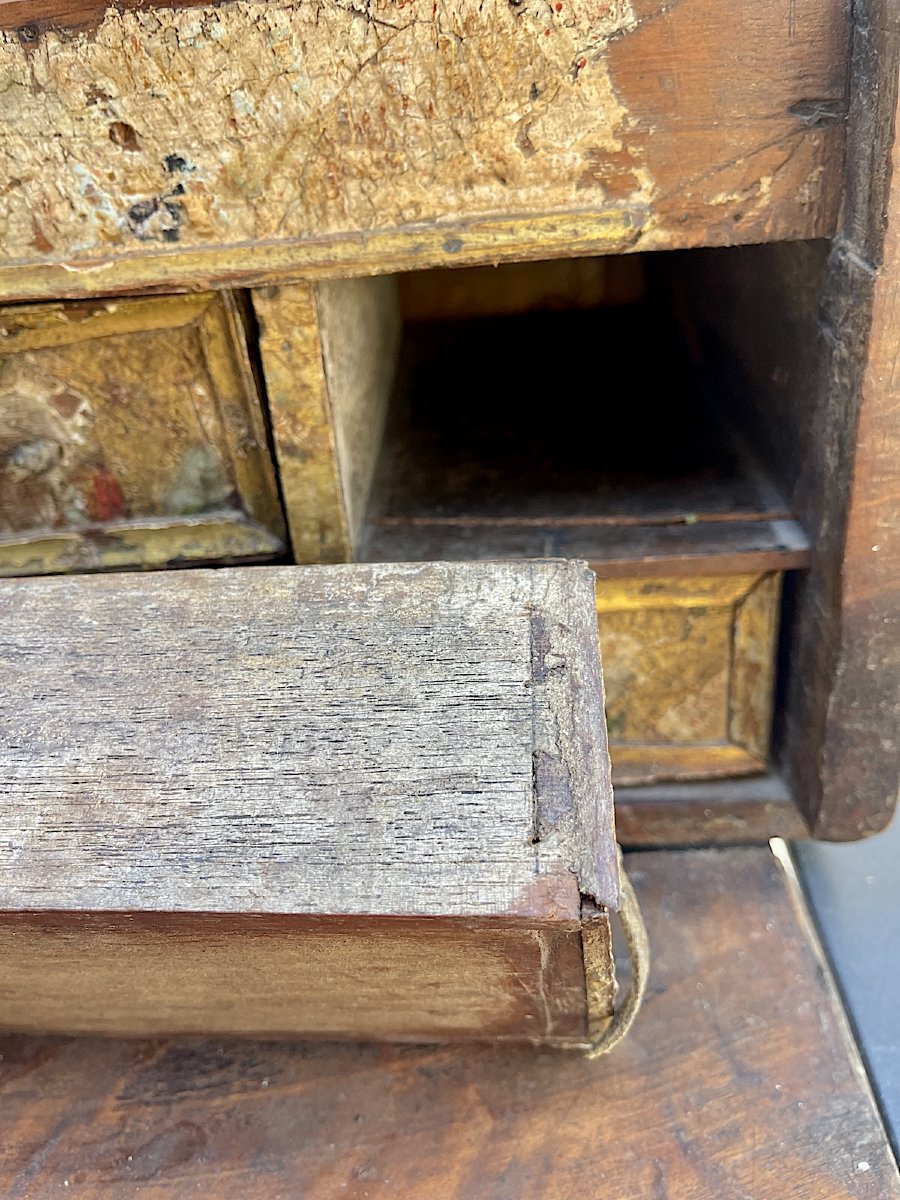
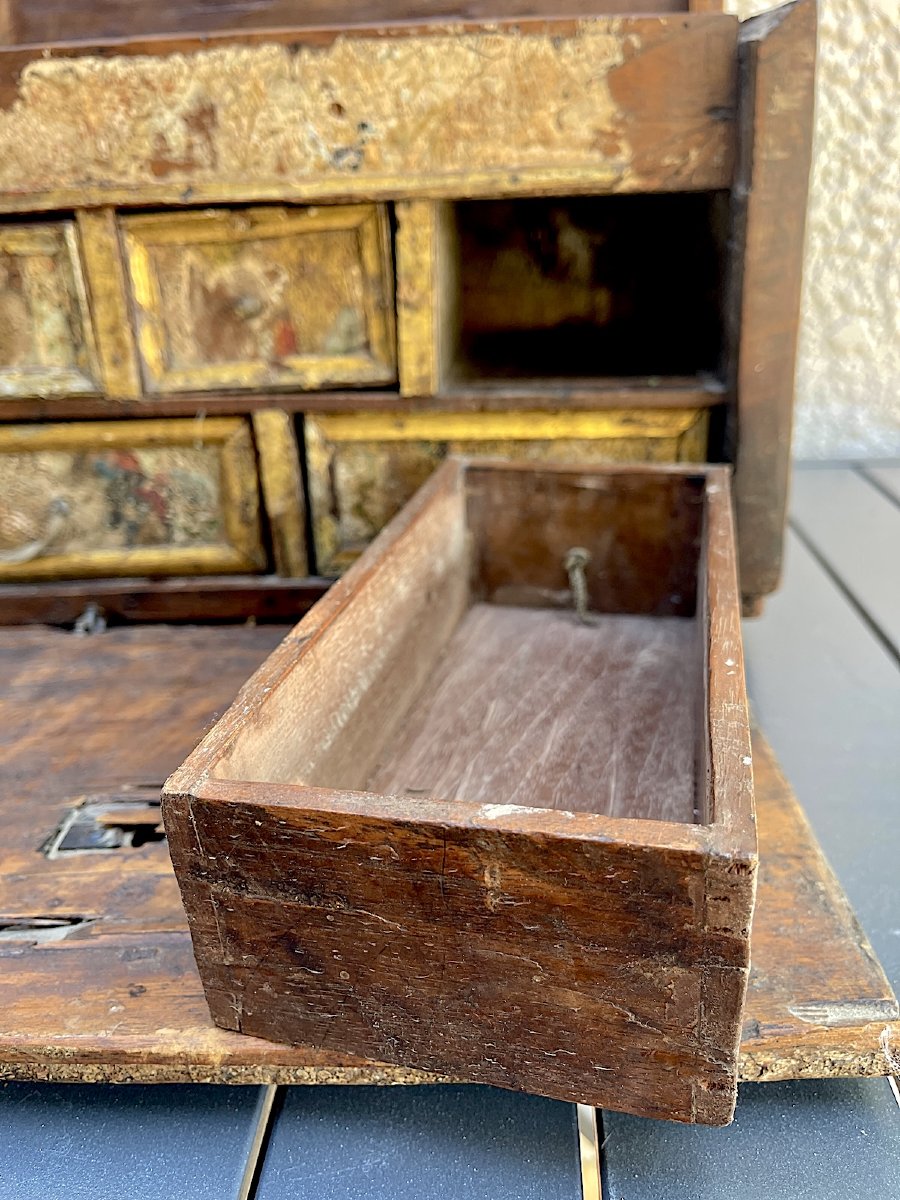
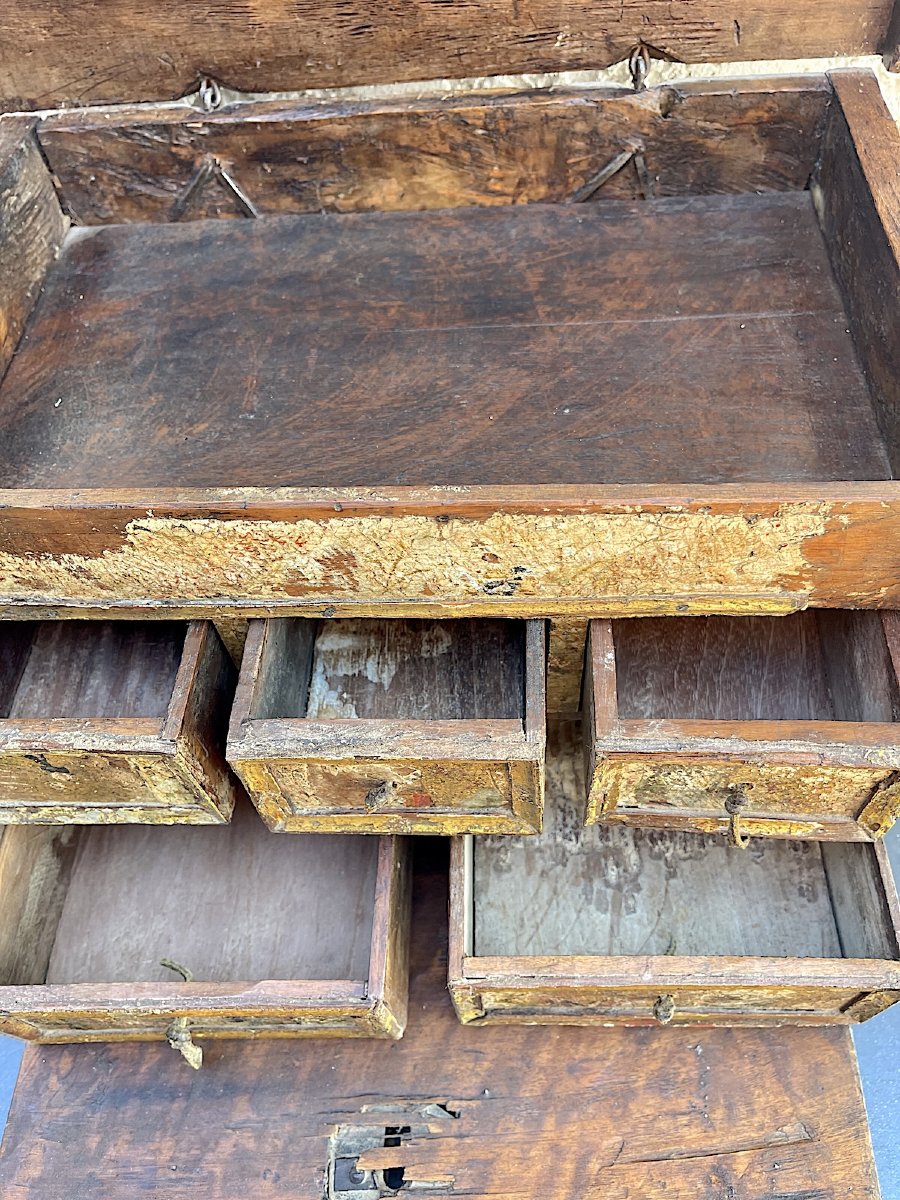
Beneath its deceptively simple exterior lies a piece of furniture designed with remarkable functional ingenuity. Behind a drop-front secured by a substantial wrought-iron lock, one discovers an upper compartment spanning the full width of the cabinet; beneath this are six drawers, neatly arranged in a symmetrical layout comprising three smaller upper drawers and three larger lower ones.
This arrangement catered to the owner's daily needs, providing space to organize administrative documents, correspondence, jewelry, coins, seals, writing implements, or devotional objects. More than just a piece of furniture, the *bargueño* served as a personal strongbox that accompanied its owner on their travels.
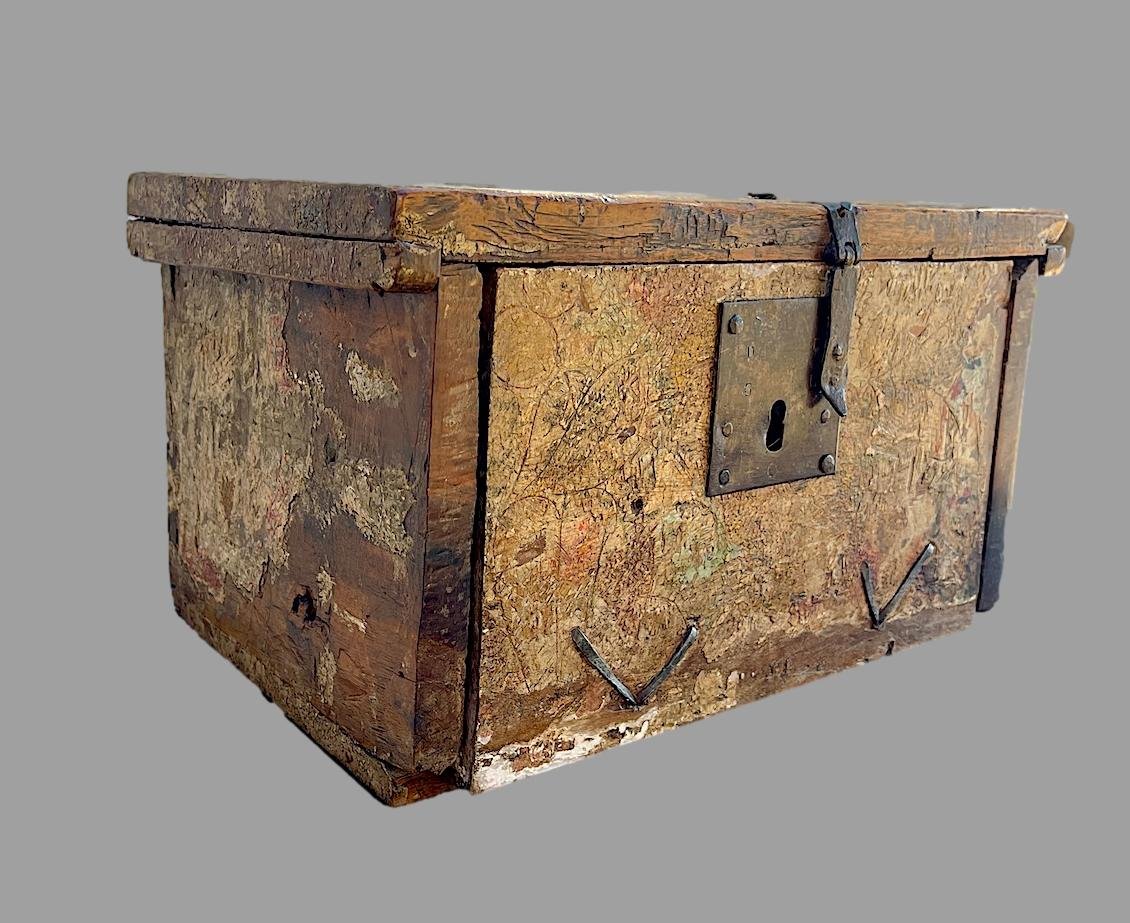
The piece retains its original lock, forged hasp, and metal reinforcements, as well as the striking textile drawer pulls—features rarely preserved after more than three centuries.
Polychromy Transformed into Landscape
One of the cabinet's greatest charms lies in the significant traces of its original polychromy.
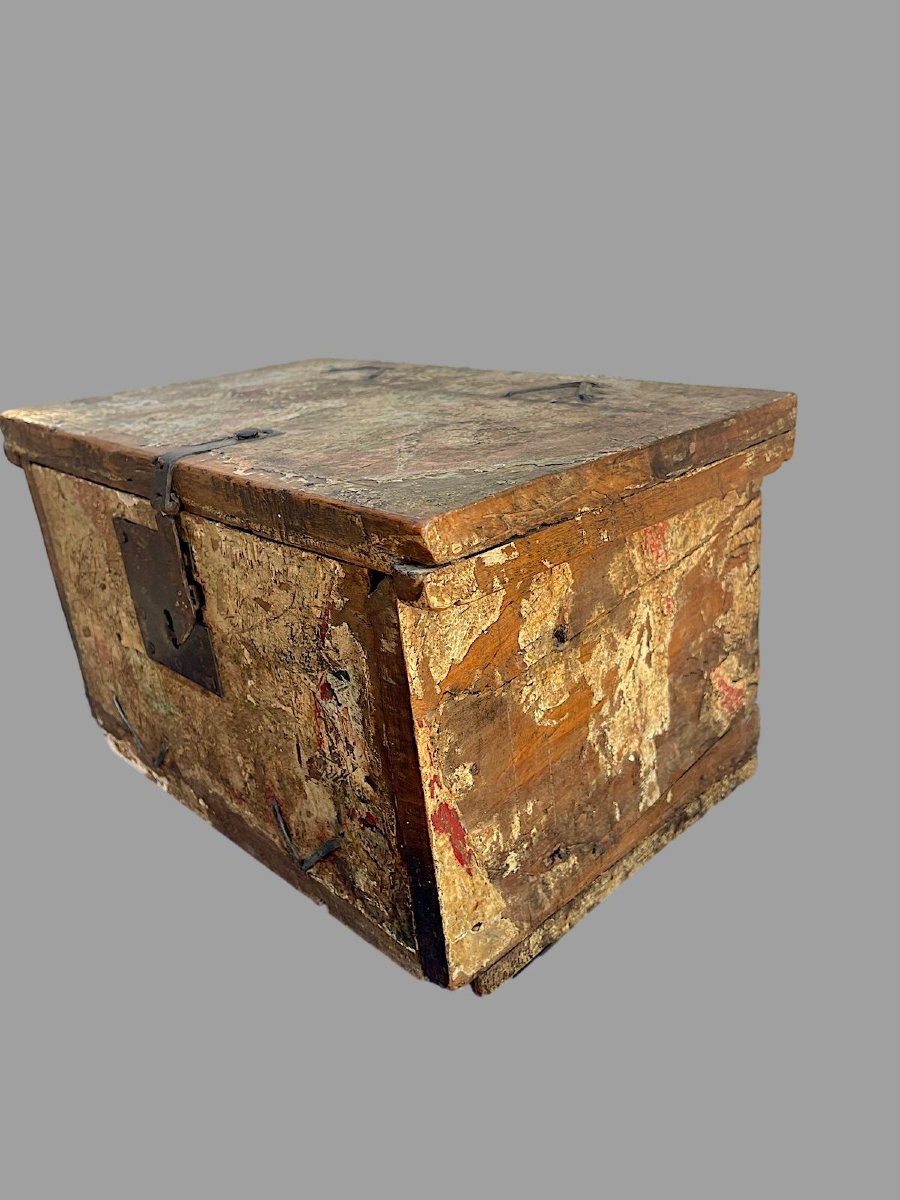
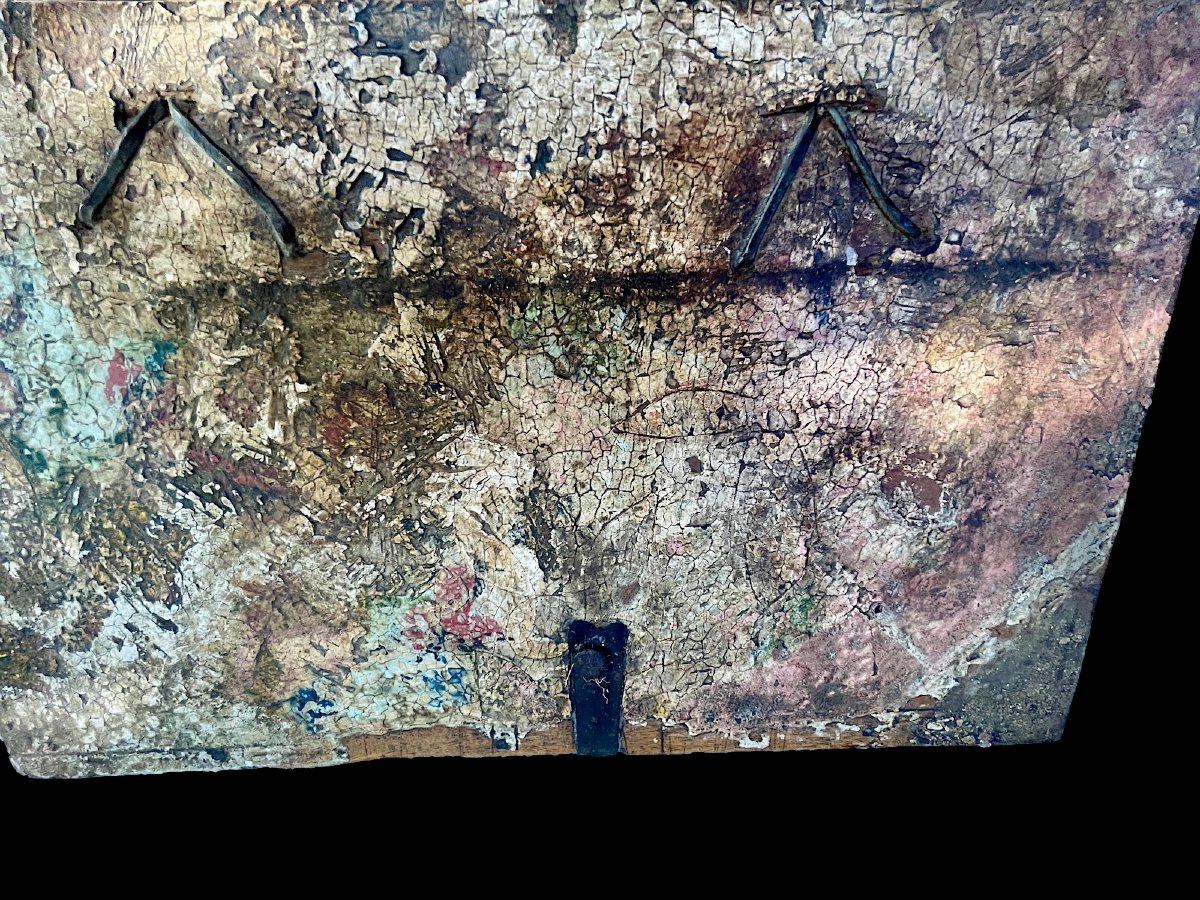
The four sides, the lid, and the drawer fronts all retain a gesso-based ground layer, overlaid with decoration that has been profoundly transformed by the passage of time. Far from being a sign of deterioration, this evolution now presents a surface of extraordinary visual richness. Successive layers of paint, lifting gesso, areas of loss, craquelure, and abrasions combine to form a veritable pictorial landscape in which time itself has become the principal artist.
The dominant tones include:
the chalky whites of the gesso,
yellow ochres,
natural earth pigments,
ferruginous reds,
hints of coppery green,
and traces of carbon black.
This deliberately restrained palette is characteristic of Spanish folk decoration from the late Golden Age, a style that prioritized decorative warmth over ostentation.
Today, light catches the textured relief of this ancient material, revealing a patina that no modern restoration could replicate.
Construction
Close examination of the construction reveals entirely hand-crafted workmanship.
The piece is made primarily of walnut—a wood favored by Spanish workshops for its stability, tight grain, and structural strength.
The bottoms of several drawers are made of oak, a feature frequently found in Spanish furniture of the 17th and 18th centuries.
The joinery follows traditional methods.
The metal fittings are entirely hand-forged.
Prominent through-nails—visible notably on the front and lid—reinforce the structure, ensuring durability during the frequent transport to which this type of furniture was subjected.
All these characteristics confirm its origins as a piece of traditional craftsmanship.
The Bargueño in the History of European Furniture
The *bargueño* holds a pivotal place in the history of Western furniture.
Emerging in Spain during the 16th century—likely in workshops in Toledo and Castile—it represents the natural evolution from the medieval chest to a specialized piece of furniture designed for writing, filing, and storing precious possessions.
Its name is traditionally linked to the small town of Bargas, near Toledo, although this origin remains a subject of debate among historians. Quickly adopted by the administrative elites of Habsburg Spain, it became one of the iconic pieces of furniture of the Spanish Golden Age.
Grand examples, richly inlaid with ivory, ebony, tortoiseshell, or geometric marquetry, were intended for the aristocracy and high-ranking dignitaries.
Alongside these prestigious creations, there existed more understated versions—such as the one presented here—crafted from walnut and adorned with polychrome decoration that has since become exceptionally rare.
These smaller models accompanied their owners on their travels, which explains their sturdy construction and substantial metal fittings.
A piece with character:
Unlike the luxurious *bargueños* intended for display in Spanish palaces, this cabinet appeals precisely because of its authenticity. Nothing about it appears artificial. Every sign of wear, abrasion, or loss of polychromy now contributes to its identity. It possesses that rare quality found in objects that have survived the centuries without significant alteration. It does not seek to impress; it tells a story. Today, this sincerity is one of the qualities most sought after by collectors of *Haute Époque* furniture.
Comparisons:
In terms of its general architecture, interior layout, and construction, this small *bargueño* belongs to the tradition of Spanish cabinets held in various European public collections. Comparable examples can be found at the Museo Nacional de Artes Decorativas in Madrid, the Museo Lázaro Galdiano, and the Victoria and Albert Museum in London, which houses several 17th- and 18th-century Spanish cabinets featuring a similar interior layout. While large, inlaid *bargueños* represent the most spectacular examples of this type of work, small polychrome models are significantly rarer on the market today, as many have been lost due to daily use.
Attribution:
Spain. Likely Castile. Late 17th to early 18th century (circa 1680–1720). Provincial workshop.
Condition:
Excellent overall condition considering its age. Perfectly sound construction. Exceptional antique patina. Original polychromy preserved as highly decorative remnants. Period metal fittings. Period textile handles. Some old maintenance-related restorations. No visible major modern restoration.
Provenance:
Former private collection.
Conclusion:
Serving as a travel chest, writing desk, and personal cabinet all in one, this small *bargueño* stands as a remarkably authentic example of Spanish furniture craftsmanship from the late 17th century. Its understated architecture, the fine quality of its walnut wood, the survival of its original polychromy, and the moving patina acquired over more than three centuries make it a collector's item that is as historically significant as it is decorative, perfectly exemplifying the tradition of Spanish Golden Age travel cabinets.
Keywords:
Bargueño – Spanish cabinet – Spanish furniture – Walnut – 17th century – Early period – Travel cabinet – Antique furniture – Spain – Castile – Chest of drawers – Collection – Arte Collection.
Shipping and insurance information:
All our packages are prepared by MBE (Mail Boxes Etc.) Narbonne, ensuring meticulous and highly secure packaging. Shipping is then handled by UPS, FedEx, or GLS, guaranteeing reliable, trackable delivery worldwide. For any purchase exceeding €2,500, an *ad valorem* insurance policy is automatically taken out with Trans-Pass, providing optimal coverage for your acquisition throughout the entire shipping process.
Portable cabinet with six drawers
Spain, likely Castile
Late 17th – Early 18th century (circa 1680–1720)
Dimensions:
Height: 22 cm
Width: 38.2 cm
Depth: 23.4 cm
Description
This remarkable small Spanish *bargueño* serves as a fine example of the domestic and portable furniture produced on the Iberian Peninsula in the late 17th century. Crafted primarily from walnut—with several drawer bottoms made of oak—it perfectly illustrates the tradition of Castilian workshops, which combined fine woods with sturdier timber for less visible structural components.
Beneath its deceptively simple exterior lies a piece of furniture designed with remarkable functional ingenuity. Behind a drop-front secured by a substantial wrought-iron lock, one discovers an upper compartment spanning the full width of the cabinet; beneath this are six drawers, neatly arranged in a symmetrical layout comprising three smaller upper drawers and three larger lower ones.
This arrangement catered to the owner's daily needs, providing space to organize administrative documents, correspondence, jewelry, coins, seals, writing implements, or devotional objects. More than just a piece of furniture, the *bargueño* served as a personal strongbox that accompanied its owner on their travels.
The piece retains its original lock, forged hasp, and metal reinforcements, as well as the striking textile drawer pulls—features rarely preserved after more than three centuries.
Polychromy Transformed into Landscape
One of the cabinet's greatest charms lies in the significant traces of its original polychromy.
The four sides, the lid, and the drawer fronts all retain a gesso-based ground layer, overlaid with decoration that has been profoundly transformed by the passage of time. Far from being a sign of deterioration, this evolution now presents a surface of extraordinary visual richness. Successive layers of paint, lifting gesso, areas of loss, craquelure, and abrasions combine to form a veritable pictorial landscape in which time itself has become the principal artist.
The dominant tones include:
the chalky whites of the gesso,
yellow ochres,
natural earth pigments,
ferruginous reds,
hints of coppery green,
and traces of carbon black.
This deliberately restrained palette is characteristic of Spanish folk decoration from the late Golden Age, a style that prioritized decorative warmth over ostentation.
Today, light catches the textured relief of this ancient material, revealing a patina that no modern restoration could replicate.
Construction
Close examination of the construction reveals entirely hand-crafted workmanship.
The piece is made primarily of walnut—a wood favored by Spanish workshops for its stability, tight grain, and structural strength.
The bottoms of several drawers are made of oak, a feature frequently found in Spanish furniture of the 17th and 18th centuries.
The joinery follows traditional methods.
The metal fittings are entirely hand-forged.
Prominent through-nails—visible notably on the front and lid—reinforce the structure, ensuring durability during the frequent transport to which this type of furniture was subjected.
All these characteristics confirm its origins as a piece of traditional craftsmanship.
The Bargueño in the History of European Furniture
The *bargueño* holds a pivotal place in the history of Western furniture.
Emerging in Spain during the 16th century—likely in workshops in Toledo and Castile—it represents the natural evolution from the medieval chest to a specialized piece of furniture designed for writing, filing, and storing precious possessions.
Its name is traditionally linked to the small town of Bargas, near Toledo, although this origin remains a subject of debate among historians. Quickly adopted by the administrative elites of Habsburg Spain, it became one of the iconic pieces of furniture of the Spanish Golden Age.
Grand examples, richly inlaid with ivory, ebony, tortoiseshell, or geometric marquetry, were intended for the aristocracy and high-ranking dignitaries.
Alongside these prestigious creations, there existed more understated versions—such as the one presented here—crafted from walnut and adorned with polychrome decoration that has since become exceptionally rare.
These smaller models accompanied their owners on their travels, which explains their sturdy construction and substantial metal fittings.
A piece with character:
Unlike the luxurious *bargueños* intended for display in Spanish palaces, this cabinet appeals precisely because of its authenticity. Nothing about it appears artificial. Every sign of wear, abrasion, or loss of polychromy now contributes to its identity. It possesses that rare quality found in objects that have survived the centuries without significant alteration. It does not seek to impress; it tells a story. Today, this sincerity is one of the qualities most sought after by collectors of *Haute Époque* furniture.
Comparisons:
In terms of its general architecture, interior layout, and construction, this small *bargueño* belongs to the tradition of Spanish cabinets held in various European public collections. Comparable examples can be found at the Museo Nacional de Artes Decorativas in Madrid, the Museo Lázaro Galdiano, and the Victoria and Albert Museum in London, which houses several 17th- and 18th-century Spanish cabinets featuring a similar interior layout. While large, inlaid *bargueños* represent the most spectacular examples of this type of work, small polychrome models are significantly rarer on the market today, as many have been lost due to daily use.
Attribution:
Spain. Likely Castile. Late 17th to early 18th century (circa 1680–1720). Provincial workshop.
Condition:
Excellent overall condition considering its age. Perfectly sound construction. Exceptional antique patina. Original polychromy preserved as highly decorative remnants. Period metal fittings. Period textile handles. Some old maintenance-related restorations. No visible major modern restoration.
Provenance:
Former private collection.
Conclusion:
Serving as a travel chest, writing desk, and personal cabinet all in one, this small *bargueño* stands as a remarkably authentic example of Spanish furniture craftsmanship from the late 17th century. Its understated architecture, the fine quality of its walnut wood, the survival of its original polychromy, and the moving patina acquired over more than three centuries make it a collector's item that is as historically significant as it is decorative, perfectly exemplifying the tradition of Spanish Golden Age travel cabinets.
Keywords:
Bargueño – Spanish cabinet – Spanish furniture – Walnut – 17th century – Early period – Travel cabinet – Antique furniture – Spain – Castile – Chest of drawers – Collection – Arte Collection.
Shipping and insurance information:
All our packages are prepared by MBE (Mail Boxes Etc.) Narbonne, ensuring meticulous and highly secure packaging. Shipping is then handled by UPS, FedEx, or GLS, guaranteeing reliable, trackable delivery worldwide. For any purchase exceeding €2,500, an *ad valorem* insurance policy is automatically taken out with Trans-Pass, providing optimal coverage for your acquisition throughout the entire shipping process.
4 450 €
Period: 17th century
Style: Renaissance, Louis 13th
Condition: Good condition
Material: Solid wood
Width: 38,2 cm
Height: 22 cm
Depth: 23,4 cm
Reference (ID): 1787153
Availability: In stock
Print