THIS OBJECT WAS SOLD
Medieval Pectoral Cross In Champlevé Enamelled Bronze - Chrism Chi-rho - D. Et S. Piéchaud
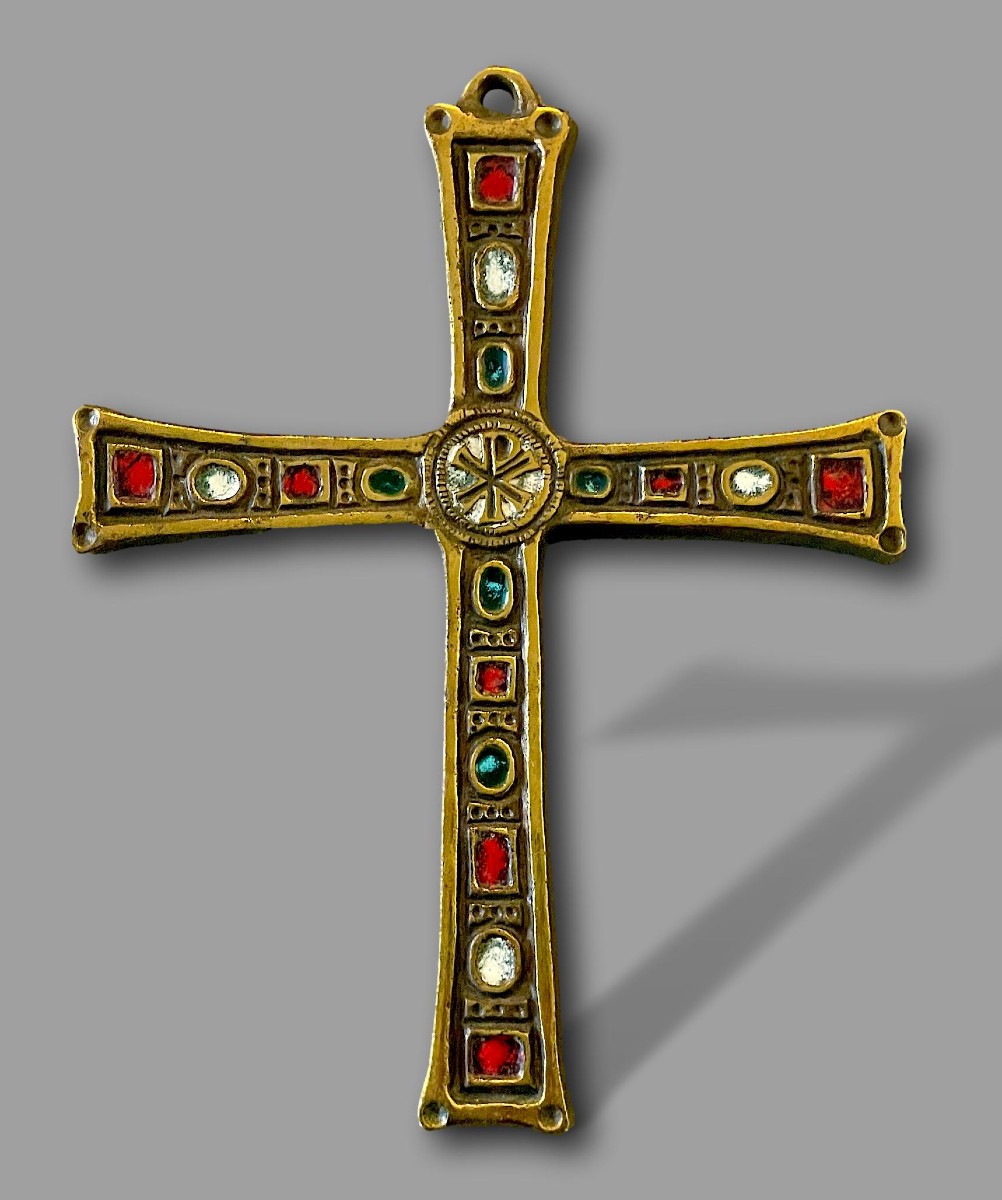
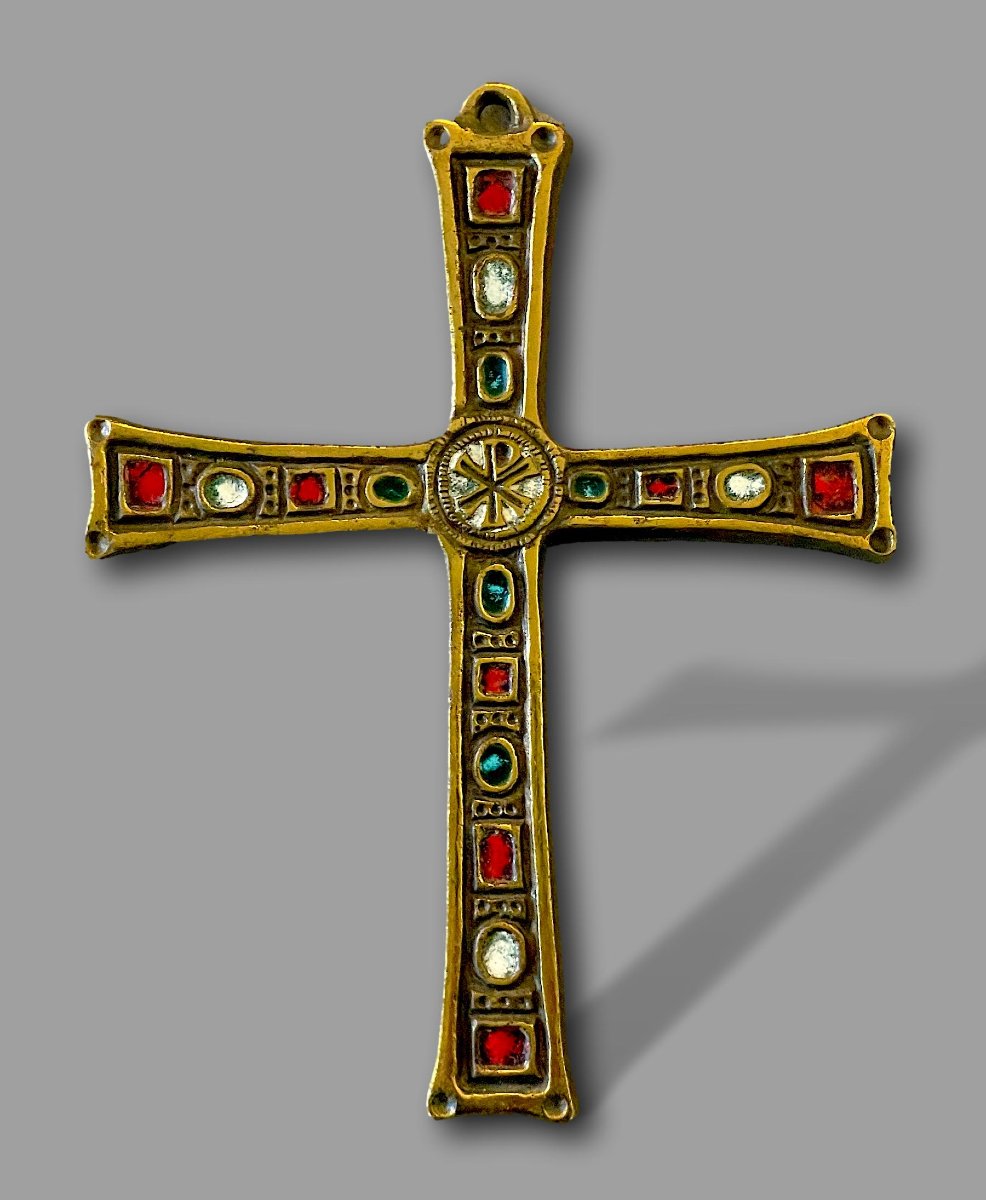

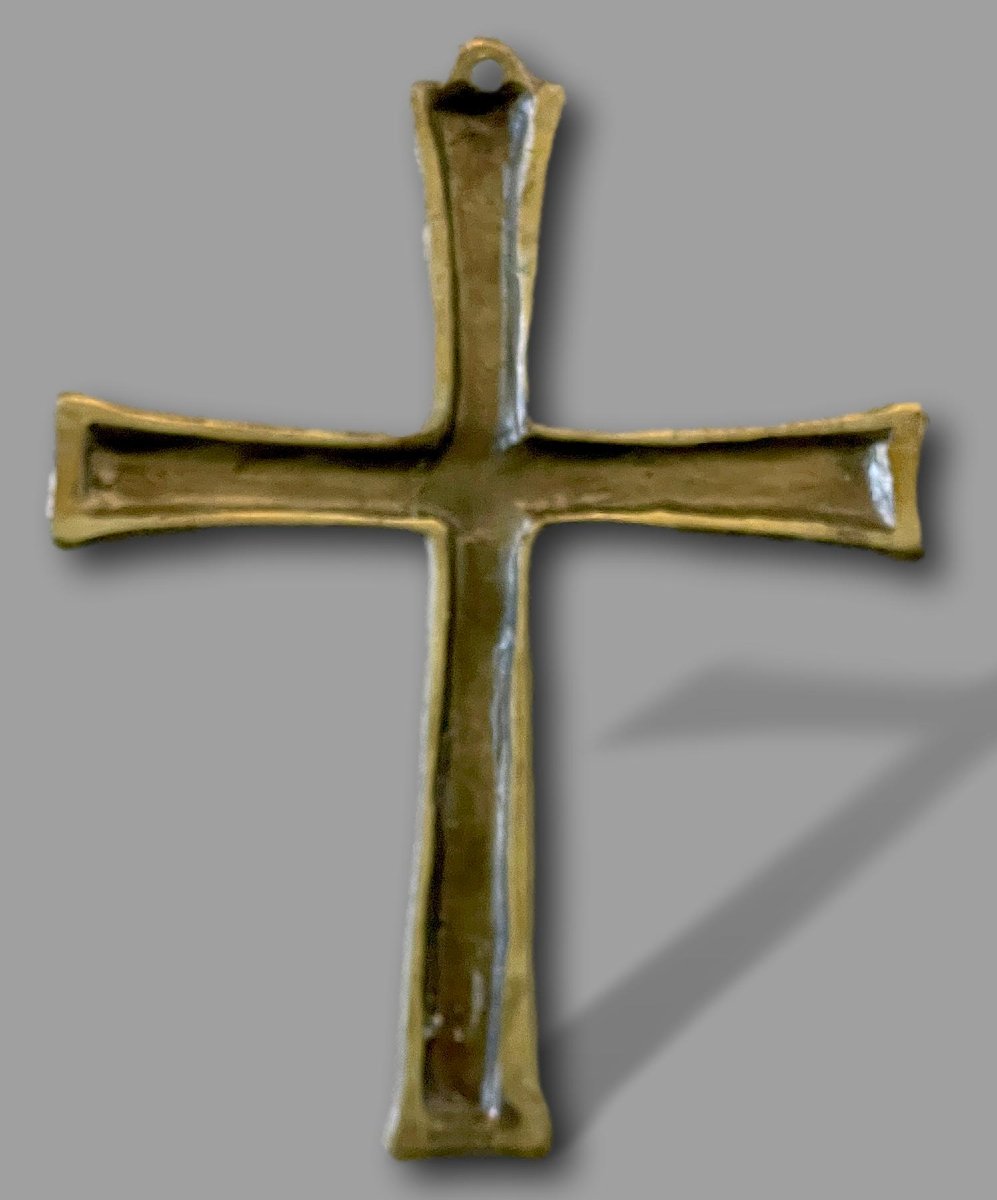
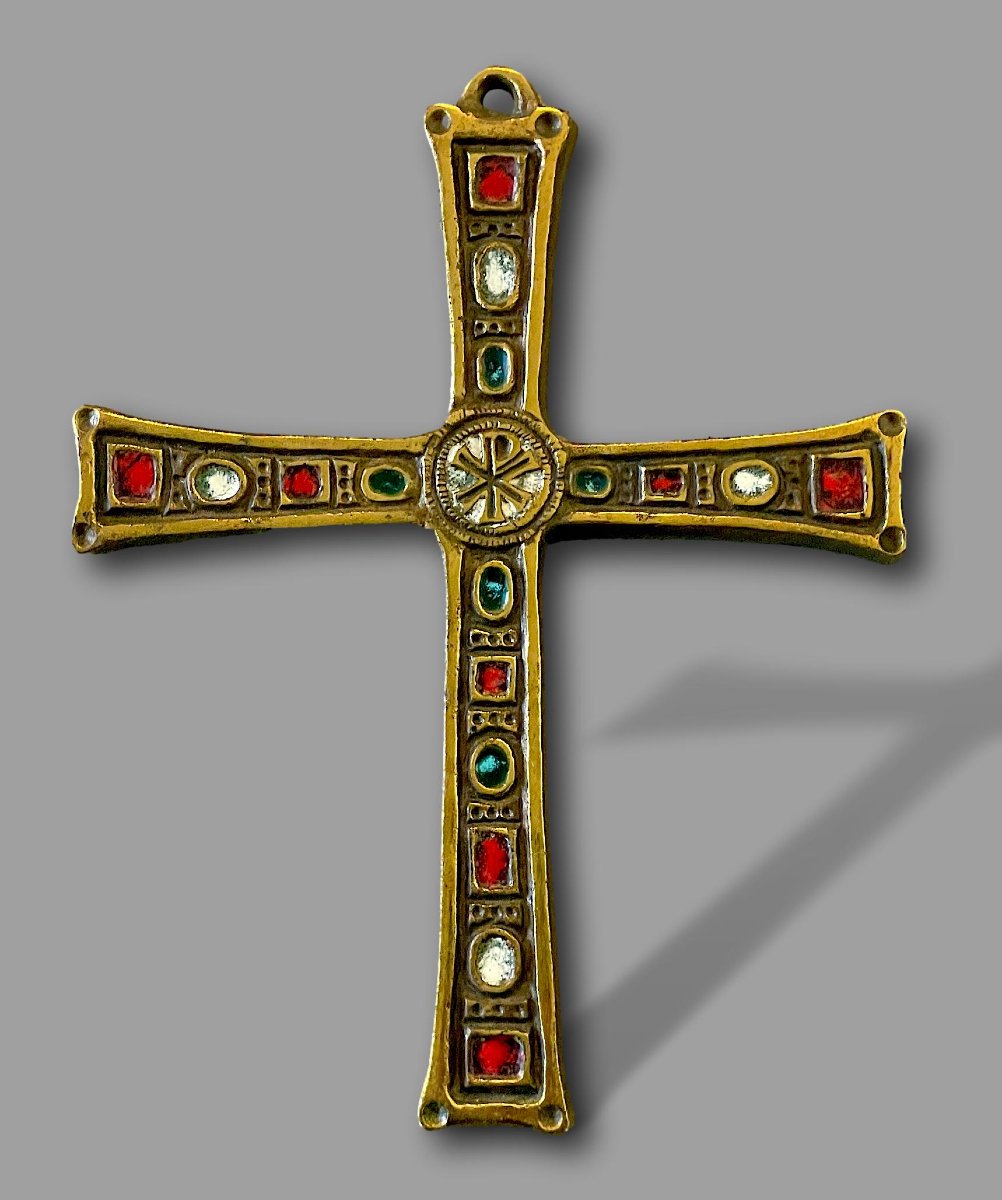


General Presentation A remarkable gilt bronze pectoral or wall cross of Latin form, approximately 16 cm high, adorned with rich polychrome champlevé enamel decoration arranged in regular registers across all four arms. The piece is pierced with a suspension ring at its top, confirming its dual purpose: a hanging devotional object or a prestigious pectoral jewel.
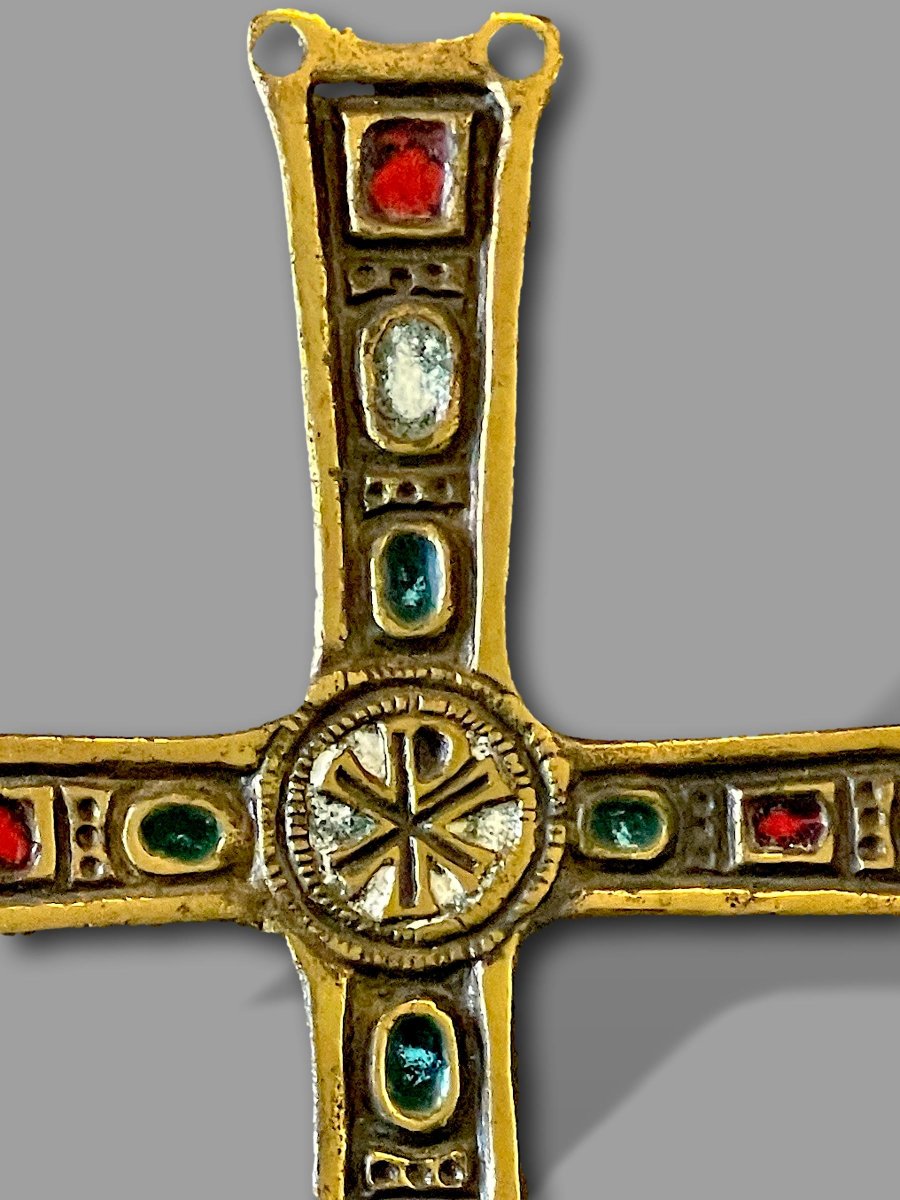
✦ Graphic and Iconographic Description The focal point of the cross is occupied by a central circular medallion within which is engraved in relief the Chi-Rho (or Christogram, ☧), the monogram of Christ formed from the first two Greek letters of his name: Χ (Chi) and Ρ (Rho). This Christological symbol, one of the oldest in Christian iconography, refers directly to the first early Christian basilicas and the imperial insignia of Constantine the Great (4th century).
The medallion is surrounded by a fine guilloché or beaded decoration, giving it the appearance of a reliquary or liturgical scroll. The four arms are punctuated by an alternating tripartite decorative sequence: cabochons in bright red enamel (square shape), cabochons in pearly white enamel (oval or round shape), and cabochons in emerald green enamel (oval shape), all set in gilt bronze, according to a rigorous geometric arrangement inherited from medieval tradition. The ends of the arms feature flared ends adorned with a large red cabochon framed by decorative rivets at the corners—a motif typical of early reliquary crosses.
✦ Technique and Materials The enamel is applied using the champlevé technique (enamel deposited in cells carved into the metal), characteristic of the great medieval schools, particularly the Limoges school (12th-13th centuries). This high-fire enameling technique, vitrified at high temperature, guarantees the permanence of the colors and perfect adhesion to the metal, qualities found on medieval works preserved in museums. The casting appears to be made of solid bronze with a light gilding or warm patina, producing an amber background that enhances the chromatic contrast of the enamels.
✦ Color Palette • Blood red / vermilion red: dominant, symbolizing Christ's sacrifice and the Passion • Milky white / pearly white: purity, divine light, resurrection • Emerald green: hope, eternal life, a reference to the precious stones of priestly pectorals • Gilded bronze: noble metallic background evoking celestial glory This color triad (red-white-green) corresponds to traditional liturgical colors and 12th-century Limoges enamels such as those found on the reliquaries of Saint Thomas Becket or the Limoges ciboria preserved in the Louvre and the Victoria & Albert Museum in London.
✦ Place in Art History This cross belongs to the long tradition of enameled reliquary crosses and pectoral crosses that reached their peak in the 12th and 13th centuries in the workshops of Limoges, the Rhine, and the Meuse. The veneration of the cross as a decorative and devotional art object began with the Emperor Constantine, and by the 4th and 5th centuries, it was beginning to adorn religious buildings. The presence of the Chi-Rho monogram at the center is a prominent early Christian motif, found on 4th-century Roman sarcophagi, the mosaics of Ravenna, and Carolingian treasures. This motif experienced a significant resurgence in the 19th century with the Neo-Gothic movement (Viollet-le-Duc, Pugin) and then in the 20th century in French sacred art workshops. Comparisons with catalogued works: • Limoges reliquary crosses, 12th century — Musée de Cluny (Paris), inv. Cl. 342 • Pectoral cross from Grandmont Abbey — British Museum
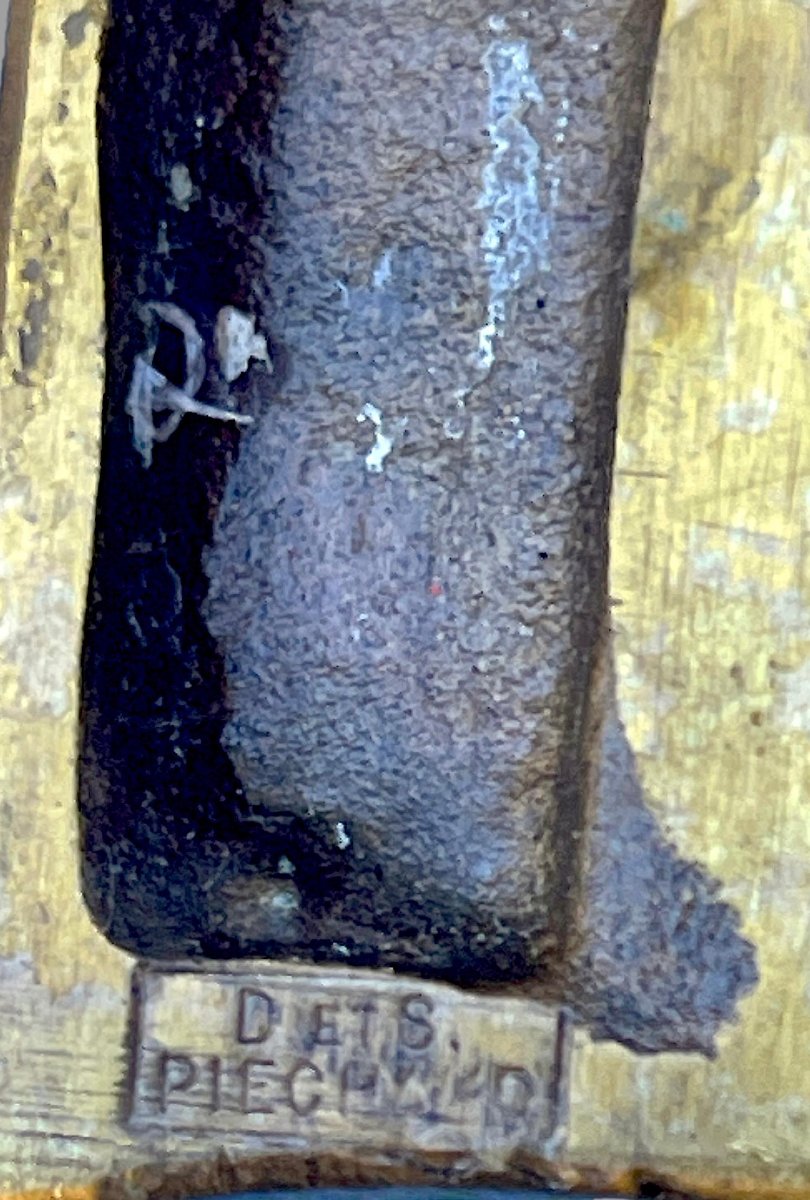
✦ The signature “D. and S. Piéchaud” engraved on the reverse confirms a collaboration between Dominique Piéchaud (1922-2011) — founder of the workshop — and his son Stephan Piéchaud (born 1950), who joined the workshop as a teenager. In 1950, Dominique and Maria-Theresia had an only son, Stephan, who joined the family workshop at the age of 16, before taking over its management in 1987. This double signature “D. and S.” thus places the piece within a precise chronological range: between circa 1966 (Stephan at 16) and 1987 (the date on which he took over the management alone and henceforth signs in his own name). This represents a period of transmission and father-son collaboration, particularly rare and sought after by collectors. From the 1950s onwards, Dominique Piéchaud created a collection of religious art and jewelry in a neo-medieval style, crafted in bronze and enamel, initially in Bordeaux and then in the Poitou-Charentes region from the 1960s.
✦ WORKSHOP BIOGRAPHY After the Second World War, Dominique Piéchaud, trained by the German sculptor Anton Nagel in Trier, settled in France with his wife Maria-Theresia (Anton's daughter).
✦ Graphic and Iconographic Description The focal point of the cross is occupied by a central circular medallion within which is engraved in relief the Chi-Rho (or Christogram, ☧), the monogram of Christ formed from the first two Greek letters of his name: Χ (Chi) and Ρ (Rho). This Christological symbol, one of the oldest in Christian iconography, refers directly to the first early Christian basilicas and the imperial insignia of Constantine the Great (4th century).
The medallion is surrounded by a fine guilloché or beaded decoration, giving it the appearance of a reliquary or liturgical scroll. The four arms are punctuated by an alternating tripartite decorative sequence: cabochons in bright red enamel (square shape), cabochons in pearly white enamel (oval or round shape), and cabochons in emerald green enamel (oval shape), all set in gilt bronze, according to a rigorous geometric arrangement inherited from medieval tradition. The ends of the arms feature flared ends adorned with a large red cabochon framed by decorative rivets at the corners—a motif typical of early reliquary crosses.
✦ Technique and Materials The enamel is applied using the champlevé technique (enamel deposited in cells carved into the metal), characteristic of the great medieval schools, particularly the Limoges school (12th-13th centuries). This high-fire enameling technique, vitrified at high temperature, guarantees the permanence of the colors and perfect adhesion to the metal, qualities found on medieval works preserved in museums. The casting appears to be made of solid bronze with a light gilding or warm patina, producing an amber background that enhances the chromatic contrast of the enamels.
✦ Color Palette • Blood red / vermilion red: dominant, symbolizing Christ's sacrifice and the Passion • Milky white / pearly white: purity, divine light, resurrection • Emerald green: hope, eternal life, a reference to the precious stones of priestly pectorals • Gilded bronze: noble metallic background evoking celestial glory This color triad (red-white-green) corresponds to traditional liturgical colors and 12th-century Limoges enamels such as those found on the reliquaries of Saint Thomas Becket or the Limoges ciboria preserved in the Louvre and the Victoria & Albert Museum in London.
✦ Place in Art History This cross belongs to the long tradition of enameled reliquary crosses and pectoral crosses that reached their peak in the 12th and 13th centuries in the workshops of Limoges, the Rhine, and the Meuse. The veneration of the cross as a decorative and devotional art object began with the Emperor Constantine, and by the 4th and 5th centuries, it was beginning to adorn religious buildings. The presence of the Chi-Rho monogram at the center is a prominent early Christian motif, found on 4th-century Roman sarcophagi, the mosaics of Ravenna, and Carolingian treasures. This motif experienced a significant resurgence in the 19th century with the Neo-Gothic movement (Viollet-le-Duc, Pugin) and then in the 20th century in French sacred art workshops. Comparisons with catalogued works: • Limoges reliquary crosses, 12th century — Musée de Cluny (Paris), inv. Cl. 342 • Pectoral cross from Grandmont Abbey — British Museum
✦ The signature “D. and S. Piéchaud” engraved on the reverse confirms a collaboration between Dominique Piéchaud (1922-2011) — founder of the workshop — and his son Stephan Piéchaud (born 1950), who joined the workshop as a teenager. In 1950, Dominique and Maria-Theresia had an only son, Stephan, who joined the family workshop at the age of 16, before taking over its management in 1987. This double signature “D. and S.” thus places the piece within a precise chronological range: between circa 1966 (Stephan at 16) and 1987 (the date on which he took over the management alone and henceforth signs in his own name). This represents a period of transmission and father-son collaboration, particularly rare and sought after by collectors. From the 1950s onwards, Dominique Piéchaud created a collection of religious art and jewelry in a neo-medieval style, crafted in bronze and enamel, initially in Bordeaux and then in the Poitou-Charentes region from the 1960s.
✦ WORKSHOP BIOGRAPHY After the Second World War, Dominique Piéchaud, trained by the German sculptor Anton Nagel in Trier, settled in France with his wife Maria-Theresia (Anton's daughter).
Explore similar pieces and discover your ideal find:
Christian Art