

Historical Portrait Of Childebert I – Oil On Canvas – 17th-century Italian Master
Artist: Ecole Italienne 17ème Siècle
Historical Portrait of Childebert I
Oil on canvas
Italian master portraitist, 17th century
Canvas dimensions: approximately 78 × 65 cm
· Italian School, likely Tuscany (Florence) or Emilia (Bologna)
· Circa 1640–1670
· Attributed to an Italian master portraitist
· In the style of historical portraits created for the great Medici and Farnese galleries
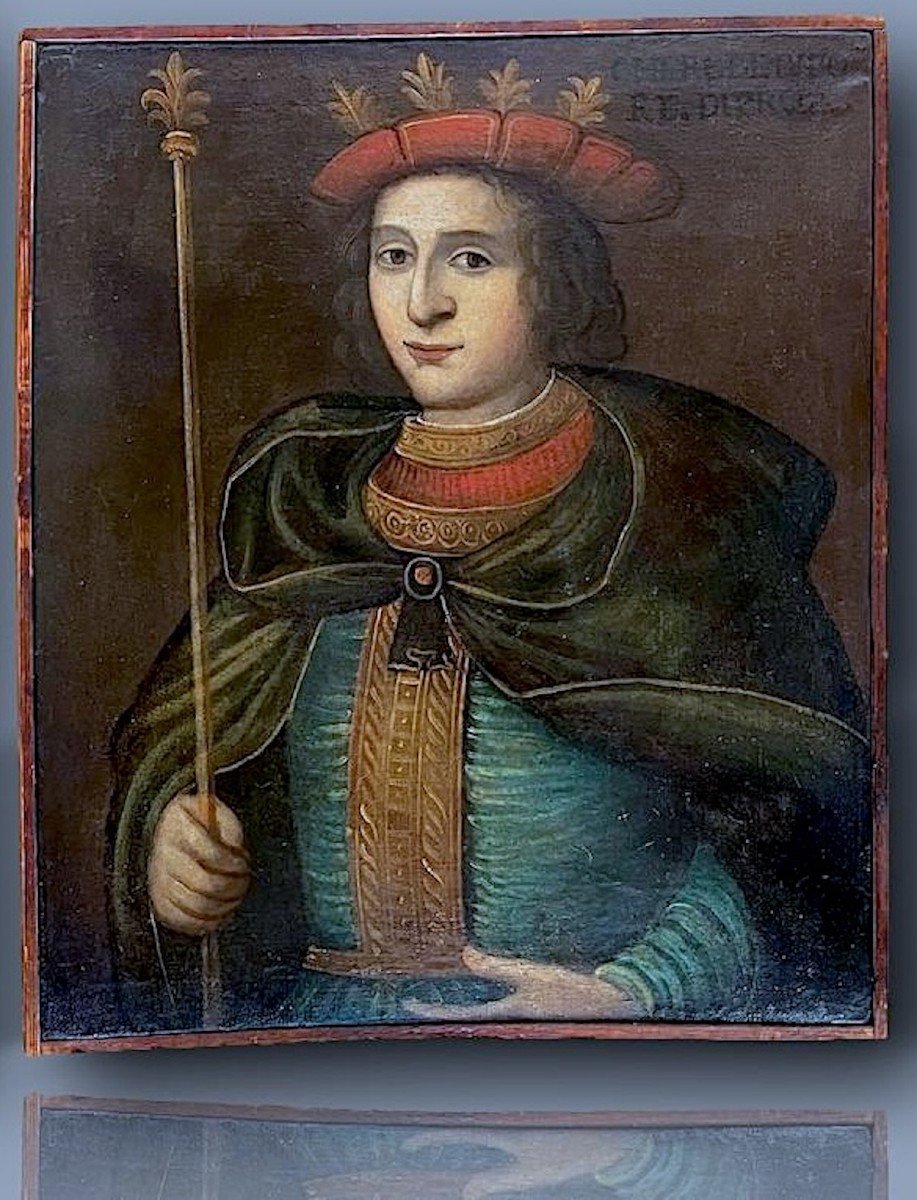
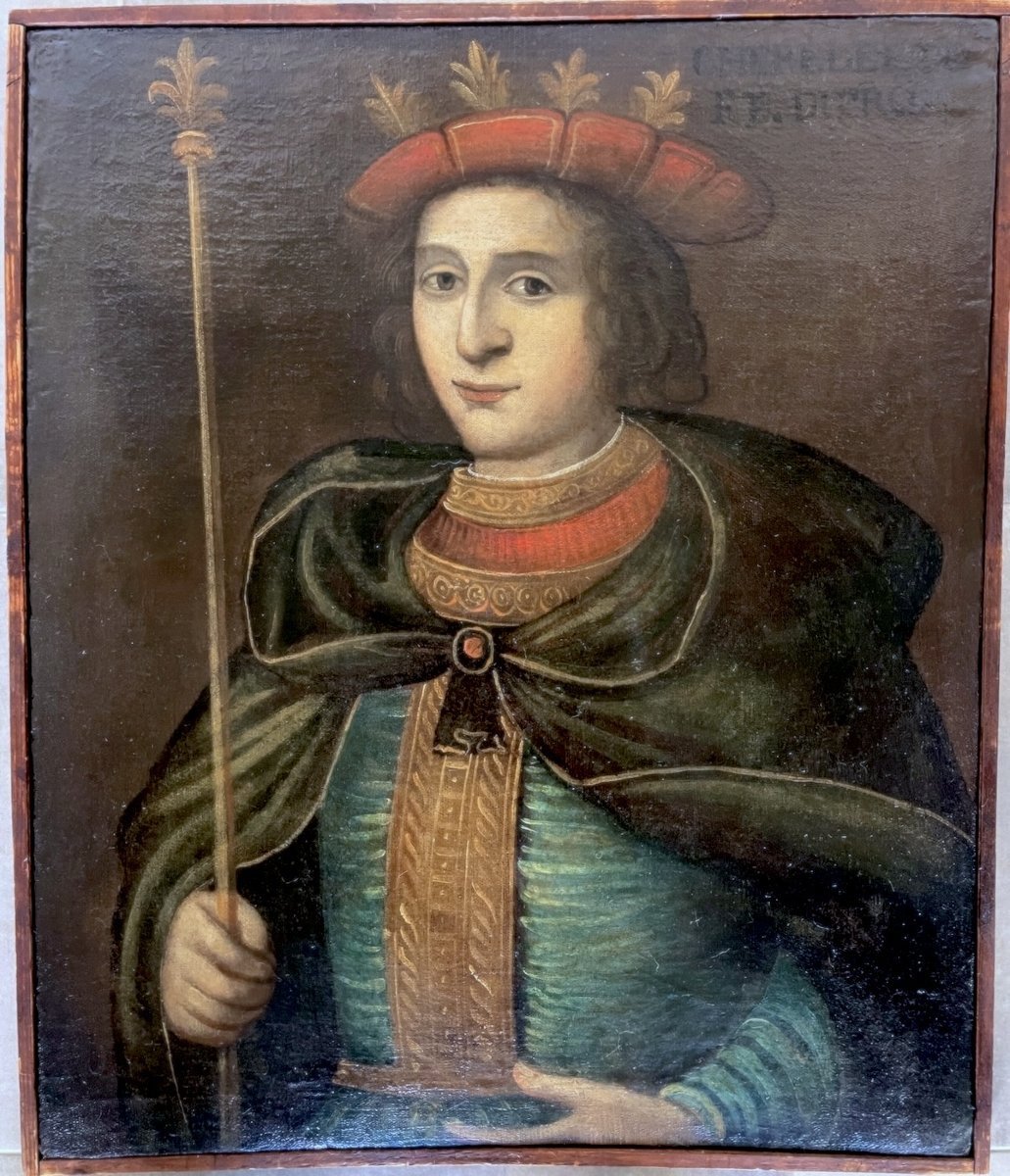
Rare and highly decorative, this historical portrait depicts Childebert I (c. 496–558), King of Paris and son of Clovis I and Queen Clotilde—a key founding figure of the Merovingian dynasty. Painted in the 17th century by an Italian master portraitist, this significant oil on canvas belongs to the prestigious tradition of "galleries of sovereigns," which enjoyed immense popularity in princely courts and grand European residences during the Baroque era.
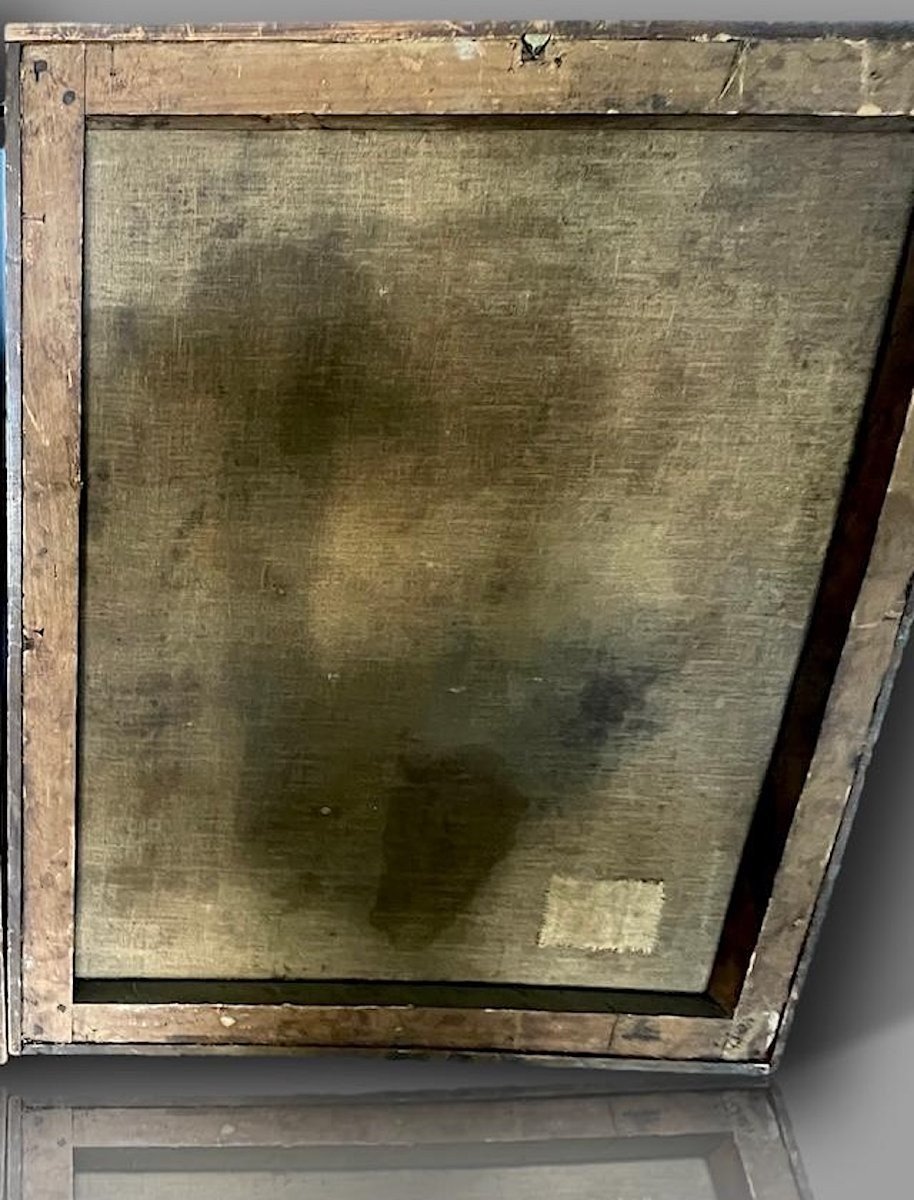
The work has undergone a high-quality historic restoration, including professional relining and a cleaning process that preserved the integrity of the paint layer. It is currently in excellent condition, with no intrusive overpainting visible under natural light, allowing the quality of execution and the richness of the original palette to be fully appreciated.
The monarch is depicted in a half-length pose, exuding a calm, regal majesty. His gaze, directed toward the viewer, conveys both the determination and the wisdom of a Christian prince. His right hand holds a long scepter topped with an elegant foliate finial—a symbol of both his temporal authority and dynastic continuity.
His attire is one of the composition's most striking features.
The king wears a red velvet tunic embellished with gold embroidery and fine braid, overlaid by a voluminous deep-green velvet cloak edged in gold. Luminous highlights accentuate the folds of the fabric with remarkable virtuosity, while the beaded ornaments and embroidery reveal a keen eye for luxurious textiles.
The red headdress, adorned with floral motifs and golden cabochons, plays a key role in glorifying the figure. Although it reflects the 17th-century conception of monarchy rather than actual Merovingian attire, it perfectly captures the idealized vision Baroque artists held of France's early kings.
The dark background, rendered in deep brownish-black tones, effectively isolates the figure. This technique—inherited from late Renaissance Italian painting and widely adopted in the 17th century—focuses all attention on the nobility of the face and the brilliance of the royal regalia.
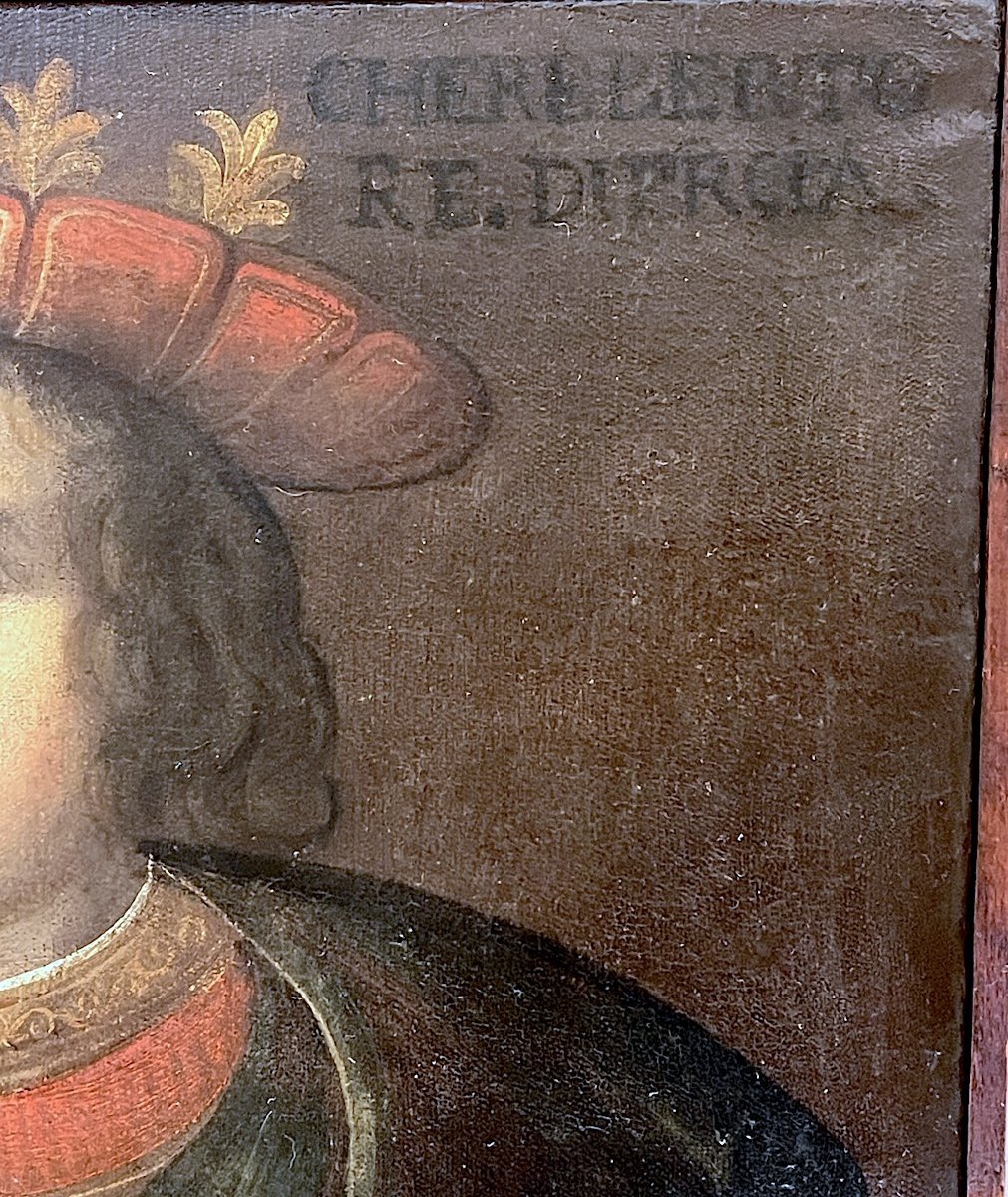
An antique inscription at the top identifies the figure as:
"CHEREBERTO RE DI FRA..."
This Latinized spelling, common in early series of royal portraits, refers to Childebert I, King of the Franks.
A work in the tradition of great historical portrait galleries
From the 16th century onwards—and increasingly during the 17th century—European courts developed a fascination with the great rulers of antiquity, the Bible, and the early Christian monarchies.
Italian workshops produced numerous series for palaces, libraries, monasteries, and aristocratic collections, depicting Roman emperors, popes, and the early kings of France.
These portraits were not intended as accurate archaeological reconstructions but rather as idealized representations of power; the rulers were depicted in the aesthetic style of the time to embody the virtues of the Christian prince: justice, courage, piety, and legitimacy.
Our painting is a fine example of this prestigious tradition.
Clear influence of Italian Baroque painting
The painting's execution reveals a solid grounding in the Italian pictorial tradition. Notable features include:
a restrained yet monumental composition;
lighting inspired by Italian *chiaroscuro*;
highly refined rendering of fabrics;
a warm palette dominated by reds, emerald greens, golden ochres, and earthy browns;
a constant pursuit of psychological nobility in the facial expression.
These characteristics evoke the major workshops active across Rome, Bologna, Florence, and Northern Italy during the 17th century.
While a definitive attribution cannot be proposed, the work aligns seamlessly with the output of a high-caliber Italian workshop specializing in major historical portraits.
Comparisons
In spirit, this painting can be compared to:
series of French kings housed in various Italian and Spanish palaces during the 17th century;
· · Giusto Sustermans (1597–1681), official portraitist to the Medici, regarding the work's monumentality and the rendering of fabrics;
· · Carlo Dolci, regarding the soft modeling of the face;
· · certain Bolognese workshops influenced by Guido Reni, regarding the idealized treatment of the figures;
· · the large series of sovereign portraits created for Italian palaces between 1640 and 1670. It belongs to the tradition of learned iconography that linked monarchical history with the celebration of power.
Historical Note: Childebert I
Childebert I (c. 496–558) was the third son of Clovis I and Queen Clotilde.
Upon his father's death in 511, he inherited the Kingdom of Paris. His reign was marked by several military campaigns against the Visigoths and Burgundians, consolidating the expansion of the Frankish kingdom.
A prince deeply committed to Christianity, he enhanced the prestige of Paris by commissioning the construction of several sanctuaries—most notably the basilica dedicated to Saint Vincent, which later became the famous Abbey of Saint-Germain-des-Prés.
His reign represents a pivotal stage in the political and religious development of the French monarchy.
Quality of the Work
This canvas is as appealing for its decorative quality as it is for its historical significance.
Its execution demonstrates an excellent mastery of official portraiture:
precise draftsmanship;
subtle modeling of the face;
meticulous rendering of the hands;
exceptional richness of the fabrics;
harmonious palette; A remarkable balance between monumental restraint and royal splendor.
Its excellent state of preservation further enhances its appeal for a collection dedicated to Old Master painting, the history of France, or European aristocratic portraiture.
A work of great appeal, whether for a discerning collector, a distinguished residence, a cabinet of curiosities, or an institution.
Careful international shipping available.
Attribution
Italian master portraitist
Italian School
17th century
#HistoricalPortrait #ChildebertI #KingOfTheFranks #Merovingians #ItalianPainting #17thCentury #RoyalPortrait #ItalianBaroque #OldMasters #FrenchHistory #EuropeanArt #OldMasterPainting #HistoricalArt #Collector #ArtCollection #Proantic #OilOnCanvas #Antiques #OldMasterPainting #HistoryOfFrance
Oil on canvas
Italian master portraitist, 17th century
Canvas dimensions: approximately 78 × 65 cm
· Italian School, likely Tuscany (Florence) or Emilia (Bologna)
· Circa 1640–1670
· Attributed to an Italian master portraitist
· In the style of historical portraits created for the great Medici and Farnese galleries
Rare and highly decorative, this historical portrait depicts Childebert I (c. 496–558), King of Paris and son of Clovis I and Queen Clotilde—a key founding figure of the Merovingian dynasty. Painted in the 17th century by an Italian master portraitist, this significant oil on canvas belongs to the prestigious tradition of "galleries of sovereigns," which enjoyed immense popularity in princely courts and grand European residences during the Baroque era.
The work has undergone a high-quality historic restoration, including professional relining and a cleaning process that preserved the integrity of the paint layer. It is currently in excellent condition, with no intrusive overpainting visible under natural light, allowing the quality of execution and the richness of the original palette to be fully appreciated.
The monarch is depicted in a half-length pose, exuding a calm, regal majesty. His gaze, directed toward the viewer, conveys both the determination and the wisdom of a Christian prince. His right hand holds a long scepter topped with an elegant foliate finial—a symbol of both his temporal authority and dynastic continuity.
His attire is one of the composition's most striking features.
The king wears a red velvet tunic embellished with gold embroidery and fine braid, overlaid by a voluminous deep-green velvet cloak edged in gold. Luminous highlights accentuate the folds of the fabric with remarkable virtuosity, while the beaded ornaments and embroidery reveal a keen eye for luxurious textiles.
The red headdress, adorned with floral motifs and golden cabochons, plays a key role in glorifying the figure. Although it reflects the 17th-century conception of monarchy rather than actual Merovingian attire, it perfectly captures the idealized vision Baroque artists held of France's early kings.
The dark background, rendered in deep brownish-black tones, effectively isolates the figure. This technique—inherited from late Renaissance Italian painting and widely adopted in the 17th century—focuses all attention on the nobility of the face and the brilliance of the royal regalia.
An antique inscription at the top identifies the figure as:
"CHEREBERTO RE DI FRA..."
This Latinized spelling, common in early series of royal portraits, refers to Childebert I, King of the Franks.
A work in the tradition of great historical portrait galleries
From the 16th century onwards—and increasingly during the 17th century—European courts developed a fascination with the great rulers of antiquity, the Bible, and the early Christian monarchies.
Italian workshops produced numerous series for palaces, libraries, monasteries, and aristocratic collections, depicting Roman emperors, popes, and the early kings of France.
These portraits were not intended as accurate archaeological reconstructions but rather as idealized representations of power; the rulers were depicted in the aesthetic style of the time to embody the virtues of the Christian prince: justice, courage, piety, and legitimacy.
Our painting is a fine example of this prestigious tradition.
Clear influence of Italian Baroque painting
The painting's execution reveals a solid grounding in the Italian pictorial tradition. Notable features include:
a restrained yet monumental composition;
lighting inspired by Italian *chiaroscuro*;
highly refined rendering of fabrics;
a warm palette dominated by reds, emerald greens, golden ochres, and earthy browns;
a constant pursuit of psychological nobility in the facial expression.
These characteristics evoke the major workshops active across Rome, Bologna, Florence, and Northern Italy during the 17th century.
While a definitive attribution cannot be proposed, the work aligns seamlessly with the output of a high-caliber Italian workshop specializing in major historical portraits.
Comparisons
In spirit, this painting can be compared to:
series of French kings housed in various Italian and Spanish palaces during the 17th century;
· · Giusto Sustermans (1597–1681), official portraitist to the Medici, regarding the work's monumentality and the rendering of fabrics;
· · Carlo Dolci, regarding the soft modeling of the face;
· · certain Bolognese workshops influenced by Guido Reni, regarding the idealized treatment of the figures;
· · the large series of sovereign portraits created for Italian palaces between 1640 and 1670. It belongs to the tradition of learned iconography that linked monarchical history with the celebration of power.
Historical Note: Childebert I
Childebert I (c. 496–558) was the third son of Clovis I and Queen Clotilde.
Upon his father's death in 511, he inherited the Kingdom of Paris. His reign was marked by several military campaigns against the Visigoths and Burgundians, consolidating the expansion of the Frankish kingdom.
A prince deeply committed to Christianity, he enhanced the prestige of Paris by commissioning the construction of several sanctuaries—most notably the basilica dedicated to Saint Vincent, which later became the famous Abbey of Saint-Germain-des-Prés.
His reign represents a pivotal stage in the political and religious development of the French monarchy.
Quality of the Work
This canvas is as appealing for its decorative quality as it is for its historical significance.
Its execution demonstrates an excellent mastery of official portraiture:
precise draftsmanship;
subtle modeling of the face;
meticulous rendering of the hands;
exceptional richness of the fabrics;
harmonious palette; A remarkable balance between monumental restraint and royal splendor.
Its excellent state of preservation further enhances its appeal for a collection dedicated to Old Master painting, the history of France, or European aristocratic portraiture.
A work of great appeal, whether for a discerning collector, a distinguished residence, a cabinet of curiosities, or an institution.
Careful international shipping available.
Attribution
Italian master portraitist
Italian School
17th century
#HistoricalPortrait #ChildebertI #KingOfTheFranks #Merovingians #ItalianPainting #17thCentury #RoyalPortrait #ItalianBaroque #OldMasters #FrenchHistory #EuropeanArt #OldMasterPainting #HistoricalArt #Collector #ArtCollection #Proantic #OilOnCanvas #Antiques #OldMasterPainting #HistoryOfFrance
2 700 €
Period: 17th century
Style: Renaissance, Louis 13th
Condition: Good condition
Material: Oil painting
Width: +- 65 cm
Height: +- 78 cm
Reference (ID): 1790105
Availability: In stock
Print