


John Scougall (c. 1645–1737) – Portrait Of A Gentleman, Possibly Sir Patrick Maxwell
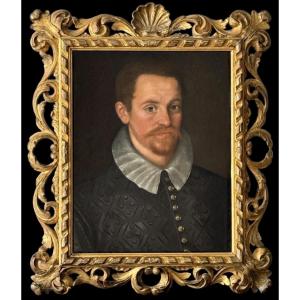
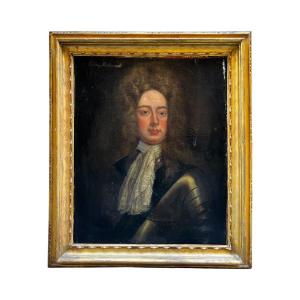
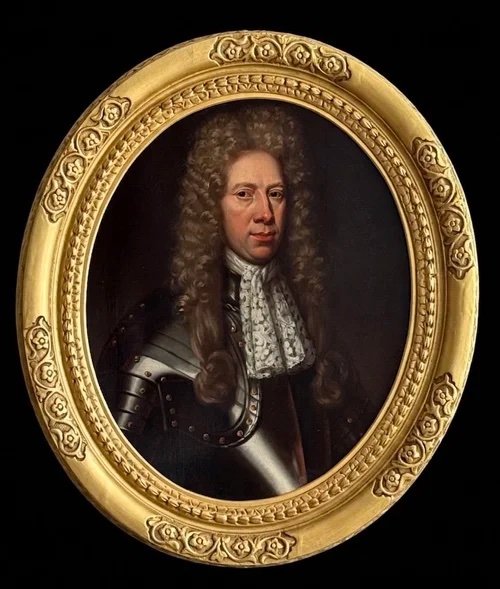
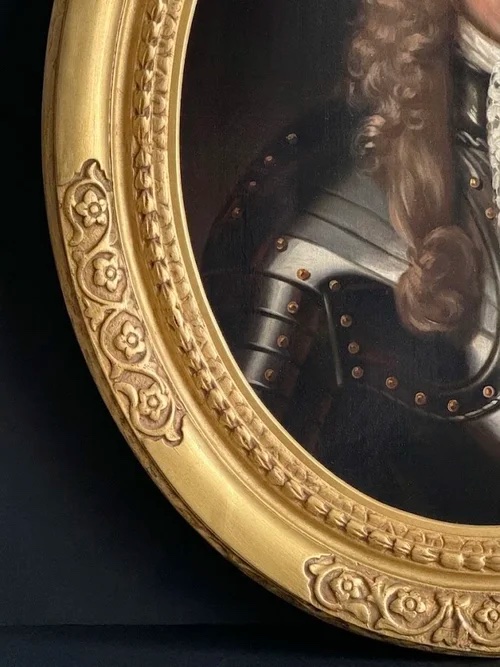
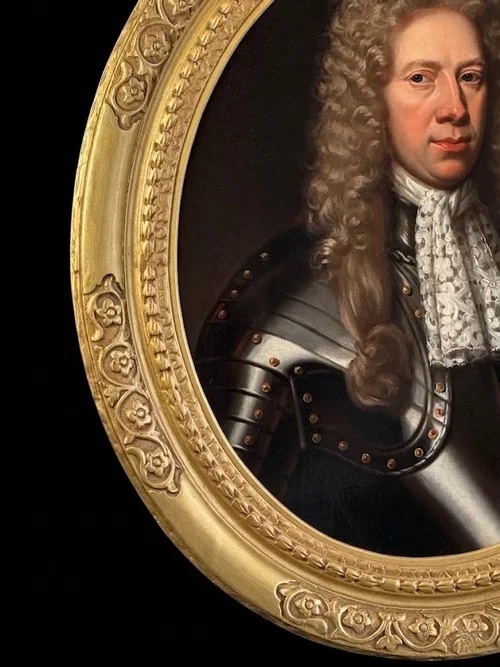
Fine 17th century portrait of a gentleman, painted in the oval by the celebrated Scottish portrait artist John Scougall (c. 1645-1723). The sitter, possibly Sir Patrick Maxwell of Springkell (1640-1723) is depicted half-length wearing plate armour, and a finely worked lace jabot.
The sitter also sports a campaign or knotted wig, and the twisted loop shapes at the very bottom of it are historically referred to as knots, bobs, or drop locks.Originally designed for soldiers in the late 17th century the long front tresses of the wig were tied or looped into these neat "bobs" to prevent the hair from dangling wildly, tangling, or getting in the way of their armour and weapons.
John Scougall (c.1645–1737) John Scougall was a prolific Scottish portrait painter and limner based in Edinburgh. He was a central figure in Scottish art history, known for painting the Scottish nobility and royalty during the Restoration period.
The son of the prominent portrait painter David Scougall (c. 1630–1685) John Scougall operated within an extended family network of artists and notable figures, including his cousin Patrick Scougall, Bishop of Aberdeen.
He ran a highly successful portrait studio in Advocates' Close, Edinburgh, which also served as a picture gallery. His work was heavily influenced by fashionable London portrait painters like Sir Peter Lely and Sir Godfrey Kneller, but it retains a uniquely individualized and distinctly Scottish character.
Scougall was commissioned by the Glasgow Town Council to paint full-length portraits of William III, Queen Mary, and Queen Anne. He also painted a celebrated series of the Kings and Queens of Scotland for the University of Glasgow. His extensive list of subjects includes the 4th Earl of Panmure (Glamis Castle), Sir Archibald Primrose, and Sir Roger Hog, Lord Harcarse. Many of his works are housed in major UK cultural institutions, including: The National Galleries of Scotland.
Sir Patrick Maxwell of Springkell (c. 1640 – April 1723). The sitter is possibly Sir Patrick Maxwell of Springkell who was the first holder of the Heron-Maxwell baronetcy having received the title in the Baronetage of Nova Scotia on 7 February 1683 as a mark of royal favour during the reign of Charles II.
A prominent landowner in Dumfriesshire, Maxwell played a political role by serving as a commissioner for the county in the Convention of Estates of 1689, which convened to address the Glorious Revolution and ultimately recognised William of Orange and Mary as joint sovereigns of Scotland.
He married Mary Gordon, daughter of William Gordon, 6th Viscount Kenmure, and their union strengthened ties with other Border families. Maxwell died in 1723 at Springkell, leaving the estate stable amid the political upheavals of the late 17th century, and was succeeded by his son without major contest.
Provenance: Lady Heron-Maxwell (according to label on verso) Anonymous sale, Christie's, London, 9 September 1999.
This fine work is in an excellent state of conservation and it is housed in a period oval ‘Lely ‘ style frame with floral cartouches, which has been sympathetically regilded, and is itself a work of art.
Higher resolution images on request.
Worldwide shipping available
Canvas:26" x 23" / 66cm x 59cm. Frame: 37" x 31" / 94cm x 79cm
Period: 17th century
Style: Other Style
Condition: Excellent condition
Material: Oil painting
Width: 79cm
Height: 94cm
Depth: 3cm
Reference (ID): 1786113
Availability: In stock