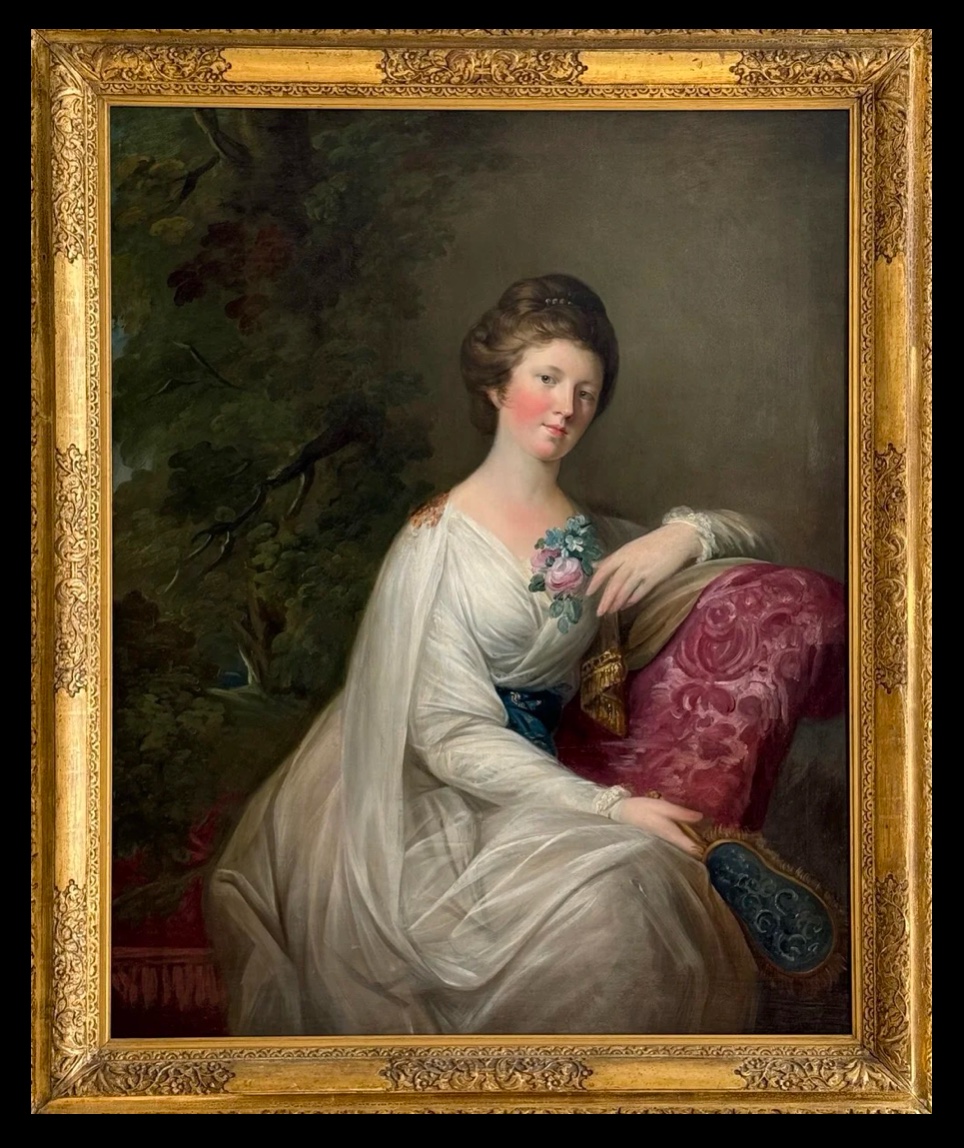
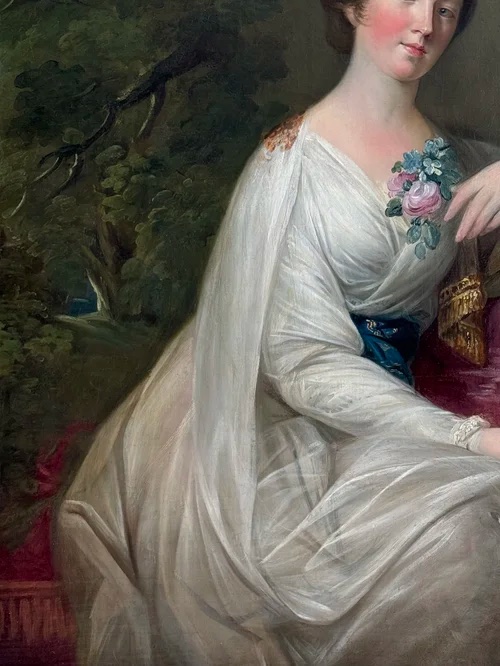
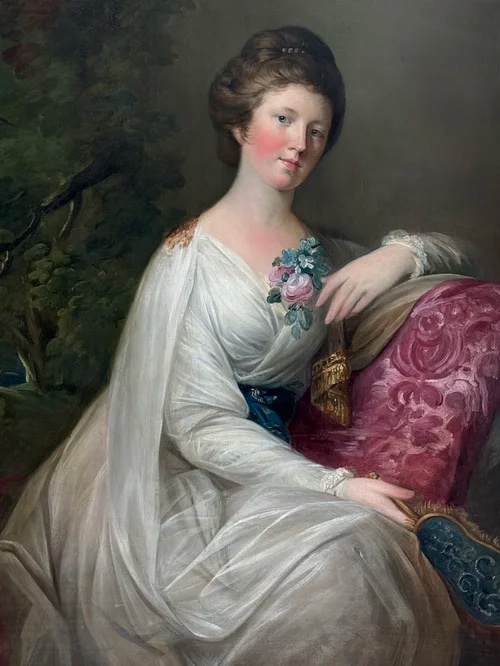
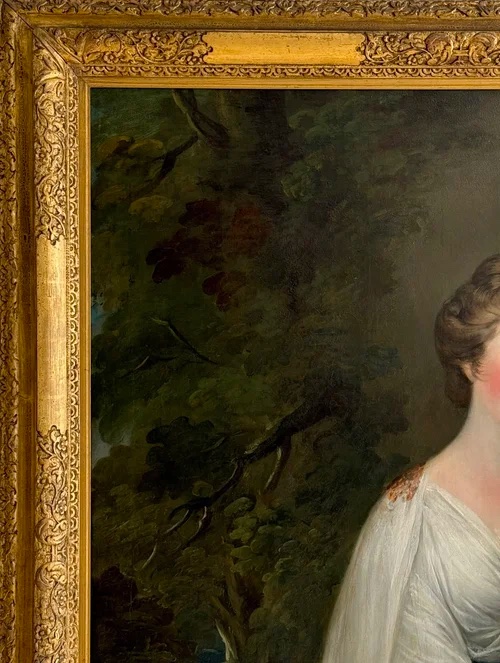
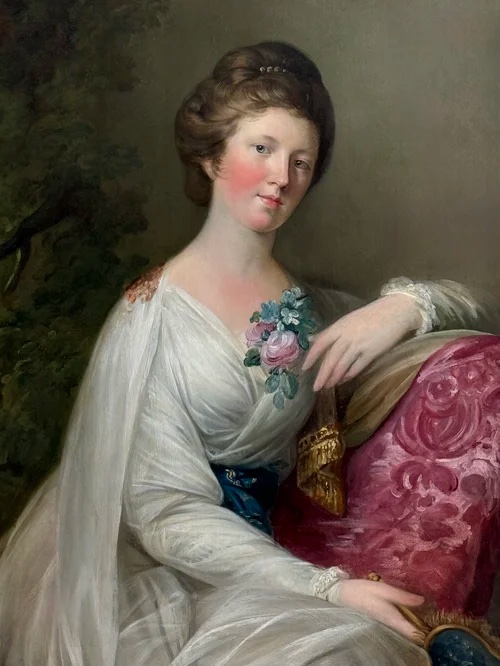
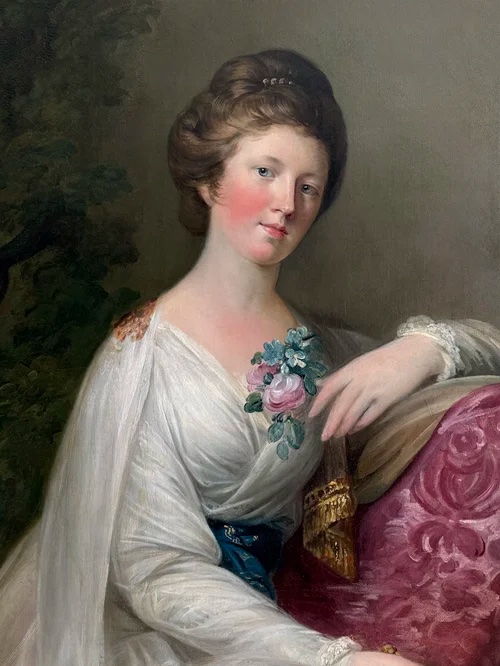
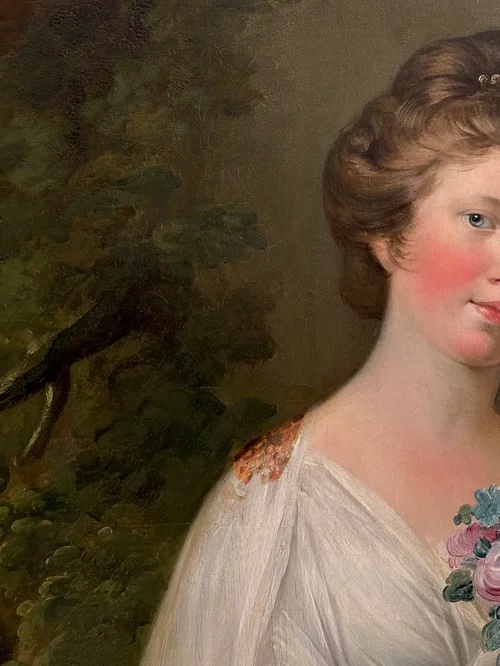
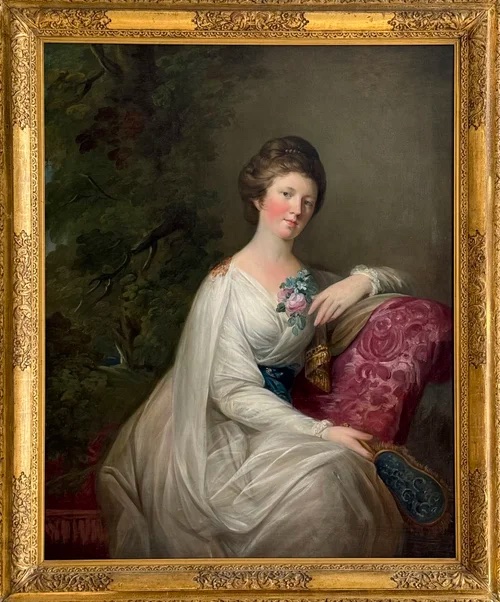


George Willison (1741-1797) - Portrait Of Henrietta Fordyce (nee Cumming).
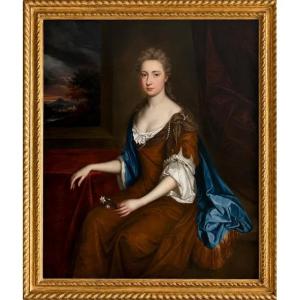
Fine, large and graceful 18th century portrait of Henrietta Fordyce (nee Cumming) by the celebrated Scottish portrait artist George Willison (1741-1797).
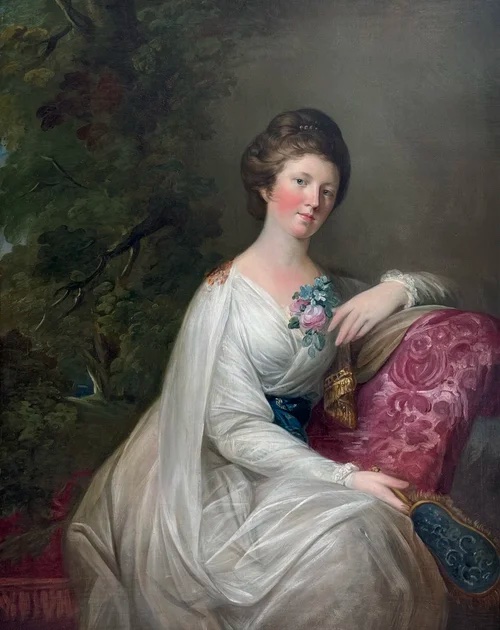
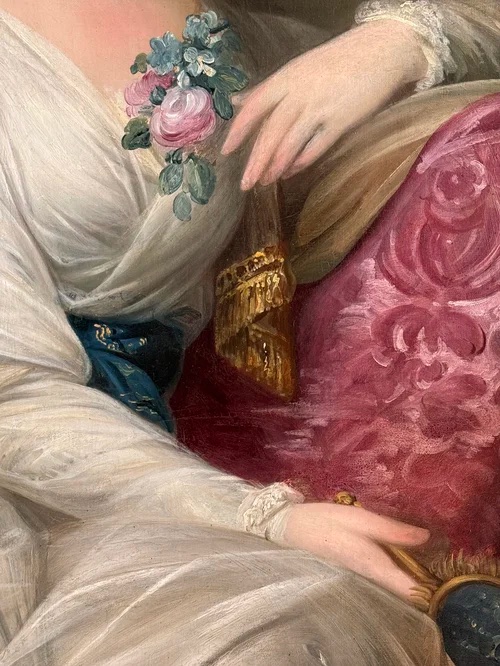
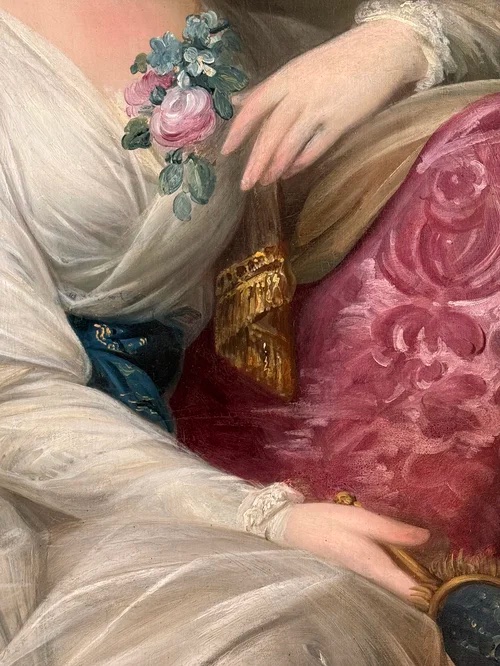
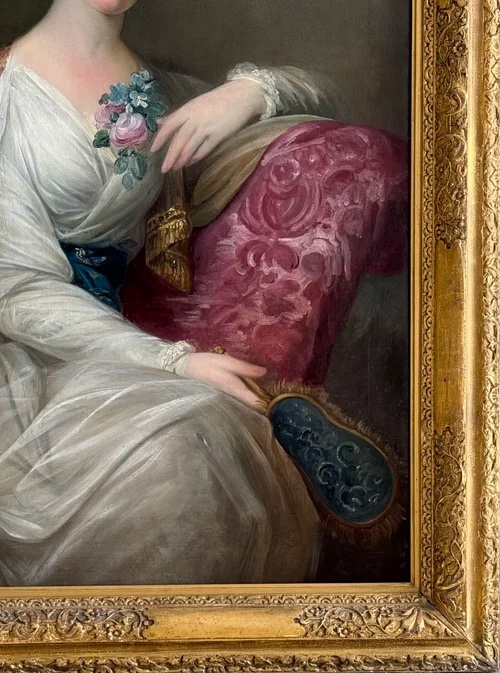
The elegant sitter is depicted three-quarter length reclining on a claret coloured chaise, amidst foliage. Wearing a white draped silk dress, she holds a fan in one hand and clasps a corsage to her busom with the other. Her hair is piled elegantly upwards and secured by pearl ornaments.
Henrietta Fordyce (1734–1823)Praised for her beauty and virtue. Henrietta Fordyce (née Cumming) was a governess renowned for her educational role in aristocratic households, and later for being the wife of Reverend James Fordyce, DD (1720–1 October 1796) Scottish Presbyterian minister and poet.
Born into a Scottish family, Fordyce received her early education in a French convent. Later in youth she began to be embedded in literary and social networks, and progressed to maintaining friendships with figures such as General Henry Seymour Conway and the poet Alison Cockburn. This exposure to Edinburgh's vibrant cultural milieu, amid the Scottish Enlightenment, shaped her developing interests in literature and moral philosophy.
Later working as a governess, Fordyce educated Lady Anne Barnard and her sisters in a period marked by informal yet influential domestic instruction. She married James Fordyce in 1771 after which the couple resided primarily in London, he was already recognised for his influential Sermons to Young Women (1765) which shaped contemporary views on female conduct. In fact in Pride and Prejudice, Mr. Collins chooses to read Fordyce’s Sermons for Young Women aloud to the Bennet sisters.
After James Fordyce's death in 1796, Henrietta became the subject of Kelly's Memoir of the late Mrs. Henrietta Fordyce (1823), an anonymous biography that highlighted her character, family life, and connections through letters, anecdotes, and poetry, portraying her as an exemplary figure of resilience and piety.
Fordyce was also a celebrated figure within the cultural milieu of Enlightenment Scotland and England, and she is depicted in several notable portraits from the late eighteenth century. One of the earliest of which is a 1774 red chalk drawing by Scottish artist Alexander Nasmyth, titled Henrietta Fordyce Cummyng Holding a Bird. In this work, Fordyce is portrayed in a delicate, intimate pose, ad this graceful portrait highlights her poise and refinement.
Her close friendhsip with celebrated Swiss neoclassical painter Angelica Kauffman resulted in Henrietta being depicted as ‘Mrs. Fordyce, at the Grave of Fingal’ it shows her in a full-length, almost profile view, showering flowers from a basket onto the grave of the legendary hero Fingal amid a mountainous Highland landscape. This work was likely commissioned within Kauffman's circle of friends, including the Fordyce family, whom she affectionately termed "the all harmonious Triad" comprising Henrietta, her husband James, and his brother William.
George Willison (1741-1797)Edinburgh-born George Willison was primarily a painter of portraits, although examples of mythological subjects are also known. The artist was much aided in his career by his wealthy uncle, George Dempster, who sponsored his nephew's training in Edinburgh and, from 1760 to 1767, in Rome.
A pupil of Mengs in Rome (before Mengs left for Madrid in 1761) Willison painted James Boswell, 1740 - 1795. Diarist and biographer of Dr Samuel Johnson in Rome in 1765 and this portrait is now on display in the Scottish National Portrait Gallery.
The artist returned to work in London from 767 and exhibited at the Scottish Academy between 1767 - 1770, and at the Royal Academy in 1771 and 1772.
Dempster, who was Director of the East India Company, then secured a post for him at the court of Mohamed Ali Khan Walejah, Nawab of the Carnatic and he was based in Madras (now Chennai), from approximately 1772 to 1784 where he became a celebrated portraitist.By the time Willison finally left London around 1784 he was wealthy man who enjoyed an opulent retirement in Edinburgh.
In our portrait Willison portrays Fordyce as a graceful emblem of Enlightenment-era femininity, This depiction not only immortalises her likeness, it also contributes to the broader visual discourse on women as patrons and subjects of sentimental art during this period.
This fine portrait has also been engraved notably through the mezzotint by Thomas Watson, which was published by Walter Shropshire, on 1 April 1771.
This fine quality and historically significant work is in an excellent state of conservation and is ready to hang in an antique hand carved and gilded ‘Lely’ style frame.
Canvas: 49 3/16in x 39 3/16in/ 125cm x 99.5cm. Framed: 57in x 47in / 145cm x 120cm.
Period: 18th century
Style: Other Style
Condition: Excellent condition
Material: Oil painting
Width: 120cm
Height: 145cm
Depth: 3cm
Reference (ID): 1751160
Availability: In stock