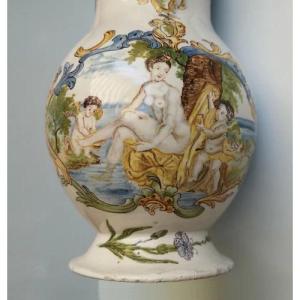


18th-century Lille Faience: Venus At The Bath—jug With A Mythological Scene—1740–1760
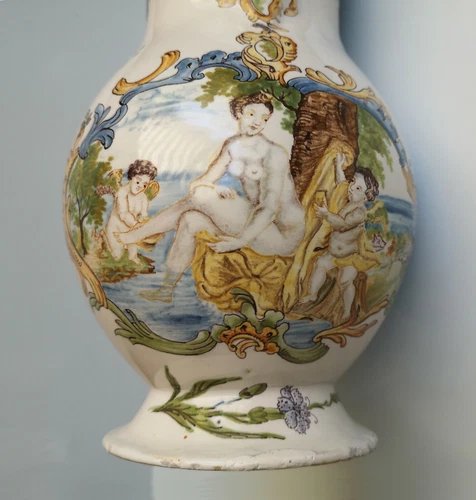
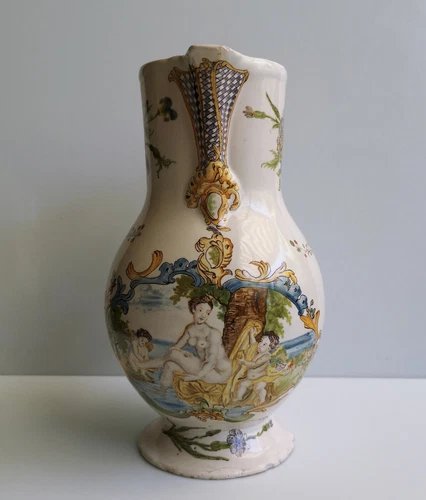
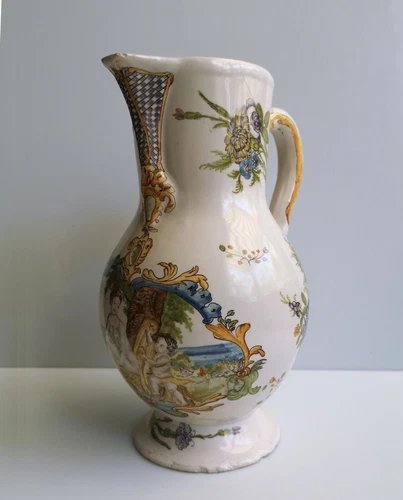
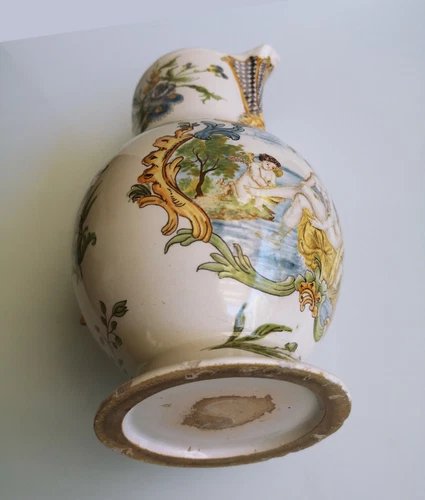
A rare baluster-shaped pitcher made of fine Lille earthenware from the Louis XV period, featuring a polychrome narrative decoration depicting Venus bathing, accompanied by a putto in a lakeside landscape, framed by blue, yellow, and manganese rocaille scrollwork.This type of mythological decoration is extremely rare in Lille’s ceramic production, which is usually dominated by floral motifs and lambrequins. This is a high-quality commissioned piece, intended for an aristocratic or literate clientele. The quality of the workmanship is remarkable: freehand painting, the modeling of the flesh tones, the depth of the landscape, and the palette typical of Lille’s great 18th century.
The spout is adorned with a rare architectural design featuring blue latticework framed by yellow lambrequins, a motif directly inspired by 18th-century draperies and damask, found only on pieces of the highest caliber.
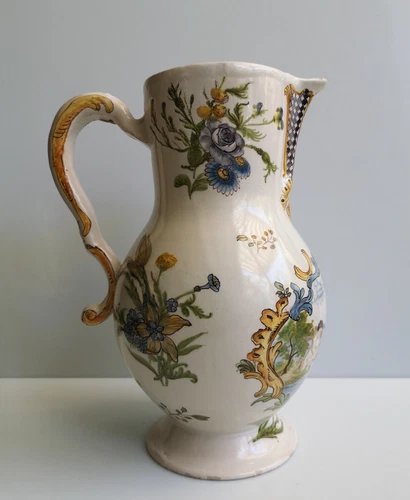
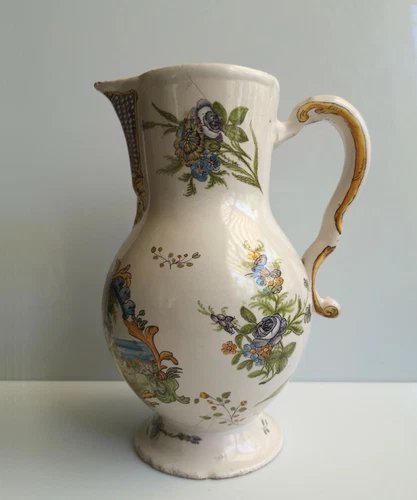
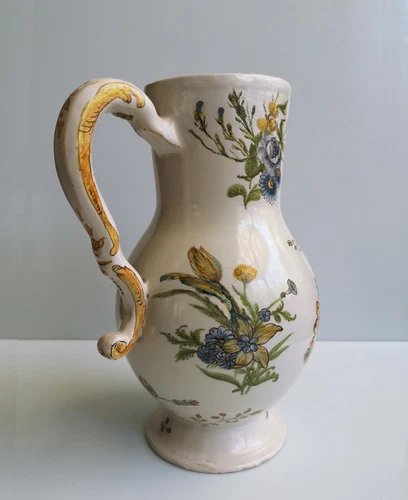
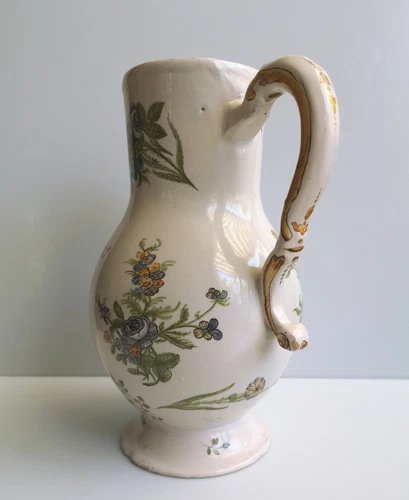
The floral decoration is exceptionally rich for a Lille faience piece: it features four distinct bouquets, painted separately rather than in a frieze, which is characteristic of commissioned pieces. Notably, the design features anemones, tulips, carnations, and small roses, accompanied by veined foliage and bluish secondary flowers, in a fresh color palette typical of the 1740s–1760s. These bouquets, rendered with delicate naturalism, directly reflect the influence of Flemish botanical models and flower collections then in use in the Lille workshops. The foot and the base of the body are embellished with flowering twigs and delicate foliage, painted with great lightness, creating an elegant transition between the mythological scene and the shape of the vase—a decorative refinement found only in the finest Lille productions.
The shape—a bulging body, ring-shaped foot, tapered neck, and trilobed spout—is characteristic of Lille productions from the mid-18th century.
Height: 22 cm
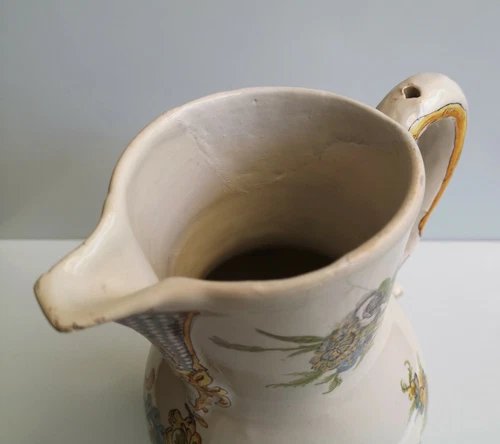
Condition: an old repair on the neck, located on the handle side; it is discreet and well integrated, with no impact on the visibility of the decoration or the piece’s structural integrity. Minor wear and chips from normal use.
A rare piece due to its subject matter, its artistic quality, and its regional provenance.
The spout is adorned with a rare architectural design featuring blue latticework framed by yellow lambrequins, a motif directly inspired by 18th-century draperies and damask, found only on pieces of the highest caliber.
The floral decoration is exceptionally rich for a Lille faience piece: it features four distinct bouquets, painted separately rather than in a frieze, which is characteristic of commissioned pieces. Notably, the design features anemones, tulips, carnations, and small roses, accompanied by veined foliage and bluish secondary flowers, in a fresh color palette typical of the 1740s–1760s. These bouquets, rendered with delicate naturalism, directly reflect the influence of Flemish botanical models and flower collections then in use in the Lille workshops. The foot and the base of the body are embellished with flowering twigs and delicate foliage, painted with great lightness, creating an elegant transition between the mythological scene and the shape of the vase—a decorative refinement found only in the finest Lille productions.
The shape—a bulging body, ring-shaped foot, tapered neck, and trilobed spout—is characteristic of Lille productions from the mid-18th century.
Height: 22 cm
Condition: an old repair on the neck, located on the handle side; it is discreet and well integrated, with no impact on the visibility of the decoration or the piece’s structural integrity. Minor wear and chips from normal use.
A rare piece due to its subject matter, its artistic quality, and its regional provenance.
900 €
Period: 18th century
Style: Louis 14th, Regency
Condition: Fully restored
Material: Ceramic
Reference (ID): 1785516
Availability: In stock
Print