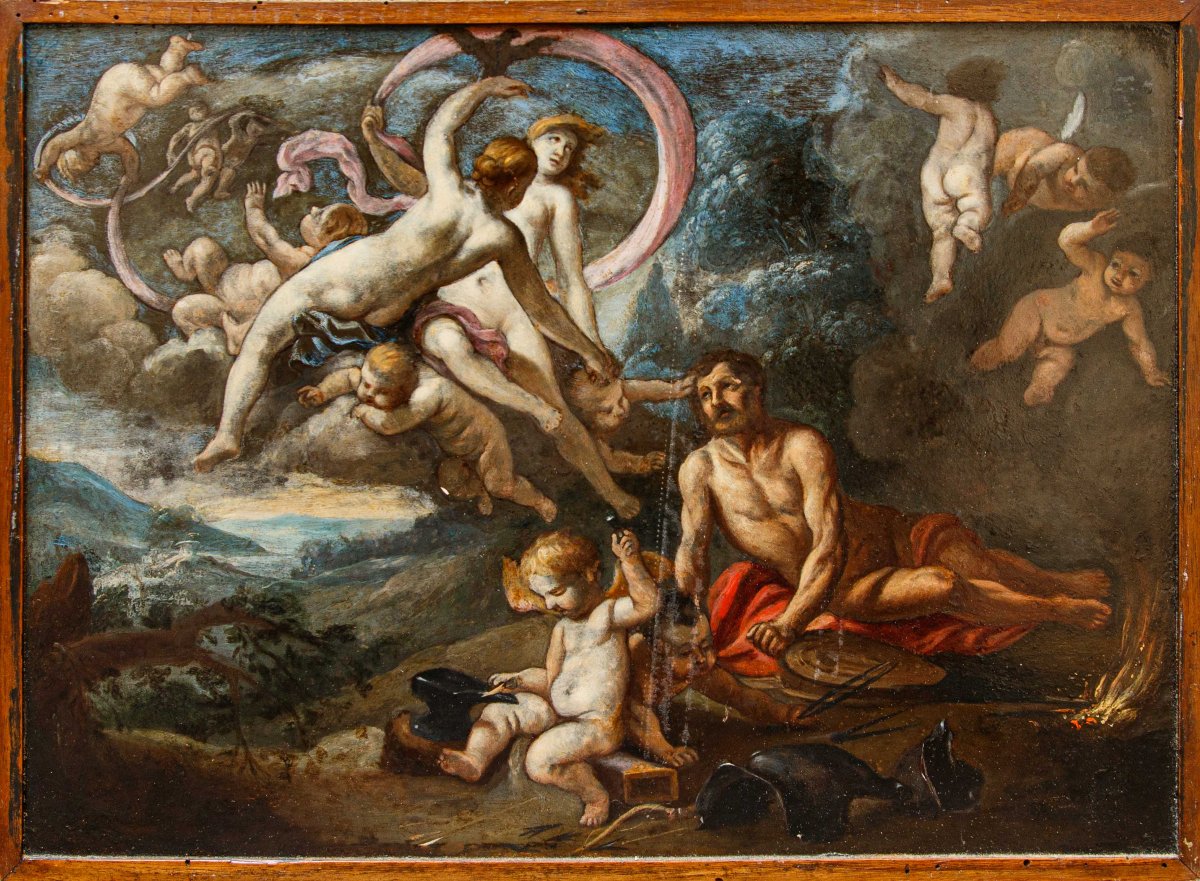
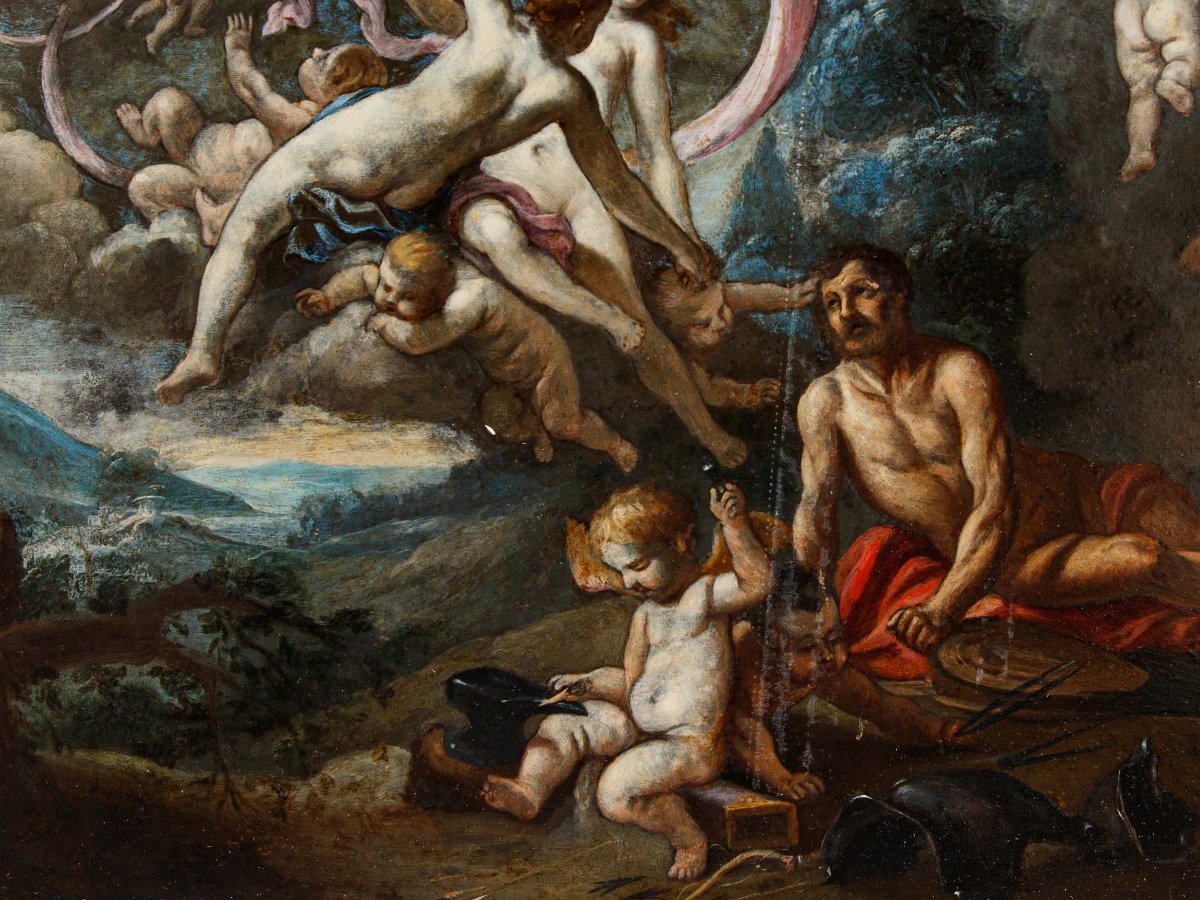
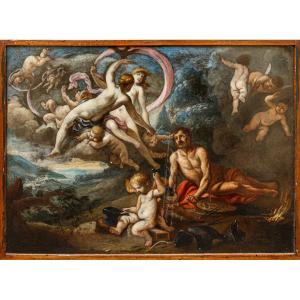


Cornelis Shut (antwerp, 1597 – Antwerp, 1655), Attributed, Venus Appears At Vulcan’s Forge
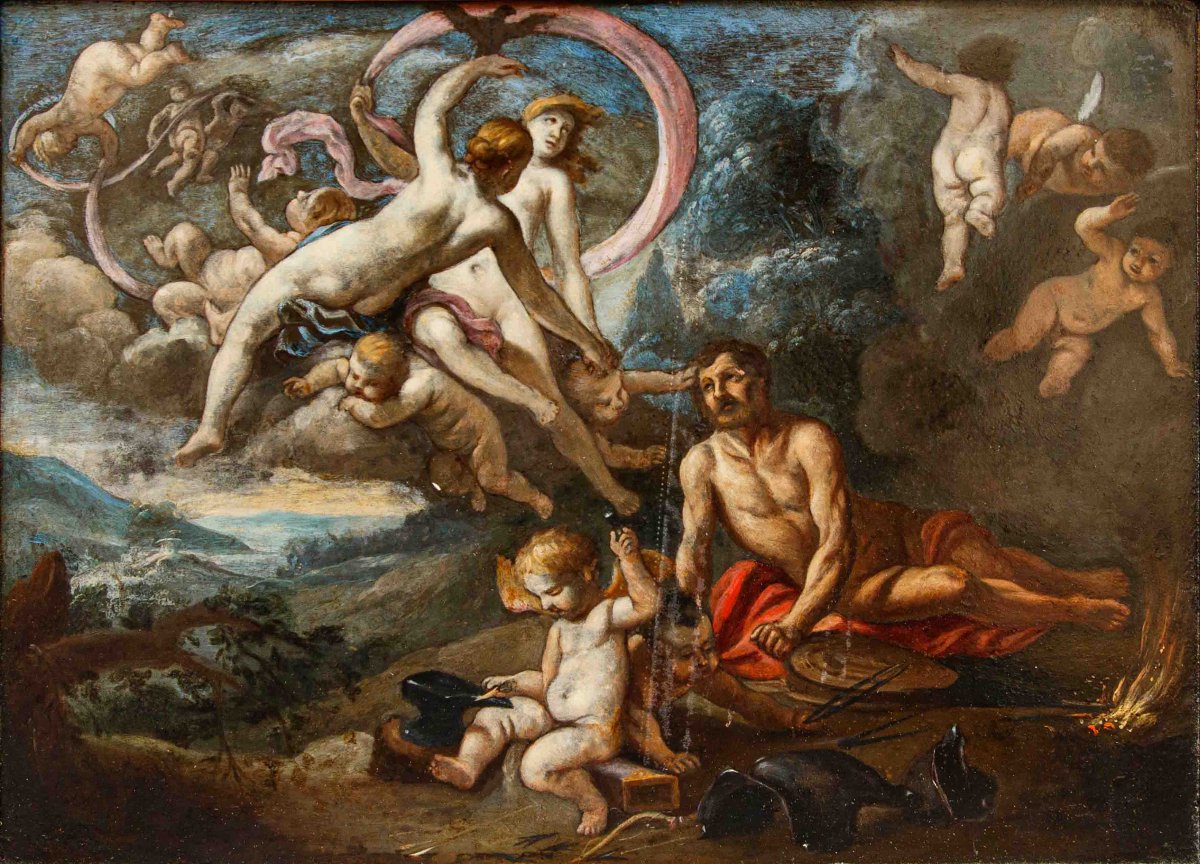
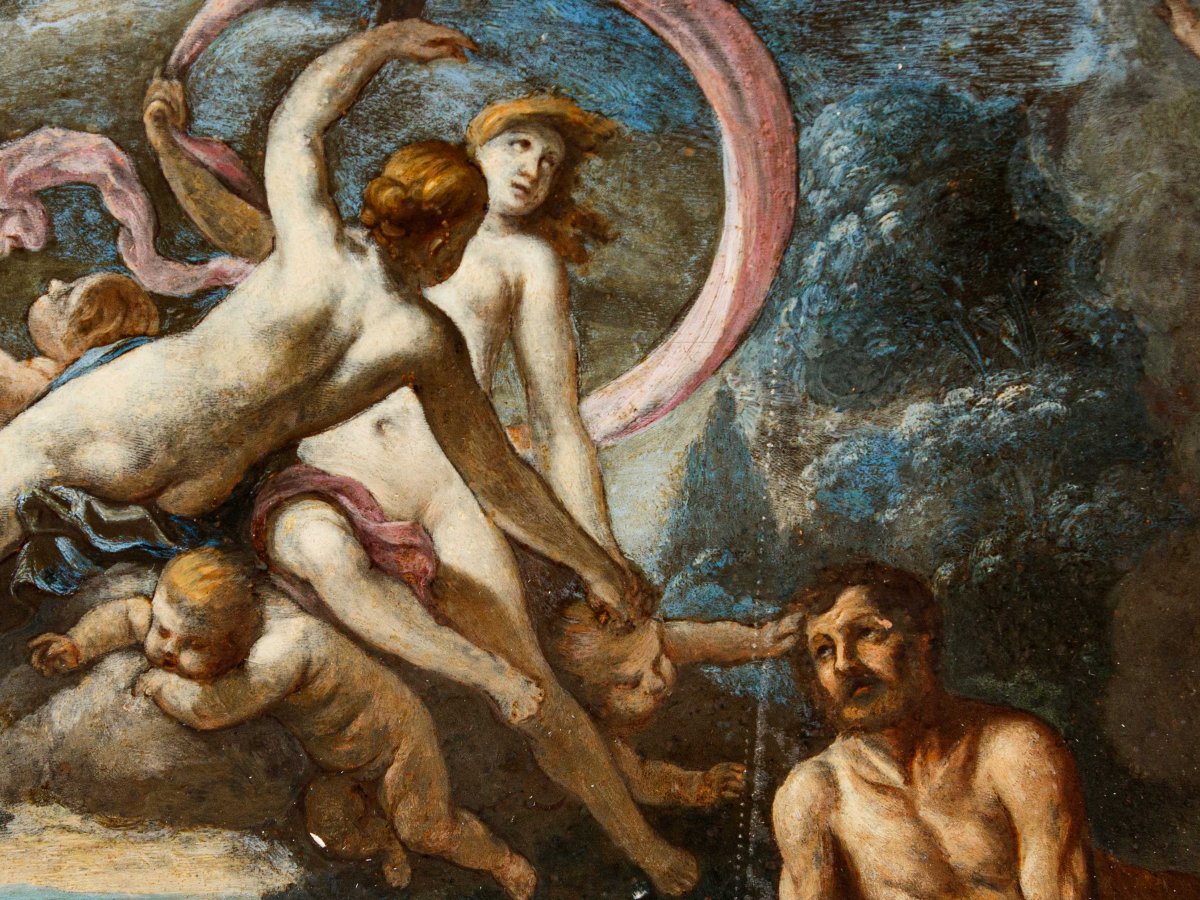
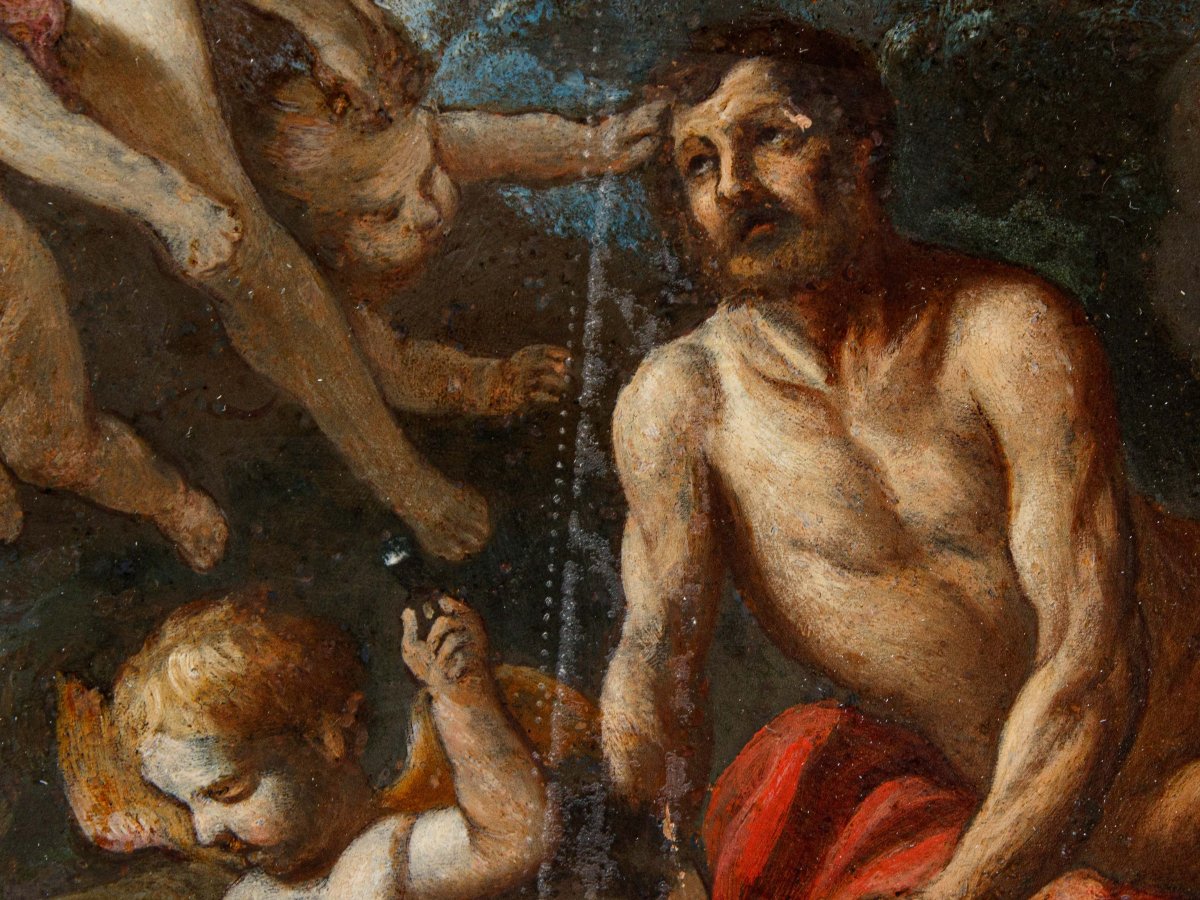
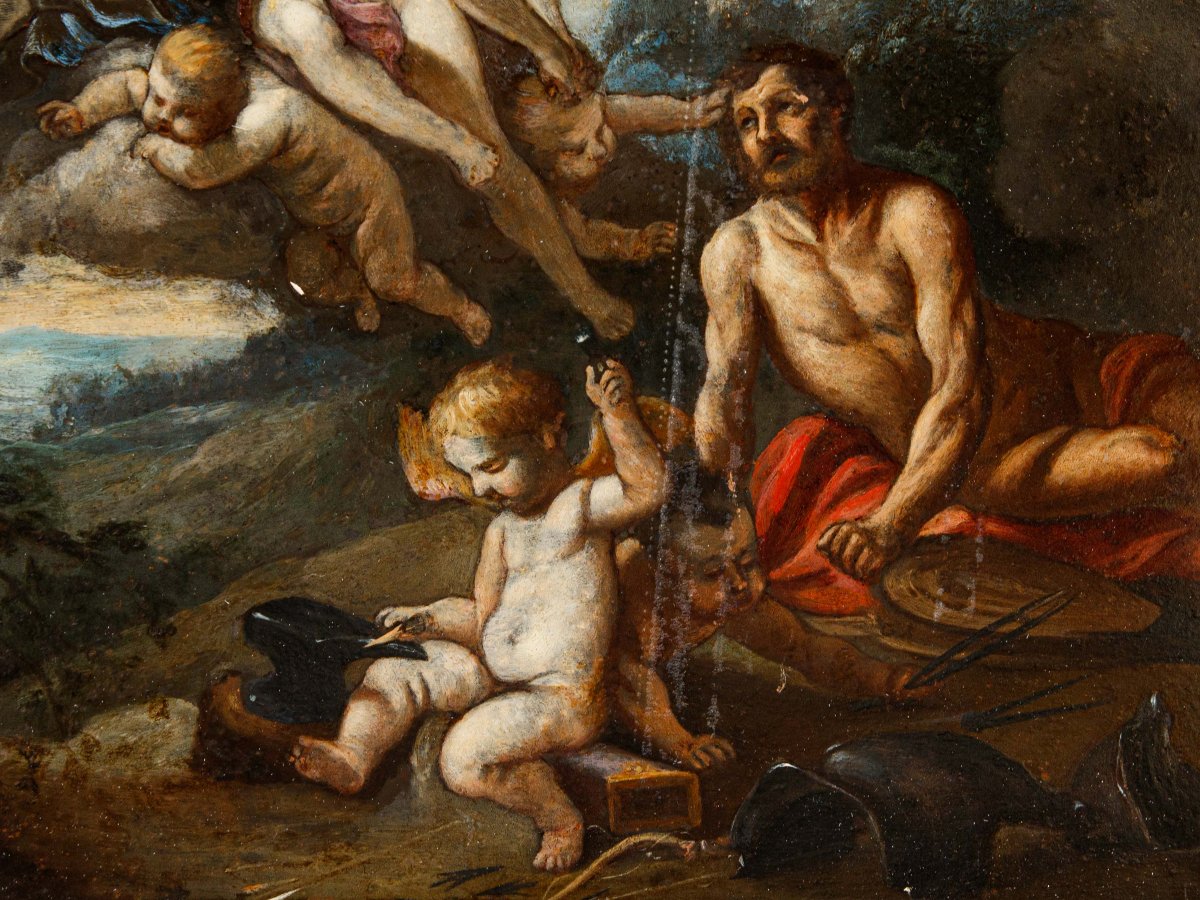
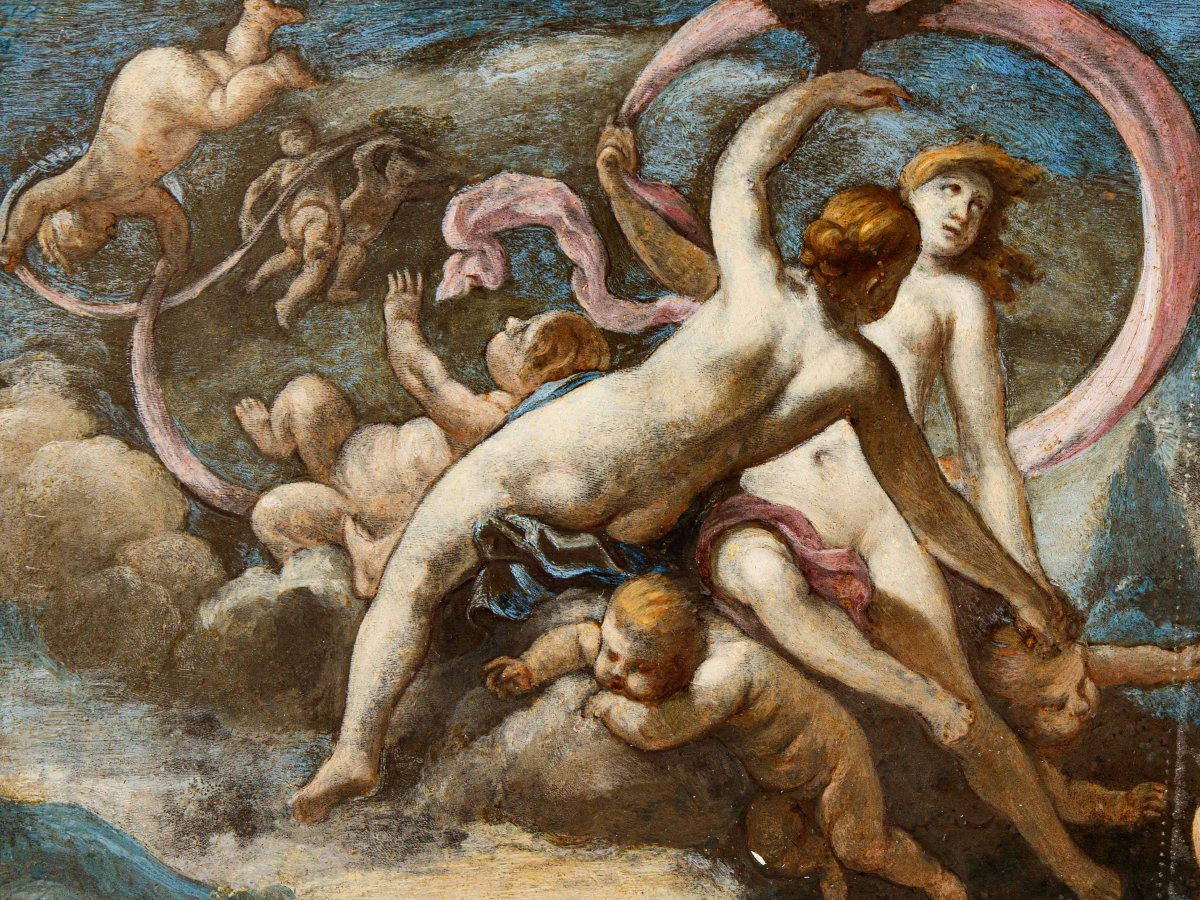
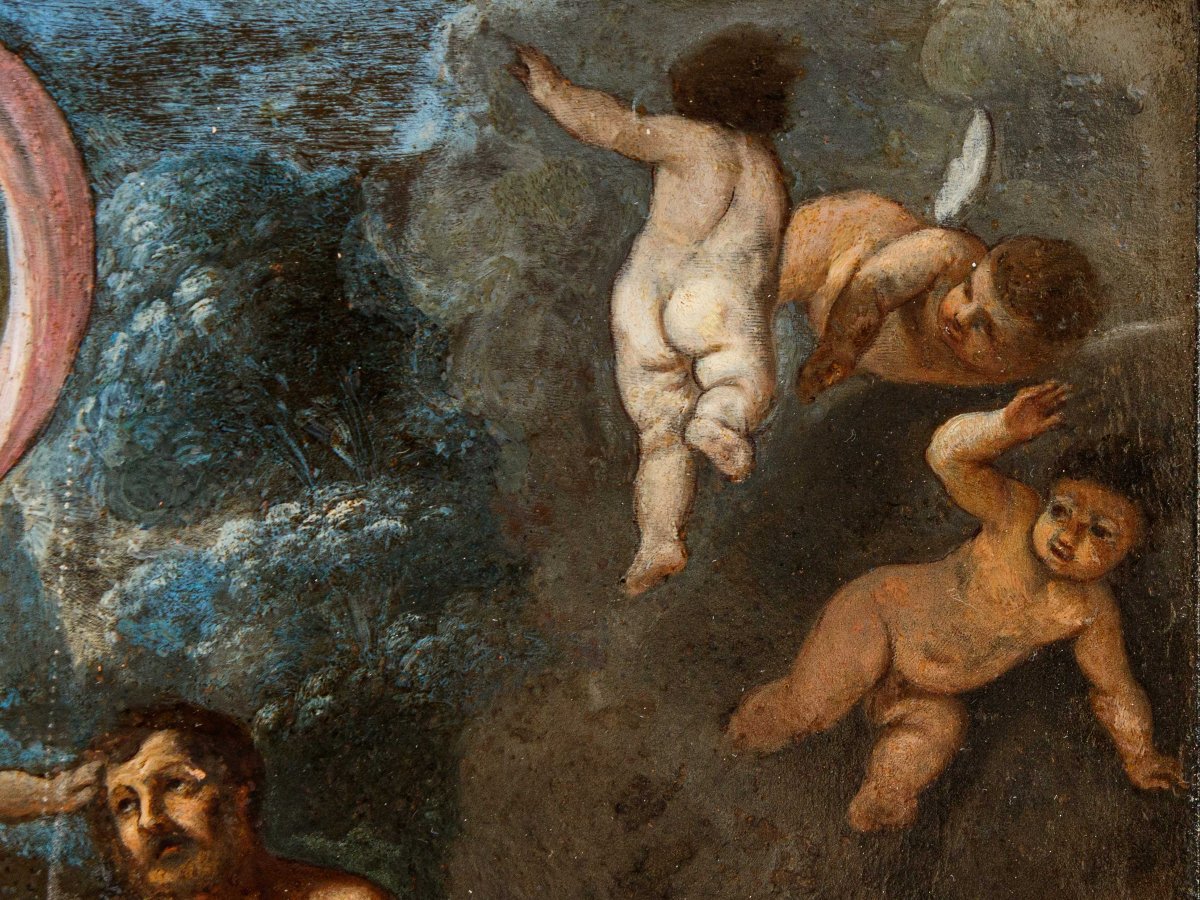
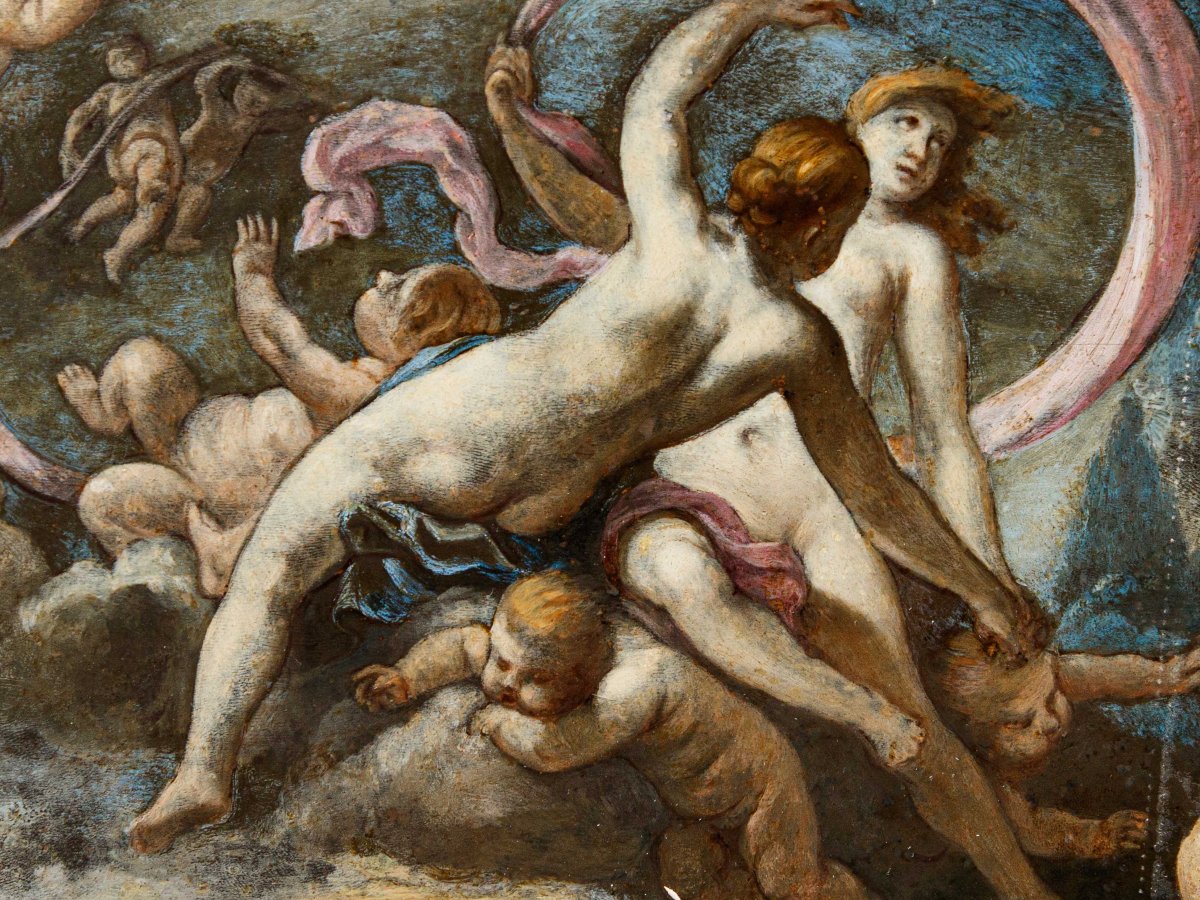
Cornelis Shut (Antwerp, 1597 – Antwerp, 1655), detail.
Venus Appears at Vulcan’s Forge
Oil on copper, 31.5 x 42.5 cm
With frame, 33 x 44.5 cm
This small-format oil on copper depicts Venus arriving at Vulcan’s forge amid a whirlwind of figures that fills most of the pictorial surface. In the upper half of the composition, the goddess—flanked by a companion and wrapped in a pink veil that unfurls in a wide circle—descends from the clouds amid a crowd of jubilant cherubs, while on the right other cherubs twirl through the air. Below, Vulcan, reclining slightly and covered by a bright red cloth, holds the tools of his trade next to a still-glowing forge, surrounded by additional cherubs fiddling with helmets and weapons. In the background lies a hilly landscape bathed in a twilight glow with a Nordic feel.
The painting is attributed to Cornelis Schut, a Flemish painter whose training remains undocumented. A connection to Rubens’s workshop is presumed; Rubens was exempt from the obligation to register his students with the Guild of Saint Luke, to which Schut was admitted in 1618–1619. His early works, however, show affinities with Abraham Janssens, the leading history painter in Antwerp during those years. From 1624 to 1627, Schut lived in Rome, where he was one of the founders of the Schildersbent and worked under the patronage of the Flemish merchant Pieter de Vischere. In 1628, he moved to Florence, where he created cartoons for the Arazzeria Medicea. Over the course of his career, he consistently adopted the mature Baroque style of Pietro da Cortona and Guercino, characterized by dynamic movement, an expressive use of light and color, with evident Mannerist remnants in the exaggerated foreshortening, chiaroscuro contrasts, and intense facial expressions.
The attribution to Schut is based on precise stylistic and thematic evidence. The type of cherubs, with their plump figures and lively gestures, appears identically in the *Madonna and Child with Saint Anne, the Young Saint John, and Angels* (in a private collection) and in the *Allegory of Autumn* (also in a private collection). The mythological subject is part of a cohesive series that includes *The Forge of Vulcan* and *The Triumph of Neptune and Amphitrite*, now at the Villa dei Georgofili in Florence, and *The Abduction of Europa*, housed at the Hermitage in St. Petersburg. His work for tapestries—including the cartoon for The Seven Liberal Arts, now at Villa Hügel in Essen—confirms Schut’s familiarity with compositions crowded with ethereal figures arranged on overlapping planes, a scheme that also governs this panel painting. Finally, *Music*, housed at the Rubenshuis in Antwerp—which was once owned by Rubens himself—attests to the direct connection between the two artists, providing further evidence of the work’s authenticity, as it so faithfully reflects Rubens’s artistic language.
Period: 17th century
Style: Other Style
Condition: Good condition
Material: Oil painting on copper
Width: 42,5
Height: 31,5
Reference (ID): 1780874
Availability: In stock