



Neo-renaissance Decorative Fireplace Screen Made Of Carved And Gilded Wood, 1830–1840
Beautiful mantelpiecefor a ceremonial fireplace in the Neo-Renaissance style, made of molded, carved, andgilded wood, featuring rich ornamentation on its crossbars and uprights with motifs ofcut-out leather cartouches, foliage, scrollwork, and rosettes, small flowers, and floral garlands.
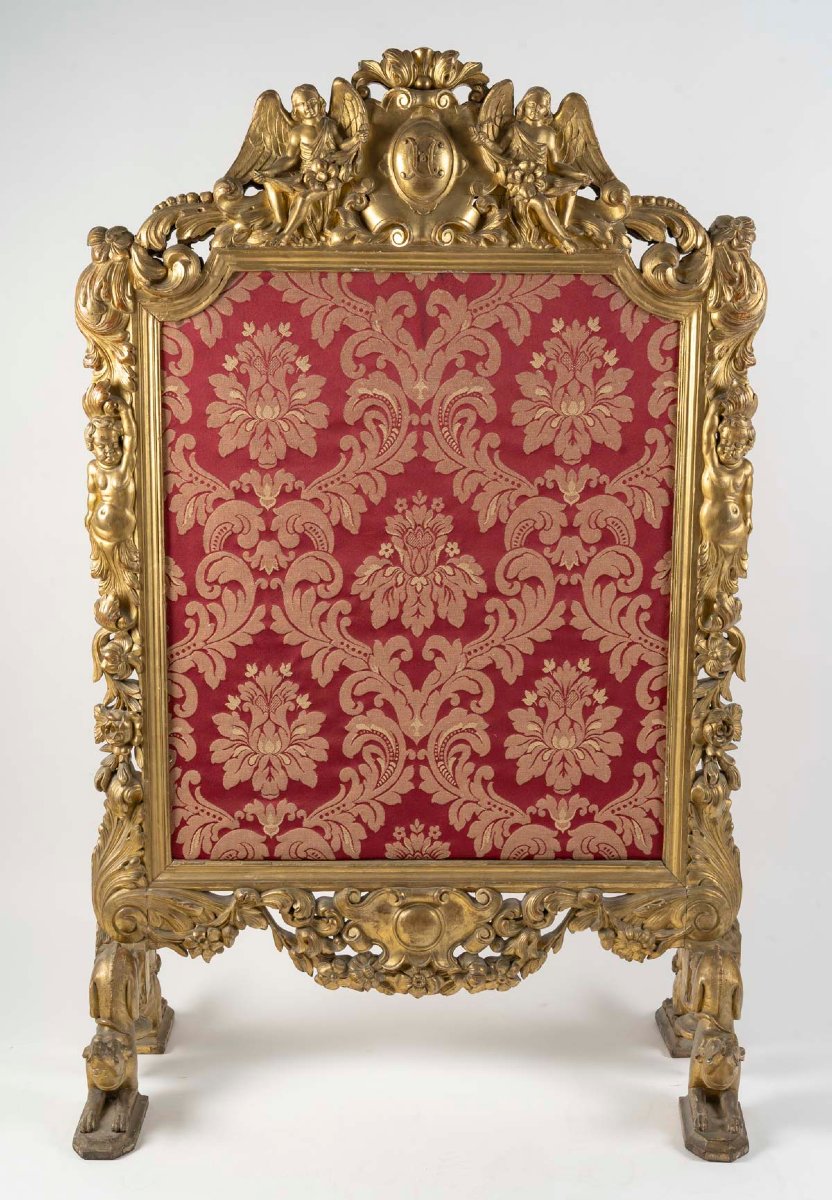
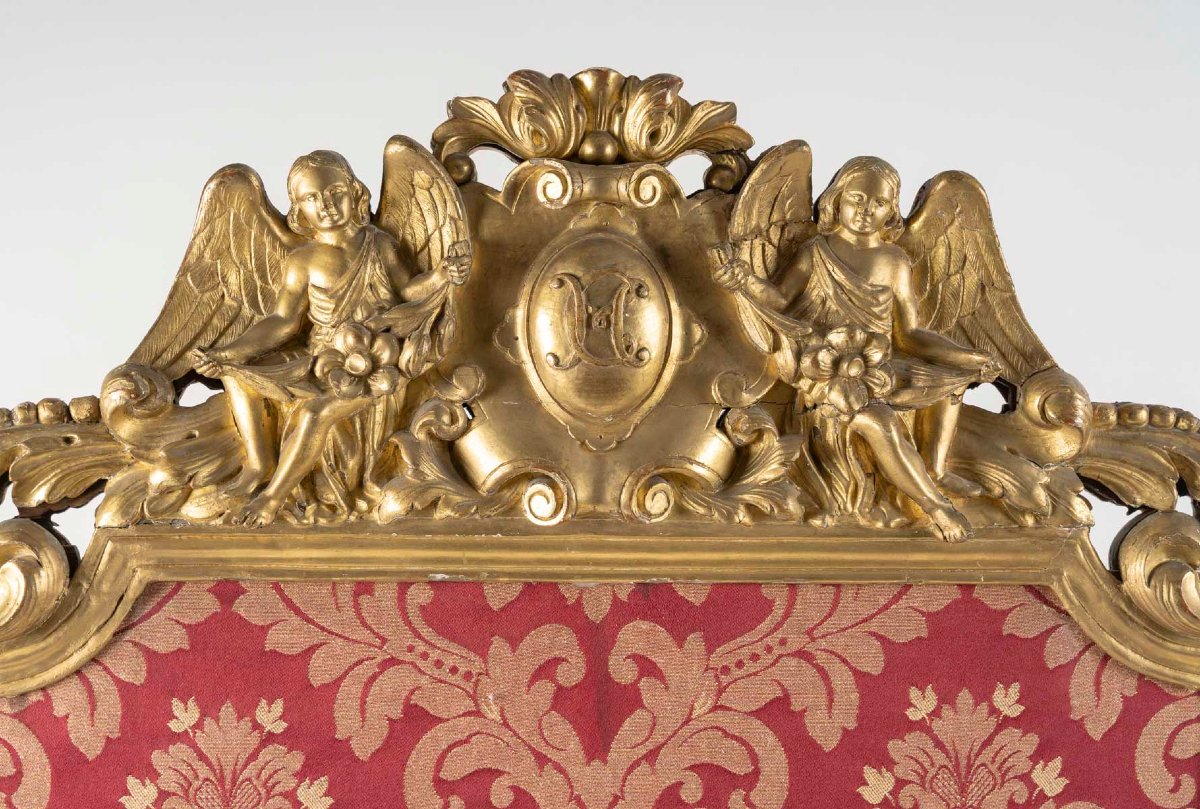
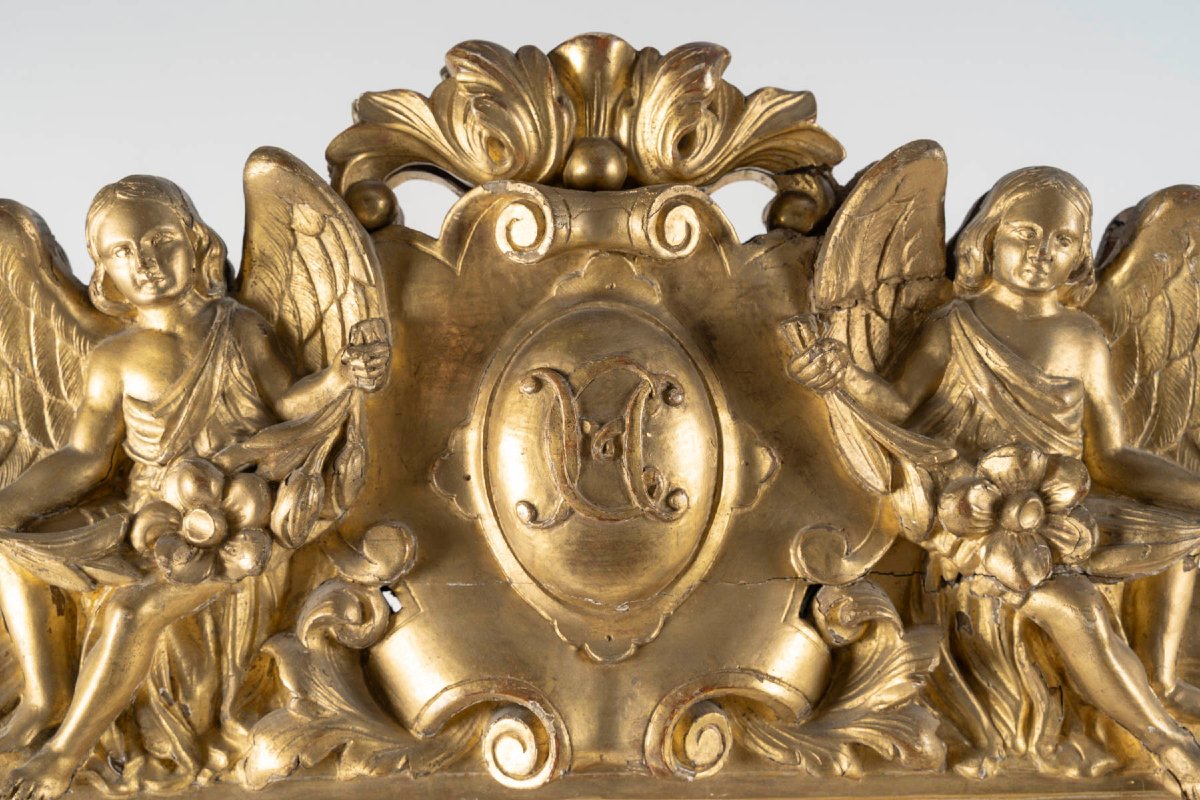
The pedimentof its upper crossbar is stamped within a domed mirror with a monogramfeaturing the intertwined initials “H.C.” flanked by cherubs; itsuprights are adorned with putti in the form of caryatids. Its base consists oflevrettes seated on glides. It features, within a rectangular frame,a textile panel with a floral design on a red background.
AParisian piece from the first half of the 19th century, Louis-Philippe period, circa1840
A SUMptuous MODELPossessing amajestic presence, this ceremonial fireplace screen, made of richlycarved and gilded wood, features on the pediment of its high, hat-shaped crossbar, withina cut-out leather cartouche punctuated by acanthus fleurons, flankedby radiant figures of cherubs withspread wings, depicted seated, each holding—in a most graceful gesture—a drapery embellishedwith a flower whose petals are in full bloom; a convex mirror stamped with the intertwined initials ofits “elitist” patron:“H.C.”Embellished on itsshoulders with voluptuous leaves andacanthus scrolls whose coils are accented with seeds inchains, it is adorned on its side panels—with their undulating profiles—with ornamental motifs interweaving flattering leafy frondsand coquettish blooms—rosebuds orspring flowers.
Within these, forming graceful caryatids,curl—sheathed to the waist—smiling toddlers with curly headsand chubby forms rendered in half-round relief.Featuringon its lower crossbar with a scalloped profile, a large leather cartouchecentered with a beautiful cabochon, it is theatrically festoonedwith an opulent floral garland whose stems are encircled within the hollows of scrolls, and with leafy acanthus scrollwork. This sumptuousopenwork border harmoniously incorporates the decorative motifs required for thisfireplace screen, which, from an ornamental standpoint, proves to be a truesuccess.
Set oneither side of a connecting block punctuated by a pendant key in the shape of aspinning top, elegant hounds—animals symbolizing loyalty andthe fidelity emblematic of the high-born aristocracy—are depicted with their hindquartershighly raised, their necks stretched out, their muzzles bold, and their legs extended onrectangular, molded footplates with rounded ends—form the curvilinear baseof this elegant piece of furniture, endowed with a “lordly” character.
Stretched over a frame,a textile covering (from a later period) in cotton damask with a floral motifof flowers, fleurons, and acanthus leaves on a red background conforms to itsrectangular frame with curved upper corners and simple molding.The fabric frame follows the line; stretched over a frame,it is adorned with a floral damask pattern on a red backgroundfrom a later period.Characterized byits fine craftsmanship, this sumptuous fireplace screen is distinguished by its ornate richness, which interprets—notwithout a certain refinement—the motifs specific to the stylistic vocabularyof the Renaissance period—such as, in this case, carved leather cartouches centered with domed mirrors flankedby cherubs, acanthus foliageinhabited by putti, garlandsarranged as festoons, and animal figureswith symbolic significance constitutes a precious testament to the fertile inventiveness ofParisian artistic joinery and cabinetmaking from the 1830s to the 1850s.
Indeed, itis a prime example of this “artistic furniture” of the“historicist” school, designed to meet the demands forprestige and comfort of the upper middle class of the time, which was then aspiring—through its affinity for the Renaissance style—a sense of nobility andrespectability.A piece ofsimilar design dating from the 1840s is cataloged and reproduced inChristopher Payne’s book, *European Furniture of the 19th Century*,Antique Collectors Club, 1981, p. 152
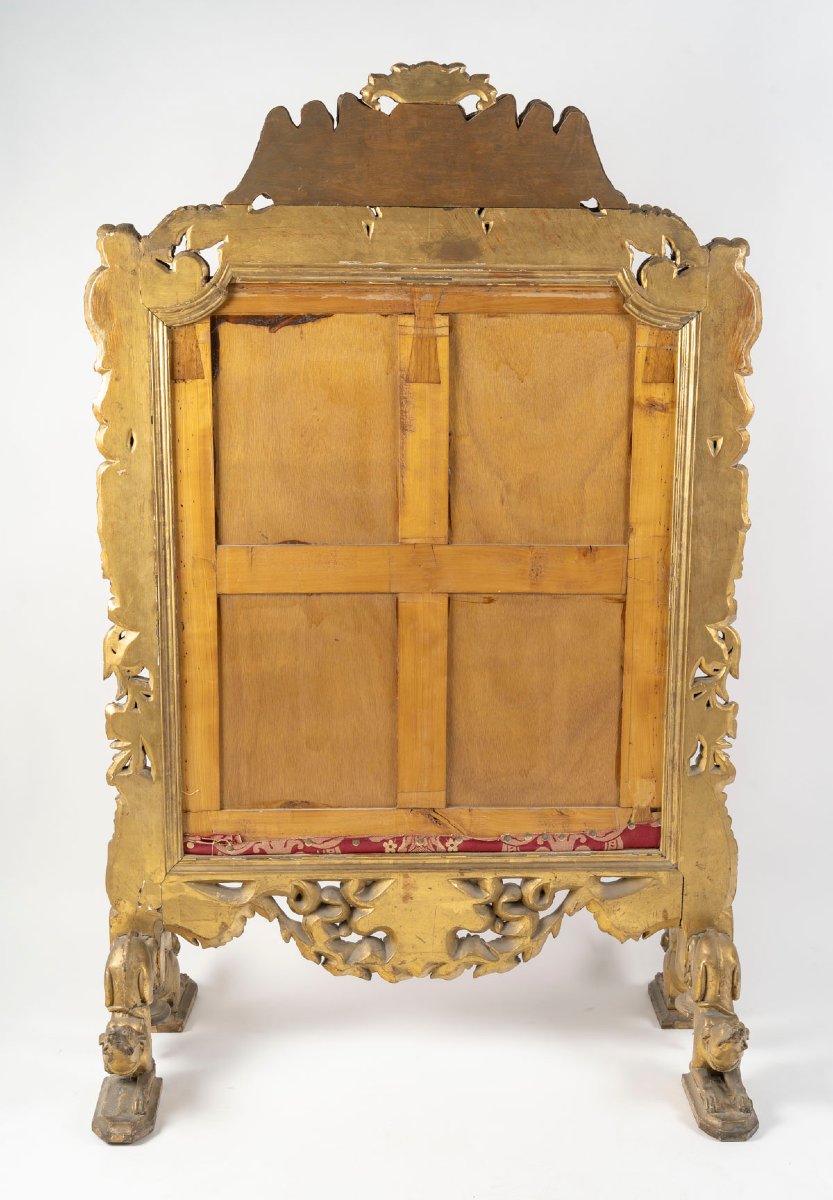
Materials: Carved and gilded wood (linden); Upholstery: damask fabric with floral decoration on a red background from a later periodDimensions: H.: 124 cm; W.: 80 cmFrenchwork, likely Parisian, in the Neo-Renaissance style from the firsthalf of the 19th century. Louis-Philippe period (1830–1848). Circa 1840.In goodoverall condition. Minor wear to the gildingon the base. Note: damage to one of the “Levrette” legs locatedon the back of the base.
The pedimentof its upper crossbar is stamped within a domed mirror with a monogramfeaturing the intertwined initials “H.C.” flanked by cherubs; itsuprights are adorned with putti in the form of caryatids. Its base consists oflevrettes seated on glides. It features, within a rectangular frame,a textile panel with a floral design on a red background.
AParisian piece from the first half of the 19th century, Louis-Philippe period, circa1840
A SUMptuous MODELPossessing amajestic presence, this ceremonial fireplace screen, made of richlycarved and gilded wood, features on the pediment of its high, hat-shaped crossbar, withina cut-out leather cartouche punctuated by acanthus fleurons, flankedby radiant figures of cherubs withspread wings, depicted seated, each holding—in a most graceful gesture—a drapery embellishedwith a flower whose petals are in full bloom; a convex mirror stamped with the intertwined initials ofits “elitist” patron:“H.C.”Embellished on itsshoulders with voluptuous leaves andacanthus scrolls whose coils are accented with seeds inchains, it is adorned on its side panels—with their undulating profiles—with ornamental motifs interweaving flattering leafy frondsand coquettish blooms—rosebuds orspring flowers.
Within these, forming graceful caryatids,curl—sheathed to the waist—smiling toddlers with curly headsand chubby forms rendered in half-round relief.Featuringon its lower crossbar with a scalloped profile, a large leather cartouchecentered with a beautiful cabochon, it is theatrically festoonedwith an opulent floral garland whose stems are encircled within the hollows of scrolls, and with leafy acanthus scrollwork. This sumptuousopenwork border harmoniously incorporates the decorative motifs required for thisfireplace screen, which, from an ornamental standpoint, proves to be a truesuccess.
Set oneither side of a connecting block punctuated by a pendant key in the shape of aspinning top, elegant hounds—animals symbolizing loyalty andthe fidelity emblematic of the high-born aristocracy—are depicted with their hindquartershighly raised, their necks stretched out, their muzzles bold, and their legs extended onrectangular, molded footplates with rounded ends—form the curvilinear baseof this elegant piece of furniture, endowed with a “lordly” character.
Stretched over a frame,a textile covering (from a later period) in cotton damask with a floral motifof flowers, fleurons, and acanthus leaves on a red background conforms to itsrectangular frame with curved upper corners and simple molding.The fabric frame follows the line; stretched over a frame,it is adorned with a floral damask pattern on a red backgroundfrom a later period.Characterized byits fine craftsmanship, this sumptuous fireplace screen is distinguished by its ornate richness, which interprets—notwithout a certain refinement—the motifs specific to the stylistic vocabularyof the Renaissance period—such as, in this case, carved leather cartouches centered with domed mirrors flankedby cherubs, acanthus foliageinhabited by putti, garlandsarranged as festoons, and animal figureswith symbolic significance constitutes a precious testament to the fertile inventiveness ofParisian artistic joinery and cabinetmaking from the 1830s to the 1850s.
Indeed, itis a prime example of this “artistic furniture” of the“historicist” school, designed to meet the demands forprestige and comfort of the upper middle class of the time, which was then aspiring—through its affinity for the Renaissance style—a sense of nobility andrespectability.A piece ofsimilar design dating from the 1840s is cataloged and reproduced inChristopher Payne’s book, *European Furniture of the 19th Century*,Antique Collectors Club, 1981, p. 152
Materials: Carved and gilded wood (linden); Upholstery: damask fabric with floral decoration on a red background from a later periodDimensions: H.: 124 cm; W.: 80 cmFrenchwork, likely Parisian, in the Neo-Renaissance style from the firsthalf of the 19th century. Louis-Philippe period (1830–1848). Circa 1840.In goodoverall condition. Minor wear to the gildingon the base. Note: damage to one of the “Levrette” legs locatedon the back of the base.
3 600 €
Period: 19th century
Style: Renaissance, Louis 13th
Condition: Good condition
Material: Gilted wood
Width: 80 cm
Height: 124 cm
Reference (ID): 1780701
Availability: In stock
Print