Officer's Sword From The American Expedition
Artist: Fouache & Compant
Artist: Fouache & Compant - Paris, 1774–178
France, around 1774–1779 — Epoch of the Marquis de La Fayette
Major historical memory
This sword is an emblematic testimony of the Franco-American alliance during the American War of Independence (1778–1783). The French officers and gentlemen engaged in the expedition from America, under the orders of the Count of Rochambeau or the Marquis de La Fayette, wore this type of silver mounts of exceptional refinement, where the royal ornamental language - lions, lilies, draperies, weapon trophies and navy anchors - glorified the monarchy while celebrating the union of the two nations against England.
Through its iconography and quality of execution, this sword embodies one of the few tangible symbols of the founding link between France and the United States, a military and ideological union from which a lasting friendship will be born.
General description
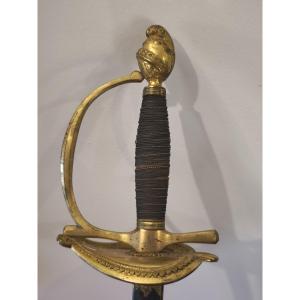
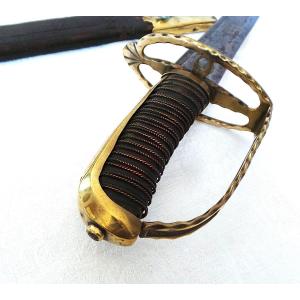
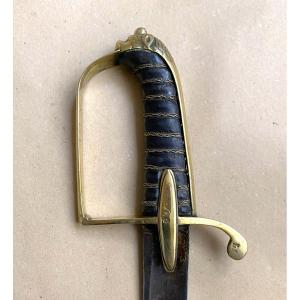
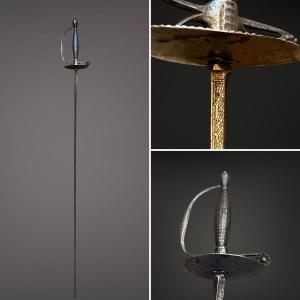
Powerful naval officer sword called "of the American expedition", in chiseled and punched silver.
Frame entirely made of solid silver, with pearl decoration, checkered and diamond tips; silver rocket punched at its base.
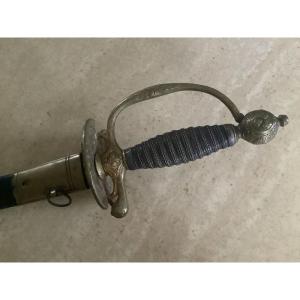
Oval guard with double donkey step; ovoid knob in suite, decorated with rosettes and pearl garlands.
Original sheath in black patent leather, with two trims (silver brass screed and butter, according to the use of the Royal Navy) and scarlet cloth tie.
Dimensions: total length 96 cm; blade 78.5 cm.
Note: the screed and butter, subjected to friction and moisture, were often made of silver brass to ensure solidity and ease of replacement
The pommeau — emblem of nobility and command
The ovoid knob, decorated with garlands and pearled rosettes, is inspired by the neoclassical models of the reign of Louis XVI. A symbol of perfection, stability and honor, it expresses the dignity of the command and the belonging of the bearer to the elite of noble officers, often from the Marine Guards (Brest, Toulon, Rochefort). The goldsmith work is of remarkable precision.
Iconographic decor — Royal and marine symbolism
On the rocket is a pearly oval medallion representing a male bust from the front, wearing a side roller wig, surrounded by military trophies: anchors, cannons, bundles of weapons.
This portrait corresponds to the style of the effigies of the Marquis de La Fayette painted between 1775 and 1780 (Duplessis, Weyler). Associated with a punched mount Fouache & Compant - active precisely when sending French troops - this medallion acquires a unique symbolic significance.
Arms – Écu de France
Under the guard plateau: shield of France with three lily flowers, supported by a standing lion, accompanied by a floating banner and naval trophies. Draperies evoke the royal coat.
Lion on the ride supporting an azure shield with three gold lily flowers, accompanied by a banner and naval trophies.
The whole forms a real coat of arms, confirming the royal and prestigious character of the weapon
Punches
• General farmers: Fouache & Compant - Paris, 1774–1780
• Paris discharge punch (1774–1779)
• Workshop technical punch
• Master goldsmith's punch: Jean-Louis Julien Active around 1764–1780
Punch: L • stylized plant attribute (stem/tree) • J
With grains of remedy in an irregular oval
Inscription on the blade
HONI IS WHO THINKS BADLY ABOUT IT
Motto of the Order of the Garter (England, 1348). In the French context, it is a chivalric motto widely used in the ornamentation of blades imported or inspired by Solingen and Klingenthal, without political link.
Museum comparisons
• National Navy Museum, Paris – inv. OA 2213: officer's sword of the American expedition, around 1775.
• Army Museum, Paris - inv. H 1242: punched silver mount Fouache & Compant, lion with the arms of France.
Historical analysis
This type of mount was intended for naval officers engaged in the American expedition (1778–1783), especially in the squadrons of Estaing and La Fayette. Massive silver mounts, executed in Paris, offered as personal endowment or acquired by noble officers. The purity of the Louis XVI style and the presence of rigorously dated punches make it a remarkable witness to the Franco-American relations that preceded Yorktown.
Note — Massive character of the weapon
Unlike court swords, which are light and intended for ceremonies, this mount has a thicker guard, a wider blade, a reinforced structure and a more frank center of gravity. It is designed for real use in the countryside and at sea, while retaining the elegance of the Louis XVI style.
EXPERT SHEET — JEAN-LOUIS JULIEN (Parisian master goldsmith)
Identification
Parisian master goldsmith Jean-Louis Julien
Active around 1764–1780
Punch: L • stylized plant attribute (stem/tree) • J
With grains of remedy in an irregular oval
Analysis
• Authentic punch
• Perfect conformity with the Louis XVI style (1774–1780)
• Technical compatibility with a Marine officer mount
• High-level Parisian manufacturing
Expertise and technical and iconographic analysis of the master goldsmith's punch
Microscopic observation makes it possible to identify an extremely sharp vertical construction, organized in three successive levels
Stylized tree → two grains → initials → lower grain.
This architecture is not fortuitous: it responds to a logic deliberately engraved by the master goldsmith.
1. The upper part: the top — a dense and deliberately cleared foliage
The highest area of the punch shows a rounded, thick, textured mass, occupying the entire width.
It is clearly the compact foliage of the stylized tree, engraved in such a way as to remain identifiable despite the smallness of the punch.
Constant characteristics under magnification:
• organic, non-geometric shape;
• greater relief thickness;
• positioning at the head of the cartridge, without another mark above.
This foliage is the visual signature of the punch.
2. The median area: two grains of remedy located under the foliage and just above the initials
Directly under the foliage appear two grains of remedy, perfectly recognizable:
• spherical shape,
• net relief,
• horizontal alignment,
• positioned between the shaft and the initials.
This arrangement is typical of vertical punches, where the symbol (here the tree) occupies the central place and forces the grains to be arranged immediately below the top of the pattern, but above the letters.
This Parisian small module punch does not measure more than 3 mm
3. The lower part: the initials L ... J of the master goldsmith
Under the upper grains are the two letters:
• L on the left
• J on the right
Their shape, their small size and their low implantation confirm that they are the initials of the master.
They occupy the lowest area of the main block, below the upper grains, but above the last lower grain.
4. The lower grain: located under the roots, at the base of the punch
Under the letters and under the roots of the tree appears a third grain of remedy, more discreet, slightly crushed.
This third grain is placed:
• totally down,
• under the line of letters,
• at the base of the cartridge,
• under the roots of the tree.
General conclusion
American expedition officer's sword mount, in solid silver, Paris, around 1774–1779, bearing the punch of master goldsmith Jean-Louis Julien.
Prestigious piece, very rare, of major historical importance.
France, around 1774–1779 — Epoch of the Marquis de La Fayette
Major historical memory
This sword is an emblematic testimony of the Franco-American alliance during the American War of Independence (1778–1783). The French officers and gentlemen engaged in the expedition from America, under the orders of the Count of Rochambeau or the Marquis de La Fayette, wore this type of silver mounts of exceptional refinement, where the royal ornamental language - lions, lilies, draperies, weapon trophies and navy anchors - glorified the monarchy while celebrating the union of the two nations against England.
Through its iconography and quality of execution, this sword embodies one of the few tangible symbols of the founding link between France and the United States, a military and ideological union from which a lasting friendship will be born.
General description
Powerful naval officer sword called "of the American expedition", in chiseled and punched silver.
Frame entirely made of solid silver, with pearl decoration, checkered and diamond tips; silver rocket punched at its base.
Oval guard with double donkey step; ovoid knob in suite, decorated with rosettes and pearl garlands.
Original sheath in black patent leather, with two trims (silver brass screed and butter, according to the use of the Royal Navy) and scarlet cloth tie.
Dimensions: total length 96 cm; blade 78.5 cm.
Note: the screed and butter, subjected to friction and moisture, were often made of silver brass to ensure solidity and ease of replacement
The pommeau — emblem of nobility and command
The ovoid knob, decorated with garlands and pearled rosettes, is inspired by the neoclassical models of the reign of Louis XVI. A symbol of perfection, stability and honor, it expresses the dignity of the command and the belonging of the bearer to the elite of noble officers, often from the Marine Guards (Brest, Toulon, Rochefort). The goldsmith work is of remarkable precision.
Iconographic decor — Royal and marine symbolism
On the rocket is a pearly oval medallion representing a male bust from the front, wearing a side roller wig, surrounded by military trophies: anchors, cannons, bundles of weapons.
This portrait corresponds to the style of the effigies of the Marquis de La Fayette painted between 1775 and 1780 (Duplessis, Weyler). Associated with a punched mount Fouache & Compant - active precisely when sending French troops - this medallion acquires a unique symbolic significance.
Arms – Écu de France
Under the guard plateau: shield of France with three lily flowers, supported by a standing lion, accompanied by a floating banner and naval trophies. Draperies evoke the royal coat.
Lion on the ride supporting an azure shield with three gold lily flowers, accompanied by a banner and naval trophies.
The whole forms a real coat of arms, confirming the royal and prestigious character of the weapon
Punches
• General farmers: Fouache & Compant - Paris, 1774–1780
• Paris discharge punch (1774–1779)
• Workshop technical punch
• Master goldsmith's punch: Jean-Louis Julien Active around 1764–1780
Punch: L • stylized plant attribute (stem/tree) • J
With grains of remedy in an irregular oval
Inscription on the blade
HONI IS WHO THINKS BADLY ABOUT IT
Motto of the Order of the Garter (England, 1348). In the French context, it is a chivalric motto widely used in the ornamentation of blades imported or inspired by Solingen and Klingenthal, without political link.
Museum comparisons
• National Navy Museum, Paris – inv. OA 2213: officer's sword of the American expedition, around 1775.
• Army Museum, Paris - inv. H 1242: punched silver mount Fouache & Compant, lion with the arms of France.
Historical analysis
This type of mount was intended for naval officers engaged in the American expedition (1778–1783), especially in the squadrons of Estaing and La Fayette. Massive silver mounts, executed in Paris, offered as personal endowment or acquired by noble officers. The purity of the Louis XVI style and the presence of rigorously dated punches make it a remarkable witness to the Franco-American relations that preceded Yorktown.
Note — Massive character of the weapon
Unlike court swords, which are light and intended for ceremonies, this mount has a thicker guard, a wider blade, a reinforced structure and a more frank center of gravity. It is designed for real use in the countryside and at sea, while retaining the elegance of the Louis XVI style.
EXPERT SHEET — JEAN-LOUIS JULIEN (Parisian master goldsmith)
Identification
Parisian master goldsmith Jean-Louis Julien
Active around 1764–1780
Punch: L • stylized plant attribute (stem/tree) • J
With grains of remedy in an irregular oval
Analysis
• Authentic punch
• Perfect conformity with the Louis XVI style (1774–1780)
• Technical compatibility with a Marine officer mount
• High-level Parisian manufacturing
Expertise and technical and iconographic analysis of the master goldsmith's punch
Microscopic observation makes it possible to identify an extremely sharp vertical construction, organized in three successive levels
Stylized tree → two grains → initials → lower grain.
This architecture is not fortuitous: it responds to a logic deliberately engraved by the master goldsmith.
1. The upper part: the top — a dense and deliberately cleared foliage
The highest area of the punch shows a rounded, thick, textured mass, occupying the entire width.
It is clearly the compact foliage of the stylized tree, engraved in such a way as to remain identifiable despite the smallness of the punch.
Constant characteristics under magnification:
• organic, non-geometric shape;
• greater relief thickness;
• positioning at the head of the cartridge, without another mark above.
This foliage is the visual signature of the punch.
2. The median area: two grains of remedy located under the foliage and just above the initials
Directly under the foliage appear two grains of remedy, perfectly recognizable:
• spherical shape,
• net relief,
• horizontal alignment,
• positioned between the shaft and the initials.
This arrangement is typical of vertical punches, where the symbol (here the tree) occupies the central place and forces the grains to be arranged immediately below the top of the pattern, but above the letters.
This Parisian small module punch does not measure more than 3 mm
3. The lower part: the initials L ... J of the master goldsmith
Under the upper grains are the two letters:
• L on the left
• J on the right
Their shape, their small size and their low implantation confirm that they are the initials of the master.
They occupy the lowest area of the main block, below the upper grains, but above the last lower grain.
4. The lower grain: located under the roots, at the base of the punch
Under the letters and under the roots of the tree appears a third grain of remedy, more discreet, slightly crushed.
This third grain is placed:
• totally down,
• under the line of letters,
• at the base of the cartridge,
• under the roots of the tree.
General conclusion
American expedition officer's sword mount, in solid silver, Paris, around 1774–1779, bearing the punch of master goldsmith Jean-Louis Julien.
Prestigious piece, very rare, of major historical importance.
7 500 €
Period: 18th century
Style: Louis 16th, Directory
Condition: Excellent condition
Reference (ID): 1779732
Availability: In stock
Print