

Small Miniature Mug And Its Soucoupe In Bordeaux Porcelain - Atelier De Vereneuilh
Artist: Bordeaux - Atelier De Verneuilh Et Neveu
Hard-paste porcelain.
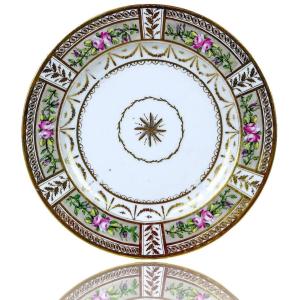
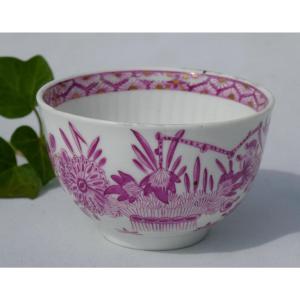
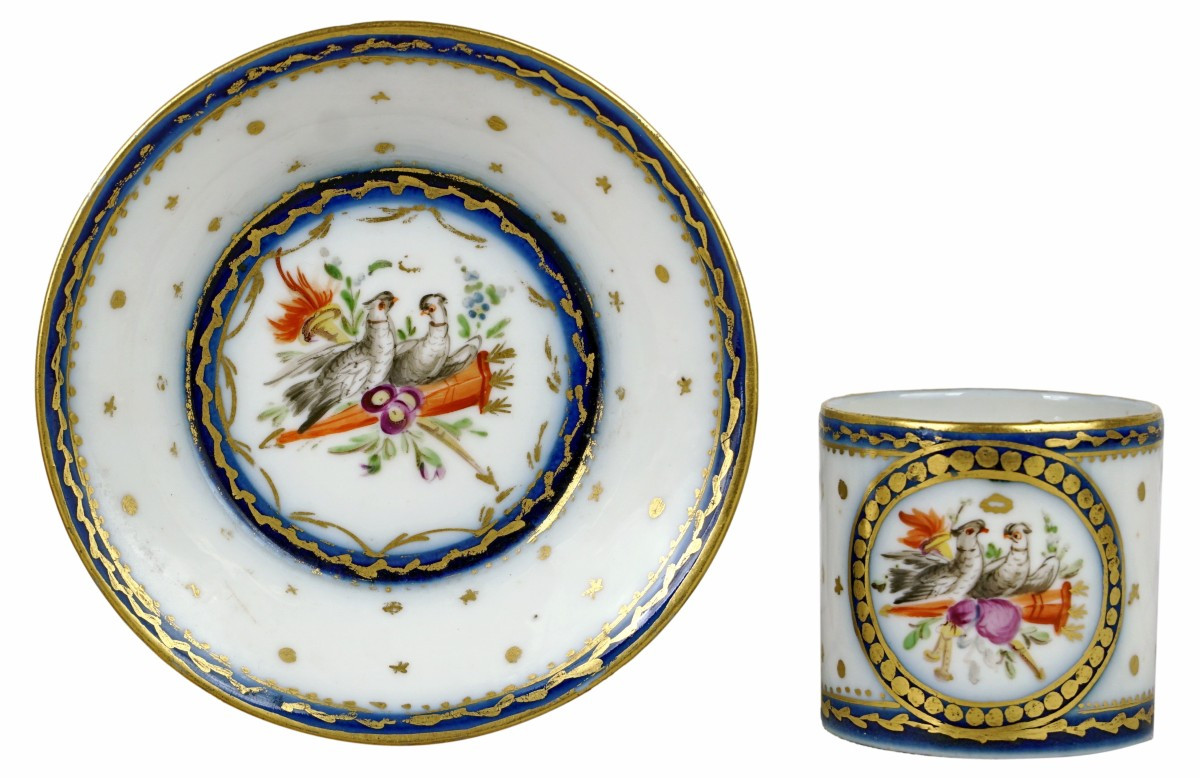
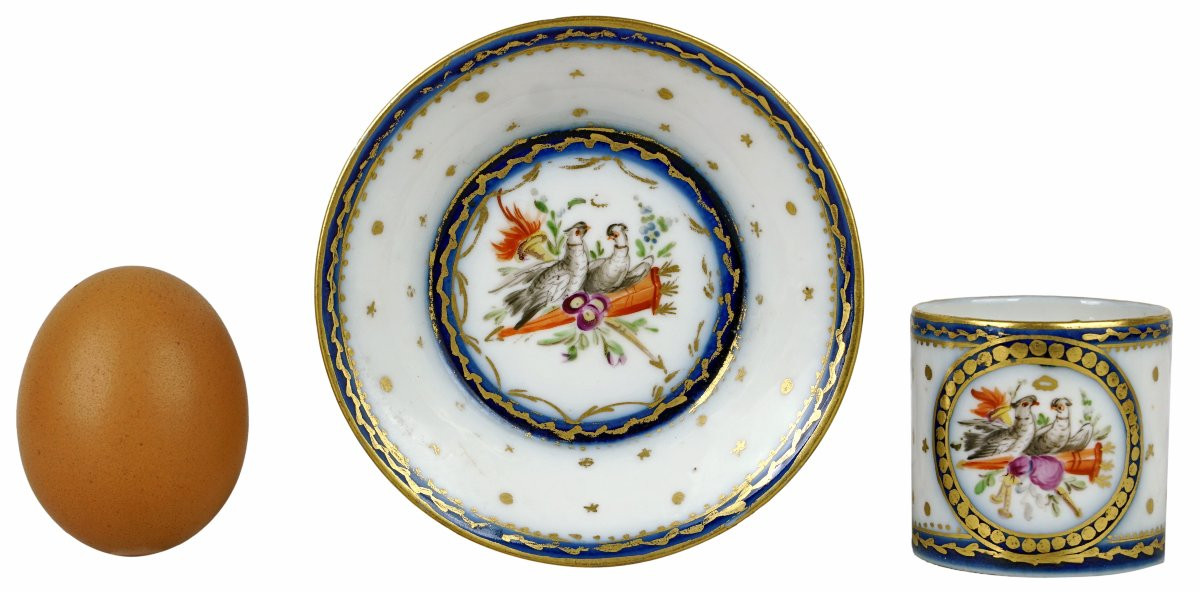
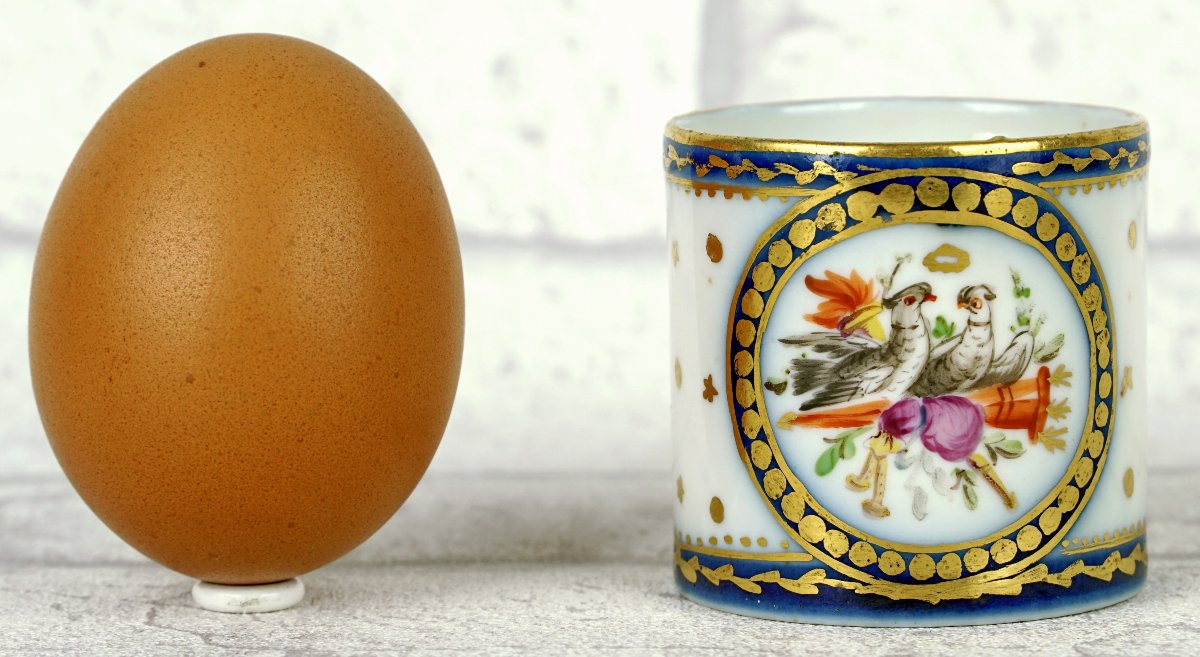
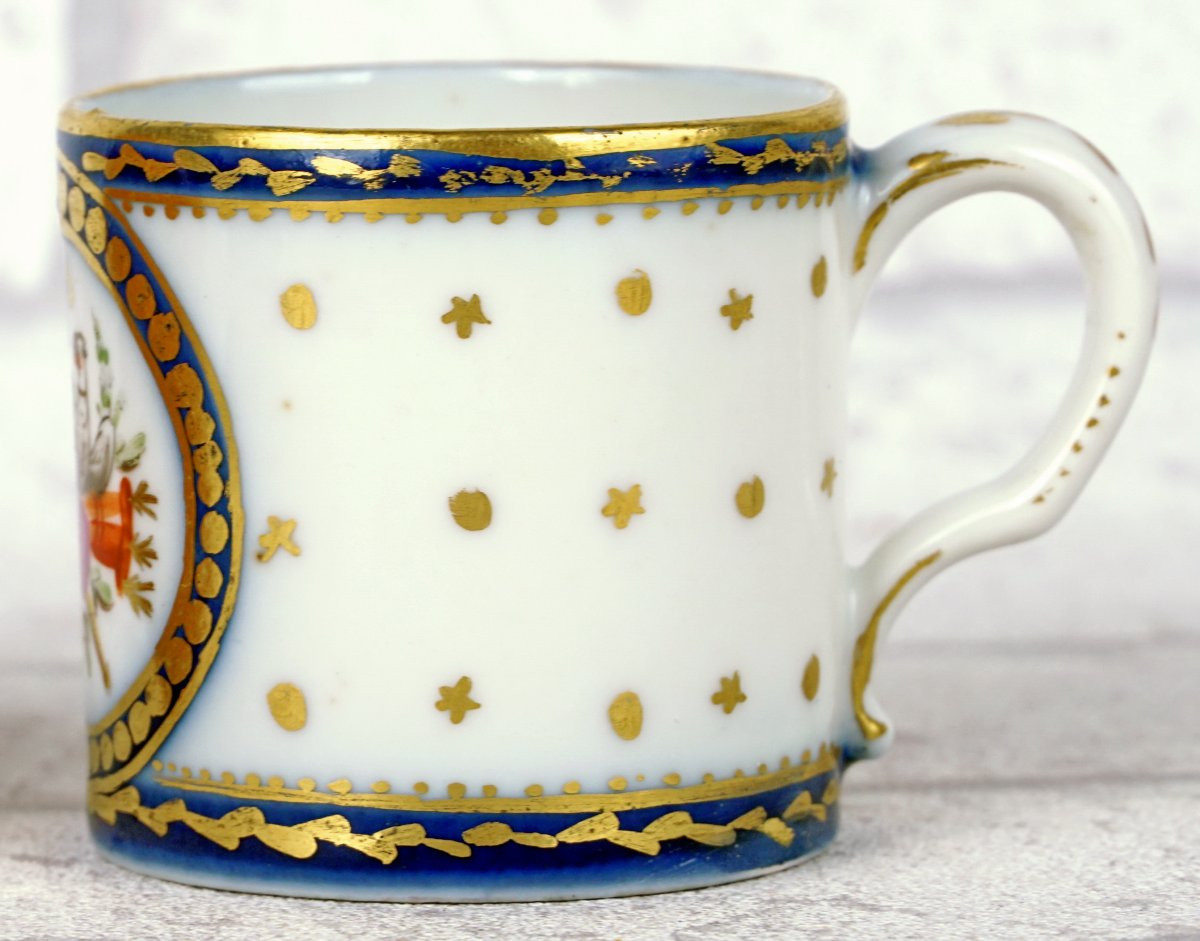
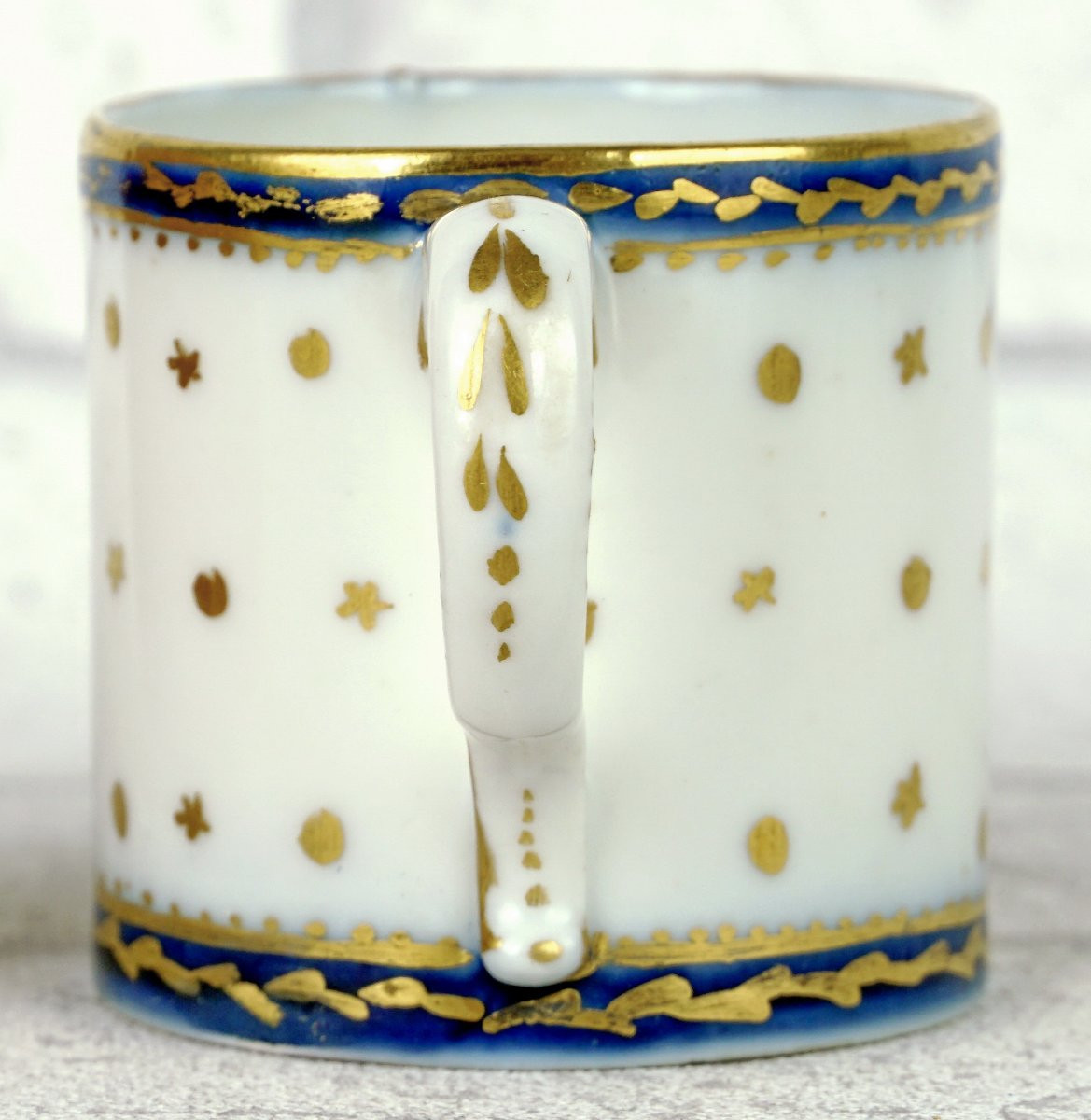
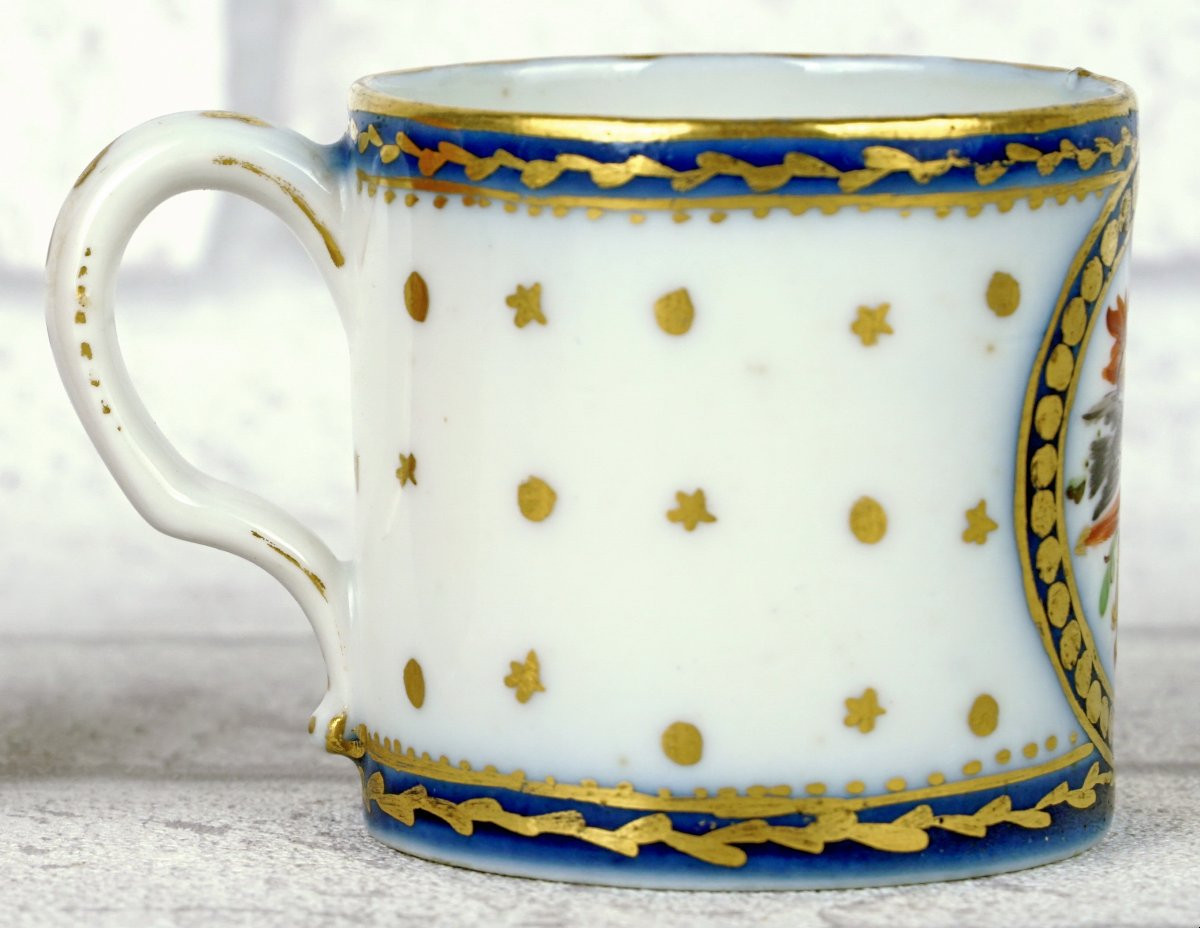
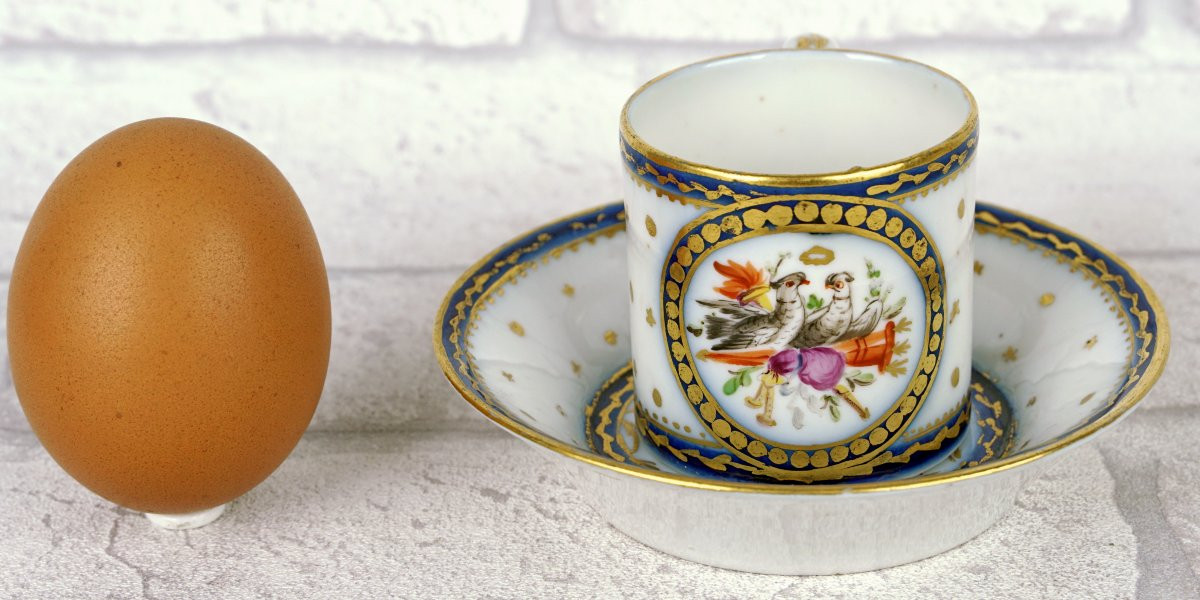
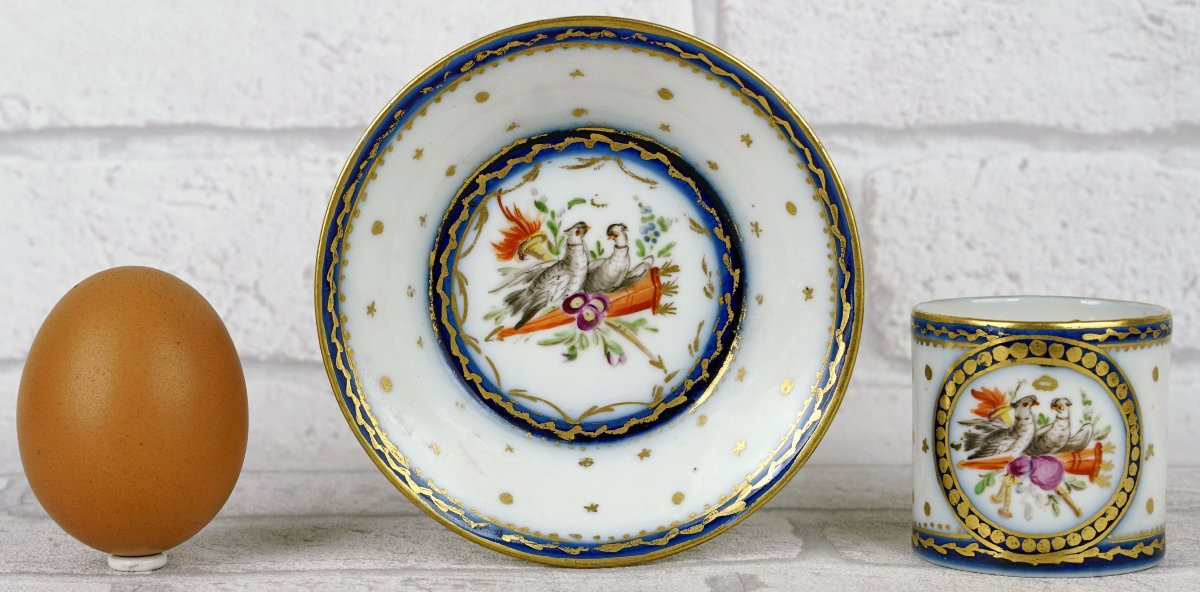
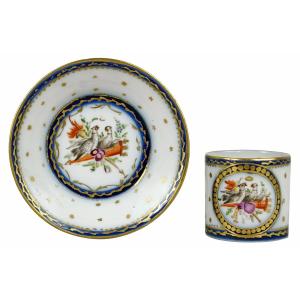
The cup and saucer feature a matching design of two doves perched on a quiver, accompanied by arrows and floral motifs. The set is bordered by cobalt blue friezes highlighted with rich gilt lines and scrolls, embellished with a scattering of small stars and dotted gold motifs. Gold rim.
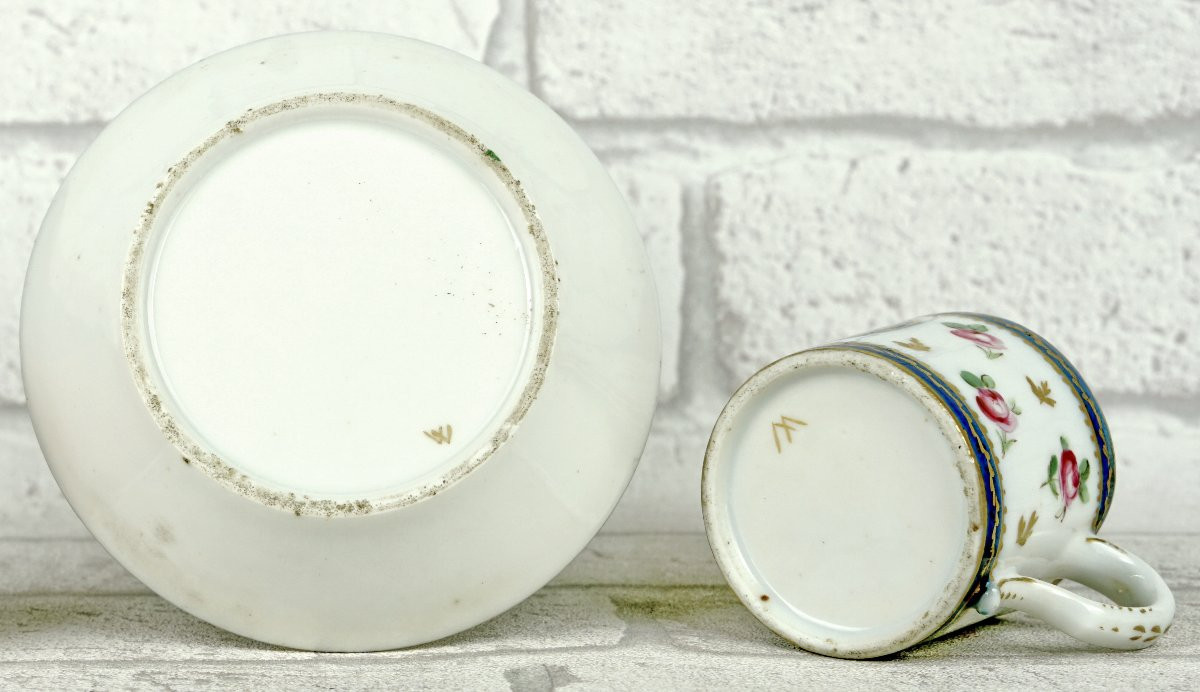
Mark(s): Hand-painted in gold "VV"
Dimensions: Cup: Height 4.6 cm - Length 6.7 cm - Saucer: Diameter 9.8 cm
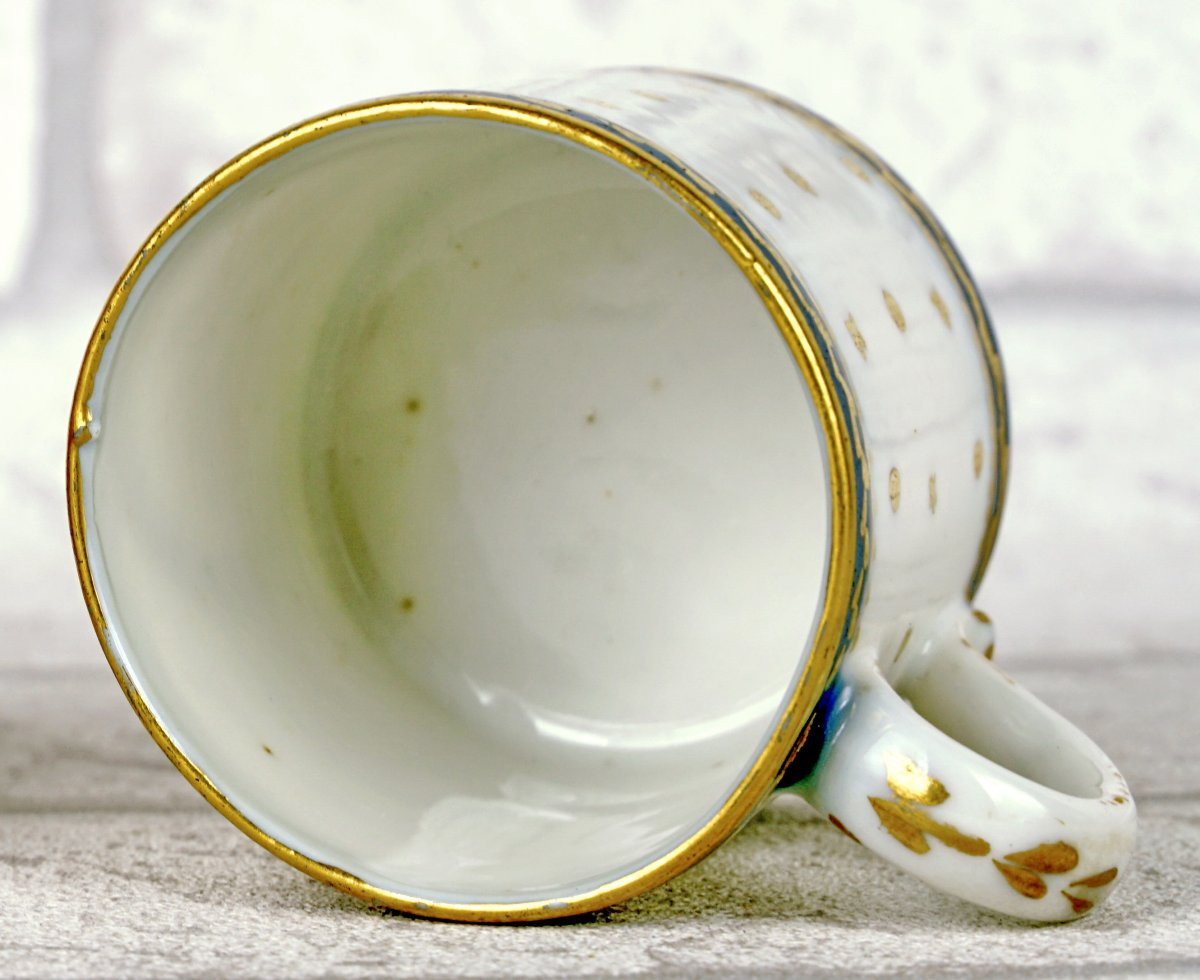
Condition(s): GOOD CONDITION - Tiny chip repaired on the rim of the cup - (Repair invisible to the naked eye)
Period: 18th century
Note(s): Minor signs of wear.
In the 18th and early 19th centuries, doves possessed a particularly rich symbolism in the decorative arts, painting, and porcelain, where they were almost never depicted randomly. In this instance, the doves perched on a quiver accompanied by arrows clearly belong to a vocabulary of love and neoclassical themes inherited from Antiquity. Doves then symbolized faithful and tender love, gentleness, attachment, and marital union, with two doves almost always evoking the image of a united couple. They are also associated with Venus—or Aphrodite—whose traditional attributes they constitute in ancient iconography, a theme revived during the Louis XVI and Empire periods. Finally, they also embody the idea of harmony and serenity. The quiver and arrows directly reference Cupid and the theme of Love. In the decorative arts of this period, an abandoned quiver accompanied by doves often constitutes an allegory of peaceful love or softened romantic feelings.
BORDEAUX PORCELAIN
"VERNEUILH and NEUVEU" and NOT "Verneuilh and Vanier" but "ALLUAUD and VANIER"
The name of the Bordeaux porcelain factory is a subject of debate. Traditionally called "Verneuilh and Vanier," this name has been incorrect for many years.
No historical documentation confirms a partnership between the Verneuilh family and Michel Vanier. Research indicates that Pierre Verneuilh and his nephew Jean founded their own factory at the Château des Terres de Bordes in Paludate, Bordeaux, in 1781. However, due to the poor quality of their production, they decided, in July 1787, to sublet the factory to Michel Vanier, an experienced porcelain maker from Valenciennes. According to a letter from Vanier to Alluaud dated November 10, 1787, this agreement stipulated that Vanier would produce white porcelain for the Verneuilh family, who would then purchase these pieces to decorate in their Bordeaux workshops.
Furthermore, facing financial difficulties very quickly, six months after his arrival in Bordeaux, Vanier partnered, on January 1, 1788, with François Alluaud of Limoges, his own clay supplier, in order to continue his production of white porcelain. The decorated pieces resulting from this collaboration bear the mark "A.V." in high-fire blue, with or without the inscription "Bordeaux," signifying "Alluaud and Vanier." It is therefore impossible for Vanier to have been simultaneously associated with the Verneuilh family and Alluaud.
Pieces decorated by the Verneuilh family are marked with two "V"s, either side by side or slightly overlapping, representing "Verneuilh et Neveu" (Pierre Verneuilh and his nephew Jean). Thus, the correct name of the factory is "VERNEUILH et NEVEU" and not "Verneuilh et Vanier," an erroneous name that has been widespread for many years.
In conclusion, although Michel Vanier played a significant role in porcelain production in Bordeaux, there is no evidence of a direct association between him and the Verneuilh family. The designation "VERNEUILH et NEVEU" therefore more accurately reflects the historical reality of the Verneuilh factory in Bordeaux between 1781 and 1786, after which it became solely a Bordeaux decorating workshop, still called "VERNEUILH et NEVEU" from 1787 to 179? (We do not know the exact end of the Verneuilh decorating workshop). It is worth noting that in 1793, the Verneuilhs were still purchasing stocks of Vanier white porcelain sold at auction following the closure of his factory in 1791. Furthermore, the Verneuils also sourced white porcelain from Parisian manufacturers such as Nast.
Ronan Lelandais
Expert in French Porcelain.
PAYMENT and SHIPPING.
ACCEPTED PAYMENTS: BANK TRANSFER / PAYPAL / CREDIT CARD online or by CHECK.
PACKAGES WILL BE MAILED WITHIN 4 DAYS.
COMBINED SHIPPING IS AVAILABLE FOR MULTIPLE PURCHASES.
The cup and saucer feature a matching design of two doves perched on a quiver, accompanied by arrows and floral motifs. The set is bordered by cobalt blue friezes highlighted with rich gilt lines and scrolls, embellished with a scattering of small stars and dotted gold motifs. Gold rim.
Mark(s): Hand-painted in gold "VV"
Dimensions: Cup: Height 4.6 cm - Length 6.7 cm - Saucer: Diameter 9.8 cm
Condition(s): GOOD CONDITION - Tiny chip repaired on the rim of the cup - (Repair invisible to the naked eye)
Period: 18th century
Note(s): Minor signs of wear.
In the 18th and early 19th centuries, doves possessed a particularly rich symbolism in the decorative arts, painting, and porcelain, where they were almost never depicted randomly. In this instance, the doves perched on a quiver accompanied by arrows clearly belong to a vocabulary of love and neoclassical themes inherited from Antiquity. Doves then symbolized faithful and tender love, gentleness, attachment, and marital union, with two doves almost always evoking the image of a united couple. They are also associated with Venus—or Aphrodite—whose traditional attributes they constitute in ancient iconography, a theme revived during the Louis XVI and Empire periods. Finally, they also embody the idea of harmony and serenity. The quiver and arrows directly reference Cupid and the theme of Love. In the decorative arts of this period, an abandoned quiver accompanied by doves often constitutes an allegory of peaceful love or softened romantic feelings.
BORDEAUX PORCELAIN
"VERNEUILH and NEUVEU" and NOT "Verneuilh and Vanier" but "ALLUAUD and VANIER"
The name of the Bordeaux porcelain factory is a subject of debate. Traditionally called "Verneuilh and Vanier," this name has been incorrect for many years.
No historical documentation confirms a partnership between the Verneuilh family and Michel Vanier. Research indicates that Pierre Verneuilh and his nephew Jean founded their own factory at the Château des Terres de Bordes in Paludate, Bordeaux, in 1781. However, due to the poor quality of their production, they decided, in July 1787, to sublet the factory to Michel Vanier, an experienced porcelain maker from Valenciennes. According to a letter from Vanier to Alluaud dated November 10, 1787, this agreement stipulated that Vanier would produce white porcelain for the Verneuilh family, who would then purchase these pieces to decorate in their Bordeaux workshops.
Furthermore, facing financial difficulties very quickly, six months after his arrival in Bordeaux, Vanier partnered, on January 1, 1788, with François Alluaud of Limoges, his own clay supplier, in order to continue his production of white porcelain. The decorated pieces resulting from this collaboration bear the mark "A.V." in high-fire blue, with or without the inscription "Bordeaux," signifying "Alluaud and Vanier." It is therefore impossible for Vanier to have been simultaneously associated with the Verneuilh family and Alluaud.
Pieces decorated by the Verneuilh family are marked with two "V"s, either side by side or slightly overlapping, representing "Verneuilh et Neveu" (Pierre Verneuilh and his nephew Jean). Thus, the correct name of the factory is "VERNEUILH et NEVEU" and not "Verneuilh et Vanier," an erroneous name that has been widespread for many years.
In conclusion, although Michel Vanier played a significant role in porcelain production in Bordeaux, there is no evidence of a direct association between him and the Verneuilh family. The designation "VERNEUILH et NEVEU" therefore more accurately reflects the historical reality of the Verneuilh factory in Bordeaux between 1781 and 1786, after which it became solely a Bordeaux decorating workshop, still called "VERNEUILH et NEVEU" from 1787 to 179? (We do not know the exact end of the Verneuilh decorating workshop). It is worth noting that in 1793, the Verneuilhs were still purchasing stocks of Vanier white porcelain sold at auction following the closure of his factory in 1791. Furthermore, the Verneuils also sourced white porcelain from Parisian manufacturers such as Nast.
Ronan Lelandais
Expert in French Porcelain.
PAYMENT and SHIPPING.
ACCEPTED PAYMENTS: BANK TRANSFER / PAYPAL / CREDIT CARD online or by CHECK.
PACKAGES WILL BE MAILED WITHIN 4 DAYS.
COMBINED SHIPPING IS AVAILABLE FOR MULTIPLE PURCHASES.
780 €
Period: 18th century
Style: Louis 16th, Directory
Condition: Excellent condition
Material: Porcelain
Reference (ID): 1766811
Availability: In stock
Print