


French School (late 19th Century) - The Rescue Of The Body Of Saint Sebastian By Saint Irene
Oil on canvas. Original canvas.
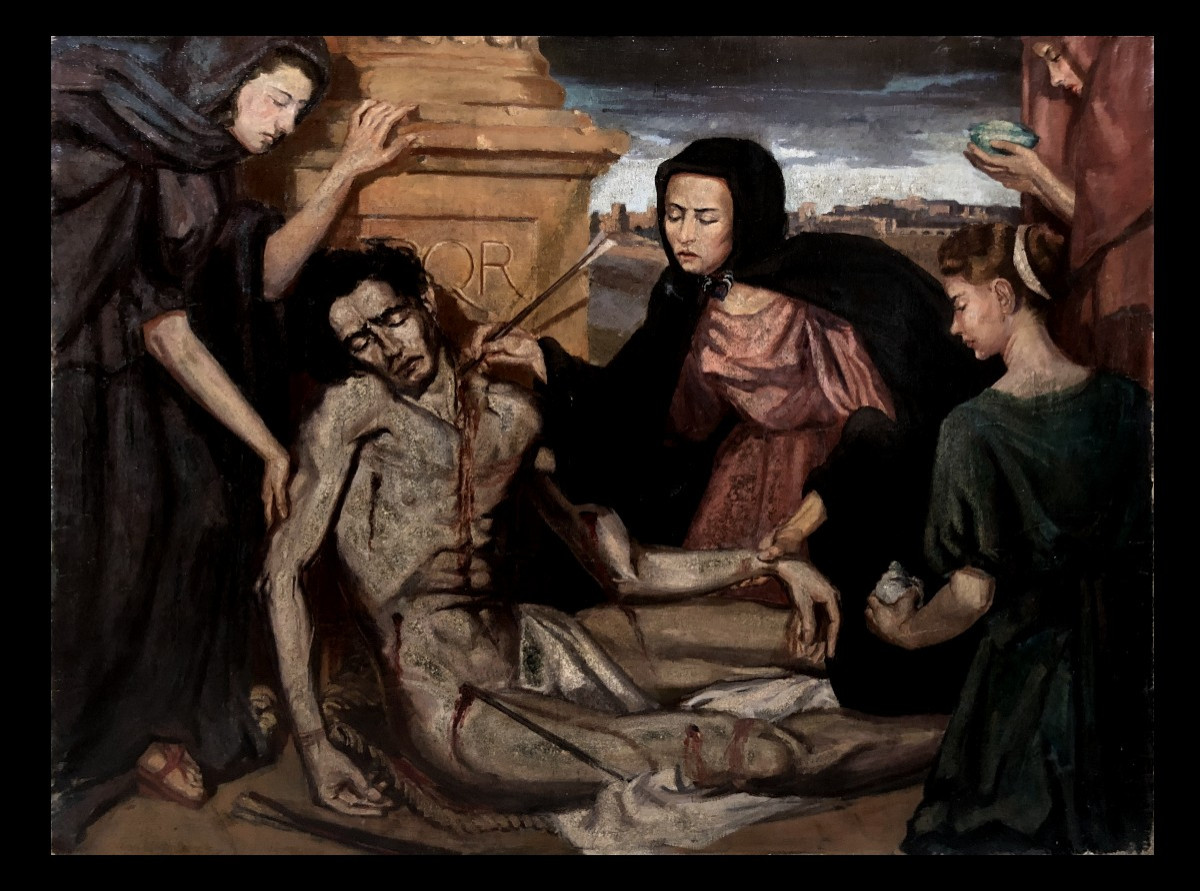
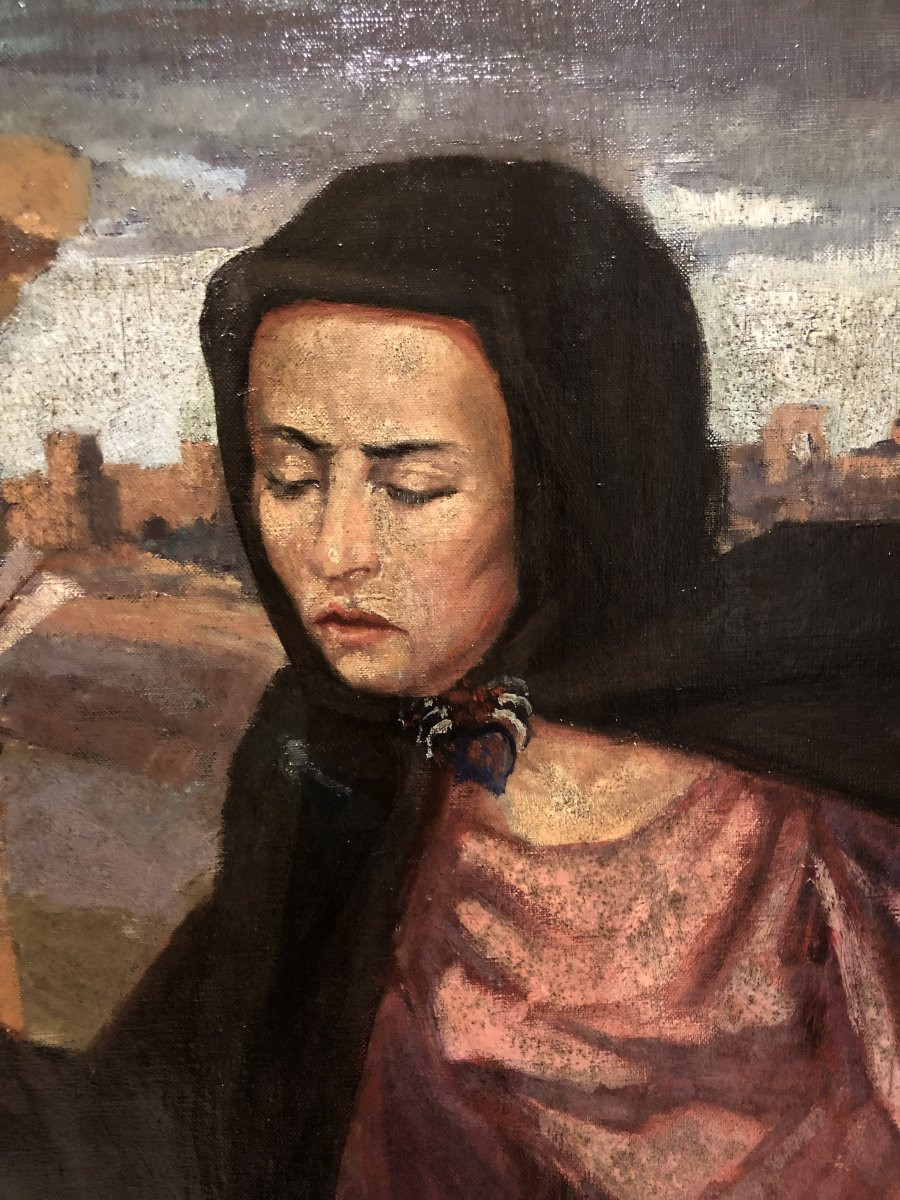
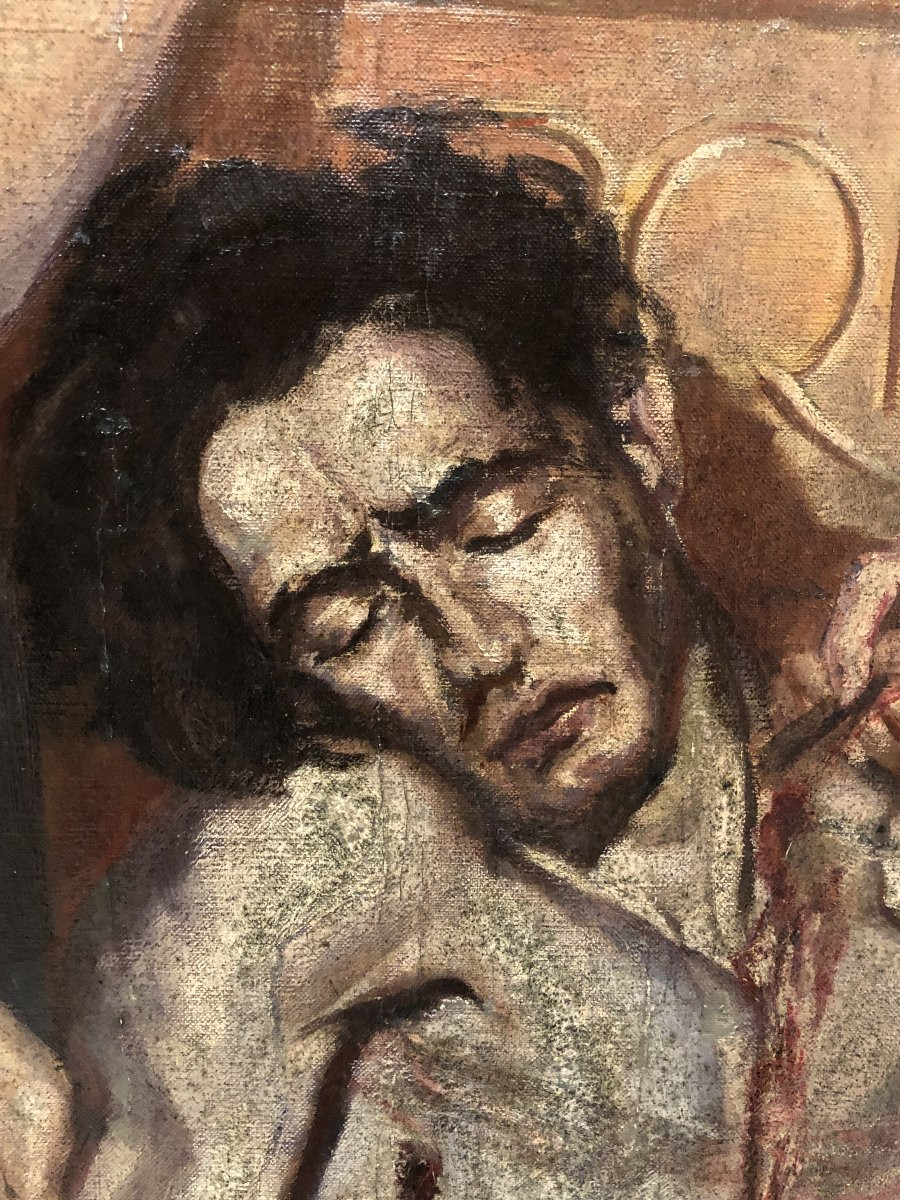
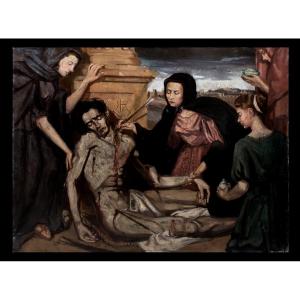
This monumental French preparatory canvas, dating from the late 19th century and whose dimensions testify to its ambition as a study for a fresco, reveals a masterly composition that pays homage to the great masters of the Roman Baroque, such as Caravaggio and Guido Reni, notably through its dramatic treatment of light. The scene, bathed in twilight, is pierced by a violent chiaroscuro that illuminates the body of Saint Sebastian, a pale-skinned young martyr, lying half-conscious, barely supported by a white loincloth and a rope knot around his wrist, leaning against the base of a classical marble column bearing, anachronistically and symbolically, the inscription "S.P.Q.R.", anchoring the scene in pagan Rome. His frail, pained figure is the focus of compassion, while his head, crowned with the invisible crown of thorns of faith, leans back in an expression of agony and ecstasy. It is at this crucial moment that the main action takes place: St. Irene, the noble Roman matron, dressed in a rich terracotta-colored tunic and a dark cloak that underlines her determination, bends over the body, not to watch over the dead, but to save the living. With one firm yet delicate hand, she grasps Sebastian's wrist, and with the other, she prepares to pull out the arrow that pierces his chest - an arrow which, unlike those fired by his executioners, is the instrument of his salvation, having missed his heart. This rescue, an act of faith and Christian love in the midst of persecution, is the driving force behind the composition.
Around the protagonists, the circle of holy women, Baroque divinities of mercy, orchestrates the scene with a choreography of gestures and glances. To the left, a figure in profile, draped in a thick cobalt-blue cloak that evokes the nobility of classical art, cradles Sebastian's head with infinite delicacy, her gaze fixed on the martyr's face, personifying piety. To the right, a younger woman kneels in an emerald-green gown symbolizing hope and rebirth. She is preparing ointments and balms to heal wounds, a bottle of perfume and a bowl at her side. A fourth figure, almost hidden in the shadows, observes with respect and admiration, completing the group with her discreet but essential presence. The atmosphere is charged with the tension of clandestine rescue and the divine light that seems to emanate from the dark, stormy sky, where clouds swirl around the column and ancient Rome can be seen in the distance, in the twilight. The vigor of the brushstrokes and the richness of the palette, with its deep ochres, purples and intense blues, testify that this painting is not a mere study, but a work of art in its own right. Here, the spirit of Roman Baroque is revived by 19th-century French sensibility, creating a scene of poignant beauty and unshakeable faith that transcends time.
- Picture size unframed : 145 x 115 cm
This monumental French preparatory canvas, dating from the late 19th century and whose dimensions testify to its ambition as a study for a fresco, reveals a masterly composition that pays homage to the great masters of the Roman Baroque, such as Caravaggio and Guido Reni, notably through its dramatic treatment of light. The scene, bathed in twilight, is pierced by a violent chiaroscuro that illuminates the body of Saint Sebastian, a pale-skinned young martyr, lying half-conscious, barely supported by a white loincloth and a rope knot around his wrist, leaning against the base of a classical marble column bearing, anachronistically and symbolically, the inscription "S.P.Q.R.", anchoring the scene in pagan Rome. His frail, pained figure is the focus of compassion, while his head, crowned with the invisible crown of thorns of faith, leans back in an expression of agony and ecstasy. It is at this crucial moment that the main action takes place: St. Irene, the noble Roman matron, dressed in a rich terracotta-colored tunic and a dark cloak that underlines her determination, bends over the body, not to watch over the dead, but to save the living. With one firm yet delicate hand, she grasps Sebastian's wrist, and with the other, she prepares to pull out the arrow that pierces his chest - an arrow which, unlike those fired by his executioners, is the instrument of his salvation, having missed his heart. This rescue, an act of faith and Christian love in the midst of persecution, is the driving force behind the composition.
Around the protagonists, the circle of holy women, Baroque divinities of mercy, orchestrates the scene with a choreography of gestures and glances. To the left, a figure in profile, draped in a thick cobalt-blue cloak that evokes the nobility of classical art, cradles Sebastian's head with infinite delicacy, her gaze fixed on the martyr's face, personifying piety. To the right, a younger woman kneels in an emerald-green gown symbolizing hope and rebirth. She is preparing ointments and balms to heal wounds, a bottle of perfume and a bowl at her side. A fourth figure, almost hidden in the shadows, observes with respect and admiration, completing the group with her discreet but essential presence. The atmosphere is charged with the tension of clandestine rescue and the divine light that seems to emanate from the dark, stormy sky, where clouds swirl around the column and ancient Rome can be seen in the distance, in the twilight. The vigor of the brushstrokes and the richness of the palette, with its deep ochres, purples and intense blues, testify that this painting is not a mere study, but a work of art in its own right. Here, the spirit of Roman Baroque is revived by 19th-century French sensibility, creating a scene of poignant beauty and unshakeable faith that transcends time.
- Picture size unframed : 145 x 115 cm
1 450 €
Period: 19th century
Style: Other Style
Condition: Excellent condition
Material: Oil painting
Reference (ID): 1766131
Availability: In stock
Print