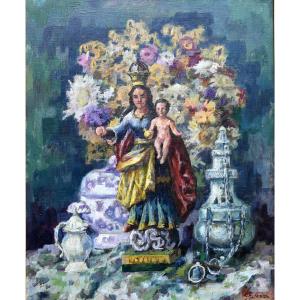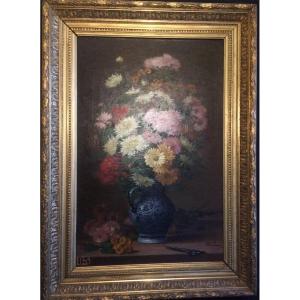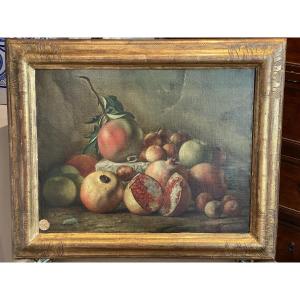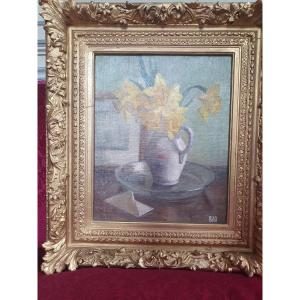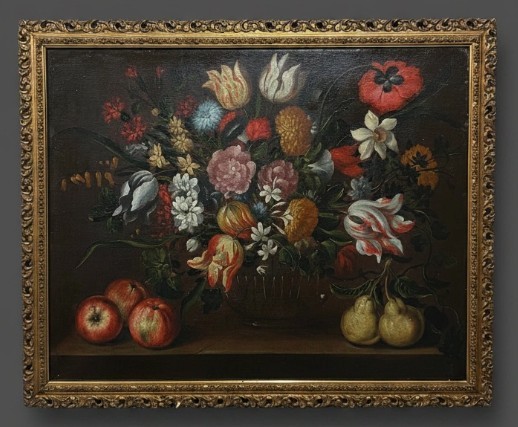
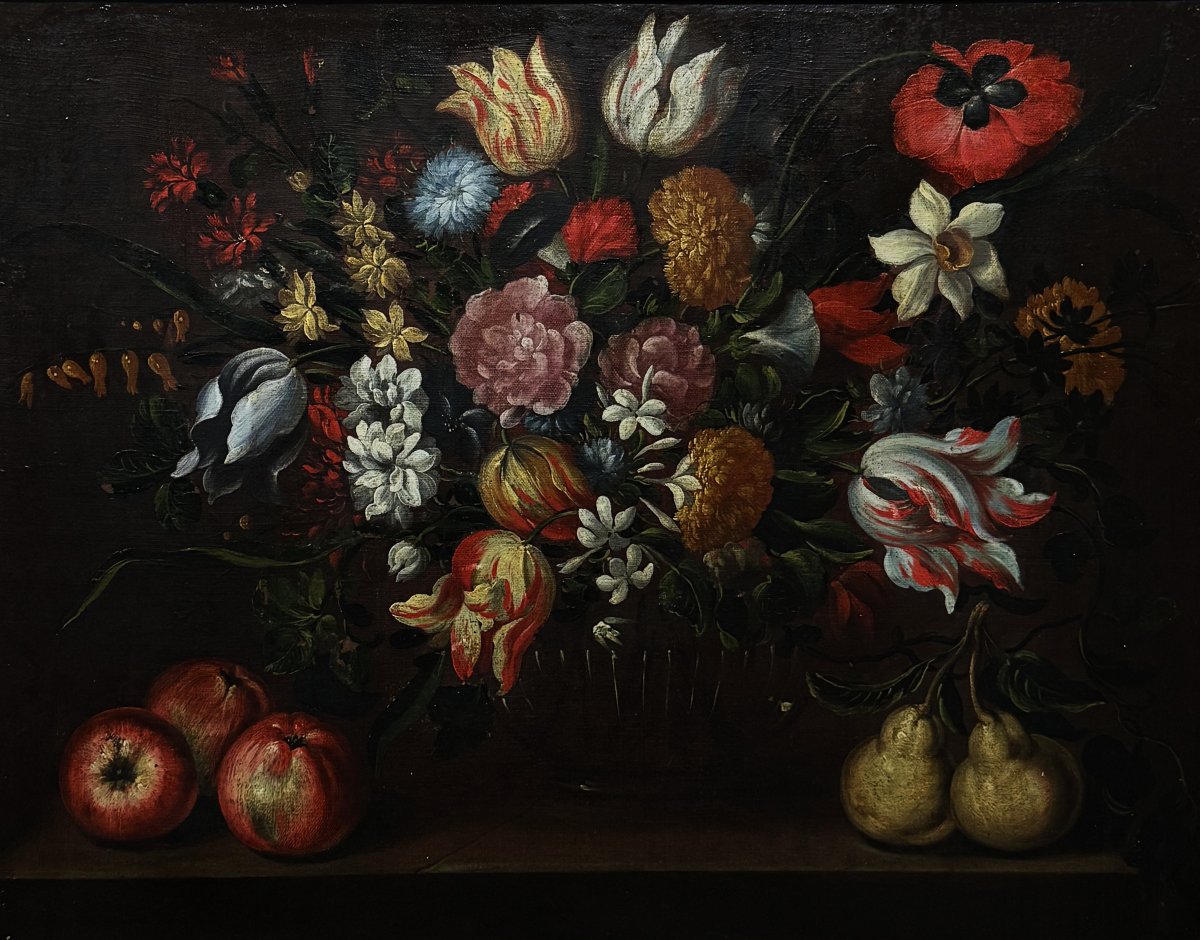
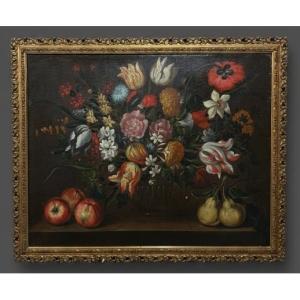


Gabriel De La Corte (1648-1694), Attributed To - Still Life With Basket Of Flowers And Pomegranates
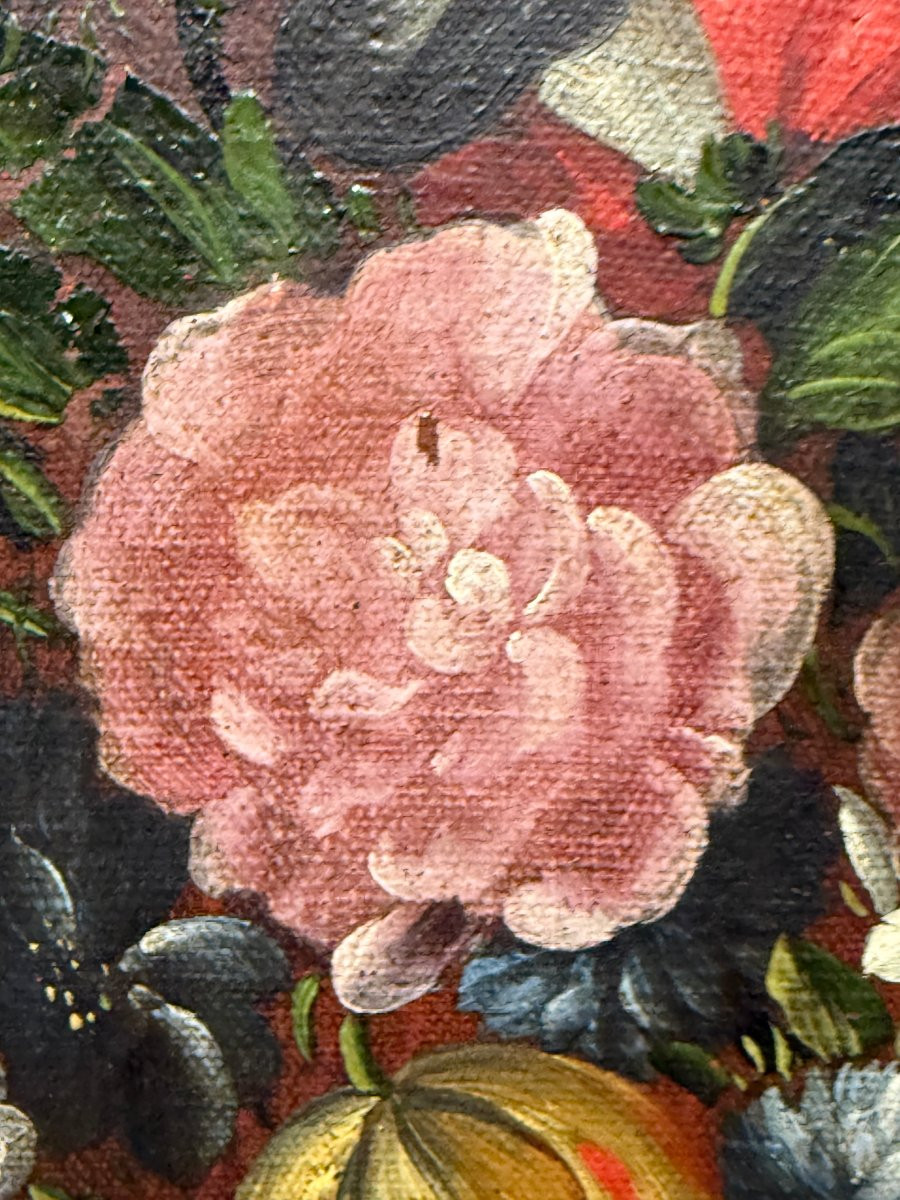
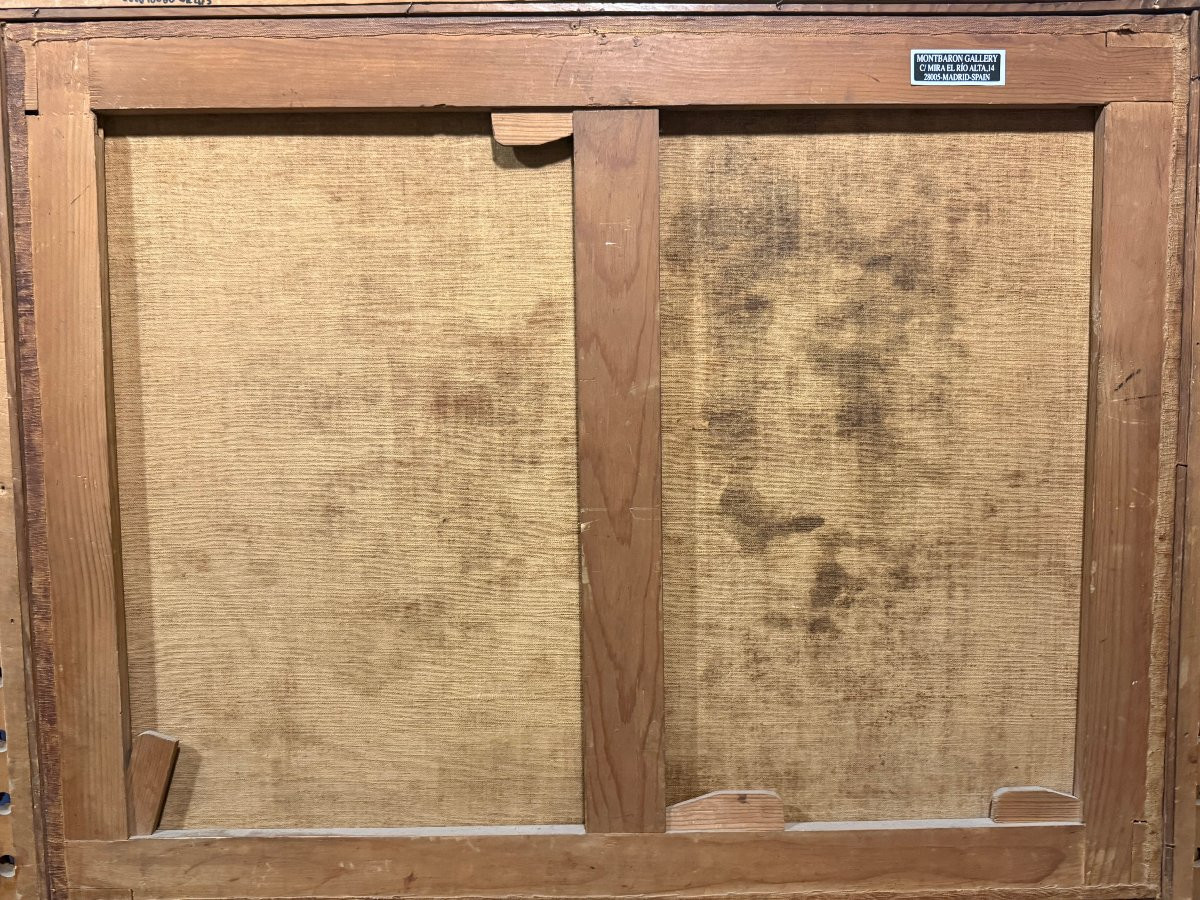
Oil on canvas. The canvas was lined and restored in the mid-19th century thanks to a remarkable and valuable conservation intervention, guaranteeing the contemplation of an exceptional example of Spanish Golden Age still life in optimal condition.
Gabriel de la Corte (1648-1694) was a renowned Baroque painter from Madrid who, despite his young age as an orphan and the absence of paternal instruction, successfully specialized in painting flowers and vases. His self-taught training was enriched by copying from life and the influence of masters such as Arellano and Mario Nuzzi. Although he actively collaborated with other artists such as Matías de Torres and Francisco Pérez Sierra - who was his son's godfather - in the creation of garlands and mixed-media compositions, Antonio Palomino recounts that he led a life marked by precariousness, forced to sell his work at derisory prices in order to survive.
In contrast to the more static style of his predecessors, De la Corte's work is distinguished by its vibrant dynamism and joyful colors. He simplified forms with dense brushstrokes, anticipating, in some respects, the Rococo aesthetic. An innovative artist, he broke with the compositional rigidity of his time; witness his ability to decentralize elements and create fanciful garlands that wrap around architectural volutes instead of conforming to traditional oval shapes. His most singular works, such as the flower masks in the Prado Museum, play with the paradox of artistic representation by fusing architectural and plant elements with natural flowers, exploring the boundaries between the simulated and the real.
- Image size unframed: 87.5 x 68 cm / 101 x 79.5 cm with exclusive late 19th-century frame.
Gabriel de la Corte (1648-1694) was a renowned Baroque painter from Madrid who, despite his young age as an orphan and the absence of paternal instruction, successfully specialized in painting flowers and vases. His self-taught training was enriched by copying from life and the influence of masters such as Arellano and Mario Nuzzi. Although he actively collaborated with other artists such as Matías de Torres and Francisco Pérez Sierra - who was his son's godfather - in the creation of garlands and mixed-media compositions, Antonio Palomino recounts that he led a life marked by precariousness, forced to sell his work at derisory prices in order to survive.
In contrast to the more static style of his predecessors, De la Corte's work is distinguished by its vibrant dynamism and joyful colors. He simplified forms with dense brushstrokes, anticipating, in some respects, the Rococo aesthetic. An innovative artist, he broke with the compositional rigidity of his time; witness his ability to decentralize elements and create fanciful garlands that wrap around architectural volutes instead of conforming to traditional oval shapes. His most singular works, such as the flower masks in the Prado Museum, play with the paradox of artistic representation by fusing architectural and plant elements with natural flowers, exploring the boundaries between the simulated and the real.
- Image size unframed: 87.5 x 68 cm / 101 x 79.5 cm with exclusive late 19th-century frame.
7 800 €
Period: 17th century
Style: Other Style
Condition: Excellent condition
Material: Oil painting
Reference (ID): 1755393
Availability: In stock
Print