

15th C. Nottingham Large Polychrome & Gilded Alabaster Panel Holy Trinity
Artist: Ateliers De Nottingham, Royaume Uni Vers 1440 - 1470
HAUTE EPOQUE, SCULPTURE
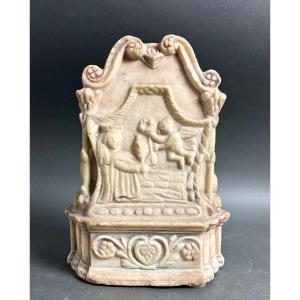
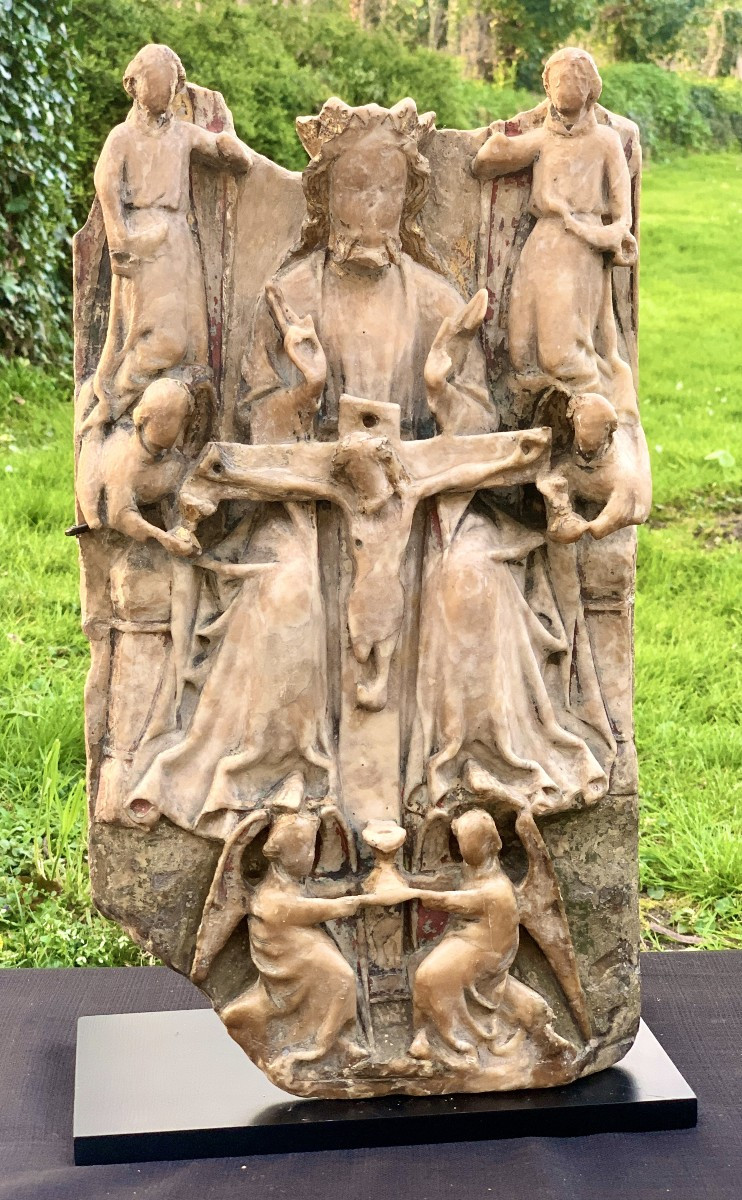
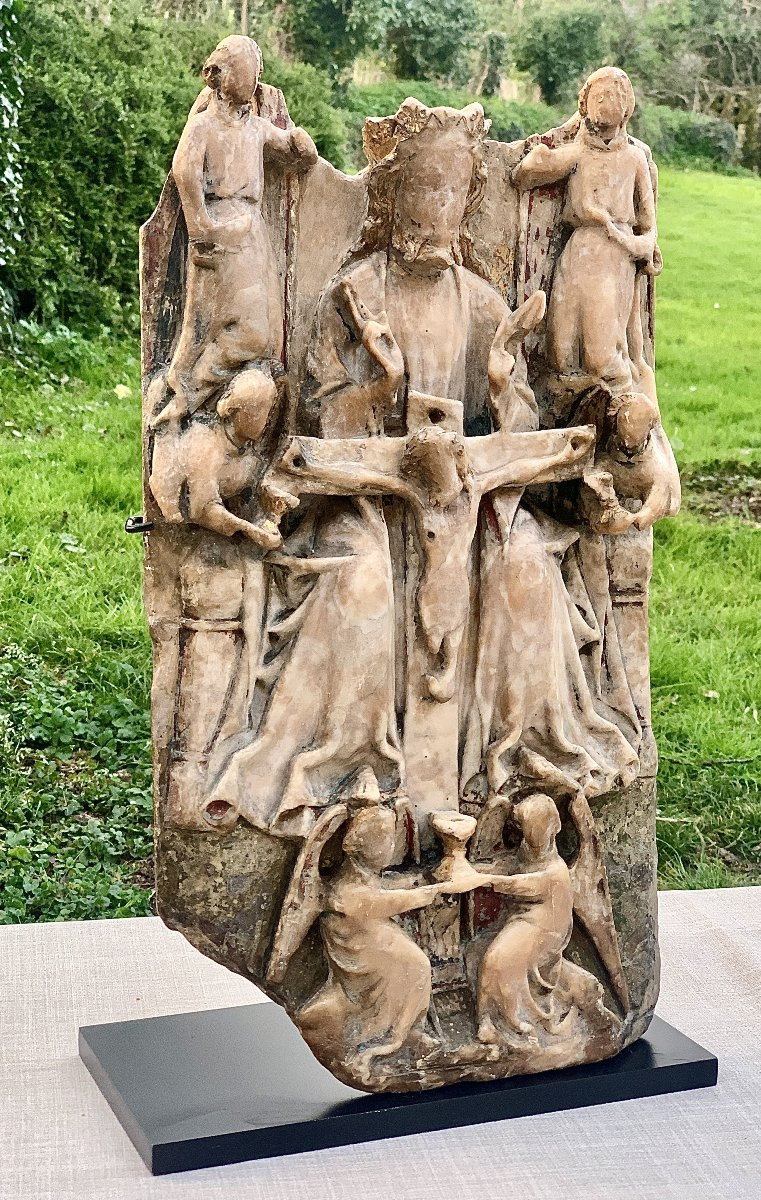
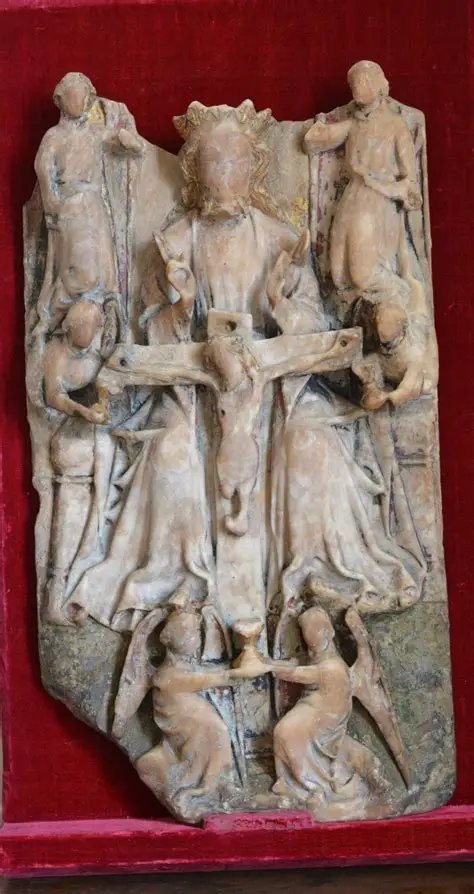
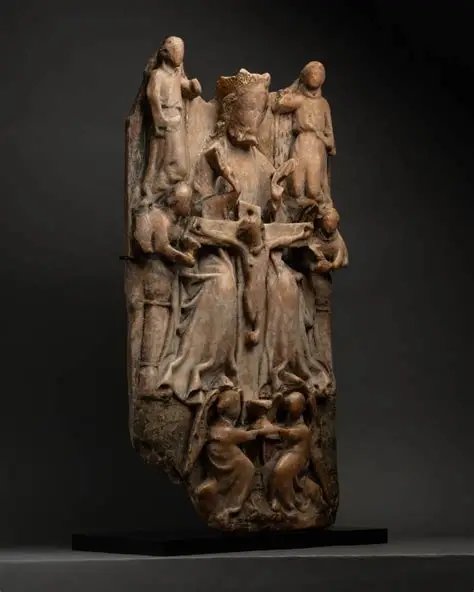
Superb medieval bas-relief albaster panel, carved, painted and gilded, depicting the throne of Grace or the Holy Trinity,
Nottingham workshops, circa 1440-1470
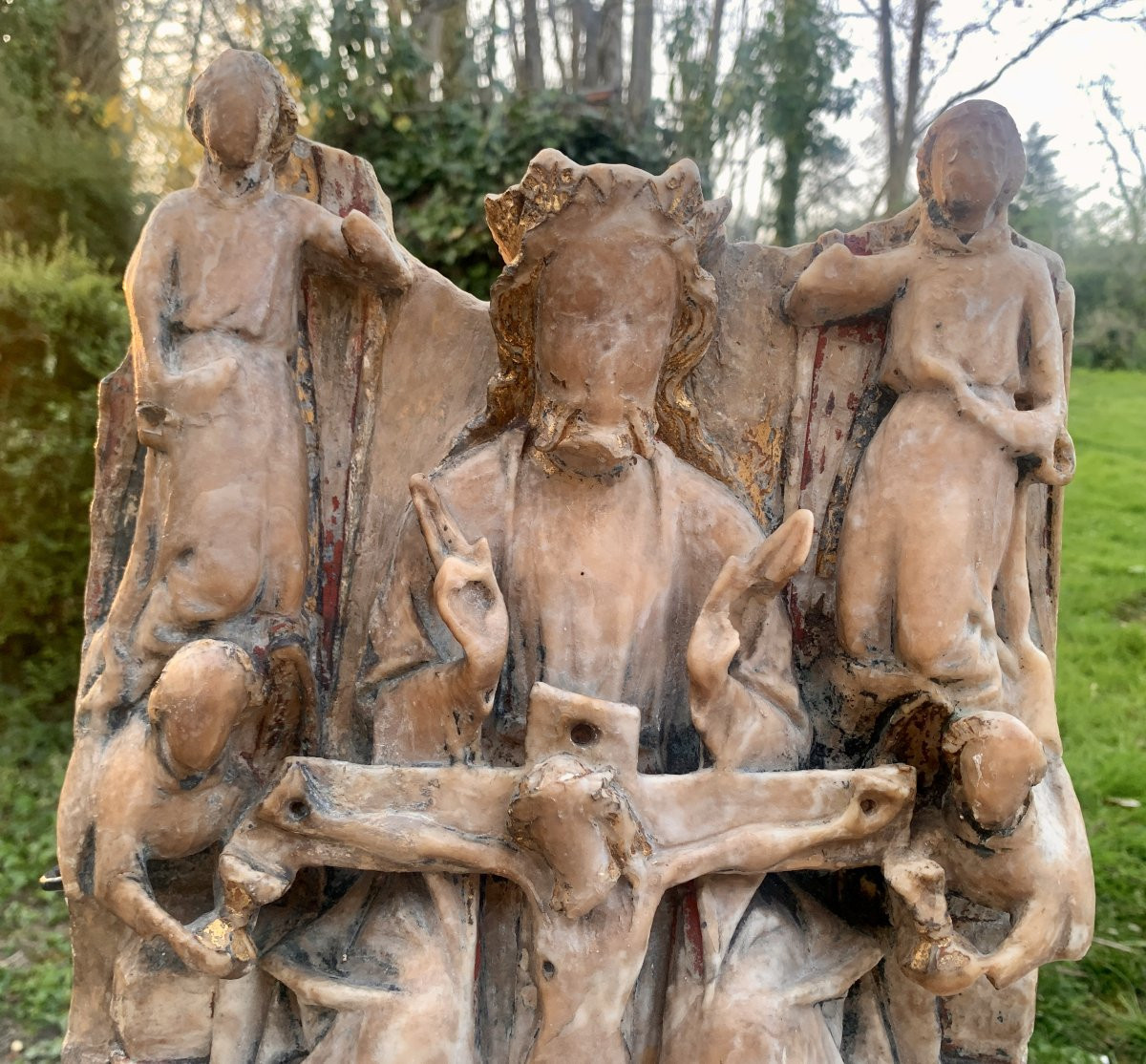
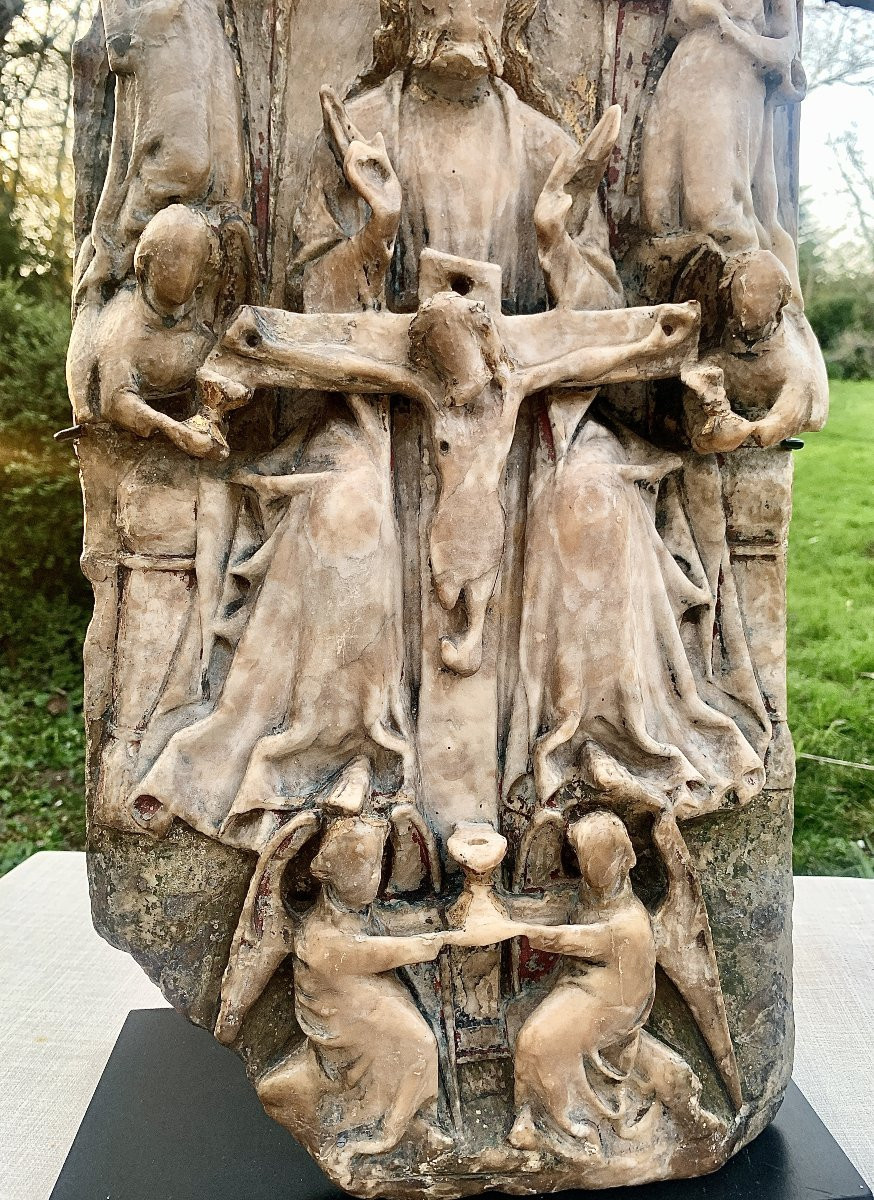
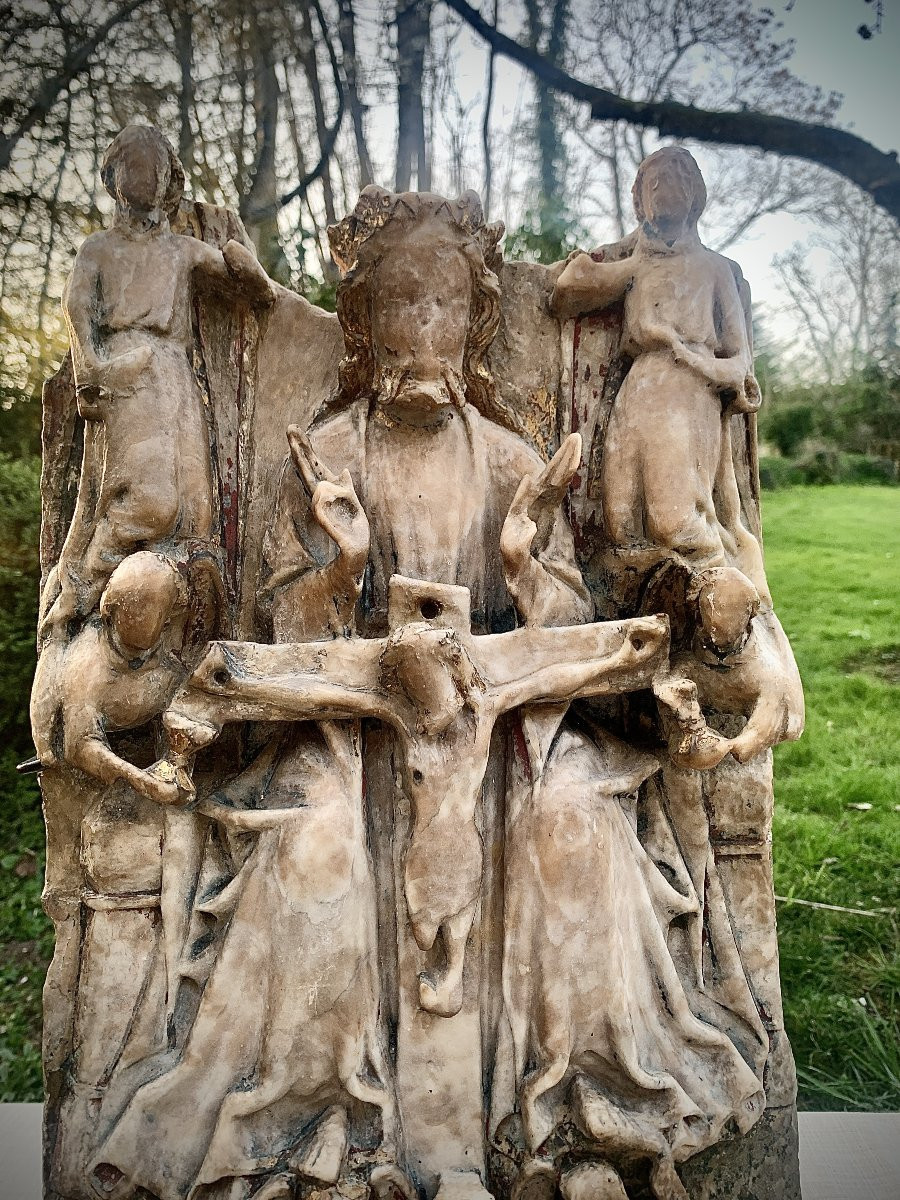
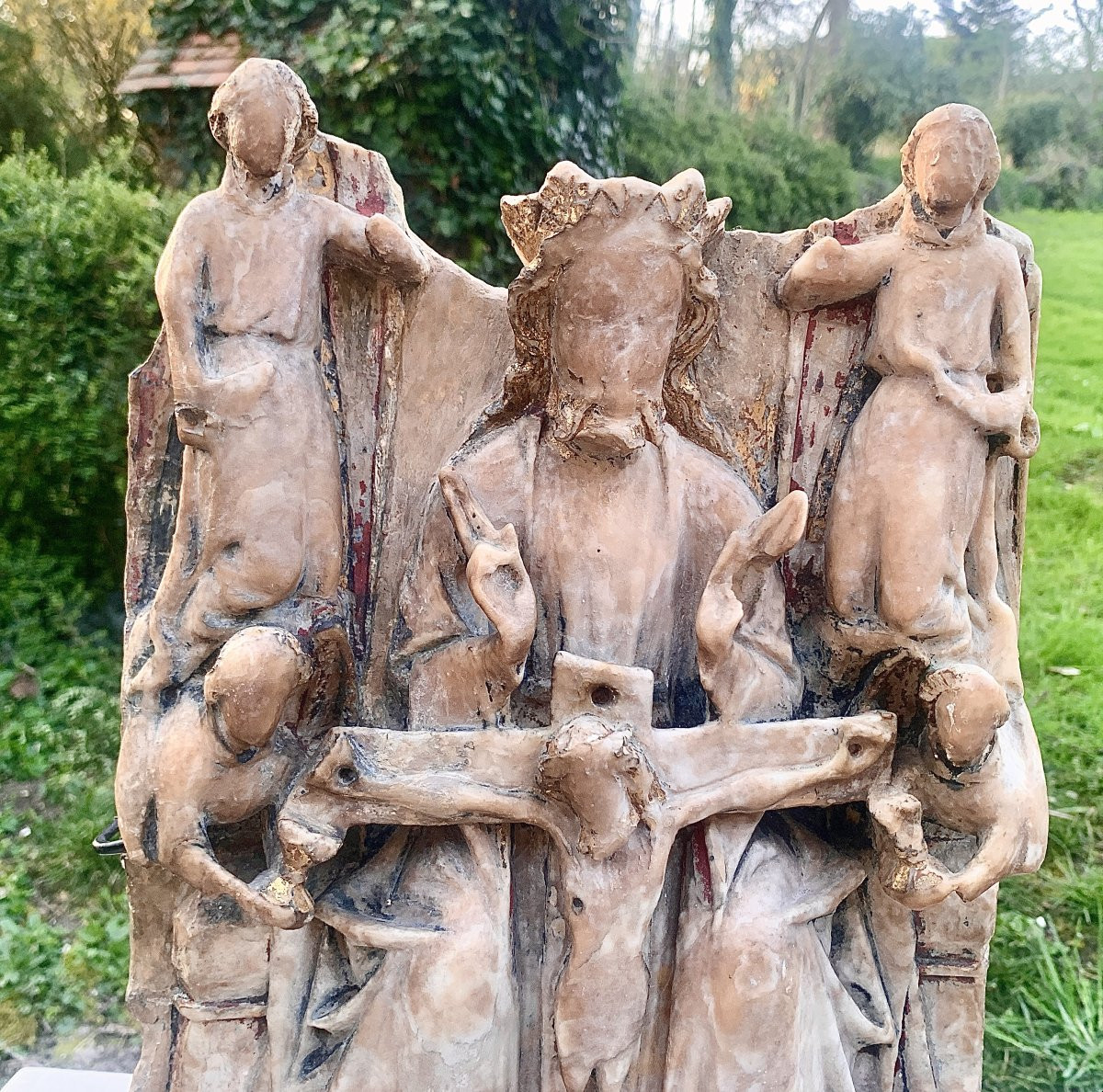
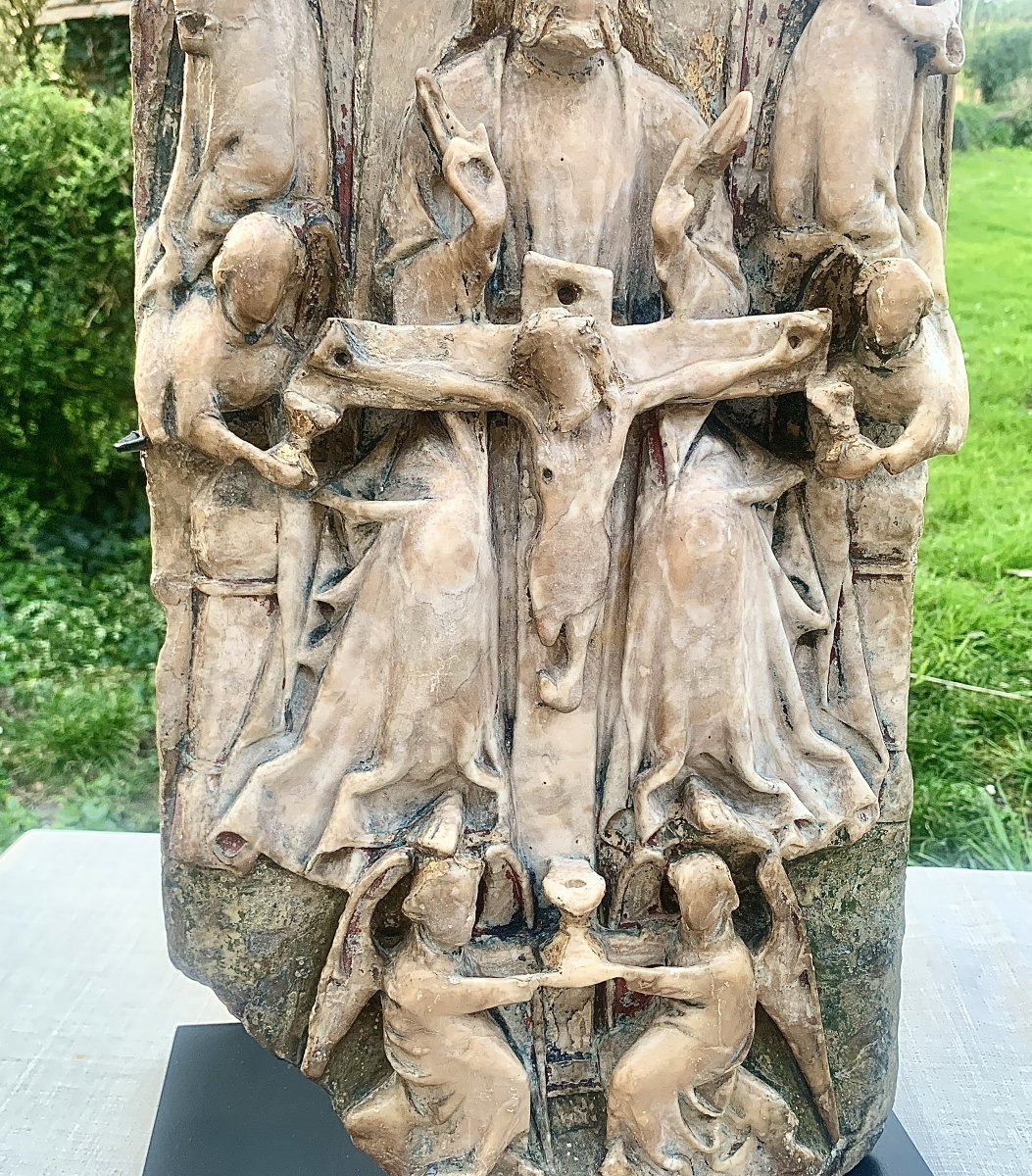
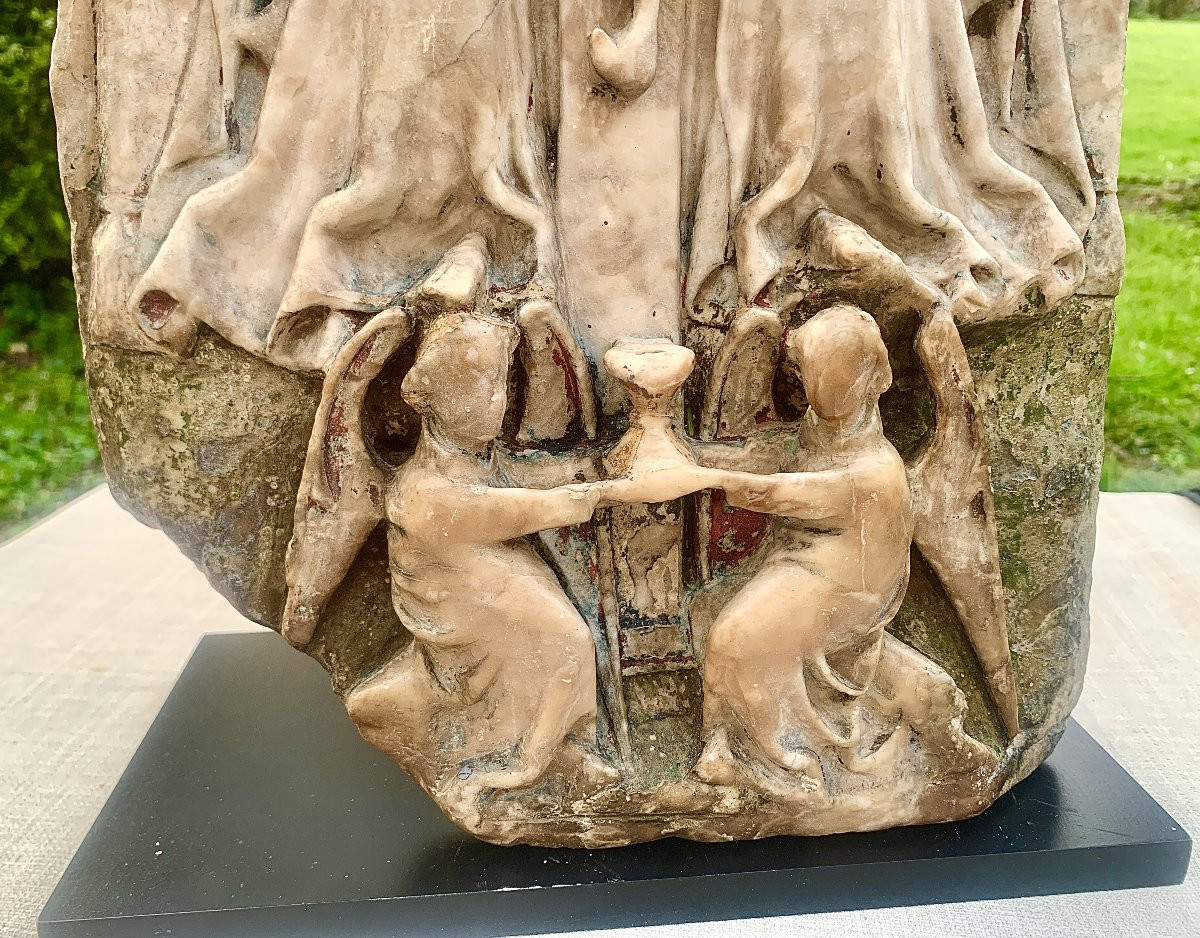
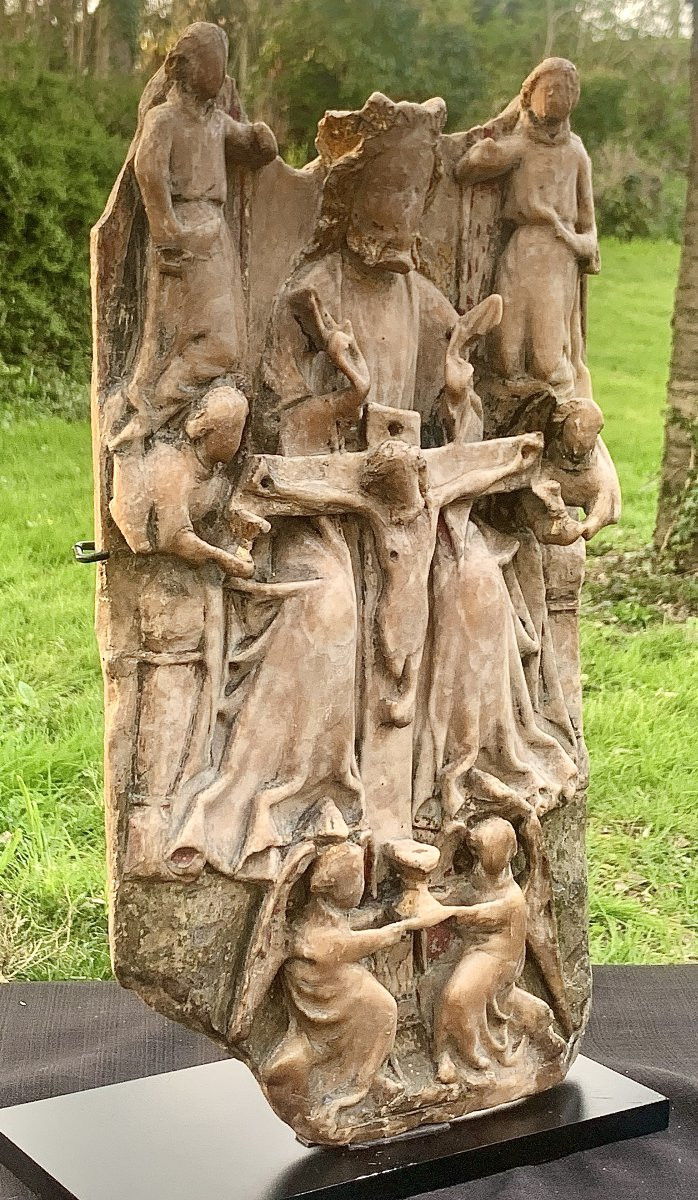
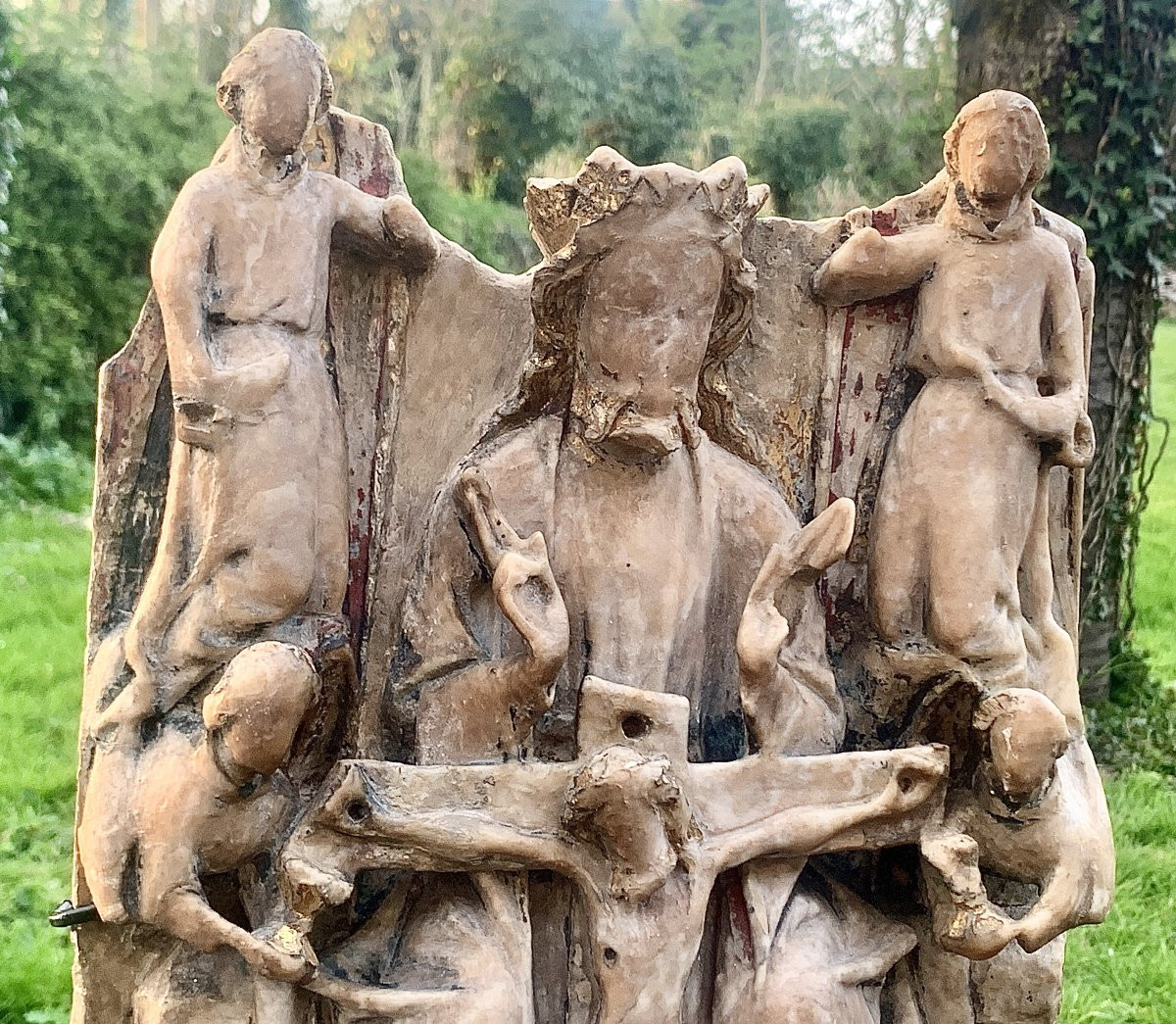
This bas-relief bears the name of the English medieval workshops, active mainly between 14th and 16th centuries. This type of alabaster panel was very actively traded throughout Europe during 15th century, and particularly in France. "In this soft and milky stone—alabaster—the artisans engraved faith as one engraves a prayer in time." Here, the scene represents a curious but classic religious iconography blending the Trinity with the Crucifixion: in the center, Christ suspended, fragile and eternal; behind him, a larger figure—God the Father—who seems to support, bear, almost offer this sacrifice. Around them, angels and celestial figures gather, accompany, perhaps weep silently.
The blue, red, or even black traces, the discreet but insistent highlights of gilding, remind us that these sculptures were not originally bare: they were painted, alive with colors, vibrant like a stained-glass window in the sun. There is in this work a paradoxical gentleness - the soft stone embraces sacred pain - and an almost musical verticality, as if each figure were rising towards a higher note, a purer light. On closer inspection, the stele seems to exude the delicate balance of the 15th century, rather than the somewhat rigid early impulses of the late 14th century.
The Nottingham workshops reached their peak between around 1400 and 1470, and several indications here hint at this maturity:
— the drapery is more supple, rather than falling in sharp folds;
— the figures are elongated with a certain grace, less hieratic than in the late 14th century;
— the composition, dense and vertical, yet highly organized and rather rigidly symmetrical, evokes those portable altarpieces intended for private devotion.
— Finally, this iconography of the Trinity known as the "Throne of Grace" (the Father presenting the Son on the cross) became widespread in 15th century.
The stone itself—alabaster—was worked with an assurance that suggests a well-established workshop, far removed from earlier tentative approaches. Thus, a proper dating suggests the second quarter of the 15th century (around 1420–1460).
In this period, faith became more narrative, almost intimate—as if sculpture no longer sought merely to depict the divine, but to make it close, almost tangible.
The stele measures 55 cm high by 28 cm wide, with a thickness of only 9 cm (just 1.5 cm for the solid base serving as the background for the panel, the rest for the sculpted relief elements). This classic format resonates perfectly with the intimate purpose of these works.
Nottingham alabasters were not made to dominate vast naves, but to inhabit more secluded spaces: private chapels, domestic altars, discreet oratories. This piece is situated here on an almost human scale—neither monument nor miniature—but present nonetheless. This dimension corresponds very well to the portable altarpieces or devotional panels of the 15th century: large enough to structure an altar, yet close enough to invite a face-to-face encounter, almost a confidence.
The scene of the Crucifixion, borne by the Trinity, then becomes a vertical meditation: the gaze rises from the earthly world (the figures at the base) to the sacrifice, and then to the divine mystery. This 15th-century work was probably intended for a private or semi-private devotion, rather than a large church decoration, a life-size sculpture… and perhaps also prayer-height.
This sculpture belongs to a very well-documented family, almost like a constellation of sister images scattered across Europe. Nottingham Alabaster - Wikipedia
Nottingham alabaster is a term used to refer to the English sculptural industry, mainly consisting of small religious sculptures, which flourished from the 14th century until the early 16th century. Alabaster sculptors worked in London, York, and Burton-on-Trent, and many probably worked very close to rural mines, but the greatest concentration was around Nottingham. This led to all medieval English production being called 'Nottingham alabaster'… Throughout their production, Nottingham alabaster images were extremely popular in Europe and exported in large quantities, some reaching very distant places. But by far, the largest export market for these images was in France, where even Today, some churches still preserve their English alabaster altarpieces, unlike in England, where surviving examples are extremely rare. The sculptures were usually vividly painted and/or gilded, sometimes entirely, sometimes partially, but much of the paint has often been lost, and many pieces have had the remainder completely removed by dealers, collectors, or museums in the past. Most alabaster altarpieces and religious sculptures, other than those remaining in church buildings in England, were destroyed during the English Reformation, after which the numerous workshops had to adapt their products to focus on church buildings. Alabaster sculptors were so successful that it became a significant export trade. Works can still be found in churches and museums across Europe, and appear in places as far away as Croatia, Iceland, and Poland.
The Victoria and Albert Museum and Nottingham Castle Museum hold the two main alabaster collections in Nottingham. in the United Kingdom.
1. The exact model: the “Holy Trinity or – Throne of Grace.”
This type, surprising for its iconography mixing the crucifixion and the Trinity, is nevertheless very common at this time. This type is described as standard in the Nottingham workshops, active from the 14th to the 16th centuries, mass-producing religious images exported throughout Europe.
A very similar example can be cited: Trinity, or Throne of Grace in alabaster, Nottingham, 15th century - N.113343.
This 15th-century Nottingham alabaster Trinity is more akin to the art of sculpture than to a bas-relief panel, but it reproduces exactly the same theme: God the Father seated supporting the cross of Christ, with the same vertical and frontal structure, in a tiered composition. The dimensions here are quite similar (45/48 cm).
The Victoria and Albert Museum in London possesses several alabaster Trinity panels often cited as major references in terms of style, dimensions, and composition. comparable, often around 40–50 cm.
In the collections of the British Museum, this example of a panel still depicts the Trinity with God holding Christ on the cross. The composition is still very similar (Father + cross + secondary figures) https://www.britishmuseum.org/collection/object/H_1893-1221-1?utm_source=chatgpt.com
2. Nottingham Castle Museum has a significant collection of local alabasters, including complete altarpieces with the same subject.
https://www.artfund.org/our-purpose/art-funded-by-you/the-passion-of-christ?utm_source=chatgpt.com This example can be dated to around 1450–1475 with its central Trinity panel.
3. Other comparable works can be cited throughout Europe. What is also fascinating is that these sculptures traveled extensively, exported in large quantities from England, and can still be found today: in France (numerous surviving examples in situ), in Spain (Santiago de Compostela), and in Italy (Naples, Museo di Capodimonte).
Direct stylistic comparison with your piece:
Our The sculpture presented here is an enriched version, like an enlarged and embellished standard workshop model: multiple angel figures (6), a more narrative version than some other panels, with the lower scene (probably liturgical or symbolic) a "block" composition rather than a simple panel. This brings it closer to more elaborate pieces, sometimes intended for small, complete altarpieces, for "parish churches, religious foundations, or high-ranking private chapels."
This work is therefore not an isolated piece—it belongs to a virtually "international" 15th-century production, standardized yet profoundly expressive. Each example retains a singularity: different wear patterns, a face erased in a different way, a prayer engraved in the stone by a forgotten hand…
This bas-relief belongs to the type/subject of the Trinity known as the "Throne of Grace," with God the Father seated, Christ on the cross held before him… and sometimes the dove (Holy Spirit), often missing.
This model is highly codified in the Nottingham workshops, with dozens of surviving examples. It is not an isolated piece, but a variation on an image repeated a thousand times—and yet, never identical.
The Victoria and Albert Museum houses numerous comparable Trinities, classified chronologically and stylistically into several types by the author Francis Cheetam (see bibliography). This further demonstrates that this production was indeed mass-produced: at least 80 examples have been identified.
Our work appears to belong to an enriched variant, between:
*The classic, flat panel, intended for an altarpiece, approximately 40–50 cm in size
*The “quasi-statue” version (your case), thicker, almost self-contained, with more developed lateral and lower figures and an expanded narrative (angels + lower scene). We can identify common features in this theme: God the Father is always represented frontally and hieratically, while Christ is very rigid and vertical. The composition is often compact, with traces of polychromy (often residual). Our piece, however, is distinguished by the abundance of secondary subjects, with angels truly framing the composition in three registers (top + sides + base). The lower scene is elaborate (probably liturgical or symbolic); these secondary figures could represent donors or monks in prayer. The vertical axis is very pronounced, as if guiding the gaze from below towards the divine. The whole is thus powerfully organized like a grid, with three horizontal registers and a vertical axis of symmetry. This panel may have formed the central part of a larger, more complete altarpiece, and could even have been its central panel (often depicting the Trinity or the Crucifixion).
*Frequently flanked on either side by several (three or four?) narrative panels, also in alabaster, on the theme of the Passion: the Arrest of Christ, the Flagellation, the Carrying of the Cross, the Resurrection,
*and often, these panels were all united by an architectural frame (pinnacles, arches, Gothic columns).
The whole was painted, gilded, vibrant, and monumental (certainly one to two meters long), like the altarpiece in Nottingham Castle Museum, dated around 1450–1475.
These altarpieces were largely dismantled during the English Reformation, exported separately, or sold off individually. The strong vertical composition of our work, its rich iconography (the other panels are often simpler), and the presence of the lower scene are characteristic of this type of central panel. These altarpieces were dismantled en masse during the English Reformation, sometimes exported or resold separately on the art market. It suggests an experienced workshop, probably from the mid-15th century, and a piece intended for a somewhat more demanding patron.
The refined dating places it around 1430–1470, the period of greatest activity for the Nottingham workshops. Our piece can be precisely classified according to a specific type based on the classification of the English author Francis CHEETAM, who published several authoritative reference works on Nottingham alabaster. Cheetham distinguishes four families of Trinity: *Type A — the purest: God simply holds Christ on the cross, sometimes with the dove (of the Holy Spirit)
*Type B — the mystical (The structure is the same, with small figures in a cloth (napkin) illustrating the theme of salvation, “Abraham’s bosom”)
*Type C — the narrative: The Trinity is central with lateral figures (angels, saints, attendants)
*Type D — the dissociated, with separate figures (this type is rarer) The “Throne of Grace” structure is classic, a common basis for all types.
Our sculpture here most likely corresponds to the evolved Type C (with hybridization), notably through:
*the presence of numerous angels (enriched composition)
*a developed lower scene, a sign of an expanded narrative program
*a significant size (55 cm), exceeding the standard panel (~40–50 cm).
Workshops no longer simply repeat the model; they enrich it. Standard and responding to a more “spiritual” and narrative demand, corresponding to a kind of expressive maturity of the 15th century.
The dating can therefore be further refined or confirmed to around 1440-1470, by cross-referencing type C (later than type A), iconographic complexity, and a larger-than-average size.
This work is not simply “from Nottingham,” but rather from a workshop mastering several variants, and probably produced for export (and in particular, very likely France). It belongs to a rare category where the series becomes almost individualized.
For Nottingham alabasters, there are no “named workshops” as in painting… but recognizable stylistic groups, like different scripts of the same language. Specialists distinguish, simplifying, three main “groups of hand” in the 15th century:
*An Early Group (circa 1380–1420), characterized by stiff figures, angular folds, and a simple composition. -Our sculpture is too fluid for that.
*A Classical Group (circa 1420–1450), characterized by a balance between rigidity and softness, figures that are still somewhat hieratic, and a structured composition.
*A Late/Mature Group (circa 1450–1500): the drapery is supple, almost flowing, the representations multiplying the figures (angels, secondary scenes); the compositions are richer and more narrative.
Cf. National Gallery, https://fr.m.wikipedia.org/wiki/Fichier:Holy_Trinity_sculpture_at_National_Gallery.jpg
It is clearly here that our sculpture falls, with:
* an unusual density of figures;
* iconographic richness (angels + lower scene);
* a slightly larger format;
* and assured workmanship in alabaster. The worn faces here are oval, soft, not very individualized, and display a calm, almost absent expression.
These criteria are typical of controlled mass production. The drapery is rendered in soft, unbroken, non-geometric “U” shapes, characteristic of the years after 1440.
Angels are numerous, sometimes slightly compressed in space, serving a decorative as well as symbolic role. This is the hallmark of enriched versions intended for more demanding clients.
The vertical composition is very prominent, organized into registers (top/center/bottom), which is the signature of late narrative altarpieces.
This specific type was very often exported to France, frequently richer in iconography and adapted to local devotion, often slightly different from standard English models.
In conclusion, this Nottingham alabaster sculpture depicts a frequently reproduced subject, the Holy Trinity—or Throne of Grace.
It is the work of an anonymous workshop, an enriched classical model that can be classified in the late/mature group of type C, according to the classification established by the English scholar and specialist CHETTAM.
Its style allows for fairly precise dating to around 1440–1470, and it was probably intended for export to France. “This is not an isolated work, nor a unique piece born of a solitary gesture. It is a note in a polyphony—that of a workshop where several hands sculpted the same faith, with almost imperceptible nuances.”
The alabaster in the Metropolitan Museum of Art, a work attributed to the Nottingham School, circa 1440–1450, although representing a different subject (the Arrest of Christ), shows the same treatment of faces, the same supple folds, and the same narrative density. The comparison confirms the "mature" stylistic group, circa 1440–1470 https://www.metmuseum.org/fr/art/collection/search/468264?utm_source=chatgpt.com
Superb medieval bas-relief albaster panel, carved, painted and gilded, depicting the throne of Grace or the Holy Trinity,
Nottingham workshops, circa 1440-1470
This bas-relief bears the name of the English medieval workshops, active mainly between 14th and 16th centuries. This type of alabaster panel was very actively traded throughout Europe during 15th century, and particularly in France. "In this soft and milky stone—alabaster—the artisans engraved faith as one engraves a prayer in time." Here, the scene represents a curious but classic religious iconography blending the Trinity with the Crucifixion: in the center, Christ suspended, fragile and eternal; behind him, a larger figure—God the Father—who seems to support, bear, almost offer this sacrifice. Around them, angels and celestial figures gather, accompany, perhaps weep silently.
The blue, red, or even black traces, the discreet but insistent highlights of gilding, remind us that these sculptures were not originally bare: they were painted, alive with colors, vibrant like a stained-glass window in the sun. There is in this work a paradoxical gentleness - the soft stone embraces sacred pain - and an almost musical verticality, as if each figure were rising towards a higher note, a purer light. On closer inspection, the stele seems to exude the delicate balance of the 15th century, rather than the somewhat rigid early impulses of the late 14th century.
The Nottingham workshops reached their peak between around 1400 and 1470, and several indications here hint at this maturity:
— the drapery is more supple, rather than falling in sharp folds;
— the figures are elongated with a certain grace, less hieratic than in the late 14th century;
— the composition, dense and vertical, yet highly organized and rather rigidly symmetrical, evokes those portable altarpieces intended for private devotion.
— Finally, this iconography of the Trinity known as the "Throne of Grace" (the Father presenting the Son on the cross) became widespread in 15th century.
The stone itself—alabaster—was worked with an assurance that suggests a well-established workshop, far removed from earlier tentative approaches. Thus, a proper dating suggests the second quarter of the 15th century (around 1420–1460).
In this period, faith became more narrative, almost intimate—as if sculpture no longer sought merely to depict the divine, but to make it close, almost tangible.
The stele measures 55 cm high by 28 cm wide, with a thickness of only 9 cm (just 1.5 cm for the solid base serving as the background for the panel, the rest for the sculpted relief elements). This classic format resonates perfectly with the intimate purpose of these works.
Nottingham alabasters were not made to dominate vast naves, but to inhabit more secluded spaces: private chapels, domestic altars, discreet oratories. This piece is situated here on an almost human scale—neither monument nor miniature—but present nonetheless. This dimension corresponds very well to the portable altarpieces or devotional panels of the 15th century: large enough to structure an altar, yet close enough to invite a face-to-face encounter, almost a confidence.
The scene of the Crucifixion, borne by the Trinity, then becomes a vertical meditation: the gaze rises from the earthly world (the figures at the base) to the sacrifice, and then to the divine mystery. This 15th-century work was probably intended for a private or semi-private devotion, rather than a large church decoration, a life-size sculpture… and perhaps also prayer-height.
This sculpture belongs to a very well-documented family, almost like a constellation of sister images scattered across Europe. Nottingham Alabaster - Wikipedia
Nottingham alabaster is a term used to refer to the English sculptural industry, mainly consisting of small religious sculptures, which flourished from the 14th century until the early 16th century. Alabaster sculptors worked in London, York, and Burton-on-Trent, and many probably worked very close to rural mines, but the greatest concentration was around Nottingham. This led to all medieval English production being called 'Nottingham alabaster'… Throughout their production, Nottingham alabaster images were extremely popular in Europe and exported in large quantities, some reaching very distant places. But by far, the largest export market for these images was in France, where even Today, some churches still preserve their English alabaster altarpieces, unlike in England, where surviving examples are extremely rare. The sculptures were usually vividly painted and/or gilded, sometimes entirely, sometimes partially, but much of the paint has often been lost, and many pieces have had the remainder completely removed by dealers, collectors, or museums in the past. Most alabaster altarpieces and religious sculptures, other than those remaining in church buildings in England, were destroyed during the English Reformation, after which the numerous workshops had to adapt their products to focus on church buildings. Alabaster sculptors were so successful that it became a significant export trade. Works can still be found in churches and museums across Europe, and appear in places as far away as Croatia, Iceland, and Poland.
The Victoria and Albert Museum and Nottingham Castle Museum hold the two main alabaster collections in Nottingham. in the United Kingdom.
1. The exact model: the “Holy Trinity or – Throne of Grace.”
This type, surprising for its iconography mixing the crucifixion and the Trinity, is nevertheless very common at this time. This type is described as standard in the Nottingham workshops, active from the 14th to the 16th centuries, mass-producing religious images exported throughout Europe.
A very similar example can be cited: Trinity, or Throne of Grace in alabaster, Nottingham, 15th century - N.113343.
This 15th-century Nottingham alabaster Trinity is more akin to the art of sculpture than to a bas-relief panel, but it reproduces exactly the same theme: God the Father seated supporting the cross of Christ, with the same vertical and frontal structure, in a tiered composition. The dimensions here are quite similar (45/48 cm).
The Victoria and Albert Museum in London possesses several alabaster Trinity panels often cited as major references in terms of style, dimensions, and composition. comparable, often around 40–50 cm.
In the collections of the British Museum, this example of a panel still depicts the Trinity with God holding Christ on the cross. The composition is still very similar (Father + cross + secondary figures) https://www.britishmuseum.org/collection/object/H_1893-1221-1?utm_source=chatgpt.com
2. Nottingham Castle Museum has a significant collection of local alabasters, including complete altarpieces with the same subject.
https://www.artfund.org/our-purpose/art-funded-by-you/the-passion-of-christ?utm_source=chatgpt.com This example can be dated to around 1450–1475 with its central Trinity panel.
3. Other comparable works can be cited throughout Europe. What is also fascinating is that these sculptures traveled extensively, exported in large quantities from England, and can still be found today: in France (numerous surviving examples in situ), in Spain (Santiago de Compostela), and in Italy (Naples, Museo di Capodimonte).
Direct stylistic comparison with your piece:
Our The sculpture presented here is an enriched version, like an enlarged and embellished standard workshop model: multiple angel figures (6), a more narrative version than some other panels, with the lower scene (probably liturgical or symbolic) a "block" composition rather than a simple panel. This brings it closer to more elaborate pieces, sometimes intended for small, complete altarpieces, for "parish churches, religious foundations, or high-ranking private chapels."
This work is therefore not an isolated piece—it belongs to a virtually "international" 15th-century production, standardized yet profoundly expressive. Each example retains a singularity: different wear patterns, a face erased in a different way, a prayer engraved in the stone by a forgotten hand…
This bas-relief belongs to the type/subject of the Trinity known as the "Throne of Grace," with God the Father seated, Christ on the cross held before him… and sometimes the dove (Holy Spirit), often missing.
This model is highly codified in the Nottingham workshops, with dozens of surviving examples. It is not an isolated piece, but a variation on an image repeated a thousand times—and yet, never identical.
The Victoria and Albert Museum houses numerous comparable Trinities, classified chronologically and stylistically into several types by the author Francis Cheetam (see bibliography). This further demonstrates that this production was indeed mass-produced: at least 80 examples have been identified.
Our work appears to belong to an enriched variant, between:
*The classic, flat panel, intended for an altarpiece, approximately 40–50 cm in size
*The “quasi-statue” version (your case), thicker, almost self-contained, with more developed lateral and lower figures and an expanded narrative (angels + lower scene). We can identify common features in this theme: God the Father is always represented frontally and hieratically, while Christ is very rigid and vertical. The composition is often compact, with traces of polychromy (often residual). Our piece, however, is distinguished by the abundance of secondary subjects, with angels truly framing the composition in three registers (top + sides + base). The lower scene is elaborate (probably liturgical or symbolic); these secondary figures could represent donors or monks in prayer. The vertical axis is very pronounced, as if guiding the gaze from below towards the divine. The whole is thus powerfully organized like a grid, with three horizontal registers and a vertical axis of symmetry. This panel may have formed the central part of a larger, more complete altarpiece, and could even have been its central panel (often depicting the Trinity or the Crucifixion).
*Frequently flanked on either side by several (three or four?) narrative panels, also in alabaster, on the theme of the Passion: the Arrest of Christ, the Flagellation, the Carrying of the Cross, the Resurrection,
*and often, these panels were all united by an architectural frame (pinnacles, arches, Gothic columns).
The whole was painted, gilded, vibrant, and monumental (certainly one to two meters long), like the altarpiece in Nottingham Castle Museum, dated around 1450–1475.
These altarpieces were largely dismantled during the English Reformation, exported separately, or sold off individually. The strong vertical composition of our work, its rich iconography (the other panels are often simpler), and the presence of the lower scene are characteristic of this type of central panel. These altarpieces were dismantled en masse during the English Reformation, sometimes exported or resold separately on the art market. It suggests an experienced workshop, probably from the mid-15th century, and a piece intended for a somewhat more demanding patron.
The refined dating places it around 1430–1470, the period of greatest activity for the Nottingham workshops. Our piece can be precisely classified according to a specific type based on the classification of the English author Francis CHEETAM, who published several authoritative reference works on Nottingham alabaster. Cheetham distinguishes four families of Trinity: *Type A — the purest: God simply holds Christ on the cross, sometimes with the dove (of the Holy Spirit)
*Type B — the mystical (The structure is the same, with small figures in a cloth (napkin) illustrating the theme of salvation, “Abraham’s bosom”)
*Type C — the narrative: The Trinity is central with lateral figures (angels, saints, attendants)
*Type D — the dissociated, with separate figures (this type is rarer) The “Throne of Grace” structure is classic, a common basis for all types.
Our sculpture here most likely corresponds to the evolved Type C (with hybridization), notably through:
*the presence of numerous angels (enriched composition)
*a developed lower scene, a sign of an expanded narrative program
*a significant size (55 cm), exceeding the standard panel (~40–50 cm).
Workshops no longer simply repeat the model; they enrich it. Standard and responding to a more “spiritual” and narrative demand, corresponding to a kind of expressive maturity of the 15th century.
The dating can therefore be further refined or confirmed to around 1440-1470, by cross-referencing type C (later than type A), iconographic complexity, and a larger-than-average size.
This work is not simply “from Nottingham,” but rather from a workshop mastering several variants, and probably produced for export (and in particular, very likely France). It belongs to a rare category where the series becomes almost individualized.
For Nottingham alabasters, there are no “named workshops” as in painting… but recognizable stylistic groups, like different scripts of the same language. Specialists distinguish, simplifying, three main “groups of hand” in the 15th century:
*An Early Group (circa 1380–1420), characterized by stiff figures, angular folds, and a simple composition. -Our sculpture is too fluid for that.
*A Classical Group (circa 1420–1450), characterized by a balance between rigidity and softness, figures that are still somewhat hieratic, and a structured composition.
*A Late/Mature Group (circa 1450–1500): the drapery is supple, almost flowing, the representations multiplying the figures (angels, secondary scenes); the compositions are richer and more narrative.
Cf. National Gallery, https://fr.m.wikipedia.org/wiki/Fichier:Holy_Trinity_sculpture_at_National_Gallery.jpg
It is clearly here that our sculpture falls, with:
* an unusual density of figures;
* iconographic richness (angels + lower scene);
* a slightly larger format;
* and assured workmanship in alabaster. The worn faces here are oval, soft, not very individualized, and display a calm, almost absent expression.
These criteria are typical of controlled mass production. The drapery is rendered in soft, unbroken, non-geometric “U” shapes, characteristic of the years after 1440.
Angels are numerous, sometimes slightly compressed in space, serving a decorative as well as symbolic role. This is the hallmark of enriched versions intended for more demanding clients.
The vertical composition is very prominent, organized into registers (top/center/bottom), which is the signature of late narrative altarpieces.
This specific type was very often exported to France, frequently richer in iconography and adapted to local devotion, often slightly different from standard English models.
In conclusion, this Nottingham alabaster sculpture depicts a frequently reproduced subject, the Holy Trinity—or Throne of Grace.
It is the work of an anonymous workshop, an enriched classical model that can be classified in the late/mature group of type C, according to the classification established by the English scholar and specialist CHETTAM.
Its style allows for fairly precise dating to around 1440–1470, and it was probably intended for export to France. “This is not an isolated work, nor a unique piece born of a solitary gesture. It is a note in a polyphony—that of a workshop where several hands sculpted the same faith, with almost imperceptible nuances.”
The alabaster in the Metropolitan Museum of Art, a work attributed to the Nottingham School, circa 1440–1450, although representing a different subject (the Arrest of Christ), shows the same treatment of faces, the same supple folds, and the same narrative density. The comparison confirms the "mature" stylistic group, circa 1440–1470 https://www.metmuseum.org/fr/art/collection/search/468264?utm_source=chatgpt.com
10 000 €
Period: Before 16th century
Style: Renaissance, Louis 13th
Condition: Excellent condition
Material: Alabaster
Width: 28 cm
Height: 55 cm
Depth: 9 cm (1,5 env pour la plaque de fond et 7,5cm pour les sculptures en bas-relief)
Reference (ID): 1760618
Availability: In stock
Print