

Haentges Freres- Louis XVI Style Cylinder Desk Based On A Model By Saunier. Early 20th Century
Artist: Haentges Freres
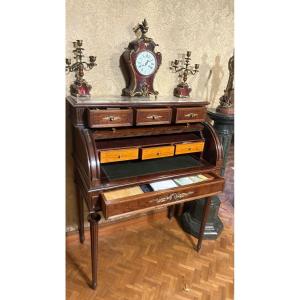
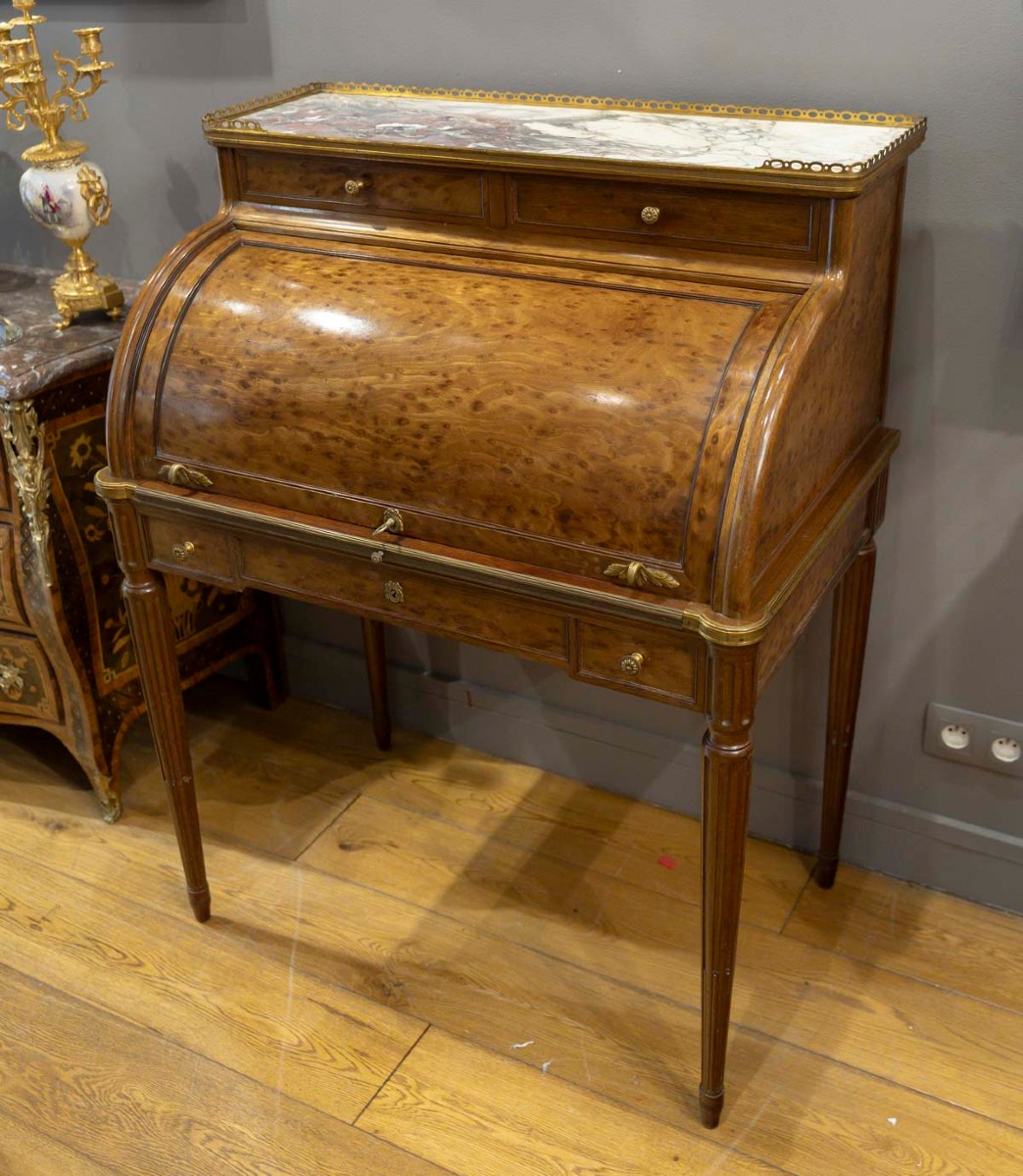
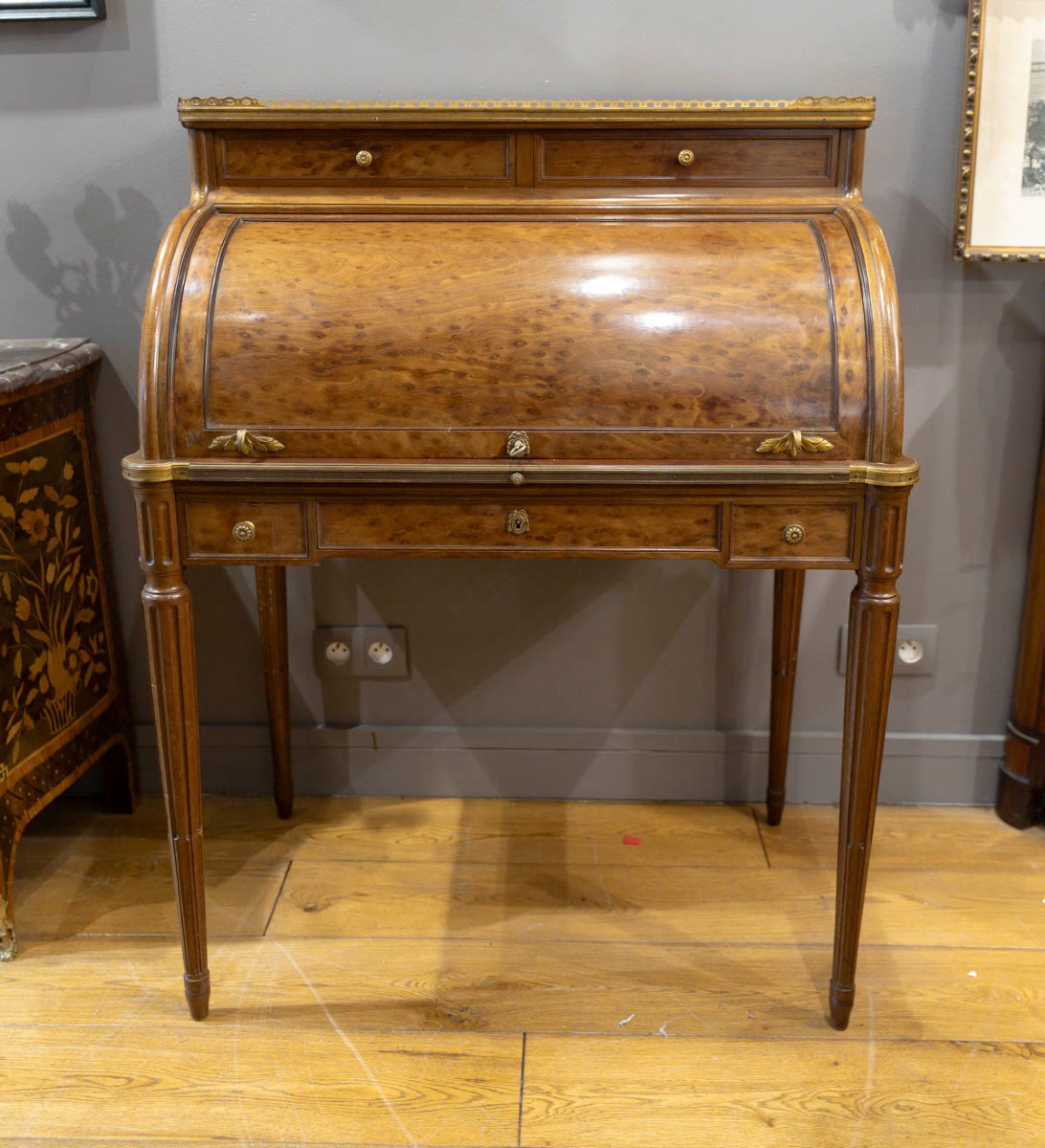
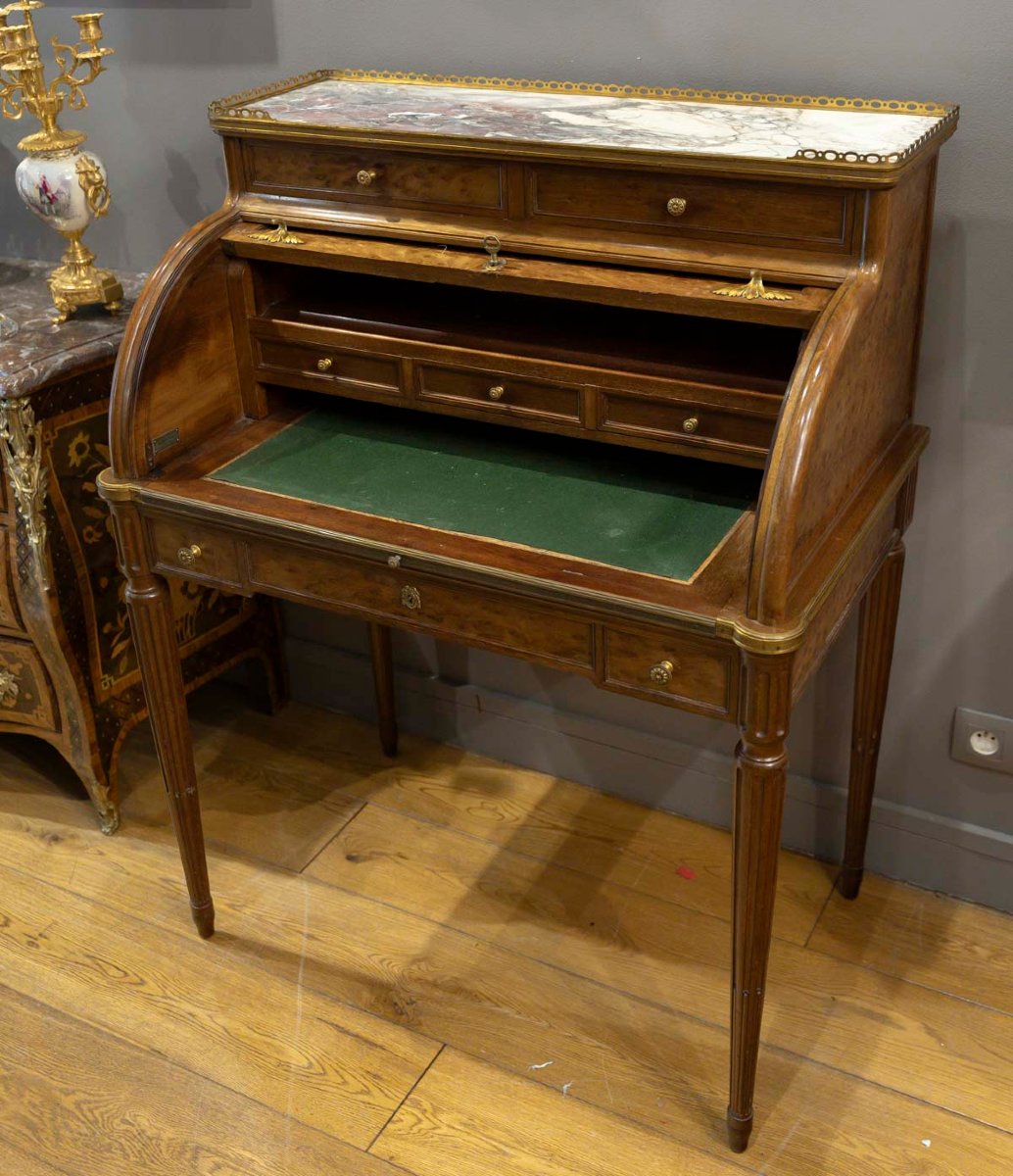
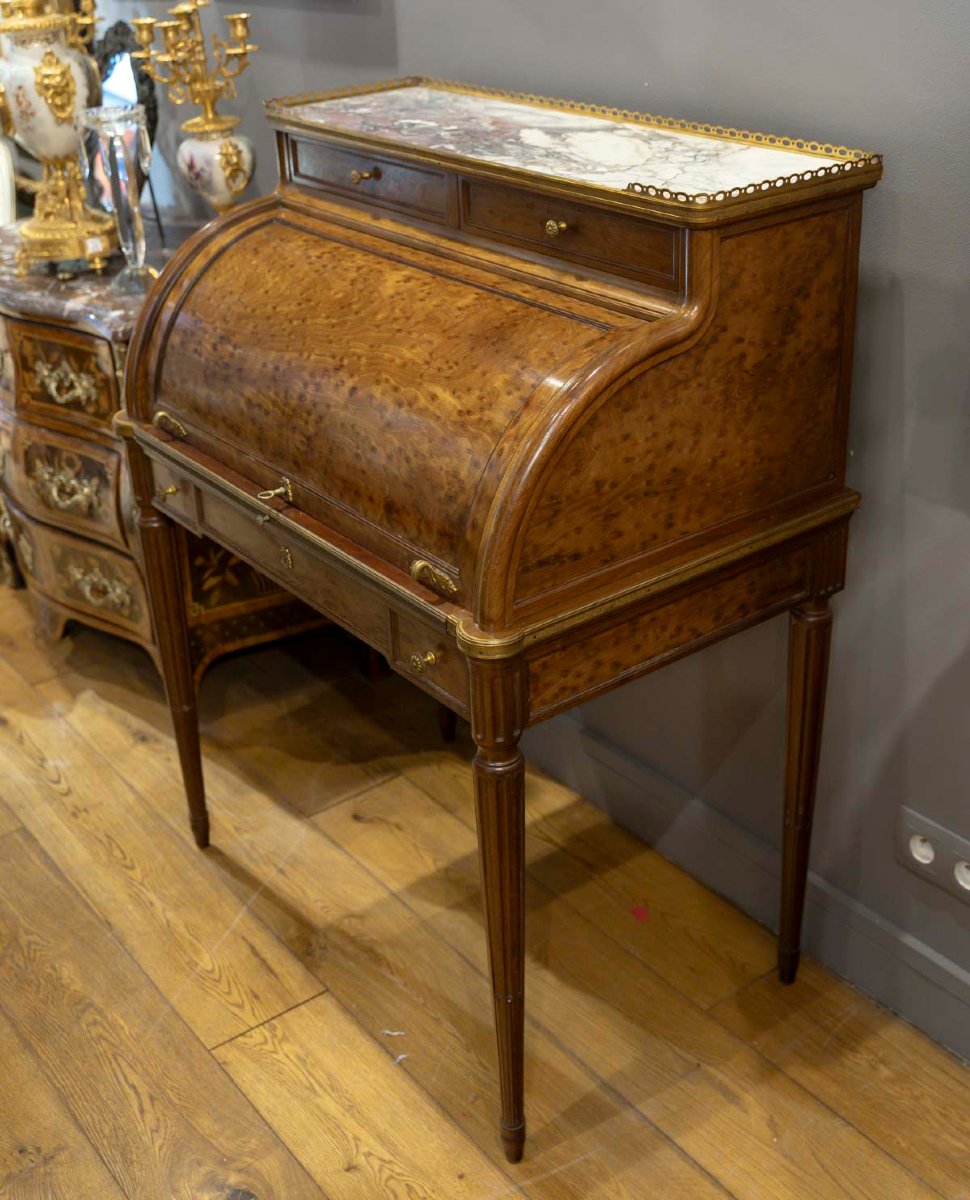
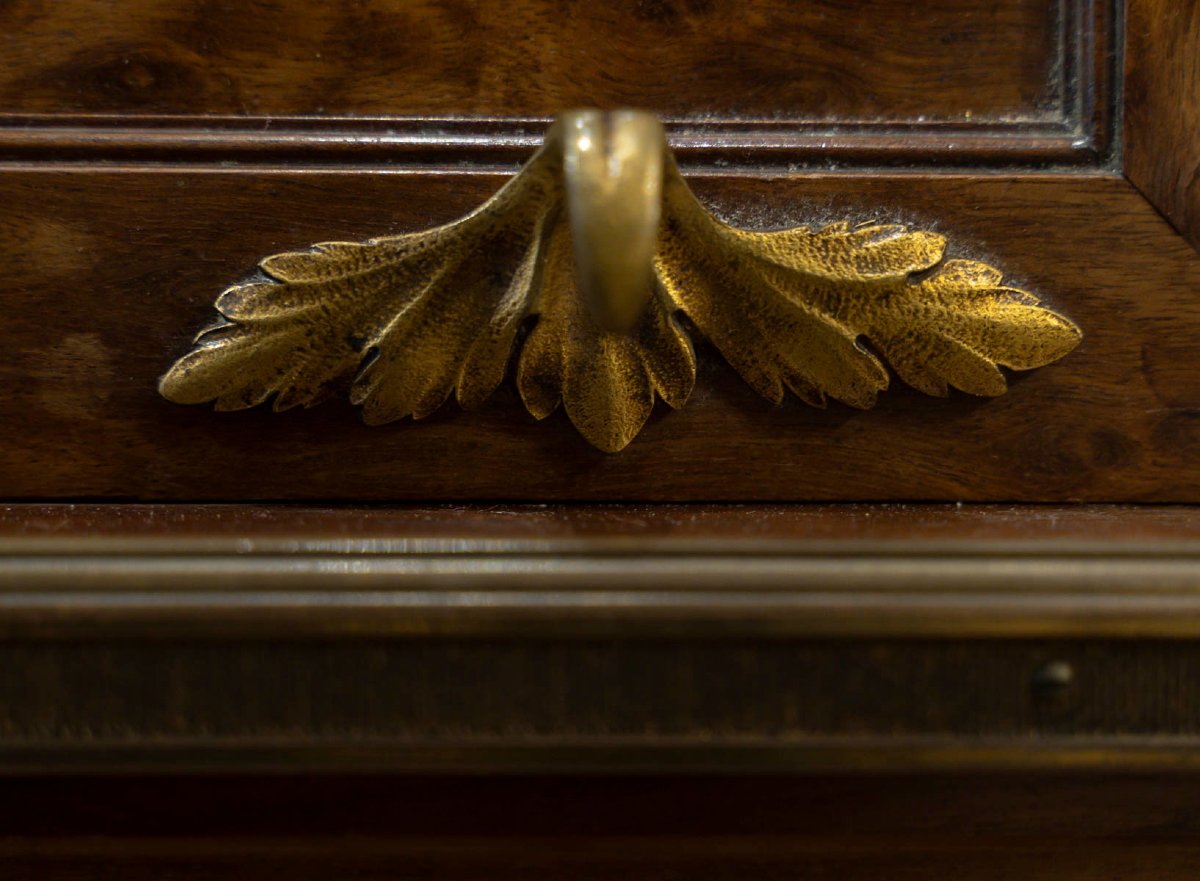
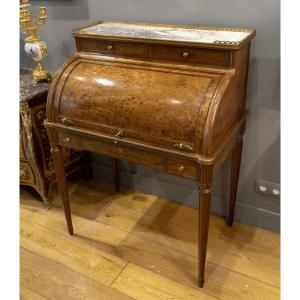
HAENTGES Frères, Paris – With its understated Louis XVI silhouette, this elegant cylinder secretary*, veneered on all sides in shimmering mottled mahogany, features an architecturally structured body with clean lines accentuated by robust mahogany moldings. A delicate, chiseled and gilded bronze ornamentation – ingots, keyhole escutcheons, fixed drawer pulls, and knobs – with classicizing motifs of reeds alternating with scalloped edges, ribboned finials, acanthus leaves, and a rosette, punctuates its rigorous harmony.
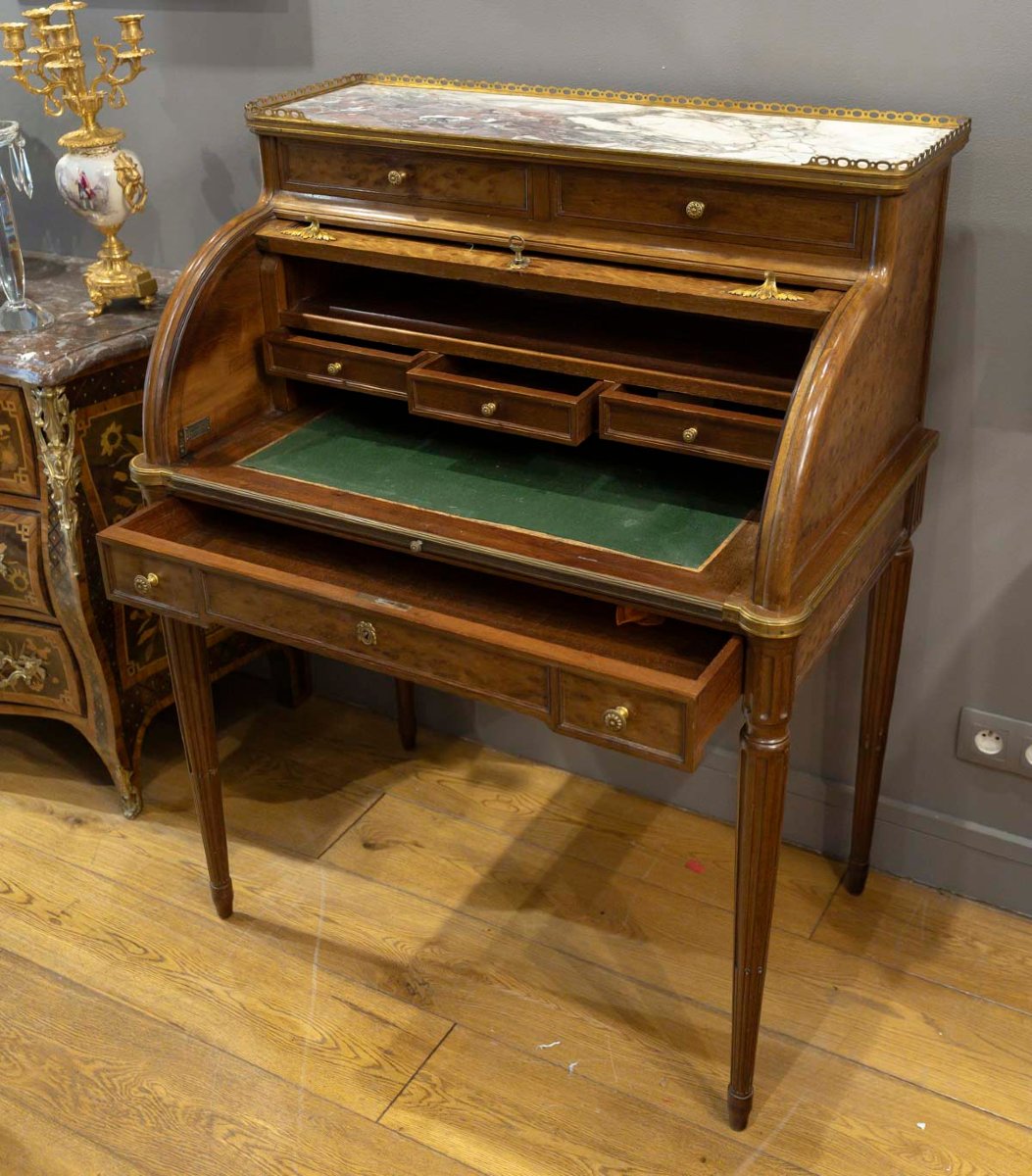
It opens in the frieze with a wide drawer – with a simulated three-part design – and, in the upper section, with two other drawers, each harmoniously framed by a subtle interplay of molded borders. Sliding back, the quarter-cylinder reveals an interior of mahogany wood worked with the grain running straight. This interior features a sliding writing surface centered with green felt trimmed in gold braid, attached to three small drawers and surmounted by a compartment spanning the entire width of the piece. Resting on four tall, fluted, tapered legs extending from pleasingly rounded uprights, this cylinder secretary is topped, on its stepped base, with a Fleur de Pêcher marble slab in a judicious chromatic harmony with the chosen wood; this slab is partially scalloped with an openwork gallery of gilt brass featuring an interlaced frieze motif.
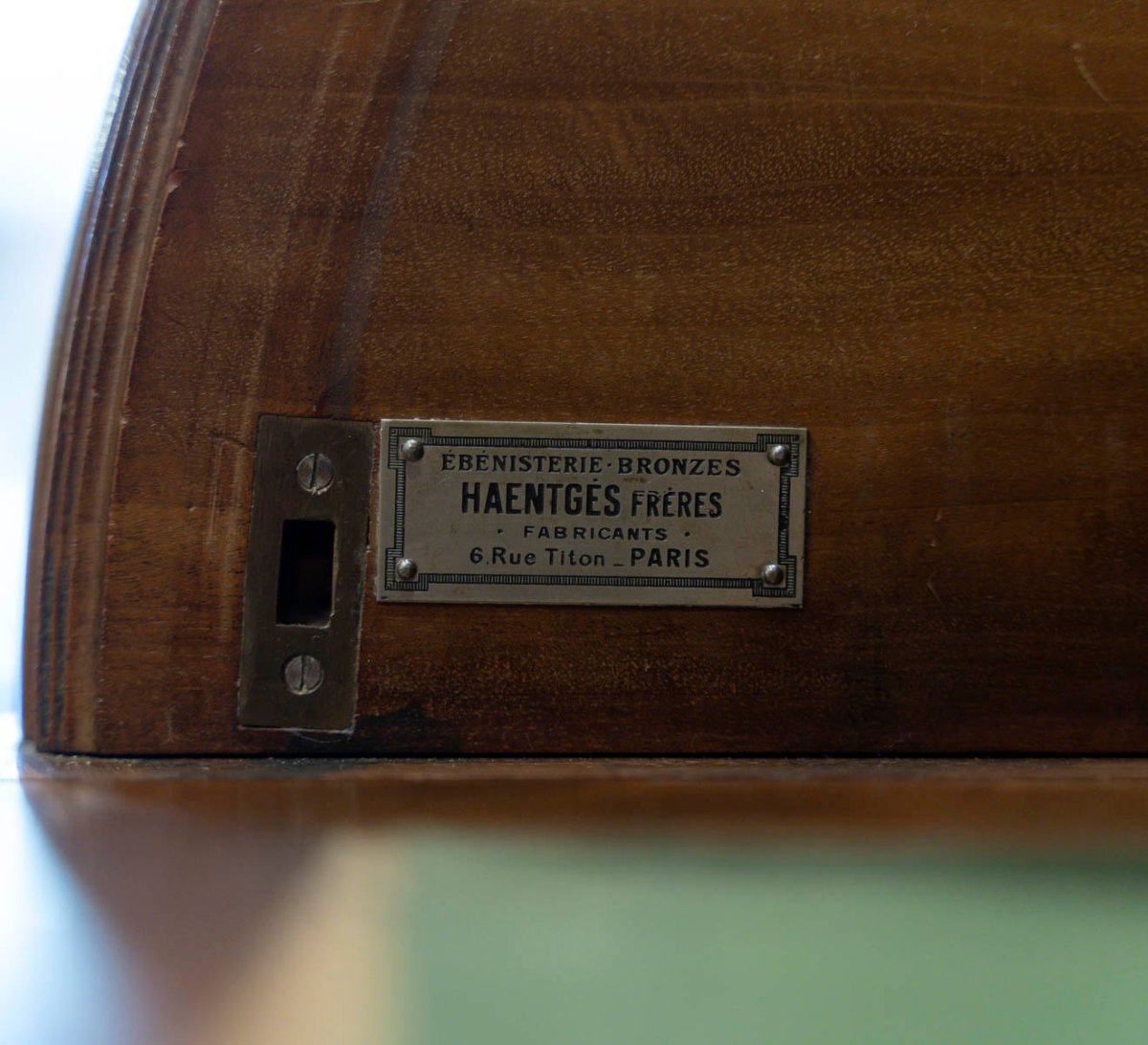
Engraved on a metal plate and stamped with its name, the Haentgès Frères company (1884-1940), which enjoyed a notable reputation in its time, stamped its mark on this piece of furniture. Endowed with both meticulous craftsmanship and high quality, it is undeniably a representative piece of Parisian fine cabinetmaking from the last third of the 19th and beginning of the 20th century, where, in this instance, luxury and restraint coexist. With its resolutely clean lines, its distinctly symmetrical proportions, and its refined mottled mahogany veneer enhanced by discreet gilt bronze mounts, this neoclassical roll-top desk can be compared to certain models designed in the second half of the 18th century, around 1780, by eminent cabinetmakers of the reign of Louis XVI. And those, more specifically, executed by Claude-Charles Saunier (1735-1807), such as his Roll-Top Secretary now in Paris at the Musée Nissim de Camondo (Inv. CM 55), from which it borrows, in smaller proportions adapted to a female clientele, the harmonious combination of materials, the ornamental restraint, and the elegant formal sobriety characteristic of the production of this emblematic cabinetmaker of the French decorative arts of his time and its predominance. Aesthetics.
* Created around 1760 by Jean-François Oeben (1720-1769), cabinetmaker and mechanic to King Louis XV, the cylinder desk—an ingenious and innovative writing piece—the most prestigious example of which is displayed at the Louvre Museum (Paris, Inv. 0A 5444), won the approval of its prestigious clientele thanks to its functionality and convenience. Its success continued unabated throughout the following century. Its design remained widely used, notably by Claude-Charles Saunier, for whom it was, among other things, a specialty.
MAISON HAENTGES Frères, a hallmark of quality
Originally from Luxembourg, this family of cabinetmakers, from father to son, has, over three generations, carved out a notable place within the Parisian fine furniture industry. Established in the capital in the 1860s, initially working (1864-1883) with J.B. Bonvallet, owner of a shop and workshops located at 6-9 rue Titon and 3, Impasse Crozatier, offering "carved furniture of all styles, walnut, blackened wood, reproduction of antique furniture," Théodore Haentgès Sr. (1836-1903) created his own establishment in 1884 at 9 and 11, rue des Immeubles-Industriels (11th arrondissement)—a street developed following the crisis in the furniture industry in the Faubourg Saint-Antoine at the end of the Second Empire—an address he maintained until the 1890s. During the following decade, assisted and then placed under the direction of his sons Théodore (1870-1937) and Jean (1872-1959), The establishment, now renowned for its "carved furniture of all styles and genres" or "reproductions of antiques," of the highest quality and "impeccable craftsmanship," has moved to 19 rue Titon, to which will be added, following its acquisition (1899) from the Widow Bonvallet, the "Furniture Collection" at 3 impasse Crozatier.
From 1901, the "Fabrique de Meubles de Style-Ancienne Maison Bonvallet-Haentgès Frères, Successeur de leur père" (Furniture Factory in the Antique Style, Bonvallet-Haentgès Brothers, Successor to their father), listed and acclaimed under the name HAENTGES FRERES, operated at 6 and 9 rue Titon. It sought to offer its clientele creations of "Cabinetmaking, Artistic Joinery," as well as "Interior Design and Sculpture" work, reflecting the aesthetic tastes of contemporary collectors. Gradually, as Lucien Magne noted in 1913, in order to align itself with "the phalanx of modernist artists such as Sauvage, Michel Dufrêne, Paul Follot, F. Jourdain, Rulhman (...)," the Haentgès Brothers company, alongside its peers "Mercier, Evrard, and Saddier," began producing, in addition to its regular production, beautiful neo-Louis style furniture. XV or Louis XVI styles, marked by the seal of elegance, "boldly in the manufacture of new furniture." This orientation prevailed in the "remarkable works of fine cabinetmaking, executed with meticulous care," combining formal modernity, the use of precious woods with new materials (glass, metal, etc.) presented by Jean Haentgès' two sons, Simon (1904-1987) and Pierre (1913-1940), at the annual Winter Salons organized by the Société des Artistes-Décoratores (Paris, Grand Palais) or at the 1925 International Exhibition of Modern Decorative and Industrial Arts, and the 1931 International Colonial Exhibition (Paris). Awarded a Silver Medal, the Haentgès Frères firm, whose "profession of faith" since its creation has been a constant "concern for quality," aimed at... "To produce only first-rate cabinetmaking" (a statement made by Simon Harntgès in: L'Art Vivant, 1934) maintained its reputation until 1940—the year in which it still appeared in the "Alphabetical Directory of Firms Representing French Quality," published by the magazine Prestige et Elégance.
Bibliographical References: Ledoux-Lebard, Denise, Le mobilier français du XIXe siècle, dictionnaire des ébénistes et des menuisiers, Ed. de L'Amateur, 2000, p. 253; Payne, Christopher, Paris, La Quintessence du meuble au XIXe siècle, Ed. Monelle-Hayot, 2018, p. 386. -Fontana, Clothilde, "Claude-Charles Saunier, a Cabinetmaker of the Age of Enlightenment," in: L'Estampille-L'Objet d'Art, no. 272, 2012, p. 109; -Legrand-Rossi, Sylvie, The Furniture of the Nissim de Camondo Museum, Dijon: Ed. Faton, (see pp. 108-109, Cat. no. 34: Cylinder Desk by Claude-Charles Saunier, Paris, circa 1780 - Inv. no. CAM.55), pp. 108-109.
Printed sources: Almanachs du Commerce, 1860-1933; Magne, Lucien, L'Art appliqué aux métiers. Décor du mobilier: meubles et sièges. Chapter IV Luxury Furniture, 1913, p.; - "HAENTGES", article in: L'Art Vivant: Revue des Amateurs et des Artistes, January 1, 1934
_______________________
Materials: oak frame; mahogany and mottled mahogany veneer; gilt bronze and brass; Fleur de Pêcher marble top; felt
Dimensions: H.: 1.15 cm; W.: 0.90 cm; D.: 0.55 cm
Stamps and marks: Metal plate affixed to the inner wall of the cylinder, engraved with the inscription: "EBENISTERIE-BRONZES/ HAENTGES FRERES/FABRICANTS/ 6, Rue Titon-PARIS" and, beneath the cabinet, an ink stamp: "HAENTGES Frères/ 6 and 9 Rue Titon-PARIS"
High-quality Parisian cabinetmaking in the Neo-Louis XVI style by the Haentgès Frères firm, based on a model by Claude-Charles Saunier (1735-1804). Late 19th-early 20th century, circa 1905.
Very good condition.
It opens in the frieze with a wide drawer – with a simulated three-part design – and, in the upper section, with two other drawers, each harmoniously framed by a subtle interplay of molded borders. Sliding back, the quarter-cylinder reveals an interior of mahogany wood worked with the grain running straight. This interior features a sliding writing surface centered with green felt trimmed in gold braid, attached to three small drawers and surmounted by a compartment spanning the entire width of the piece. Resting on four tall, fluted, tapered legs extending from pleasingly rounded uprights, this cylinder secretary is topped, on its stepped base, with a Fleur de Pêcher marble slab in a judicious chromatic harmony with the chosen wood; this slab is partially scalloped with an openwork gallery of gilt brass featuring an interlaced frieze motif.
Engraved on a metal plate and stamped with its name, the Haentgès Frères company (1884-1940), which enjoyed a notable reputation in its time, stamped its mark on this piece of furniture. Endowed with both meticulous craftsmanship and high quality, it is undeniably a representative piece of Parisian fine cabinetmaking from the last third of the 19th and beginning of the 20th century, where, in this instance, luxury and restraint coexist. With its resolutely clean lines, its distinctly symmetrical proportions, and its refined mottled mahogany veneer enhanced by discreet gilt bronze mounts, this neoclassical roll-top desk can be compared to certain models designed in the second half of the 18th century, around 1780, by eminent cabinetmakers of the reign of Louis XVI. And those, more specifically, executed by Claude-Charles Saunier (1735-1807), such as his Roll-Top Secretary now in Paris at the Musée Nissim de Camondo (Inv. CM 55), from which it borrows, in smaller proportions adapted to a female clientele, the harmonious combination of materials, the ornamental restraint, and the elegant formal sobriety characteristic of the production of this emblematic cabinetmaker of the French decorative arts of his time and its predominance. Aesthetics.
* Created around 1760 by Jean-François Oeben (1720-1769), cabinetmaker and mechanic to King Louis XV, the cylinder desk—an ingenious and innovative writing piece—the most prestigious example of which is displayed at the Louvre Museum (Paris, Inv. 0A 5444), won the approval of its prestigious clientele thanks to its functionality and convenience. Its success continued unabated throughout the following century. Its design remained widely used, notably by Claude-Charles Saunier, for whom it was, among other things, a specialty.
MAISON HAENTGES Frères, a hallmark of quality
Originally from Luxembourg, this family of cabinetmakers, from father to son, has, over three generations, carved out a notable place within the Parisian fine furniture industry. Established in the capital in the 1860s, initially working (1864-1883) with J.B. Bonvallet, owner of a shop and workshops located at 6-9 rue Titon and 3, Impasse Crozatier, offering "carved furniture of all styles, walnut, blackened wood, reproduction of antique furniture," Théodore Haentgès Sr. (1836-1903) created his own establishment in 1884 at 9 and 11, rue des Immeubles-Industriels (11th arrondissement)—a street developed following the crisis in the furniture industry in the Faubourg Saint-Antoine at the end of the Second Empire—an address he maintained until the 1890s. During the following decade, assisted and then placed under the direction of his sons Théodore (1870-1937) and Jean (1872-1959), The establishment, now renowned for its "carved furniture of all styles and genres" or "reproductions of antiques," of the highest quality and "impeccable craftsmanship," has moved to 19 rue Titon, to which will be added, following its acquisition (1899) from the Widow Bonvallet, the "Furniture Collection" at 3 impasse Crozatier.
From 1901, the "Fabrique de Meubles de Style-Ancienne Maison Bonvallet-Haentgès Frères, Successeur de leur père" (Furniture Factory in the Antique Style, Bonvallet-Haentgès Brothers, Successor to their father), listed and acclaimed under the name HAENTGES FRERES, operated at 6 and 9 rue Titon. It sought to offer its clientele creations of "Cabinetmaking, Artistic Joinery," as well as "Interior Design and Sculpture" work, reflecting the aesthetic tastes of contemporary collectors. Gradually, as Lucien Magne noted in 1913, in order to align itself with "the phalanx of modernist artists such as Sauvage, Michel Dufrêne, Paul Follot, F. Jourdain, Rulhman (...)," the Haentgès Brothers company, alongside its peers "Mercier, Evrard, and Saddier," began producing, in addition to its regular production, beautiful neo-Louis style furniture. XV or Louis XVI styles, marked by the seal of elegance, "boldly in the manufacture of new furniture." This orientation prevailed in the "remarkable works of fine cabinetmaking, executed with meticulous care," combining formal modernity, the use of precious woods with new materials (glass, metal, etc.) presented by Jean Haentgès' two sons, Simon (1904-1987) and Pierre (1913-1940), at the annual Winter Salons organized by the Société des Artistes-Décoratores (Paris, Grand Palais) or at the 1925 International Exhibition of Modern Decorative and Industrial Arts, and the 1931 International Colonial Exhibition (Paris). Awarded a Silver Medal, the Haentgès Frères firm, whose "profession of faith" since its creation has been a constant "concern for quality," aimed at... "To produce only first-rate cabinetmaking" (a statement made by Simon Harntgès in: L'Art Vivant, 1934) maintained its reputation until 1940—the year in which it still appeared in the "Alphabetical Directory of Firms Representing French Quality," published by the magazine Prestige et Elégance.
Bibliographical References: Ledoux-Lebard, Denise, Le mobilier français du XIXe siècle, dictionnaire des ébénistes et des menuisiers, Ed. de L'Amateur, 2000, p. 253; Payne, Christopher, Paris, La Quintessence du meuble au XIXe siècle, Ed. Monelle-Hayot, 2018, p. 386. -Fontana, Clothilde, "Claude-Charles Saunier, a Cabinetmaker of the Age of Enlightenment," in: L'Estampille-L'Objet d'Art, no. 272, 2012, p. 109; -Legrand-Rossi, Sylvie, The Furniture of the Nissim de Camondo Museum, Dijon: Ed. Faton, (see pp. 108-109, Cat. no. 34: Cylinder Desk by Claude-Charles Saunier, Paris, circa 1780 - Inv. no. CAM.55), pp. 108-109.
Printed sources: Almanachs du Commerce, 1860-1933; Magne, Lucien, L'Art appliqué aux métiers. Décor du mobilier: meubles et sièges. Chapter IV Luxury Furniture, 1913, p.; - "HAENTGES", article in: L'Art Vivant: Revue des Amateurs et des Artistes, January 1, 1934
_______________________
Materials: oak frame; mahogany and mottled mahogany veneer; gilt bronze and brass; Fleur de Pêcher marble top; felt
Dimensions: H.: 1.15 cm; W.: 0.90 cm; D.: 0.55 cm
Stamps and marks: Metal plate affixed to the inner wall of the cylinder, engraved with the inscription: "EBENISTERIE-BRONZES/ HAENTGES FRERES/FABRICANTS/ 6, Rue Titon-PARIS" and, beneath the cabinet, an ink stamp: "HAENTGES Frères/ 6 and 9 Rue Titon-PARIS"
High-quality Parisian cabinetmaking in the Neo-Louis XVI style by the Haentgès Frères firm, based on a model by Claude-Charles Saunier (1735-1804). Late 19th-early 20th century, circa 1905.
Very good condition.
3 200 €
Period: 19th century
Style: Louis 16th, Directory
Condition: Excellent condition
Material: Mahogany
Width: 90 cm
Height: 115 cm
Depth: 55 cm
Reference (ID): 1760185
Availability: In stock
Print