
The Twelve Great Feasts – 18th-century Russian Icon
Russian iconographer
Moscow School, second half of the 18th century
The Twelve Feasts of the Byzantine Liturgical Year
Egg tempera on wood, 54×45 cm
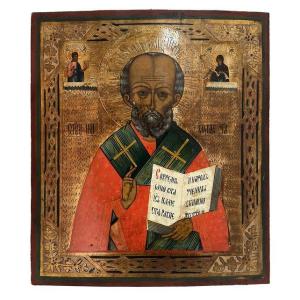
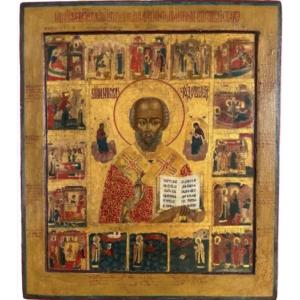
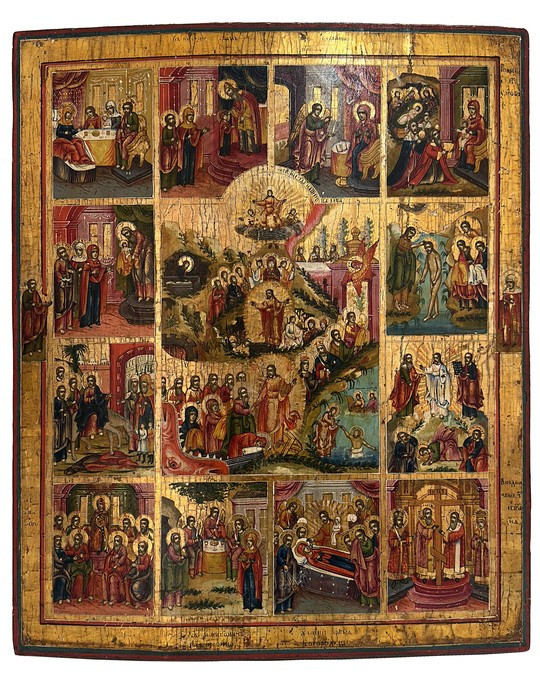
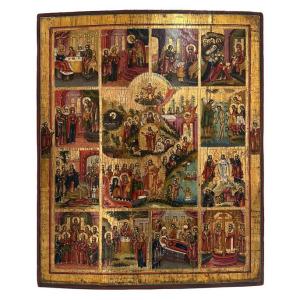
The icon belongs to the Dodekaorton type, a cycle of the twelve major feasts of the Orthodox liturgical calendar, arranged here in a paneled composition surrounding a central oval-shaped scene.
At the center stands a large Resurrection–Descent into Hell (Anastasis), in which Christ, radiating golden light, snatches Adam and Eve from the realm of the dead, surrounded by angels and patriarchs: the scene serves as the theological axis of the entire panel, since the Resurrection is the foundation to which all the other feasts refer.
The twelve peripheral panels depict, reading in horizontal rows from top to bottom: the Nativity of the Virgin, the Presentation of the Virgin in the Temple, the Annunciation, the Nativity of Christ; the Presentation of Jesus in the Temple (Hypapante), the Baptism (Theophany), the Transfiguration, the Entry into Jerusalem; the Dormition of the Virgin (Koimesis), the Pentecost, the Ascension, and the Exaltation of the Cross.
The inscriptions in Church Slavonic accompanying each panel confirm its affiliation with the Muscovite tradition of the second half of the 18th century, characterized by a vibrant palette—lacquer reds, brilliant golds, warm flesh tones—and by a meticulous, narrative style derived from the workshops of the Stroganovs.
The gold leaf background, the red and green borders, and the quality of the painting suggest a work of high craftsmanship, intended for private devotion or the domestic chapel of a wealthy family.
Period: 18th century
Style: Other Style
Condition: Good condition
Material: Oil painting on wood
Width: 45 cm.
Height: 54 cm.
Reference (ID): 1756607
Availability: In stock