
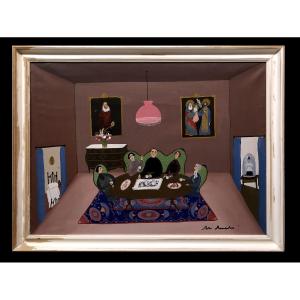


école Naïf Espagnole (1970s) - Hot Chocolate For Monsieur Le Curé
Oil on canvas. Original canvas. Title and date on the back. Signature illegible.
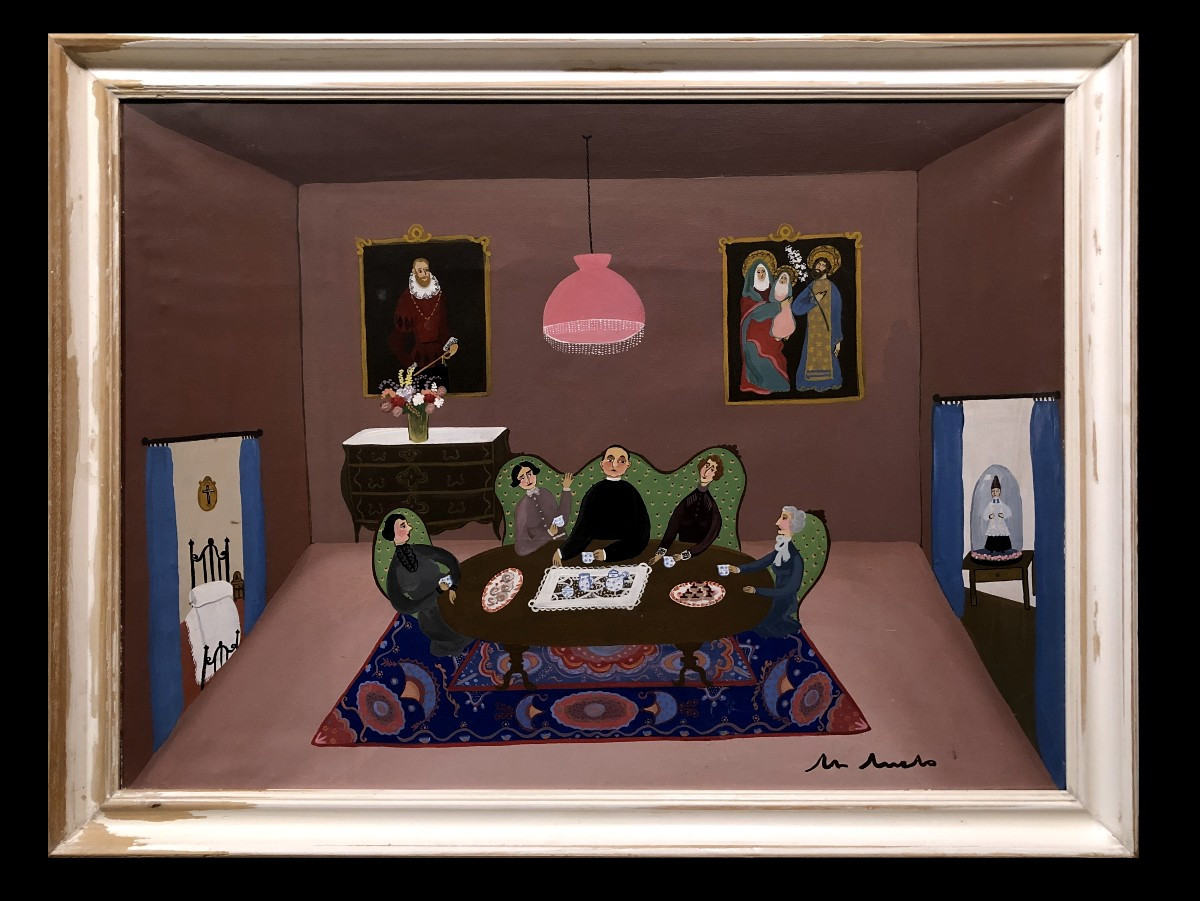
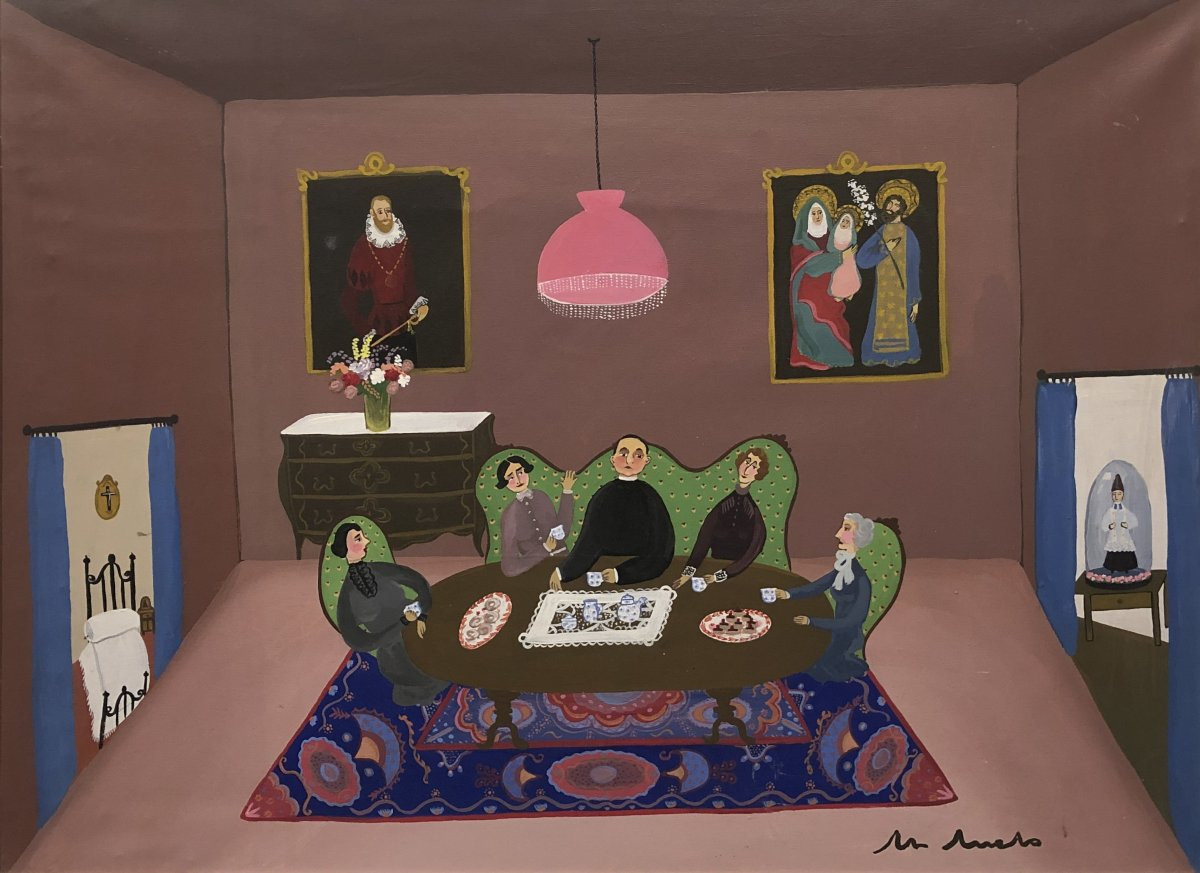
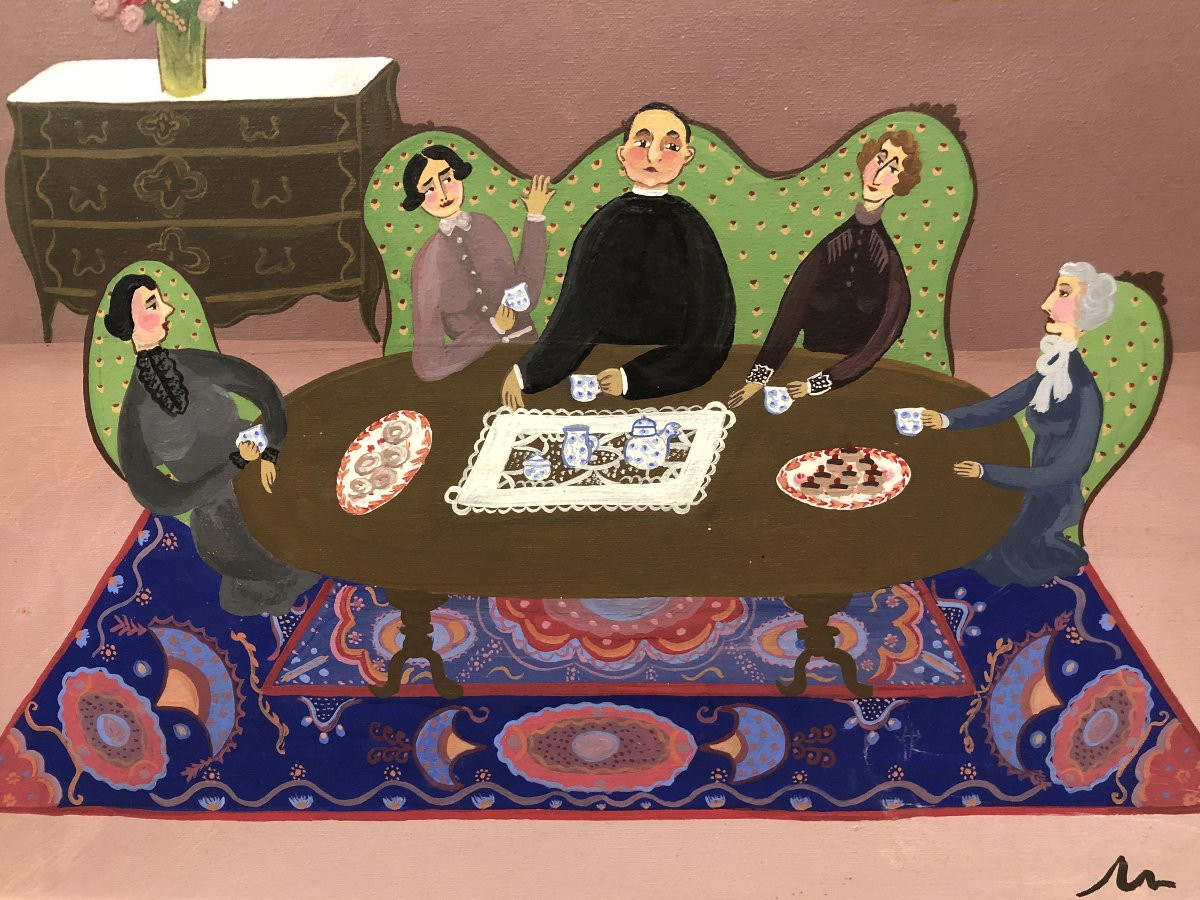
In this almost punishingly naive canvas, the Spain of "it's always been like this" retreats behind a bastion of antique Sargadelos porcelain, whose scenes of the English countryside gaze, stunned, at the onslaught of croutons. Under a flat light that ignores shadows - for in this house, ambiguity is a sin - the parish priest acts as the spiritual pivot, a stain of pitch-black who pretends to listen to the village gossip while his mind, no doubt, calculates the budget for the stage of the next procession. Around him, the four pious women, wrapped in a mourning that isn't necessarily black but seems like a second skin, are the figures of a theological chess game whose only movement is resistance: their heads, crowned with buns of impossible geometry, guard centuries of dogma and conventual pastry recipes.
This vantage point, nobly alien to the laws of physics, allows us to peer into neighboring rooms, where iron beds stand like instruments of pious torture, tamed only by the rigor of crocheted bedspreads. These bedspreads are not a source of heat, but a manifesto: thousands of knots woven with the patience of someone waiting for the Last Judgment, all the while keeping a close eye on the saucepan to prevent it from sticking. In this starched white, there's an aggressive purity, a sharpness that exudes a scent of lavender and weekly confession, a web of threads that seems to want to capture the time before the Seventies - with their noisy, cathode-ray TV-fueled modernity - crossed the threshold.
And dominating it all, from a chapel that looks more like a devotional bunker than a place of worship, a plaster Infant Jesus observes the tea party with a disquieting maturity. Dressed in velvet that has survived three confiscations of ecclesiastical property and two wars, the Infant seems the real director of this 19th-century diorama. His glassy gaze doesn't rest on the guests, but on the emptiness of the future, aware that as long as there's one last sip of chocolate and one last drop of oil in the lamp, this Spain of sacristy and camphor will refuse to hand back the keys to the kingdom, reminding us that, sometimes, eternity is nothing more than a rainy afternoon, knitting and a good cup of badly poured tea.
- Image size unframed: 60 x 45 cm / 68 x 53 cm with exclusive custom frame.
In this almost punishingly naive canvas, the Spain of "it's always been like this" retreats behind a bastion of antique Sargadelos porcelain, whose scenes of the English countryside gaze, stunned, at the onslaught of croutons. Under a flat light that ignores shadows - for in this house, ambiguity is a sin - the parish priest acts as the spiritual pivot, a stain of pitch-black who pretends to listen to the village gossip while his mind, no doubt, calculates the budget for the stage of the next procession. Around him, the four pious women, wrapped in a mourning that isn't necessarily black but seems like a second skin, are the figures of a theological chess game whose only movement is resistance: their heads, crowned with buns of impossible geometry, guard centuries of dogma and conventual pastry recipes.
This vantage point, nobly alien to the laws of physics, allows us to peer into neighboring rooms, where iron beds stand like instruments of pious torture, tamed only by the rigor of crocheted bedspreads. These bedspreads are not a source of heat, but a manifesto: thousands of knots woven with the patience of someone waiting for the Last Judgment, all the while keeping a close eye on the saucepan to prevent it from sticking. In this starched white, there's an aggressive purity, a sharpness that exudes a scent of lavender and weekly confession, a web of threads that seems to want to capture the time before the Seventies - with their noisy, cathode-ray TV-fueled modernity - crossed the threshold.
And dominating it all, from a chapel that looks more like a devotional bunker than a place of worship, a plaster Infant Jesus observes the tea party with a disquieting maturity. Dressed in velvet that has survived three confiscations of ecclesiastical property and two wars, the Infant seems the real director of this 19th-century diorama. His glassy gaze doesn't rest on the guests, but on the emptiness of the future, aware that as long as there's one last sip of chocolate and one last drop of oil in the lamp, this Spain of sacristy and camphor will refuse to hand back the keys to the kingdom, reminding us that, sometimes, eternity is nothing more than a rainy afternoon, knitting and a good cup of badly poured tea.
- Image size unframed: 60 x 45 cm / 68 x 53 cm with exclusive custom frame.
320 €
Period: 20th century
Style: Tribal Art
Condition: Excellent condition
Material: Oil painting
Reference (ID): 1750069
Availability: In stock
Print