THIS OBJECT WAS SOLD
Francesco Fidanza (1747-1819) Attributed. Animated Seascape Circa 1780.
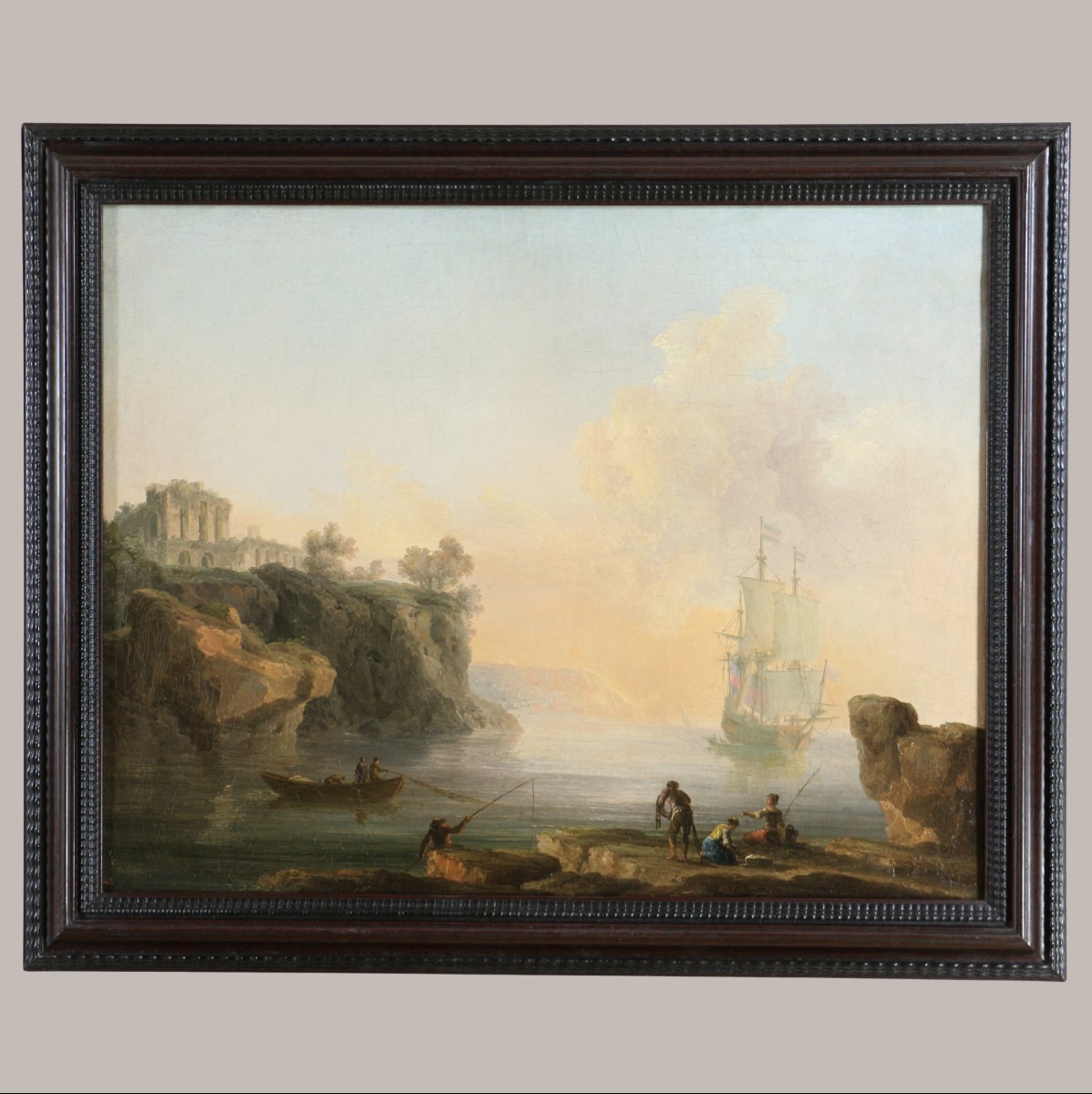


Francesco Fidanza (1747-1819) attributed. Animated seascape circa 1780.
Lined canvas, 62 cm by 48.5 cm
Frame, 71.5 cm by 58 cm.
We also offer this painting with another frame, see ad ID: 1714390
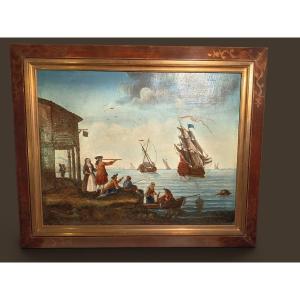
This superb composition depicts a vast coastal landscape bathed in diffused golden light. To the left, an imposing rocky cliff dominates the scene; at the top stand partially crumbled ancient ruins, whose open arcades stand out against a clear, pearly sky. A few trees dot the ridge, softening the mineral mass.
In the foreground, in calm water with subtle reflections, several fishermen enliven the scene: one, standing on a rock, holds a line; others, installed in a boat, pull a net. On the opposite shore, a small group of figures, busy with baskets and nets, introduce a note of everyday life.
To the right, a large three-masted ship with partially furled sails rises in a luminous mist. Its rigging is delicately cut against the warm atmosphere of the horizon. The overall effect is classically balanced: dark mass on the left, luminous opening on the right, depth suggested by a slightly blurred distance.
The palette combines warm ochres, softened greens and grayed blues. The enveloping light and gentle transitions lend the scene a poetic, Mediterranean atmosphere.
Francesco Fidanza (1747-1819)
Francesco Fidanza (1747-1819) was an Italian landscape painter born in Rome into a family of artists. He was the son of landscape painter Gregorio Fidanza, who gave him his initial training and introduced him to the tradition of classical Roman landscape painting. From the outset, Francesco's environment was profoundly influenced by the legacy of 17th-century landscape painting, and by the decisive influence of Claude-Joseph Vernet, whose success in Italy was considerable.
His first activity was in Rome, where he produced idealized landscapes, harbor scenes and views of ancient ruins for an aristocratic and cultured clientele. His compositions are in the "capriccio" tradition: invented or recomposed architectures, coastal towers, imaginary ports bathed in a warm, diffused light. Early on, he developed a taste for balanced compositions, often conceived as decorative pendants.
In the 1770s, he moved to Milan, where he gained considerable recognition. He was appointed professor of landscape at the Brera Academy, confirming his status in the Lombard artistic landscape. In Milan, his style became more refined: the light became more pearly, the atmospheres more enveloping, the brushstrokes more melancholy. His works are characterized by milky skies, slightly misty horizons, rocks built into large colored masses and small, animated figures - fishermen, travelers, merchants - harmoniously integrated into the landscape.
Francesco Fidanza belonged to a generation that continued the classical tradition while orienting it towards a more atmospheric, pre-romantic sensibility. He does not seek spectacular dramatization; on the contrary, his landscapes favor balance, luminous softness and discreet poetry. His art represents a synthesis of Roman tradition and Venetian influence, adapted to the decorative tastes of the late 18th century.
He died in 1819. His work occupies an important place in the evolution of Italian landscape between Classicism and the first Romantic inflections, and he remains today a major figure of late 18th-century Italian landscape.
He died in 1819.
Lined canvas, 62 cm by 48.5 cm
Frame, 71.5 cm by 58 cm.
We also offer this painting with another frame, see ad ID: 1714390
This superb composition depicts a vast coastal landscape bathed in diffused golden light. To the left, an imposing rocky cliff dominates the scene; at the top stand partially crumbled ancient ruins, whose open arcades stand out against a clear, pearly sky. A few trees dot the ridge, softening the mineral mass.
In the foreground, in calm water with subtle reflections, several fishermen enliven the scene: one, standing on a rock, holds a line; others, installed in a boat, pull a net. On the opposite shore, a small group of figures, busy with baskets and nets, introduce a note of everyday life.
To the right, a large three-masted ship with partially furled sails rises in a luminous mist. Its rigging is delicately cut against the warm atmosphere of the horizon. The overall effect is classically balanced: dark mass on the left, luminous opening on the right, depth suggested by a slightly blurred distance.
The palette combines warm ochres, softened greens and grayed blues. The enveloping light and gentle transitions lend the scene a poetic, Mediterranean atmosphere.
Francesco Fidanza (1747-1819)
Francesco Fidanza (1747-1819) was an Italian landscape painter born in Rome into a family of artists. He was the son of landscape painter Gregorio Fidanza, who gave him his initial training and introduced him to the tradition of classical Roman landscape painting. From the outset, Francesco's environment was profoundly influenced by the legacy of 17th-century landscape painting, and by the decisive influence of Claude-Joseph Vernet, whose success in Italy was considerable.
His first activity was in Rome, where he produced idealized landscapes, harbor scenes and views of ancient ruins for an aristocratic and cultured clientele. His compositions are in the "capriccio" tradition: invented or recomposed architectures, coastal towers, imaginary ports bathed in a warm, diffused light. Early on, he developed a taste for balanced compositions, often conceived as decorative pendants.
In the 1770s, he moved to Milan, where he gained considerable recognition. He was appointed professor of landscape at the Brera Academy, confirming his status in the Lombard artistic landscape. In Milan, his style became more refined: the light became more pearly, the atmospheres more enveloping, the brushstrokes more melancholy. His works are characterized by milky skies, slightly misty horizons, rocks built into large colored masses and small, animated figures - fishermen, travelers, merchants - harmoniously integrated into the landscape.
Francesco Fidanza belonged to a generation that continued the classical tradition while orienting it towards a more atmospheric, pre-romantic sensibility. He does not seek spectacular dramatization; on the contrary, his landscapes favor balance, luminous softness and discreet poetry. His art represents a synthesis of Roman tradition and Venetian influence, adapted to the decorative tastes of the late 18th century.
He died in 1819. His work occupies an important place in the evolution of Italian landscape between Classicism and the first Romantic inflections, and he remains today a major figure of late 18th-century Italian landscape.
He died in 1819.
Explore similar pieces and discover your ideal find:
Seascapes, Marine Paintings