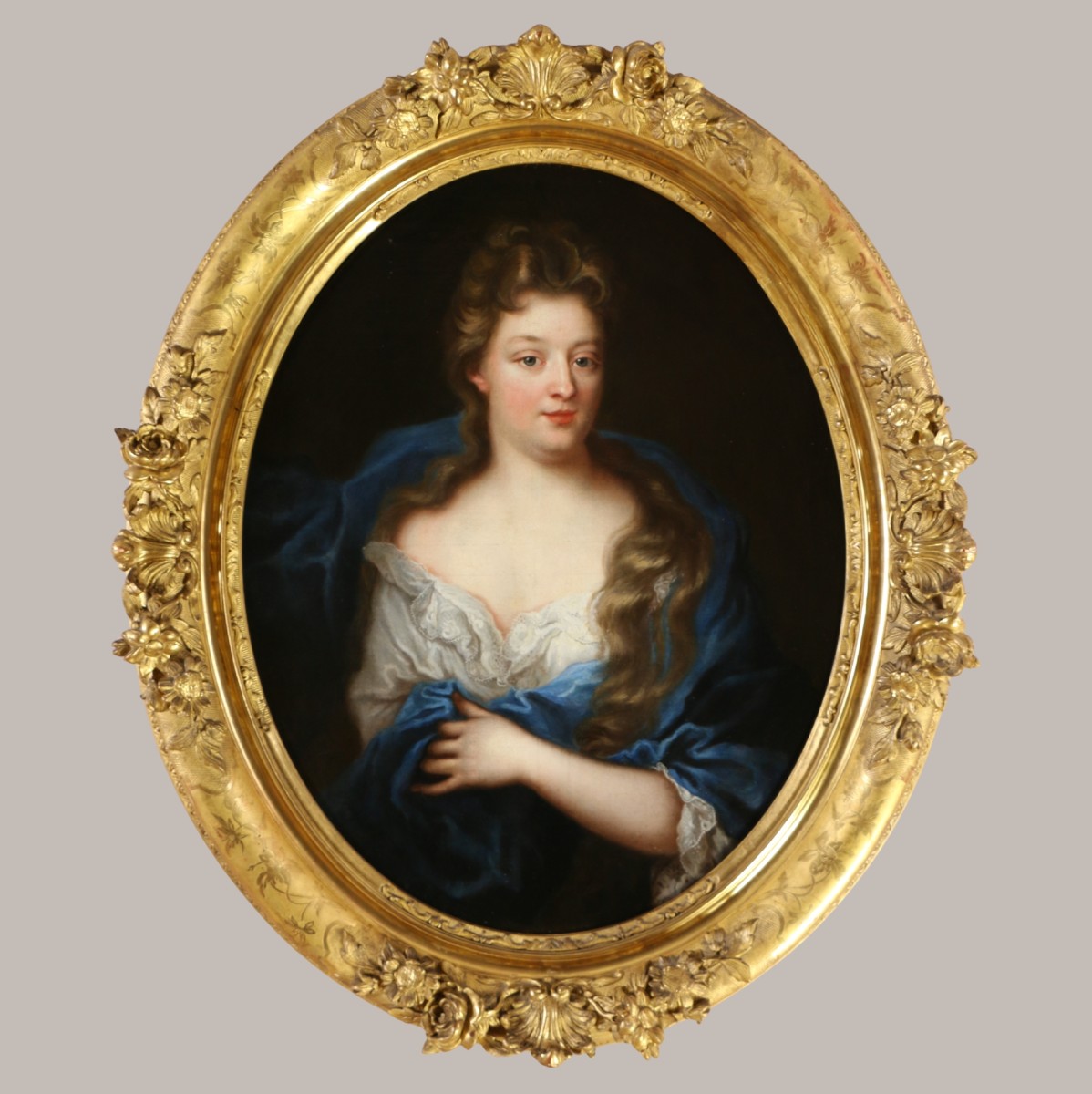


Pierre Mignard (1612-1695) And Workshop. Portrait Of A Lady Of Quality Circa 1680.
Artist: Pierre Mignard (1612-1695) Et Atelier.
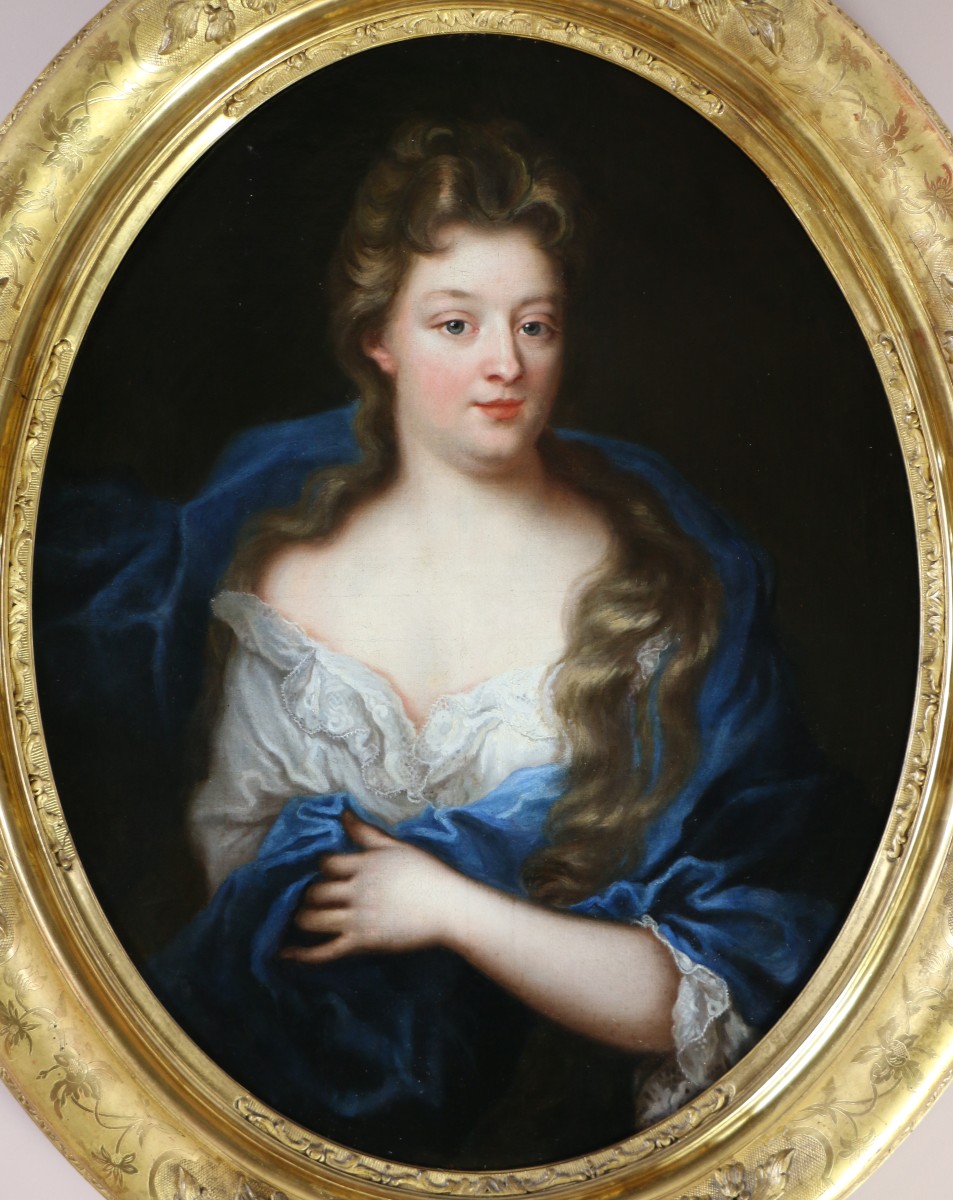
Pierre Mignard (1612-1695) and workshop. Portrait of a Lady of Quality, circa 1680.
Relined canvas, 81 cm x 65 cm.
Antique frame, 100 cm x 85 cm.
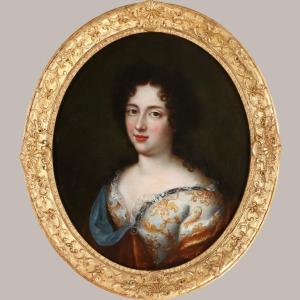
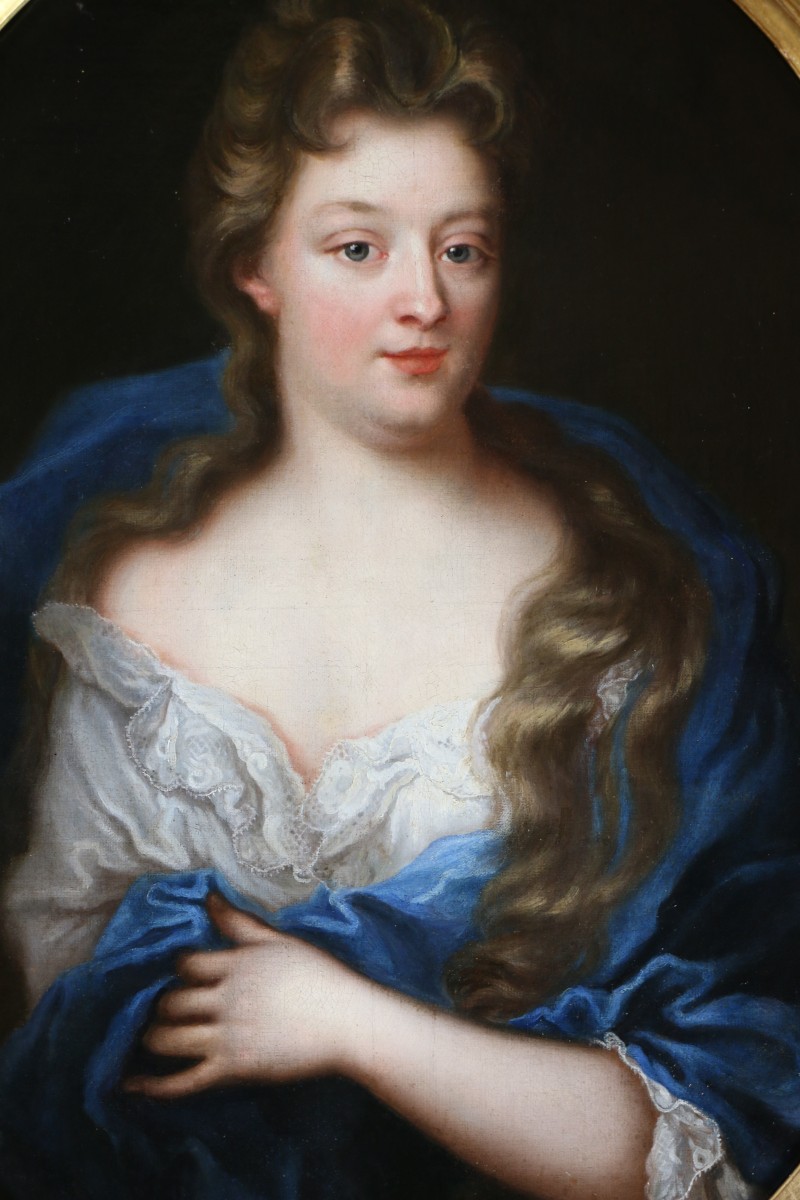
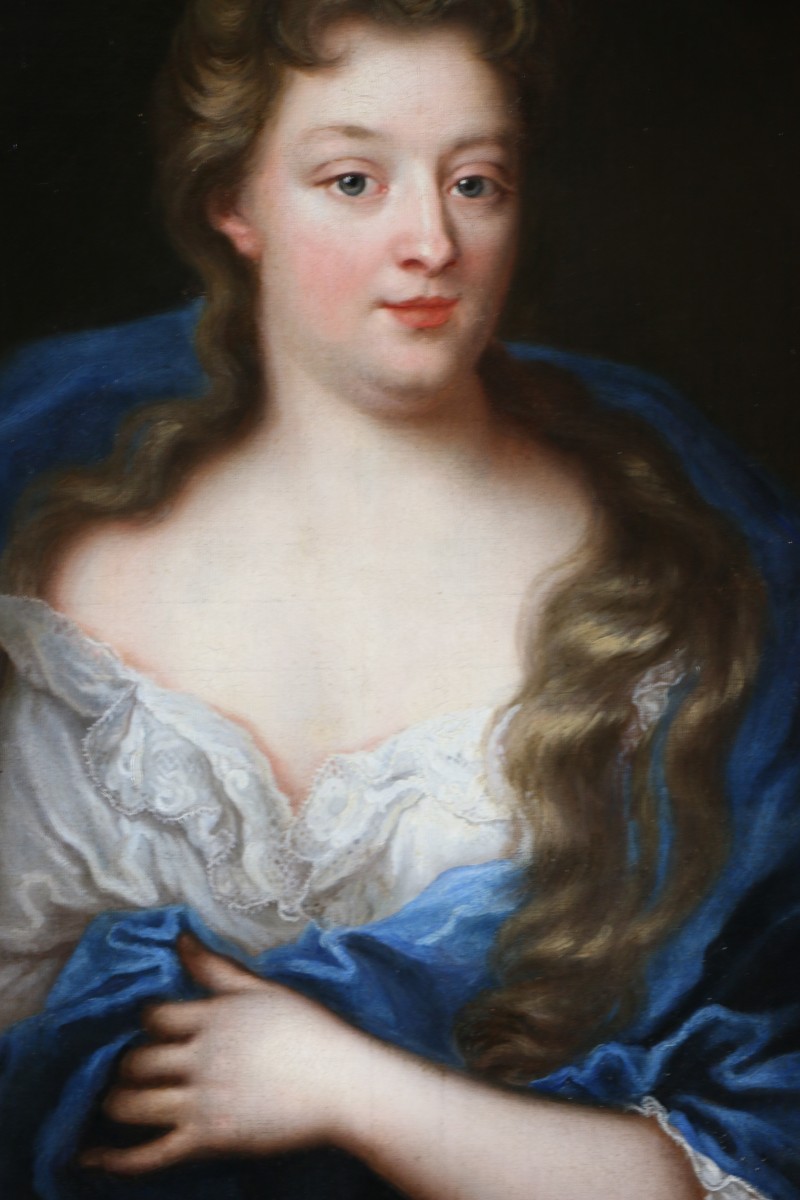
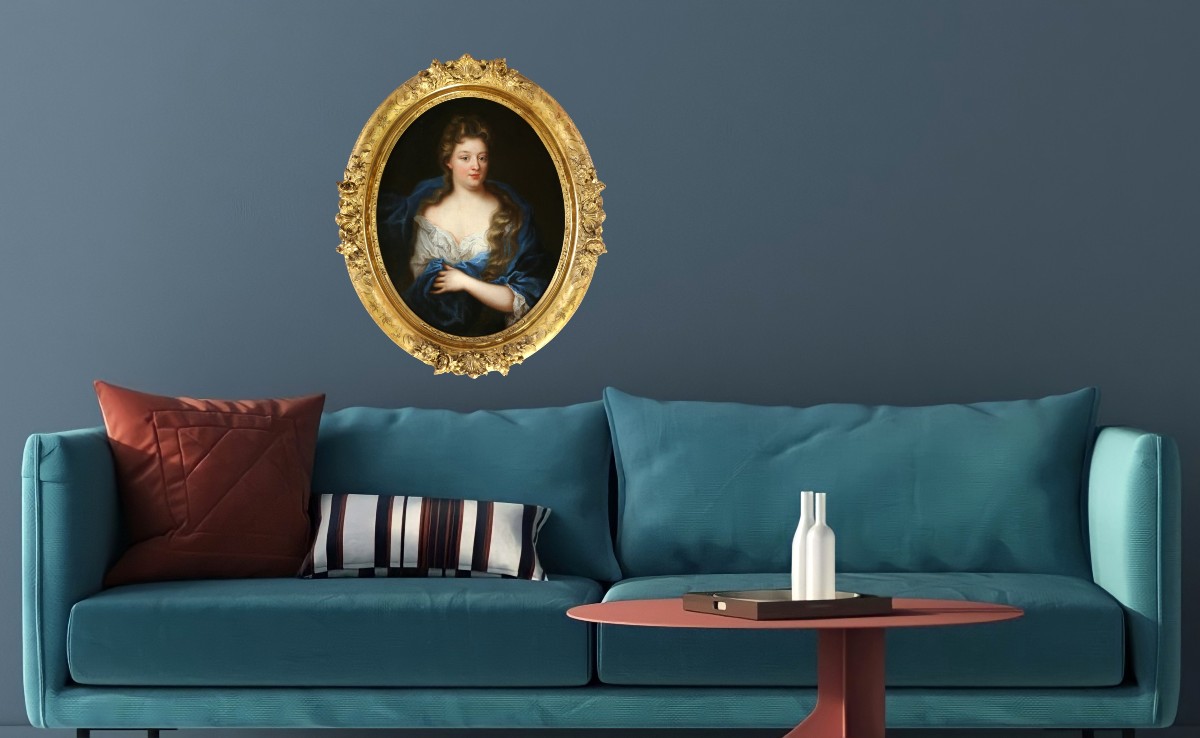
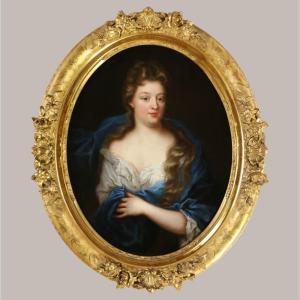
This magnificently framed portrait depicts a young woman, shown half-length, turned slightly to the left. She wears a white chemise edged with delicate lace, the folds of which are rendered with a richer fabric, and a full drape of deep blue velvet covering her shoulders and arm. Her right hand holds the fabric in a supple and measured gesture, typical of aristocratic portraits of the late 17th century. The hairstyle, voluminous and structured at the crown, corresponds to the beginnings of the "Fontange" style, which appeared around 1680 at the court of Louis XIV. The curls are elegantly arranged, though not yet reaching the architectural verticality of later decades. Long, wavy locks fall over her shoulders. The treatment of the face is particularly refined: the complexions are smooth, blended, and luminous, with very soft transitions between shadow and light. A subtle highlight illuminates the bridge of the nose; the eyelids and the inner corners of the eyes are delicately pink. The subtle, almost enamel-like modeling recalls the style of Parisian portrait painters active in Pierre Mignard's circle. The dark, neutral background enhances the clarity of the complexion and the brilliance of the blue drapery. The overall effect is one of restraint and elegance.
Pierre Mignard (1612-1695),
known as "Mignard the Roman," was born in Troyes in 1612 and became one of the great French painters of the reign of Louis XIV. Trained first by his father and then at Fontainebleau, he left at a very young age for Italy, where he stayed for more than twenty years, primarily in Rome. This extended stay in Rome profoundly influenced his style: he absorbed the legacy of Italian classicism, the art of clear drawing, balanced compositions, and a certain gentleness in the treatment of figures. In Rome, he frequented artistic and aristocratic circles, forging a solid reputation thanks to his elegant portraits and religious works. His nickname, "Mignard the Roman," stems precisely from this Italian period, which distinguishes his career from that of other contemporary French artists. Returning to France around 1657, he quickly established himself as a sought-after portraitist for Parisian high society. His style is characterized by smooth, luminous complexions, extremely blended transitions, and a graceful idealization of his subjects. His female faces, in particular, possess an almost enamel-like softness, with delicate modeling and a discreet refinement that appealed to the aristocracy. Mignard maintained a famous rivalry with Charles Le Brun, then First Painter to the King and a dominant figure at the Royal Academy. This opposition left a lasting mark on Parisian artistic life. After Le Brun's death, Mignard finally attained the highest positions: in 1690, he became First Painter to the King and Director of the Royal Academy of Painting and Sculpture, thus culminating a career long pursued outside the official institutions. Besides his numerous court portraits, including those of Louis XIV and Madame de Maintenon, he also created important religious and mythological decorations, notably for the Val-de-Grâce, the Château de Saint-Cloud, and various Parisian townhouses. His work reflects the classical aesthetic of the Grand Siècle: restraint, elegance, clarity, and idealization. Pierre Mignard died in Paris in 1695, at the height of his official recognition. He left behind a prolific output and an influential workshop that helped disseminate his style throughout France. His art embodies one of the most refined expressions of French classicism under Louis XIV.
Relined canvas, 81 cm x 65 cm.
Antique frame, 100 cm x 85 cm.
This magnificently framed portrait depicts a young woman, shown half-length, turned slightly to the left. She wears a white chemise edged with delicate lace, the folds of which are rendered with a richer fabric, and a full drape of deep blue velvet covering her shoulders and arm. Her right hand holds the fabric in a supple and measured gesture, typical of aristocratic portraits of the late 17th century. The hairstyle, voluminous and structured at the crown, corresponds to the beginnings of the "Fontange" style, which appeared around 1680 at the court of Louis XIV. The curls are elegantly arranged, though not yet reaching the architectural verticality of later decades. Long, wavy locks fall over her shoulders. The treatment of the face is particularly refined: the complexions are smooth, blended, and luminous, with very soft transitions between shadow and light. A subtle highlight illuminates the bridge of the nose; the eyelids and the inner corners of the eyes are delicately pink. The subtle, almost enamel-like modeling recalls the style of Parisian portrait painters active in Pierre Mignard's circle. The dark, neutral background enhances the clarity of the complexion and the brilliance of the blue drapery. The overall effect is one of restraint and elegance.
Pierre Mignard (1612-1695),
known as "Mignard the Roman," was born in Troyes in 1612 and became one of the great French painters of the reign of Louis XIV. Trained first by his father and then at Fontainebleau, he left at a very young age for Italy, where he stayed for more than twenty years, primarily in Rome. This extended stay in Rome profoundly influenced his style: he absorbed the legacy of Italian classicism, the art of clear drawing, balanced compositions, and a certain gentleness in the treatment of figures. In Rome, he frequented artistic and aristocratic circles, forging a solid reputation thanks to his elegant portraits and religious works. His nickname, "Mignard the Roman," stems precisely from this Italian period, which distinguishes his career from that of other contemporary French artists. Returning to France around 1657, he quickly established himself as a sought-after portraitist for Parisian high society. His style is characterized by smooth, luminous complexions, extremely blended transitions, and a graceful idealization of his subjects. His female faces, in particular, possess an almost enamel-like softness, with delicate modeling and a discreet refinement that appealed to the aristocracy. Mignard maintained a famous rivalry with Charles Le Brun, then First Painter to the King and a dominant figure at the Royal Academy. This opposition left a lasting mark on Parisian artistic life. After Le Brun's death, Mignard finally attained the highest positions: in 1690, he became First Painter to the King and Director of the Royal Academy of Painting and Sculpture, thus culminating a career long pursued outside the official institutions. Besides his numerous court portraits, including those of Louis XIV and Madame de Maintenon, he also created important religious and mythological decorations, notably for the Val-de-Grâce, the Château de Saint-Cloud, and various Parisian townhouses. His work reflects the classical aesthetic of the Grand Siècle: restraint, elegance, clarity, and idealization. Pierre Mignard died in Paris in 1695, at the height of his official recognition. He left behind a prolific output and an influential workshop that helped disseminate his style throughout France. His art embodies one of the most refined expressions of French classicism under Louis XIV.
8 800 €
Period: 17th century
Style: Louis 14th, Regency
Condition: Good condition
Material: Oil painting
Length: 81 cm, 100 cm avec le cadre
Width: 65 cm, 85 cm avec le cadre
Reference (ID): 1708674
Availability: In stock
Print