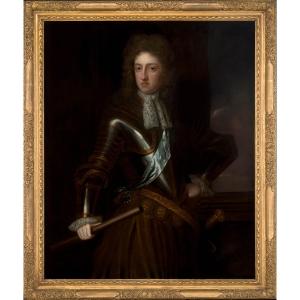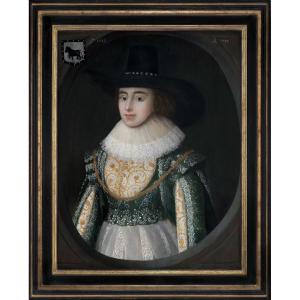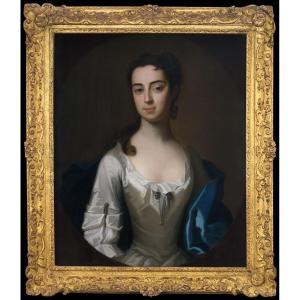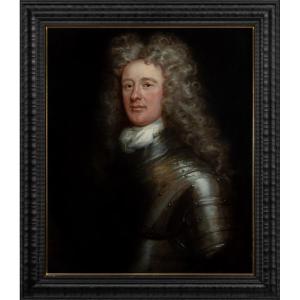


Portrait Of A Lady, In A Black Dress With Red Satin Sleeves And Pearls C.1660–1680
Artist: école Anglaise, Vers 1660–1680, Entourage De Sir Peter Lely (1618–1680)
Portrait of a Lady, in a Black Dress with Red Satin Sleeves and Pearls
English School c.1660–1680
Circle of Sir Peter Lely (1618-1680)
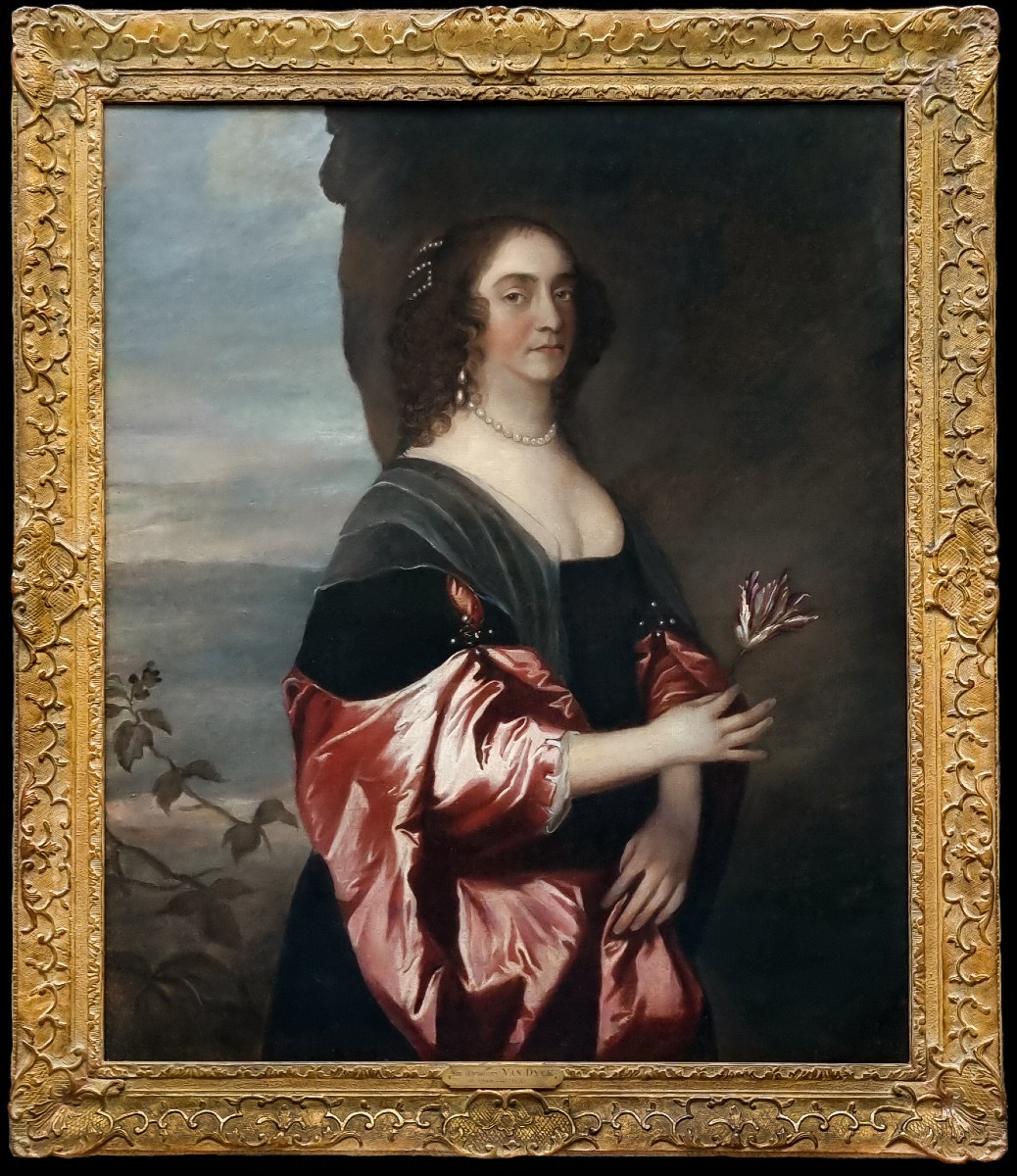
This striking portrait is a compelling example of the enduring power of Van Dyck’s legacy in England. At over a metre in height, it possesses real presence—precisely the kind of work intended to command attention within a principal interior.
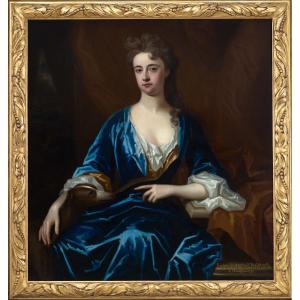
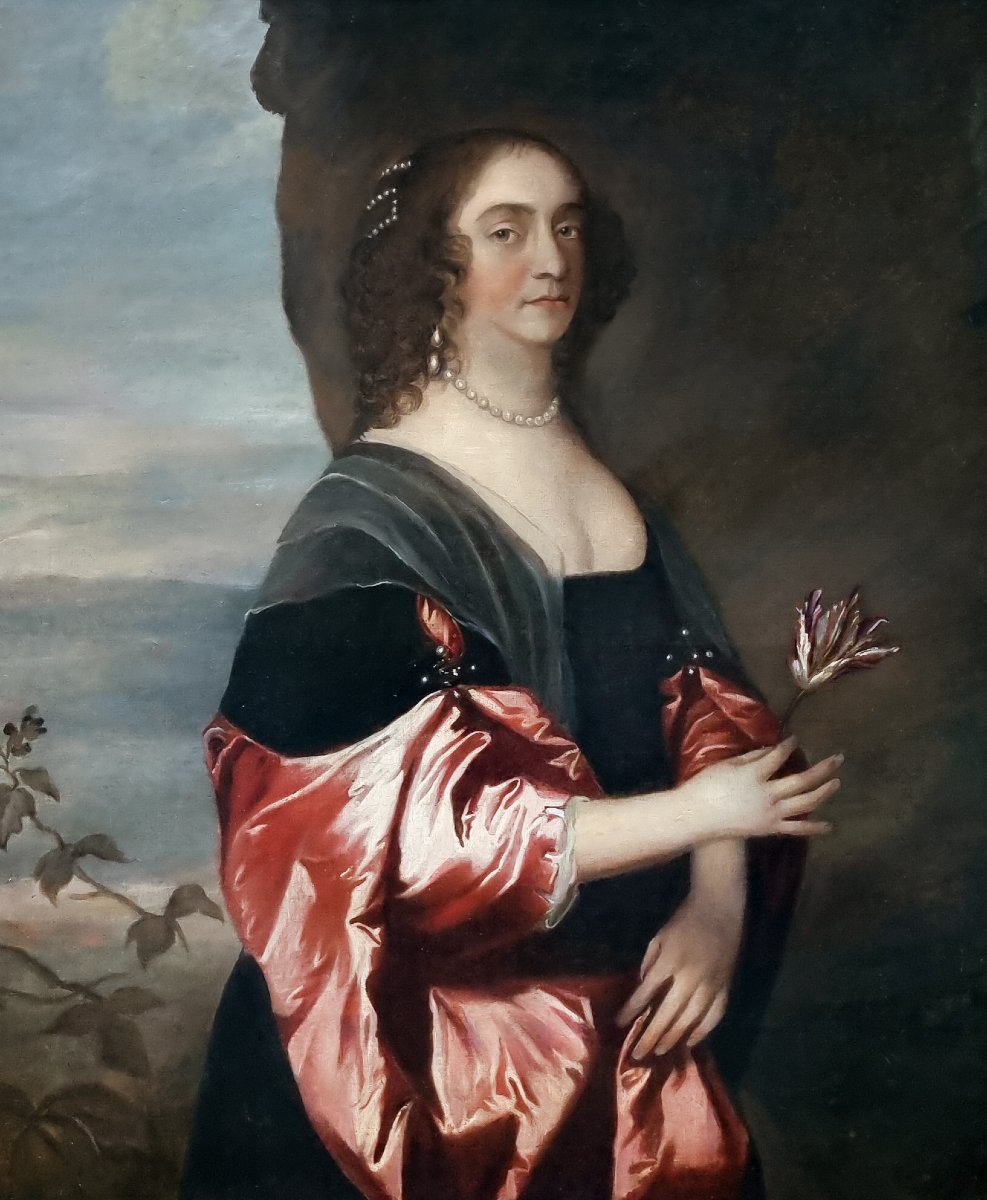
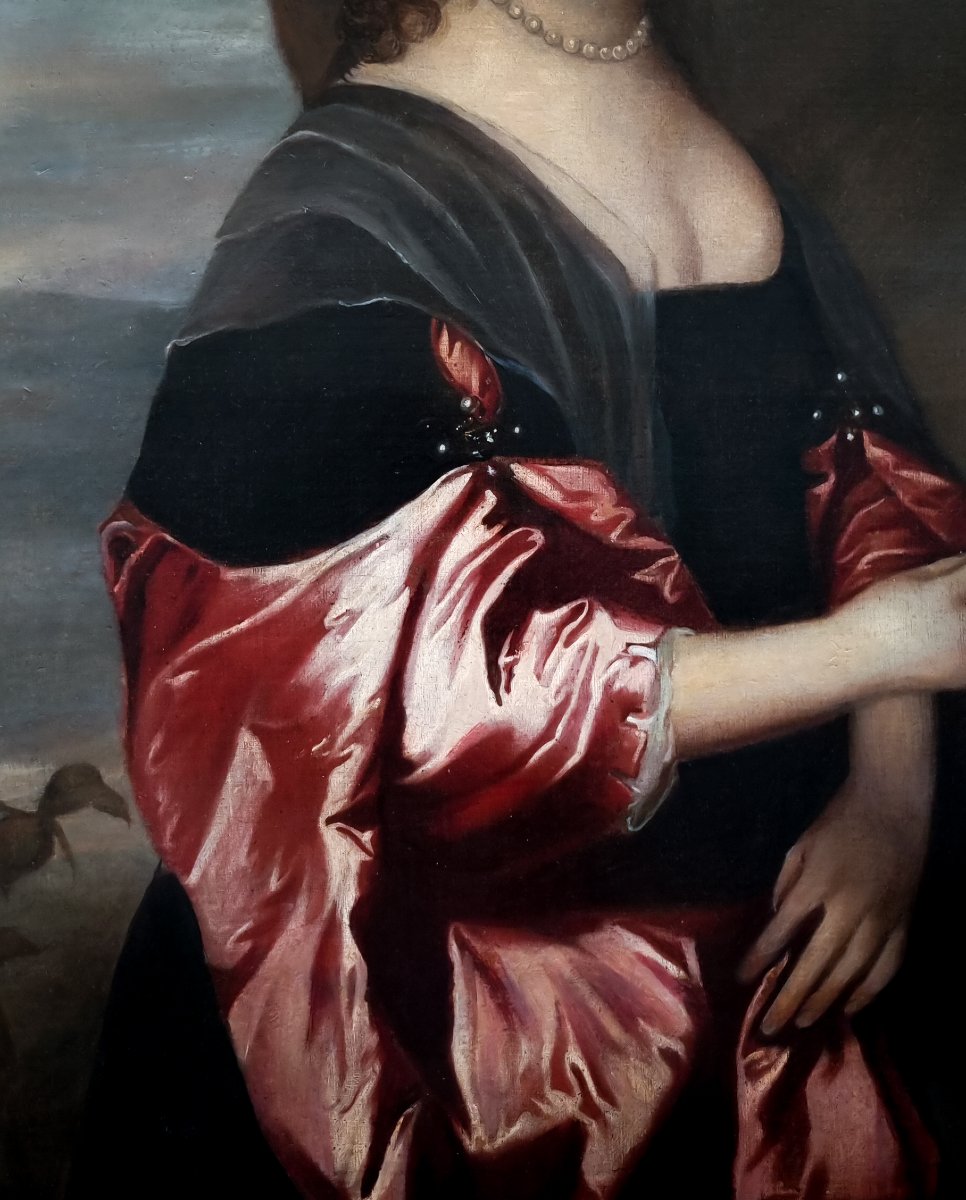
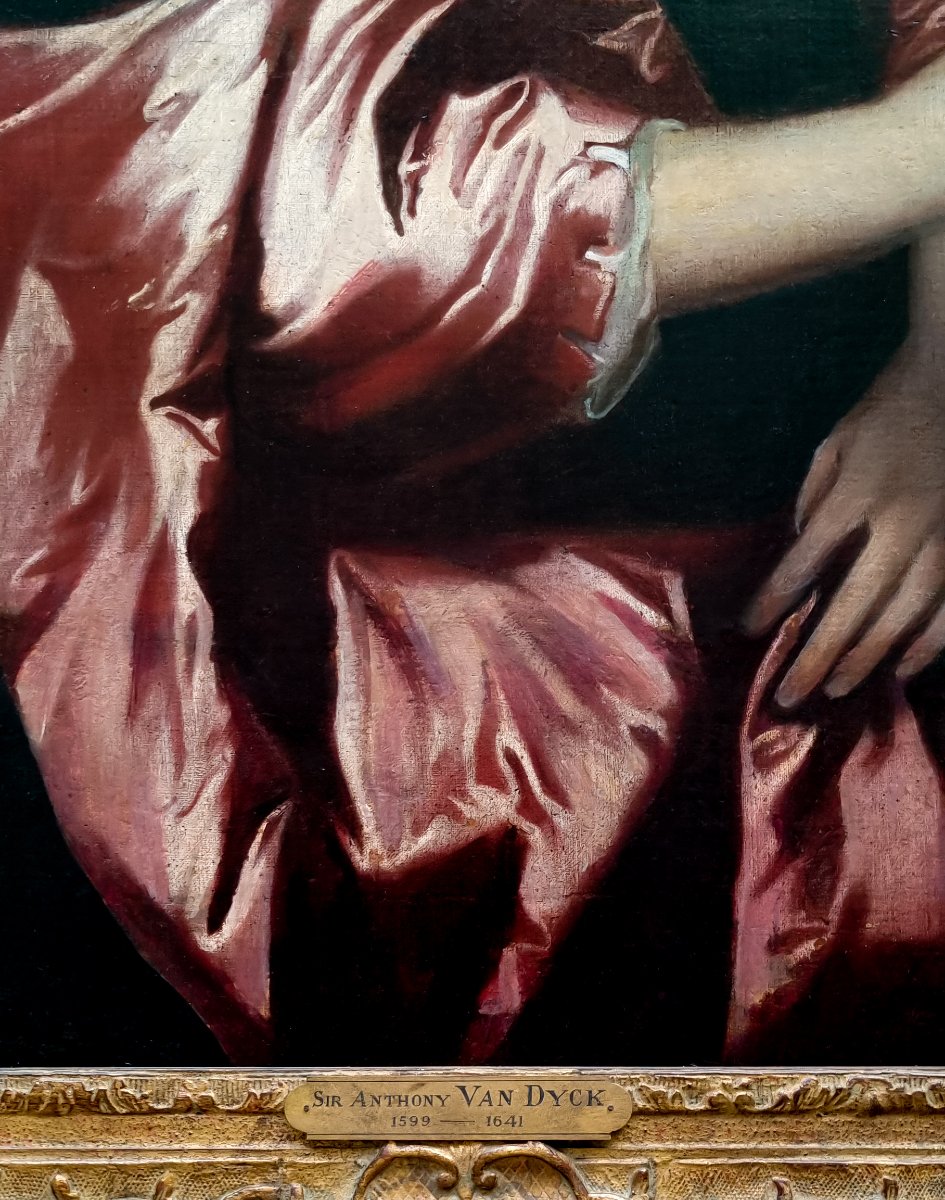
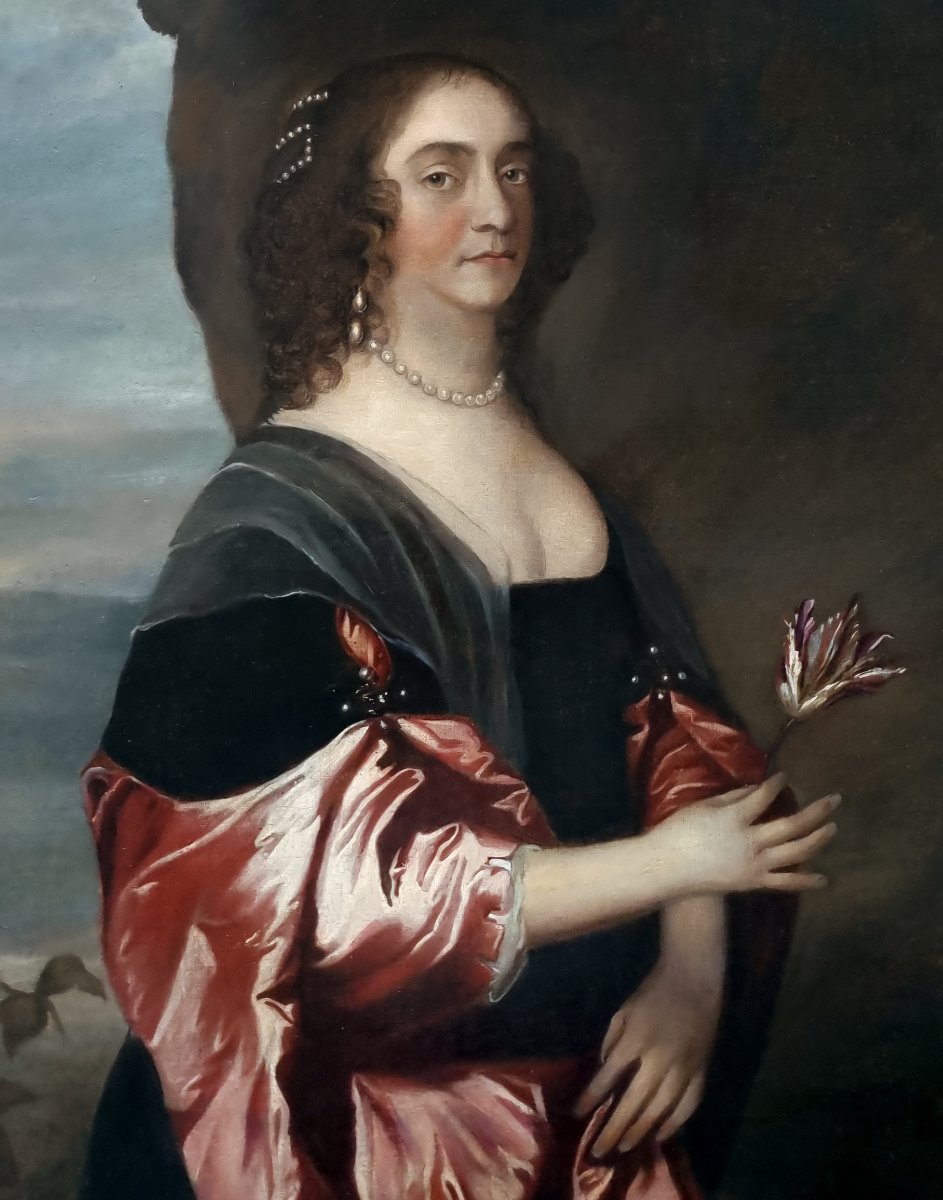
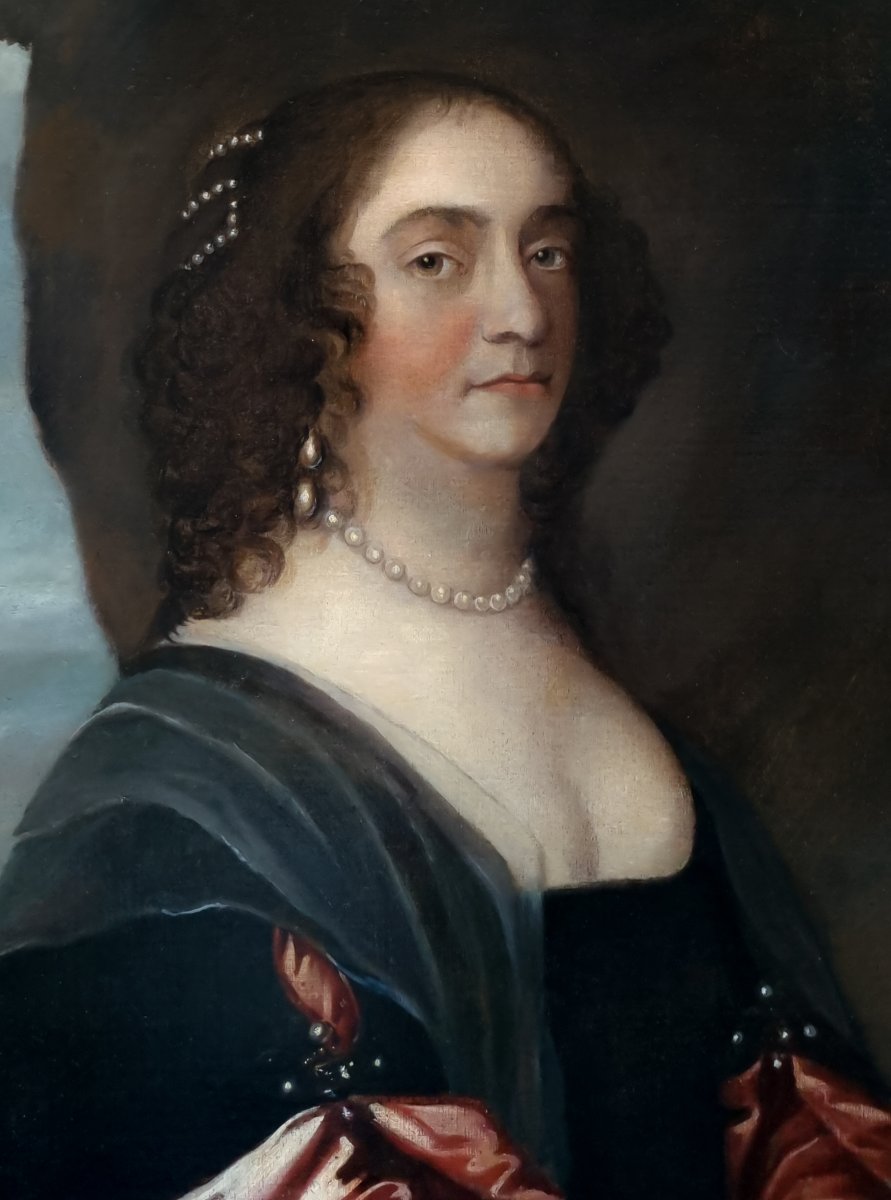
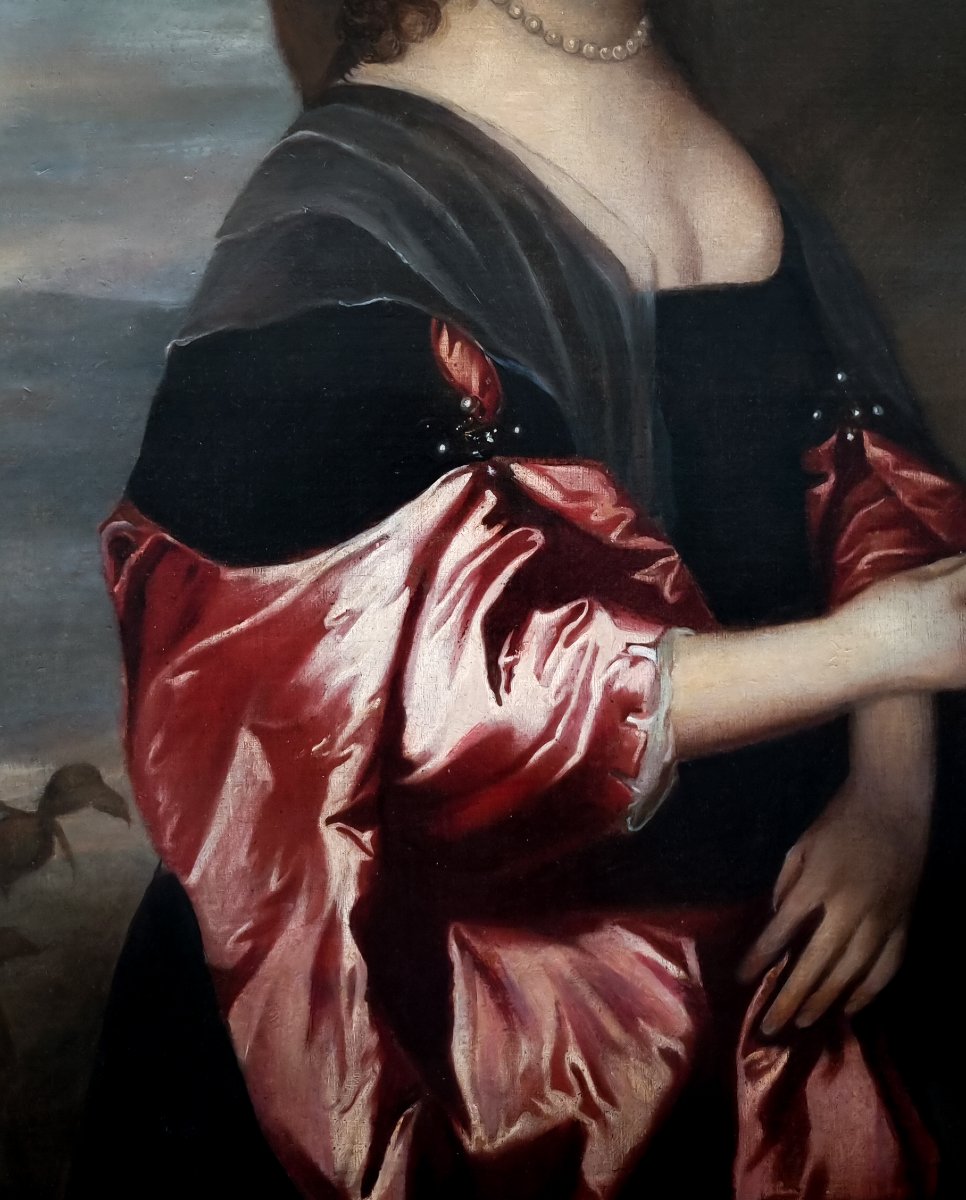
The sitter is shown half-length, set before a rocky landscape, a compositional formula that derives ultimately from the portrait inventions of Anthony van Dyck and remained dominant in England well into the later seventeenth century. She wears a black silk bodice cut low across the chest, softened by a fine gauzy scarf draped across her shoulders, and adorned with a single strand of pearls and matching drop earrings. Her sleeves—rendered in a brilliant crimson satin—are articulated with sharp highlights that catch the light in a manner both decorative and painterly. Her hair is worn long and softly curled, interwoven with pearls, and falls naturally about her shoulders. The costume, together with the handling of paint, situates the work securely in the period circa 1660–1680, when Van Dyck’s earlier idiom was absorbed and reinterpreted by a generation of English painters.
The identity of the sitter is not recorded, yet the painting provides sufficient cues to situate her convincingly within a specific social and historical framework. She is almost certainly a member of the landed gentry or minor aristocracy—wealthy, established, and conscious of her status, but not of the highest courtly rank. The absence of heraldry or inscription suggests that the portrait was commissioned for private display rather than public assertion, most likely as part of a familial decorative scheme within a country house. Women of this type were typically portrayed not as individuals in isolation, but as integral components of dynastic continuity: wives, mothers, and custodians of lineage.
It is therefore highly probable that this painting originally formed part of a pair, representing husband and wife, commissioned to mark marriage, inheritance, or the consolidation of an estate. One might envisage the sitter as the wife of a country gentleman—perhaps a Member of Parliament, a Justice of the Peace, or a landowner whose family had risen in prominence during the political upheavals of the mid-seventeenth century. Families of this tier, particularly in counties such as Hampshire, Surrey, or Kent, frequently commissioned portraits to assert stability in the aftermath of the English Civil War. A plausible context would be that of a marriage alliance between two established families, the portrait serving both as a personal likeness and as a statement of continuity following years of national disruption.
Her husband, in such a scenario, would likely have belonged to the governing class of provincial England: a figure engaged in local administration, perhaps with Parliamentarian sympathies during the Civil War, and later integrated into the restored social order under Charles II. Their children—if the typical pattern is followed—would have inherited both land and portraiture, the latter forming a visual genealogy displayed in halls and principal chambers. The setting for such a work would have been a country house of moderate scale, neither ducal nor modest, but representative of the stable, landholding elite whose identity was closely tied to place and lineage.
The painting must also be understood within the broader context of the English art market of the time. Following the death of Van Dyck in 1641, his influence did not diminish but instead became the foundation upon which English portraiture was built. During the Restoration, artists such as Sir Peter Lely and his contemporaries adapted Van Dyck’s compositional formulas to suit a new generation of patrons. The demand for portraits expanded significantly as political stability returned and wealth consolidated in the hands of the gentry. Portraiture was no longer confined to the court; it became an essential instrument of social identity across the provinces. Workshops and independent painters alike produced images that echoed Van Dyck’s elegance while accommodating the preferences and budgets of a broader clientele.
This painting belongs precisely to that moment. While not by Van Dyck himself, it draws directly upon his prototypes—particularly the combination of column, landscape, and informal yet dignified pose. The handling suggests an English artist working within this tradition, possibly trained in or influenced by the studio practices that dominated London in the 1660s and 1670s. The slightly firmer modelling of the face, the more defined contours, and the emphatic treatment of satin distinguish it from Van Dyck’s own hand, yet these qualities are entirely consistent with the best mid-tier portraitists of the Restoration period.
Today, the painting offers a compelling combination of aesthetic, historical, and practical advantages. It is of a scale that lends gravitas to an interior, yet remains manageable; its palette—anchored by black, red, and soft flesh tones—is both dramatic and versatile; and its subject, while anonymous, embodies a recognisable and appealing archetype of English aristocratic femininity. The clear connection to Van Dyck’s influential style provides a strong art-historical anchor. As a result, it occupies a highly desirable position within the market: a painting of genuine presence and authenticity, rooted in one of the most important traditions of European portraiture, and capable of transforming both a space and a collection with equal authority.
Measurements: Height 132.5cm, Width 114.5cm framed (Height 52”, Width 45” framed)
English School c.1660–1680
Circle of Sir Peter Lely (1618-1680)
This striking portrait is a compelling example of the enduring power of Van Dyck’s legacy in England. At over a metre in height, it possesses real presence—precisely the kind of work intended to command attention within a principal interior.
The sitter is shown half-length, set before a rocky landscape, a compositional formula that derives ultimately from the portrait inventions of Anthony van Dyck and remained dominant in England well into the later seventeenth century. She wears a black silk bodice cut low across the chest, softened by a fine gauzy scarf draped across her shoulders, and adorned with a single strand of pearls and matching drop earrings. Her sleeves—rendered in a brilliant crimson satin—are articulated with sharp highlights that catch the light in a manner both decorative and painterly. Her hair is worn long and softly curled, interwoven with pearls, and falls naturally about her shoulders. The costume, together with the handling of paint, situates the work securely in the period circa 1660–1680, when Van Dyck’s earlier idiom was absorbed and reinterpreted by a generation of English painters.
The identity of the sitter is not recorded, yet the painting provides sufficient cues to situate her convincingly within a specific social and historical framework. She is almost certainly a member of the landed gentry or minor aristocracy—wealthy, established, and conscious of her status, but not of the highest courtly rank. The absence of heraldry or inscription suggests that the portrait was commissioned for private display rather than public assertion, most likely as part of a familial decorative scheme within a country house. Women of this type were typically portrayed not as individuals in isolation, but as integral components of dynastic continuity: wives, mothers, and custodians of lineage.
It is therefore highly probable that this painting originally formed part of a pair, representing husband and wife, commissioned to mark marriage, inheritance, or the consolidation of an estate. One might envisage the sitter as the wife of a country gentleman—perhaps a Member of Parliament, a Justice of the Peace, or a landowner whose family had risen in prominence during the political upheavals of the mid-seventeenth century. Families of this tier, particularly in counties such as Hampshire, Surrey, or Kent, frequently commissioned portraits to assert stability in the aftermath of the English Civil War. A plausible context would be that of a marriage alliance between two established families, the portrait serving both as a personal likeness and as a statement of continuity following years of national disruption.
Her husband, in such a scenario, would likely have belonged to the governing class of provincial England: a figure engaged in local administration, perhaps with Parliamentarian sympathies during the Civil War, and later integrated into the restored social order under Charles II. Their children—if the typical pattern is followed—would have inherited both land and portraiture, the latter forming a visual genealogy displayed in halls and principal chambers. The setting for such a work would have been a country house of moderate scale, neither ducal nor modest, but representative of the stable, landholding elite whose identity was closely tied to place and lineage.
The painting must also be understood within the broader context of the English art market of the time. Following the death of Van Dyck in 1641, his influence did not diminish but instead became the foundation upon which English portraiture was built. During the Restoration, artists such as Sir Peter Lely and his contemporaries adapted Van Dyck’s compositional formulas to suit a new generation of patrons. The demand for portraits expanded significantly as political stability returned and wealth consolidated in the hands of the gentry. Portraiture was no longer confined to the court; it became an essential instrument of social identity across the provinces. Workshops and independent painters alike produced images that echoed Van Dyck’s elegance while accommodating the preferences and budgets of a broader clientele.
This painting belongs precisely to that moment. While not by Van Dyck himself, it draws directly upon his prototypes—particularly the combination of column, landscape, and informal yet dignified pose. The handling suggests an English artist working within this tradition, possibly trained in or influenced by the studio practices that dominated London in the 1660s and 1670s. The slightly firmer modelling of the face, the more defined contours, and the emphatic treatment of satin distinguish it from Van Dyck’s own hand, yet these qualities are entirely consistent with the best mid-tier portraitists of the Restoration period.
Today, the painting offers a compelling combination of aesthetic, historical, and practical advantages. It is of a scale that lends gravitas to an interior, yet remains manageable; its palette—anchored by black, red, and soft flesh tones—is both dramatic and versatile; and its subject, while anonymous, embodies a recognisable and appealing archetype of English aristocratic femininity. The clear connection to Van Dyck’s influential style provides a strong art-historical anchor. As a result, it occupies a highly desirable position within the market: a painting of genuine presence and authenticity, rooted in one of the most important traditions of European portraiture, and capable of transforming both a space and a collection with equal authority.
Measurements: Height 132.5cm, Width 114.5cm framed (Height 52”, Width 45” framed)
9 650 €
Period: 17th century
Style: Louis 14th, Regency
Condition: Excellent condition
Material: Oil painting
Width: 114.5
Height: 132.5
Depth: 7
Reference (ID): 1742542
Availability: In stock
Print