



Portrait Of A Lady In A White Dress With Blue Ribbons, Oil On Canvas, C.1745, Fine Carved Frame
Artist: Attribué à Henry Pickering (actif Vers 1740–1771)
Portrait of a Lady in a White Silk Dress with Blue Ribbon Bows c.1745–1755
Attributed to Henry Pickering (fl. c.1740–1771)
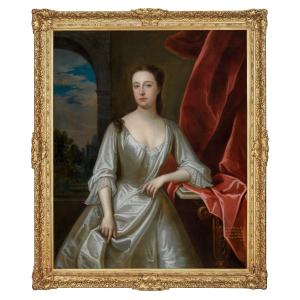
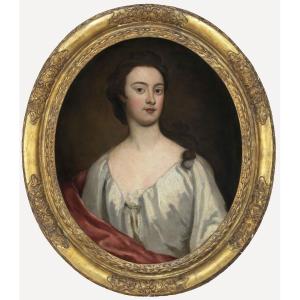
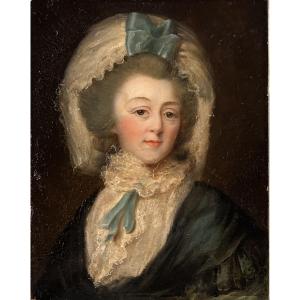
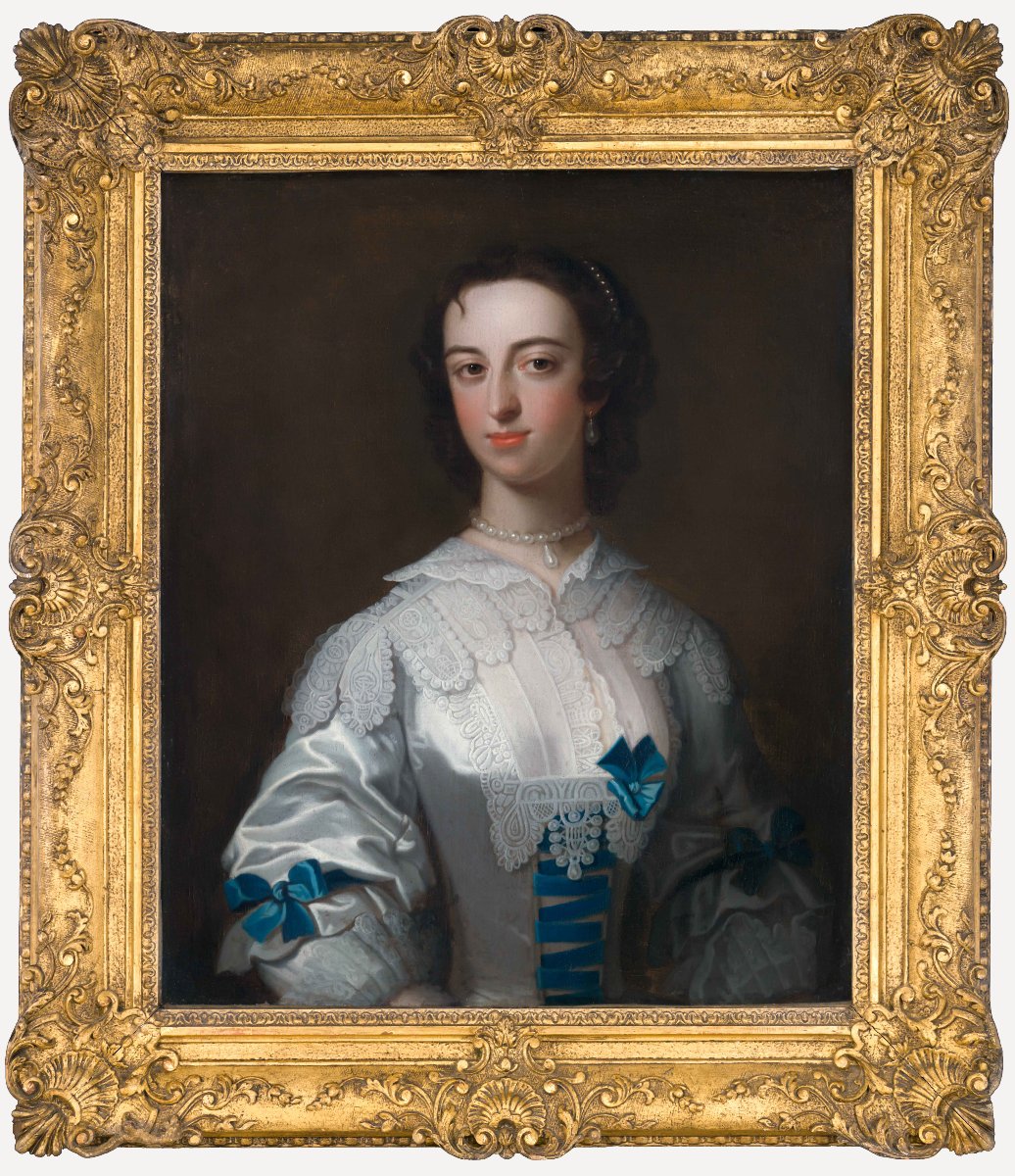
In this captivating mid 18th century portrait, a young English lady is presented in a luminous white satin gown trimmed with intricate lace and blue ribbon bows. The image radiates elegance and refinement: the satin is painted with a soft sheen, the lace collar and sleeve ruffles (engageantes) rendered in delicate detail, and a string of pearls with a teardrop pendant resting at her throat. Her brown hair is styled naturally, tied close to her head —a fashionable look of the 1740s. All against a plain warm-brown background, she emerges with an almost luminous clarity. The result is a vivid, graceful likeness that exemplifies the so called “Van Dyck” costume style popular in Britain around 1745–1755. Indeed, historians note that by the late 1740s such a high-lace collar and ribboned stomacher had become one of the hallmarks of Georgian ladies’ portraits.
The sitter herself appears to be a woman of some standing, likely in her twenties or thirties. By context and design she seems connected to the affluent gentry families of southern England. Intriguingly, the same composition and costume appear in a known portrait of Susannah Earle of Eastcourt (d. 1796), an heir of the Hicks family of Gloucestershire. Susannah Earle was first cousin to Sir Howe Hicks of Witcombe Park, and a key figure in the local elite (“instrumental in introducing her Hicks cousins to the Beach family,” according to family histories). Our sitter could plausibly have been a kinswoman or contemporary of that circle – perhaps another daughter of the Hicks or related families – who likewise would be commemorated by a fine portrait. Even a noted source observes that Susannah Earle “had twinkling pearl earrings and fashionable lace,” words that well describe the pearls and lace adorning our lady. Although no name is inscribed on this canvas, the combination of ivory satin, elaborate lace engageantes, blue ribbon bows and pearl jewelry places her firmly among the prosperous, fashion-conscious women of mid Georgian England. She likely lived on a country estate (perhaps in Wiltshire or Gloucestershire), participating in the social life of the county elite. (If she were a married bride, the portrait could have been commissioned to mark that event, as was typical: new brides commonly had their likenesses painted in full finery for their husband’s ancestral home.)
At the time this portrait was painted (around 1745–1755), England was in a period of increasing wealth and cultural confidence. The Hanoverian dynasty was firmly established after the 1745 Jacobite rising, and trade and commerce were growing. Wealthy families competed to display their status, often through portraiture. Leading London studios, inspired by the Baroque tradition of Sir Anthony van Dyck, produced crisply elegant “Vandyke dress” images like this one. Demand for such portraits was high, and prices supported skilled specialists. Notable patrons of the era – including Horace Walpole at Strawberry Hill – sought fashionable likenesses by emerging painters. In fact, a portrait of a young girl by Henry Pickering dated 1759 and signed “H. Pickering Pinxit” matches this painting’s dimensions and similarly detailed satin and lace. This shows that Pickering was offering works in this size and style to the market.
Complementing the portrait itself is its original Rococo period frame: a boldly carved giltwood surround of heavy scrollwork, shells and acanthus ornament. The warm gold of the frame beautifully echoes the glowing tones of the sitter’s costume, enhancing her presence. Such a frame, richly ornamented yet tasteful, was typical for a painting of high quality in a grand home. It contributes to the impression of pedigree and splendour.
Based on style and documented comparables, this painting can be confidently attributed to Henry Pickering (fl. c.1740–1771) or his immediate circle. Pickering was an English portraitist whose work closely followed the conventions of Thomas Hudson; indeed, Christie's notes that Pickering was “often likened stylistically to Thomas Hudson” and that he employed the same drapery painter, Joseph van Aken. The portrait’s serene face, eyes and smooth modelling recall the character of Pickering’s authenticated works. For example, a signed Pickering of 1743 portrays Susannah Holt in a white dress with a pale blue wrap. Likewise, the nearly identical portrait of Susannah Earle is catalogued as “attributed to Henry Pickering”. These strong parallels – matching canvas size, fabric detailing and composition – make Pickering the most persuasive candidate. As a note of provenance, a painting of Susannah Holt by Pickering was sold through Christie's (as cited above), and the Susannah Earle portrait (from the Hicks family collection) was sold at Chorley’s in 2022 under his name. In short, the technique and history of this portrait align closely with Pickering’s known output.
Today this portrait shines as an exceptional example of Georgian portraiture. Its finely rendered costume and jewellery, the sitter’s composed gaze, and the rich gilt frame combine to offer both aesthetic beauty and historical depth. For a collector, it represents a rare opportunity to acquire a work by a recognized 18th-century hand (with all the insights that entails) in excellent state. Its graceful colour palette and striking composition will attract the eye in any collection.
Henry Pickering (c.1720–c.1771) was an English portrait painter active in London and the provinces. Although few personal records survive, he became known for fashionable likenesses in the 1740s–60s. His manner was heavily influenced by the great portraitists Thomas Hudson and Sir Godfrey Kneller; like them, Pickering often painted his sitters half-length against neutral grounds and worked with drapery specialist Joseph van Aken. Examples of Pickering’s signed work survive (for instance, a signed 1759 portrait at Strawberry Hill), confirming the style seen here. During his career, Pickering attracted commissions from gentry families who wanted well-appointed, up-to-date portraits of their kin. This painting exemplifies his typical approach: dignified elegance rather than flamboyance, with special care given to sumptuous textiles and accessories. Pickering died around 1771, leaving behind a legacy largely through his images of Georgian society. Our portrait stands as a distinguished representative of his oeuvre.
Measurements:Height 100cm, Width 87cm framed (Height 39.5”, Width 34.25” framed)
Attributed to Henry Pickering (fl. c.1740–1771)
In this captivating mid 18th century portrait, a young English lady is presented in a luminous white satin gown trimmed with intricate lace and blue ribbon bows. The image radiates elegance and refinement: the satin is painted with a soft sheen, the lace collar and sleeve ruffles (engageantes) rendered in delicate detail, and a string of pearls with a teardrop pendant resting at her throat. Her brown hair is styled naturally, tied close to her head —a fashionable look of the 1740s. All against a plain warm-brown background, she emerges with an almost luminous clarity. The result is a vivid, graceful likeness that exemplifies the so called “Van Dyck” costume style popular in Britain around 1745–1755. Indeed, historians note that by the late 1740s such a high-lace collar and ribboned stomacher had become one of the hallmarks of Georgian ladies’ portraits.
The sitter herself appears to be a woman of some standing, likely in her twenties or thirties. By context and design she seems connected to the affluent gentry families of southern England. Intriguingly, the same composition and costume appear in a known portrait of Susannah Earle of Eastcourt (d. 1796), an heir of the Hicks family of Gloucestershire. Susannah Earle was first cousin to Sir Howe Hicks of Witcombe Park, and a key figure in the local elite (“instrumental in introducing her Hicks cousins to the Beach family,” according to family histories). Our sitter could plausibly have been a kinswoman or contemporary of that circle – perhaps another daughter of the Hicks or related families – who likewise would be commemorated by a fine portrait. Even a noted source observes that Susannah Earle “had twinkling pearl earrings and fashionable lace,” words that well describe the pearls and lace adorning our lady. Although no name is inscribed on this canvas, the combination of ivory satin, elaborate lace engageantes, blue ribbon bows and pearl jewelry places her firmly among the prosperous, fashion-conscious women of mid Georgian England. She likely lived on a country estate (perhaps in Wiltshire or Gloucestershire), participating in the social life of the county elite. (If she were a married bride, the portrait could have been commissioned to mark that event, as was typical: new brides commonly had their likenesses painted in full finery for their husband’s ancestral home.)
At the time this portrait was painted (around 1745–1755), England was in a period of increasing wealth and cultural confidence. The Hanoverian dynasty was firmly established after the 1745 Jacobite rising, and trade and commerce were growing. Wealthy families competed to display their status, often through portraiture. Leading London studios, inspired by the Baroque tradition of Sir Anthony van Dyck, produced crisply elegant “Vandyke dress” images like this one. Demand for such portraits was high, and prices supported skilled specialists. Notable patrons of the era – including Horace Walpole at Strawberry Hill – sought fashionable likenesses by emerging painters. In fact, a portrait of a young girl by Henry Pickering dated 1759 and signed “H. Pickering Pinxit” matches this painting’s dimensions and similarly detailed satin and lace. This shows that Pickering was offering works in this size and style to the market.
Complementing the portrait itself is its original Rococo period frame: a boldly carved giltwood surround of heavy scrollwork, shells and acanthus ornament. The warm gold of the frame beautifully echoes the glowing tones of the sitter’s costume, enhancing her presence. Such a frame, richly ornamented yet tasteful, was typical for a painting of high quality in a grand home. It contributes to the impression of pedigree and splendour.
Based on style and documented comparables, this painting can be confidently attributed to Henry Pickering (fl. c.1740–1771) or his immediate circle. Pickering was an English portraitist whose work closely followed the conventions of Thomas Hudson; indeed, Christie's notes that Pickering was “often likened stylistically to Thomas Hudson” and that he employed the same drapery painter, Joseph van Aken. The portrait’s serene face, eyes and smooth modelling recall the character of Pickering’s authenticated works. For example, a signed Pickering of 1743 portrays Susannah Holt in a white dress with a pale blue wrap. Likewise, the nearly identical portrait of Susannah Earle is catalogued as “attributed to Henry Pickering”. These strong parallels – matching canvas size, fabric detailing and composition – make Pickering the most persuasive candidate. As a note of provenance, a painting of Susannah Holt by Pickering was sold through Christie's (as cited above), and the Susannah Earle portrait (from the Hicks family collection) was sold at Chorley’s in 2022 under his name. In short, the technique and history of this portrait align closely with Pickering’s known output.
Today this portrait shines as an exceptional example of Georgian portraiture. Its finely rendered costume and jewellery, the sitter’s composed gaze, and the rich gilt frame combine to offer both aesthetic beauty and historical depth. For a collector, it represents a rare opportunity to acquire a work by a recognized 18th-century hand (with all the insights that entails) in excellent state. Its graceful colour palette and striking composition will attract the eye in any collection.
Henry Pickering (c.1720–c.1771) was an English portrait painter active in London and the provinces. Although few personal records survive, he became known for fashionable likenesses in the 1740s–60s. His manner was heavily influenced by the great portraitists Thomas Hudson and Sir Godfrey Kneller; like them, Pickering often painted his sitters half-length against neutral grounds and worked with drapery specialist Joseph van Aken. Examples of Pickering’s signed work survive (for instance, a signed 1759 portrait at Strawberry Hill), confirming the style seen here. During his career, Pickering attracted commissions from gentry families who wanted well-appointed, up-to-date portraits of their kin. This painting exemplifies his typical approach: dignified elegance rather than flamboyance, with special care given to sumptuous textiles and accessories. Pickering died around 1771, leaving behind a legacy largely through his images of Georgian society. Our portrait stands as a distinguished representative of his oeuvre.
Measurements:Height 100cm, Width 87cm framed (Height 39.5”, Width 34.25” framed)
7 450 €
Period: 18th century
Style: Louis 15th - Transition
Condition: Excellent condition
Material: Oil painting
Width: 87
Height: 100
Depth: 8
Reference (ID): 1742336
Availability: In stock
Print