




Portrait Of Prince George Of Denmark, Duke Of Cumberland, In Armour C.1690–1695, Oil On Canvas
Artist: Atelier De Sir Godfrey Kneller (1646–1723)
Portrait of Prince George of Denmark, Duke of Cumberland (1653–1708) c.1690–1695
Studio of Sir Godfrey Kneller (1646–1723)
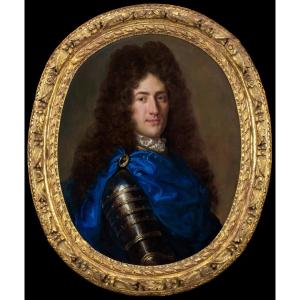
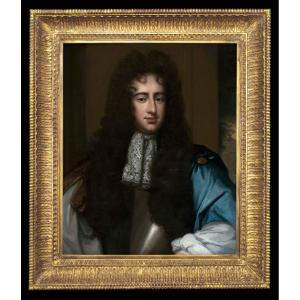
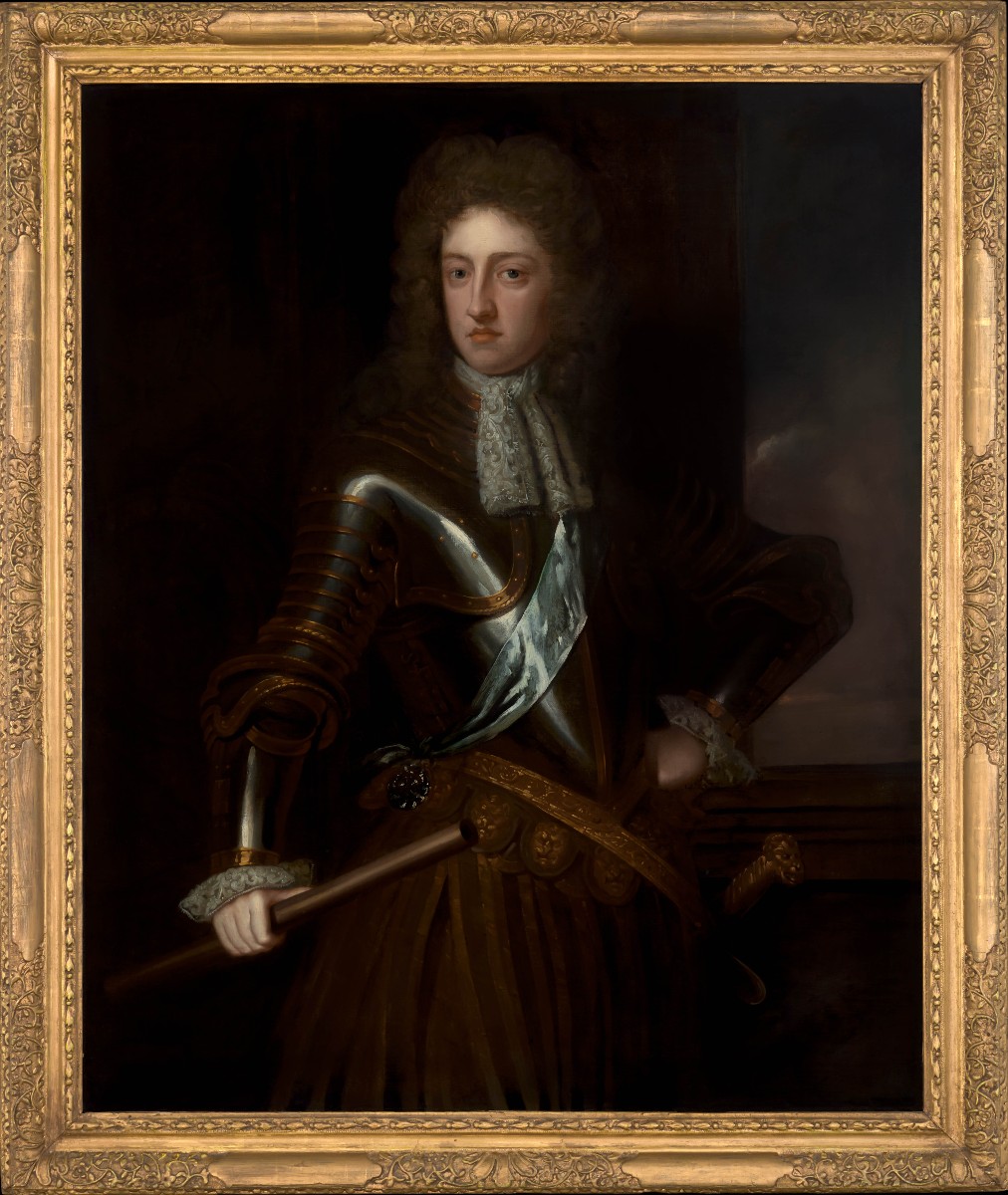
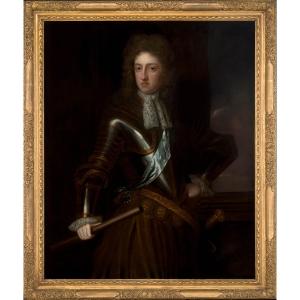
Few portraits embody the visual authority and dynastic symbolism of the late Stuart court as convincingly as this commanding three-quarter-length image of Prince George of Denmark, depicted in gleaming ceremonial armour with the blue ribbon of the Order of the Garter crossing his breast. The painting combines the grand rhetoric of royal portraiture with the refined studio practice of the leading portrait painter of the age, offering collectors a work that not only possesses striking visual presence but also connects directly to the political and cultural world of late seventeenth-century England. Its large scale, authoritative pose and association with the most influential portrait studio of the period ensure both decorative impact and historical significance, making it a portrait that functions equally well as a work of art and as a document of the Stuart court.
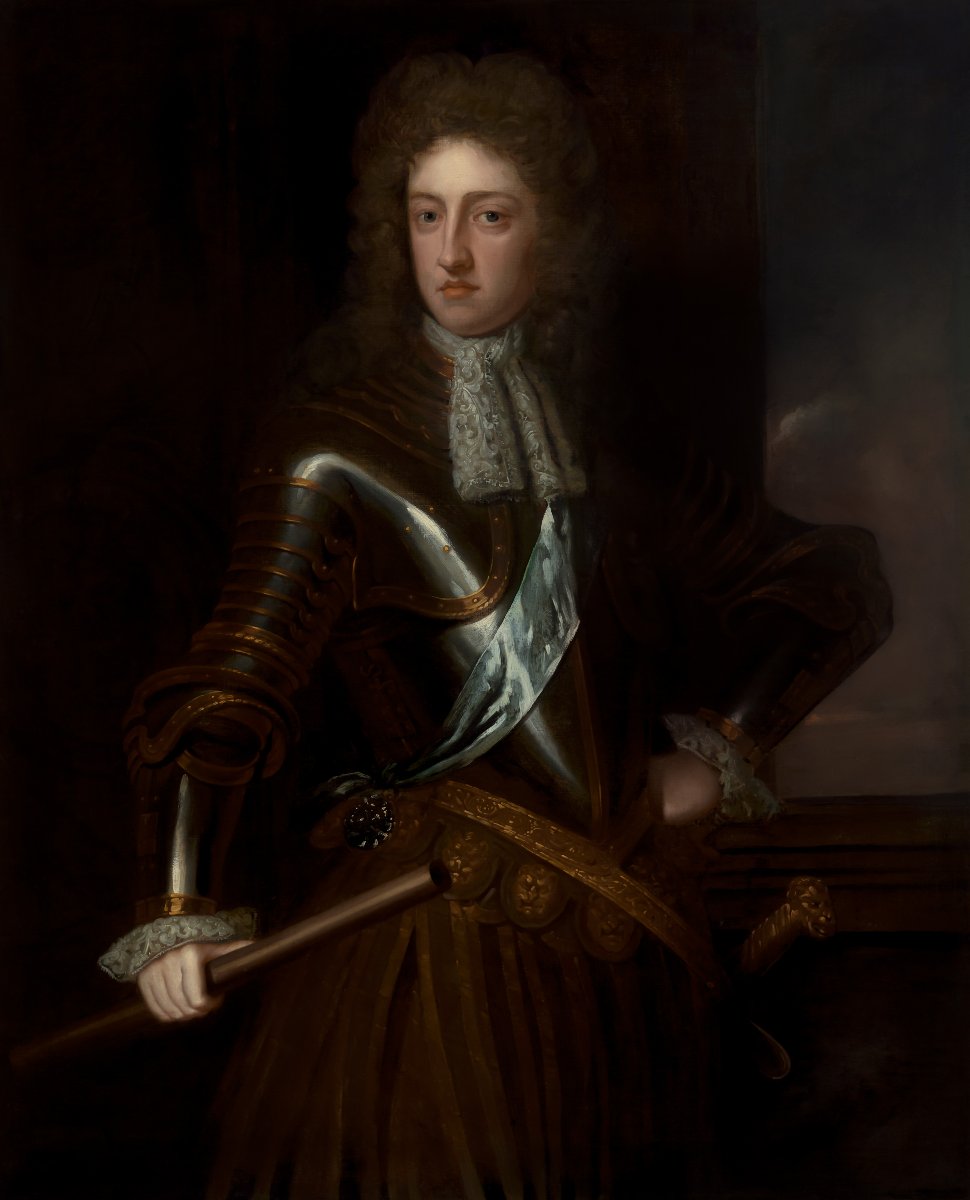
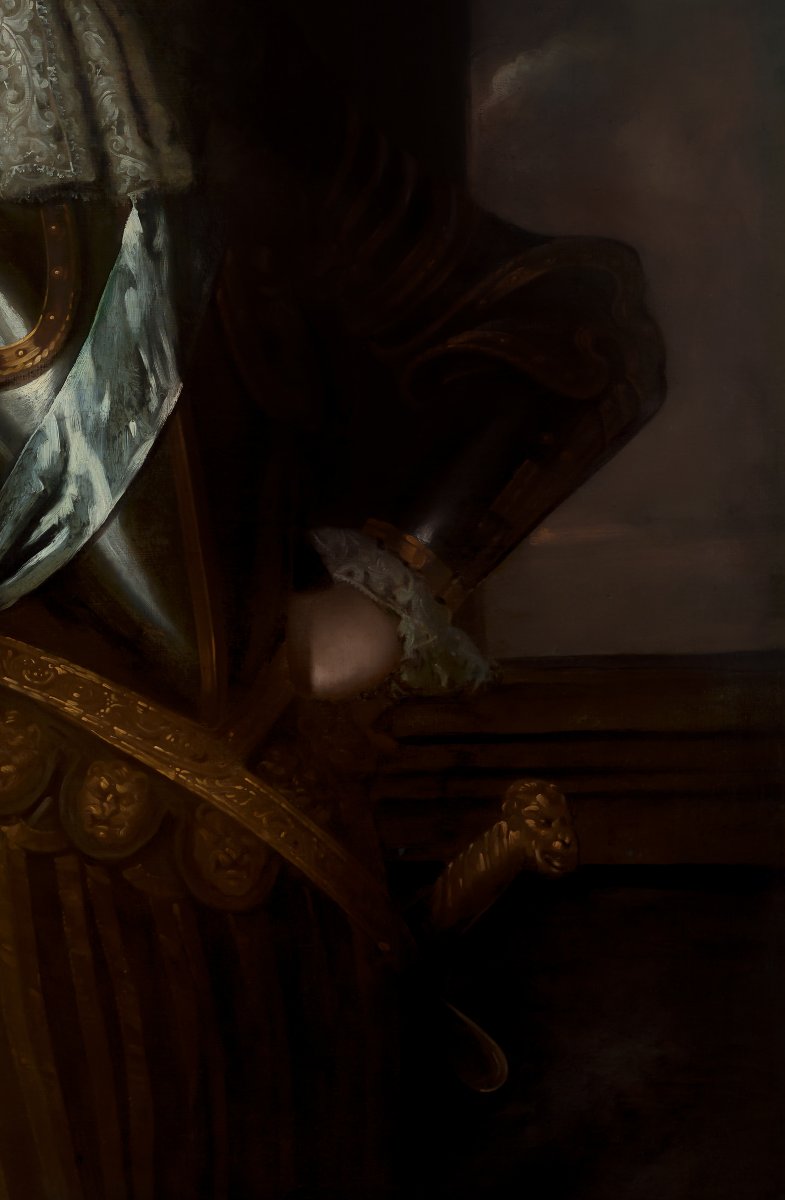
The sitter is shown wearing polished ceremonial armour of the type fashionable in the final decades of the seventeenth century. Such armour, rarely intended for actual combat by this date, was used in portraiture to convey martial virtue and princely authority. The breastplate and articulated shoulder plates gleam with carefully rendered highlights, emphasizing the reflective surfaces of parade armour while projecting an image of strength and command. Draped diagonally across the cuirass is the broad blue ribbon of the Order of the Garter, England’s most prestigious chivalric order, whose members were drawn almost exclusively from the highest ranks of the aristocracy and royal family. The sitter holds a baton of command, another symbol frequently used in portraits of high-ranking military figures and princes to denote authority over armies and the state. Beneath the armour appear the richly textured skirts of a military coat and lace cuffs, while the voluminous periwig — cascading in full curls around the shoulders — reflects the height of aristocratic fashion during the reigns of William III and Mary II. Together these elements firmly place the portrait within the circa 1690–1700 period, when court portraiture in England reached its most sophisticated and internationally influential form.
Prince George of Denmark (1653–1708) was born in Copenhagen, the younger son of King Frederick III of Denmark and Queen Sophie Amalie of Brunswick-Lüneburg. Though not originally destined for a major political role in England, his life became closely intertwined with British history through his marriage to the future queen Anne, Queen of Great Britain, the daughter of James, Duke of York (later James II). The marriage, arranged in 1683, formed part of the broader diplomatic relationships linking the Protestant courts of northern Europe. Despite initial doubts in England regarding the suitability of the Danish prince, the marriage proved to be one of genuine affection and loyalty, with contemporary accounts describing George as a quiet and devoted husband who supported Anne through the complex political upheavals that followed.
The couple’s married life unfolded against one of the most turbulent periods in British history. Just five years after their wedding the Glorious Revolution transformed the political landscape of England, deposing Anne’s father James II and placing her sister Mary and brother-in-law William of Orange on the throne as joint monarchs. Prince George quickly aligned himself with the new regime, thereby securing his position within the evolving Protestant succession. In recognition of his loyalty and royal standing he was created Duke of Cumberland in 1689, and he was invested as a Knight of the Order of the Garter shortly thereafter. These honours elevated him to the highest ranks of the English aristocracy and ensured that he became a prominent figure within the royal court.
Although Prince George held various honorary military titles, including Lord High Admiral later in life, his public reputation rested more on his steadfast support of his wife than on military achievement. The couple suffered great personal tragedy through the loss of numerous children; Anne endured at least seventeen pregnancies, yet only one child, Prince William, Duke of Gloucester, survived beyond infancy, and he too died in 1700. These repeated losses shaped both Anne’s personal life and the future of the English monarchy, ultimately leading to the Act of Settlement of 1701, which secured the Protestant succession through the House of Hanover. After the death of William III in 1702, Anne ascended the throne as queen, making Prince George consort to the sovereign during the early years of the eighteenth century. He died in 1708, four years before Anne herself, leaving behind a reputation for loyalty and quiet integrity.
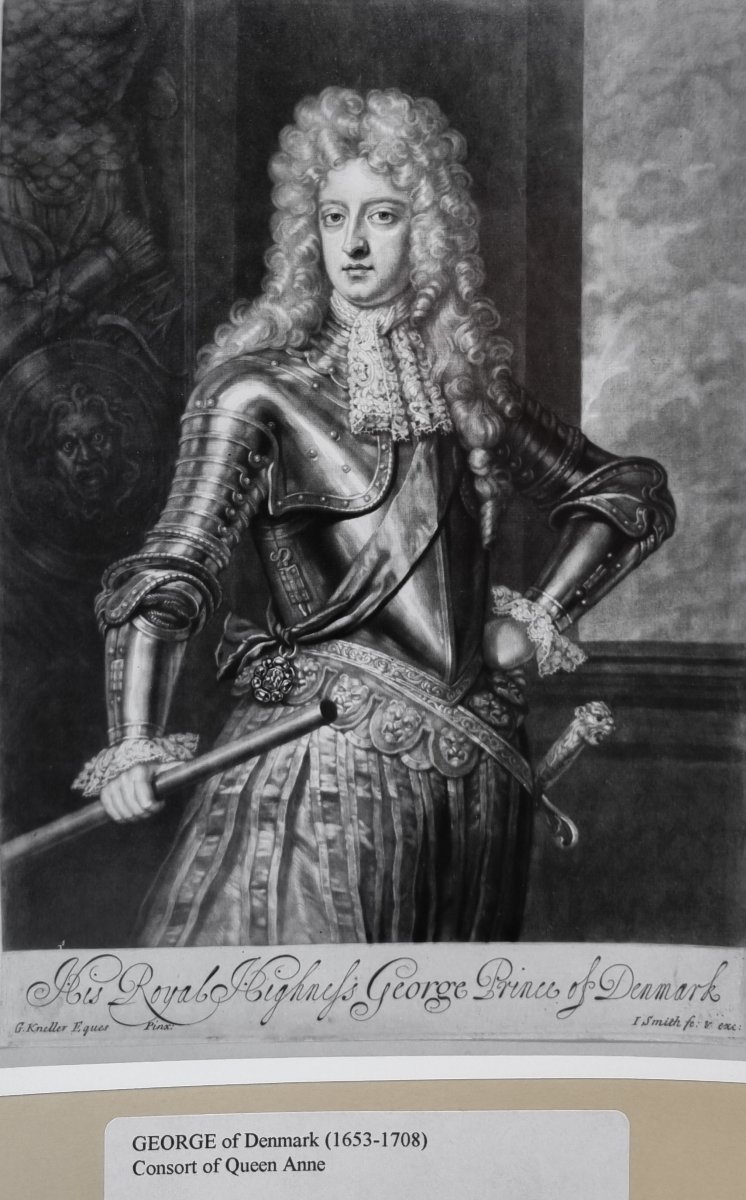
Portraits such as the present work were produced within a thriving art market centred on the studio of Sir Godfrey Kneller, who served as the principal portraitist to the English court from the reign of Charles II through that of George I. Kneller’s workshop functioned on a sophisticated production system capable of supplying portraits of royal and aristocratic sitters to patrons across Britain and Europe. Once a successful composition had been established, it was often reproduced in several studio versions for diplomatic gifts, aristocratic supporters, and prominent country houses. The present portrait corresponds exactly to a known composition engraved by the eminent mezzotint engraver John Smith, whose print of Prince George bears the inscription “G. Kneller pinxt,” confirming that the prototype painting originated with Kneller himself. The engraving, preserved today in the Royal Collection and other major repositories, demonstrates that this portrait type was widely circulated and admired during the late Stuart period.
Such studio portraits were integral to the visual culture of the period, enabling the royal image to be disseminated widely among loyal patrons and aristocratic households. The format — approximately 50 by 40 inches, the standard three-quarter portrait size used by Kneller’s studio — further confirms its place within this tradition.
The painting is presented in a handsome carved and gilded frame eighteenth-century frame, whose rich ornament complements the grandeur of the portrait while harmonising with the dark tonalities of the background and the gleaming armour of the sitter.
As a studio version derived from a documented composition by Sir Godfrey Kneller, depicting the husband of Queen Anne at a pivotal moment in English history, our portrait represents both a striking work of late Stuart portraiture and a tangible connection to the political and dynastic narratives of the period. Its impressive scale, elegant execution, and royal subject ensure strong decorative appeal, while the documented engraved prototype and identifiable sitter provide the depth of historical context prized by collectors, making this painting a desirable example of the grand portraiture that defined the English court at the close of the seventeenth century.
Provenance:
Probably commissioned for a supporter of the court of William III and Queen Anne, England, late 17th century;
By descent in private collections in Britain;
Relined in the 19th century by W. Morrell, London;
Monte Cristo Galleries, Armadale, Victoria, Australia;
Private collection, Australia
Private collection, US
Measurements:
Height 142cm, Width 120cm framed (Height 56”, Width 47.25” framed)
Studio of Sir Godfrey Kneller (1646–1723)
Few portraits embody the visual authority and dynastic symbolism of the late Stuart court as convincingly as this commanding three-quarter-length image of Prince George of Denmark, depicted in gleaming ceremonial armour with the blue ribbon of the Order of the Garter crossing his breast. The painting combines the grand rhetoric of royal portraiture with the refined studio practice of the leading portrait painter of the age, offering collectors a work that not only possesses striking visual presence but also connects directly to the political and cultural world of late seventeenth-century England. Its large scale, authoritative pose and association with the most influential portrait studio of the period ensure both decorative impact and historical significance, making it a portrait that functions equally well as a work of art and as a document of the Stuart court.
The sitter is shown wearing polished ceremonial armour of the type fashionable in the final decades of the seventeenth century. Such armour, rarely intended for actual combat by this date, was used in portraiture to convey martial virtue and princely authority. The breastplate and articulated shoulder plates gleam with carefully rendered highlights, emphasizing the reflective surfaces of parade armour while projecting an image of strength and command. Draped diagonally across the cuirass is the broad blue ribbon of the Order of the Garter, England’s most prestigious chivalric order, whose members were drawn almost exclusively from the highest ranks of the aristocracy and royal family. The sitter holds a baton of command, another symbol frequently used in portraits of high-ranking military figures and princes to denote authority over armies and the state. Beneath the armour appear the richly textured skirts of a military coat and lace cuffs, while the voluminous periwig — cascading in full curls around the shoulders — reflects the height of aristocratic fashion during the reigns of William III and Mary II. Together these elements firmly place the portrait within the circa 1690–1700 period, when court portraiture in England reached its most sophisticated and internationally influential form.
Prince George of Denmark (1653–1708) was born in Copenhagen, the younger son of King Frederick III of Denmark and Queen Sophie Amalie of Brunswick-Lüneburg. Though not originally destined for a major political role in England, his life became closely intertwined with British history through his marriage to the future queen Anne, Queen of Great Britain, the daughter of James, Duke of York (later James II). The marriage, arranged in 1683, formed part of the broader diplomatic relationships linking the Protestant courts of northern Europe. Despite initial doubts in England regarding the suitability of the Danish prince, the marriage proved to be one of genuine affection and loyalty, with contemporary accounts describing George as a quiet and devoted husband who supported Anne through the complex political upheavals that followed.
The couple’s married life unfolded against one of the most turbulent periods in British history. Just five years after their wedding the Glorious Revolution transformed the political landscape of England, deposing Anne’s father James II and placing her sister Mary and brother-in-law William of Orange on the throne as joint monarchs. Prince George quickly aligned himself with the new regime, thereby securing his position within the evolving Protestant succession. In recognition of his loyalty and royal standing he was created Duke of Cumberland in 1689, and he was invested as a Knight of the Order of the Garter shortly thereafter. These honours elevated him to the highest ranks of the English aristocracy and ensured that he became a prominent figure within the royal court.
Although Prince George held various honorary military titles, including Lord High Admiral later in life, his public reputation rested more on his steadfast support of his wife than on military achievement. The couple suffered great personal tragedy through the loss of numerous children; Anne endured at least seventeen pregnancies, yet only one child, Prince William, Duke of Gloucester, survived beyond infancy, and he too died in 1700. These repeated losses shaped both Anne’s personal life and the future of the English monarchy, ultimately leading to the Act of Settlement of 1701, which secured the Protestant succession through the House of Hanover. After the death of William III in 1702, Anne ascended the throne as queen, making Prince George consort to the sovereign during the early years of the eighteenth century. He died in 1708, four years before Anne herself, leaving behind a reputation for loyalty and quiet integrity.
Portraits such as the present work were produced within a thriving art market centred on the studio of Sir Godfrey Kneller, who served as the principal portraitist to the English court from the reign of Charles II through that of George I. Kneller’s workshop functioned on a sophisticated production system capable of supplying portraits of royal and aristocratic sitters to patrons across Britain and Europe. Once a successful composition had been established, it was often reproduced in several studio versions for diplomatic gifts, aristocratic supporters, and prominent country houses. The present portrait corresponds exactly to a known composition engraved by the eminent mezzotint engraver John Smith, whose print of Prince George bears the inscription “G. Kneller pinxt,” confirming that the prototype painting originated with Kneller himself. The engraving, preserved today in the Royal Collection and other major repositories, demonstrates that this portrait type was widely circulated and admired during the late Stuart period.
Such studio portraits were integral to the visual culture of the period, enabling the royal image to be disseminated widely among loyal patrons and aristocratic households. The format — approximately 50 by 40 inches, the standard three-quarter portrait size used by Kneller’s studio — further confirms its place within this tradition.
The painting is presented in a handsome carved and gilded frame eighteenth-century frame, whose rich ornament complements the grandeur of the portrait while harmonising with the dark tonalities of the background and the gleaming armour of the sitter.
As a studio version derived from a documented composition by Sir Godfrey Kneller, depicting the husband of Queen Anne at a pivotal moment in English history, our portrait represents both a striking work of late Stuart portraiture and a tangible connection to the political and dynastic narratives of the period. Its impressive scale, elegant execution, and royal subject ensure strong decorative appeal, while the documented engraved prototype and identifiable sitter provide the depth of historical context prized by collectors, making this painting a desirable example of the grand portraiture that defined the English court at the close of the seventeenth century.
Provenance:
Probably commissioned for a supporter of the court of William III and Queen Anne, England, late 17th century;
By descent in private collections in Britain;
Relined in the 19th century by W. Morrell, London;
Monte Cristo Galleries, Armadale, Victoria, Australia;
Private collection, Australia
Private collection, US
Measurements:
Height 142cm, Width 120cm framed (Height 56”, Width 47.25” framed)
13 250 €
Period: 17th century
Style: Louis 14th, Regency
Condition: Excellent condition
Material: Oil painting
Width: 120
Height: 142
Depth: 8
Reference (ID): 1719288
Availability: In stock
Print