THIS OBJECT WAS SOLD
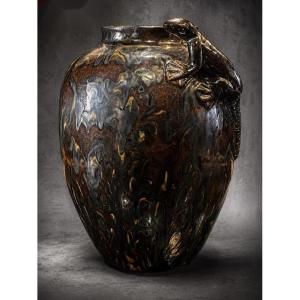
Neo-greek Vase By Pierre Almès At Bacs Golfe Juan ~1922. Barol, Ciboure, Massier Floutier
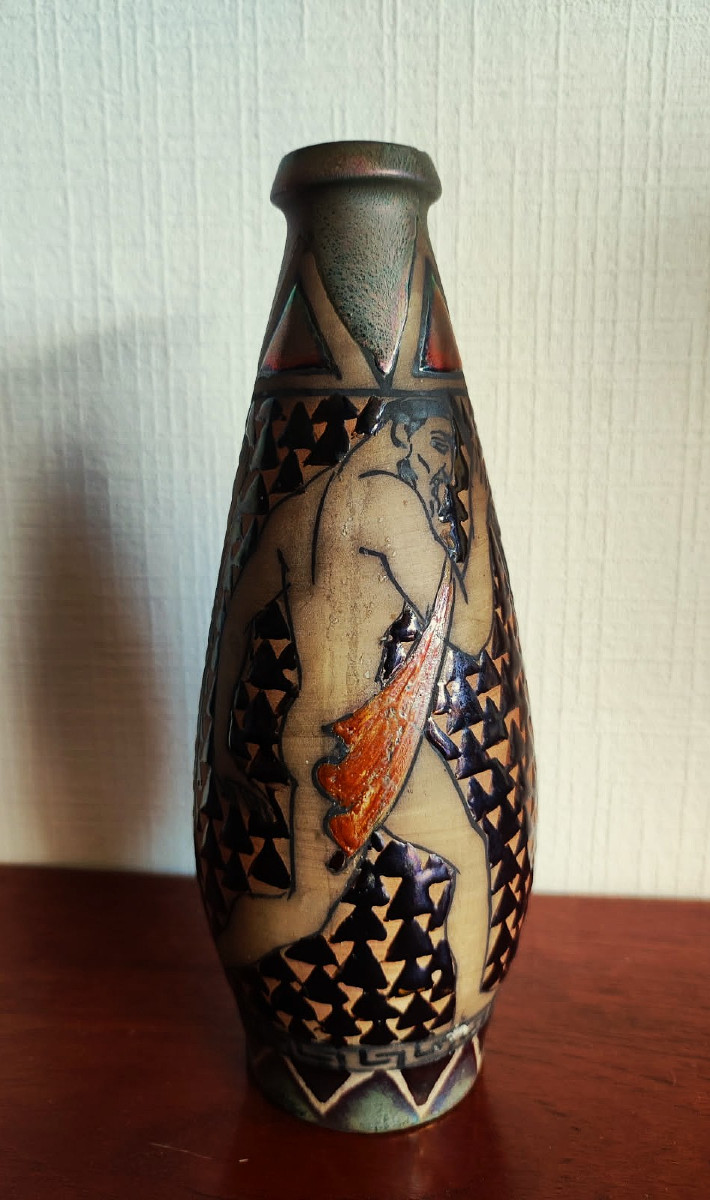
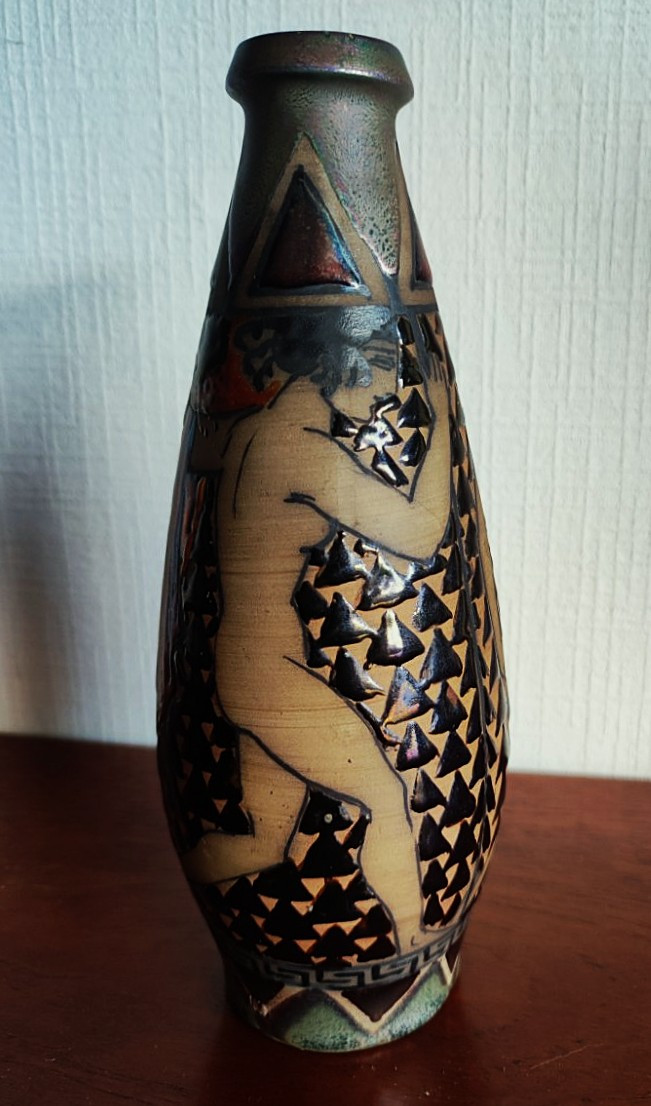
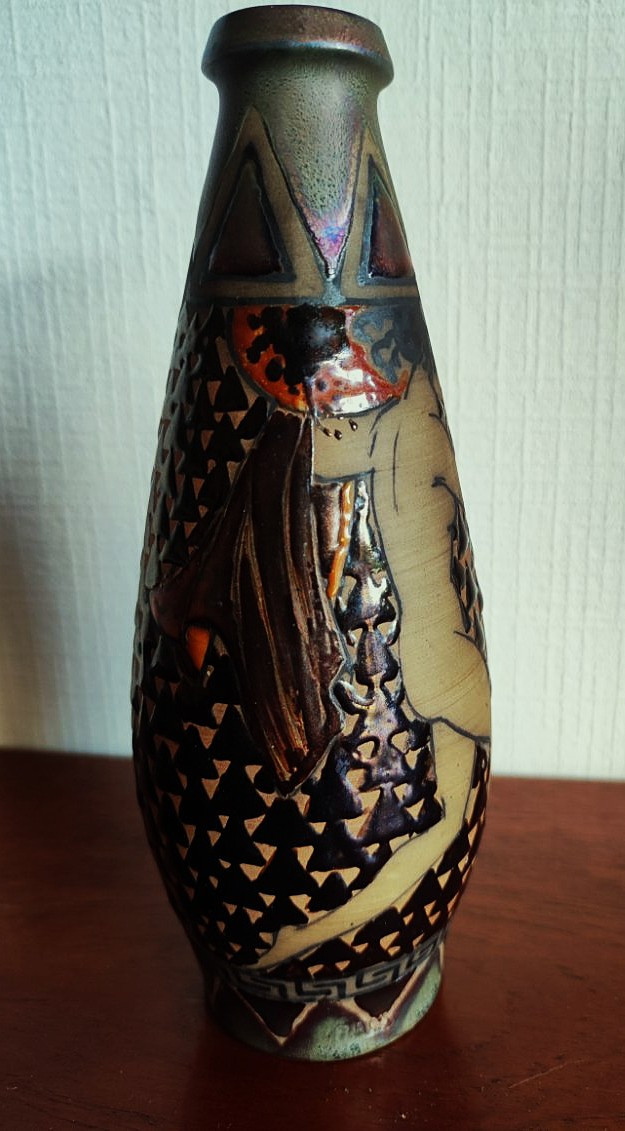
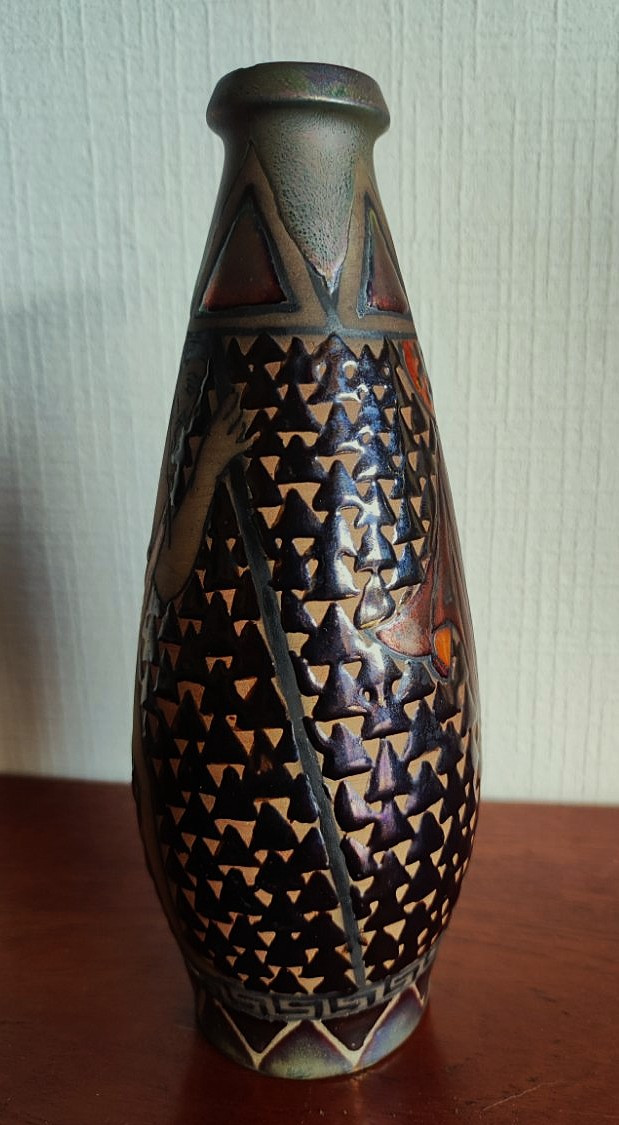
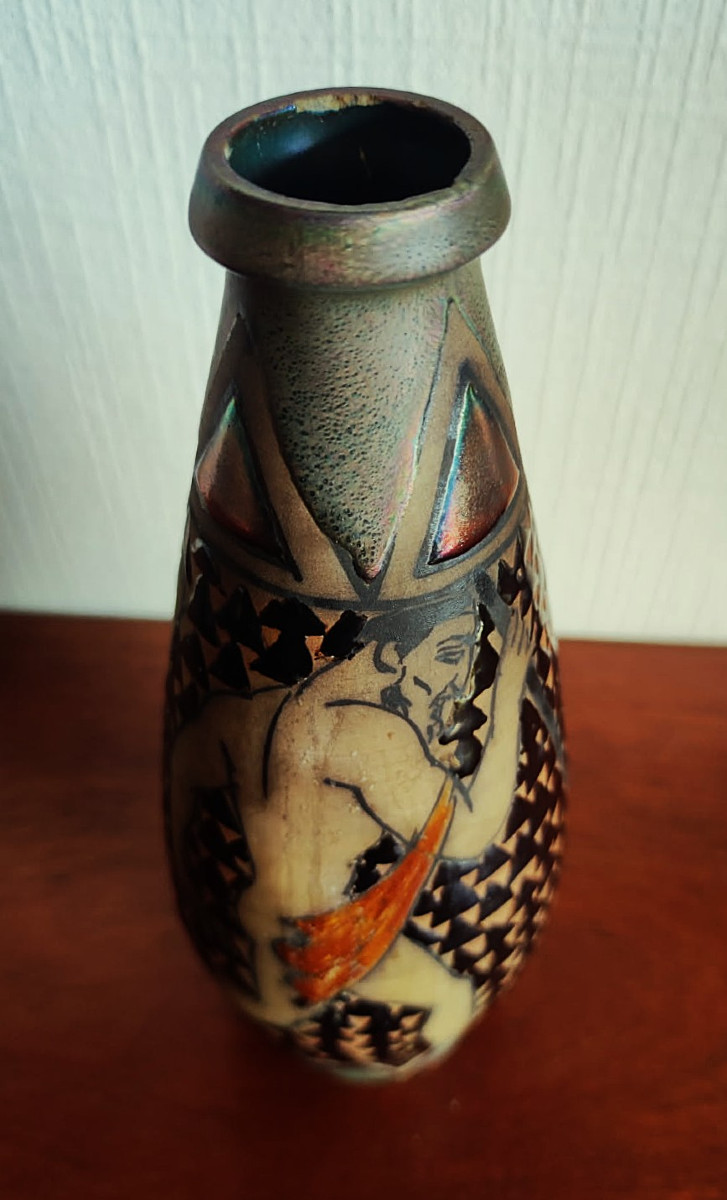
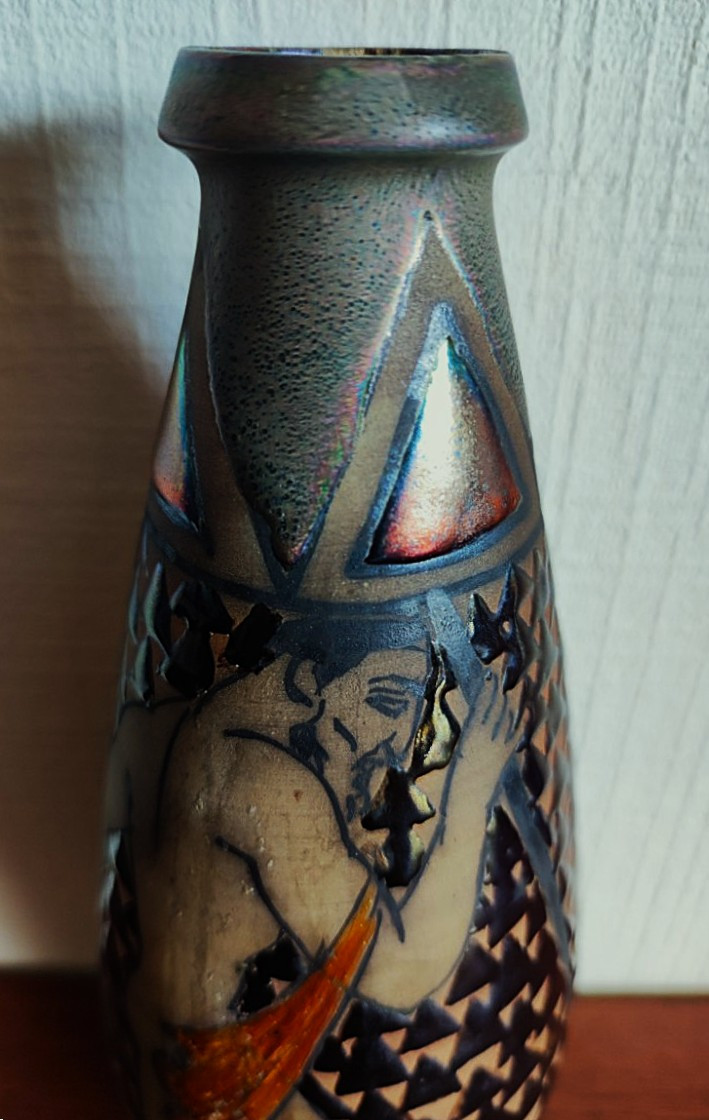

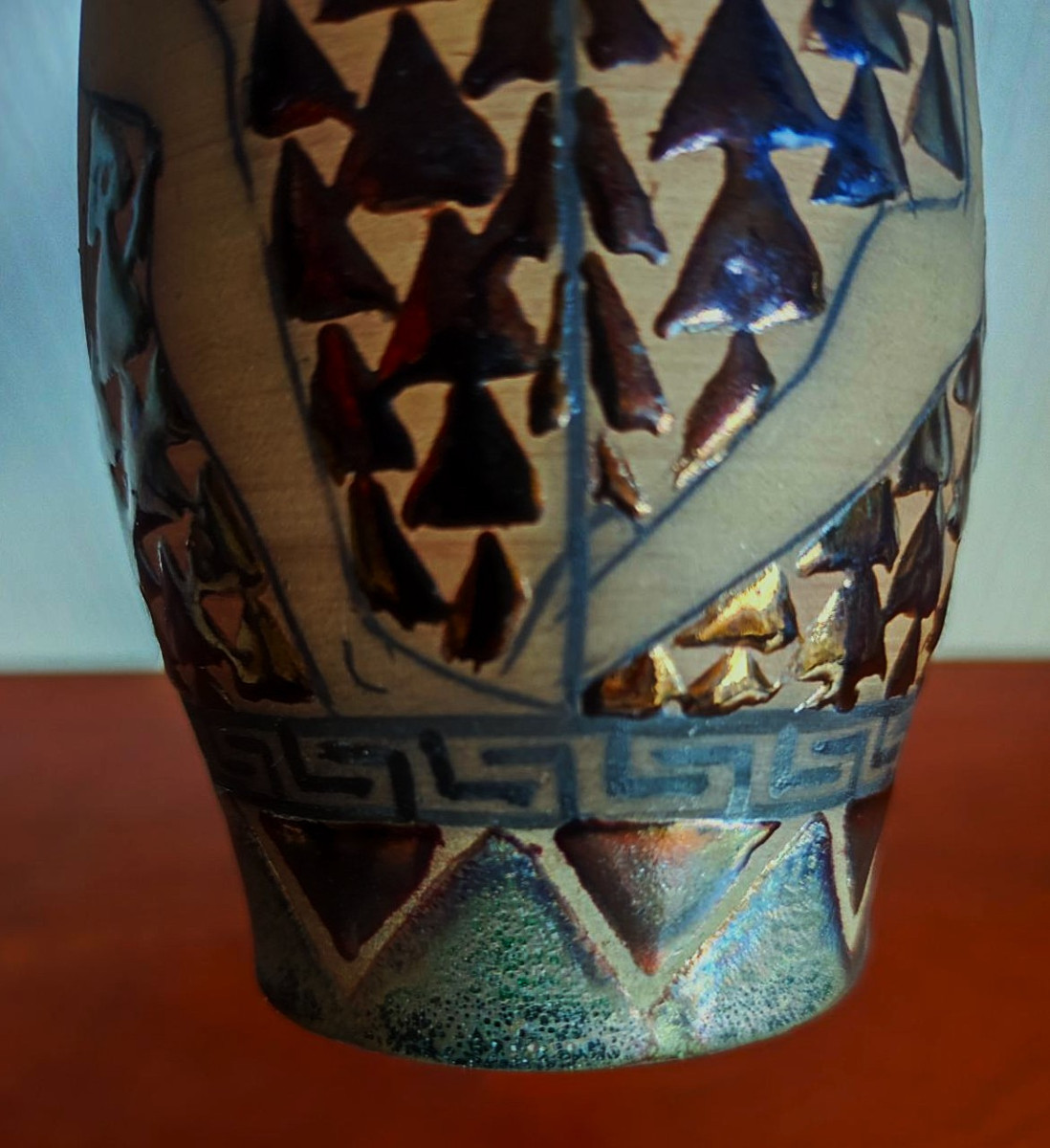

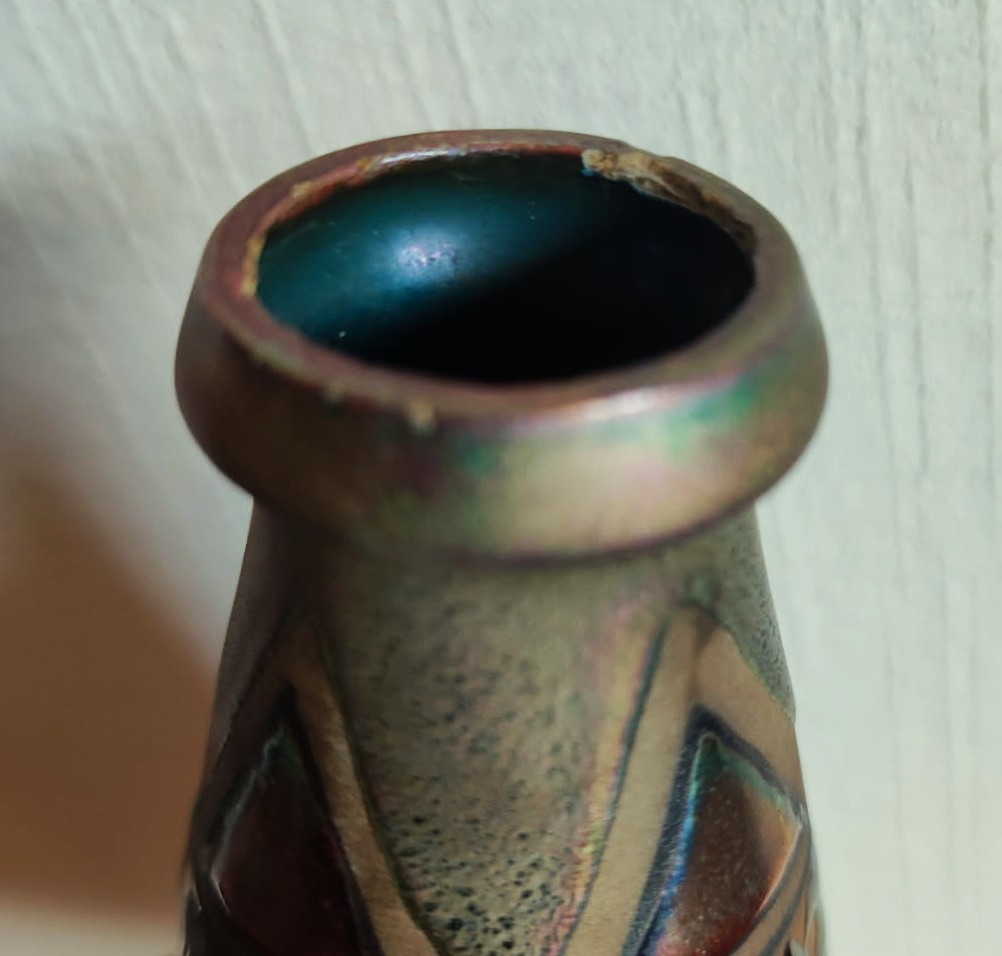
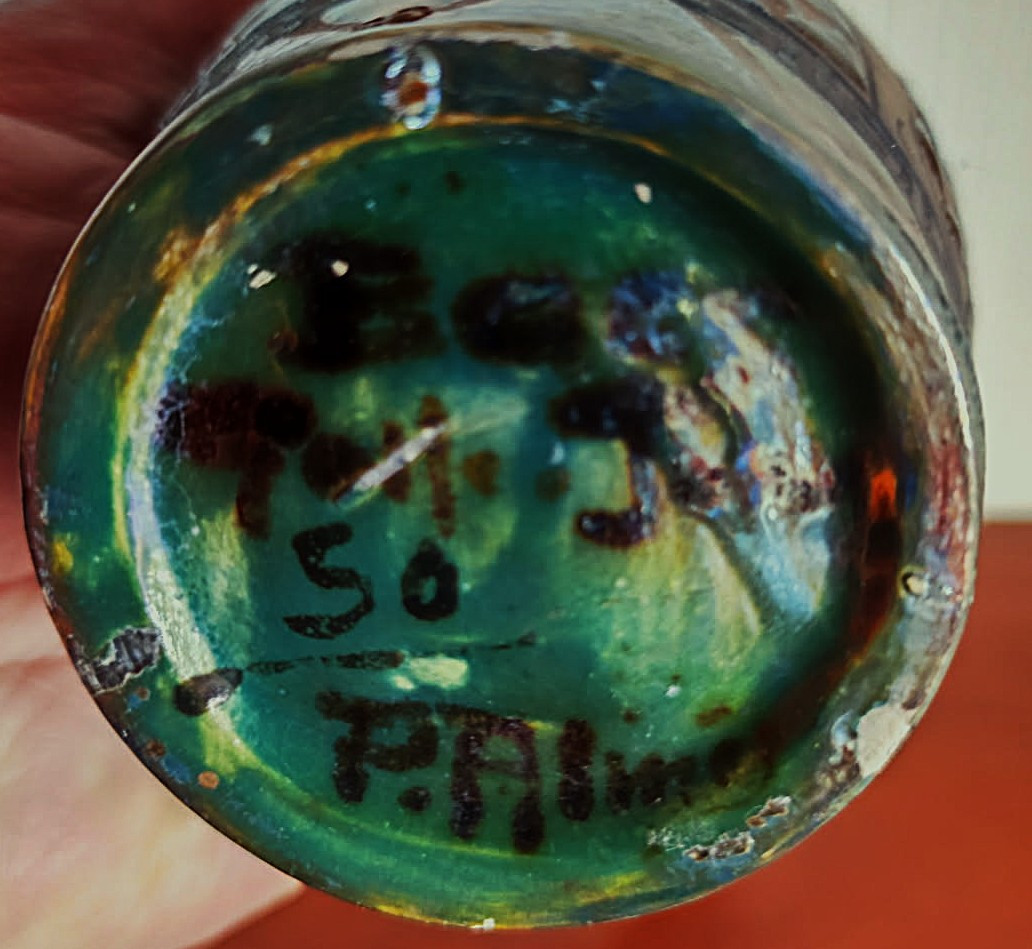
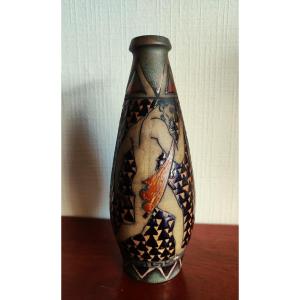


An extremely rare and exquisite stoneware vase from the BACS workshop in Golfe Juan, decorated by Pierre Almès circa 1922-1924. Signed by hand underneath: Bacs Golfe Juan + Pierre Almès + the number 50 + the impressed BACS stamp near the base. Height: 19 cm. In very good condition; I note only slight wear inside the neck and underneath, that's all. No cracks or repairs. This is a very rare and magnificent ceramic vase made by Pierre Almès in the BACS workshop in Golfe Juan around 1922/24. It features a beautiful decoration of two dancing figures, a man and a woman, in the Neo-Greek style, along with geometric motifs such as triangles, and a small Greek frieze at the base of the vase. Almès skillfully plays with the raw clay and superb flamed and iridescent glazes in shades of green and mauve, as well as touches of vermilion red; the interior and underside are green. One immediately thinks of Pierre Almès's work at Ciboure in the Basque Country, extremely similar in terms of decoration, although Ciboure does not use iridescent glazes. Pierre Edmond Guillaume Almes, born in Béziers on November 10, 1880, and died on December 17, 1944, in Saint-Jean-de-Luz,was a French painter, watercolorist, poster artist, and ceramicist. Hepainted banners for the Cannes Film Festival, Mediterranean landscapes, and views of the Basque Country. A student of Fernand Cormon, a member of the Salon des Artistes Français (where he won a silver medal), he exhibited in Toulon, Cannes, Nice, Bayonne, and Saint-Jean-de-Luz. He is known as a ceramic decorator, a field in which he excelled, particularly in adding figures to the rounded forms of vases. He created stoneware from the Ciboure pottery in the Basque Country, as well as glazed earthenware from the Bacs workshop in Golfe-Juan on the French Riviera. For these pieces, he combined the iridescent enamel of the Massier school with his decorating skills, depicting Neo-Greek figures and landscapes of the French Riviera. A 2020 exhibition at the Bayonne Museum of Art and History sheds further light on his artistic journey.A friend of Louis Floutier, whom he met at Fernand Cormon's, he was offered a job in Ciboure at the pottery he was founding with Étienne Vilotte and the potter Lecas, which he did in 1920. During this time, he signed a few pieces decorated in the Greek style, then returned to the southeast, to Cannes, to work in the Bacs workshop in Golfe Juan from 1922 to 1924. Pieces from this period are therefore very rare. From 1924 onwards, he returned to decorating stoneware pieces by E. Vilotte, most of them unsigned at Vilotte's request. However, a few ceramics with Basque decoration were again signed P. Almès around 1930/1935. The absence of signatures from the decorators, due to theregistration of the EV trademark in May 1922, applies to Pierre Almès just as much as to the other ceramists who worked for ÉtienneVilotte in the 1920s and 1930s, which can make the attribution of the works difficult. However, in Severine Berger's book, *La poterie de Ciboure 1919-1945*, dedicated to the first period of the pottery, the Almès style is defined as easily recognizable: "a fairly firm style, the well-accentuated movements nevertheless remain harmonious, and above all, there is a very particular rendering of the profiles, heads, and necks." Furthermore, besides the BACS vase, another example signed by Pierre Almès from the BACS period is reproduced on page 67 in Edgard Pelichet's book (Grand Pont Lausanne editions), *La céramique art déco*, which allows us to make progress in identifying later, unsigned models produced after 1924 in Ciboure, by showing two types of subjects that the artist would revisit: figures with baskets of fruit, and dancers with tambourines or cymbals, sometimes with a stole elegantly draped over the shoulder or arm. Pierre Almès, by liberating the forms and movement of the figures, is the one who, along with Jean Léon, contributed most to the transformation of the classical style towards the Art Deco aesthetic, as early as 1922, by stylizing and sublimating the sensuality of male and female bodies, sometimes with a touch of humor. As for the BACS workshop, it is said to have operated from 1912 to 1914, but this is a mistake; it must have been 1924, as evidenced by the sets designed by Pierre Almès. BACS is the acronym for Barel, Alexandre (the set designer for Jérôme Massier), Carle, and Sicard. The workshop was located in the "Manoir Eden-Roc" in Golfe-Juan, at the expense of its owner, a wealthy philanthropist. Founded by Jean Barol (1873-1966) after his departure from the prestigiousManufacture Clément Massier, the acronym BACS reflects the association of exceptional talents: JeanBarol, Marius Alexandre (1880-1959), former decorator for JérômeMassier, Jean Carle, and François Sicard (1850-1942). Together,
Explore similar pieces and discover your ideal find:
other ceramics