THIS OBJECT WAS SOLD
Clock Allegory Of Correspondence
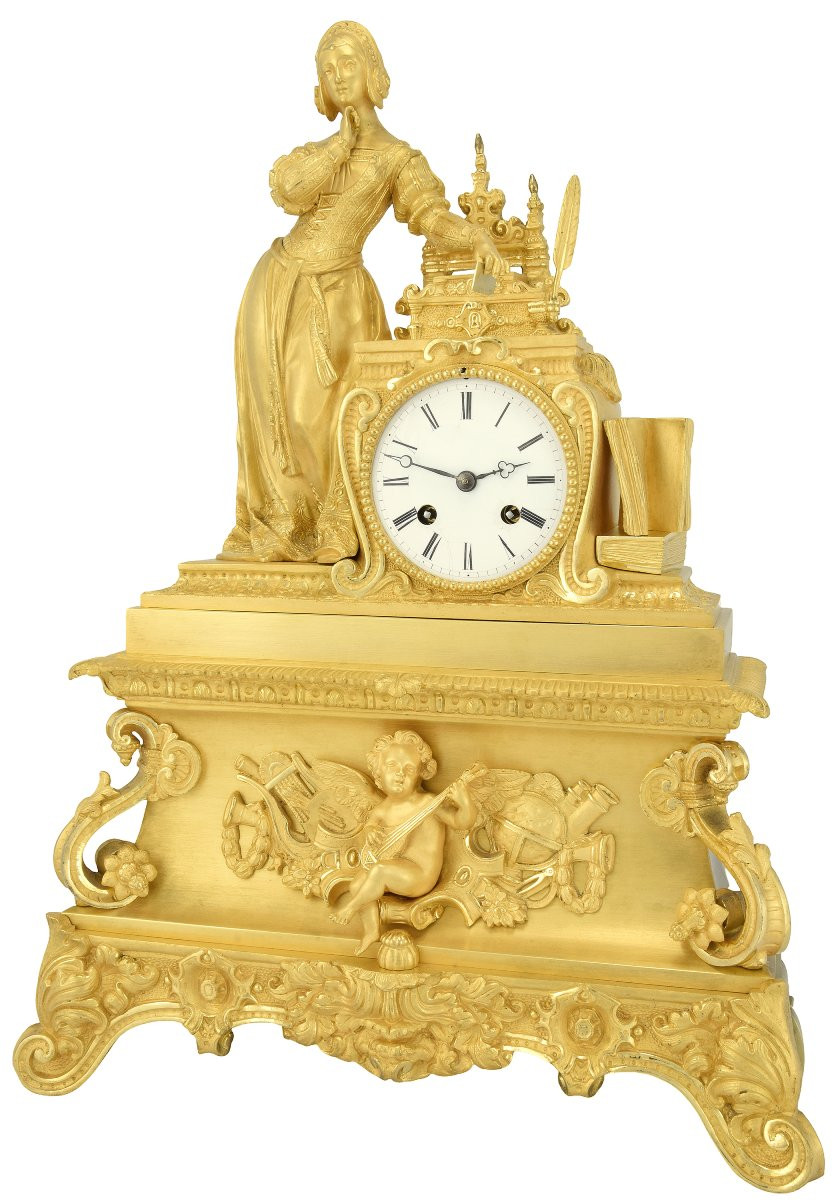






A remarkable Louis-Philippe period clock (circa 1850-1860), this
refined piece reflects the historicist taste of the 19th century,
drawing inspiration from Renaissance aesthetics. It unfolds a veritable
narrative scene, both intimate and erudite, where the mercury-gilt
bronze architecture serves as a setting for a poetic evocation of
knowledge, writing, and the arts.
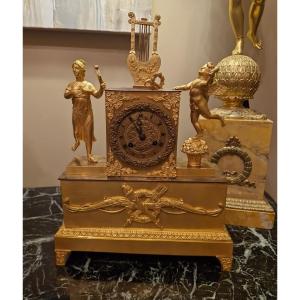
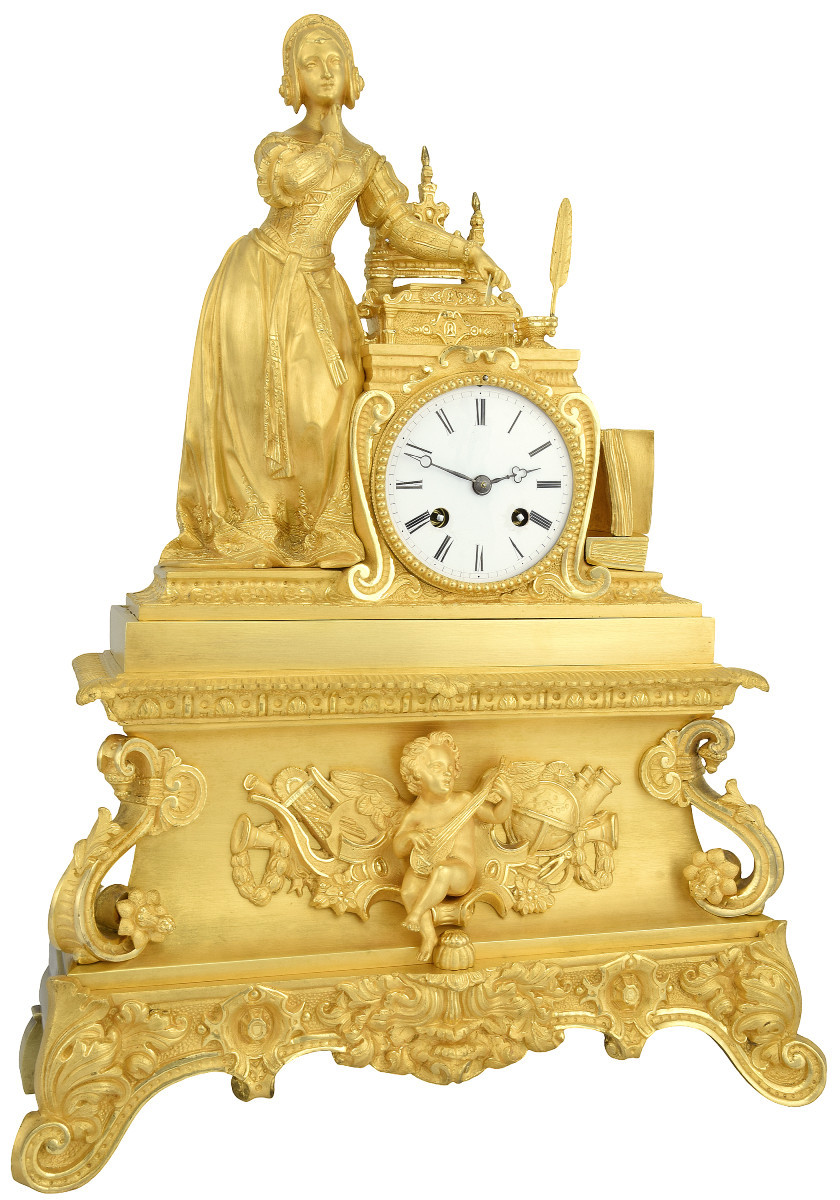
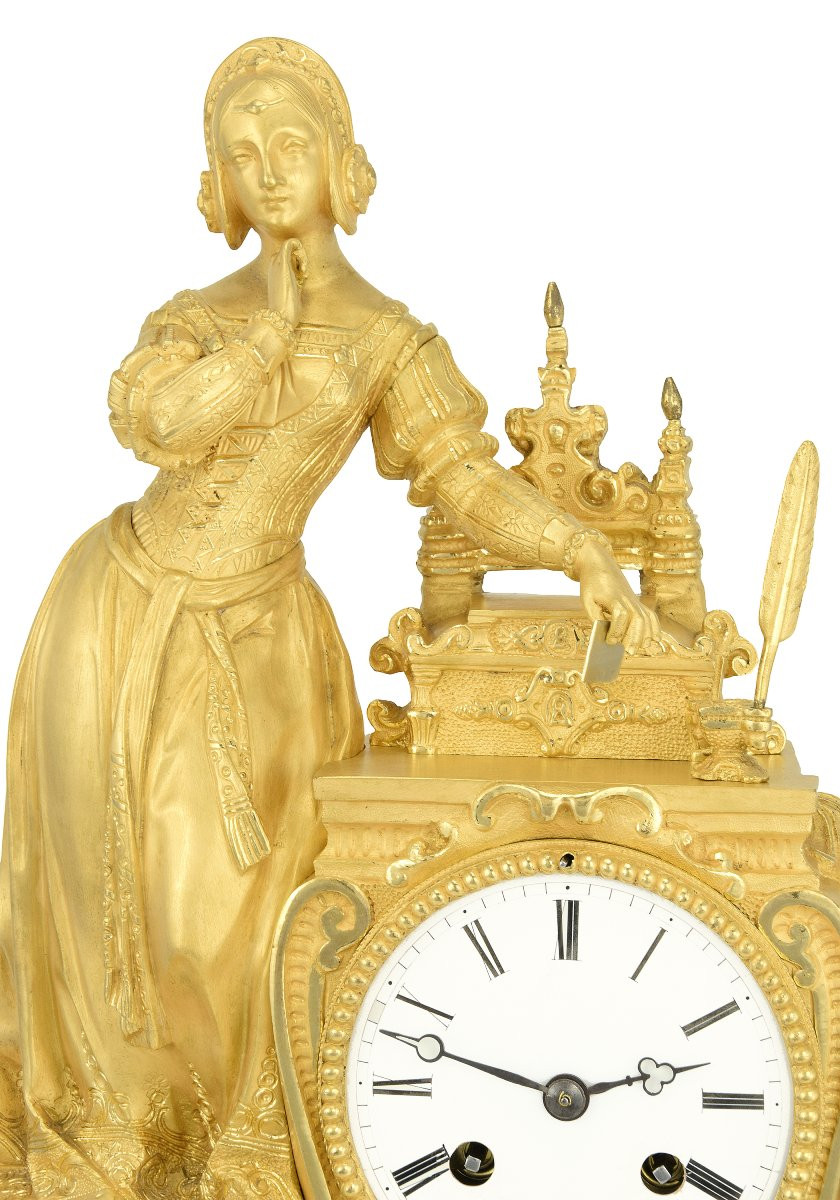
The composition is organized around a stylized Renaissance study or study, subtly suggested by the presence of a finely crafted lockbox placed atop the clock. This small, symbolic piece, treated like a precious chest, evokes the preservation of letters, secrets, or intimate thoughts. Beside it, an inkwell topped with a quill completes this scholarly world, embodying the act of writing, transmitting, and creating.
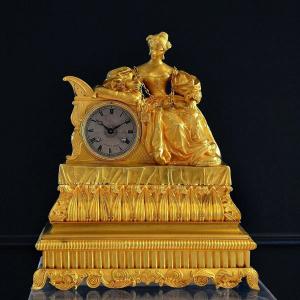
A richly dressed female figure, inspired by the elegance of the Renaissance in the style of the 16th century. Draped in a gown with ample, meticulously carved folds, she adopts a graceful and meditative pose, holding a letter in a suspended gesture, as if caught in the act of reading or in the moment before the reply—a subtle allegory of correspondence, intellect, or discreet love. Her serene face, with its idealized features, is framed by a finely ornamented headdress, while the treatment of the costume reveals remarkable craftsmanship: embroidery, braid, floral motifs, and textile textures are rendered with exceptional precision.
The enamel dial integrates harmoniously into this setting, framed by architectural and ornamental motifs inspired by the Renaissance: beaded friezes, scrolls, cartouches, and volutes compose a rich yet perfectly balanced decoration.
In the lower section, the piece rests on a flowing base with generous scrolls, punctuated by volute-shaped brackets and richly sculpted vegetal ornamentation. A delicately modeled winged putto, seated at the heart of a decorative trophy, plays a stringed instrument. He is surrounded by scholarly attributes—globes, books, instruments—forming an allegory of the arts and sciences. This lower register engages in a dialogue with the upper scene, creating a thematic continuity between music, study, and writing.
The quality of execution is remarkable: the extremely fine chasing highlights every detail, from the textile textures to the most minute decorative elements. The mercury gilding provides a warm and deep light, characteristic of high-quality art bronzes.
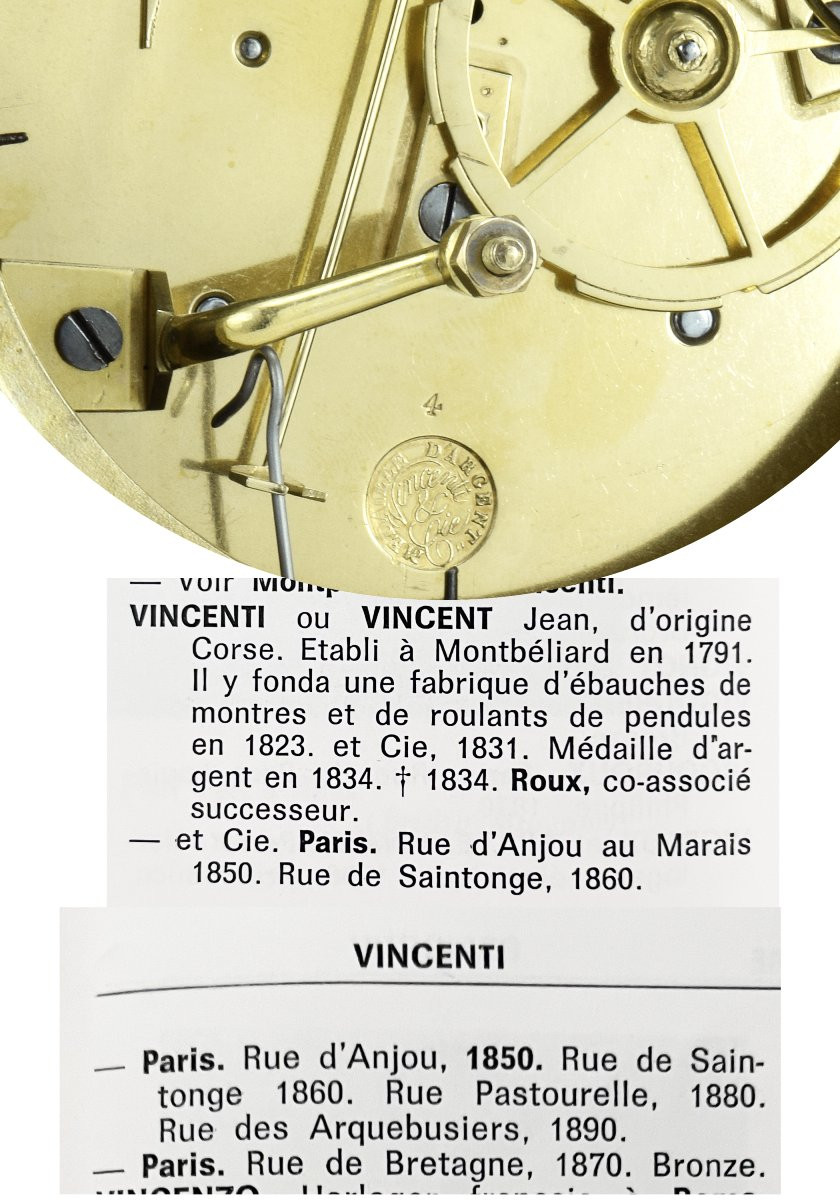
Technically, the movement is stamped "Vincenti et Cie," a prestigious watchmaking house listed in Tardy's dictionary of watchmakers, a guarantee of authenticity and reliability. This signature attests to a highly precise mechanism, typical of the finest French production of the period.
This clock is more than just a timekeeping instrument: it tells a story. It depicts a moment suspended in an idealized study, where a young woman, pen and letter in hand, embodies the spirit of the Renaissance as revisited by the 19th century—a sensitive tribute to knowledge, intimacy, and timeless elegance.
The original mechanism is intact and unaltered, with a wire suspension. The hour and half-hour strikes are played on an antique bell, producing a clear and authentic sound.
ORDERING AND ADDITIONAL INFORMATION FROM OUR WEBSITE
The composition is organized around a stylized Renaissance study or study, subtly suggested by the presence of a finely crafted lockbox placed atop the clock. This small, symbolic piece, treated like a precious chest, evokes the preservation of letters, secrets, or intimate thoughts. Beside it, an inkwell topped with a quill completes this scholarly world, embodying the act of writing, transmitting, and creating.
A richly dressed female figure, inspired by the elegance of the Renaissance in the style of the 16th century. Draped in a gown with ample, meticulously carved folds, she adopts a graceful and meditative pose, holding a letter in a suspended gesture, as if caught in the act of reading or in the moment before the reply—a subtle allegory of correspondence, intellect, or discreet love. Her serene face, with its idealized features, is framed by a finely ornamented headdress, while the treatment of the costume reveals remarkable craftsmanship: embroidery, braid, floral motifs, and textile textures are rendered with exceptional precision.
The enamel dial integrates harmoniously into this setting, framed by architectural and ornamental motifs inspired by the Renaissance: beaded friezes, scrolls, cartouches, and volutes compose a rich yet perfectly balanced decoration.
In the lower section, the piece rests on a flowing base with generous scrolls, punctuated by volute-shaped brackets and richly sculpted vegetal ornamentation. A delicately modeled winged putto, seated at the heart of a decorative trophy, plays a stringed instrument. He is surrounded by scholarly attributes—globes, books, instruments—forming an allegory of the arts and sciences. This lower register engages in a dialogue with the upper scene, creating a thematic continuity between music, study, and writing.
The quality of execution is remarkable: the extremely fine chasing highlights every detail, from the textile textures to the most minute decorative elements. The mercury gilding provides a warm and deep light, characteristic of high-quality art bronzes.
Technically, the movement is stamped "Vincenti et Cie," a prestigious watchmaking house listed in Tardy's dictionary of watchmakers, a guarantee of authenticity and reliability. This signature attests to a highly precise mechanism, typical of the finest French production of the period.
This clock is more than just a timekeeping instrument: it tells a story. It depicts a moment suspended in an idealized study, where a young woman, pen and letter in hand, embodies the spirit of the Renaissance as revisited by the 19th century—a sensitive tribute to knowledge, intimacy, and timeless elegance.
The original mechanism is intact and unaltered, with a wire suspension. The hour and half-hour strikes are played on an antique bell, producing a clear and authentic sound.
ORDERING AND ADDITIONAL INFORMATION FROM OUR WEBSITE
Explore similar pieces and discover your ideal find:
Mantel Clocks