
Ernst Carl Walter Retzlaff (berlin, 1898 – Detmold, 1976), Alpine Landscape With Cabin
Ernst Carl Walter Retzlaff (Berlin, 1898 – Detmold, 1976)
Alpine landscape with cabin
Oil on canvas, 69 x 79.5 cm – with frame, 89 x 98 cm
Signed bottom right
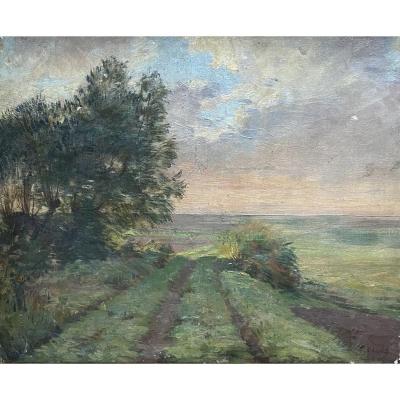
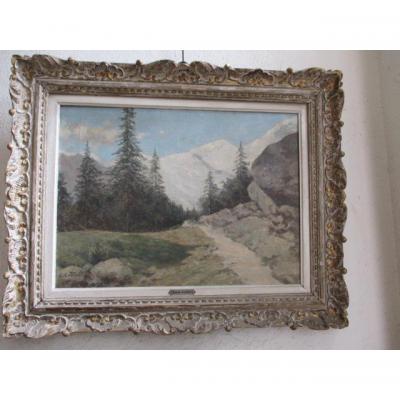
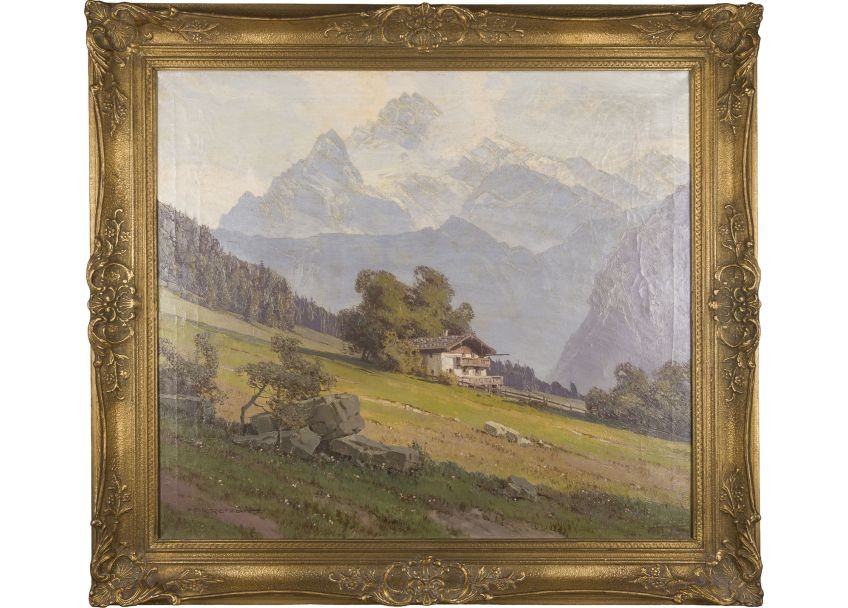
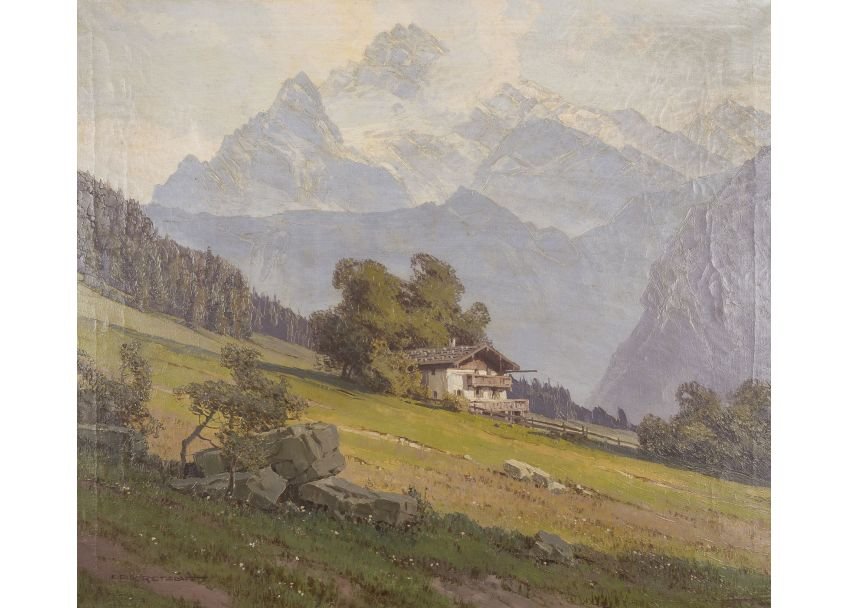
Ernst Carl Walter Retzlaff's oil on canvas painting Alpine Landscape with Cabin represents an exemplary synthesis of the poetics of an artist who knew how to navigate the currents of late Impressionism and realism with a rare coherence. Born in Berlin in 1898, Retzlaff devoted much of his career to celebrating the natural world, finding his subjects of choice in the Lippe region and the majestic peaks of the Alps. This work, characterized by a diffused and almost ethereal light, captures the very essence of mountain stasis, conveying that feeling of deep and immutable silence that is typical of his production. The composition is divided into diagonal planes that guide the observer's eye from the foreground, marked by rocky outcrops and low, arid vegetation, towards the heart of the scene, where a typical alpine hut stands protected by a small group of trees. The building, with its wooden balcony and sloping roof, serves as a human hub in a setting dominated by wilderness, symbolizing a harmonious and non-invasive bond between man and the environment. In the background, the peaks emerge among the mists and clouds with bluish and purplish hues, gradually fading. Retzlaff's technique here reveals his mastery of the pictorial material: the brushstrokes are decisive but at the same time capable of delicate nuances, especially in the rendering of the atmospheric vapors that envelop the rocky peaks. Although the artist lived through the century of the great avant-garde and formal ruptures, this canvas demonstrates his desire to remain faithful to a figurative representation that privileges feeling and contemplation over abstract experimentation. As an active member of the Lippischer Künstlerbund, Retzlaff helped keep alive a regional artistic tradition that saw landscape not only as an aesthetic subject, but as a cultural and identity value to be preserved, especially in the complex historical phases of the post-World War II period. The Lippisches Landesmuseum in Detmold today preserves the legacy of this painter, recognizing in works like this the ability to stop time and restore the poetic dignity of the mountain. The skillful use of contrasts between the warmth of the earth in the foreground and the cold of the perennial snows creates a chromatic balance that invites reflection, making the canvas not a simple postcard-like view, but a spiritual testimony to the grandeur of nature. In this vision, Retzlaff confirms himself as a master of landscape, capable of transforming a realistic observation into a visual narrative dense with atmosphere and charged with a serene melancholy that continues to dialogue with the contemporary observer through the purity of his light.
Alpine landscape with cabin
Oil on canvas, 69 x 79.5 cm – with frame, 89 x 98 cm
Signed bottom right
Ernst Carl Walter Retzlaff's oil on canvas painting Alpine Landscape with Cabin represents an exemplary synthesis of the poetics of an artist who knew how to navigate the currents of late Impressionism and realism with a rare coherence. Born in Berlin in 1898, Retzlaff devoted much of his career to celebrating the natural world, finding his subjects of choice in the Lippe region and the majestic peaks of the Alps. This work, characterized by a diffused and almost ethereal light, captures the very essence of mountain stasis, conveying that feeling of deep and immutable silence that is typical of his production. The composition is divided into diagonal planes that guide the observer's eye from the foreground, marked by rocky outcrops and low, arid vegetation, towards the heart of the scene, where a typical alpine hut stands protected by a small group of trees. The building, with its wooden balcony and sloping roof, serves as a human hub in a setting dominated by wilderness, symbolizing a harmonious and non-invasive bond between man and the environment. In the background, the peaks emerge among the mists and clouds with bluish and purplish hues, gradually fading. Retzlaff's technique here reveals his mastery of the pictorial material: the brushstrokes are decisive but at the same time capable of delicate nuances, especially in the rendering of the atmospheric vapors that envelop the rocky peaks. Although the artist lived through the century of the great avant-garde and formal ruptures, this canvas demonstrates his desire to remain faithful to a figurative representation that privileges feeling and contemplation over abstract experimentation. As an active member of the Lippischer Künstlerbund, Retzlaff helped keep alive a regional artistic tradition that saw landscape not only as an aesthetic subject, but as a cultural and identity value to be preserved, especially in the complex historical phases of the post-World War II period. The Lippisches Landesmuseum in Detmold today preserves the legacy of this painter, recognizing in works like this the ability to stop time and restore the poetic dignity of the mountain. The skillful use of contrasts between the warmth of the earth in the foreground and the cold of the perennial snows creates a chromatic balance that invites reflection, making the canvas not a simple postcard-like view, but a spiritual testimony to the grandeur of nature. In this vision, Retzlaff confirms himself as a master of landscape, capable of transforming a realistic observation into a visual narrative dense with atmosphere and charged with a serene melancholy that continues to dialogue with the contemporary observer through the purity of his light.
1 600 €
Period: 20th century
Style: Other Style
Condition: Good condition
Material: Oil painting
Width: 79,5
Height: 69
Reference (ID): 1739043
Availability: In stock
Print