






Flemish Painter, Late 17th Century, Landscape With Shepherd And Waterfall
Flemish painter, late 17th century
Landscape with shepherd and waterfall
Oil on canvas, 61 x 97.5 cm
With the frame, 78 x 114 cm
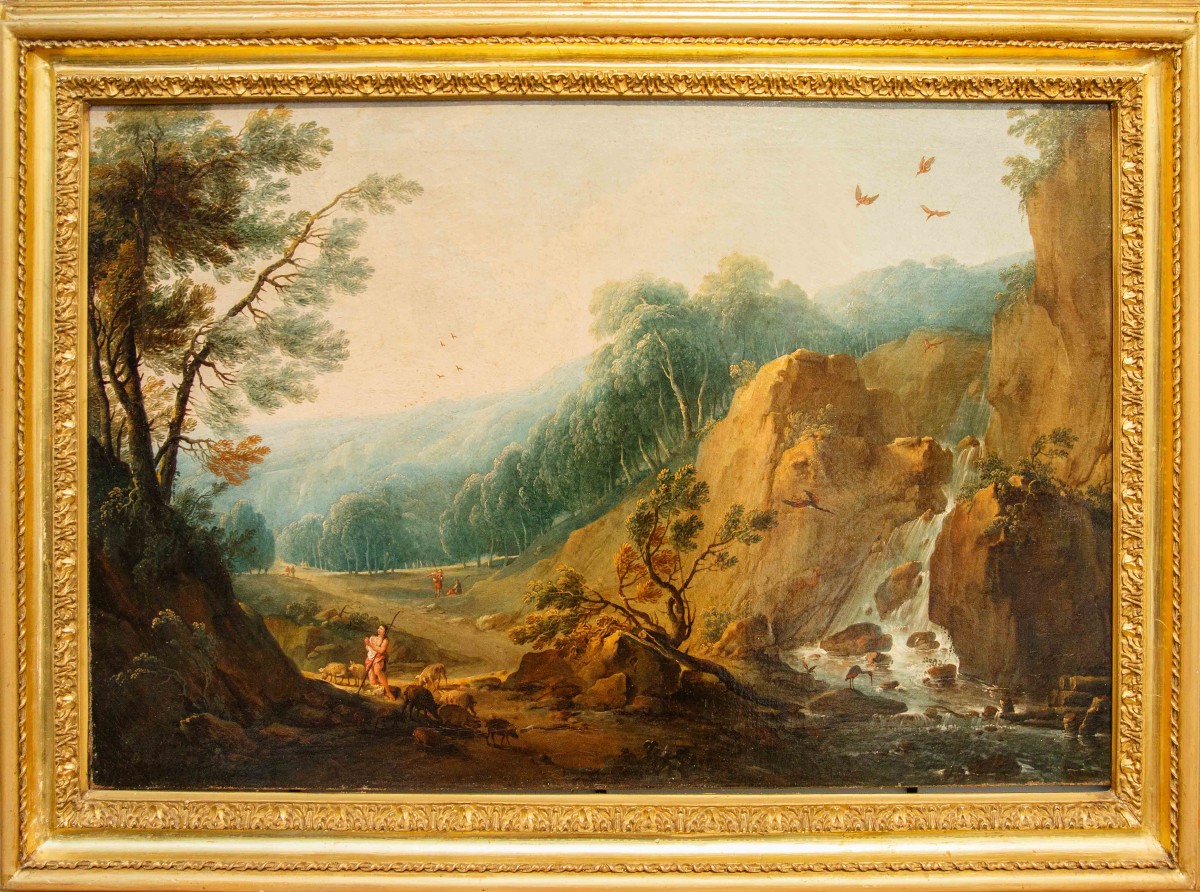
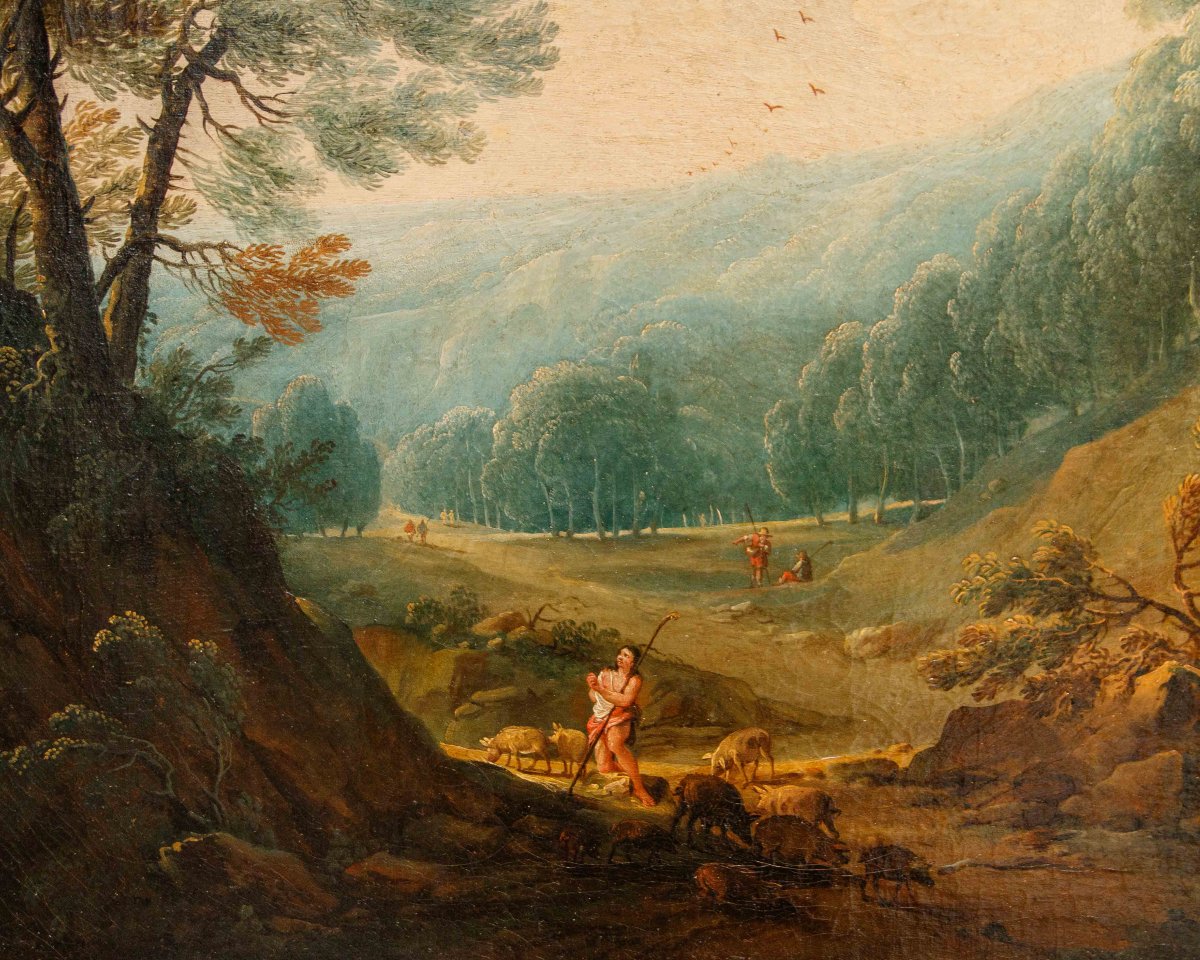
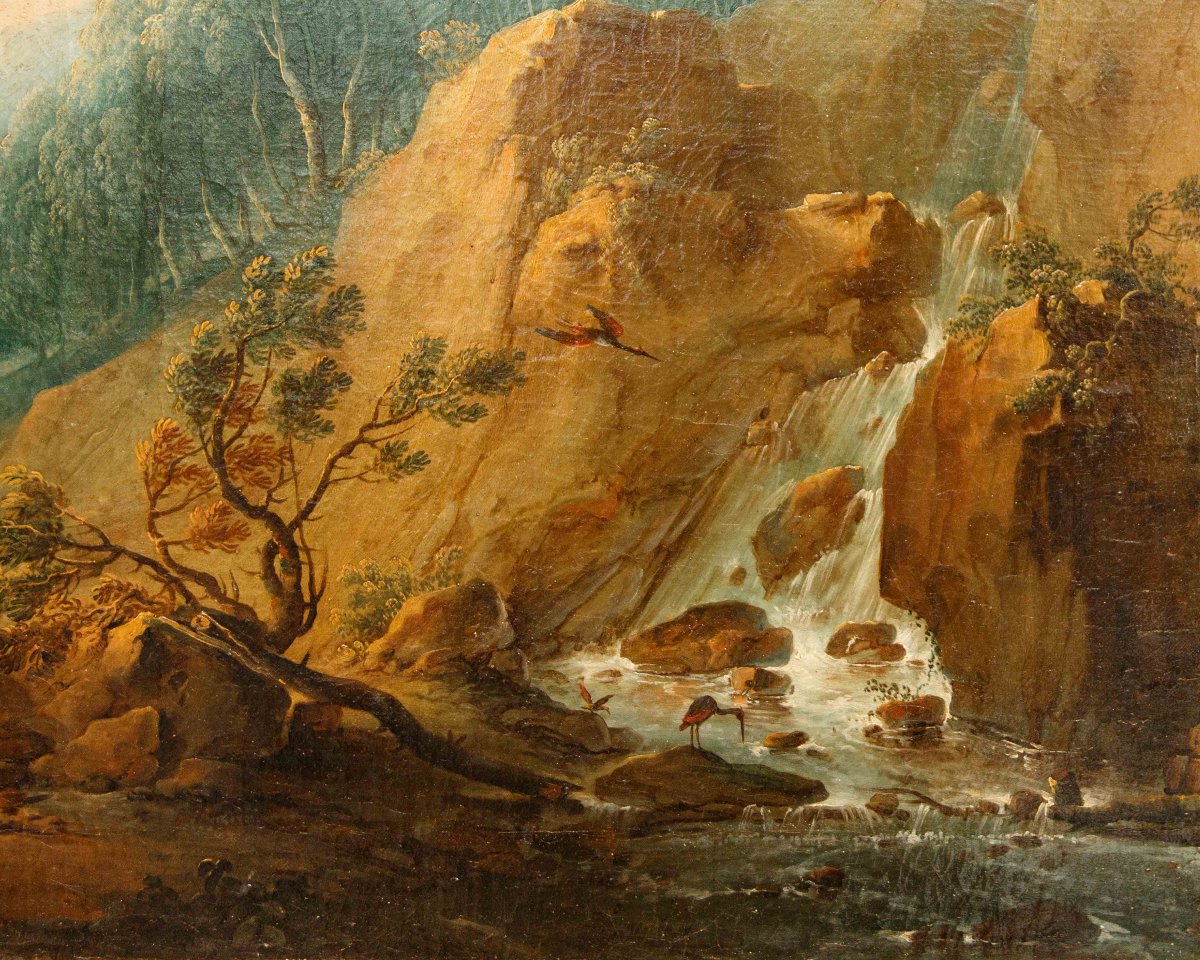
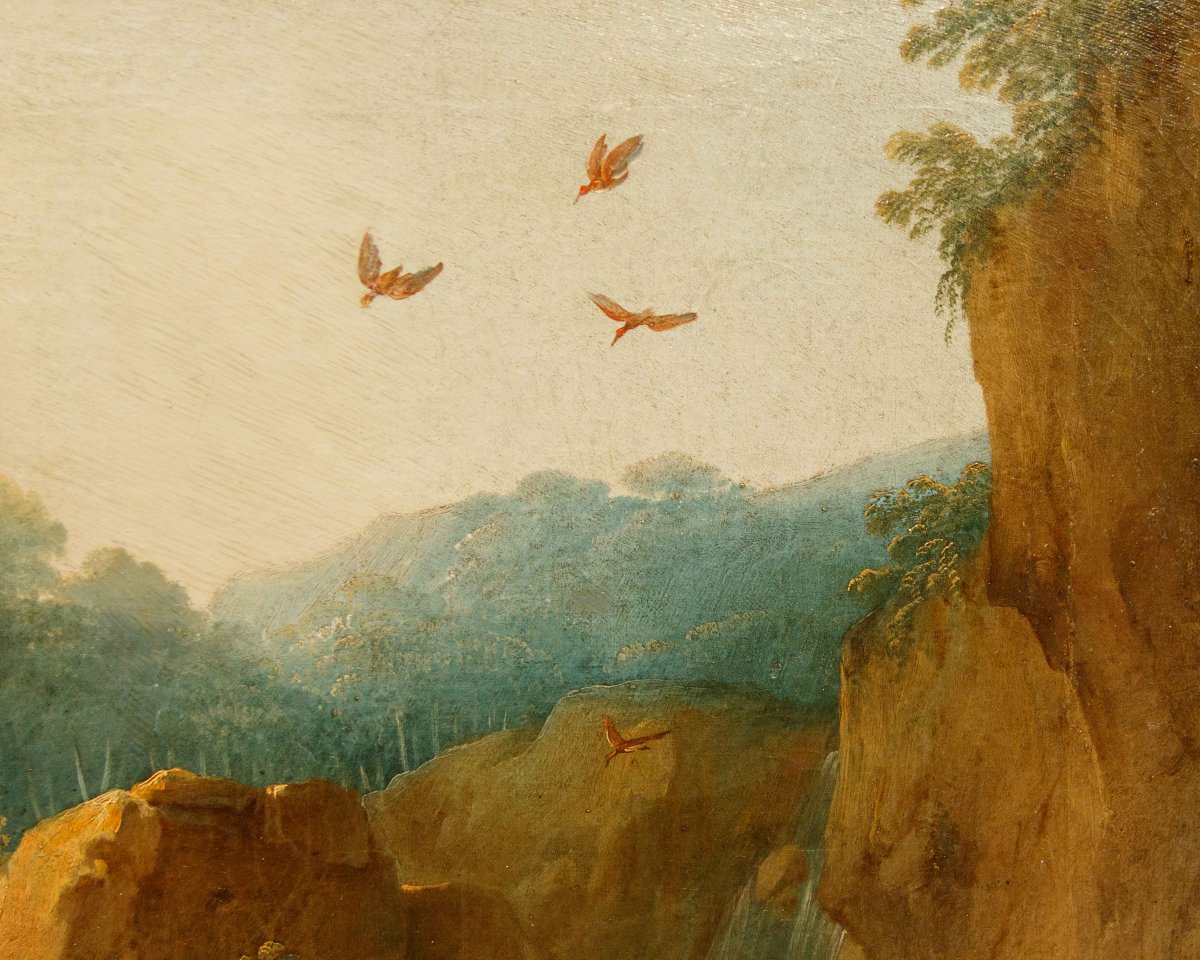
The painting depicts a large natural landscape conceived as the true protagonist of the composition, according to a sensibility typical of the Flemish tradition romanized between the late 17th and early 18th centuries. The viewer's eye is guided through a spatial construction articulated in depth, organized according to the principle of “natural backdrops”: on the left, a dark and compact tree mass serves as a closing element, while on the right, the imposing rock formation, animated by the waterfall and the stream, creates a scenographic counterpoint that frames the central opening of the small valley. This compositional system, clearly derived from the models developed by Paul Bril and his workshop, orders nature harmoniously and legibly. The landscape is divided into two main registers: the mountainous and rocky one on the right, dominated by the waterfall, and the gentler and more wooded one on the left, with large green areas that slope towards the bottom. The waterfall is not rendered as a precise transcription of a natural fact, but as a true scenographic effect, a recurring motif in Nordic Italianizing landscapes, often inspired by ideal views of central Italy. Within this vast natural framework, a small figure of a shepherd is inserted, in an apparently marginal but semantically central position. The man, intent on herding cattle, is depicted kneeling in an attitude of prayer, turning towards a source of light not directly visible to the viewer. The scene does not tell a precise episode, nor does it refer to an identifiable saint or a recognizable biblical character. On the contrary, the pastor takes on the value of a “universal man”, a homo rusticus who embodies spontaneous and natural piety. Prayer, in this context, has no narrative function but a symbolic one: it does not describe an event, but rather suggests an attitude, an internal state. This iconographic choice allows for a plurality of readings. From a Christian point of view, the kneeling figure alludes to the presence of the divine in creation, to the possibility of recognizing God through the contemplation of nature. On a moral level, the pastor's silent gesture recalls values of humility and recollection, devoid of any rhetoric. In a broader, almost philosophical perspective, the image suggests a cosmic harmony, a balance between man and the natural world around him. Due to these characteristics, the work is consistently placed in the vein of the Italianizing Flemish landscape between the late seventeenth and early eighteenth centuries, probably as the work of a late follower of seventeenth-century models, intended for a cultured audience. Paintings of this type were particularly appreciated by private collectors and found an ideal location in studios, cabinets or spaces dedicated to meditation, where the landscape, rather than being observed, could be contemplated as a mental place of silence, order and reflection.
Landscape with shepherd and waterfall
Oil on canvas, 61 x 97.5 cm
With the frame, 78 x 114 cm
The painting depicts a large natural landscape conceived as the true protagonist of the composition, according to a sensibility typical of the Flemish tradition romanized between the late 17th and early 18th centuries. The viewer's eye is guided through a spatial construction articulated in depth, organized according to the principle of “natural backdrops”: on the left, a dark and compact tree mass serves as a closing element, while on the right, the imposing rock formation, animated by the waterfall and the stream, creates a scenographic counterpoint that frames the central opening of the small valley. This compositional system, clearly derived from the models developed by Paul Bril and his workshop, orders nature harmoniously and legibly. The landscape is divided into two main registers: the mountainous and rocky one on the right, dominated by the waterfall, and the gentler and more wooded one on the left, with large green areas that slope towards the bottom. The waterfall is not rendered as a precise transcription of a natural fact, but as a true scenographic effect, a recurring motif in Nordic Italianizing landscapes, often inspired by ideal views of central Italy. Within this vast natural framework, a small figure of a shepherd is inserted, in an apparently marginal but semantically central position. The man, intent on herding cattle, is depicted kneeling in an attitude of prayer, turning towards a source of light not directly visible to the viewer. The scene does not tell a precise episode, nor does it refer to an identifiable saint or a recognizable biblical character. On the contrary, the pastor takes on the value of a “universal man”, a homo rusticus who embodies spontaneous and natural piety. Prayer, in this context, has no narrative function but a symbolic one: it does not describe an event, but rather suggests an attitude, an internal state. This iconographic choice allows for a plurality of readings. From a Christian point of view, the kneeling figure alludes to the presence of the divine in creation, to the possibility of recognizing God through the contemplation of nature. On a moral level, the pastor's silent gesture recalls values of humility and recollection, devoid of any rhetoric. In a broader, almost philosophical perspective, the image suggests a cosmic harmony, a balance between man and the natural world around him. Due to these characteristics, the work is consistently placed in the vein of the Italianizing Flemish landscape between the late seventeenth and early eighteenth centuries, probably as the work of a late follower of seventeenth-century models, intended for a cultured audience. Paintings of this type were particularly appreciated by private collectors and found an ideal location in studios, cabinets or spaces dedicated to meditation, where the landscape, rather than being observed, could be contemplated as a mental place of silence, order and reflection.
3 600 €
Period: 17th century
Style: Other Style
Condition: Good condition
Material: Oil painting
Width: 97,5
Height: 61
Reference (ID): 1693536
Availability: In stock
Print