







Alberto Carlieri (1672 – After 1720), Solomon Worships Idols
Alberto Carlieri (1672 – after 1720)
Solomon worships idols
Oil on canvas, 48.5 x 36 cm
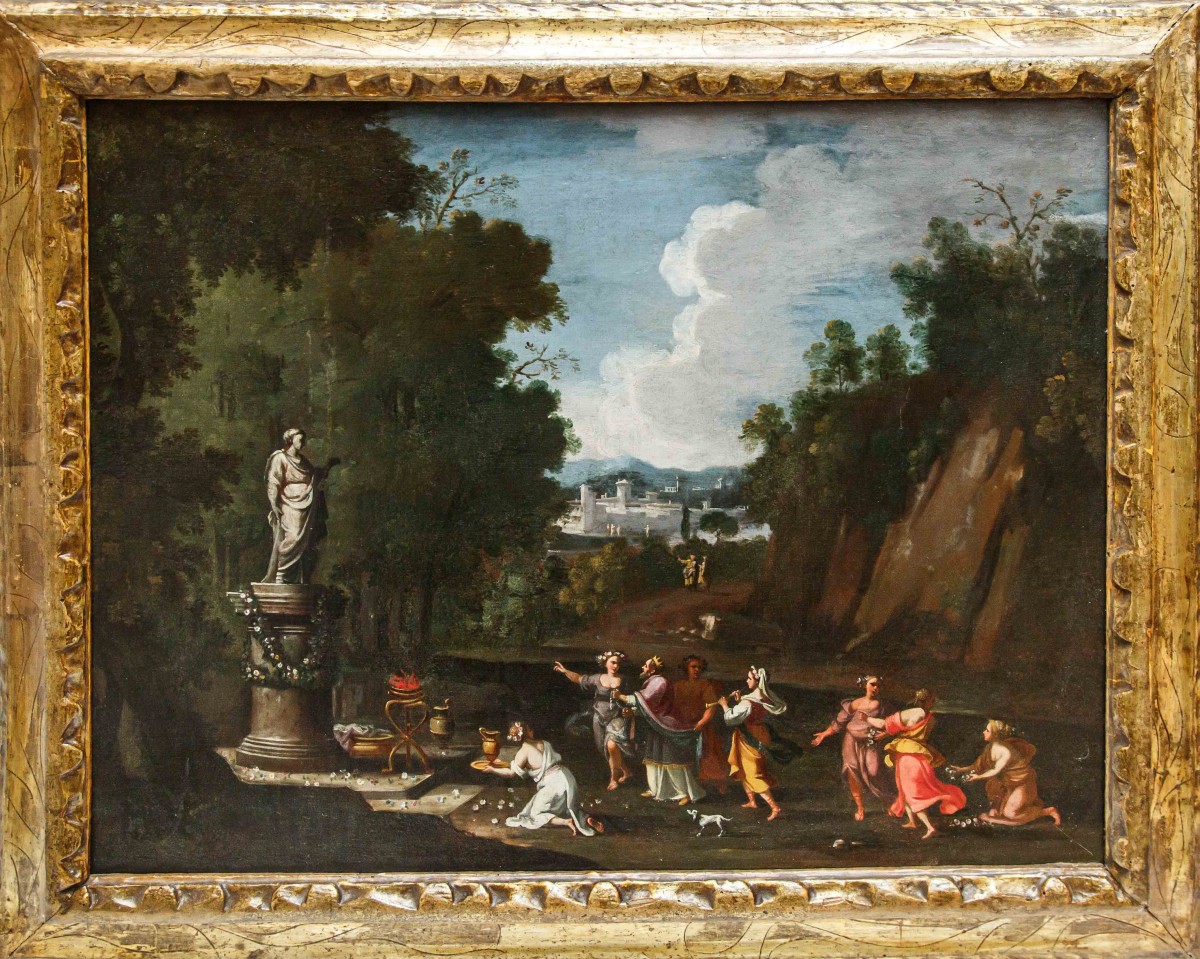
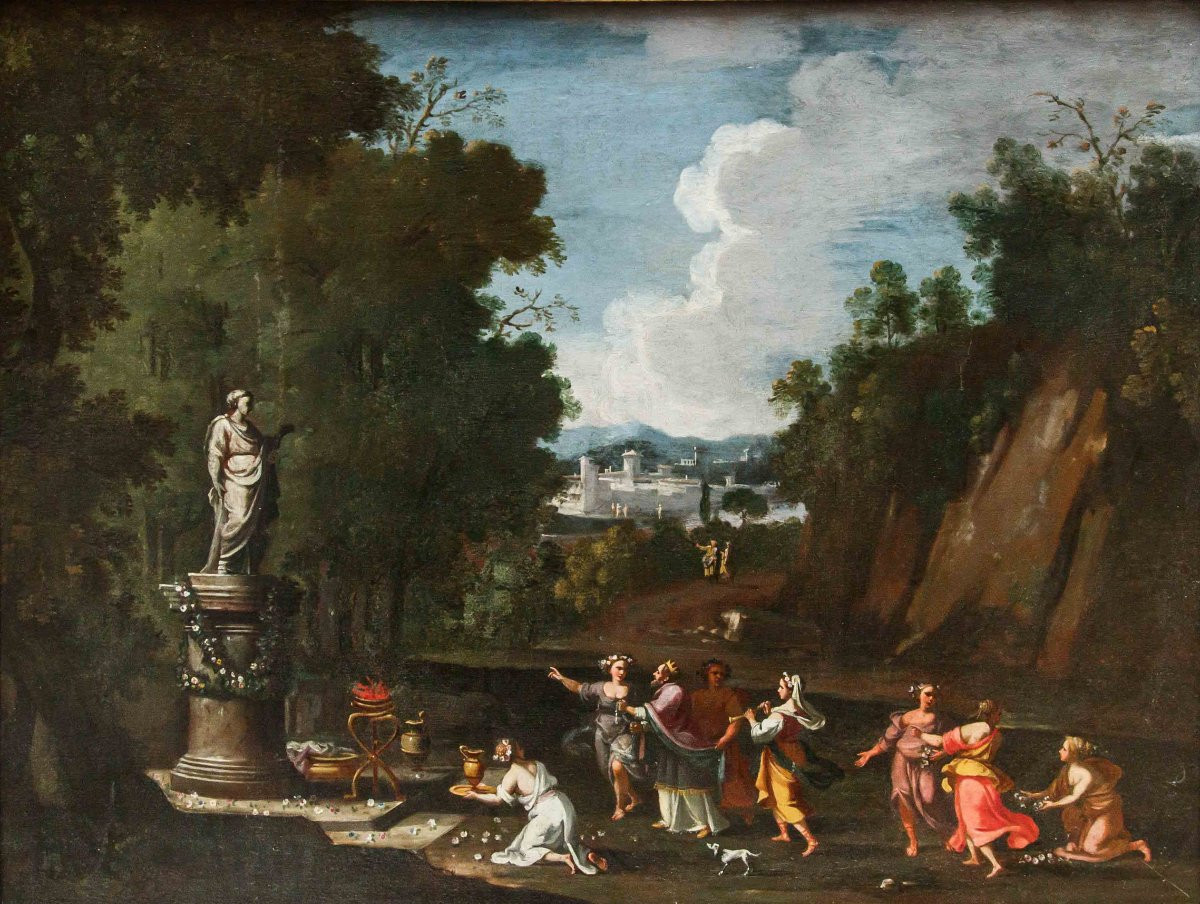
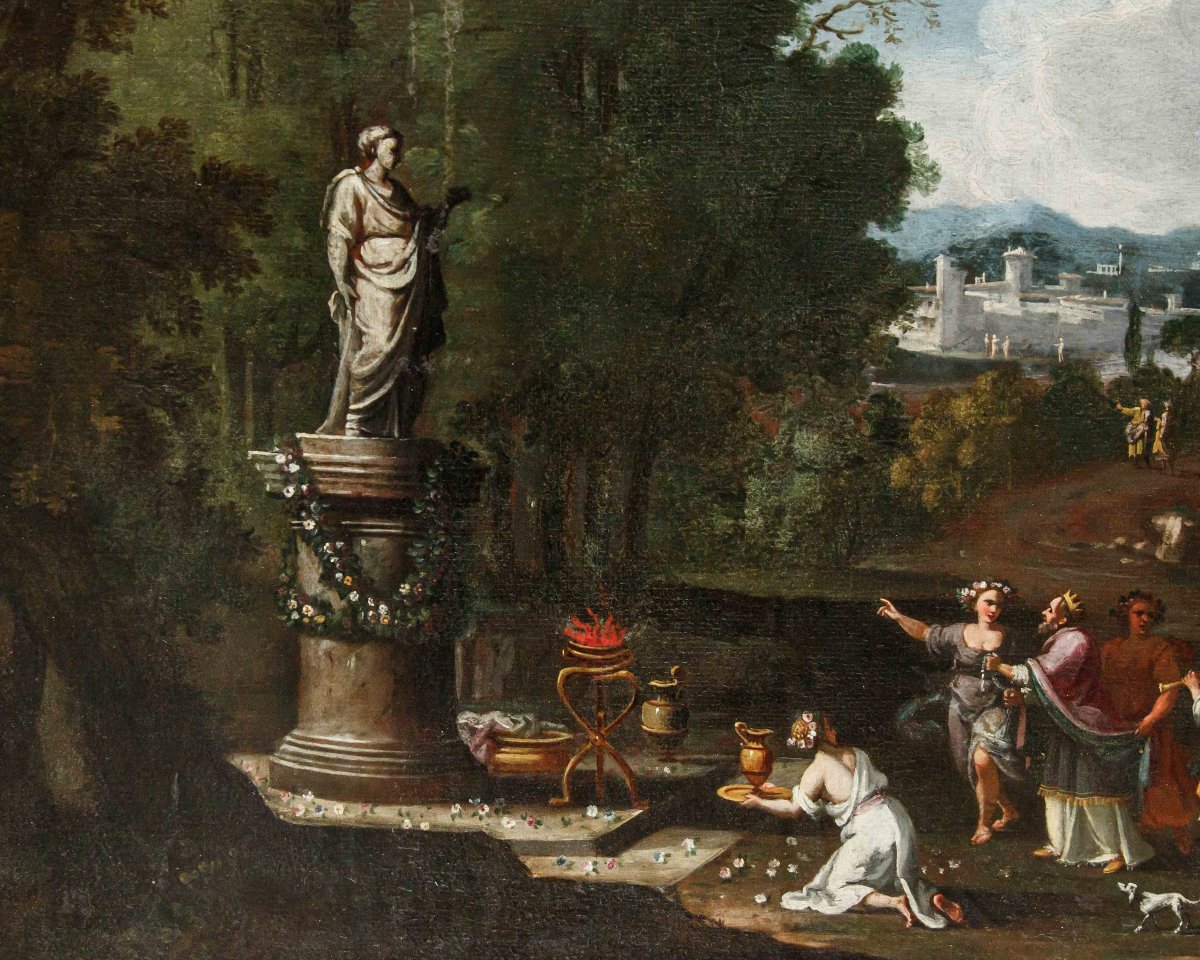
The work in question, whose scene is identified as Solomon worshipping idols, constitutes a unique or almost unique feature in Carlieri's compositional methodology. The iconographic subject originates from the First Book of Kings (11:4-8), describing King Solomon's sin of idolatry. The scene takes place in the foreground, where a group of figures perform acts of veneration at an altar surmounted by a statue (the idol). The central figure, identifiable with Solomon by his prominent position and princely attire, is surrounded by women, symbolizing the consorts who led him to apostasy. The action focuses on offering and worship, crucial moments that crystallize the narrative of sin. The element of stylistic rupture and compositional originality lie in the deliberate choice to replace monumental architecture (a key feature of Carlieri's entire production) with an imposing landscape. Here, Carlieri fits into the tradition of ideal landscape derived from masters active in Rome such as Claude Lorrain and Gaspard Dughet.
The way in which the figures are treated is similar, who, in this context, become protagonists, overcoming their function as simple boundary elements as in his caprices. The figures are generally well colored and clear to stand out against the background of the landscape or classical ruins. Their clothes often feature brightly colored drapes (such as red, yellow, or blue), while their faces are characterized by rosy cheeks and pointed noses. The statue depicted also appears as a recurring typological element in the artist's production; this distinctive figure is frequently found in his compositions.
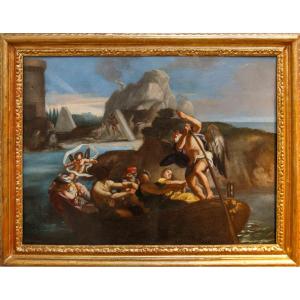
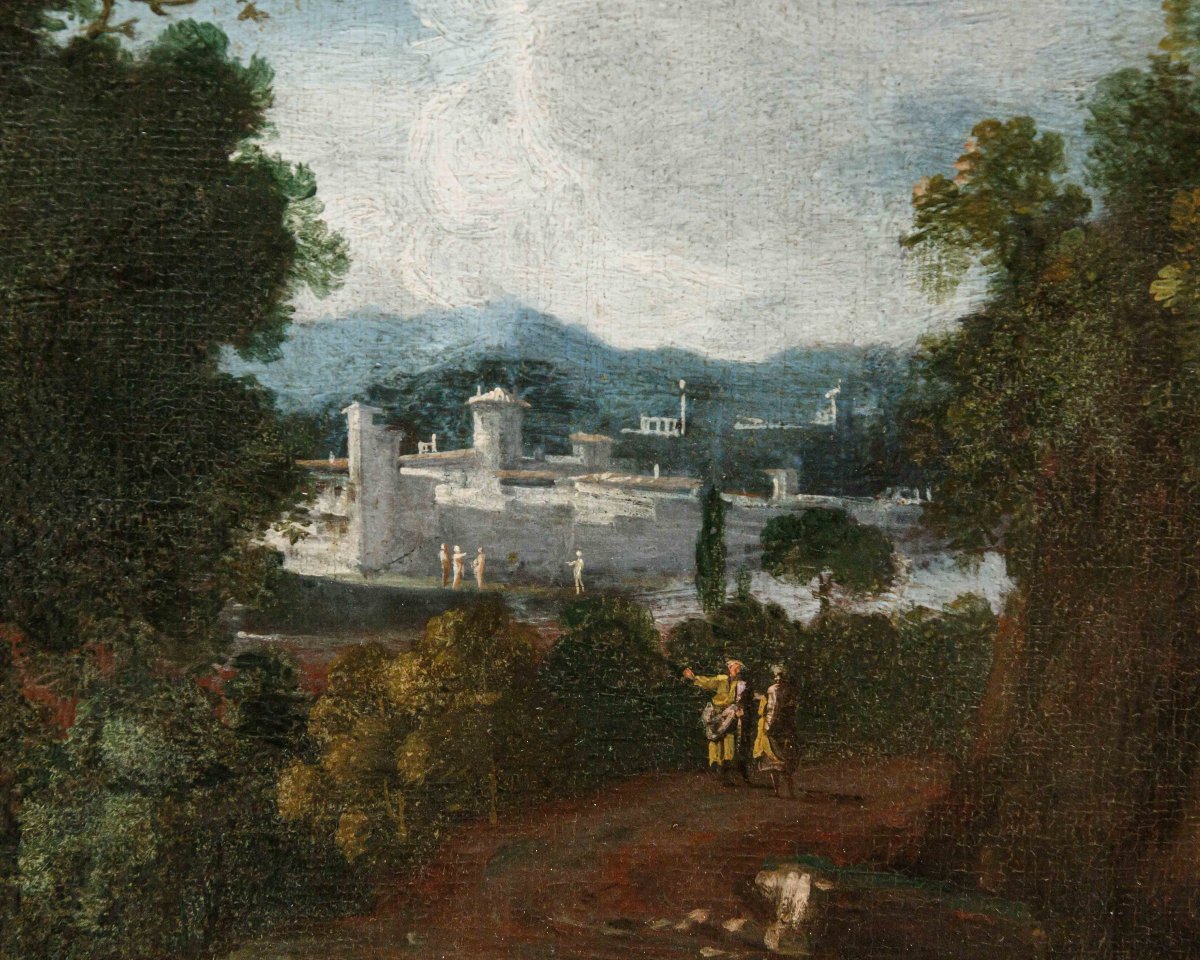
The work of Alberto Carlieri (1672-1720) reveals a fundamental pictorial innovation in Rome between the seventeenth and eighteenth centuries. Born and culturally educated in the Roman environment, Carlieri established himself as the main interpreter of a modern evolution of the quadraturist genre, moving beyond the seventeenth-century tradition to adopt a three-dimensional and rigorous conception of space. The critical definition of his artistic personality is largely due to the pioneering insights of Hermann Voss (1959), who isolated a catalogue of one hundred and forty-four paintings, and to the subsequent and precise biographical and stylistic reconstruction carried out by David Marshall (2004), who confirmed the early mentions of Carlieri in contemporary sources (Orlandi, 1719, and later). Introduced to whims by Giuseppe de’ Marchis, Carlieri perfected his art under the guidance of Andrea Pozzo, the author of the treatise De Perspectiva pictorum et architectorum, who influenced its methodology with a precise and design-based structural elaboration. Carlieri distinguished himself for a lucid orchestration between architectural interiors and exteriors, while maintaining a certain fidelity to Ghisolfi-Codazzi's inventive approaches in his first phase, but minimizing the Ruinistic component compared to Giovanni Ghisolfi's solutions. An example is the Courtyard of the Palace (Private Collection), which attests to its scientific application of scenographic backdrops borrowed directly from Pozzo's perspective drawings. It is precisely this clear constructive clarity that had previously led to attributional confusion with Giovanni Paolo Panini, of whom Carlieri is now recognized as an essential precursor in works such as the Sacrifice of Callirhoe. Starting from the Achilles among the daughters of Lycomedes (signed and dated), Voss and Marshall were able to trace back to Carlieri's brush a vast corpus of works (such as the Flight into Egypt, Esther and Ahasuerus, the Judgement of Solomon and several classical Scenes), previously dispersed and incorrectly attributed, confirming its importance also through its documented presence in prestigious collecting collections, including that of Filippo Colonna. The painting can be compared with the work Moses Saved from the Waters, in which we see the same treatment of the landscape and especially of the clouds in the background, just as the presence of a city is turreted in the distance.
Solomon worships idols
Oil on canvas, 48.5 x 36 cm
The work in question, whose scene is identified as Solomon worshipping idols, constitutes a unique or almost unique feature in Carlieri's compositional methodology. The iconographic subject originates from the First Book of Kings (11:4-8), describing King Solomon's sin of idolatry. The scene takes place in the foreground, where a group of figures perform acts of veneration at an altar surmounted by a statue (the idol). The central figure, identifiable with Solomon by his prominent position and princely attire, is surrounded by women, symbolizing the consorts who led him to apostasy. The action focuses on offering and worship, crucial moments that crystallize the narrative of sin. The element of stylistic rupture and compositional originality lie in the deliberate choice to replace monumental architecture (a key feature of Carlieri's entire production) with an imposing landscape. Here, Carlieri fits into the tradition of ideal landscape derived from masters active in Rome such as Claude Lorrain and Gaspard Dughet.
The way in which the figures are treated is similar, who, in this context, become protagonists, overcoming their function as simple boundary elements as in his caprices. The figures are generally well colored and clear to stand out against the background of the landscape or classical ruins. Their clothes often feature brightly colored drapes (such as red, yellow, or blue), while their faces are characterized by rosy cheeks and pointed noses. The statue depicted also appears as a recurring typological element in the artist's production; this distinctive figure is frequently found in his compositions.
The work of Alberto Carlieri (1672-1720) reveals a fundamental pictorial innovation in Rome between the seventeenth and eighteenth centuries. Born and culturally educated in the Roman environment, Carlieri established himself as the main interpreter of a modern evolution of the quadraturist genre, moving beyond the seventeenth-century tradition to adopt a three-dimensional and rigorous conception of space. The critical definition of his artistic personality is largely due to the pioneering insights of Hermann Voss (1959), who isolated a catalogue of one hundred and forty-four paintings, and to the subsequent and precise biographical and stylistic reconstruction carried out by David Marshall (2004), who confirmed the early mentions of Carlieri in contemporary sources (Orlandi, 1719, and later). Introduced to whims by Giuseppe de’ Marchis, Carlieri perfected his art under the guidance of Andrea Pozzo, the author of the treatise De Perspectiva pictorum et architectorum, who influenced its methodology with a precise and design-based structural elaboration. Carlieri distinguished himself for a lucid orchestration between architectural interiors and exteriors, while maintaining a certain fidelity to Ghisolfi-Codazzi's inventive approaches in his first phase, but minimizing the Ruinistic component compared to Giovanni Ghisolfi's solutions. An example is the Courtyard of the Palace (Private Collection), which attests to its scientific application of scenographic backdrops borrowed directly from Pozzo's perspective drawings. It is precisely this clear constructive clarity that had previously led to attributional confusion with Giovanni Paolo Panini, of whom Carlieri is now recognized as an essential precursor in works such as the Sacrifice of Callirhoe. Starting from the Achilles among the daughters of Lycomedes (signed and dated), Voss and Marshall were able to trace back to Carlieri's brush a vast corpus of works (such as the Flight into Egypt, Esther and Ahasuerus, the Judgement of Solomon and several classical Scenes), previously dispersed and incorrectly attributed, confirming its importance also through its documented presence in prestigious collecting collections, including that of Filippo Colonna. The painting can be compared with the work Moses Saved from the Waters, in which we see the same treatment of the landscape and especially of the clouds in the background, just as the presence of a city is turreted in the distance.
9 000 €
Period: 17th century
Style: Other Style
Condition: Good condition
Material: Oil painting
Width: 48,5
Height: 36
Reference (ID): 1692271
Availability: In stock
Print