THIS OBJECT WAS SOLD
Pygmalion And Galatea, 18th-century Drawing, Circle Or Follower Of François Boucher
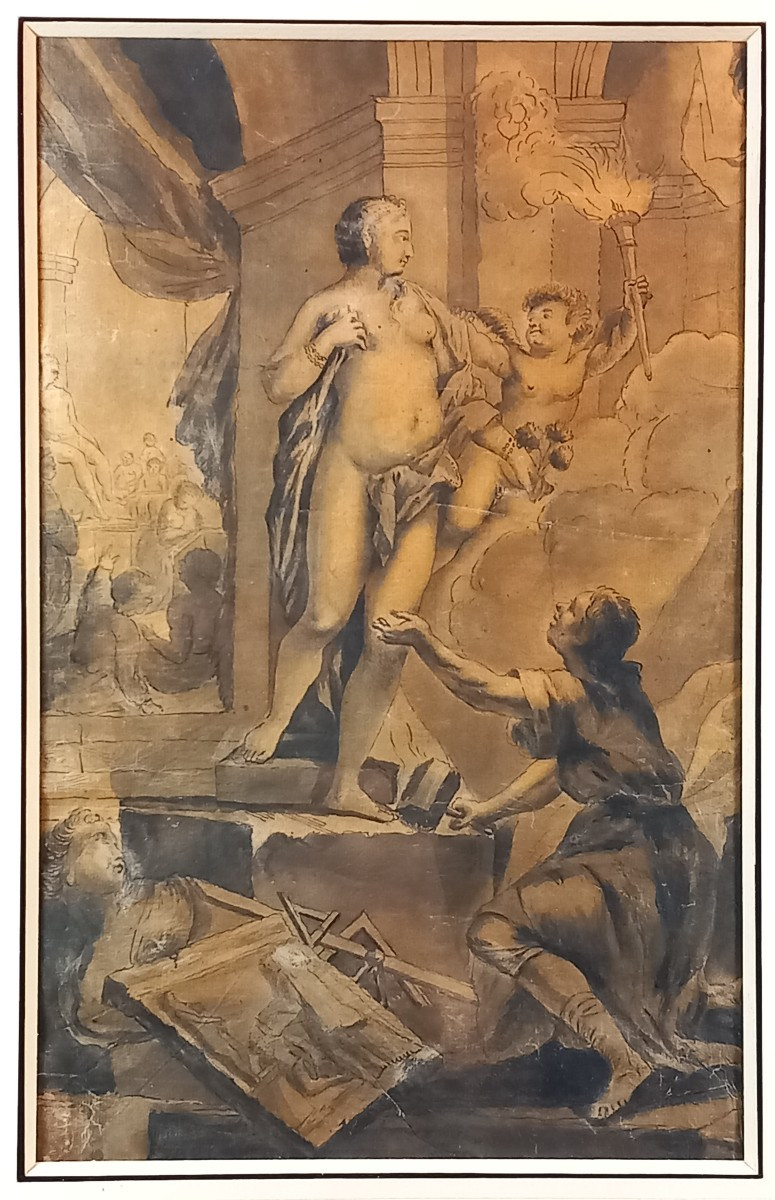




Pygmalion and Galatea, Allegory of Artistic Creation
The Sculpture Animated by Genius.
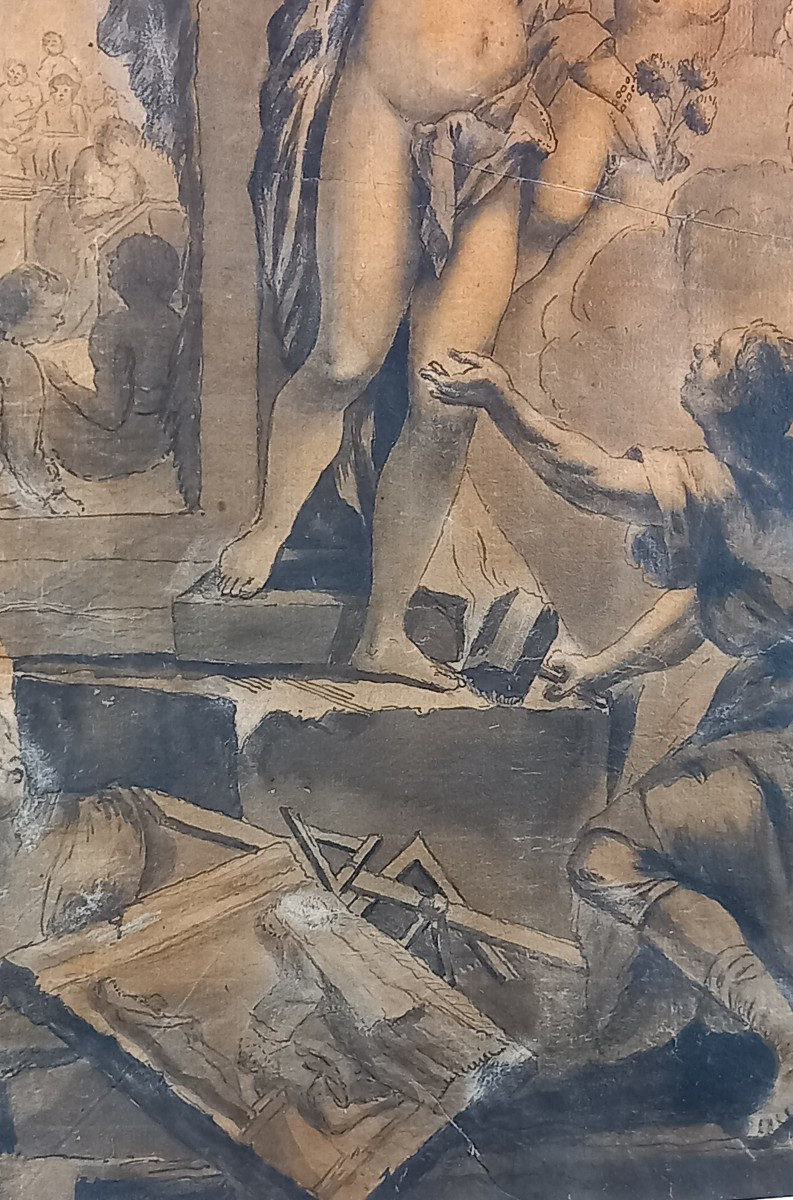
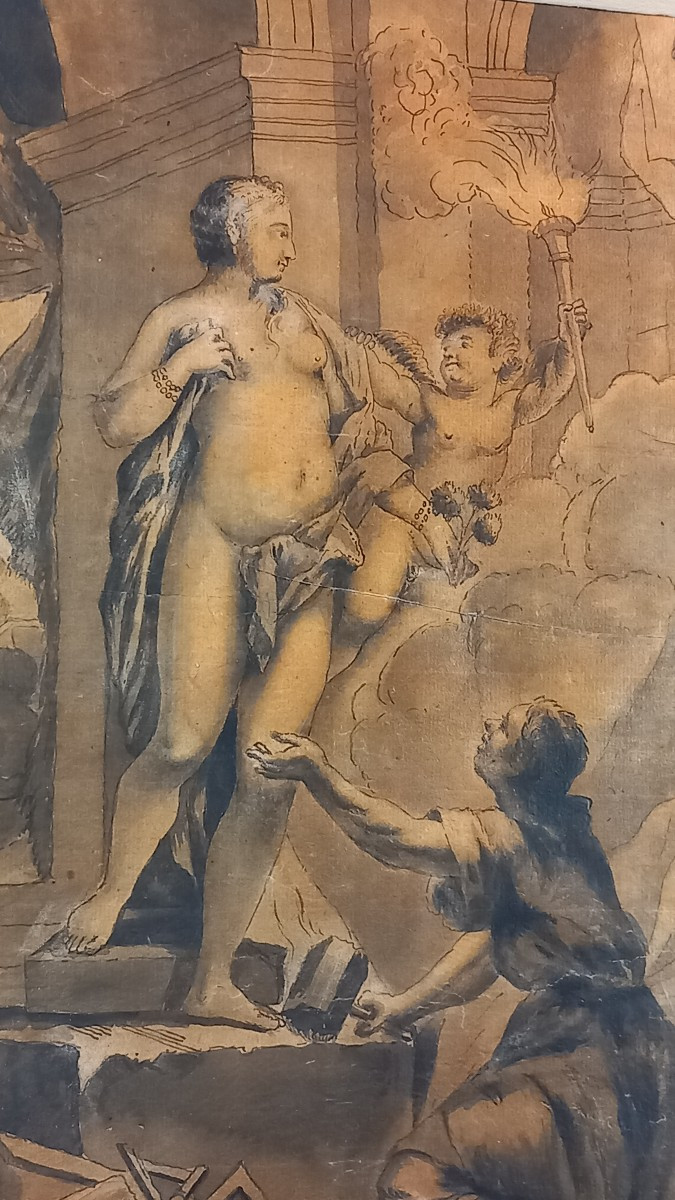
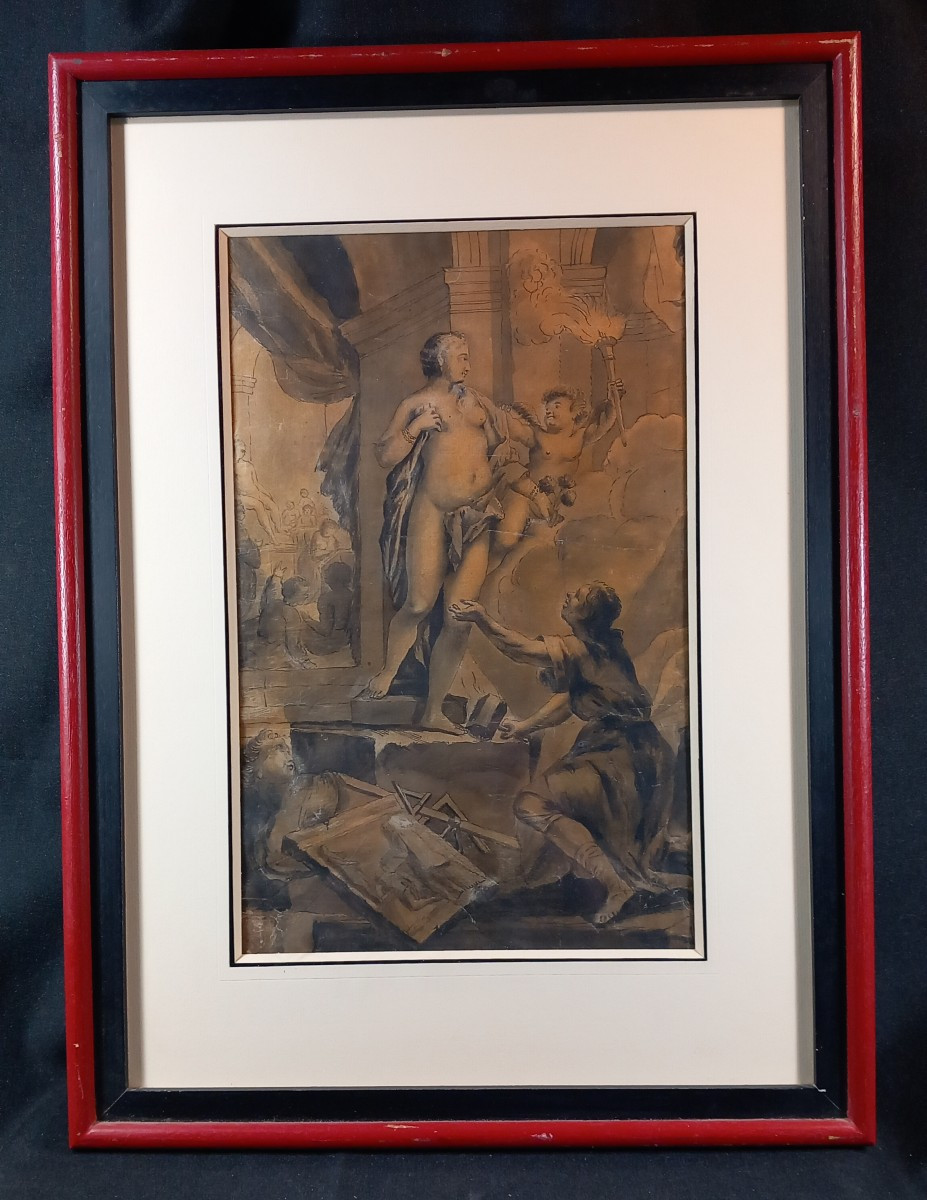
This work depicts, at its center, a nude statue representing Galatea, evoking an ideal of classical beauty. The moment captured by the artist
is the instant when the statue is in the midst of its transition from stone to life.
Its pose oscillates between classical statuary and a sway of the hips reminiscent of
the Rococo movement.
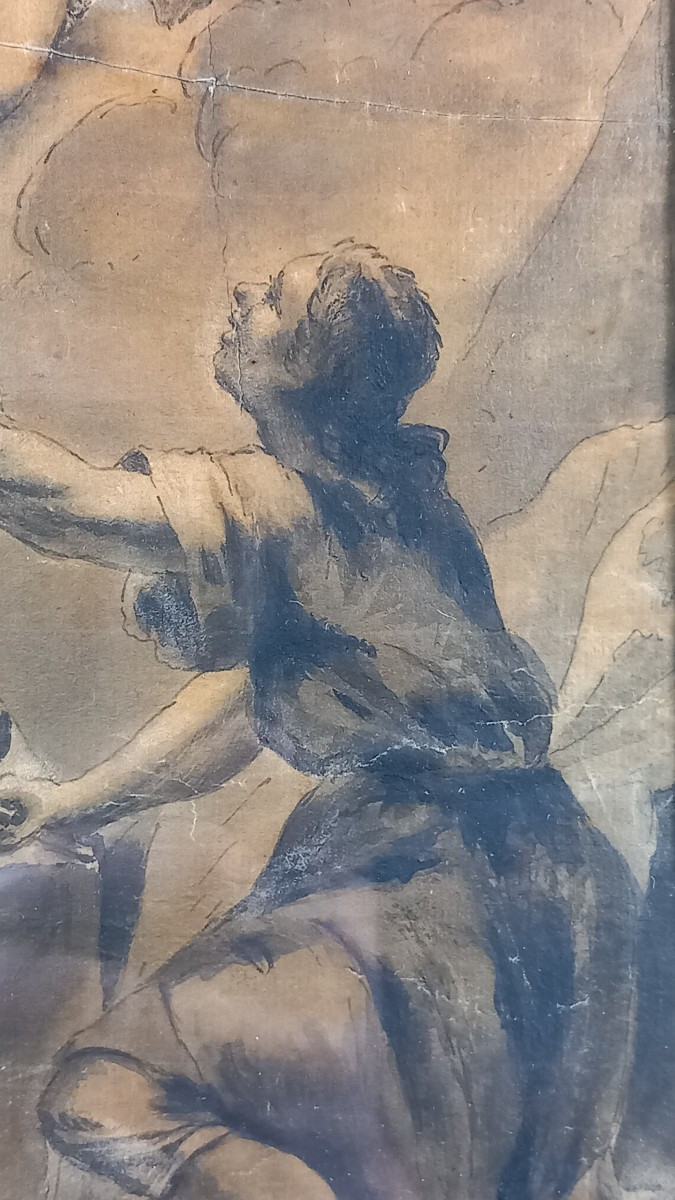
At the sculpture's feet, the sculptor, Pygmalion,
kneels, raising his hands in a gesture of adoration. He still holds
his mallet and seems to have interrupted his work, captivated by his sculpted creation
coming to life.
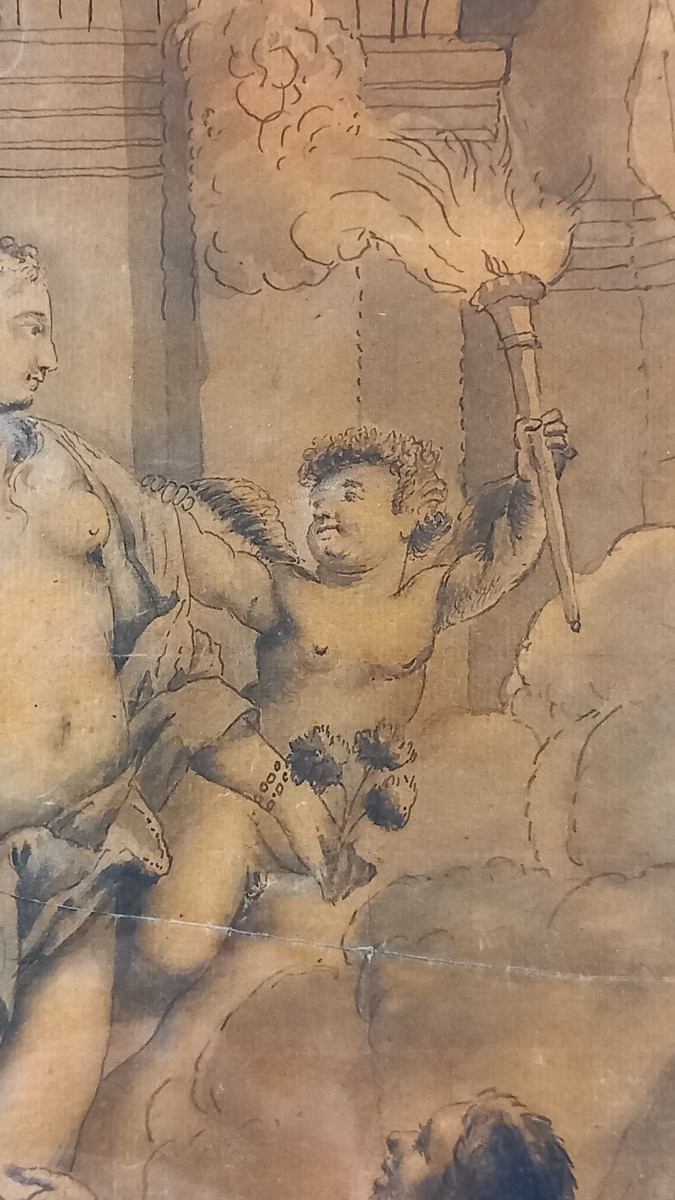
Behind the statue, a small winged putto brandishes a flaming torch.
This is one of the central elements of the narrative: fire here symbolizes
the spark of life, divine inspiration, or the passion that "animates"
inert matter.
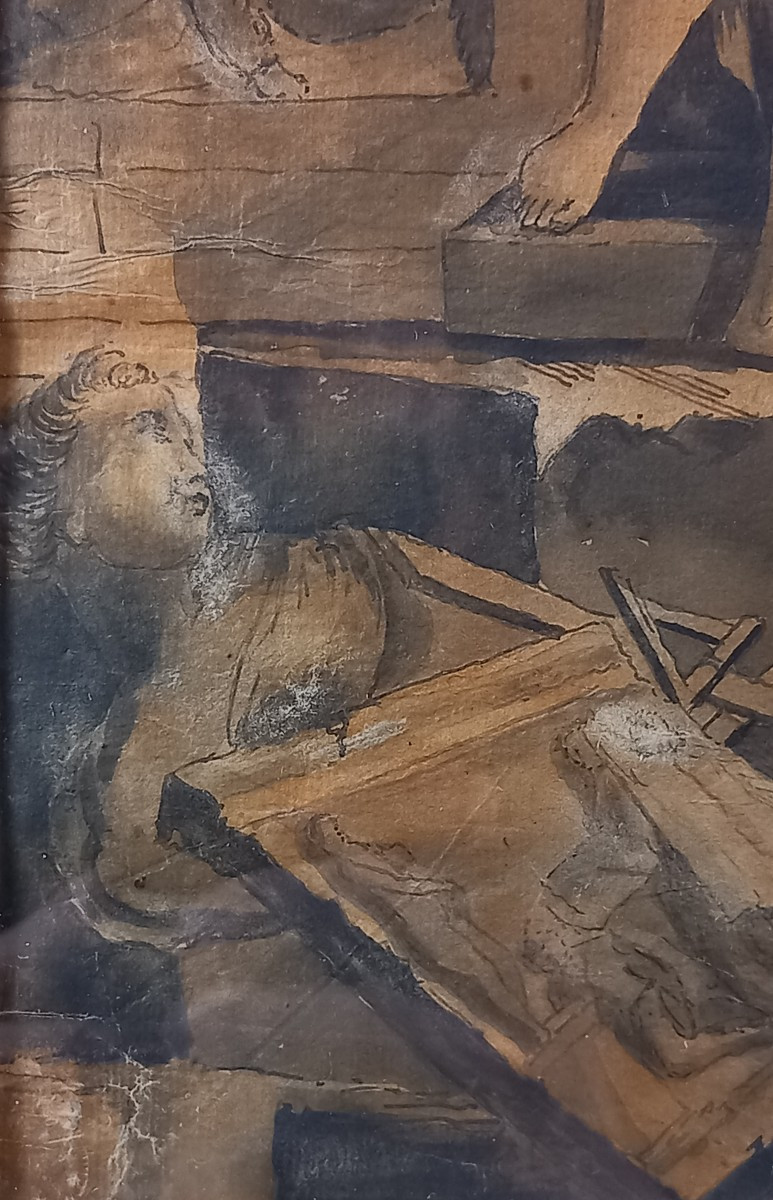
The elements framing this central scene are extremely rich in technical detail, anchoring the scene in the reality of a mid-18th-century sculptor's workshop. On the left, a bas-relief depicting a scene in the classical style is visible, one of the artist's unfinished works. A compass and set square are also discernible, symbols of the geometric precision and intellectual rigor necessary for art, often associated with architecture and sculpture. The scene takes place within a monumental setting of columns and arches, typical of the nascent Neoclassical or late Baroque style. To the left in the background, an opening (window or archway) offers a glimpse of other figures, suggesting that the scene is adjacent to an academy or workshop where the master works under the watchful eyes of his students. The use of a pen on laid paper (recognizable by its slightly striated texture, typical of the period) allows for great finesse of line. The washes (the gray or brown shadows) add relief and a theatrical dimension to the light, creating a chiaroscuro effect that reinforces the dramatic aspect of the miracle. This technique of brown or gray washes over a nervous pen stroke is typical of "first draft" drawings or allegorical composition projects from his workshop. This scene is an interpretation of the myth of Pygmalion and Galatea, an extremely popular subject under Louis XV and Louis XVI, as it celebrated the almost divine power of the artist capable of bringing his dreams to life. The treatment of the bodies, particularly that of the statue (Galatea) with its full forms and graceful curves, strongly evokes the aesthetic of the painter François Boucher (1703-1770). The little genius with the torch is also very characteristic of Boucher's "children," with their chubby limbs and round faces.
The subject (Pygmalion) and the presence of very specific attributes in the foreground (compass, set square, bas-relief) evoke compositions intended for engraving. The drawing also recalls the work of Charles Monnet (1732-1819): he produced numerous allegories of the arts and mythological scenes in pen and wash, often with this clarity of composition and this taste for antique architectural settings. Finally, the representation of the sculptor, with his theatrical pose and pronounced drapery, could also be linked to the school of Carle Van Loo (1705-1765). The latter painted famous cycles on the "Arts" where the tools of sculpture and architecture are prominently featured. Dimensions of the drawing (visible): 21.2 x 33.4 cm Dimensions of the frame: 37.3 x 51 cm Traces of old folds and damage, modern frame.
The Sculpture Animated by Genius.
This work depicts, at its center, a nude statue representing Galatea, evoking an ideal of classical beauty. The moment captured by the artist
is the instant when the statue is in the midst of its transition from stone to life.
Its pose oscillates between classical statuary and a sway of the hips reminiscent of
the Rococo movement.
At the sculpture's feet, the sculptor, Pygmalion,
kneels, raising his hands in a gesture of adoration. He still holds
his mallet and seems to have interrupted his work, captivated by his sculpted creation
coming to life.
Behind the statue, a small winged putto brandishes a flaming torch.
This is one of the central elements of the narrative: fire here symbolizes
the spark of life, divine inspiration, or the passion that "animates"
inert matter.
The elements framing this central scene are extremely rich in technical detail, anchoring the scene in the reality of a mid-18th-century sculptor's workshop. On the left, a bas-relief depicting a scene in the classical style is visible, one of the artist's unfinished works. A compass and set square are also discernible, symbols of the geometric precision and intellectual rigor necessary for art, often associated with architecture and sculpture. The scene takes place within a monumental setting of columns and arches, typical of the nascent Neoclassical or late Baroque style. To the left in the background, an opening (window or archway) offers a glimpse of other figures, suggesting that the scene is adjacent to an academy or workshop where the master works under the watchful eyes of his students. The use of a pen on laid paper (recognizable by its slightly striated texture, typical of the period) allows for great finesse of line. The washes (the gray or brown shadows) add relief and a theatrical dimension to the light, creating a chiaroscuro effect that reinforces the dramatic aspect of the miracle. This technique of brown or gray washes over a nervous pen stroke is typical of "first draft" drawings or allegorical composition projects from his workshop. This scene is an interpretation of the myth of Pygmalion and Galatea, an extremely popular subject under Louis XV and Louis XVI, as it celebrated the almost divine power of the artist capable of bringing his dreams to life. The treatment of the bodies, particularly that of the statue (Galatea) with its full forms and graceful curves, strongly evokes the aesthetic of the painter François Boucher (1703-1770). The little genius with the torch is also very characteristic of Boucher's "children," with their chubby limbs and round faces.
The subject (Pygmalion) and the presence of very specific attributes in the foreground (compass, set square, bas-relief) evoke compositions intended for engraving. The drawing also recalls the work of Charles Monnet (1732-1819): he produced numerous allegories of the arts and mythological scenes in pen and wash, often with this clarity of composition and this taste for antique architectural settings. Finally, the representation of the sculptor, with his theatrical pose and pronounced drapery, could also be linked to the school of Carle Van Loo (1705-1765). The latter painted famous cycles on the "Arts" where the tools of sculpture and architecture are prominently featured. Dimensions of the drawing (visible): 21.2 x 33.4 cm Dimensions of the frame: 37.3 x 51 cm Traces of old folds and damage, modern frame.
Explore similar pieces and discover your ideal find:
drawings