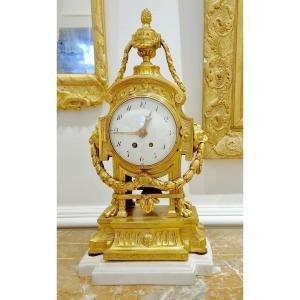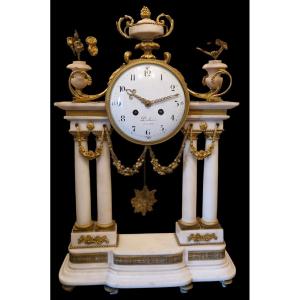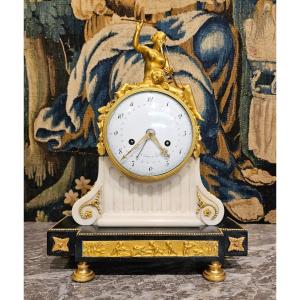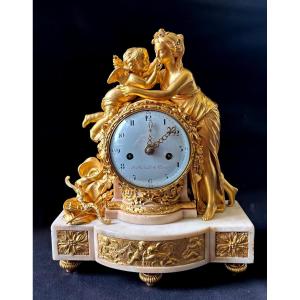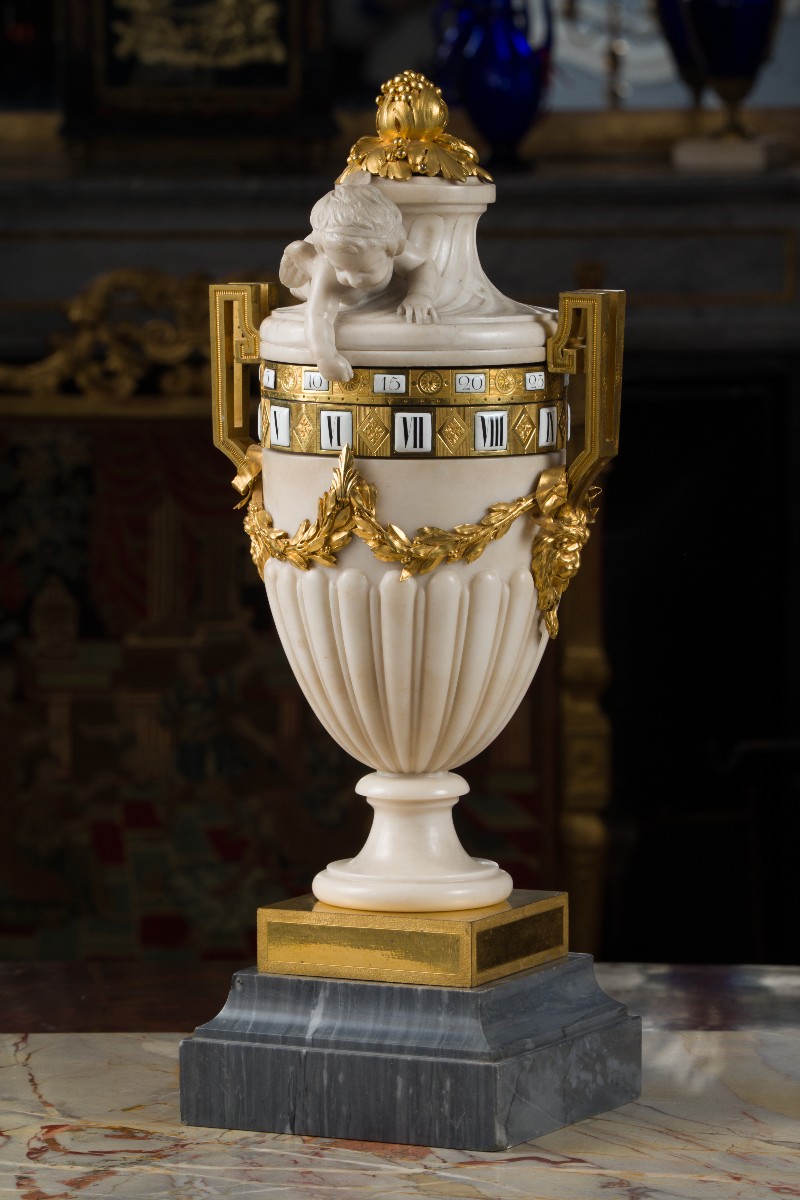


Clock With Rotating Circles In White Marble, Blue Turquin Marble And Chiseled And Gilded Bronze
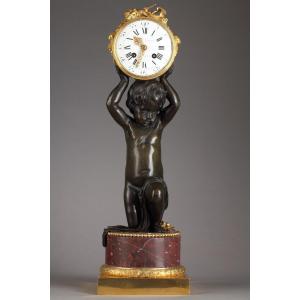
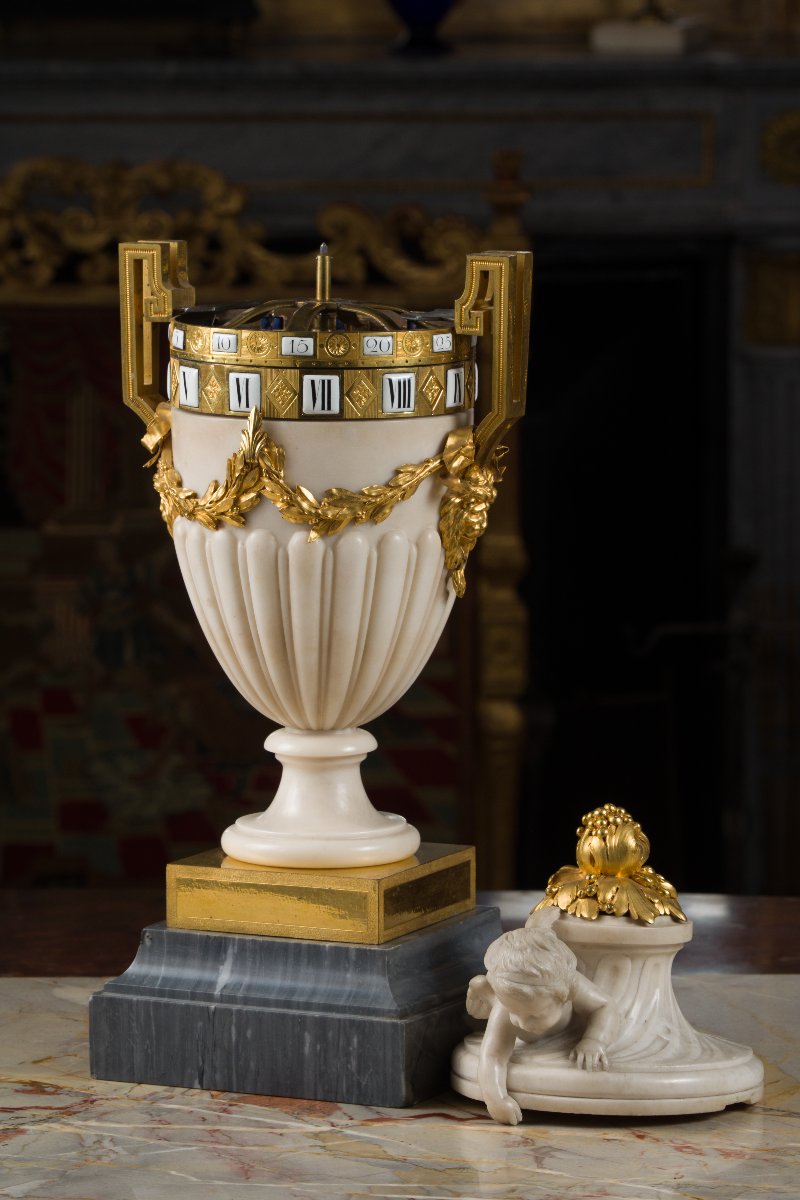
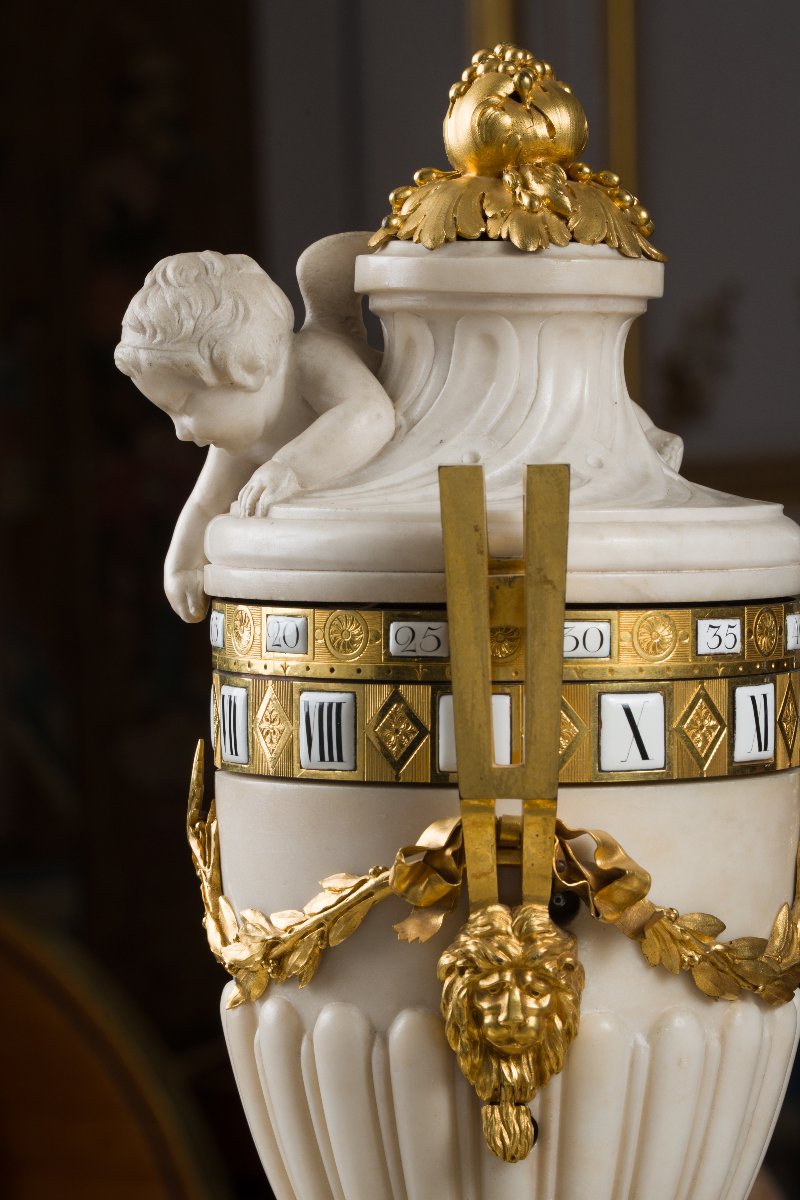
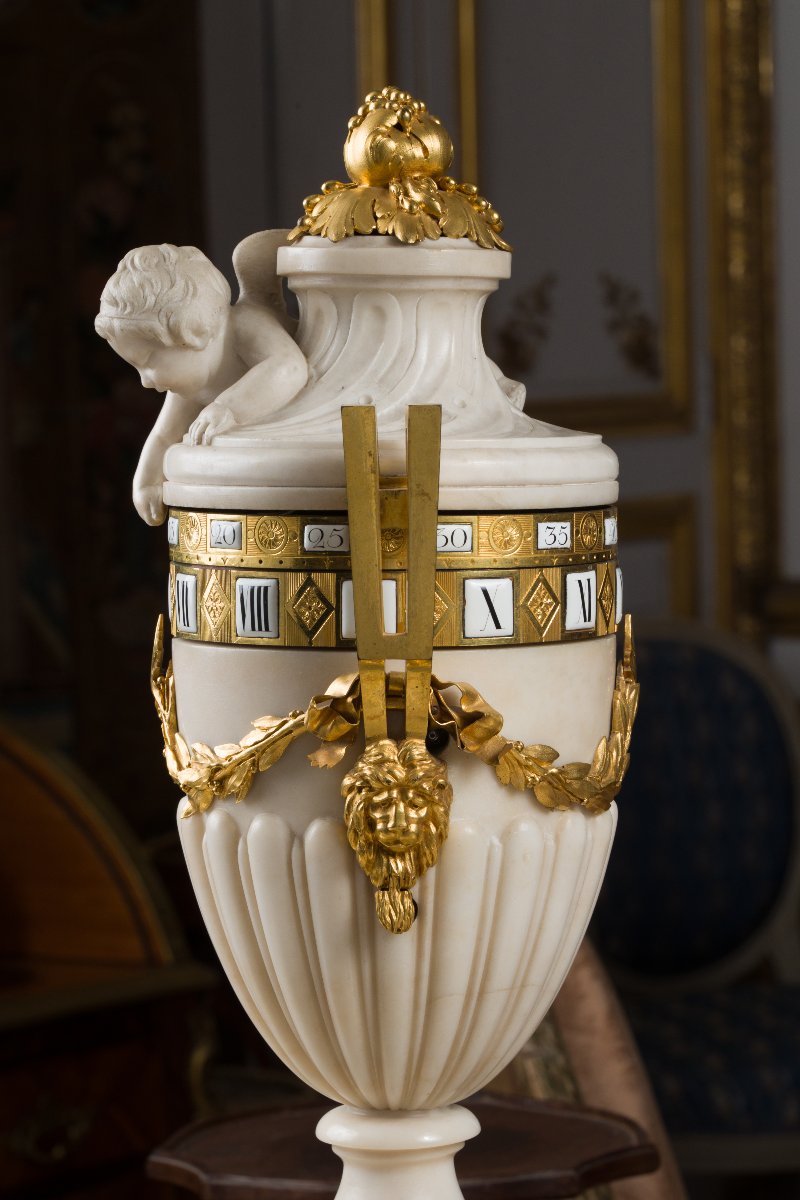
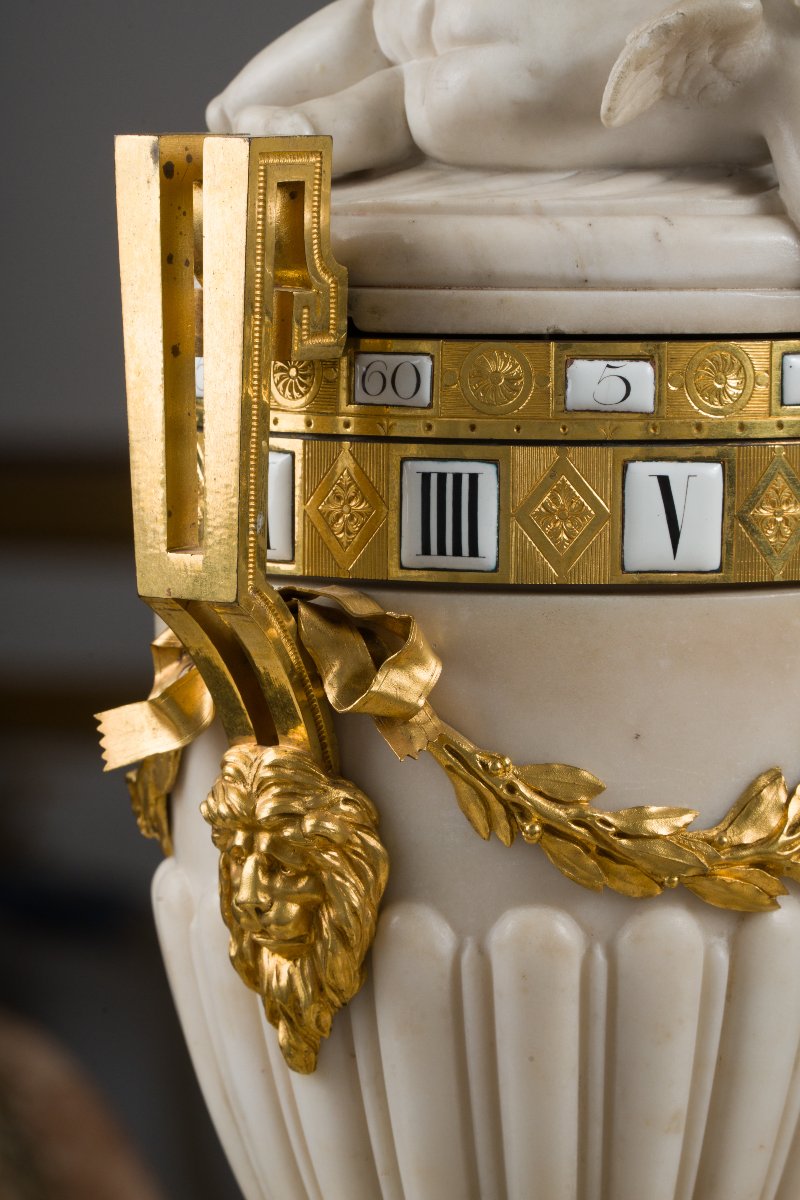
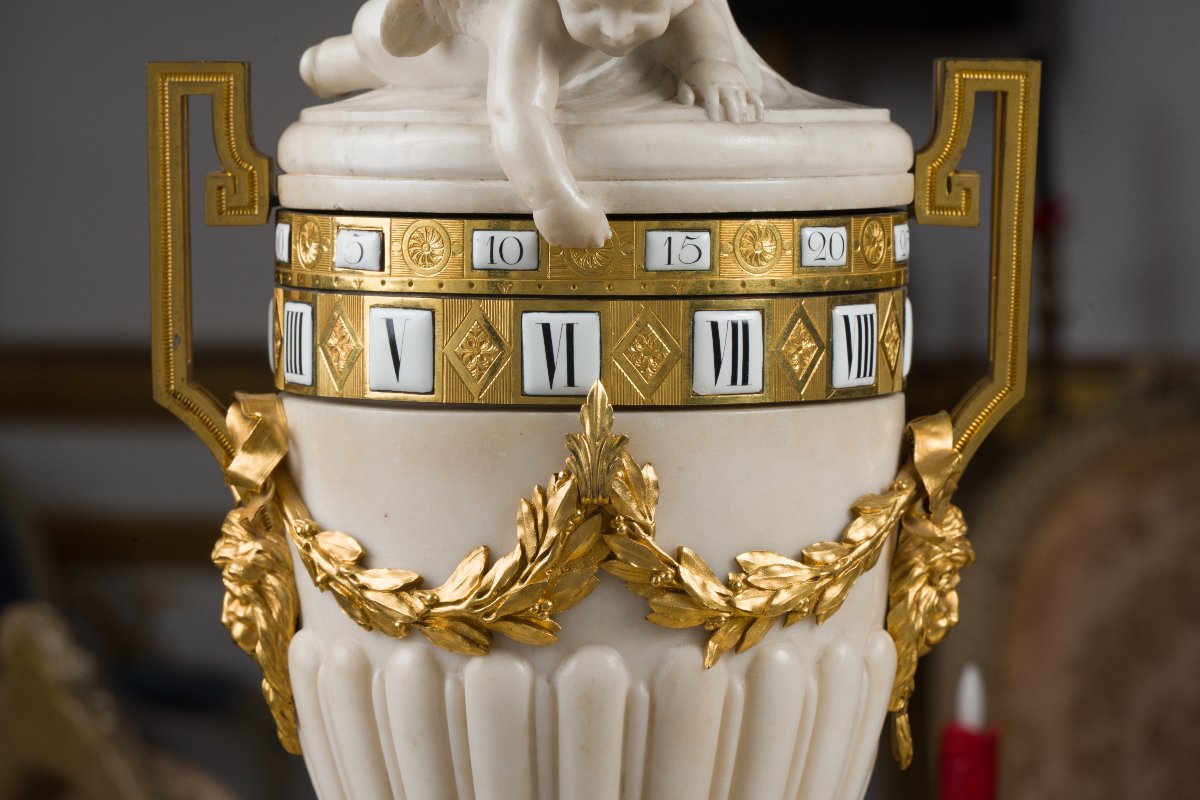
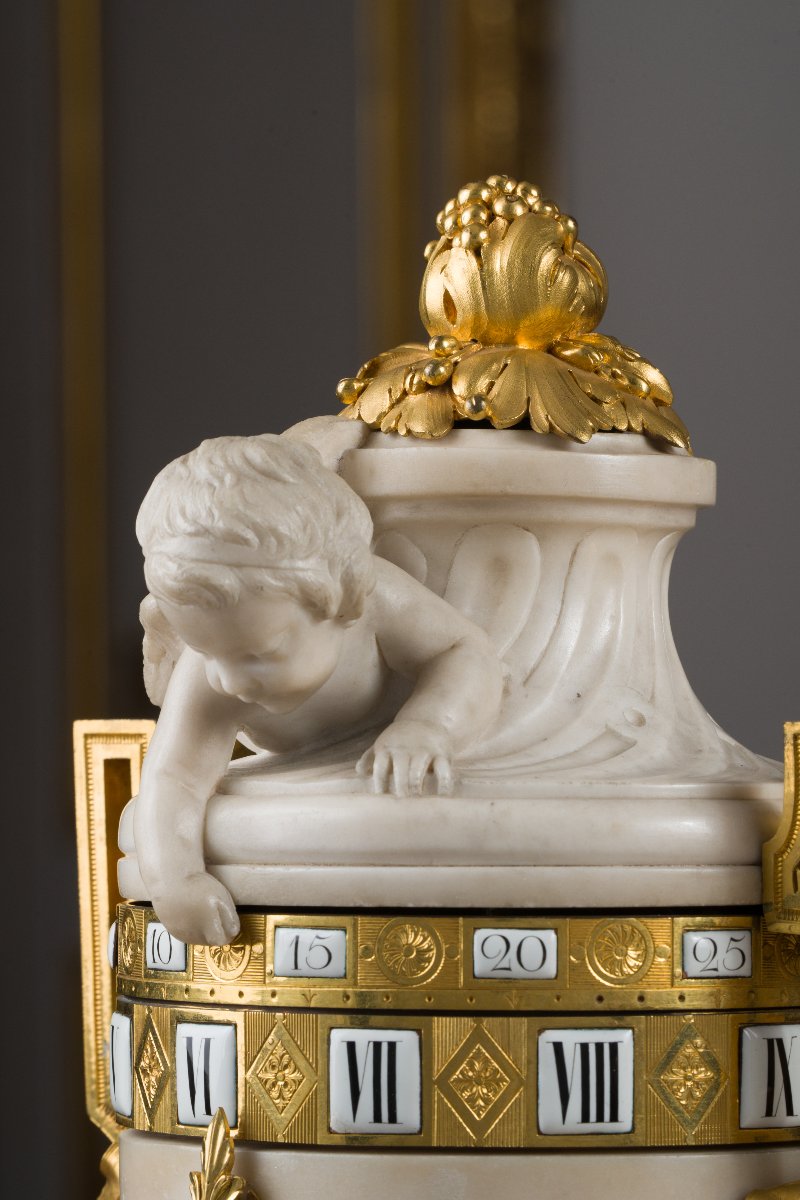
The rectangular movement was designed for the vase into which it fits, featuring a verge escapement, a thread suspension for the balance, and striking of the hours and half-hours with a count wheel on the back plate. The rotating rings in gilt bronze are decorated with lozenges for the hours and rosettes for the minutes. They include enamel cartouches with Roman numerals for the hours and Arabic numerals for the minutes. The right hand of Cupid forms the fixed pointer.
The movement is wound on the right, and the striking mechanism on the left, via two openings in the marble on the right side at the level of the lion’s head. The fast/slow adjustment is positioned flat on top of the movement, using a graduated circular index marked F/S.
The balance oscillates vertically from front to back of the movement, which is unusual.
Louis XVI period, circa 1780
In used condition
Height: 52 cm
Width: 20 cm
Depth: 17.4 cm
History
At the beginning of the second half of the 18th century, we witness a renewal of the ornamental schemes that had previously prevailed in Parisian decorative arts. Following the archaeological discoveries of Pompeii and Herculaneum, collectors, artists, and craftsmen gradually adopted the new principles of Neoclassicism.
In the specific field of horology, this transformation led to the creation of new models of clocks known as “rotating ring” clocks, more elegantly suited than traditional circular dials to their new cases shaped like antique vases. This new fashion, which appealed to major collectors, reached its peak during the reign of Louis XVI.
The clock we present was created in this context and stands apart from nearly all other known examples—typically made entirely of gilt bronze—through its combination of a white marble vase and finely chased and gilded bronze decoration, whose exceptional craftsmanship allows an attribution to the bronzier Pierre Gouthière.
Among the rare comparable examples, also combining these two materials, one may note: a first model sold at auction at Christie’s in London on April 6, 1978 (lot 14); and a second, with ram’s head handles and a lid adorned with a putto sculpted in the round, formerly in the celebrated collection of Count Greffulhe, dispersed in London in 1937 (Sotheby’s sale, July 23, 1937, lot 38).
Biography
Pierre Gouthière (1732–1813)
Pierre Gouthière was undoubtedly the most talented Parisian chaser of his time. Patronized by the duc d’Aumont, one of the greatest collectors of the second half of the 18th century, Gouthière obtained in 1767 the title of gilder to the Menus Plaisirs du Roi, the royal administration responsible, among other things, for managing the sovereign’s private commissions to artists and craftsmen.
This appointment brought him exceptional renown and enabled him to build the most prestigious clientele of the period, composed exclusively of collectors of rare and precious objects. Among them were members of the royal family and the duc d’Aumont, as well as leading aristocrats such as the marquis de Marigny (brother of the marquise de Pompadour), Princess Kinsky, the comtesse du Barry (the King’s mistress), the duchesse de Mazarin, the duc de Duras, and the duchesse de Villeroy, along with prominent financiers, notably Baudard de Saint-James, immensely wealthy Treasurer General of the Navy, and the powerful banker Thélusson.
Detailed Description
Two superimposed dials, or rotating rings, composed of enamel cartouches, indicate the hours in Roman numerals on the first and the minutes in Arabic numerals on the second.
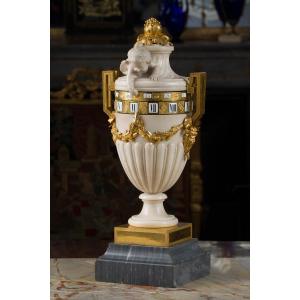
The movement is housed within a superb antique-style vase in white statuary marble, carved with broad leaves and gadrooned friezes worked in spirals. The square, openwork handles are highlighted with fluted motifs and rest on lion masks. The body is adorned with garlands of laurel leaves and berries, within which a serpent intertwines, its tongue indicating the hour. Finally, the finial is decorated with a seed emerging from a leafy bouquet.
The vase stands on a molded pedestal encircled by a ribboned frieze of laurel leaves and berries, supported by a square base, itself resting on a quadrangular plinth in gilt bronze with plain reserves set within matted frames.
Provenance
Former Seligmann collection
Collection of Baron Eugène Fould
Collection of Nathaniel de Rothschild
Inventory
Georges Samary, “Collection de Monsieur le Baron Eugène Fould”, July 1913, No. 8
Bibliography
La Décoration, “Connaissance des Arts” collection, Hachette, 1963, p. 264
Les plus belles pendules françaises by Giacomo and Aurélie Wannenes, Polistampa, 2013, p. 185
Comparative Bibliography
An identical clock: Sotheby & Co sale, July 23, 1937, lot 38
White marble and chased, gilt bronze clock, Paris, circa 1775–1780, formerly in the collection of Count Greffulhe.
Period: 18th century
Style: Louis 16th, Directory
Condition: Condition of use
Material: Marble
Reference (ID): 1732462
Availability: In stock