THIS OBJECT WAS SOLD
Japanese Bronze By Yoshishi Shibata: Female Nude With Drapery

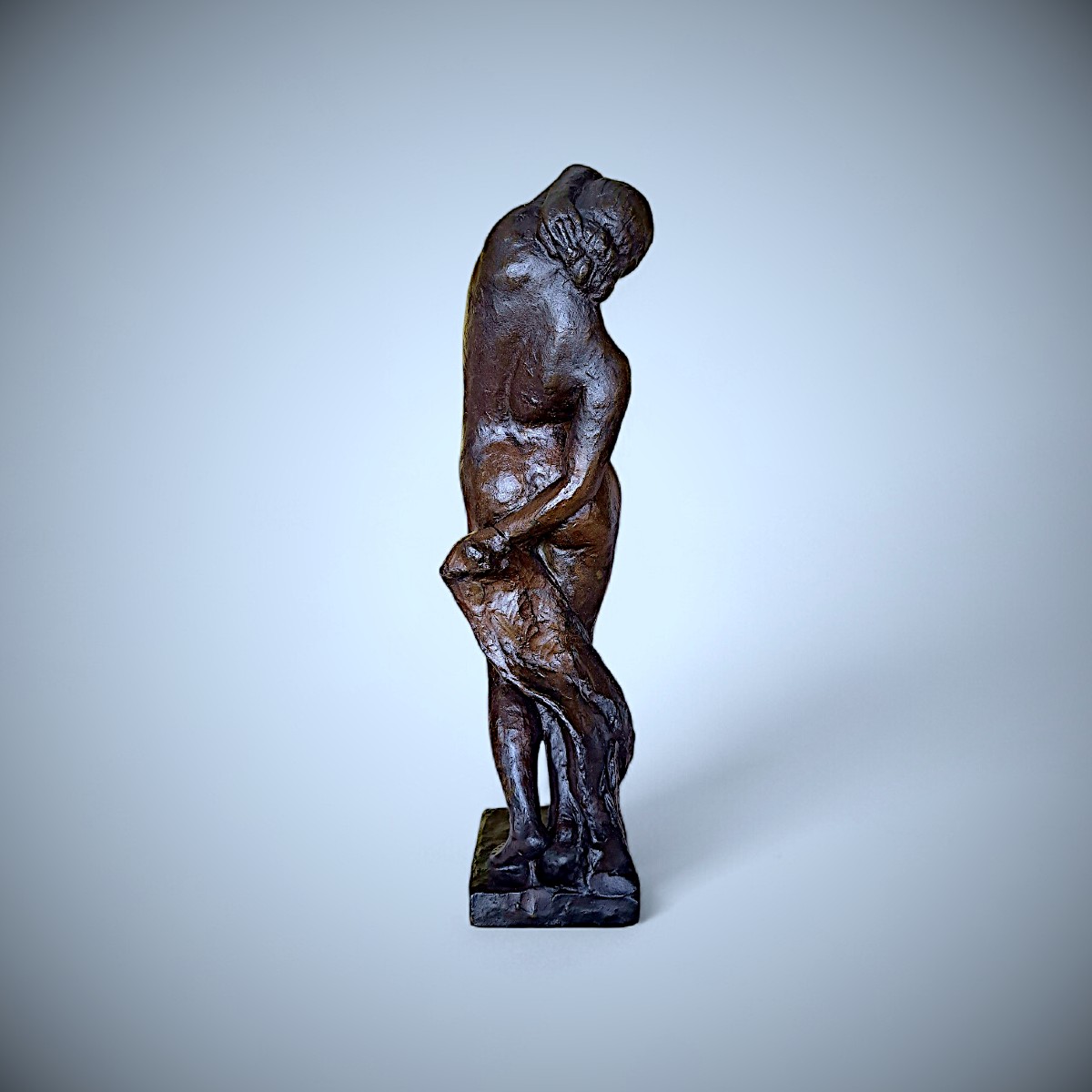

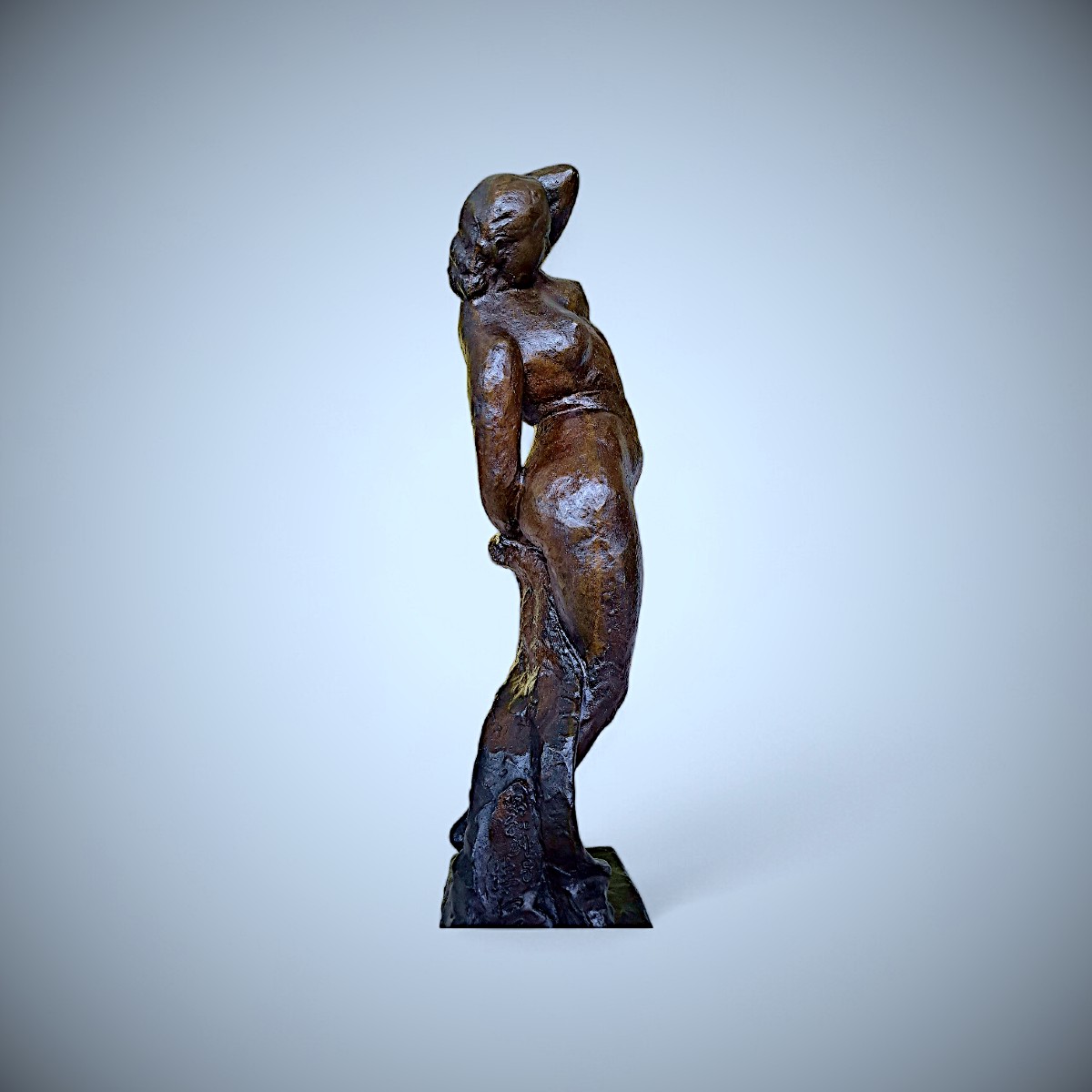

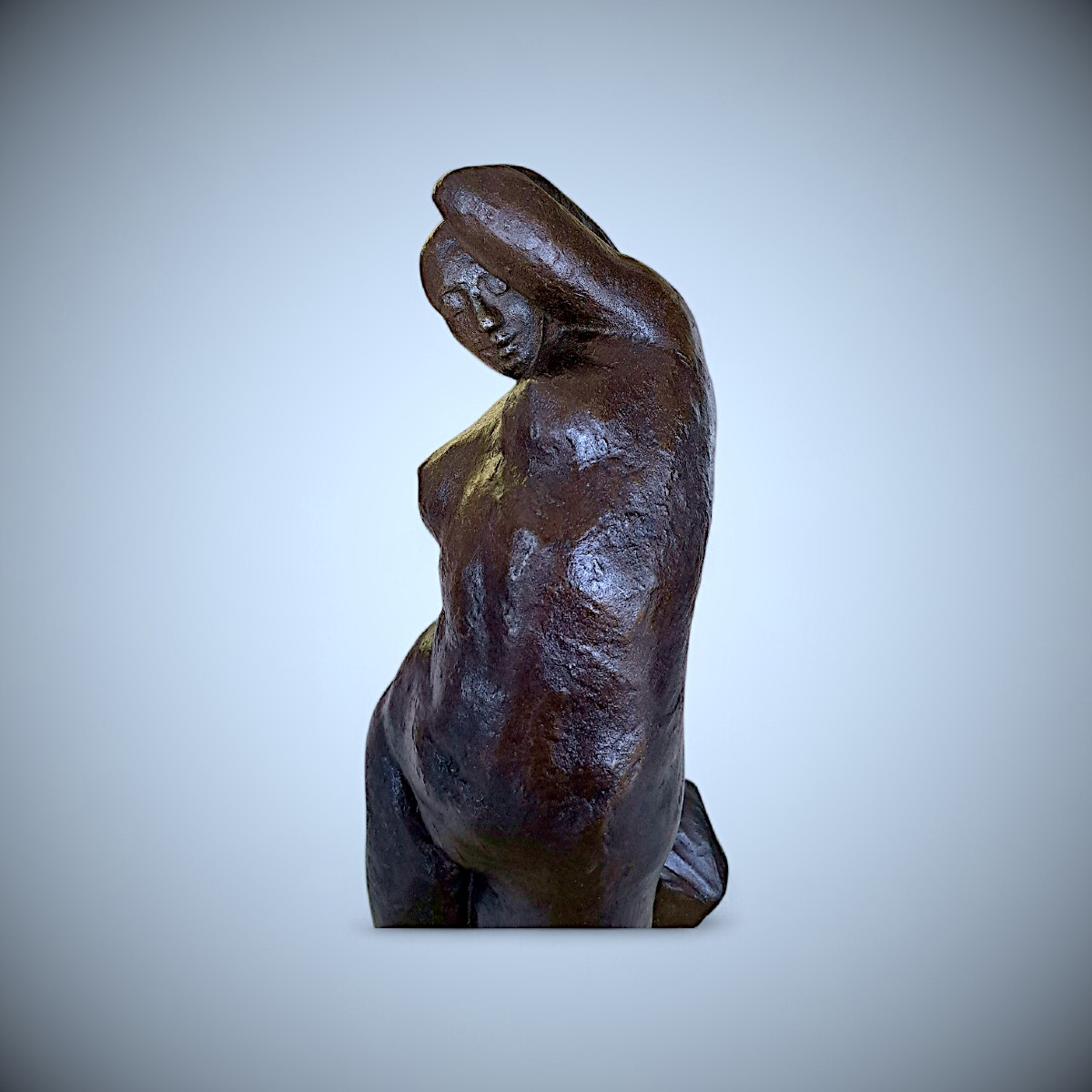


This expressive bronze figure by Yoshishi Shibata (1900-1968), also known by the pseudonyms Kaishi or Kachi, belongs to the refined tradition of Japanese academic sculpture that developed between the end of the Taishō era and the beginning of the Shōwa era.
Born in Tokyo in 1900 as Fukushirō Kanno, Shibata came from a demanding artistic lineage; he studied under the renowned sculptor Kitamura Seibō, a major figure in the transmission of Western naturalism to modern Japanese sculpture.
The work presented here reveals a sculptor thoroughly immersed in this academic tradition, without, however, being subservient to it. The female nude is conceived in a delicate contrapposto pose, her body subtly twisting as one arm rises behind her head in a gesture that is both intimate and introspective. The composition avoids ostentatious classicism in favor of a more compact, almost introspective monumentality. The volumes are gently modeled, the absence of superfluous anatomical details being deliberate, allowing the figure to oscillate between a naturalistic presence and a meditative, serene abstraction.
The surface treatment is particularly striking: the bronze displays a warm, nuanced patina, its slightly granular texture capturing the light and animating the otherwise understated form. This sensitivity to the surface recalls the major trends in early Shōwa sculpture, where touch and mass were often favored over linear precision. The downcast gaze and simplified facial features further reinforce this sense of interiority, situating the work within a distinctly Japanese reinterpretation of Western sculptural ideals.
Shibata's documented career—which includes exhibition works such as "The Strong Man" (displayed at a state-sponsored exhibition in 1942), as well as public commissions like the Gifu Park Maiden Statue and the bust of Fukuzawa Yukichi at Keio University—places him firmly within the circle of academically trained sculptors who sustained Japan's official sculptural culture until the mid-20th century. His membership in the Japan Ceramic Sculpture Association in 1951 testifies to a versatile practice, at the crossroads of traditional materials and modern sculptural research.
In this context, the bronze presented here can be understood not only as a studio work, but also as a component of a broader exploration of the human figure, running parallel to his public commissions. It reflects a period in Japanese sculpture when the imported language of European naturalism had been fully assimilated and subtly transformed, tempered by restraint, introspection, and a refined sensitivity to the material. As such, this sculpture is a compelling example of Shibata Yoshishi's mature style: at the crossroads of academic discipline and personal expression, and emblematic of a generation of artists whose contributions, although often discreet, remain essential to the history of modern Japanese sculpture.
Born in Tokyo in 1900 as Fukushirō Kanno, Shibata came from a demanding artistic lineage; he studied under the renowned sculptor Kitamura Seibō, a major figure in the transmission of Western naturalism to modern Japanese sculpture.
The work presented here reveals a sculptor thoroughly immersed in this academic tradition, without, however, being subservient to it. The female nude is conceived in a delicate contrapposto pose, her body subtly twisting as one arm rises behind her head in a gesture that is both intimate and introspective. The composition avoids ostentatious classicism in favor of a more compact, almost introspective monumentality. The volumes are gently modeled, the absence of superfluous anatomical details being deliberate, allowing the figure to oscillate between a naturalistic presence and a meditative, serene abstraction.
The surface treatment is particularly striking: the bronze displays a warm, nuanced patina, its slightly granular texture capturing the light and animating the otherwise understated form. This sensitivity to the surface recalls the major trends in early Shōwa sculpture, where touch and mass were often favored over linear precision. The downcast gaze and simplified facial features further reinforce this sense of interiority, situating the work within a distinctly Japanese reinterpretation of Western sculptural ideals.
Shibata's documented career—which includes exhibition works such as "The Strong Man" (displayed at a state-sponsored exhibition in 1942), as well as public commissions like the Gifu Park Maiden Statue and the bust of Fukuzawa Yukichi at Keio University—places him firmly within the circle of academically trained sculptors who sustained Japan's official sculptural culture until the mid-20th century. His membership in the Japan Ceramic Sculpture Association in 1951 testifies to a versatile practice, at the crossroads of traditional materials and modern sculptural research.
In this context, the bronze presented here can be understood not only as a studio work, but also as a component of a broader exploration of the human figure, running parallel to his public commissions. It reflects a period in Japanese sculpture when the imported language of European naturalism had been fully assimilated and subtly transformed, tempered by restraint, introspection, and a refined sensitivity to the material. As such, this sculpture is a compelling example of Shibata Yoshishi's mature style: at the crossroads of academic discipline and personal expression, and emblematic of a generation of artists whose contributions, although often discreet, remain essential to the history of modern Japanese sculpture.
Explore similar pieces and discover your ideal find:
Asian Bronze Sculptures