THIS OBJECT WAS SOLD
Follower Of Abraham Storck, Mediterranean Port With Sailing Ships, Figures






Follower of Abraham Storck
Dutch/Flemish School, first half of the 18th century
Mediterranean Port with Sailing Ships, Figures, and Coastal Architecture
Oil on canvas, 62 × 74.5 cm
framed in a gilded wooden frame
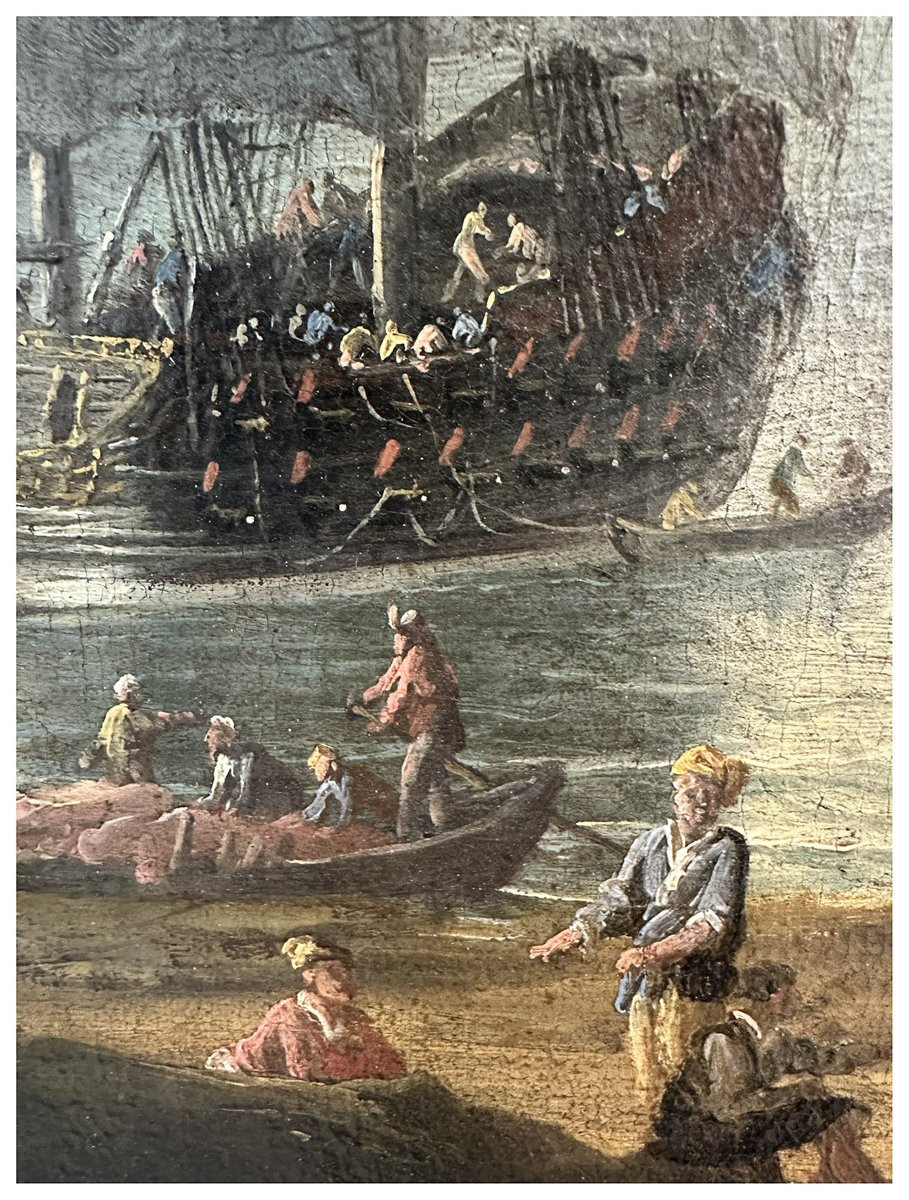
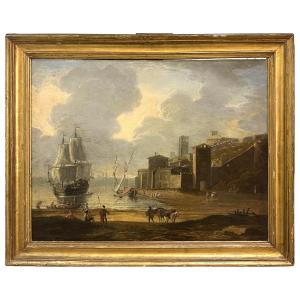
The composition opens onto a broad Mediterranean-style port view, dominated on the left by an imposing three-masted sailing ship with full sails, bearing the Dutch flag atop its mainmast. The vessel, depicted in three-quarters, is surrounded by smaller vessels: a launch crowded with sailors moves away from its side toward the shore, while a lateen-rigged felucca with red sails bobs to the right, anchored near the beach.
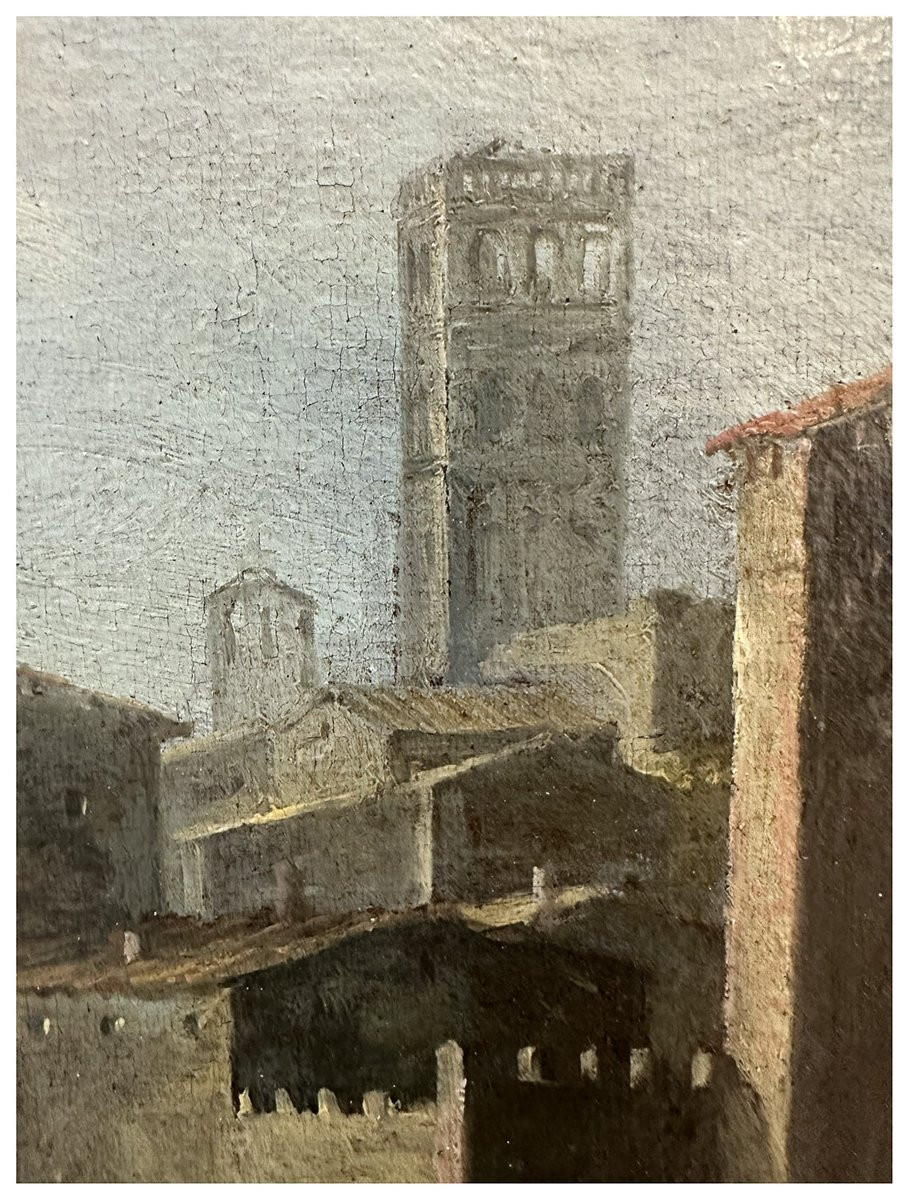
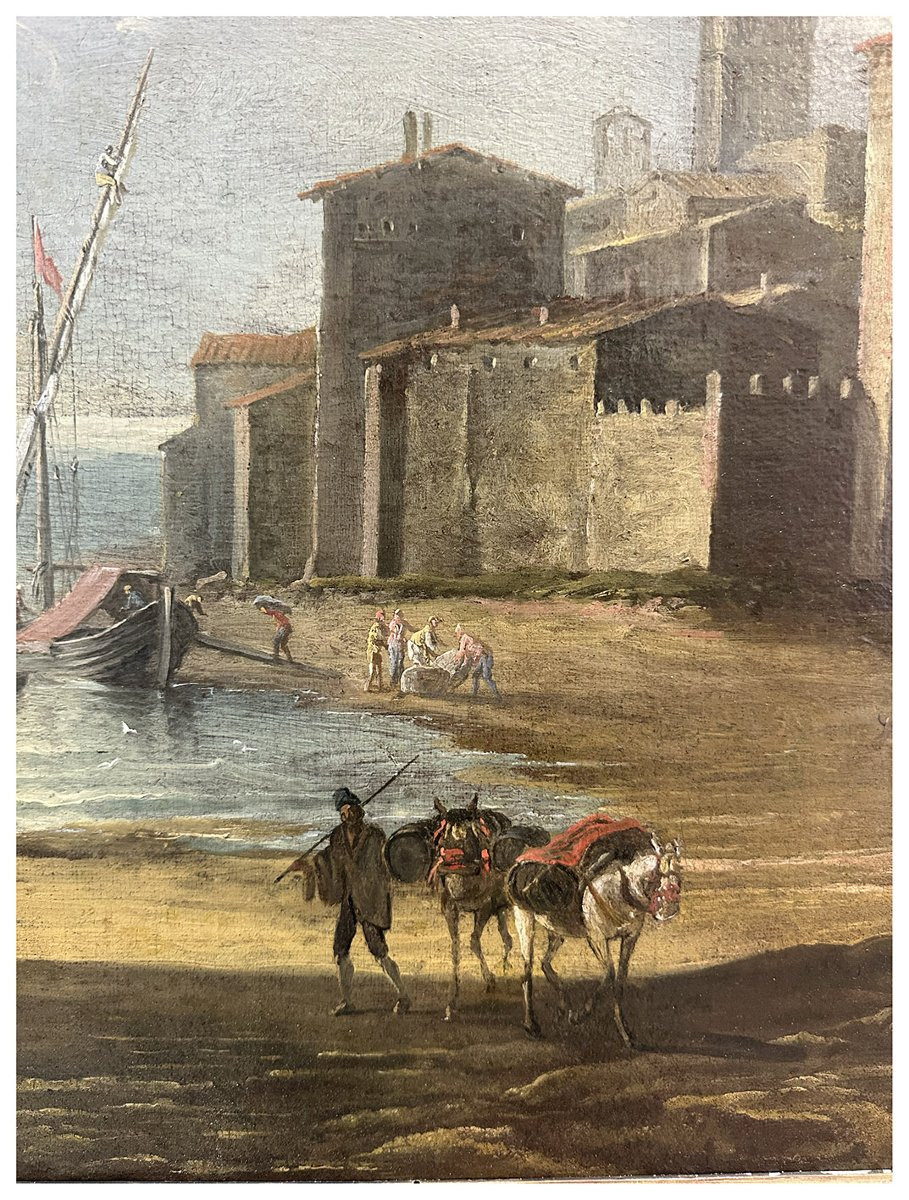
The foreground is enlivened by a group of figures in colorful costumes—a sailor in red and black, a Levantine with a loaded mule, and women seated on rocks—giving the scene the anecdotal liveliness so dear to the tradition of Nordic bambocciate, transplanted to the landscape of the South. In the background to the right stands a coastal village with a crenellated tower and dark stone bastions, crowned by a hill on which other buildings tower: an urban landscape reminiscent of the coasts of Liguria, Provence, or the Spanish Levant, but rendered in a picturesque capriccio rather than a faithful view.
The sky occupies almost half the painting surface and reveals the hand of a painter skilled in atmospheric treatment: masses of whitish clouds gather toward the center, allowing a golden glow to filter through, illuminating the water with iridescent reflections, and dissolving toward the left into a more open sky. The grazing and theatrical light unifies the scene, lending it an almost theatrical feel.
HISTORICAL AND ARTISTIC CONTEXT
The seascape with a harbor—a blend of topographical view and poetic invention—was one of the most fertile and sought-after genres in European painting between the 17th and 18th centuries.
The origins of this genre lie in 17th-century Holland, where artists such as Jan Porcellis, Simon de Vlieger, and Jan van de Cappelle established a tradition of atmospheric marine paintings centered on the pearl-gray light of the North Sea. However, it was with the generation of Willem van de Velde the Younger and the painters active between Amsterdam and Antwerp in the second half of the 17th century that the genre reached its fullest flowering, gradually opening up to Mediterranean landscapes—sunnier, more picturesque, populated by figures in exotic garb—under the influence of his Italian sojourn and the manner of Claude Lorrain.
It was in this climate that Abraham Storck (Amsterdam, c. 1644–1708) developed his work, one of the most prolific and esteemed port landscape painters of his time. Son of the painter Jan Jansz Storck, from the 1670s onward, Abraham specialized in compositions that combined the documentary precision of the Flemish navy with the picturesque beauty of southern ports—real or imagined. His medium- to large-format canvases consistently combine the same elements: sailing ships with national flags, Mediterranean-style coastal architecture (towers, bastions, ochre-colored houses), foreground figures of merchants, sailors, and commoners, and open skies with dramatic clouds. Storck worked almost exclusively for the Dutch domestic market and international commissions, achieving widespread popularity through engravings based on his paintings.
The success of Storck's model was enormous and lasted well beyond his death: in the first half of the eighteenth century, numerous painters—Dutch, Flemish, but also French and Italian—replicated and modified his inventions, giving rise to a veritable mass production of capricious ports destined for the most diverse European markets. This painting fits into this current, its composition—three-story layout, distribution of vessels, architectural typology, and color palette dominated by silvery grays and warm earth tones—faithfully reflects Storck's prototypes while revealing the interpretative freedom of a capable and individual follower.
ATTRIBUTIVE NOTES
The work exhibits all the typological and stylistic characteristics of Abraham Storck's circle: the fluid and confident rendering of the sky and water, the precise definition of the figures in Levantine costume, the convincing rendering of the three-masted sailing ship with its rigging, and the perspective construction of the view with its architectural backdrop on the right. The overall quality of execution is high and suggests a painter of Nordic training, likely active between 1700 and 1740. A provenance from the Amsterdam school or from Flemish-Dutch circles operating for the southern European market cannot be excluded.
Dutch/Flemish School, first half of the 18th century
Mediterranean Port with Sailing Ships, Figures, and Coastal Architecture
Oil on canvas, 62 × 74.5 cm
framed in a gilded wooden frame
The composition opens onto a broad Mediterranean-style port view, dominated on the left by an imposing three-masted sailing ship with full sails, bearing the Dutch flag atop its mainmast. The vessel, depicted in three-quarters, is surrounded by smaller vessels: a launch crowded with sailors moves away from its side toward the shore, while a lateen-rigged felucca with red sails bobs to the right, anchored near the beach.
The foreground is enlivened by a group of figures in colorful costumes—a sailor in red and black, a Levantine with a loaded mule, and women seated on rocks—giving the scene the anecdotal liveliness so dear to the tradition of Nordic bambocciate, transplanted to the landscape of the South. In the background to the right stands a coastal village with a crenellated tower and dark stone bastions, crowned by a hill on which other buildings tower: an urban landscape reminiscent of the coasts of Liguria, Provence, or the Spanish Levant, but rendered in a picturesque capriccio rather than a faithful view.
The sky occupies almost half the painting surface and reveals the hand of a painter skilled in atmospheric treatment: masses of whitish clouds gather toward the center, allowing a golden glow to filter through, illuminating the water with iridescent reflections, and dissolving toward the left into a more open sky. The grazing and theatrical light unifies the scene, lending it an almost theatrical feel.
HISTORICAL AND ARTISTIC CONTEXT
The seascape with a harbor—a blend of topographical view and poetic invention—was one of the most fertile and sought-after genres in European painting between the 17th and 18th centuries.
The origins of this genre lie in 17th-century Holland, where artists such as Jan Porcellis, Simon de Vlieger, and Jan van de Cappelle established a tradition of atmospheric marine paintings centered on the pearl-gray light of the North Sea. However, it was with the generation of Willem van de Velde the Younger and the painters active between Amsterdam and Antwerp in the second half of the 17th century that the genre reached its fullest flowering, gradually opening up to Mediterranean landscapes—sunnier, more picturesque, populated by figures in exotic garb—under the influence of his Italian sojourn and the manner of Claude Lorrain.
It was in this climate that Abraham Storck (Amsterdam, c. 1644–1708) developed his work, one of the most prolific and esteemed port landscape painters of his time. Son of the painter Jan Jansz Storck, from the 1670s onward, Abraham specialized in compositions that combined the documentary precision of the Flemish navy with the picturesque beauty of southern ports—real or imagined. His medium- to large-format canvases consistently combine the same elements: sailing ships with national flags, Mediterranean-style coastal architecture (towers, bastions, ochre-colored houses), foreground figures of merchants, sailors, and commoners, and open skies with dramatic clouds. Storck worked almost exclusively for the Dutch domestic market and international commissions, achieving widespread popularity through engravings based on his paintings.
The success of Storck's model was enormous and lasted well beyond his death: in the first half of the eighteenth century, numerous painters—Dutch, Flemish, but also French and Italian—replicated and modified his inventions, giving rise to a veritable mass production of capricious ports destined for the most diverse European markets. This painting fits into this current, its composition—three-story layout, distribution of vessels, architectural typology, and color palette dominated by silvery grays and warm earth tones—faithfully reflects Storck's prototypes while revealing the interpretative freedom of a capable and individual follower.
ATTRIBUTIVE NOTES
The work exhibits all the typological and stylistic characteristics of Abraham Storck's circle: the fluid and confident rendering of the sky and water, the precise definition of the figures in Levantine costume, the convincing rendering of the three-masted sailing ship with its rigging, and the perspective construction of the view with its architectural backdrop on the right. The overall quality of execution is high and suggests a painter of Nordic training, likely active between 1700 and 1740. A provenance from the Amsterdam school or from Flemish-Dutch circles operating for the southern European market cannot be excluded.
Explore similar pieces and discover your ideal find:
Seascapes, Marine Paintings