THIS OBJECT WAS SOLD
Follower Of Nicolas Poussin, Holy Family With The Infant Saint John The Baptist.oil On Canvas


Follower of Nicolas Poussin
France, late 18th - early 19th century
Holy Family with the Infant Saint John the Baptist
oil on canvas, 59 x 48 cm
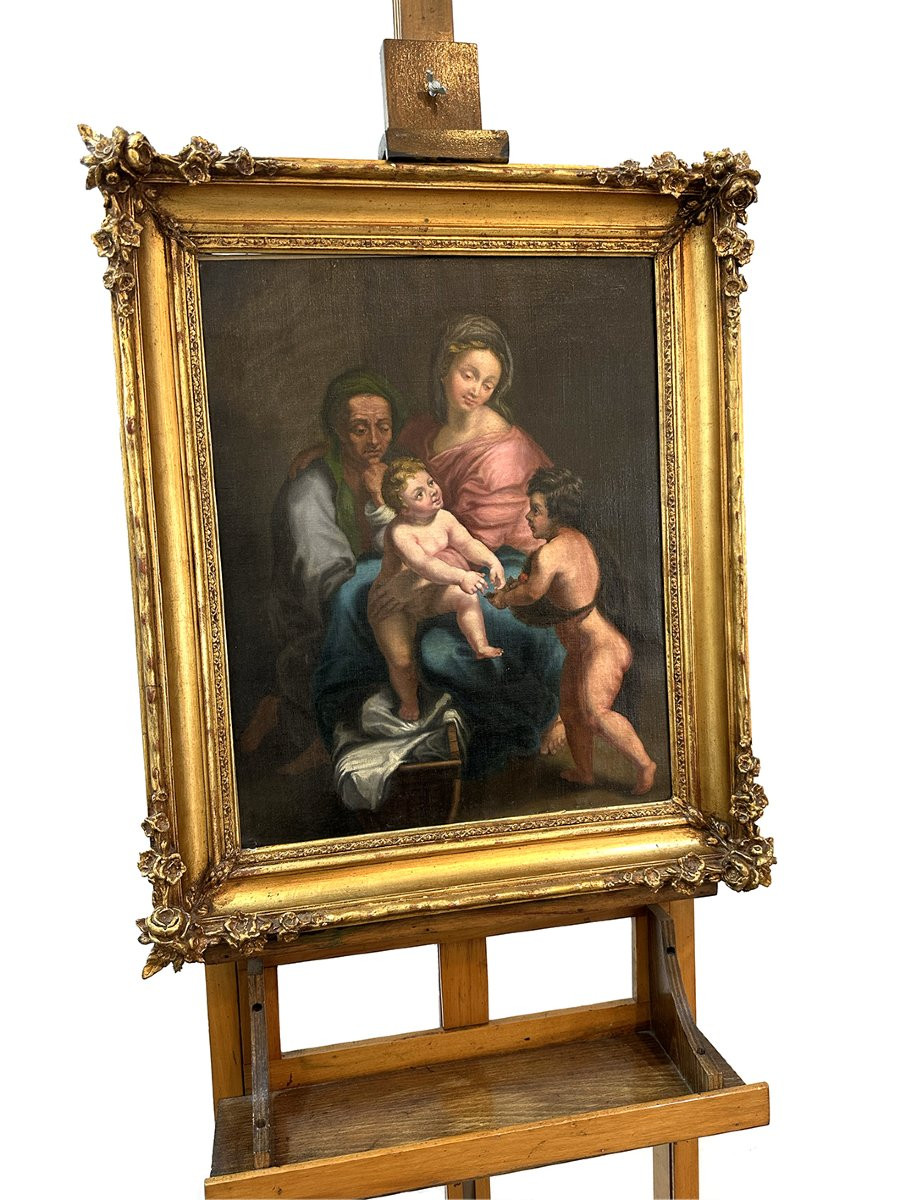
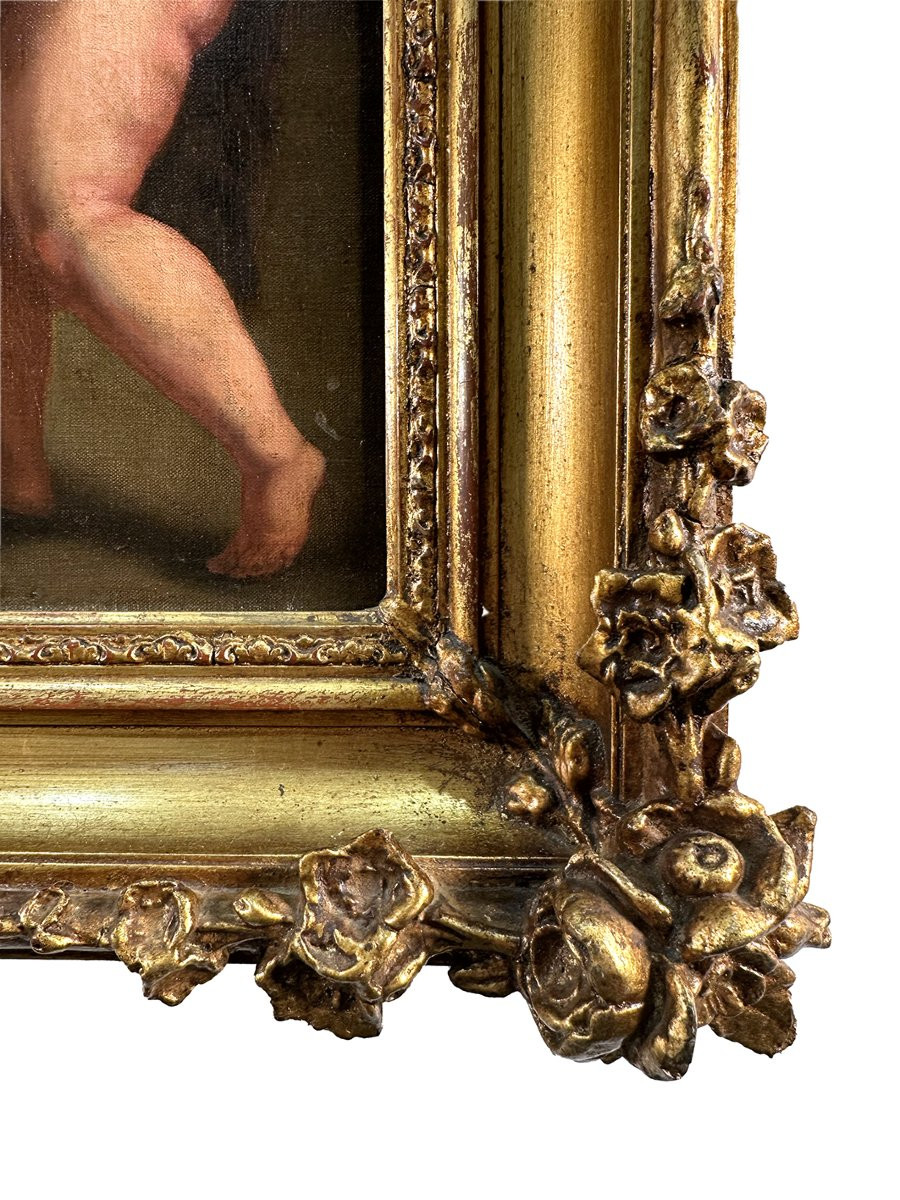
Within a wooden frame and gilded pastiglia, totaling 75 x 66 cm
Artistic Context: The French School between the 18th and 19th centuries
Between the late 18th and early 19th centuries, French painting underwent a period of profound reflection on its classical past. The Grand Tour and the French Academy in Rome maintained a lively interest in the great masters of the 17th century, particularly Nicolas Poussin (Les Andelys, 1594 – Rome, 1665), considered the father of French classicism in painting and an unsurpassed model of rational composition and formal balance.
In this neoclassical and academic climate, numerous painters and students of the École des Beaux-Arts devoted themselves to the study and revival of Poussin's sacred subjects, translating them into a contemporary yet respectful language. The French academies promoted the cult of Poussin as a fundamental aesthetic norm, and the production of paintings "à la manière de Poussin" was a consolidated educational practice, also appreciated by the bourgeois and aristocratic collectors of the time.
This painting fits perfectly into this current: the work reveals a cultured hand, with a solid academic background, reinterpreting seventeenth-century iconographic models with technical mastery and refined chromatic sensitivity.
The subject: The Holy Family with the Infant Saint John the Baptist
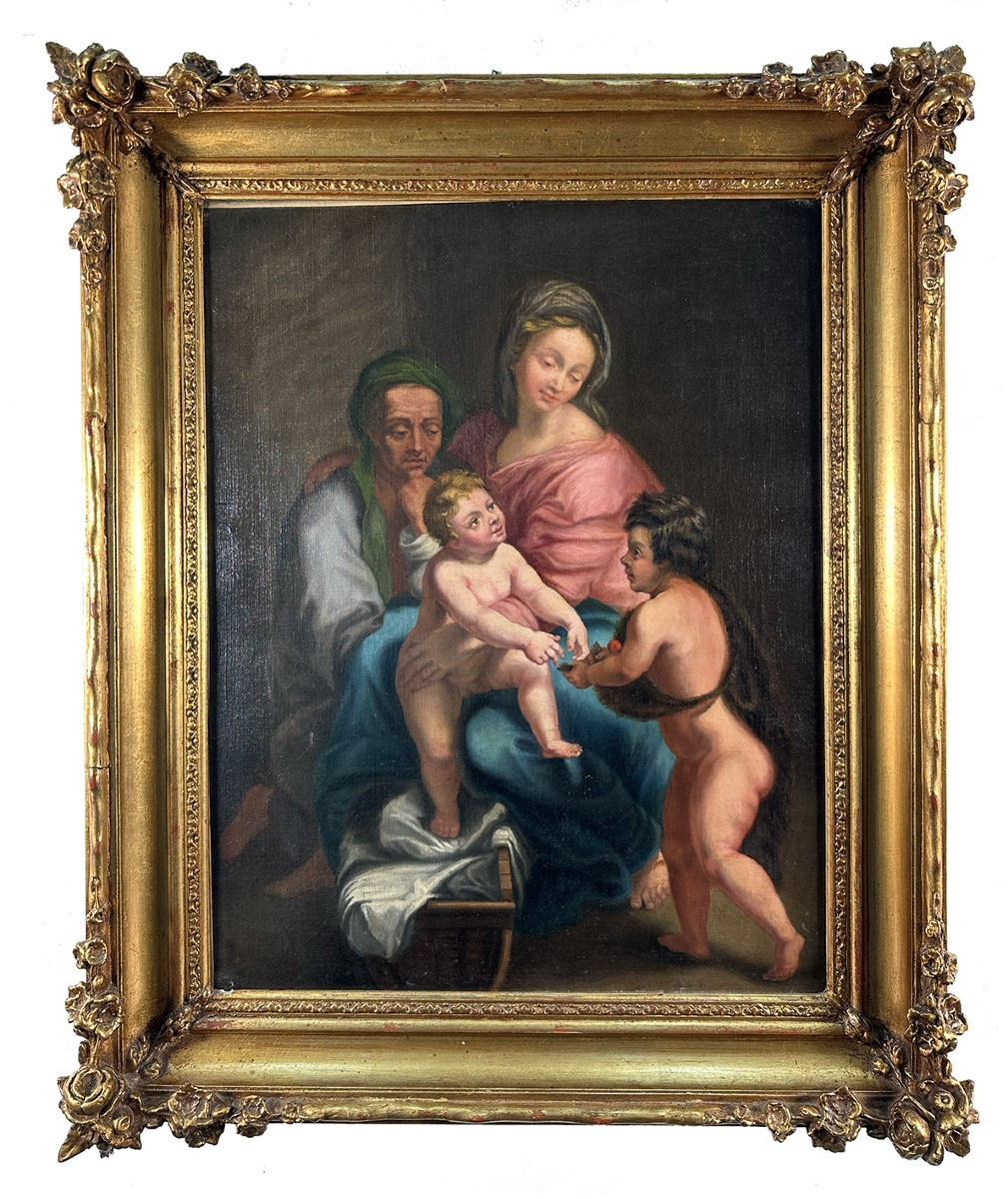
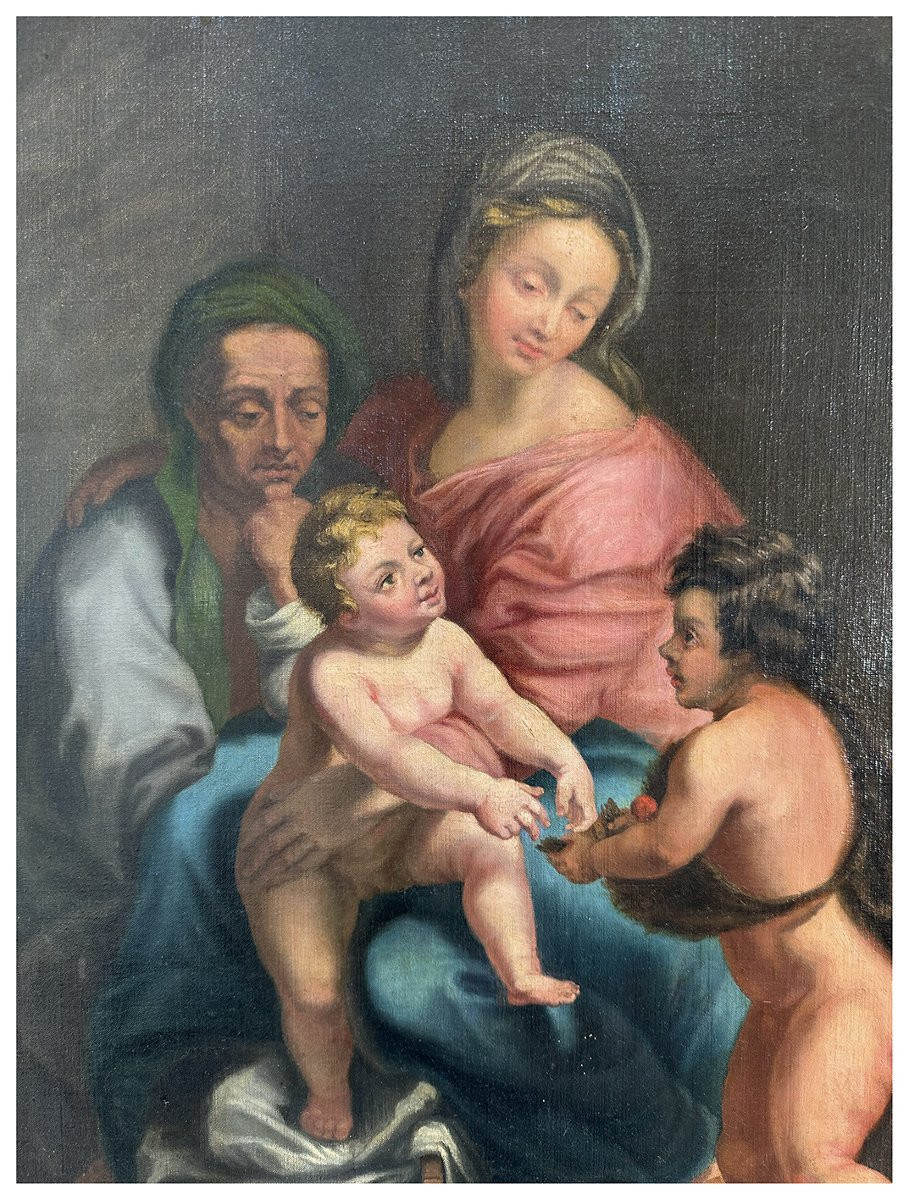
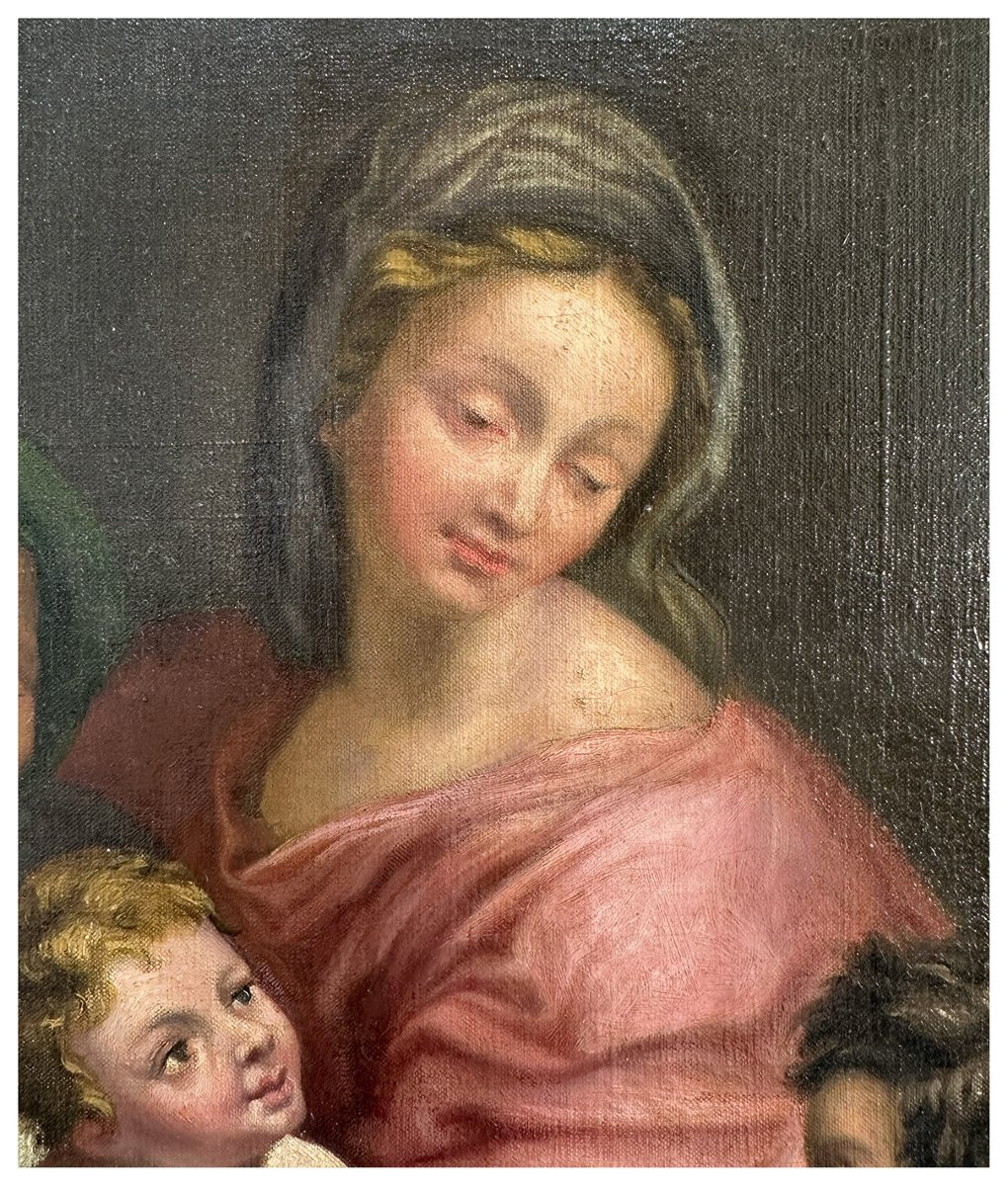
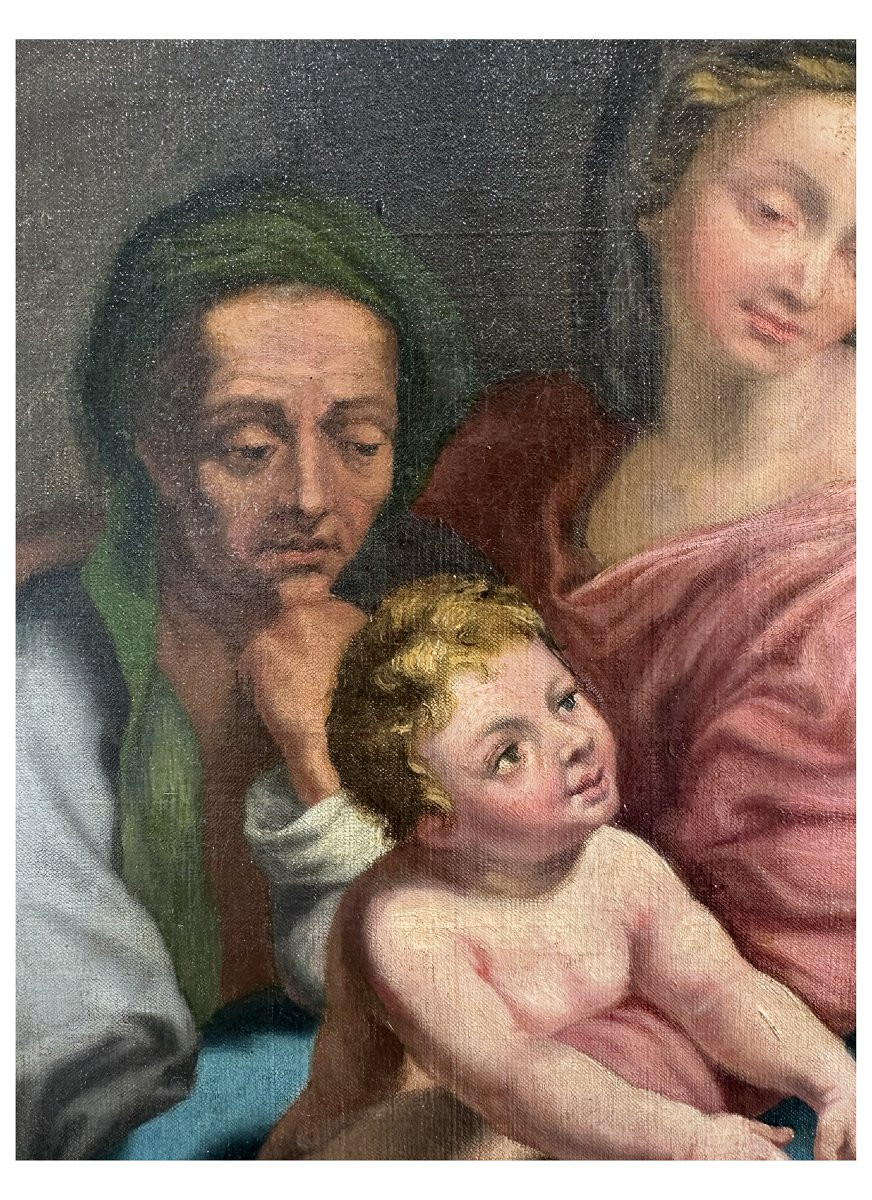
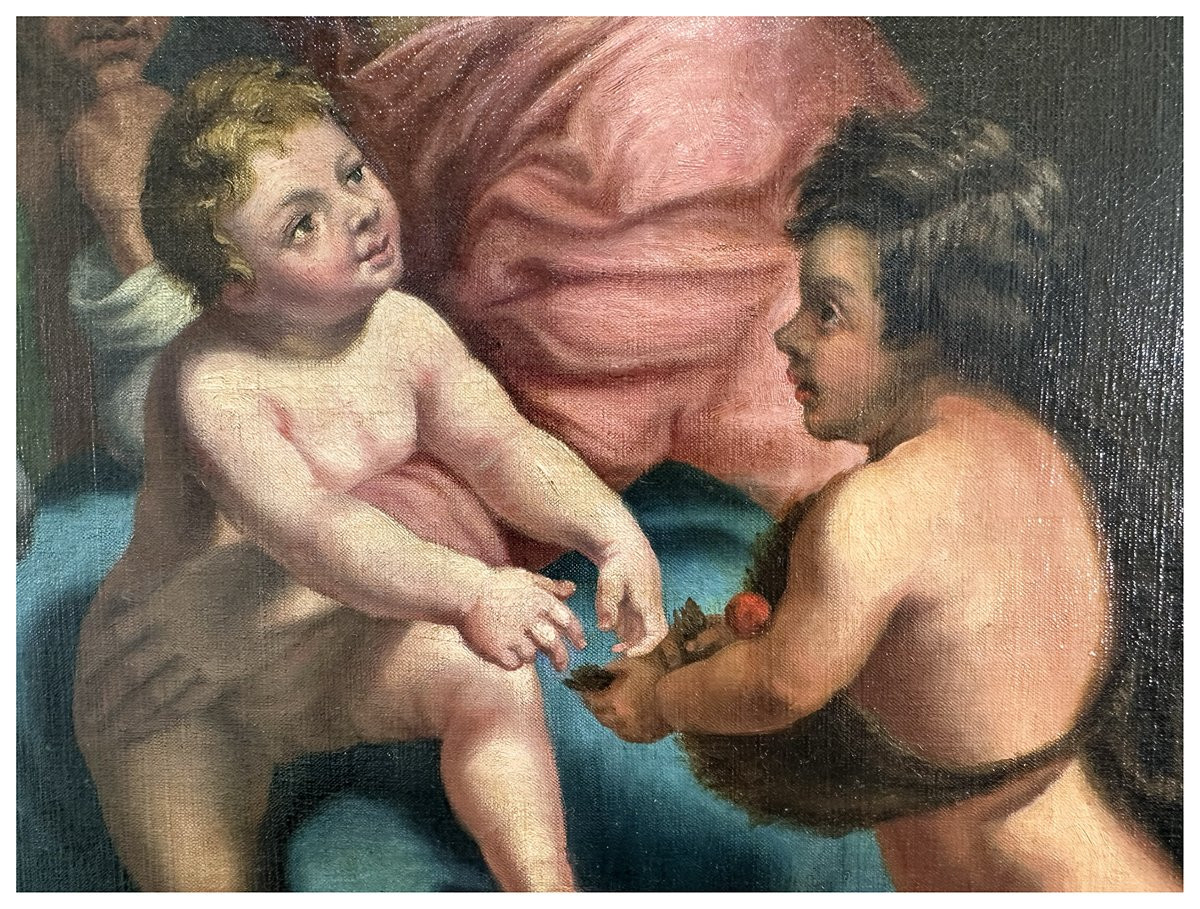
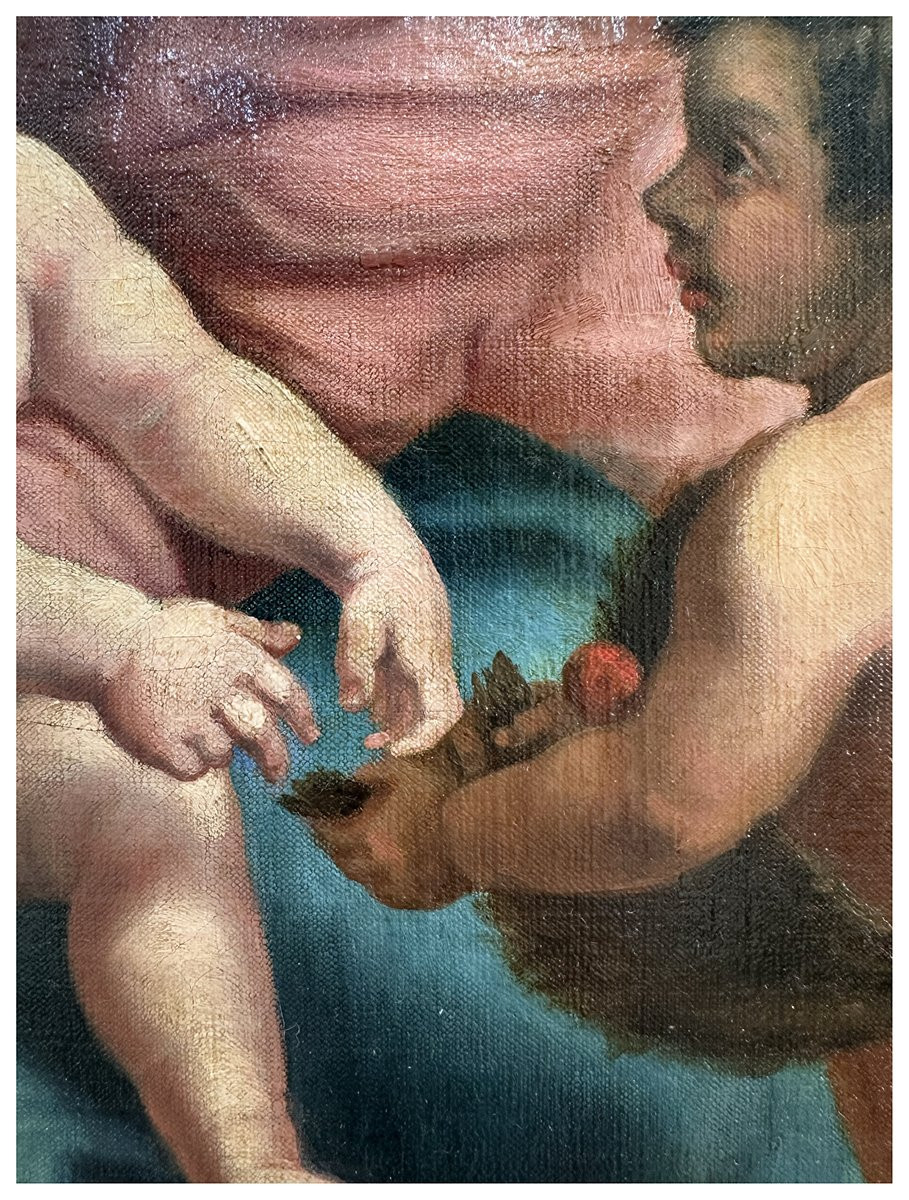
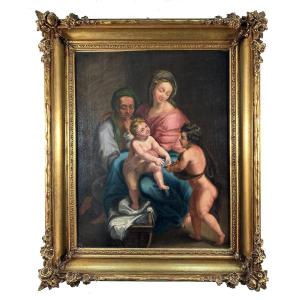
The painting depicts one of the most beloved subjects in Christian painting tradition: the Holy Family with the infant Saint John the Baptist (the so-called "Giovannino"). The four figures are arranged in a classical pyramidal pattern, a direct legacy of Raphael's influence, influenced by 17th-century classicism. The Madonna, at the center of the composition, holds the Child Jesus in her lap; behind her, an elderly figure—identifiable as Saint Anne—observes the scene with a thoughtful and involved gaze. On the right, the young Saint John the Baptist, recognizable by the animal strap around his waist, reaches out to the Child, offering him a piece of fruit or a small object in a gesture of childlike devotion and affection.
The iconography is rich in symbolic references: the contact between the two children prefigures the bond between John and Jesus, between the Forerunner and the Messiah. The fruit offered by the young John alludes to redemption and future sacrifice. The intimate and contemplative scene unfolds against a dark, neutral background that focuses attention on the figures and enhances their sculptural volumes.
Pictorial and Stylistic Analysis
Formally, the painting reveals a solid classicist culture. The composition is structured according to an implicit pyramidal geometry, with the figures arranged in a studied balance that recalls the monumentality of the Holy Families of Poussin and his circle. The figures' modeling is achieved through diffused light that gently shapes the volumes, avoiding the harsh contrasts of Caravaggism and favoring the softness typical of the Parisian academic school.
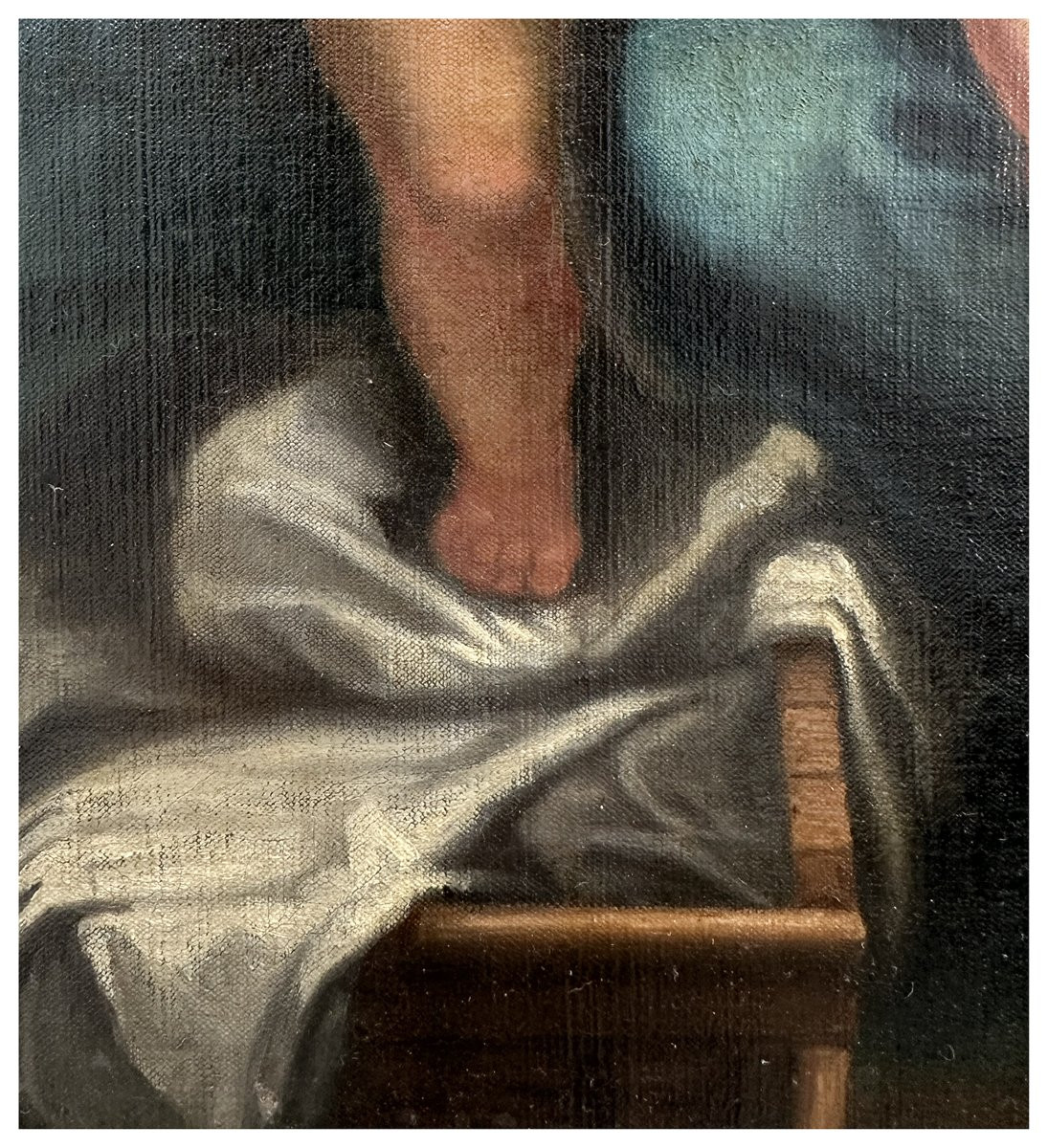
The color palette is refined and controlled: the antique rose of the Madonna's robe, the deep blue of her cloak, the luminous white of the lower drapery, and the green of the elderly Anne's headdress combine in elegant chromatic arrangements reminiscent of the coloristic approaches of French painters trained in the Poussin and Bolognese tradition. The children's soft complexions, treated with fluid and expert brushwork, demonstrate the artist's technical prowess.
The dark, undefined background, typical of 17th-century Italian portraiture adapted to the French academic tradition, lends the composition a depth and a sense of spiritual contemplation that elevate the painting above mere serial production, attesting to the quality of a cultured and technically mature follower.
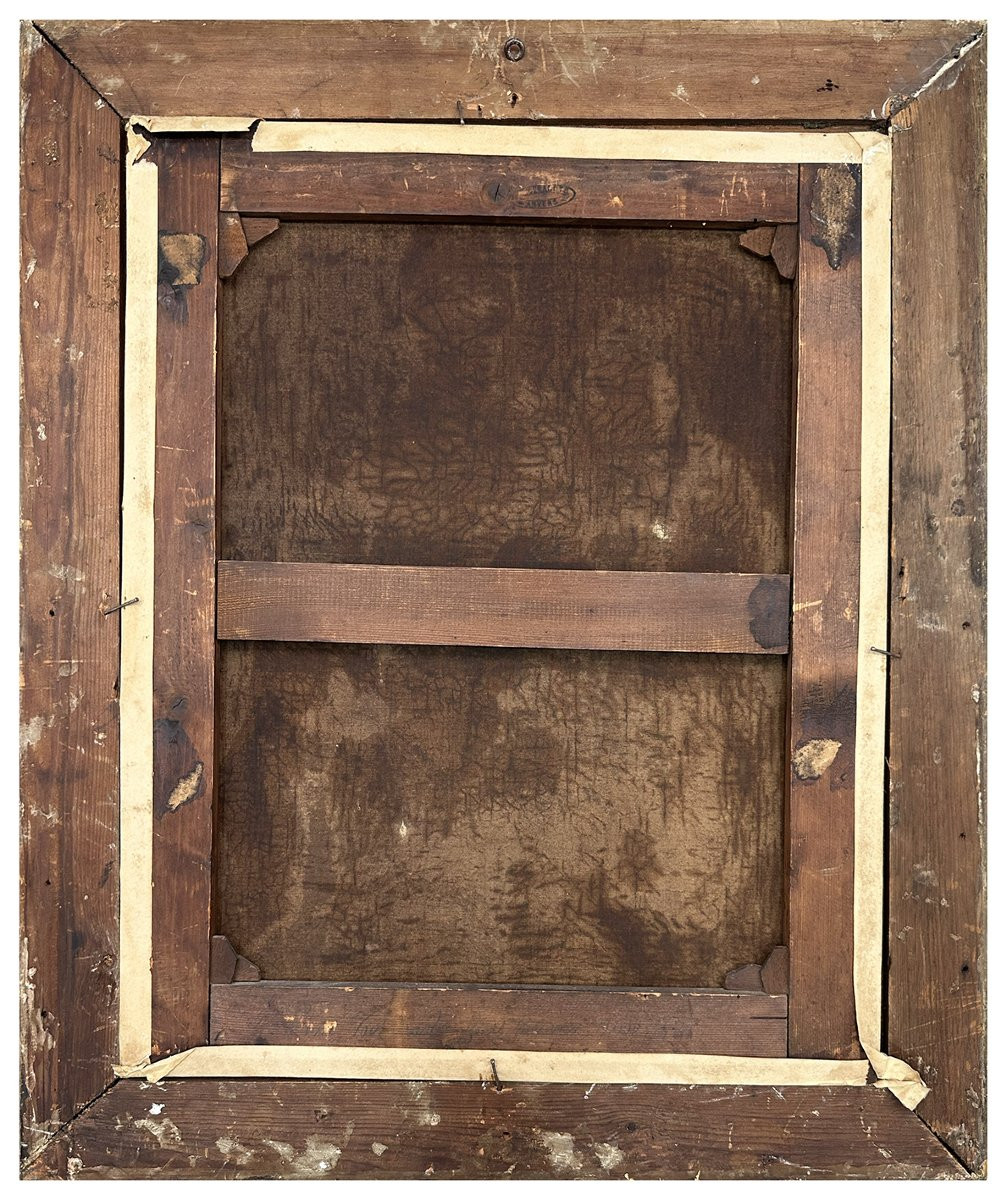
The painting is in good condition, with its original period frame in carved and gilded wood, enhancing its aesthetic and documentary value. The pictorial quality, superior to the average for contemporary serial production, and the compositional refinement make it a piece of certain interest for collectors of French Old Masters and for enthusiasts of the European classicist tradition.
Works by followers of Poussin of this quality are prized at international auctions of Old Masters and in prestigious private collections. The subject of the Holy Family, combined with such an illustrious stylistic provenance, guarantees a prestigious placement in any exhibition or collection context.
France, late 18th - early 19th century
Holy Family with the Infant Saint John the Baptist
oil on canvas, 59 x 48 cm
Within a wooden frame and gilded pastiglia, totaling 75 x 66 cm
Artistic Context: The French School between the 18th and 19th centuries
Between the late 18th and early 19th centuries, French painting underwent a period of profound reflection on its classical past. The Grand Tour and the French Academy in Rome maintained a lively interest in the great masters of the 17th century, particularly Nicolas Poussin (Les Andelys, 1594 – Rome, 1665), considered the father of French classicism in painting and an unsurpassed model of rational composition and formal balance.
In this neoclassical and academic climate, numerous painters and students of the École des Beaux-Arts devoted themselves to the study and revival of Poussin's sacred subjects, translating them into a contemporary yet respectful language. The French academies promoted the cult of Poussin as a fundamental aesthetic norm, and the production of paintings "à la manière de Poussin" was a consolidated educational practice, also appreciated by the bourgeois and aristocratic collectors of the time.
This painting fits perfectly into this current: the work reveals a cultured hand, with a solid academic background, reinterpreting seventeenth-century iconographic models with technical mastery and refined chromatic sensitivity.
The subject: The Holy Family with the Infant Saint John the Baptist
The painting depicts one of the most beloved subjects in Christian painting tradition: the Holy Family with the infant Saint John the Baptist (the so-called "Giovannino"). The four figures are arranged in a classical pyramidal pattern, a direct legacy of Raphael's influence, influenced by 17th-century classicism. The Madonna, at the center of the composition, holds the Child Jesus in her lap; behind her, an elderly figure—identifiable as Saint Anne—observes the scene with a thoughtful and involved gaze. On the right, the young Saint John the Baptist, recognizable by the animal strap around his waist, reaches out to the Child, offering him a piece of fruit or a small object in a gesture of childlike devotion and affection.
The iconography is rich in symbolic references: the contact between the two children prefigures the bond between John and Jesus, between the Forerunner and the Messiah. The fruit offered by the young John alludes to redemption and future sacrifice. The intimate and contemplative scene unfolds against a dark, neutral background that focuses attention on the figures and enhances their sculptural volumes.
Pictorial and Stylistic Analysis
Formally, the painting reveals a solid classicist culture. The composition is structured according to an implicit pyramidal geometry, with the figures arranged in a studied balance that recalls the monumentality of the Holy Families of Poussin and his circle. The figures' modeling is achieved through diffused light that gently shapes the volumes, avoiding the harsh contrasts of Caravaggism and favoring the softness typical of the Parisian academic school.
The color palette is refined and controlled: the antique rose of the Madonna's robe, the deep blue of her cloak, the luminous white of the lower drapery, and the green of the elderly Anne's headdress combine in elegant chromatic arrangements reminiscent of the coloristic approaches of French painters trained in the Poussin and Bolognese tradition. The children's soft complexions, treated with fluid and expert brushwork, demonstrate the artist's technical prowess.
The dark, undefined background, typical of 17th-century Italian portraiture adapted to the French academic tradition, lends the composition a depth and a sense of spiritual contemplation that elevate the painting above mere serial production, attesting to the quality of a cultured and technically mature follower.
The painting is in good condition, with its original period frame in carved and gilded wood, enhancing its aesthetic and documentary value. The pictorial quality, superior to the average for contemporary serial production, and the compositional refinement make it a piece of certain interest for collectors of French Old Masters and for enthusiasts of the European classicist tradition.
Works by followers of Poussin of this quality are prized at international auctions of Old Masters and in prestigious private collections. The subject of the Holy Family, combined with such an illustrious stylistic provenance, guarantees a prestigious placement in any exhibition or collection context.
Explore similar pieces and discover your ideal find:
religious paintings