

Duval-gozlan Landscape Painting Cottage Seascape Brittany Twilight 1900
Artist: Léon Duval-gozlan
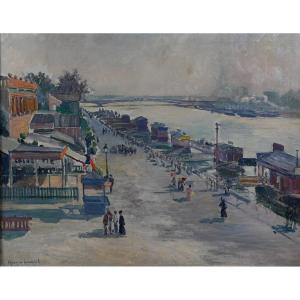
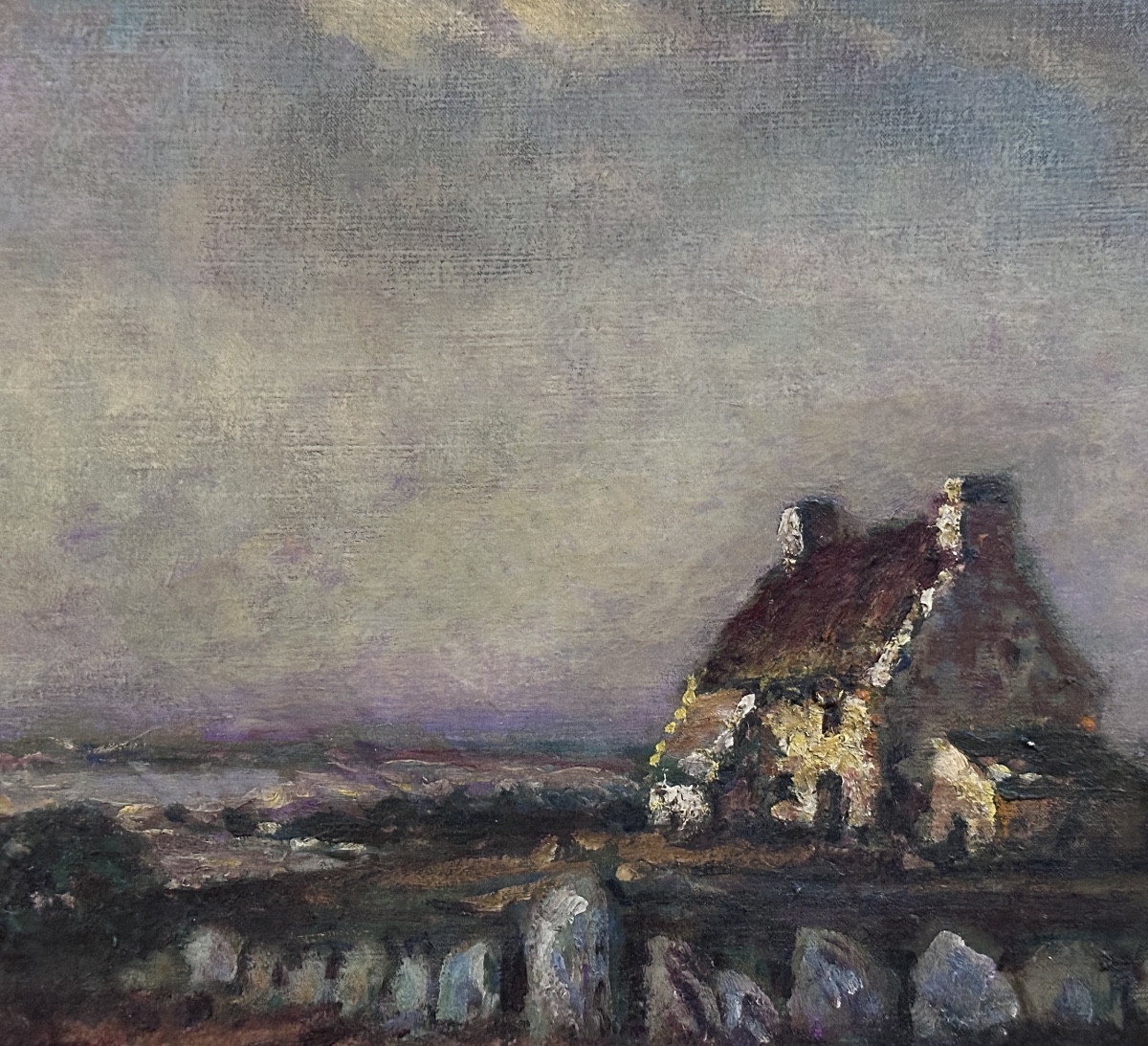
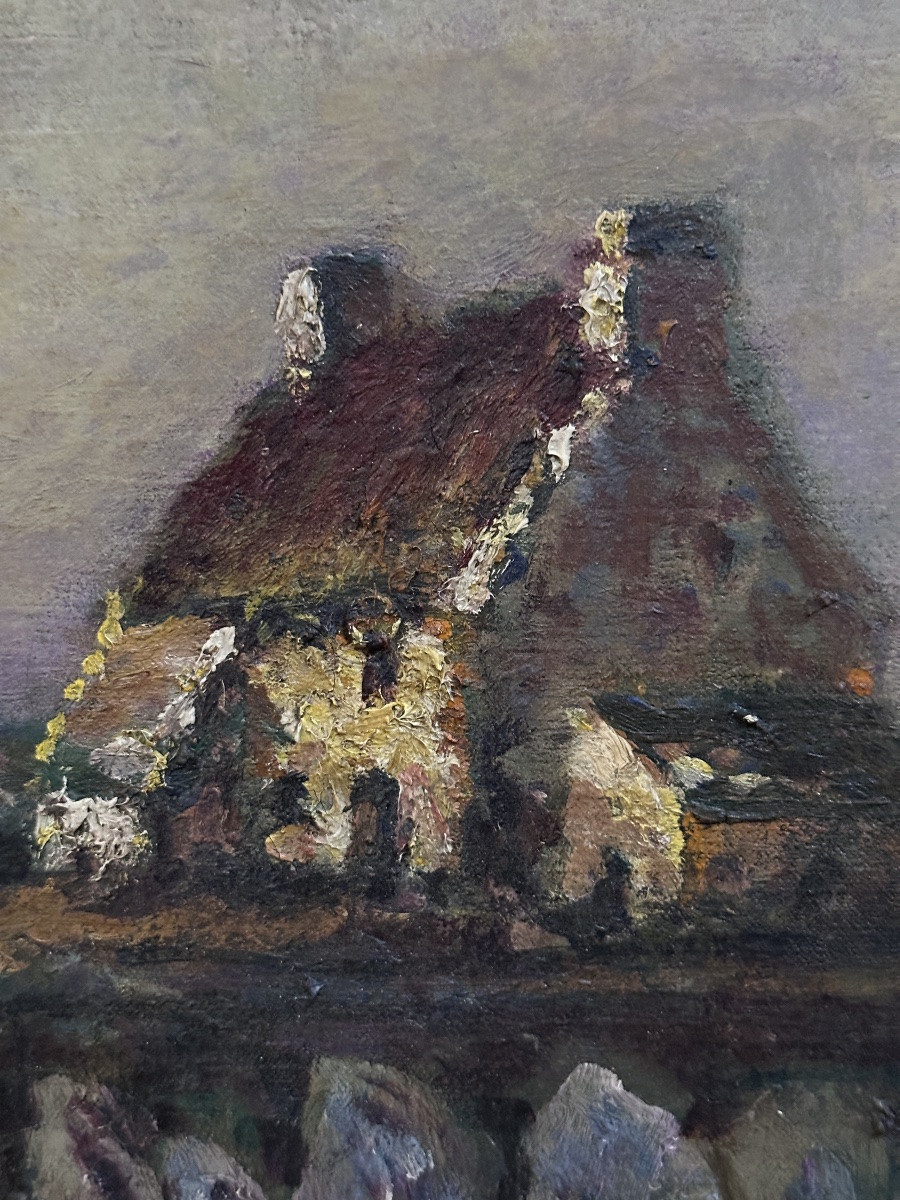
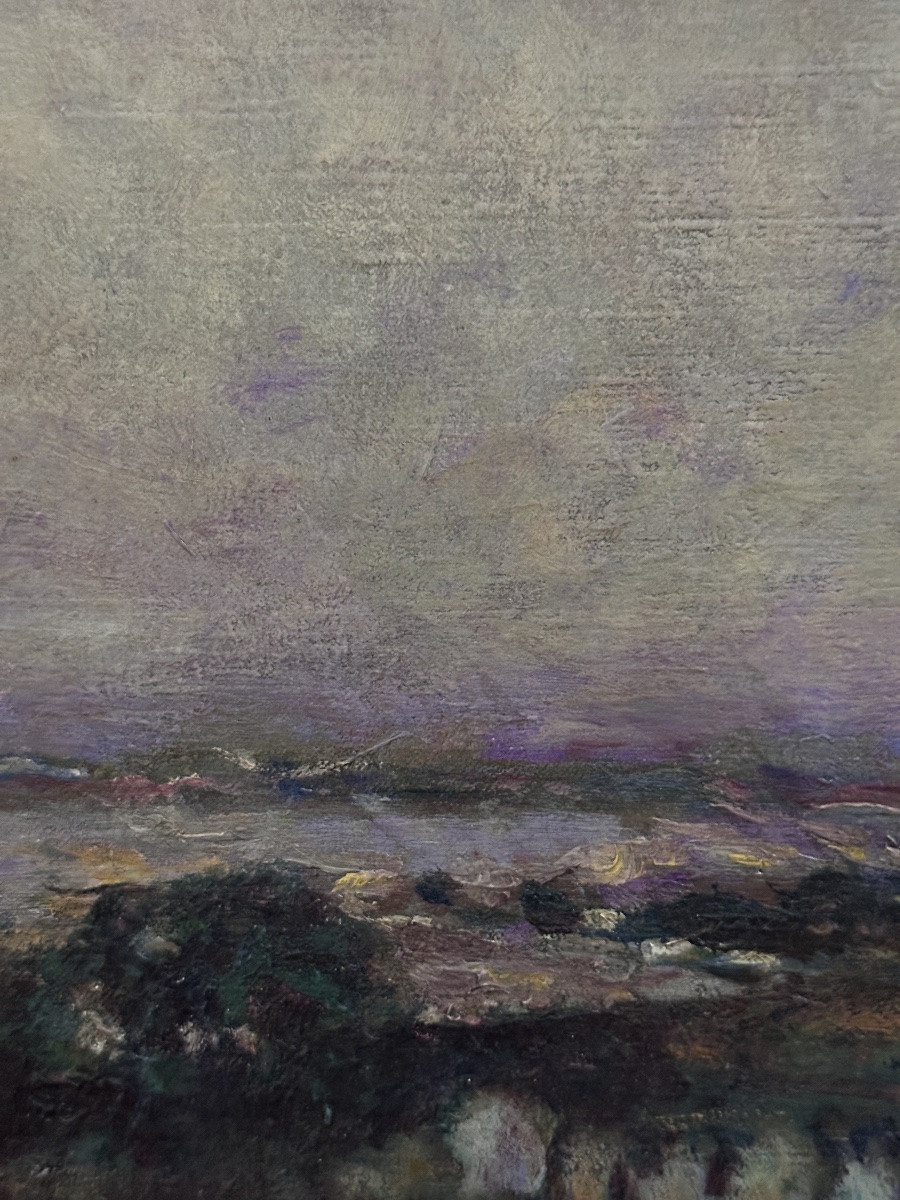
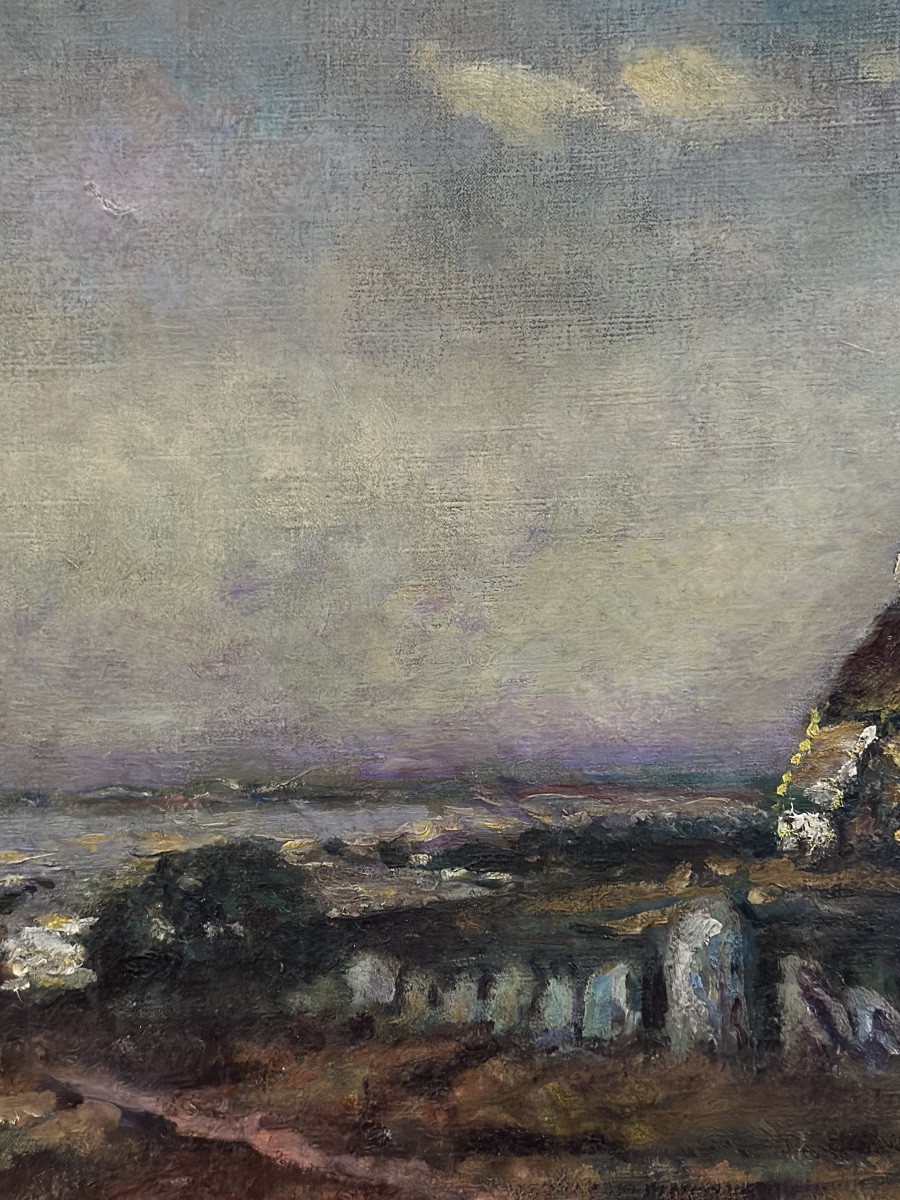
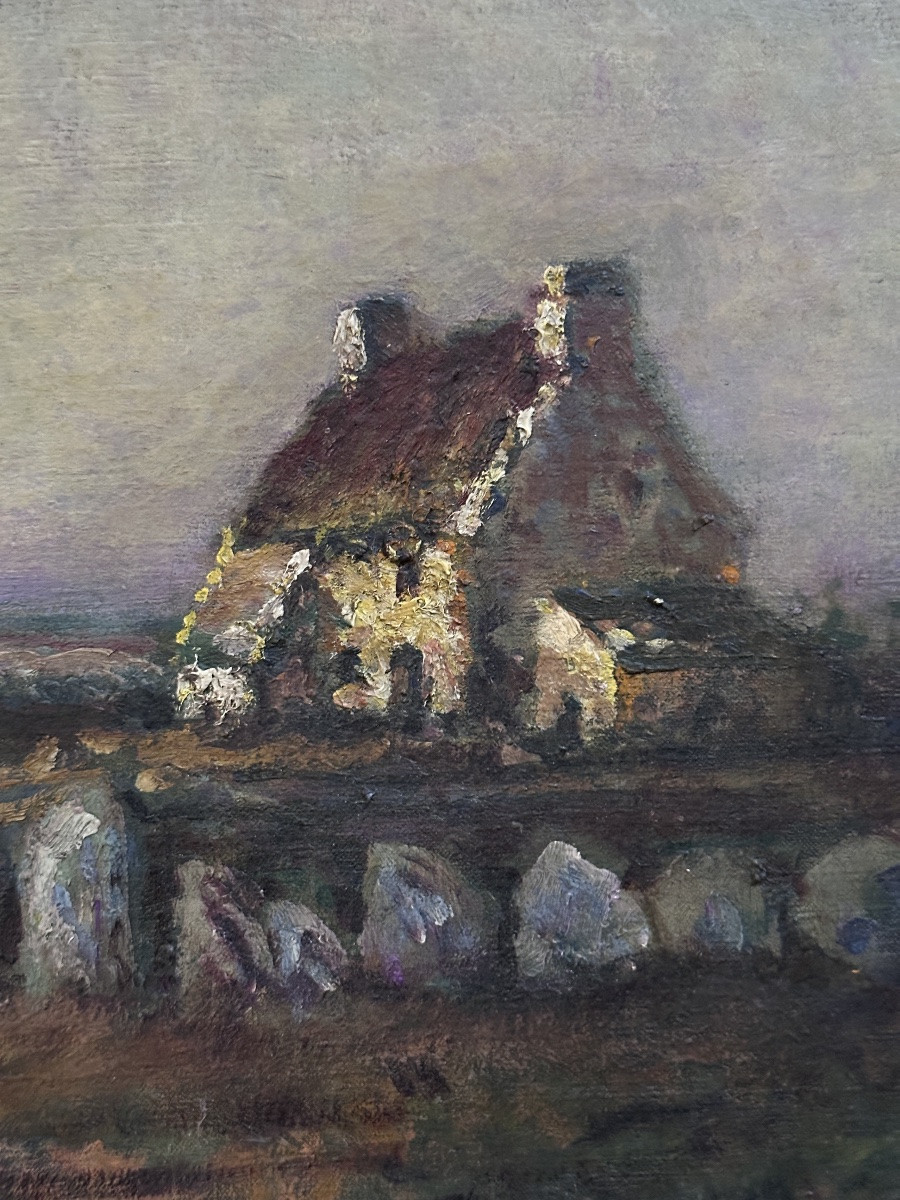
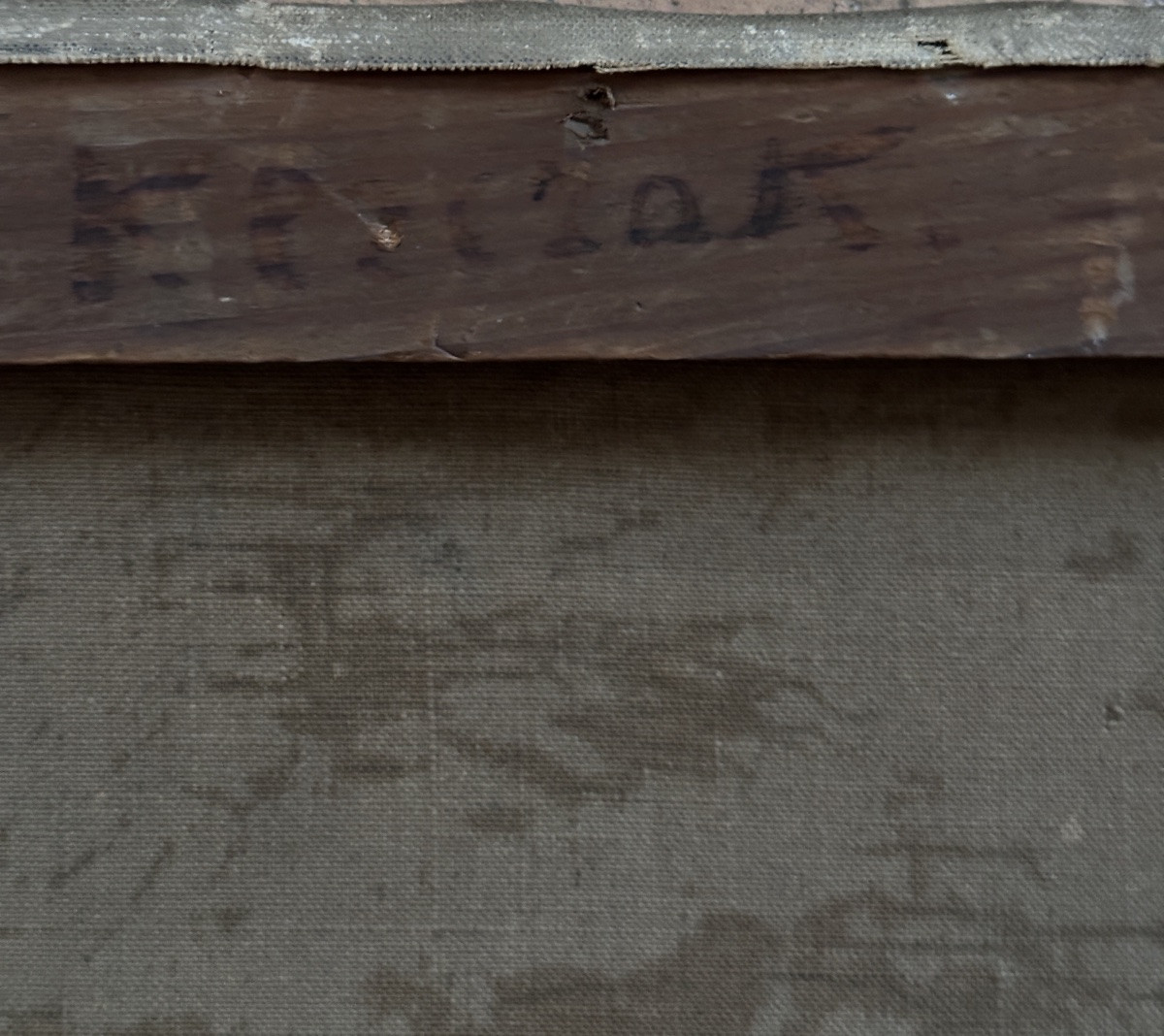
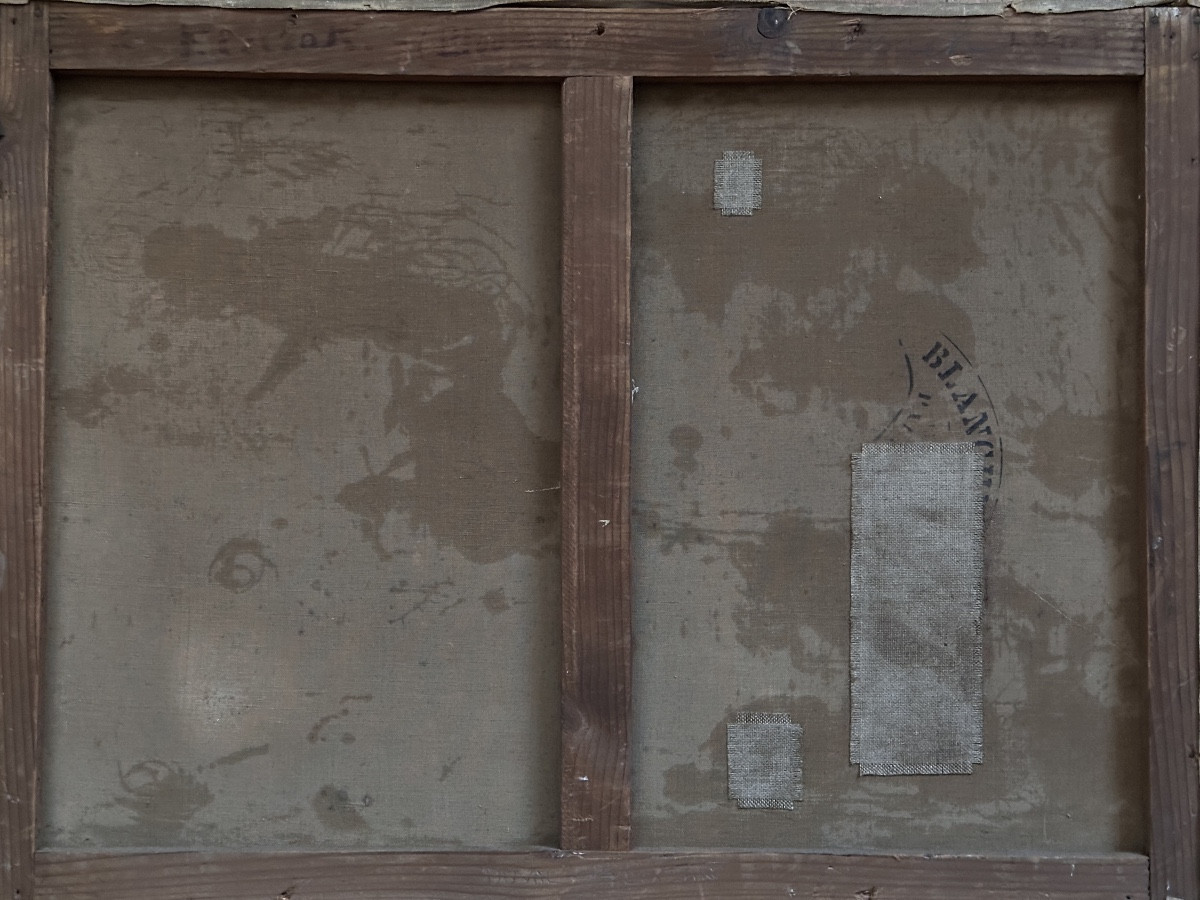
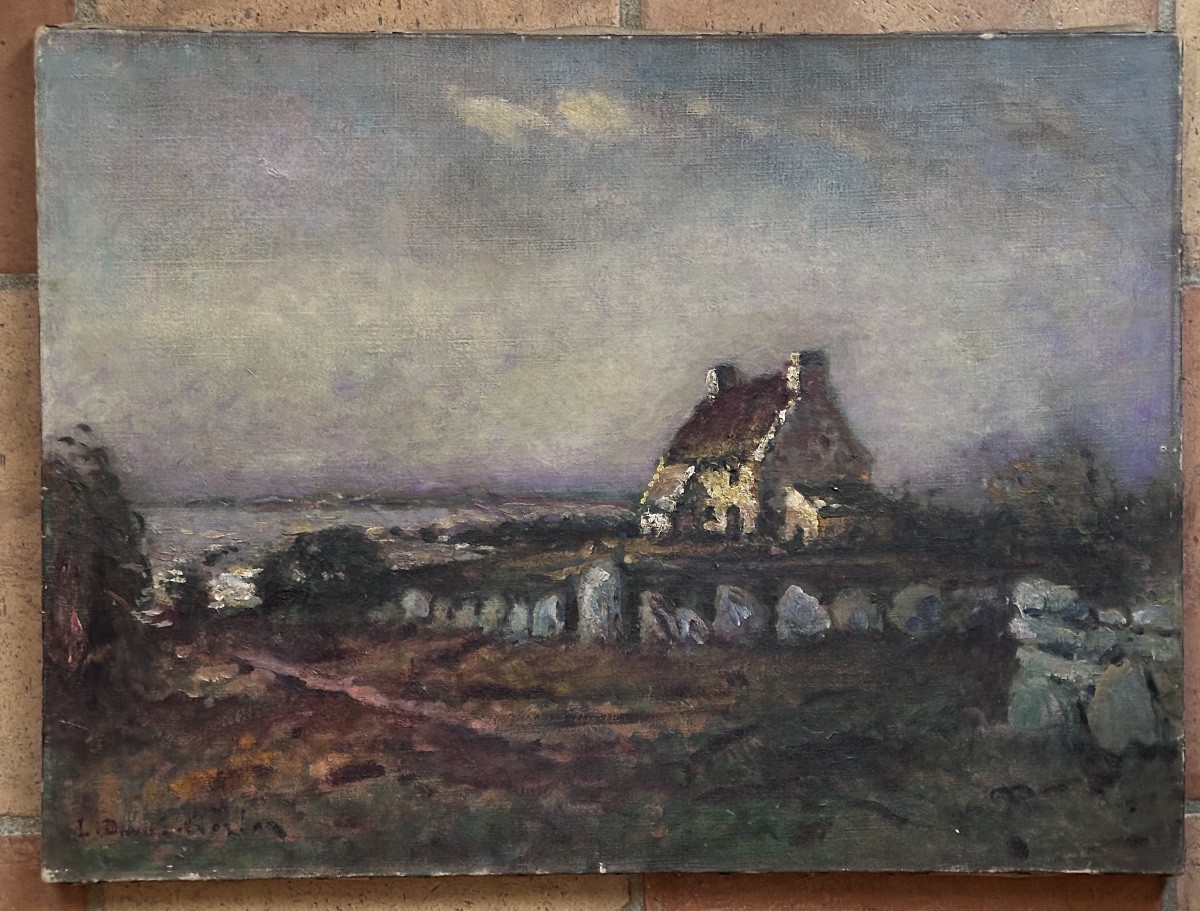
Léon Duval-Gozlan, Landscape, Thatched Cottage by the Sea, Brittany, 1900. A beautiful landscape composition set in Brittany, depicting an isolated thatched cottage by the sea, in an open, rugged, and almost archaic environment. The house, nestled beneath a vast and nuanced sky, dominates a foreground of dark earth punctuated by standing stones that reinforce the ancient and silent character of the site. Far from being merely picturesque, the work prioritizes atmosphere, the inner resonance of the place, and a condensed vision of the Breton landscape. Léon Duval-Gozlan, a Parisian painter born in 1853, turned strongly to southern Brittany after discovering the region in 1910, following in the footsteps of Maxime Maufra and the Quiberon peninsula. The painting's strength lies in its meditative tone. The composition is built around a striking contrast between, on the one hand, the dark, earthy foreground and, on the other, the opening of a vast, milky sky, rendered in bluish grays, muted mauves, and muted greens. This veiled, almost subdued palette lends the scene a particular poetic intensity. This is not a purely descriptive notation, but a sensitive transcription of the landscape, where Breton reality seems filtered through an inner vision. The thatched cottage acts as a symbolic core. It is not merely a motif of rural dwelling; it becomes a fragile yet persistent human presence, like a refuge in a space battered by air, salt, and time. The standing stones in the foreground, almost like a field of stelae or stylized menhirs, accentuate this interpretation. It is here that the canvas takes on a discreet yet real Symbolist hue: the landscape is no longer merely seen, it is imbued with memory, gravity, a kind of earthly spirituality. This sensitivity is reinforced by the silence of the scene, the absence of narrative, and this way of suspending time in a cold light. The brushwork reflects a more restrained Post-Impressionism, rich in texture and synthesis. The denser impasto on the house, the light highlights applied in thick strokes, the simplified masses of the trees and the land—all of this situates the work within the pictorial culture of Brittany around and after 1900, where Impressionism had already been absorbed and then internalized. The sea and sky are not treated as topographical surveys; they are reduced to harmonies of color and vibrant washes of color. In this respect, the painting is very much in the Blanchet-Vert style of 1900, or more broadly, Post-Impressionist, with a poetic and almost visionary inflection. The comparison with the great Breton painters of the period is relevant, provided it is formulated as a kinship of spirit and not as an equivalence of skill. The work can be likened to the internalized Brittany of Désiré-Lucas, for its poetic gravity, its use of color, and its taste for muted harmonies. It also evokes Henry Moret for its simplification of forms, its atmospheric density, and the prominence of the Breton coastline within a Post-Impressionist syntax. Henry Moret, associated with Pont-Aven, indeed devoted a large part of his work to the Breton coast, and his career is often presented as a transition from Pont-Aven to Impressionism in Brittany. In the cultural background, one can also consider Maxime Maufra, with whom Duval-Gozlan was close and whose presence in Kerhostin played a direct role in his Breton roots. Available biographical sources emphasize this connection, as well as Duval-Gozlan's settlement in connection with southern Brittany and the Quiberon peninsula. Léon Duval-Gozlan was born in 1853 and died in 1941. A Parisian painter, he discovered southern Brittany at the beginning of the 20th century, around 1910, and became permanently attached to the Quiberon peninsula. He is noted as being close to Maxime Maufra, whose example and artistic environment were significant in his Breton orientation. Several sources describe his work as following in the footsteps of Impressionism, with a supple, colorful, sometimes heavily textured brushstroke applied to Breton landscapes and subjects. Oil on canvas, signed lower left. Dimensions: 66 x 48 cm. Signed lower left: Léon Duval-Gozlan. Old inscriptions on the stretcher mentioning the location. Restorations to be noted are of very high quality and very well executed.
400 €
Period: 20th century
Style: Art Nouveau
Condition: Good condition
Material: Oil painting
Width: 66
Height: 48
Reference (ID): 1723899
Availability: In stock
Print