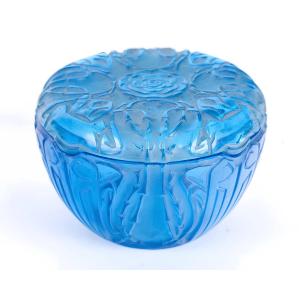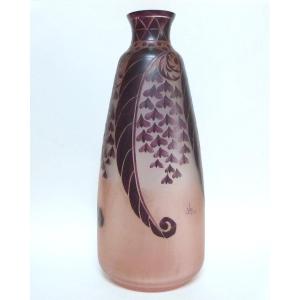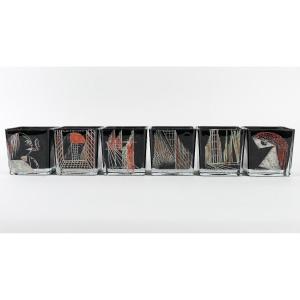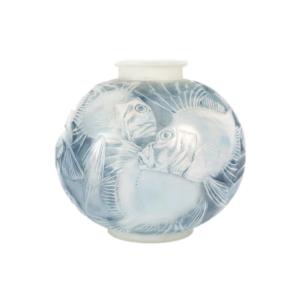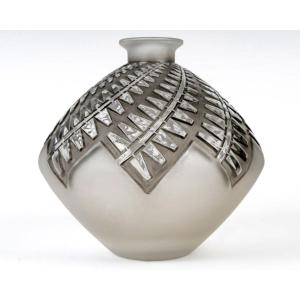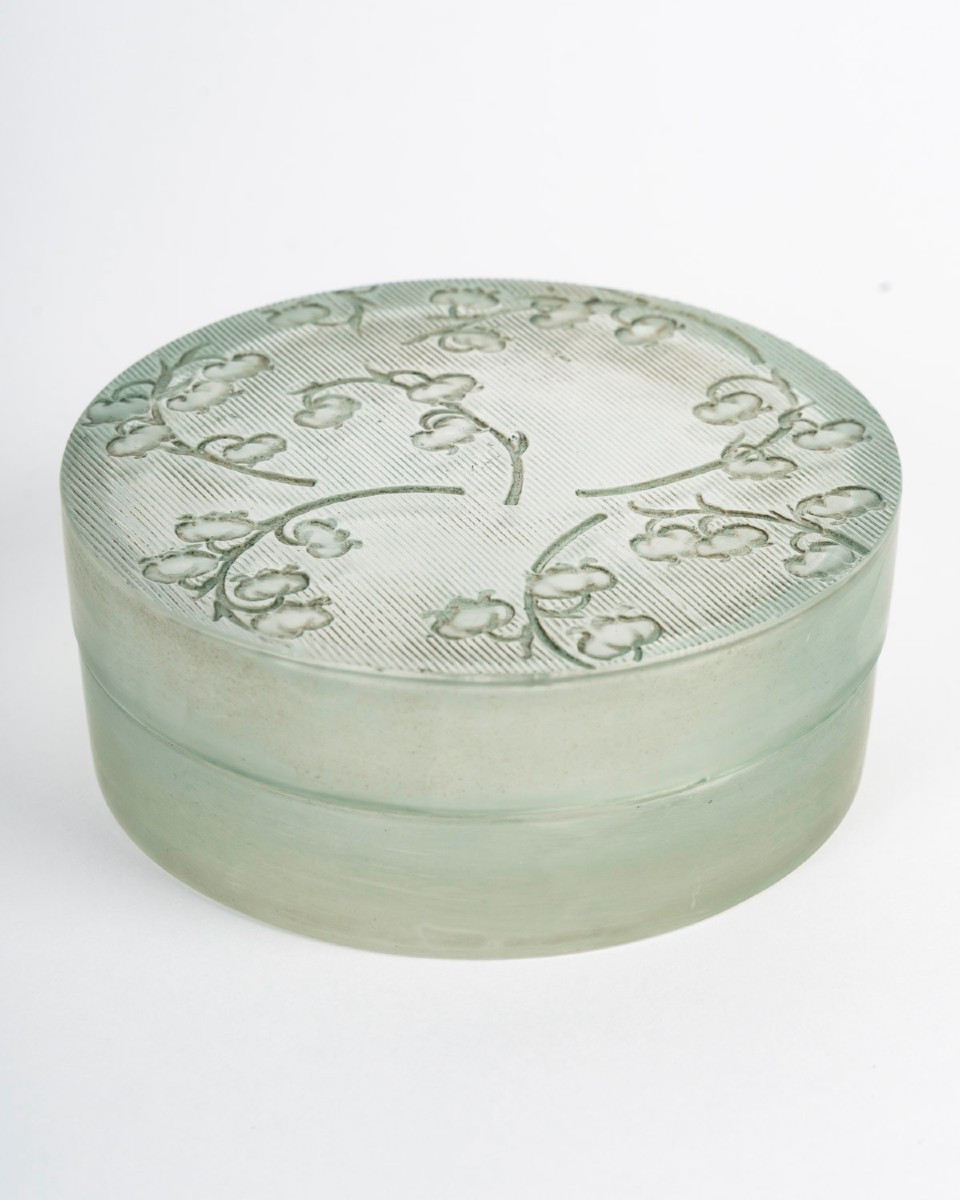
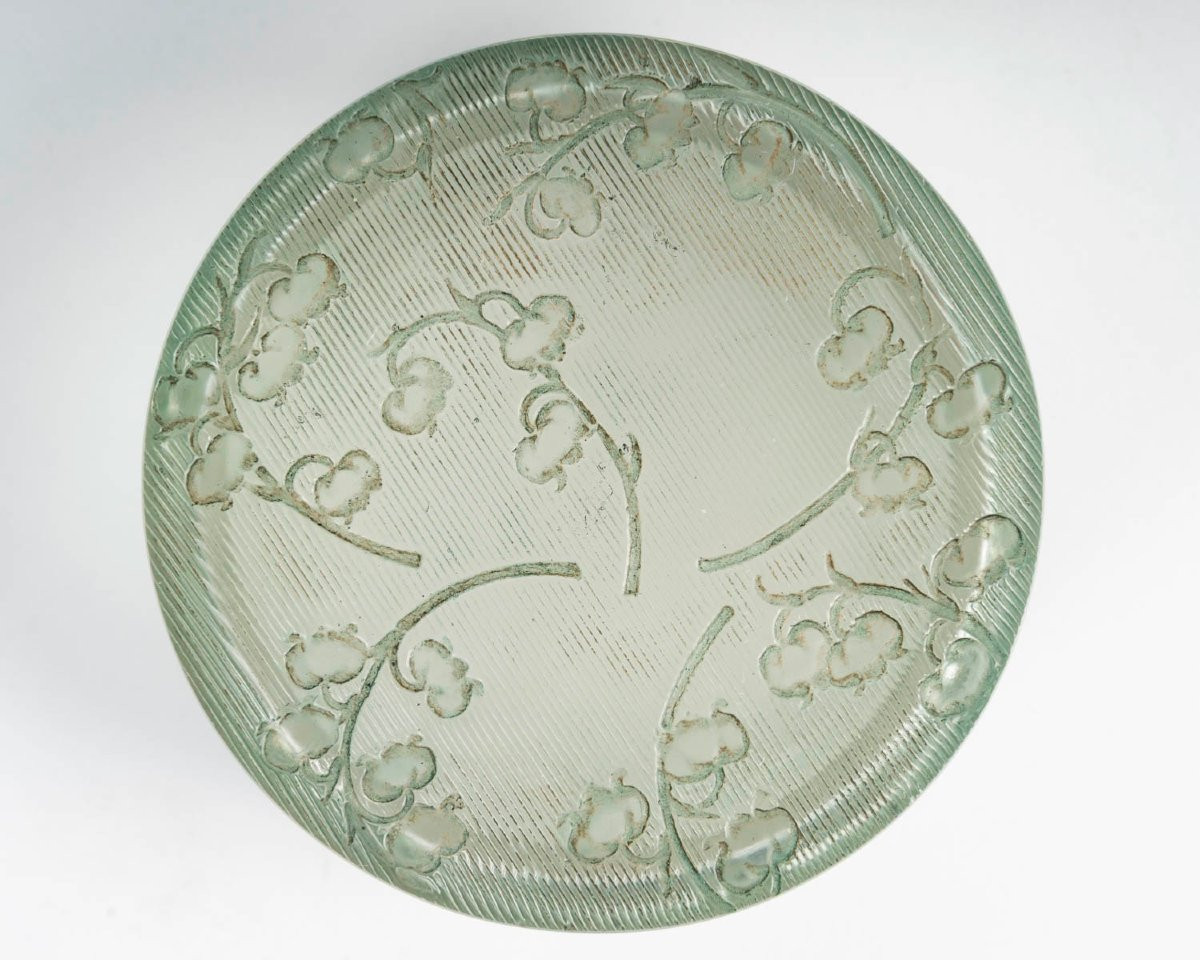


René Lalique (1860-1945) Boite Muguets, Circa 1920
Artist: René Lalique (1860-1945)
René Lalique (1860-1945)
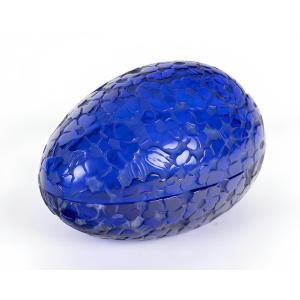
Boite Muguets
Molded-pressed Glass
Circa 1920
Signed R.LALIQUE (difficult to read)
Not yet published in Félix Marcilhac, René Lalique - Catalogue Raisonné de l'Œuvre de Verre, Les Éditions de l'Amateur, Paris, 2011
Will be published in next edition
René Lalique’s first experiments in the field of glass date back to the 1890s. The manufacturing processes of jewelry familiarize him with vitrifiable materials, and it is undoubtedly thanks to enamel that he discovers glass.
Engraving it and setting it, he uses it gradually to replace the gems. Translucent and transparent like them, it has the advantage of being designed and manufactured according to the final project.
René Lalique also creates small objects, vases and sculptures, according to the lost wax technique.
A little later, he experiments with the blowing technique in a mold, but a precious mold, made of chiseled silver, remaining integral to the glass that it encloses to become a frame.
His meeting with François Coty, leading him not only to create but also to produce perfume bottles, opens new horizons for him.
A real technological and commercial revolution is taking place, which could not have succeeded without the skill and inspiration of the artist.
Although mass-produced, his creations are unquestionably works of art.
A way of perpetuating the philosophy of Art Nouveau which wanted to reconcile Art and Industry.
Little by little, René Lalique diversifies his productions. In 1912, perfectly mastering the techniques, he decided to devote himself exclusively to glass. He then organizes his last jewelry exhibition and the general public discovers him as a master glassmaker.
Avant-garde jeweler, René Lalique, by becoming a glassmaker, also distinguishes himself from his predecessors. He abandons multilayer glass with varied colors in favor of clarity and transparency, natural qualities of glass.
At the level of forms too, he affirms his difference. Léon Rosenthal summarizes it this way: flexibility, weighting, symmetry. He uses them with perfect freedom, according to his tendencies which are of elegance rather than strength, with a perpetual need for invention. He does not shrink from audacity, nor from fantasy, but his differences are always measured.
Eclectic creator, René Lalique is not only interested in dishes, vases and statuettes. He also designed radiator caps for luxury cars in the roaring twenties, decorated trains like the Pullman Express on the Côte d'Azur, cruise ships with exceptional fountains, and is interested in religious architecture...
Attentive observer of Beings and Things, René Lalique found in nature a fertile inhabitant. He dissected and examined it, observing its particular lines, forms and structures, seeking and finding in them the spark of life. He scrutinized plants and flowers, studied aquatic life, observed reptiles and birds, and was fascinated by insects. But he not only questioned the earth and the sky, plants and trees, human creation, the face and the female body also instilled in him a creative breath. His genius comes from his ability to adapt and com-pose.
He does not copy nature, he does not style the different elements, he creates while transforming, creations that bring the magic of matter to life.
If René Lalique puts all his sensitivity in his interpretation, it is equally nou-rished by the great artistic movements. In 1900, the writer Pol Neveux pointed out that the masterpieces of the Egyptians and Italo-Greeks had never been considered with a more penetrating eye than his own, and the art of the By-zantines, the Florentines, and the Japanese was only jealously studied by him.
When he turns towards glass, he draws clean lines and the ornament, often geographically defined, is declined in new rhythms, with syncopated cadences, associated with these crazy years thrown into speed. But he also knows, if necessary, how to soften them with sculptures of plants, animals or women of very naturalistic design. Thus, over time, René Lalique not only had the cou-rage, but also the talent, to adapt his inspiration to new trends without abandoning his personality.
Boite Muguets
Molded-pressed Glass
Circa 1920
Signed R.LALIQUE (difficult to read)
Not yet published in Félix Marcilhac, René Lalique - Catalogue Raisonné de l'Œuvre de Verre, Les Éditions de l'Amateur, Paris, 2011
Will be published in next edition
René Lalique’s first experiments in the field of glass date back to the 1890s. The manufacturing processes of jewelry familiarize him with vitrifiable materials, and it is undoubtedly thanks to enamel that he discovers glass.
Engraving it and setting it, he uses it gradually to replace the gems. Translucent and transparent like them, it has the advantage of being designed and manufactured according to the final project.
René Lalique also creates small objects, vases and sculptures, according to the lost wax technique.
A little later, he experiments with the blowing technique in a mold, but a precious mold, made of chiseled silver, remaining integral to the glass that it encloses to become a frame.
His meeting with François Coty, leading him not only to create but also to produce perfume bottles, opens new horizons for him.
A real technological and commercial revolution is taking place, which could not have succeeded without the skill and inspiration of the artist.
Although mass-produced, his creations are unquestionably works of art.
A way of perpetuating the philosophy of Art Nouveau which wanted to reconcile Art and Industry.
Little by little, René Lalique diversifies his productions. In 1912, perfectly mastering the techniques, he decided to devote himself exclusively to glass. He then organizes his last jewelry exhibition and the general public discovers him as a master glassmaker.
Avant-garde jeweler, René Lalique, by becoming a glassmaker, also distinguishes himself from his predecessors. He abandons multilayer glass with varied colors in favor of clarity and transparency, natural qualities of glass.
At the level of forms too, he affirms his difference. Léon Rosenthal summarizes it this way: flexibility, weighting, symmetry. He uses them with perfect freedom, according to his tendencies which are of elegance rather than strength, with a perpetual need for invention. He does not shrink from audacity, nor from fantasy, but his differences are always measured.
Eclectic creator, René Lalique is not only interested in dishes, vases and statuettes. He also designed radiator caps for luxury cars in the roaring twenties, decorated trains like the Pullman Express on the Côte d'Azur, cruise ships with exceptional fountains, and is interested in religious architecture...
Attentive observer of Beings and Things, René Lalique found in nature a fertile inhabitant. He dissected and examined it, observing its particular lines, forms and structures, seeking and finding in them the spark of life. He scrutinized plants and flowers, studied aquatic life, observed reptiles and birds, and was fascinated by insects. But he not only questioned the earth and the sky, plants and trees, human creation, the face and the female body also instilled in him a creative breath. His genius comes from his ability to adapt and com-pose.
He does not copy nature, he does not style the different elements, he creates while transforming, creations that bring the magic of matter to life.
If René Lalique puts all his sensitivity in his interpretation, it is equally nou-rished by the great artistic movements. In 1900, the writer Pol Neveux pointed out that the masterpieces of the Egyptians and Italo-Greeks had never been considered with a more penetrating eye than his own, and the art of the By-zantines, the Florentines, and the Japanese was only jealously studied by him.
When he turns towards glass, he draws clean lines and the ornament, often geographically defined, is declined in new rhythms, with syncopated cadences, associated with these crazy years thrown into speed. But he also knows, if necessary, how to soften them with sculptures of plants, animals or women of very naturalistic design. Thus, over time, René Lalique not only had the cou-rage, but also the talent, to adapt his inspiration to new trends without abandoning his personality.
3 800 €
Period: 20th century
Style: Art Deco
Condition: Good condition
Material: Glass
Diameter: 8 cm
Height: 4 cm
Reference (ID): 1714074
Availability: In stock
Print