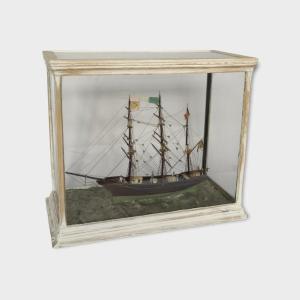
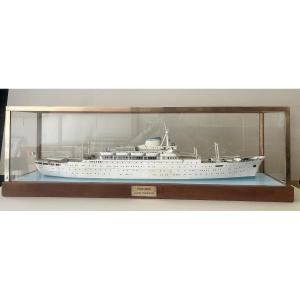
Schooner. Model Of The Slave-trading Brig Schooner Ouragan, 1830
Artist: Anonyme
Model of the brig, slave schooner Ouragan from 1830.
20th century.
Length: 83 cm
Height: 60 cm.
There is no such thing as a slave ship in the strict sense. It refers to an ordinary merchant ship that, for part of its existence, transported enslaved Africans. From the 15th to the end of the 17th century, they came in all types and sizes: Portuguese caravels, Spanish galleons, and Dutch flutes, but also former warships converted for the slave trade, such as frigates, lighter and faster than ships of the line, or corvettes, fast and maneuverable, intermediate between the frigate and the brig. However, in the 18th century, a strong trend emerged when the slave trade was officially condemned by the Treaty of Vienna in 1815. Having become illegal, it continued for half a century in the French colonies. To continue their activities, slave traders had to design vessels capable of evading surveillance ships: small, very fast, heavily camouflaged ships of relatively low tonnage. The brig became their preferred vessel, thanks to its maneuverability and speed, ideal for coastal trade and raids. Indeed, these small, very fast ships could not only escape the raiding parties but also navigate upriver. African islands offered more discreet anchorages than coastal ports. The Ouragan was one of these ships which, thanks to its sleek lines and clinker-built hull, combined speed and maneuverability and became one of the fastest slave ships of the 19th century. (Villèle Historical Museum)
20th century.
Length: 83 cm
Height: 60 cm.
There is no such thing as a slave ship in the strict sense. It refers to an ordinary merchant ship that, for part of its existence, transported enslaved Africans. From the 15th to the end of the 17th century, they came in all types and sizes: Portuguese caravels, Spanish galleons, and Dutch flutes, but also former warships converted for the slave trade, such as frigates, lighter and faster than ships of the line, or corvettes, fast and maneuverable, intermediate between the frigate and the brig. However, in the 18th century, a strong trend emerged when the slave trade was officially condemned by the Treaty of Vienna in 1815. Having become illegal, it continued for half a century in the French colonies. To continue their activities, slave traders had to design vessels capable of evading surveillance ships: small, very fast, heavily camouflaged ships of relatively low tonnage. The brig became their preferred vessel, thanks to its maneuverability and speed, ideal for coastal trade and raids. Indeed, these small, very fast ships could not only escape the raiding parties but also navigate upriver. African islands offered more discreet anchorages than coastal ports. The Ouragan was one of these ships which, thanks to its sleek lines and clinker-built hull, combined speed and maneuverability and became one of the fastest slave ships of the 19th century. (Villèle Historical Museum)
480 €
Period: 20th century
Style: Other Style
Condition: Good condition
Material: Solid wood
Length: 83 cm
Height: 60 cm
Reference (ID): 1712931
Availability: In stock
Print