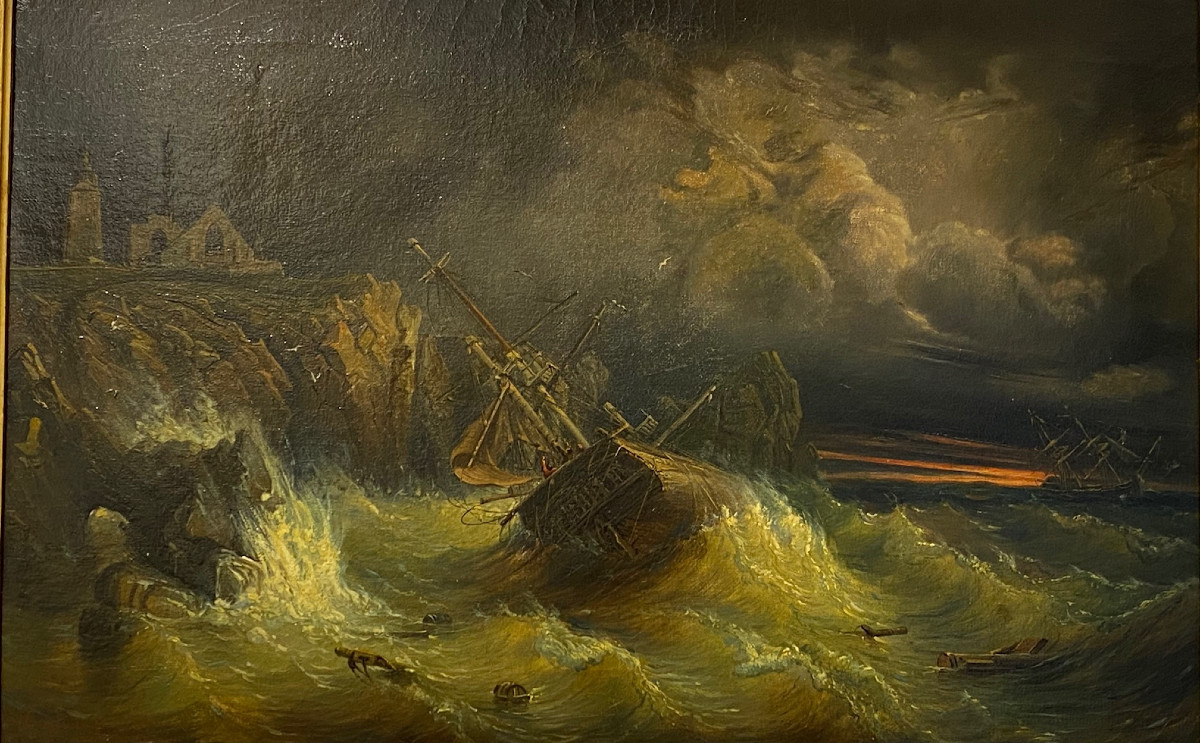
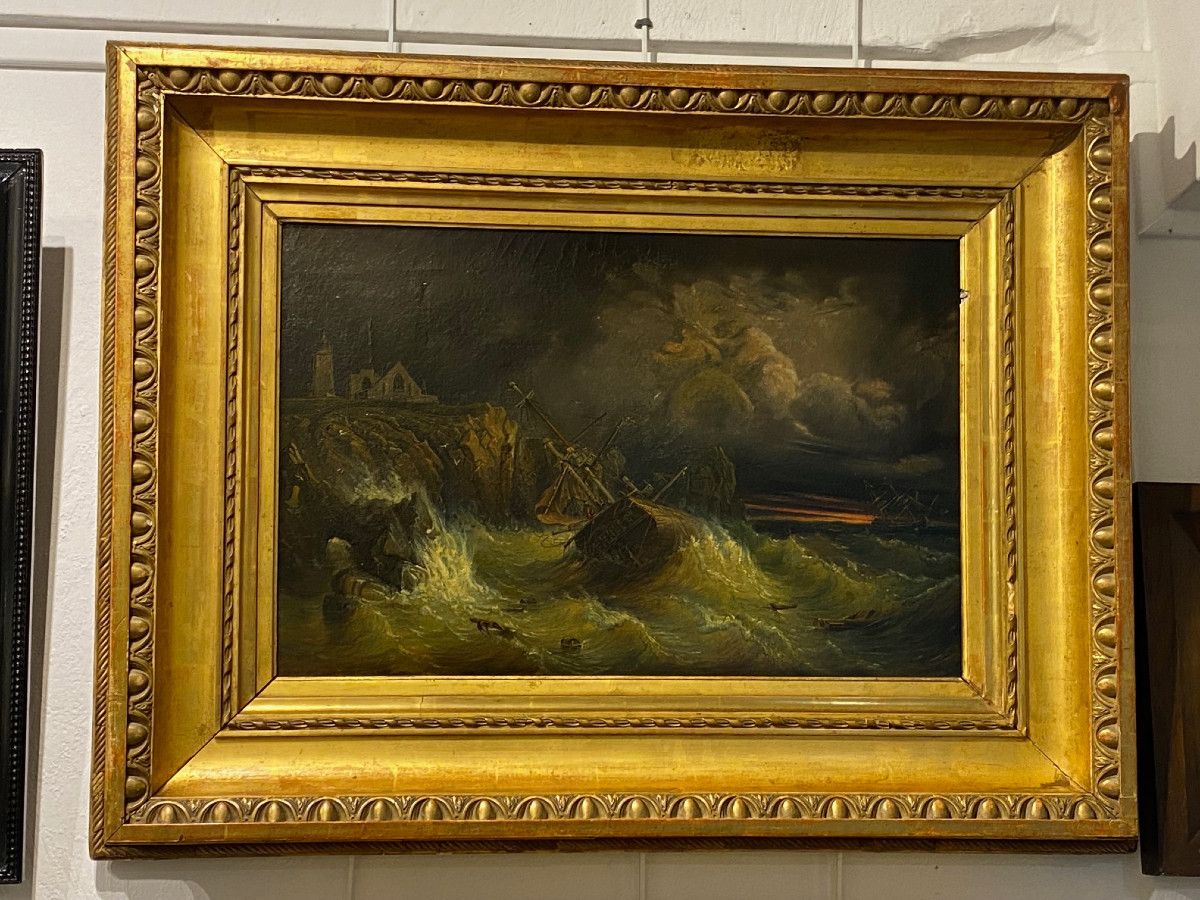



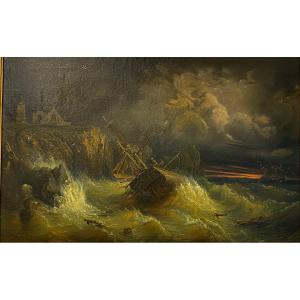


"Théodore Gudin (1802-1880) - Shipwrecks Off Pointe Saint-mathieu - Oil On Canvas "
Théodore GUDIN (1802-1880) ‘Shipwrecks off Pointe Saint-Mathieu’
Steep cliffs swept by the wind and sea, an imposing lighthouse watching over the ruins of an ancient abbey... Here, the charm works its magic. Pointe Saint-Mathieu seems to encapsulate the essence of Brittany. A stone's throw away, the port of Le Conquet provides access to the islands of Ouessant and Molène. In Plougonvelin, the small village lends its authentic charm to the beautiful family resort.
Under Louis-Philippe, Théodore Gudin was made a baron. The king commissioned him to paint 90 pictures for the museum at Versailles, commemorating episodes in French naval history.
He was promoted to Officer of the Legion of Honour in 1841 and, exhibiting in Berlin in 1845, he received the Pour le Mérite cross.
In 1844, he married Louise Margaret Gordon-Hay (1820-1890), daughter of an English general and goddaughter of Louis-Philippe; the couple had three children. His Anglophilia went hand in hand with his numerous trips to London, where he stayed from 1821 onwards alongside Eugène Isabey. The two men exhibited there until the 1830s, becoming acquainted with the work of Turner.
When the Revolution of 1848 broke out, he divided his time between France and England and maintained good relations with all political powers. However, during the coup d'état of 1851, Gudin sided with the Republicans.
He was promoted to Commander of the Legion of Honour in 1857.
He was vice-president of the newly formed Central Society for the Rescue of Shipwrecked Persons, which he helped to establish in 1864, haunted by the memory of his brother Louis's drowning.
At the end of 1870, Gudin went into exile in England after the fall of the Empire.
Théodore Gudin owned the Kermor marshes (300 hectares) between Sainte-Marine and Île-Tudy, which were transformed into polders in 1853. In 1871, Gudin entrusted Eugène de Toulgoët, a shipowner from Loctudy, with the management of the Kermor Fisheries Company, which embarked on fish farming (breeding turbot, sea bass and other luxury fish) in ponds created behind the dyke. But the experiment was short-lived.
He died at his home in Boulogne-Billancourt on 12 April 1880.
(source: Wikipedia)
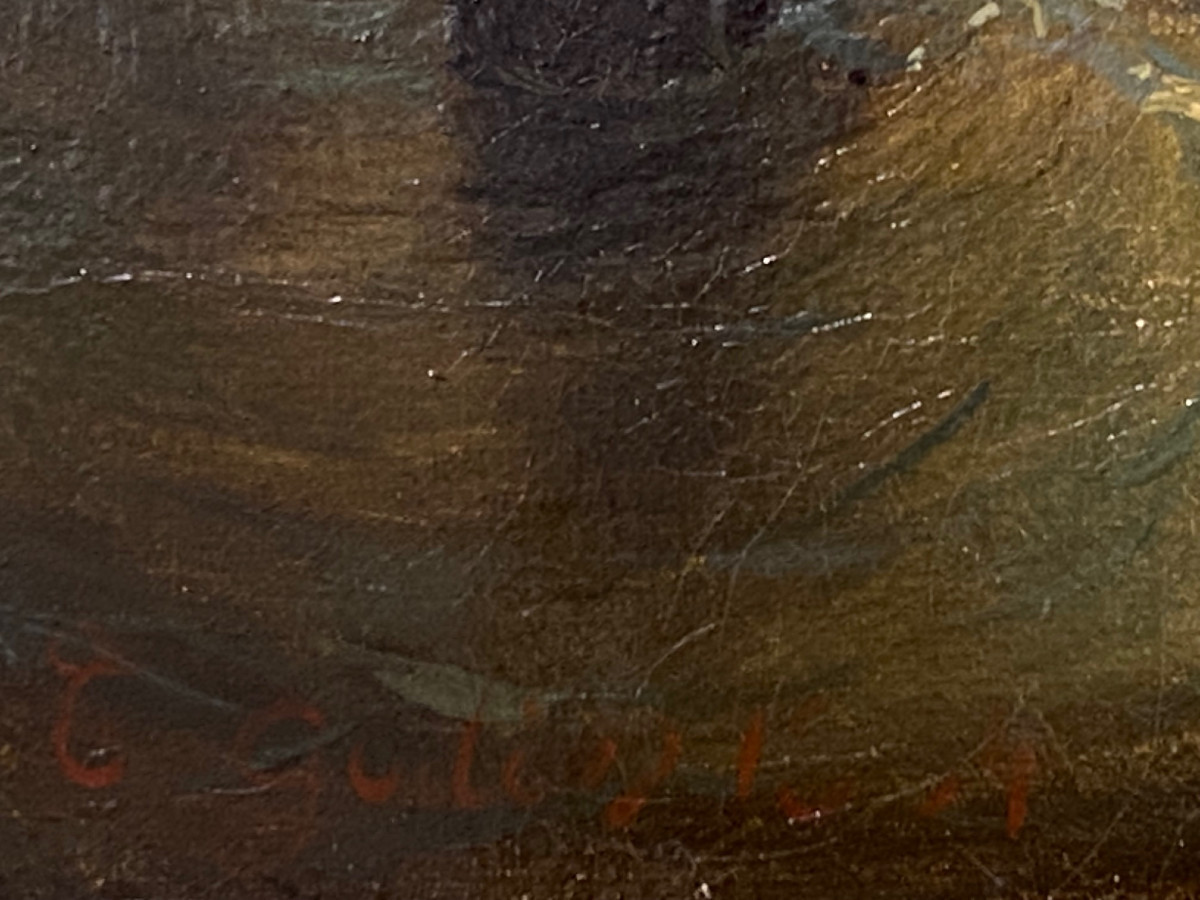
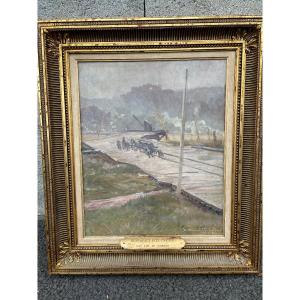
Oil on canvas, signed and dated lower left. (original canvas, not relined)
Frame size: 86 cm x 67 cm
Size of the work: 57 cm x 38 cm
Museum references:
Bordeaux, Museum of Fine Arts: Captain Desse of Bordeaux's act of devotion to the Dutch ship Le Colombus, 1829[23].
Cahors, Musée de Cahors Henri-Martin: Marine par temps d'orage (Seascape in stormy weather), 1837.
Dijon, Magnin Museum:
Entrance to the port of Le Havre;
Beach at low tide.
Orléans, Museum of Fine Arts:
Seascape, sunrise, 1850, oil on canvas, 38 x 46.5 cm (lost in June 1940)[24].
Steamboat in a storm, circa 1840, pastel on paper mounted on cardboard, 32.7 x 49.4 cm[25].
Paris, National Maritime Museum:
Fire on the Kent, 1825 or Shipwreck of the Kent (Loss of East Indiaman Kent), (1828);
Napoleon III's visit to Genoa, 1859, (1865);
Battle of Ouessant, 1778.
Quimper, Museum of Fine Arts:
Storm on the coast of Belle-Ile, 1851;
The Port of Camaret.
Saint-Denis, Léon-Dierx Museum: Sunrise over Bourbon Island (1868)
Translated with DeepL.com (free version)










 Le Magazine de PROANTIC
 TRÉSORS Magazine
 Rivista Artiquariato