



Agost Pottery, 18th Century – Implicit Zoomorphic Object, Spanish Folk Art
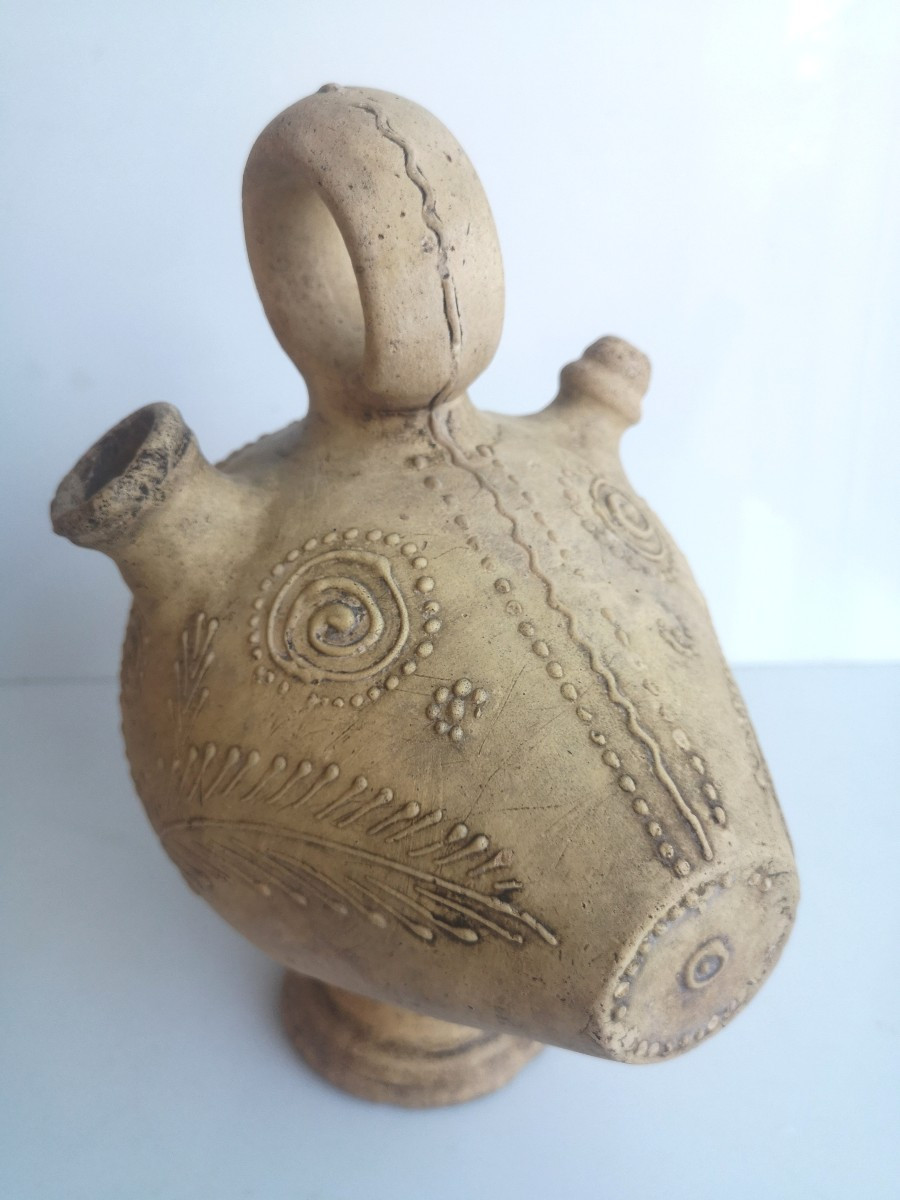
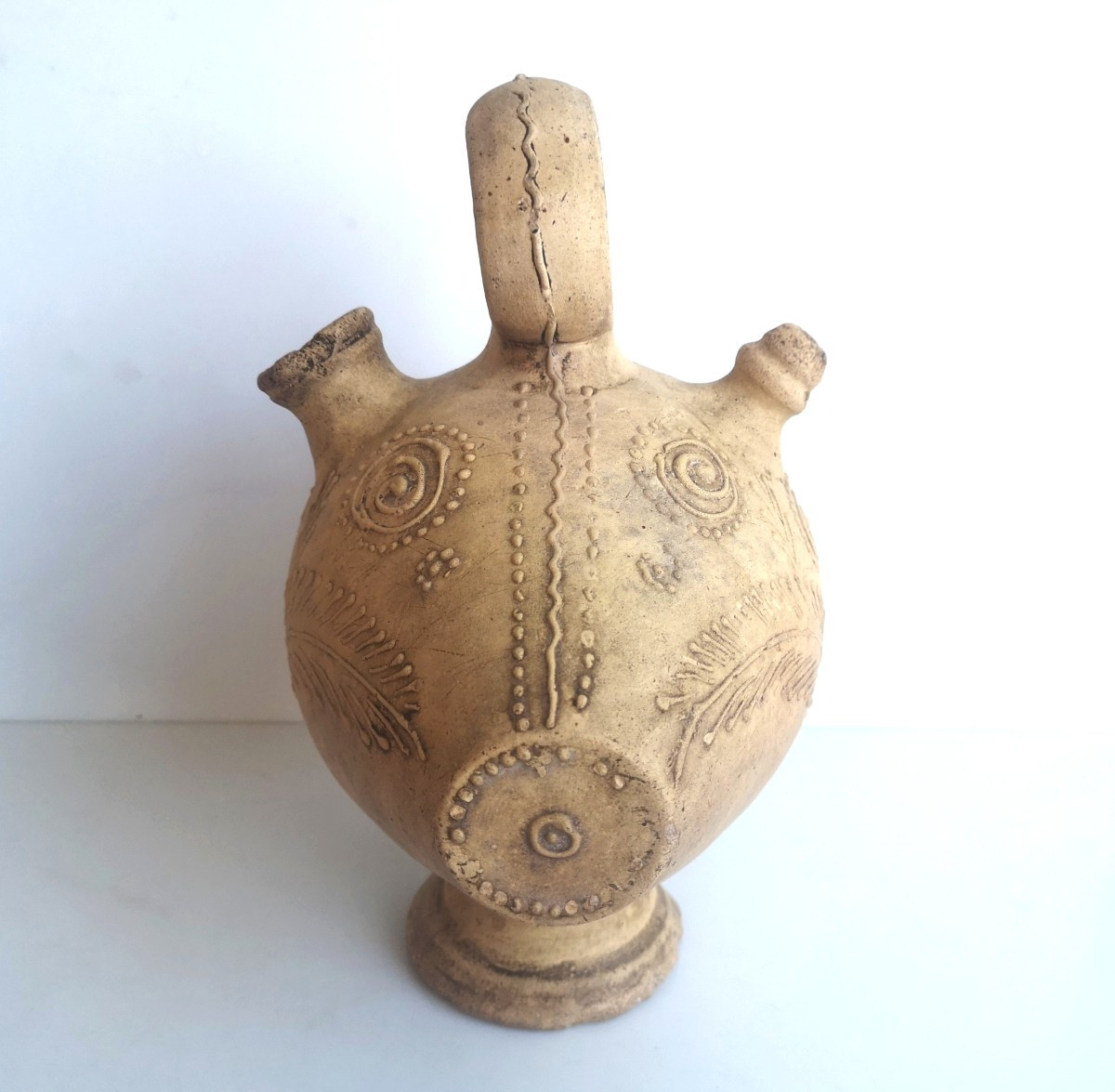
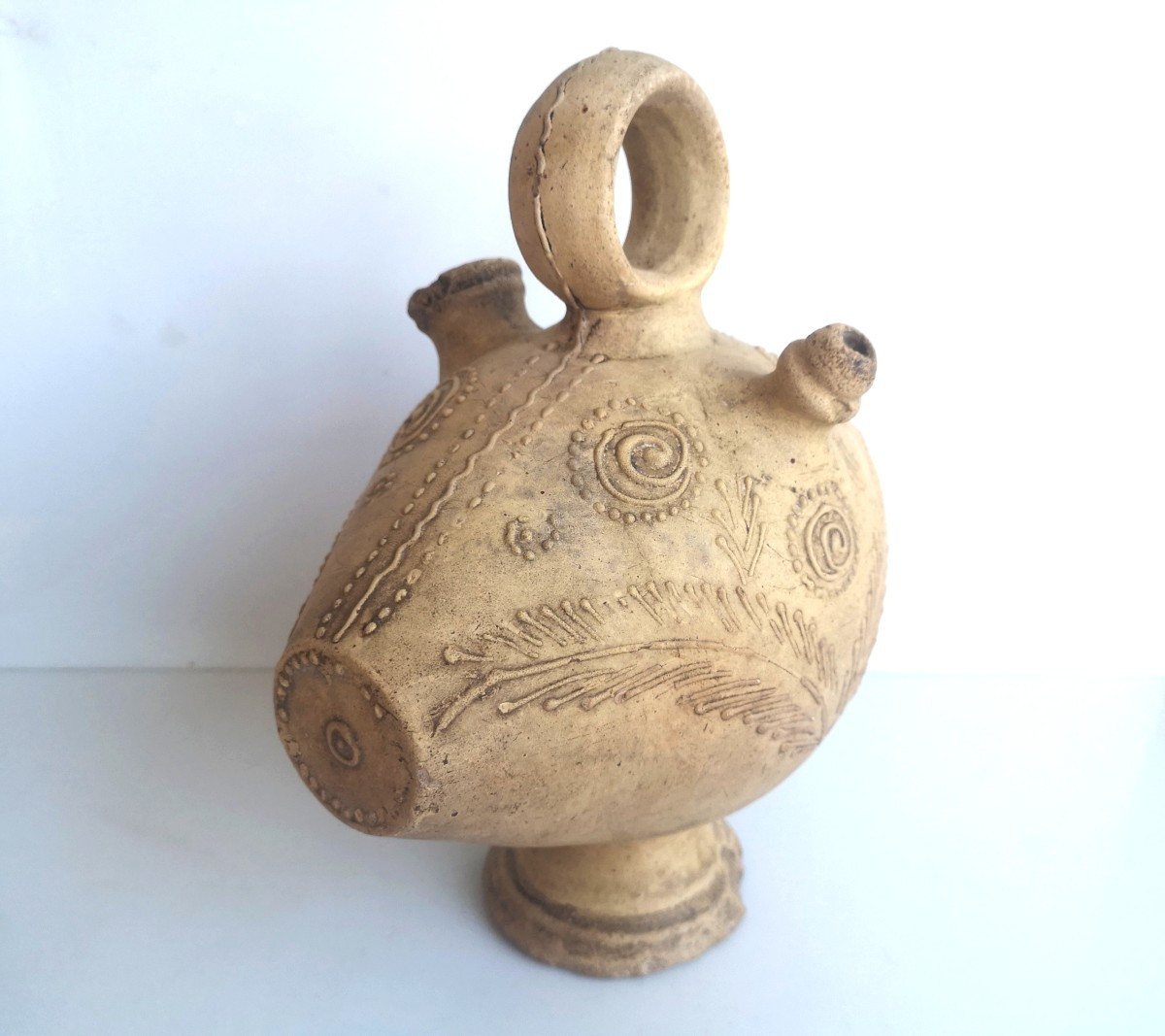
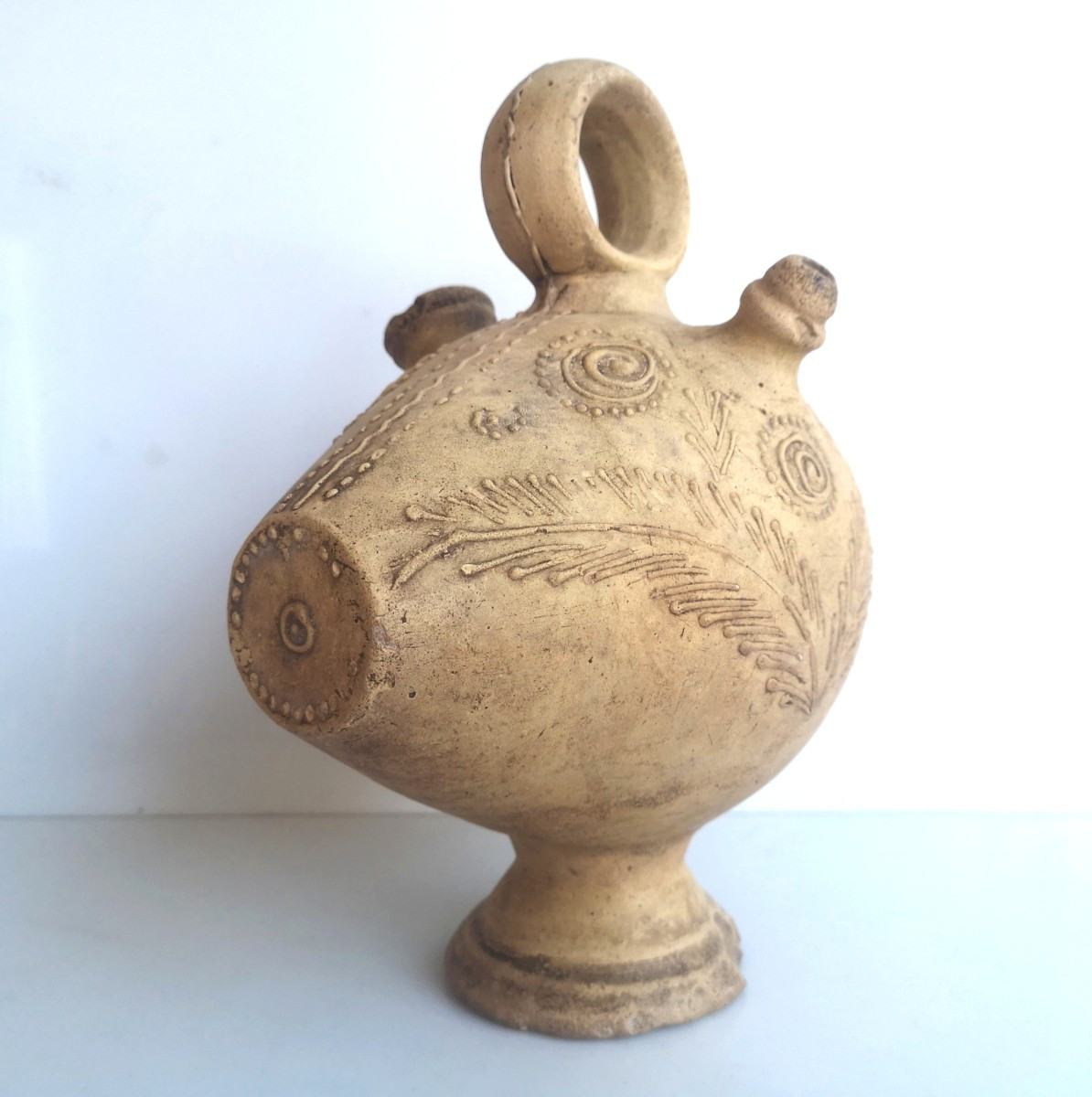
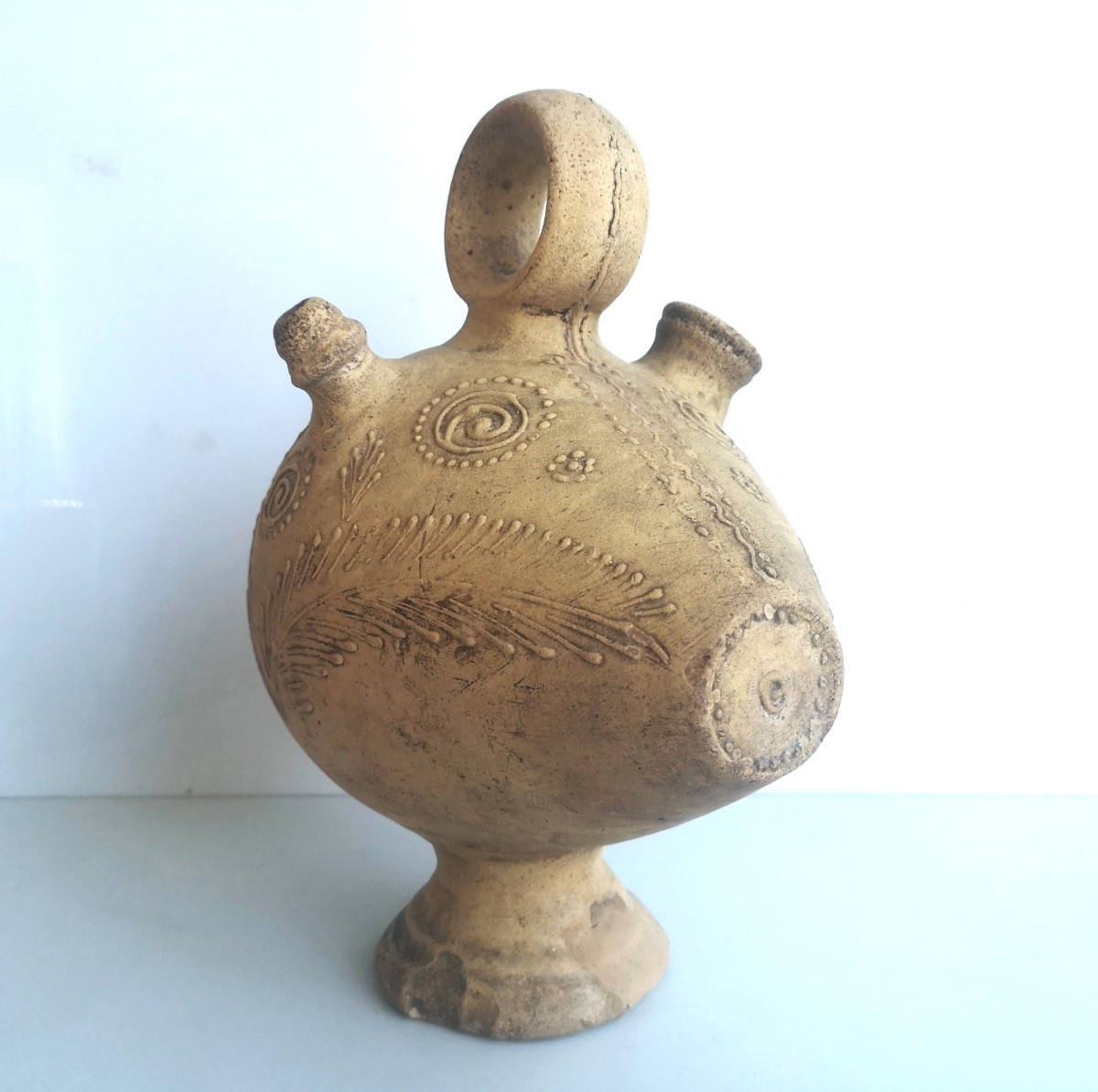
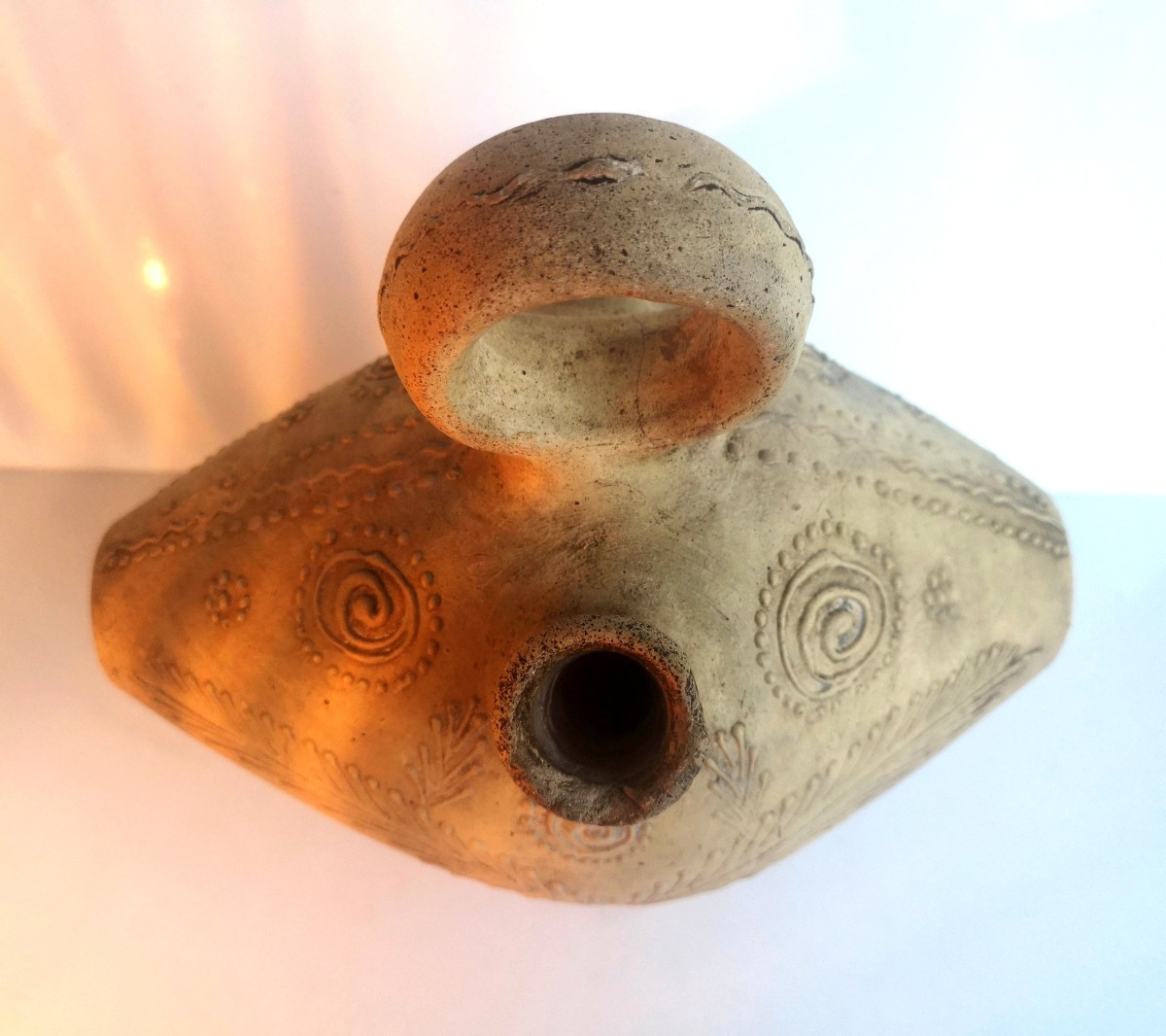
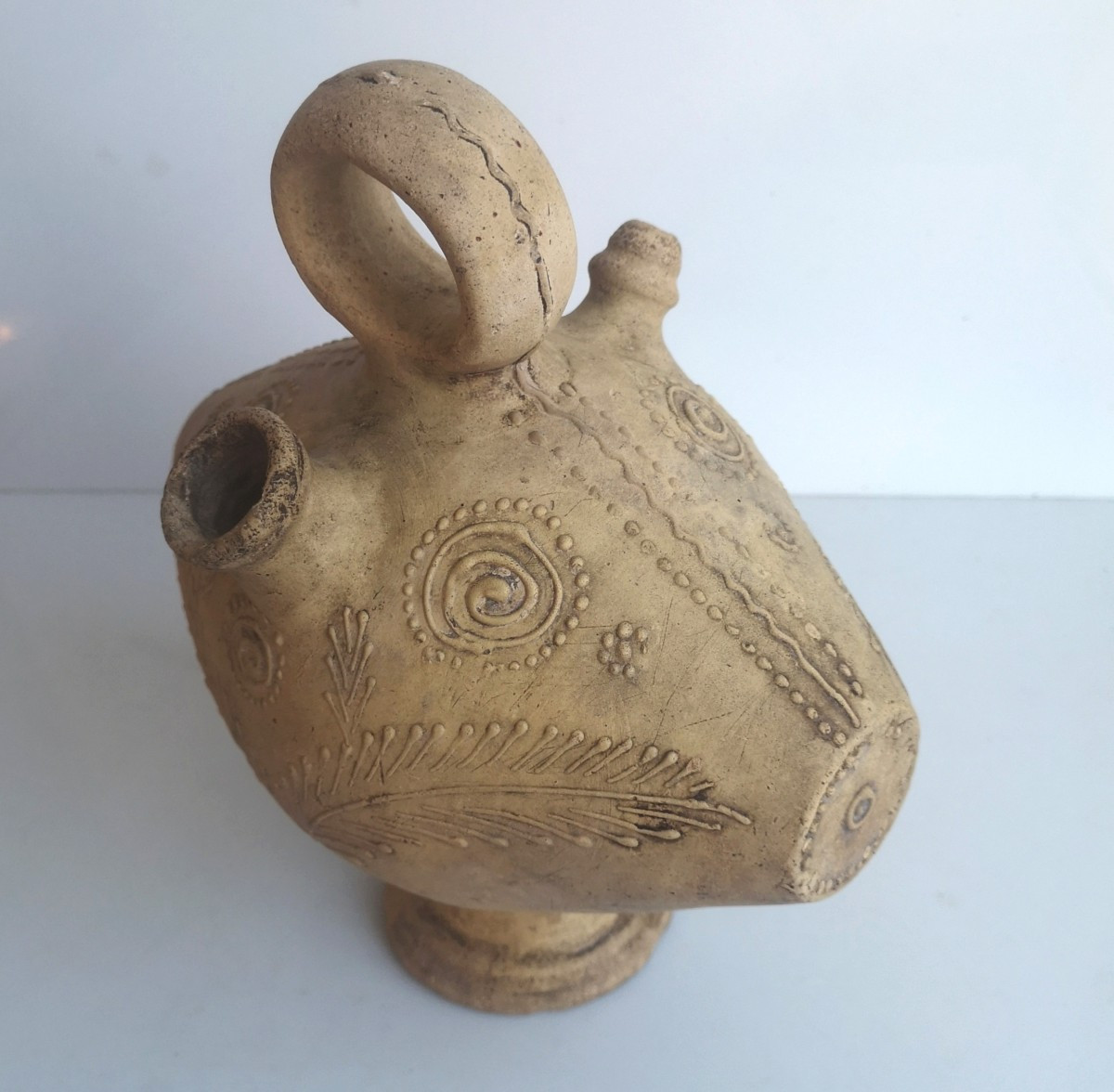
This rare 18th-century Agost pottery, a cantir (botijo) in the local tradition, is first and foremost a work of folk art: a remarkably imaginative zoomorphic composition where several stylized, never literal, animal figures appear depending on the viewing angle, solely through the interplay of shapes and volumes.
A rare antique Spanish cantir, entirely handcrafted in light ochre terracotta, it fully embodies the most inventive folk art.
Far beyond its utilitarian function, this piece is distinguished by a highly sculptural formal construction, based on an implicit and perceptual zoomorphism of great subtlety.
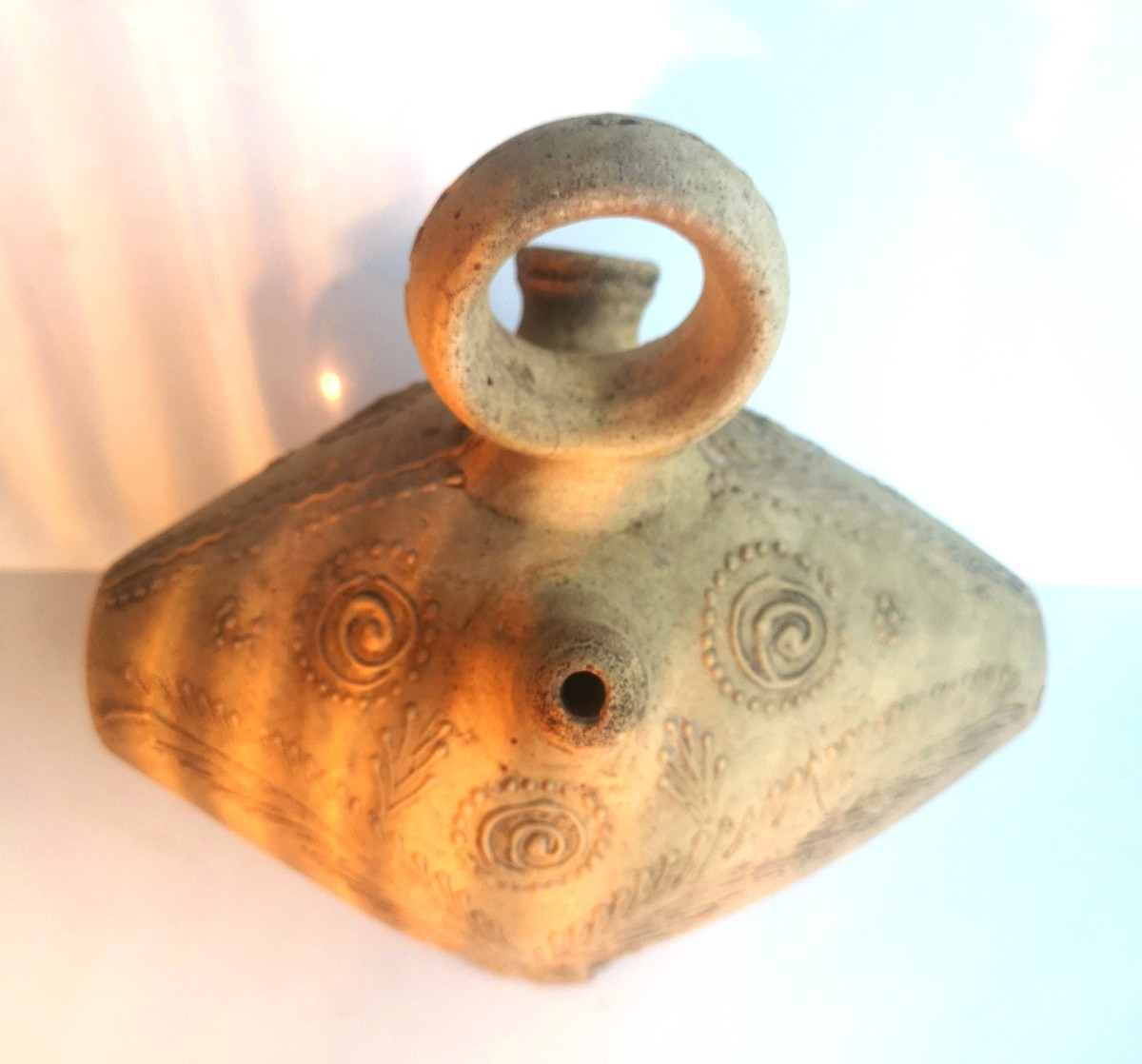
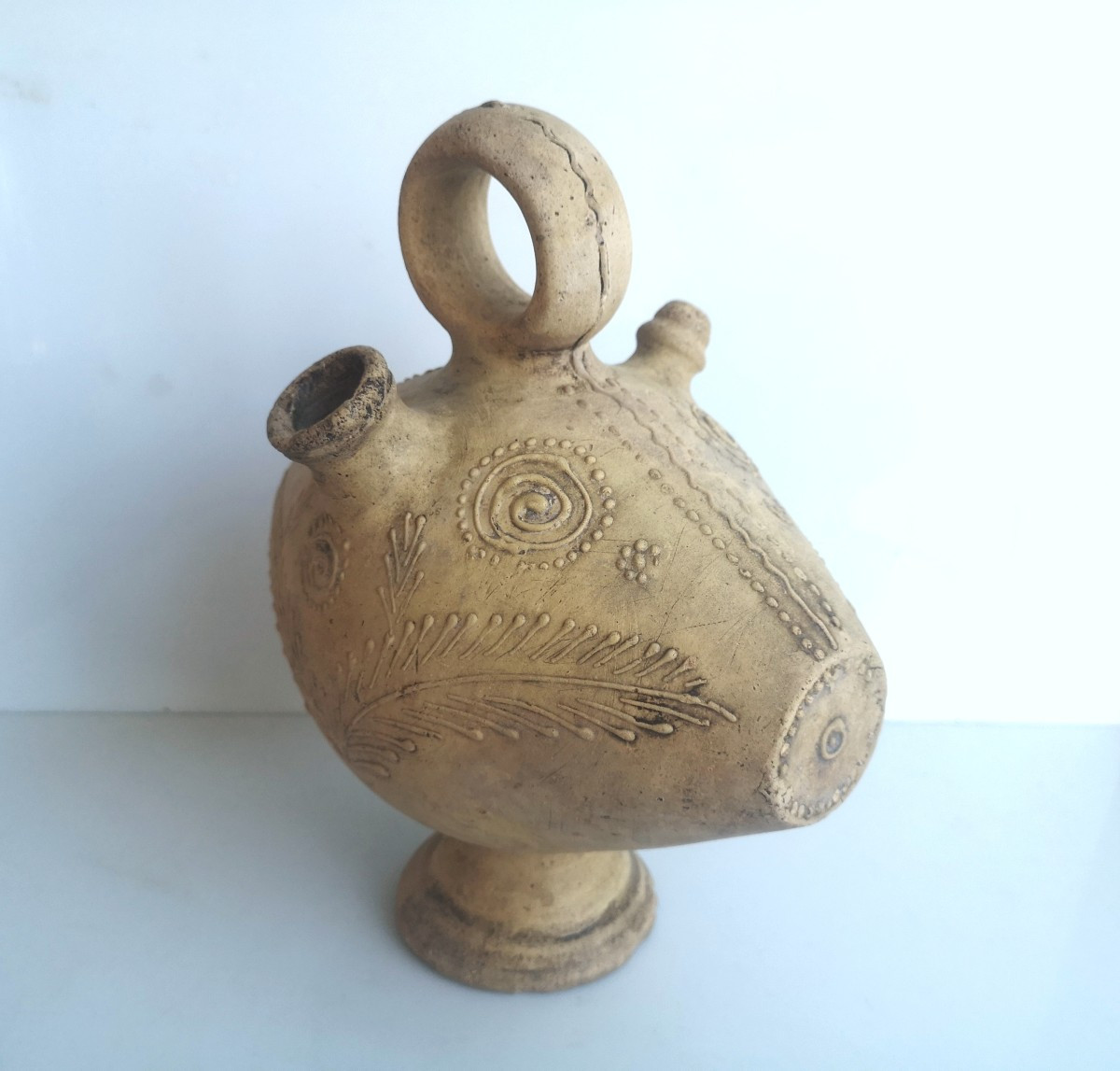
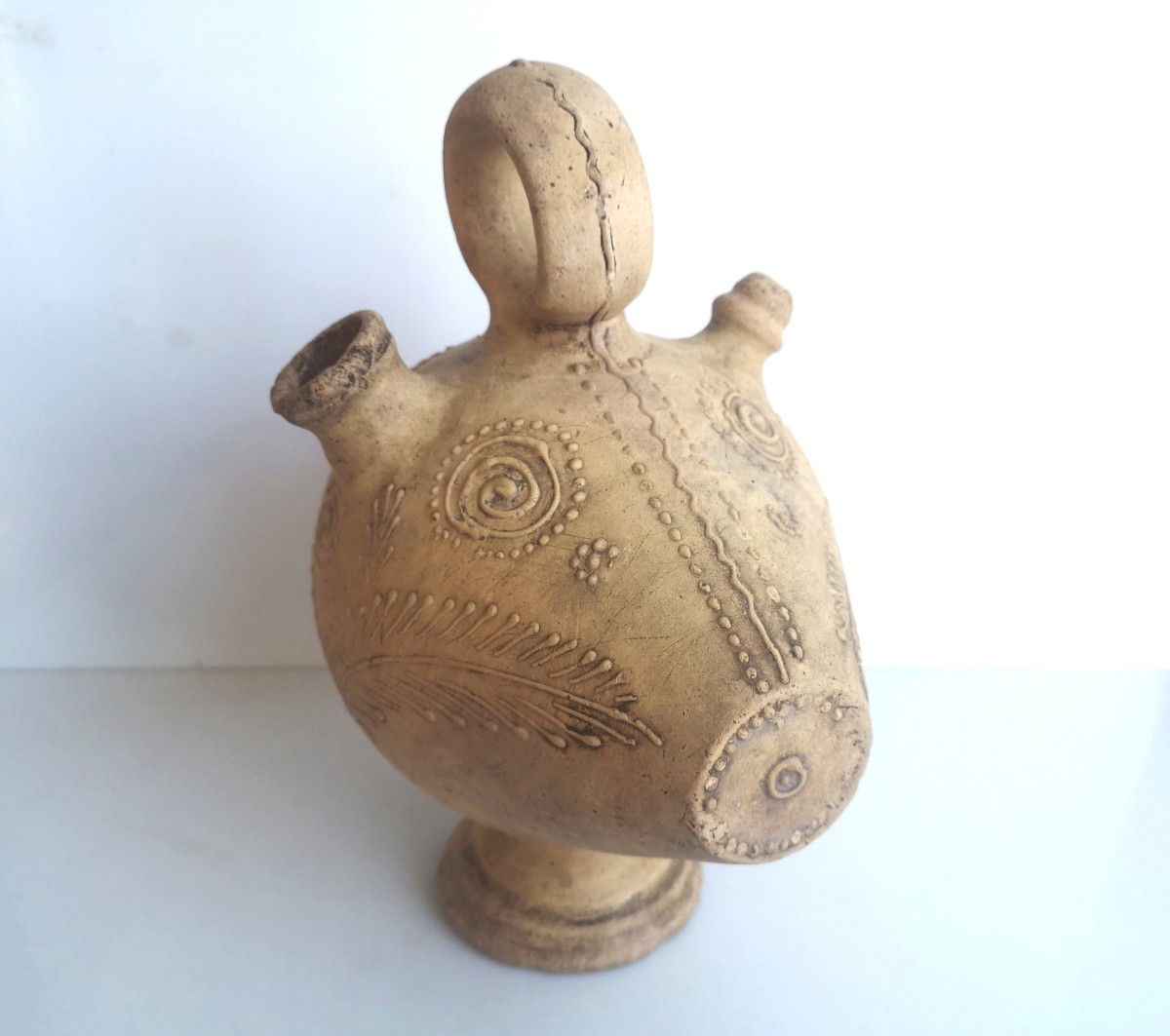
The animal interpretation relies on no explicit figurative decoration. It arises from a system of formal analogies intelligently distributed throughout the entire volume: the vegetal scrolls modeled in relief can be perceived as expressive eyes; the flattened extremities of the body evoke a muzzle; the two tubular ends are spontaneously interpreted as ears; The longitudinal loop acts as a dorsal ridge emphasizing the axis of the “head”.
Depending on the angle of view and the rotation of the object, four distinct zoomorphic readings appear, one on each of the faces of the cantir, offering as many animal “faces”, amiable, slightly fantastic, never caricatural.
The animal is not shown: it is suggested, intuited, reconstructed by the eye, which gives the object a rare intellectual and aesthetic depth.
This freedom of invention, combined with a deliberate asymmetry and a deliberately non-standardized execution, testifies to the imagination of a rural potter and places this piece at the crossroads of utilitarian ceramics, naive sculpture, and outsider art. The piece shares strong stylistic similarities with the traditional productions of Agost, an important pottery center in the Alicante hinterland, active from the 17th century onwards, renowned for its hand-shaped cantirs (traditional pottery vessels) and its decorative vocabulary of branches, supple scrolls, and reliefs applied directly to the raw clay.
Condition: very good overall condition. The foot has been previously damaged with a localized chip (approx. 3 × 3 cm), without altering the artistic interpretation of the piece. The body is intact, with no major cracks or previous restorations.
Origin: Spain, Valencian region, Agost (attributed).
Period: 18th century.
Dimensions: Height 23,5 cm,
Length 21,5 cm.
A rare and expressive piece, ideal for a collector of traditional Spanish ceramics, folk art, outsider art, or objects with strong visual and symbolic significance.
A rare antique Spanish cantir, entirely handcrafted in light ochre terracotta, it fully embodies the most inventive folk art.
Far beyond its utilitarian function, this piece is distinguished by a highly sculptural formal construction, based on an implicit and perceptual zoomorphism of great subtlety.
The animal interpretation relies on no explicit figurative decoration. It arises from a system of formal analogies intelligently distributed throughout the entire volume: the vegetal scrolls modeled in relief can be perceived as expressive eyes; the flattened extremities of the body evoke a muzzle; the two tubular ends are spontaneously interpreted as ears; The longitudinal loop acts as a dorsal ridge emphasizing the axis of the “head”.
Depending on the angle of view and the rotation of the object, four distinct zoomorphic readings appear, one on each of the faces of the cantir, offering as many animal “faces”, amiable, slightly fantastic, never caricatural.
The animal is not shown: it is suggested, intuited, reconstructed by the eye, which gives the object a rare intellectual and aesthetic depth.
This freedom of invention, combined with a deliberate asymmetry and a deliberately non-standardized execution, testifies to the imagination of a rural potter and places this piece at the crossroads of utilitarian ceramics, naive sculpture, and outsider art. The piece shares strong stylistic similarities with the traditional productions of Agost, an important pottery center in the Alicante hinterland, active from the 17th century onwards, renowned for its hand-shaped cantirs (traditional pottery vessels) and its decorative vocabulary of branches, supple scrolls, and reliefs applied directly to the raw clay.
Condition: very good overall condition. The foot has been previously damaged with a localized chip (approx. 3 × 3 cm), without altering the artistic interpretation of the piece. The body is intact, with no major cracks or previous restorations.
Origin: Spain, Valencian region, Agost (attributed).
Period: 18th century.
Dimensions: Height 23,5 cm,
Length 21,5 cm.
A rare and expressive piece, ideal for a collector of traditional Spanish ceramics, folk art, outsider art, or objects with strong visual and symbolic significance.
640 €
Period: 18th century
Style: Other Style
Condition: Condition of use
Material: Terracotta
Length: 21, 5 cm
Height: 23,5 cm
Reference (ID): 1704139
Availability: In stock
Print